Edoardo Cervoni, M.D.

RHINOSINUSITIS:
DIAGNOSIS AND
TREATMENT
GP Trainees 27/11/13,
Education Centre RPH

1
Discolosures
• Grant/Research Support: no
disclosure
• Consultant: no disclosure
• Major Shareholder: Locumdoctor4u
Ltd. (Locum and Concierge Medical
Services)
• I will not be discussing “off-label”
uses of medications or investigations
ENT Referrals
i.

Most ENT referrals are linked to Audiological and
Otological problems.

ii.

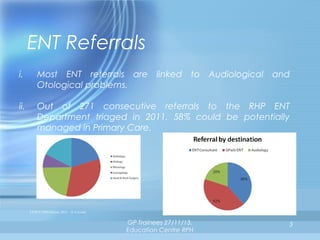
Out of 271 consecutive referrals to the RHP ENT
Department triaged in 2011, 58% could be potentially
managed in Primary Care.

CLPCT NHS Survey 2011 – E Cervoni

GP Trainees 27/11/13,
Education Centre RPH

3
ENT Referrals
i.

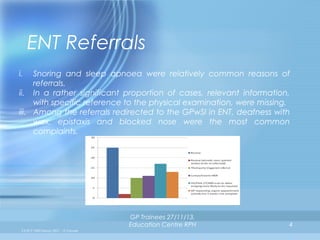
Snoring and sleep apnoea were relatively common reasons of
referrals.
ii. In a rather significant proportion of cases, relevant information,
with specific reference to the physical examination, were missing.
iii. Among the referrals redirected to the GPwSI in ENT, deafness with
wax, epistaxis and blocked nose were the most common
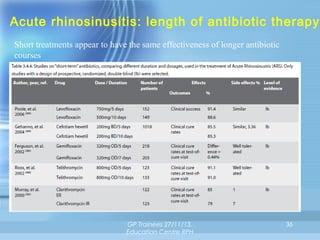
complaints.

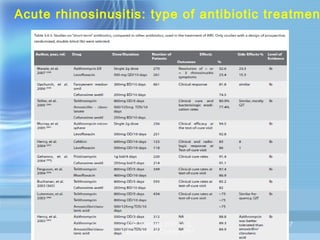
GP Trainees 27/11/13,
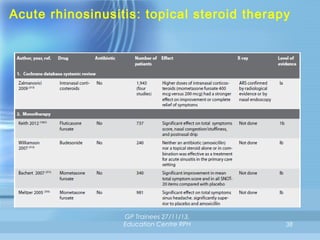
Education Centre RPH
CLPCT NHS Survey 2011 – E Cervoni

4
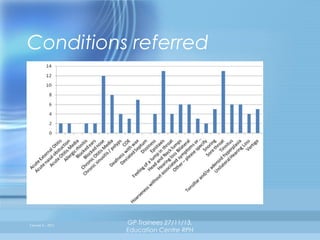
Conditions referred

Cervoni E - 2011

GP Trainees 27/11/13,
Education Centre RPH
EPOS 2012

GP Trainees 27/11/13,
Education Centre RPH

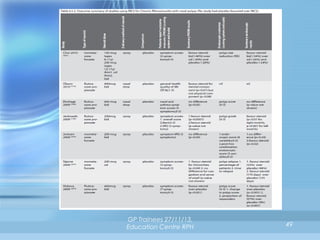
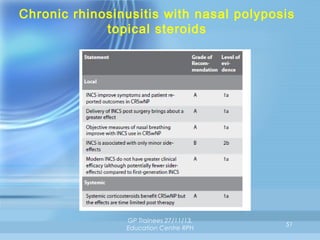
6
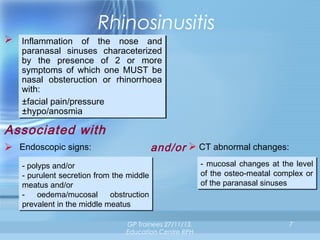
Rhinosinusitis
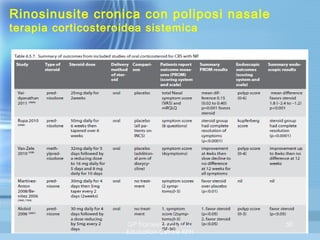
 Inflammation of the nose and
Inflammation of the nose and
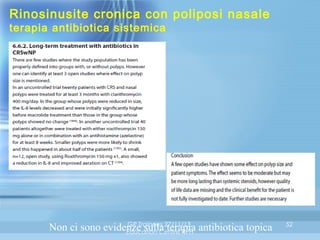
paranasal sinuses characeterized
by the presence of 2 or more
symptoms of which one MUST be
nasal obsteruction or rhinorrhoea
with:
with:
±facial pain/pressure
±hypo/anosmia
±hypo/anosmia

Associated with
and/or  CT abnormal changes:

 Endoscopic signs:
- polyps and/or
- polyps and/or
- purulent secretion from the middle
meatus and/or
meatus and/or
- oedema/mucosal
oedema/mucosal obstruction
obstruction
prevalent in the middle meatus

GP Trainees 27/11/13,
Education Centre RPH

- mucosal changes at the level
of the osteo-meatal complex or
of the paranasal sinuses

7
CLASSIFICATION
on severity of the symptoms

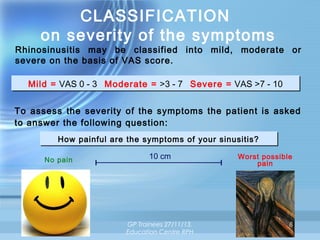
Rhinosinusitis may be classified into mild, moderate or
severe on the basis of VAS score.
Mild = VAS 0 - 3 Moderate = >3 - 7 Severe = VAS >7 - 10
To assess the severity of the symptoms the patient is asked
to answer the following question:
How painful are the symptoms of your sinusitis?
No pain

10 cm

GP Trainees 27/11/13,
Education Centre RPH

Worst possible
pain

8
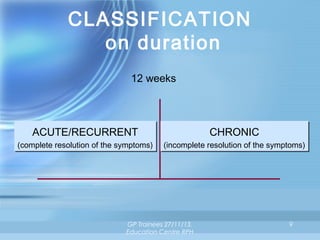
CLASSIFICATION
on duration
12 weeks

ACUTE/RECURRENT

(complete resolution of the symptoms)

CHRONIC

(incomplete resolution of the symptoms)

GP Trainees 27/11/13,
Education Centre RPH

9
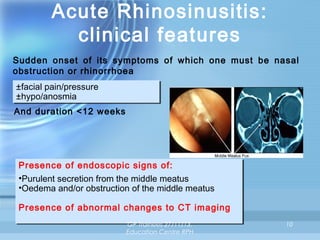
Acute Rhinosinusitis:
clinical features
Sudden onset of its symptoms of which one must be nasal
obstruction or rhinorrhoea
±facial pain/pressure
±hypo/anosmia
±hypo/anosmia
And duration <12 weeks

Presence of endoscopic signs of:
••Purulent secretion from the middle meatus
Purulent secretion from the middle meatus
••Oedema and/or obstruction of the middle meatus
Oedema and/or obstruction of the middle meatus
Presence of abnormal changes to CT imaging
GP Trainees 27/11/13,
Education Centre RPH

10


Acute rhinosinusitis:
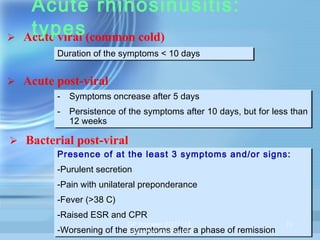
types
Acute viral (common cold)
Duration of the symptoms < 10 days

 Acute post-viral
-- Symptoms oncrease after 5 days
Symptoms oncrease after 5 days
-- Persistence of the symptoms after 10 days, but for less than
Persistence of the symptoms after 10 days, but for less than
12 weeks
12 weeks

 Bacterial post-viral
Presence of at the least 3 symptoms and/or signs:
-Purulent secretion
-Purulent secretion
-Pain with unilateral preponderance
-Fever (>38 C)
-Fever (>38 C)
-Raised ESR and CPR
-Raised ESR and CPR

GP Trainees 27/11/13,

-Worsening of theEducation Centre RPHa phase of remission
-Worsening of the symptoms after a phase of remission
symptoms after

11
Acute rhinosinusitis:
differential diagnosis


Viral infection of the upper airways

 Allergic rhinitis
Confirmed positivity to a common allergen
It is characterized by rhinorrhoea (which is not
purulent), senstion of nasal obstruction, itchy nose,
sneezing (spontaneus regression of the symptoms
or following treatment)
Associated to ophtalmological symptoms/signs

 Odontogenic
Absence of nasal signs and symptoms
GP Trainees 27/11/13,
Education Centre RPH

12
CHRONIC RHINOSINUSITIS
Sudden appearance of two or more symptoms of which ine
should be nasal obstruction or rhinorrhoea
±facial pain/pressure
±hypo/anosmia
±hypo/anosmia
Duration >12 weeks
Presence of endoscopic signs of:
••Nasal polyps
Nasal polyps
••Muco-purulent secretion from the middle meatus
Muco-purulent secretion from the middle meatus
••Oedema and/or obstruction of the middle meatus
Oedema and/or obstruction of the middle meatus
Presence of CT abnormalities

GP Trainees 27/11/13,
Education Centre RPH

13
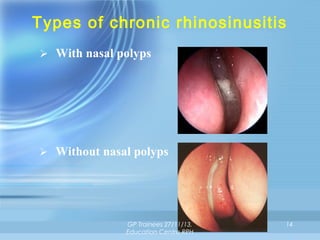
Types of chronic rhinosinusitis
 With nasal polyps

 Without nasal polyps

GP Trainees 27/11/13,
Education Centre RPH

14
GP Trainees 27/11/13,
Education Centre RPH
15
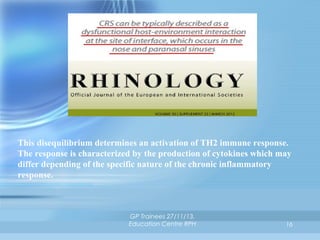
This disequilibrium determines an activation of TH2 immune response.
The response is characterized by the production of cytokines which may
differ depending of the specific nature of the chronic inflammatory
response.

GP Trainees 27/11/13,
Education Centre RPH

16
Allergic fungal
rhinosinusitis
Usually unilateral, with occasional purulent secretion
Characterized by high levels of IL-4, IL-5 and IL-13.
The high levels of IL-5 observed on those patients affected by allergic fungal
rhinosinusitis highlights who this condition may be considered
independently from oesinophils dysfunction disease.

GP Trainees 27/11/13,
Education Centre RPH

17
Allergic fungal rhinosinusitis

GP Trainees 27/11/13,
Education Centre RPH

18
Invasive form
• Acute fulminant
• Chronic: - granulomatous
- invasive
Non-invasive form
• Allergic fungal rhinosinusitis
• Fungal ball
GP Trainees 27/11/13,
Education Centre RPH

19
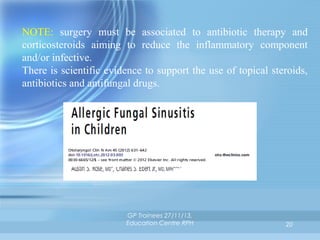
NOTE: surgery must be associated to antibiotic therapy and
corticosteroids aiming to reduce the inflammatory component
and/or infective.
There is scientific evidence to support the use of topical steroids,
antibiotics and antifungal drugs.

GP Trainees 27/11/13,
Education Centre RPH

20
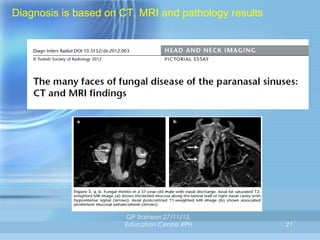
Diagnosis is based on CT, MRI and pathology results

GP Trainees 27/11/13,
Education Centre RPH

21
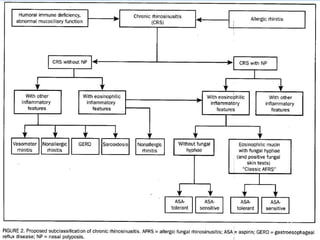
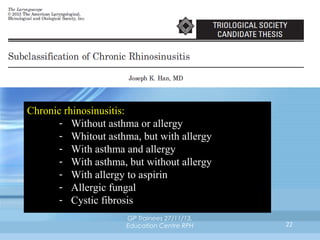
Chronic rhinosinusitis:
- Without asthma or allergy
- Whitout asthma, but with allergy
- With asthma and allergy
- With asthma, but without allergy
- With allergy to aspirin
- Allergic fungal
- Cystic fibrosis
GP Trainees 27/11/13,
Education Centre RPH

22
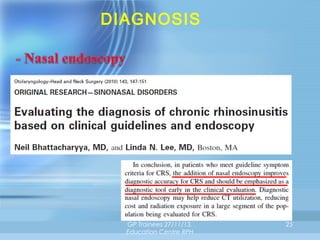
DIAGNOSIS
- Anamnesis
- Anterior rhinoscopy
- Nasal endoscopy
- Nasal swab
- CT
- MRI
- Biofilm Research

GP Trainees 27/11/13,
Education Centre RPH

23
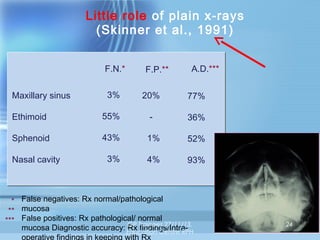
Little role of plain x-rays
(Skinner et al., 1991)
F.N.*

F.P.**

A.D.***

3%

20%

77%

Ethimoid

55%

-

36%

Sphenoid

43%

1%

52%

3%

4%

93%

Maxillary sinus

Nasal cavity

* False negatives: Rx normal/pathological
** mucosa
*** False positives: Rx pathological/ normal 27/11/13,
GP Trainees
mucosa Diagnostic accuracy: Education Centre RPH
Rx findings/Intraoperative findings in keeping with Rx

24
DIAGNOSIS

GP Trainees 27/11/13,
Education Centre RPH

25
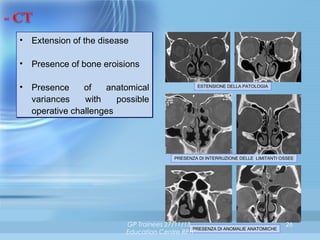
• Extension of the disease
• Presence of bone eroisions
• Presence
of
anatomical
variances
with
possible
operative challenges

ESTENSIONE DELLA PATOLOGIA

PRESENZA DI INTERRUZIONE DELLE LIMITANTI OSSEE

GP Trainees 27/11/13,
PRESENZA DI ANOMALIE ANATOMICHE
Education Centre RPH

26
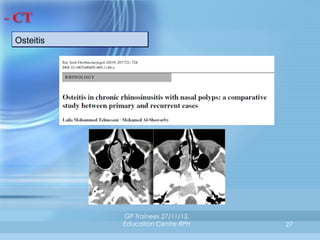
Osteitis

GP Trainees 27/11/13,
Education Centre RPH

27
Does not offer details of bone structures
Overestimes presence of mucosal abnormalities
GP Trainees 27/11/13,
Education Centre RPH

28
Excellent visualization of soft tissues.
Helpful to assess neoplastic pathology
Helpful to assess the extension of inflammatory processes.

GP Trainees 27/11/13,
Education Centre RPH

29
GP Trainees 27/11/13,
Education Centre RPH

30
DIAGNOSIS

GP Trainees 27/11/13,
Education Centre RPH

31
European guidelines
for the treatment of
rhinosinusitis and nasal
polyps

GP Trainees 27/11/13,
Education Centre RPH

32
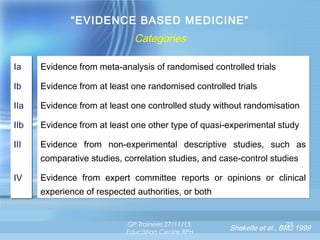
“EVIDENCE BASED MEDICINE”

Categories
Ia

Evidence from meta-analysis of randomised controlled trials

Ib

Evidence from at least one randomised controlled trials

IIa

Evidence from at least one controlled study without randomisation

IIb

Evidence from at least one other type of quasi-experimental study

III

Evidence from non-experimental descriptive studies, such as
comparative studies, correlation studies, and case-control studies

IV

Evidence from expert committee reports or opinions or clinical
experience of respected authorities, or both

GP Trainees 27/11/13,
Education Centre RPH

33

Shekelle et al., BMJ 1999
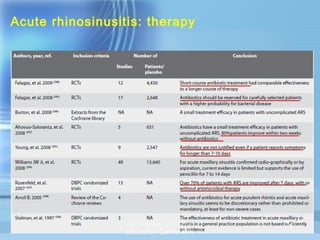
Acute rhinosinusitis: therapy

GP Trainees 27/11/13,
Education Centre RPH

34
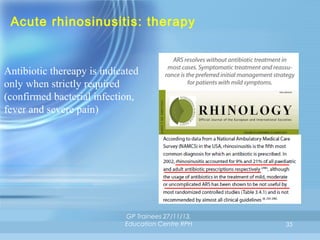
Acute rhinosinusitis: therapy

Antibiotic thereapy is indicated
only when strictly required
(confirmed bacterial infection,
fever and severe pain)

GP Trainees 27/11/13,
Education Centre RPH

35
Acute rhinosinusitis: length of antibiotic therapy
Short treatments appear to have the same effectiveness of longer antibiotic
courses

GP Trainees 27/11/13,
Education Centre RPH

36
Acute rhinosinusitis: type of antibiotic treatmen

GP Trainees 27/11/13,
Education Centre RPH

37
Acute rhinosinusitis: topical steroid therapy

GP Trainees 27/11/13,
Education Centre RPH

38
Acute rhinosinusitis: combined therapy

(steroid and oral antibiotic)

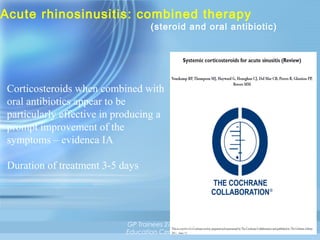
Corticosteroids when combined with
oral antibiotics appear to be
particularly effective in producing a
prompt improvement of the
symptoms – evidenca IA
Duration of treatment 3-5 days

GP Trainees 27/11/13,
Education Centre RPH

39
Acute rhinosinusitis: complications
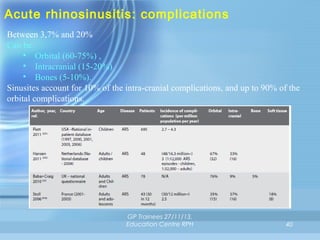
Between 3,7% and 20%
Can be:
• Orbital (60-75%) ,
• Intracranial (15-20%)
• Bones (5-10%).
Sinusites account for 10% of the intra-cranial complications, and up to 90% of the
orbital complications.

GP Trainees 27/11/13,
Education Centre RPH

40
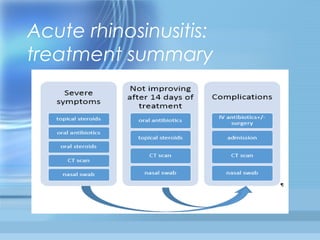
Acute rhinosinusitis:
treatment summary
Chronic rhinosinusitis without nasal
polyposis
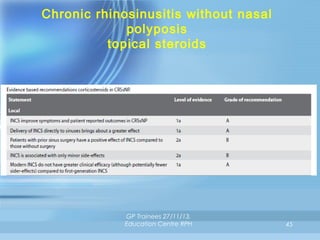
topical steroids

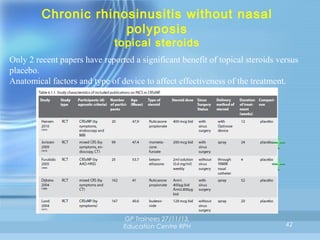
Only 2 recent papers have reported a significant benefit of topical steroids versus
placebo.
Anatomical factors and type of device to affect effectiveness of the treatment.

GP Trainees 27/11/13,
Education Centre RPH

42
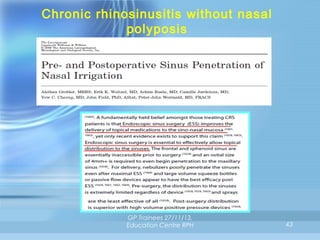
Chronic rhinosinusitis without nasal
polyposis
topical steroids

GP Trainees 27/11/13,
Education Centre RPH

43
Chronic rhinosinusitis without nasal
polyposis
topical steroids

GP Trainees 27/11/13,
Education Centre RPH

44
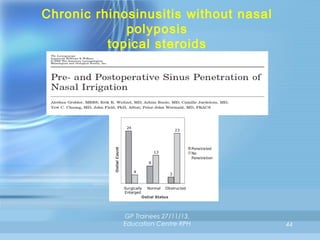
Chronic rhinosinusitis without nasal
polyposis
topical steroids

GP Trainees 27/11/13,
Education Centre RPH

45
Chronic rhinosinusitis without nasal
polyposis
topical antibiotics

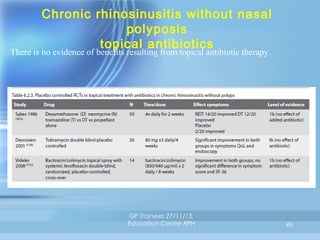
There is no evidence of benefits resulting from topical antibiotic therapy.

GP Trainees 27/11/13,
Education Centre RPH

46
Chronic rhinosinusitis without nasal
polyposis
oral antibiotics

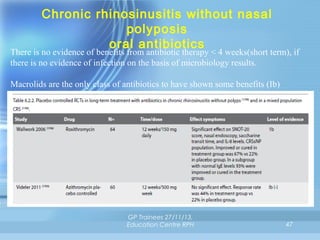
There is no evidence of benefits from antibiotic therapy < 4 weeks(short term), if
there is no evidence of infection on the basis of microbiology results.
Macrolids are the only class of antibiotics to have shown some benefits (Ib)

GP Trainees 27/11/13,
Education Centre RPH

47
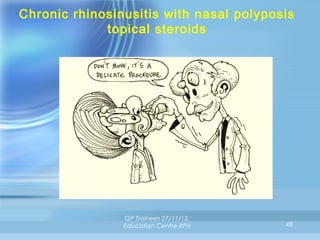
Chronic rhinosinusitis with nasal polyposis
topical steroids

GP Trainees 27/11/13,
Education Centre RPH

48
GP Trainees 27/11/13,
Education Centre RPH

49
Rinosinusite cronica con poliposi nasale
terapia corticosteroidea sistemica

GP Trainees 27/11/13,
Education Centre RPH

50
Chronic rhinosinusitis with nasal polyposis
topical steroids

GP Trainees 27/11/13,
Education Centre RPH

51
Rinosinusite cronica con poliposi nasale
terapia antibiotica sistemica

GP Trainees
Non ci sono evidenze sulla 27/11/13, antibiotica topica
terapia
Education Centre RPH

52
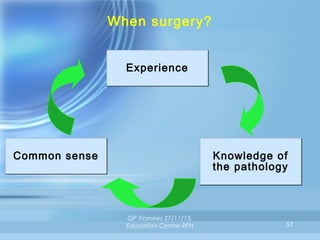
When surgery?
Experience

Common sense

Knowledge of
the pathology

GP Trainees 27/11/13,
Education Centre RPH

53
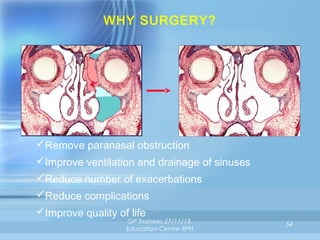
WHY SURGERY?

Remove paranasal obstruction
Improve ventilation and drainage of sinuses
Reduce number of exacerbations
Reduce complications
Improve quality of life

GP Trainees 27/11/13,
Education Centre RPH

54
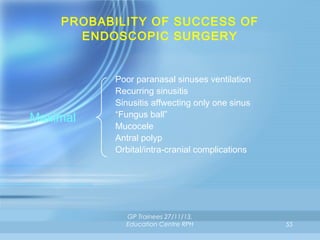
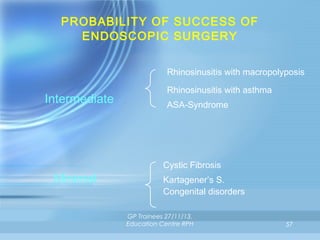
PROBABILITY OF SUCCESS OF
ENDOSCOPIC SURGERY

Maximal

Poor paranasal sinuses ventilation
Recurring sinusitis
Sinusitis affwecting only one sinus
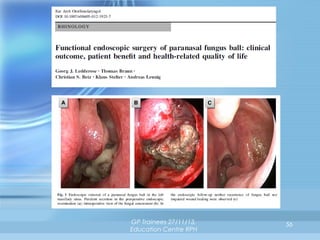
“Fungus ball”
Mucocele
Antral polyp
Orbital/intra-cranial complications

GP Trainees 27/11/13,
Education Centre RPH

55
GP Trainees 27/11/13,
Education Centre RPH

56
PROBABILITY OF SUCCESS OF
ENDOSCOPIC SURGERY
Rhinosinusitis with macropolyposis

Intermediate

Minimal

Rhinosinusitis with asthma
ASA-Syndrome

Cystic Fibrosis
Kartagener’s S.
Congenital disorders
GP Trainees 27/11/13,
Education Centre RPH

57
GP Trainees 27/11/13,
Education Centre RPH

58

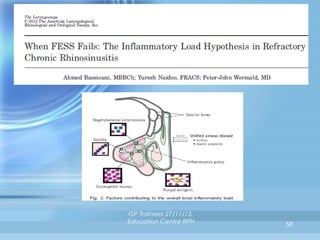
Acute and Chronic Rhinosinusitis: diagnosis and management: current opinions.

  • 1.
    Edoardo Cervoni, M.D. RHINOSINUSITIS: DIAGNOSISAND TREATMENT GP Trainees 27/11/13, Education Centre RPH 1
  • 2.
    Discolosures • Grant/Research Support:no disclosure • Consultant: no disclosure • Major Shareholder: Locumdoctor4u Ltd. (Locum and Concierge Medical Services) • I will not be discussing “off-label” uses of medications or investigations
  • 3.
    ENT Referrals i. Most ENTreferrals are linked to Audiological and Otological problems. ii. Out of 271 consecutive referrals to the RHP ENT Department triaged in 2011, 58% could be potentially managed in Primary Care. CLPCT NHS Survey 2011 – E Cervoni GP Trainees 27/11/13, Education Centre RPH 3
  • 4.
    ENT Referrals i. Snoring andsleep apnoea were relatively common reasons of referrals. ii. In a rather significant proportion of cases, relevant information, with specific reference to the physical examination, were missing. iii. Among the referrals redirected to the GPwSI in ENT, deafness with wax, epistaxis and blocked nose were the most common complaints. GP Trainees 27/11/13, Education Centre RPH CLPCT NHS Survey 2011 – E Cervoni 4
  • 5.
    Conditions referred Cervoni E- 2011 GP Trainees 27/11/13, Education Centre RPH
  • 6.
    EPOS 2012 GP Trainees27/11/13, Education Centre RPH 6
  • 7.
    Rhinosinusitis  Inflammation ofthe nose and Inflammation of the nose and paranasal sinuses characeterized paranasal sinuses characeterized by the presence of 2 or more by the presence of 2 or more symptoms of which one MUST be symptoms of which one MUST be nasal obsteruction or rhinorrhoea nasal obsteruction or rhinorrhoea with: with: ±facial pain/pressure ±facial pain/pressure ±hypo/anosmia ±hypo/anosmia Associated with and/or  CT abnormal changes:  Endoscopic signs: - polyps and/or - polyps and/or - purulent secretion from the middle - purulent secretion from the middle meatus and/or meatus and/or - oedema/mucosal oedema/mucosal obstruction obstruction prevalent in the middle meatus prevalent in the middle meatus GP Trainees 27/11/13, Education Centre RPH - mucosal changes at the level - mucosal changes at the level of the osteo-meatal complex or of the osteo-meatal complex or of the paranasal sinuses of the paranasal sinuses 7
  • 8.
    CLASSIFICATION on severity ofthe symptoms Rhinosinusitis may be classified into mild, moderate or severe on the basis of VAS score. Mild = VAS 0 - 3 Moderate = >3 - 7 Severe = VAS >7 - 10 Mild = VAS 0 - 3 Moderate = >3 - 7 Severe = VAS >7 - 10 To assess the severity of the symptoms the patient is asked to answer the following question: How painful are the symptoms of your sinusitis? How painful are the symptoms of your sinusitis? No pain 10 cm GP Trainees 27/11/13, Education Centre RPH Worst possible pain 8
  • 9.
    CLASSIFICATION on duration 12 weeks ACUTE/RECURRENT (completeresolution of the symptoms) (complete resolution of the symptoms) CHRONIC (incomplete resolution of the symptoms) (incomplete resolution of the symptoms) GP Trainees 27/11/13, Education Centre RPH 9
  • 10.
    Acute Rhinosinusitis: clinical features Suddenonset of its symptoms of which one must be nasal obstruction or rhinorrhoea ±facial pain/pressure ±facial pain/pressure ±hypo/anosmia ±hypo/anosmia And duration <12 weeks Presence of endoscopic signs of: Presence of endoscopic signs of: ••Purulent secretion from the middle meatus Purulent secretion from the middle meatus ••Oedema and/or obstruction of the middle meatus Oedema and/or obstruction of the middle meatus Presence of abnormal changes to CT imaging Presence of abnormal changes to CT imaging GP Trainees 27/11/13, Education Centre RPH 10
  • 11.
     Acute rhinosinusitis: types Acute viral(common cold) Duration of the symptoms < 10 days Duration of the symptoms < 10 days  Acute post-viral -- Symptoms oncrease after 5 days Symptoms oncrease after 5 days -- Persistence of the symptoms after 10 days, but for less than Persistence of the symptoms after 10 days, but for less than 12 weeks 12 weeks  Bacterial post-viral Presence of at the least 3 symptoms and/or signs: Presence of at the least 3 symptoms and/or signs: -Purulent secretion -Purulent secretion -Pain with unilateral preponderance -Pain with unilateral preponderance -Fever (>38 C) -Fever (>38 C) -Raised ESR and CPR -Raised ESR and CPR GP Trainees 27/11/13, -Worsening of theEducation Centre RPHa phase of remission -Worsening of the symptoms after a phase of remission symptoms after 11
  • 12.
    Acute rhinosinusitis: differential diagnosis  Viralinfection of the upper airways  Allergic rhinitis Confirmed positivity to a common allergen Confirmed positivity to a common allergen It is characterized by rhinorrhoea (which is not It is characterized by rhinorrhoea (which is not purulent), senstion of nasal obstruction, itchy nose, purulent), senstion of nasal obstruction, itchy nose, sneezing (spontaneus regression of the symptoms sneezing (spontaneus regression of the symptoms or following treatment) or following treatment) Associated to ophtalmological symptoms/signs Associated to ophtalmological symptoms/signs  Odontogenic Absence of nasal signs and symptoms Absence of nasal signs and symptoms GP Trainees 27/11/13, Education Centre RPH 12
  • 13.
    CHRONIC RHINOSINUSITIS Sudden appearanceof two or more symptoms of which ine should be nasal obstruction or rhinorrhoea ±facial pain/pressure ±facial pain/pressure ±hypo/anosmia ±hypo/anosmia Duration >12 weeks Presence of endoscopic signs of: Presence of endoscopic signs of: ••Nasal polyps Nasal polyps ••Muco-purulent secretion from the middle meatus Muco-purulent secretion from the middle meatus ••Oedema and/or obstruction of the middle meatus Oedema and/or obstruction of the middle meatus Presence of CT abnormalities Presence of CT abnormalities GP Trainees 27/11/13, Education Centre RPH 13
  • 14.
    Types of chronicrhinosinusitis  With nasal polyps  Without nasal polyps GP Trainees 27/11/13, Education Centre RPH 14
  • 15.
  • 16.
    This disequilibrium determinesan activation of TH2 immune response. The response is characterized by the production of cytokines which may differ depending of the specific nature of the chronic inflammatory response. GP Trainees 27/11/13, Education Centre RPH 16
  • 17.
    Allergic fungal rhinosinusitis Usually unilateral,with occasional purulent secretion Characterized by high levels of IL-4, IL-5 and IL-13. The high levels of IL-5 observed on those patients affected by allergic fungal rhinosinusitis highlights who this condition may be considered independently from oesinophils dysfunction disease. GP Trainees 27/11/13, Education Centre RPH 17
  • 18.
    Allergic fungal rhinosinusitis GPTrainees 27/11/13, Education Centre RPH 18
  • 19.
    Invasive form • Acutefulminant • Chronic: - granulomatous - invasive Non-invasive form • Allergic fungal rhinosinusitis • Fungal ball GP Trainees 27/11/13, Education Centre RPH 19
  • 20.
    NOTE: surgery mustbe associated to antibiotic therapy and corticosteroids aiming to reduce the inflammatory component and/or infective. There is scientific evidence to support the use of topical steroids, antibiotics and antifungal drugs. GP Trainees 27/11/13, Education Centre RPH 20
  • 21.
    Diagnosis is basedon CT, MRI and pathology results GP Trainees 27/11/13, Education Centre RPH 21
  • 22.
    Chronic rhinosinusitis: - Withoutasthma or allergy - Whitout asthma, but with allergy - With asthma and allergy - With asthma, but without allergy - With allergy to aspirin - Allergic fungal - Cystic fibrosis GP Trainees 27/11/13, Education Centre RPH 22
  • 23.
    DIAGNOSIS - Anamnesis - Anteriorrhinoscopy - Nasal endoscopy - Nasal swab - CT - MRI - Biofilm Research GP Trainees 27/11/13, Education Centre RPH 23
  • 24.
    Little role ofplain x-rays (Skinner et al., 1991) F.N.* F.P.** A.D.*** 3% 20% 77% Ethimoid 55% - 36% Sphenoid 43% 1% 52% 3% 4% 93% Maxillary sinus Nasal cavity * False negatives: Rx normal/pathological ** mucosa *** False positives: Rx pathological/ normal 27/11/13, GP Trainees mucosa Diagnostic accuracy: Education Centre RPH Rx findings/Intraoperative findings in keeping with Rx 24
  • 25.
  • 26.
    • Extension ofthe disease • Presence of bone eroisions • Presence of anatomical variances with possible operative challenges ESTENSIONE DELLA PATOLOGIA PRESENZA DI INTERRUZIONE DELLE LIMITANTI OSSEE GP Trainees 27/11/13, PRESENZA DI ANOMALIE ANATOMICHE Education Centre RPH 26
  • 27.
  • 28.
    Does not offerdetails of bone structures Does not offer details of bone structures Overestimes presence of mucosal abnormalities Overestimes presence of mucosal abnormalities GP Trainees 27/11/13, Education Centre RPH 28
  • 29.
    Excellent visualization ofsoft tissues. Excellent visualization of soft tissues. Helpful to assess neoplastic pathology Helpful to assess neoplastic pathology Helpful to assess the extension of inflammatory processes. Helpful to assess the extension of inflammatory processes. GP Trainees 27/11/13, Education Centre RPH 29
  • 30.
  • 31.
  • 32.
    European guidelines for thetreatment of rhinosinusitis and nasal polyps GP Trainees 27/11/13, Education Centre RPH 32
  • 33.
    “EVIDENCE BASED MEDICINE” Categories Ia Evidencefrom meta-analysis of randomised controlled trials Evidence from meta-analysis of randomised controlled trials Ib Evidence from at least one randomised controlled trials Evidence from at least one randomised controlled trials IIa Evidence from at least one controlled study without randomisation Evidence from at least one controlled study without randomisation IIb Evidence from at least one other type of quasi-experimental study Evidence from at least one other type of quasi-experimental study III Evidence from non-experimental descriptive studies, such as Evidence from non-experimental descriptive studies, such as comparative studies, correlation studies, and case-control studies comparative studies, correlation studies, and case-control studies IV Evidence from expert committee reports or opinions or clinical Evidence from expert committee reports or opinions or clinical experience of respected authorities, or both experience of respected authorities, or both GP Trainees 27/11/13, Education Centre RPH 33 Shekelle et al., BMJ 1999
  • 34.
    Acute rhinosinusitis: therapy GPTrainees 27/11/13, Education Centre RPH 34
  • 35.
    Acute rhinosinusitis: therapy Antibioticthereapy is indicated only when strictly required (confirmed bacterial infection, fever and severe pain) GP Trainees 27/11/13, Education Centre RPH 35
  • 36.
    Acute rhinosinusitis: lengthof antibiotic therapy Short treatments appear to have the same effectiveness of longer antibiotic courses GP Trainees 27/11/13, Education Centre RPH 36
  • 37.
    Acute rhinosinusitis: typeof antibiotic treatmen GP Trainees 27/11/13, Education Centre RPH 37
  • 38.
    Acute rhinosinusitis: topicalsteroid therapy GP Trainees 27/11/13, Education Centre RPH 38
  • 39.
    Acute rhinosinusitis: combinedtherapy (steroid and oral antibiotic) Corticosteroids when combined with oral antibiotics appear to be particularly effective in producing a prompt improvement of the symptoms – evidenca IA Duration of treatment 3-5 days GP Trainees 27/11/13, Education Centre RPH 39
  • 40.
    Acute rhinosinusitis: complications Between3,7% and 20% Can be: • Orbital (60-75%) , • Intracranial (15-20%) • Bones (5-10%). Sinusites account for 10% of the intra-cranial complications, and up to 90% of the orbital complications. GP Trainees 27/11/13, Education Centre RPH 40
  • 41.
  • 42.
    Chronic rhinosinusitis withoutnasal polyposis topical steroids Only 2 recent papers have reported a significant benefit of topical steroids versus placebo. Anatomical factors and type of device to affect effectiveness of the treatment. GP Trainees 27/11/13, Education Centre RPH 42
  • 43.
    Chronic rhinosinusitis withoutnasal polyposis topical steroids GP Trainees 27/11/13, Education Centre RPH 43
  • 44.
    Chronic rhinosinusitis withoutnasal polyposis topical steroids GP Trainees 27/11/13, Education Centre RPH 44
  • 45.
    Chronic rhinosinusitis withoutnasal polyposis topical steroids GP Trainees 27/11/13, Education Centre RPH 45
  • 46.
    Chronic rhinosinusitis withoutnasal polyposis topical antibiotics There is no evidence of benefits resulting from topical antibiotic therapy. GP Trainees 27/11/13, Education Centre RPH 46
  • 47.
    Chronic rhinosinusitis withoutnasal polyposis oral antibiotics There is no evidence of benefits from antibiotic therapy < 4 weeks(short term), if there is no evidence of infection on the basis of microbiology results. Macrolids are the only class of antibiotics to have shown some benefits (Ib) GP Trainees 27/11/13, Education Centre RPH 47
  • 48.
    Chronic rhinosinusitis withnasal polyposis topical steroids GP Trainees 27/11/13, Education Centre RPH 48
  • 49.
  • 50.
    Rinosinusite cronica conpoliposi nasale terapia corticosteroidea sistemica GP Trainees 27/11/13, Education Centre RPH 50
  • 51.
    Chronic rhinosinusitis withnasal polyposis topical steroids GP Trainees 27/11/13, Education Centre RPH 51
  • 52.
    Rinosinusite cronica conpoliposi nasale terapia antibiotica sistemica GP Trainees Non ci sono evidenze sulla 27/11/13, antibiotica topica terapia Education Centre RPH 52
  • 53.
    When surgery? Experience Common sense Knowledgeof the pathology GP Trainees 27/11/13, Education Centre RPH 53
  • 54.
    WHY SURGERY? Remove paranasalobstruction Improve ventilation and drainage of sinuses Reduce number of exacerbations Reduce complications Improve quality of life GP Trainees 27/11/13, Education Centre RPH 54
  • 55.
    PROBABILITY OF SUCCESSOF ENDOSCOPIC SURGERY Maximal Poor paranasal sinuses ventilation Recurring sinusitis Sinusitis affwecting only one sinus “Fungus ball” Mucocele Antral polyp Orbital/intra-cranial complications GP Trainees 27/11/13, Education Centre RPH 55
  • 56.
  • 57.
    PROBABILITY OF SUCCESSOF ENDOSCOPIC SURGERY Rhinosinusitis with macropolyposis Intermediate Minimal Rhinosinusitis with asthma ASA-Syndrome Cystic Fibrosis Kartagener’s S. Congenital disorders GP Trainees 27/11/13, Education Centre RPH 57
  • 58.