“
”
ANTIGEN ANTIBODY
INTERACTION
Submitted by:
Nesma Samad
INTRODUCTION
Antigen-antibody interaction is a fundamental process in immunology that
plays a central role in the immune response. It involves the recognition and
binding of antigens by specific antibodies, leading to a series of immune
reactions that help protect the body against pathogens and foreign
substances.
The antigen-antibody interaction is highly specific, resembling a
lock-and-key mechanism. The binding between an antibody and its
corresponding antigen is governed by forces such as electrostatic interactions,
hydrogen bonding, and van der Waals forces. This specificity allows
antibodies to selectively recognize and bind to their target antigens while
ignoring others.
ANTIGEN- ANTIBODY INTERACTION
• The antigen-antibody interaction is a bimolecular association similar
to an enzyme-substrate interaction, with an important distinction: it
does not lead to an irreversible chemical alteration in either the
antibody or the antigen and therefore is reversible.
• The interaction between an antibody and an antigen involves various
noncovalent interactions between the antigenic determinant, or
epitope, of the antigen and the variable-region (V/Vi) domain of the
antibody molecule, particularly the hypervariable regions, or comple-
mentarity-determining regions (CDRs).
Chemical Bonds Responsible for the Antigen-
Antibody Interaction
• The interaction between the Ab-binding site and the epitope involves
exclusively non-covalent bonds, in a similar manner to that in which proteins
bind to their cellular receptors, or enzymes bind to their substrates.
• The binding is reversible and can be prevented or dissociated by high ionic
strength or extreme pH. The following intermolecular forces are involved in Ag-
Ab binding:
• (1) Hydrogen bonds
• (2) Ionic bonds
• (3) Hydrophobic interactions
• (4) Van der Waals interactions
• The exquisite specificity of antigen-antibody interactions has led to the
development of a variety of immunologic assays.
• These assays can be used to detect the presence of either antibody or
antigen and have played vital roles in diagnosing diseases, monitoring the
level of the humoral immune response, and identifying molecules of
biological or medical interest.
• These assays differ in their speed and their sensitivity ; some are strictly
qualitative , and others are quantitative.
• Because the strength of each of these interactions is weak compared
with that of a covalent bond ,a large number of such interactions are
required to form a strong Ag-Ab interaction.
• Furthermore, each of these non-covalent interactions operates over a
very small distance generally about -1 angstrom, or a little less;
consequently, a strong Ag-Ab interaction depends on a very close fit
between the antigen and antibody.
Strength of Ag-Ab interaction:
1. ANTIBODY AFFINITY
• The strength of the total noncovalent interactions between a single antigen-
binding site on an antibody and a single epitope is the affinity of the antibody for
that epitope.
• Low-affinity antibodies bind antigen weakly and tend to dissociate readily,
whereas high-affinity antibodies bind antigen more tightly and remain bound
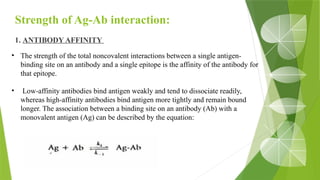
longer. The association between a binding site on an antibody (Ab) with a
monovalent antigen (Ag) can be described by the equation:

• Where k1 is the forward (association) rate constant and K-| is the reverse

(dissociation) rate constant. The ratio of K1/k-1 is the association
constant Ka (i.e., k1/k-1 = Ka ) a measure of affinity.
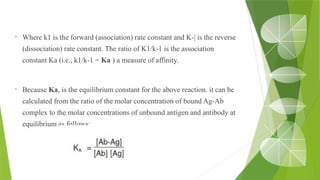
• Because Ka, is the equilibrium constant for the above reaction. it can be
calculated from the ratio of the molar concentration of bound Ag-Ab
complex to the molar concentrations of unbound antigen and antibody at
equilibrium as follows:
• Ka = affinity constant
• [Ab] = molar concentration of unoccupied binding sites on the antibody
• [Ag] = molar concentration of unoccupied binding sites on the antigen
• [Ab-Ag] = molar concentration of the antibody-antigen complex
Kd is a quantitative indicator of the stability of an Ag-Ab complex; very stable
complexes have very low values of Kd and less stable ones have higher values.
 The association constant, K, can be determined by equilibrium dialysis or
by various newer methods.
2.ANTIBODY AVIDITY
• When complex antigens containing multiple, repeating antigenic
determinants are mixed with antibodies containing multiple binding sites,
the interaction of an antibody molecule with an antigen molecule at one
site will increase the probability strength of such multiple interactions
between a multi-valent antibody and antigen is called the avidity.
• The avidity of an antibody is a better measure of its binding capacity
within biological systems (e.g., the reaction of an antibody with antigenic
determinants on a virus or bacterial cell) than the affinity of its individual
binding sites.
• Avidity is also known as the functional affinity.
• Avidity is determined by three factors:
•The binding affinity
•The valency
•The structural arrangement
• All antibodies are multivalent (e.g. IgGs are bivalent and and IgMs are
decavalent} The greater an immunoglobulin's valency (number of antigen
binding sites), the greater the amount of antigen it can bind.
• Similarly, antigens can demonstrate multivalency because they can bind
to more than one antibody. Multimeric interactions between an antibody
and an antigen help their stabilisation.
Affinity versus avidity:
 Affinity refers to the strength of a single antibody-
antigen interaction.
 Each IgG antigen binding site typicaly has high
affinity for its target
 Avidity refers to the strength of all interactions
combined.
 1gM typically has low affinity antigen binding
sites, but there are 10 of them . So, avidity is high.
3.CROSS REACTIVITY
• Although Ag-Ab reactions are highly specific, in some cases antibody elicited by one antigen can cross-
react with an unrelated antigen.
• Such cross-reactivity occurs if two different antigens share an identical epitope or if antibodies specific
for one epitope also bind to an unrelated epitope possessing similar chemical properties.
• In the latter case, the antibody's affinity for the cross-reacting epitope is usually less than that for the
original epitope.
 Cross-reactivity is often observed among polysaccharide antigens that contain similar
oligosaccharide residues.
 The ABO blood-group antigens, for example, are glycoproteins expressed on red blood
cells.
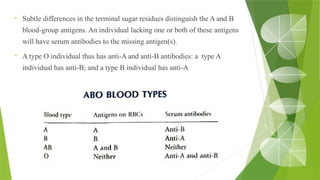
• Subtle differences in the terminal sugar residues distinguish the A and B
blood-group antigens. An individual lacking one or both of these antigens
will have serum antibodies to the missing antigen(s).
• A type O individual thus has anti-A and anti-B antibodies: a type A
individual has anti-B; and a type B individual has anti-A
• An antiserum raised against an Ag, can also react with a similar Ag of another
type. This is called cross reaction and the Ag which produces the cross
reaction is called Cross reactive Ag. But the strength of Ab raised against its
own Ag is strong.
• The bonds involved in cross reactions are weak .
• Example: The serum raised against albumin of hen's egg can cross react with
albumin obtained from duck's egg.
• The antiserum raised against human insulin will react with the insulin of Pig,
Sheep, whale etc.
• The antiserum raised against Pneumococcal polysaccharides will react with
E.coli, blood group A and collagen Ag's.
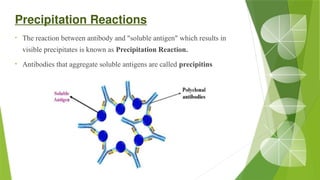
Precipitation Reactions
• The reaction between antibody and "soluble antigen" which results in
visible precipitates is known as Precipitation Reaction.
• Antibodies that aggregate soluble antigens are called precipitins
• For precipitation reactions, antibody should be bivalent (i.e. should have
more than one antigen binding sites) and antigen should be bivalent or
polyvalent (i.e. must have at least two copies of the same or epitopes).
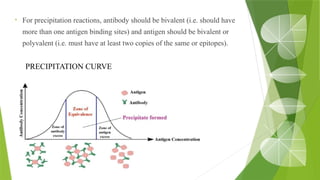
PRECIPITATION CURVE
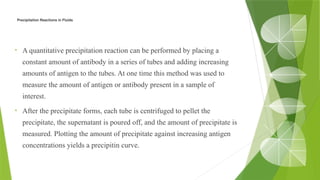
Precipitation Reactions in Fluids
• A quantitative precipitation reaction can be performed by placing a
constant amount of antibody in a series of tubes and adding increasing
amounts of antigen to the tubes. At one time this method was used to
measure the amount of antigen or antibody present in a sample of
interest.
• After the precipitate forms, each tube is centrifuged to pellet the
precipitate, the supernatant is poured off, and the amount of precipitate is
measured. Plotting the amount of precipitate against increasing antigen
concentrations yields a precipitin curve.
Precipitation Reactions in Gels
• When antigen and antibody diffuse toward one another in agar, or when
antibody is incorporated into the agar and antigen diffuses into the antibody-
containing matrix, a visible line of precipitation will form.
• As in a precipitation reaction in Auid. visible precipitation occurs in the
region of equivalence, whereas no visible precipitate forms in regions of
antibody or antigen excess. These immunodiffusion reactions can be used to
determine relative concentrations of antibodies or antigens, to compare anti-
gens, or to determine the relative purity of an antigen preparation. Two
immunodiffusion techniques are radial immunodiffusion (Mancini
method) and double immunodiffusion (Ouchterlony method); both are
carried out in a semisolid medium such as agar.
RADIAL IMMUNODIFFUSION
(Mancini Method)
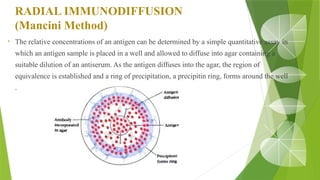
• The relative concentrations of an antigen can be determined by a simple quantitative assay in
which an antigen sample is placed in a well and allowed to diffuse into agar containing a
suitable dilution of an antiserum. As the antigen diffuses into the agar, the region of
equivalence is established and a ring of precipitation, a precipitin ring, forms around the well
.
• The area of the precipitin ring is proportional to the concentration of
antigen. By comparing the area of the precipitin ring with a standard
curve (obtained by measuring the precipitin areas of known
concentrations of the antigen), the concentration of the antigen sample
can be determined.
Double Immunodiffusion
(Ouchterlony Method)
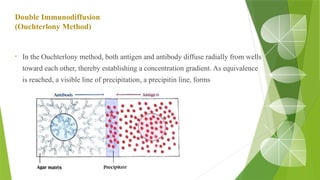
• In the Ouchterlony method, both antigen and antibody diffuse radially from wells
toward each other, thereby establishing a concentration gradient. As equivalence
is reached, a visible line of precipitation, a precipitin line, forms
• This simple technique is an effective qualitative tool for determining the
relationship between antigens and the number of different Ag-Ab systems
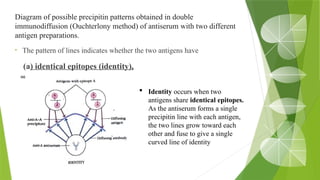
present. The pattern of the precipitin lines that form when two different
antigen preparations are placed in adjacent wells indicates whether they
share epitopes:
Diagram of possible precipitin patterns obtained in double
immunodiffusion (Ouchterlony method) of antiserum with two different
antigen preparations.
• The pattern of lines indicates whether the two antigens have
(a) identical epitopes (identity),
 Identity occurs when two
antigens share identical epitopes.
As the antiserum forms a single
precipitin line with each antigen,
the two lines grow toward each
other and fuse to give a single
curved line of identity
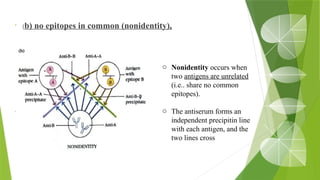
• (b) no epitopes in common (nonidentity),
o Nonidentity occurs when
two antigens are unrelated
(i.e.. share no common
epitopes).
o The antiserum forms an
independent precipitin line
with each antigen, and the
two lines cross
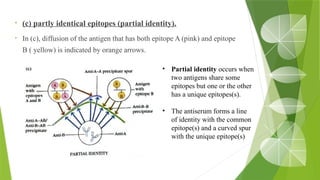
• (c) partly identical epitopes (partial identity).
• In (c), diffusion of the antigen that has both epitope A (pink) and epitope
B ( yellow) is indicated by orange arrows.
• Partial identity occurs when
two antigens share some
epitopes but one or the other
has a unique epitopes(s).
• The antiserum forms a line
of identity with the common
epitope(s) and a curved spur
with the unique epitope(s)
Application of Precipitation reaction:
• Detection of unknown antibody to diagnose infection
e.g. VDRL test for syphilis.
• Standardization of toxins and antitoxins.
• Identification of Bacteria
e.g. Lancified grouping of streptococci.
• Identification of bacterial component
e.g Ascoli's thermoprecipitin test for Bacillus anthracis.
Agglutination Reactions
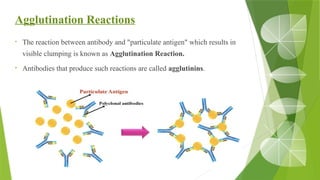
• The reaction between antibody and "particulate antigen" which results in
visible clumping is known as Agglutination Reaction.
• Antibodies that produce such reactions are called agglutinins.
• Agglutination reactions are similar in principle to precipitation reactions
as antibody should be bivalent_(ie. should have more than one antigen
binding sites) and antigen should be bivalent or polvvalent (i.e. must have
at least two copies of the same or epitopes).
Prozone effect:
• Excess of antibody inhibits agglutination reactions this inhibition is
called the prozone effect.
Hemagglutination
• Agglutination reactions are routinely performed to type red blood cells
(RBCs).
• In typing for the ABO antigens, RBCs are mixed on a slide with
antisera to the A or B blood-group antigens. If the antigen is present on
the cells, they agglutinate, forming a visible clump on the slide.
• Determination of which antigens are present on donor and recipient
RBs is the basis for matching blood types for transfusions.
Bacterial Agglutination
• A bacterial infection often elicits the production of serum antibodies
specific for surface antigens on the bacterial cells.
• The presence of such antibodies can be detected by bacterial
agglutination reactions.
• Agglutination reactions also provide a way to type bacteria.
• For instance, different species of the bacterium Salmonella can be distinguished
by agglutination reactions with a panel of typing antisera.
'Passive Agglutination
• The sensitivity and simplicity of agglutination reactions can be extended to
soluble antigens by the technique of passive hemagglutination.
• In this technique, antigen-coated red blood cells are prepared by mixing a
soluble antigen with red blood cells that have been treated with tannic acid or
chromium chloride, both of which promote adsorption of the antigen to the
surface of the cells.
• Serum containing antibody is serially diluted into microtiter plate wells, and the
antigen-coated red blood cells are then added to each well; agglutination is
assessed by the size of the characteristic spread pattern of agglutinated red blood
cells on the bottor of the well, like the pattern seen in agglutination reaction
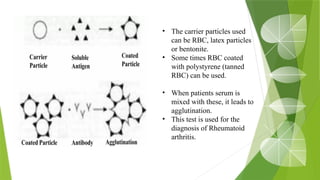
• The carrier particles used
can be RBC, latex particles
or bentonite.
• Some times RBC coated
with polystyrene (tanned
RBC) can be used.
• When patients serum is
mixed with these, it leads to
agglutination.
• This test is used for the
diagnosis of Rheumatoid
arthritis.
Agglutination Inhibition
• A modification of the agglutination reaction, called agglutination
inhibition, provides a highly sensitive assay for small quantities of an
antigen.
• For example, one of the early type of home pregnancy test kits included
latex particles coated with human chorionic gonadotropin (HCG) and
antibody to HCG .
• The addition of urine from a pregnant woman, which contained HCG,
inhibited agglutination the latex particles when the anti-HCG antibody
was add. thus the absence of agglutination indicated pregnancy.
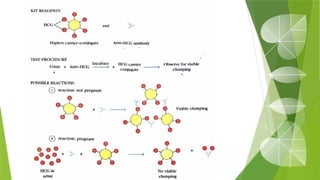
• The early home pregnancy test kit employed hapten inhibition to determine the
presence or absence of human chorionic gonadotropin (HCG).
• The original test kits used the presence or absence of visible clumping to determine
whether HCG was present. If a woman was not pregnant, her urine would not contain
HCG; in this case, the anti-HCG antibodies and HCG-carrier conjugate in the kit
would react, producing visible clumping.
 If a woman was pregnant, the HCG in her urine would bind to the anti-HCG
antibodies, thus inhibiting the subsequent binding of the antibody to the HCG-
carrier conjugate.
• Because of this inhibition, no visible clumping occurred if a woman was
pregnant.
• The kits currently on the market use ELISA-based assays
• Agglutination inhibition assays also can be used to determine if an
individual is using certain types of illegal drugs, such as cocaine or
heroin.
• Agglutination inhibition assays are widely used in clinical laboratories to
determine whether an individual has been exposed to certain types of
viruses that cause agglutination of red blood cells.
Application of Agglutination reaction:
• Cross-matching and grouping of blood.
• Identification of Bacteria. E.g. Serotyping of Vibrio cholera, Serotyping
of Salmonella Typhi and Paratyphi.
• Serological diagnosis of various diseases. E.g Rapid plasma regains
(RPR) test for Syphilis, Antistreptolysin O (ASO) test for rheumatic
fever.
• Detection of unknown antigen in various clinical specimens. E.g.
detection of Vi antigen of Salmonella Typhi in the urine.
RPR Test ( Rapid Plasma Reagin)
• The Rapid Plasma Reagin (RPR) test is a blood test used for the screening and diagnosis of syphilis, a
sexually transmitted infection caused by the bacterium Treponema pallidum. The RPR test is based on the
detection of antibodies produced by the immune system in response to the infection.Here's how the RPR test
works:
It involves collecting a blood sample from the patient, which is then mixed with a cardiolipin
antigen derived from beef heart tissue. The antigen is coated onto tiny carbon particles
suspended in the PR test reagent.
During the test, if the patient has syphilis, antibodies known as reagins will react with the
cardiolipin antigen on the carbon particles, causing them to clump together or agglutinate.
The degree of agglutination observed is evaluated and reported as a titer, indicating the
highest dilution of the patient's blood that still produces visible agglutination.
Antistreptolysin O (ASO) test
for rheumatic fever.
• The Antistreptolysin O (ASO) test is a blood test used to detect the presence of antibodies called
antistreptolysin O in the bloodstream. It is primarily used to aid in the diagnosis of rheumatic
fever, a complication that can occur after a group A Streptococcus infection, such as strep throat.
• During the test, a blood sample is collected from the patient and mixed with Streptolysin O, a toxin
produced by group A Streptococcus bacteria. If the patient has been previously exposed to a
streptococcal infection, their immune system may have produced antistreptolysin O antibodies.
• These antibodies will bind to the Streptolysin O in the test mixture.
The level of antistreptolysin O antibodies in the blood is then measured, and the test result is
reported as a titer or concentration of antibodies.
A higher titer suggests a recent or ongoing streptococcal infection, but it does not directly diagnose
rheumatic fever.
Rf test(Rheumatoid factor)
• The Latex Agglutination-Rheumatoid Factor (RF) test is a laboratory test
used to detect the presence of rheumatoid factor antibodies in the blood.
Rheumatoid factor is an autoantibody that targets the body's own tissues,
particularly in individuals with rheumatoid arthritis.
• A blood sample is collected from the patient, mixed with latex particles that are coated with
human immunoglobulin G (IgG), During this incubation period, if the patient has
rheumatoid factor antibodies, they will bind to the IgG-coated latex particles, causing them
to clump together or agglutinate.
• After incubation, the degree of agglutination or clumping is observed and evaluated. The
test result is reported as either positive (agglutination observed) or negative (no
agglutination observed).
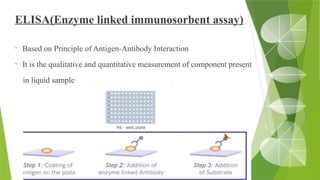
ELISA(Enzyme linked immunosorbent assay)
• Based on Principle of Antigen-Antibody Interaction
• It is the qualitative and quantitative measurement of component present
in liquid sample
Widal test
• The Widal test helps in diagnosing enteric fever by detecting antibodies
against S. typhi and S. paratyphi. A significant rise in antibody titers in
paired samples collected at different time points or a high single titer is
suggestive of a current or recent infection.
• However, it's important to note that the Widal test has limitations. It may
give false-positive results due to cross-reactivity with other infections or
previous vaccinations. Additionally, antibody titers can remain elevated for
an extended period after the infection, making it difficult to determine the
exact timing of the infection based on this test alone.
Factors Affecting Antigen-Antibody
Interaction
• Temperature: It depends on the chemical nature of epitopes, paratopes,
and, bonds involved. Eg. hydrogen bonds are stable at low temperatures
and hydrophobic bonds are stable at high temperatures.
• pH: Optimal pH range is 6.5 to 8.5. Extreme pH values change the
conformation of antibodies and inhibit the reaction.
• Ionic strength: The effect of ionic is important in blood group serology.
Here the reaction is significantly influenced by sodium and chloride
ions. In normal saline solution, Na+ and CI- cluster around the complex
and partially neutralize charges, potentially interfering with antibody
binding to antigen.
•
Enzyme Treatment: Many proteolytic enzymes are used to enhance the
Ag-Ab reactions. Some of the commonly used ones are papain, ficin,
bromelin.
• Concentrations of Ag and Ab: Increase in the concentration of antigen
and antibody enhances the reaction.
• No. of antigen-binding sites: More the no. of antigen-binding sites on the
antibody, the more the chances of interaction. For eg., IgM is a pentamer
and hence has 10 binding sites whereas IgG is a monomer and hence
has only 2 binding sites so IgM will bind more efficiently with antigens.
• Structural arrangement: If the structure of epitope and paratope is such
that they could fit well as lock and key then it enhances the interaction
between antigen and antibody.
Applications of Antigen-Antibody interaction
• The most common use is the determination of blood groups i.e. blood typing.
• Rapid diagnosis test kits used for pregnancy detection as well as detection of several
diseases such as malaria, dengue, etc. are based on this principle. They require very
little time for the tests.
• Serological ascertainment of exposure to infectious agents.
• Quantification of drugs, hormones, viral antigens, etc.
• Detection of presence or absence of proteins in serum.
• llTo study the characteristics of different immunodeficiency diseases.
• To perform confirmatory tests for infections such as Western Blotting for HIV
infection.
CONCLUSION
• Antigen-antibody interactions also play a crucial role in immunodiagnostic
techniques. These techniques utilize the specific binding between antigens and
antibodies to detect and quantify the presence of antigens or antibodies in
biological samples. Examples of such techniques include ELISA, Western
blotting, and immunofluorescence.
• Understanding the principles of antigen-antibody interactions is essential for
comprehending immune responses, developing vaccines, and diagnosing
diseases. Ongoing research in this field continues to deepen our understanding
of these interactions and their applications in immunology and medical science.
Thankyou

Antigen Antibody Interaction. .

  • 1.
  • 2.
    INTRODUCTION Antigen-antibody interaction isa fundamental process in immunology that plays a central role in the immune response. It involves the recognition and binding of antigens by specific antibodies, leading to a series of immune reactions that help protect the body against pathogens and foreign substances. The antigen-antibody interaction is highly specific, resembling a lock-and-key mechanism. The binding between an antibody and its corresponding antigen is governed by forces such as electrostatic interactions, hydrogen bonding, and van der Waals forces. This specificity allows antibodies to selectively recognize and bind to their target antigens while ignoring others.
  • 3.
    ANTIGEN- ANTIBODY INTERACTION •The antigen-antibody interaction is a bimolecular association similar to an enzyme-substrate interaction, with an important distinction: it does not lead to an irreversible chemical alteration in either the antibody or the antigen and therefore is reversible. • The interaction between an antibody and an antigen involves various noncovalent interactions between the antigenic determinant, or epitope, of the antigen and the variable-region (V/Vi) domain of the antibody molecule, particularly the hypervariable regions, or comple- mentarity-determining regions (CDRs).
  • 4.
    Chemical Bonds Responsiblefor the Antigen- Antibody Interaction • The interaction between the Ab-binding site and the epitope involves exclusively non-covalent bonds, in a similar manner to that in which proteins bind to their cellular receptors, or enzymes bind to their substrates. • The binding is reversible and can be prevented or dissociated by high ionic strength or extreme pH. The following intermolecular forces are involved in Ag- Ab binding: • (1) Hydrogen bonds • (2) Ionic bonds • (3) Hydrophobic interactions • (4) Van der Waals interactions
  • 5.
    • The exquisitespecificity of antigen-antibody interactions has led to the development of a variety of immunologic assays. • These assays can be used to detect the presence of either antibody or antigen and have played vital roles in diagnosing diseases, monitoring the level of the humoral immune response, and identifying molecules of biological or medical interest. • These assays differ in their speed and their sensitivity ; some are strictly qualitative , and others are quantitative.
  • 6.
    • Because thestrength of each of these interactions is weak compared with that of a covalent bond ,a large number of such interactions are required to form a strong Ag-Ab interaction. • Furthermore, each of these non-covalent interactions operates over a very small distance generally about -1 angstrom, or a little less; consequently, a strong Ag-Ab interaction depends on a very close fit between the antigen and antibody.
  • 7.
    Strength of Ag-Abinteraction: 1. ANTIBODY AFFINITY • The strength of the total noncovalent interactions between a single antigen- binding site on an antibody and a single epitope is the affinity of the antibody for that epitope. • Low-affinity antibodies bind antigen weakly and tend to dissociate readily, whereas high-affinity antibodies bind antigen more tightly and remain bound longer. The association between a binding site on an antibody (Ab) with a monovalent antigen (Ag) can be described by the equation:
  • 8.
    • Where k1is the forward (association) rate constant and K-| is the reverse (dissociation) rate constant. The ratio of K1/k-1 is the association constant Ka (i.e., k1/k-1 = Ka ) a measure of affinity. • Because Ka, is the equilibrium constant for the above reaction. it can be calculated from the ratio of the molar concentration of bound Ag-Ab complex to the molar concentrations of unbound antigen and antibody at equilibrium as follows:
  • 9.
    • Ka =affinity constant • [Ab] = molar concentration of unoccupied binding sites on the antibody • [Ag] = molar concentration of unoccupied binding sites on the antigen • [Ab-Ag] = molar concentration of the antibody-antigen complex Kd is a quantitative indicator of the stability of an Ag-Ab complex; very stable complexes have very low values of Kd and less stable ones have higher values.  The association constant, K, can be determined by equilibrium dialysis or by various newer methods.
  • 10.
    2.ANTIBODY AVIDITY • Whencomplex antigens containing multiple, repeating antigenic determinants are mixed with antibodies containing multiple binding sites, the interaction of an antibody molecule with an antigen molecule at one site will increase the probability strength of such multiple interactions between a multi-valent antibody and antigen is called the avidity. • The avidity of an antibody is a better measure of its binding capacity within biological systems (e.g., the reaction of an antibody with antigenic determinants on a virus or bacterial cell) than the affinity of its individual binding sites.
  • 11.
    • Avidity isalso known as the functional affinity. • Avidity is determined by three factors: •The binding affinity •The valency •The structural arrangement • All antibodies are multivalent (e.g. IgGs are bivalent and and IgMs are decavalent} The greater an immunoglobulin's valency (number of antigen binding sites), the greater the amount of antigen it can bind. • Similarly, antigens can demonstrate multivalency because they can bind to more than one antibody. Multimeric interactions between an antibody and an antigen help their stabilisation.
  • 12.
    Affinity versus avidity: Affinity refers to the strength of a single antibody- antigen interaction.  Each IgG antigen binding site typicaly has high affinity for its target  Avidity refers to the strength of all interactions combined.  1gM typically has low affinity antigen binding sites, but there are 10 of them . So, avidity is high.
  • 13.
    3.CROSS REACTIVITY • AlthoughAg-Ab reactions are highly specific, in some cases antibody elicited by one antigen can cross- react with an unrelated antigen. • Such cross-reactivity occurs if two different antigens share an identical epitope or if antibodies specific for one epitope also bind to an unrelated epitope possessing similar chemical properties. • In the latter case, the antibody's affinity for the cross-reacting epitope is usually less than that for the original epitope.  Cross-reactivity is often observed among polysaccharide antigens that contain similar oligosaccharide residues.  The ABO blood-group antigens, for example, are glycoproteins expressed on red blood cells.
  • 14.
    • Subtle differencesin the terminal sugar residues distinguish the A and B blood-group antigens. An individual lacking one or both of these antigens will have serum antibodies to the missing antigen(s). • A type O individual thus has anti-A and anti-B antibodies: a type A individual has anti-B; and a type B individual has anti-A
  • 15.
    • An antiserumraised against an Ag, can also react with a similar Ag of another type. This is called cross reaction and the Ag which produces the cross reaction is called Cross reactive Ag. But the strength of Ab raised against its own Ag is strong. • The bonds involved in cross reactions are weak . • Example: The serum raised against albumin of hen's egg can cross react with albumin obtained from duck's egg. • The antiserum raised against human insulin will react with the insulin of Pig, Sheep, whale etc. • The antiserum raised against Pneumococcal polysaccharides will react with E.coli, blood group A and collagen Ag's.
  • 16.
    Precipitation Reactions • Thereaction between antibody and "soluble antigen" which results in visible precipitates is known as Precipitation Reaction. • Antibodies that aggregate soluble antigens are called precipitins
  • 17.
    • For precipitationreactions, antibody should be bivalent (i.e. should have more than one antigen binding sites) and antigen should be bivalent or polyvalent (i.e. must have at least two copies of the same or epitopes). PRECIPITATION CURVE
  • 18.
    Precipitation Reactions inFluids • A quantitative precipitation reaction can be performed by placing a constant amount of antibody in a series of tubes and adding increasing amounts of antigen to the tubes. At one time this method was used to measure the amount of antigen or antibody present in a sample of interest. • After the precipitate forms, each tube is centrifuged to pellet the precipitate, the supernatant is poured off, and the amount of precipitate is measured. Plotting the amount of precipitate against increasing antigen concentrations yields a precipitin curve.
  • 19.
    Precipitation Reactions inGels • When antigen and antibody diffuse toward one another in agar, or when antibody is incorporated into the agar and antigen diffuses into the antibody- containing matrix, a visible line of precipitation will form. • As in a precipitation reaction in Auid. visible precipitation occurs in the region of equivalence, whereas no visible precipitate forms in regions of antibody or antigen excess. These immunodiffusion reactions can be used to determine relative concentrations of antibodies or antigens, to compare anti- gens, or to determine the relative purity of an antigen preparation. Two immunodiffusion techniques are radial immunodiffusion (Mancini method) and double immunodiffusion (Ouchterlony method); both are carried out in a semisolid medium such as agar.
  • 20.
    RADIAL IMMUNODIFFUSION (Mancini Method) •The relative concentrations of an antigen can be determined by a simple quantitative assay in which an antigen sample is placed in a well and allowed to diffuse into agar containing a suitable dilution of an antiserum. As the antigen diffuses into the agar, the region of equivalence is established and a ring of precipitation, a precipitin ring, forms around the well .
  • 21.
    • The areaof the precipitin ring is proportional to the concentration of antigen. By comparing the area of the precipitin ring with a standard curve (obtained by measuring the precipitin areas of known concentrations of the antigen), the concentration of the antigen sample can be determined.
  • 22.
    Double Immunodiffusion (Ouchterlony Method) •In the Ouchterlony method, both antigen and antibody diffuse radially from wells toward each other, thereby establishing a concentration gradient. As equivalence is reached, a visible line of precipitation, a precipitin line, forms
  • 23.
    • This simpletechnique is an effective qualitative tool for determining the relationship between antigens and the number of different Ag-Ab systems present. The pattern of the precipitin lines that form when two different antigen preparations are placed in adjacent wells indicates whether they share epitopes:
  • 24.
    Diagram of possibleprecipitin patterns obtained in double immunodiffusion (Ouchterlony method) of antiserum with two different antigen preparations. • The pattern of lines indicates whether the two antigens have (a) identical epitopes (identity),  Identity occurs when two antigens share identical epitopes. As the antiserum forms a single precipitin line with each antigen, the two lines grow toward each other and fuse to give a single curved line of identity
  • 25.
    • (b) noepitopes in common (nonidentity), o Nonidentity occurs when two antigens are unrelated (i.e.. share no common epitopes). o The antiserum forms an independent precipitin line with each antigen, and the two lines cross
  • 26.
    • (c) partlyidentical epitopes (partial identity). • In (c), diffusion of the antigen that has both epitope A (pink) and epitope B ( yellow) is indicated by orange arrows. • Partial identity occurs when two antigens share some epitopes but one or the other has a unique epitopes(s). • The antiserum forms a line of identity with the common epitope(s) and a curved spur with the unique epitope(s)
  • 27.
    Application of Precipitationreaction: • Detection of unknown antibody to diagnose infection e.g. VDRL test for syphilis. • Standardization of toxins and antitoxins. • Identification of Bacteria e.g. Lancified grouping of streptococci. • Identification of bacterial component e.g Ascoli's thermoprecipitin test for Bacillus anthracis.
  • 28.
    Agglutination Reactions • Thereaction between antibody and "particulate antigen" which results in visible clumping is known as Agglutination Reaction. • Antibodies that produce such reactions are called agglutinins.
  • 29.
    • Agglutination reactionsare similar in principle to precipitation reactions as antibody should be bivalent_(ie. should have more than one antigen binding sites) and antigen should be bivalent or polvvalent (i.e. must have at least two copies of the same or epitopes). Prozone effect: • Excess of antibody inhibits agglutination reactions this inhibition is called the prozone effect.
  • 30.
    Hemagglutination • Agglutination reactionsare routinely performed to type red blood cells (RBCs). • In typing for the ABO antigens, RBCs are mixed on a slide with antisera to the A or B blood-group antigens. If the antigen is present on the cells, they agglutinate, forming a visible clump on the slide. • Determination of which antigens are present on donor and recipient RBs is the basis for matching blood types for transfusions.
  • 31.
    Bacterial Agglutination • Abacterial infection often elicits the production of serum antibodies specific for surface antigens on the bacterial cells. • The presence of such antibodies can be detected by bacterial agglutination reactions. • Agglutination reactions also provide a way to type bacteria. • For instance, different species of the bacterium Salmonella can be distinguished by agglutination reactions with a panel of typing antisera.
  • 32.
    'Passive Agglutination • Thesensitivity and simplicity of agglutination reactions can be extended to soluble antigens by the technique of passive hemagglutination. • In this technique, antigen-coated red blood cells are prepared by mixing a soluble antigen with red blood cells that have been treated with tannic acid or chromium chloride, both of which promote adsorption of the antigen to the surface of the cells. • Serum containing antibody is serially diluted into microtiter plate wells, and the antigen-coated red blood cells are then added to each well; agglutination is assessed by the size of the characteristic spread pattern of agglutinated red blood cells on the bottor of the well, like the pattern seen in agglutination reaction
  • 33.
    • The carrierparticles used can be RBC, latex particles or bentonite. • Some times RBC coated with polystyrene (tanned RBC) can be used. • When patients serum is mixed with these, it leads to agglutination. • This test is used for the diagnosis of Rheumatoid arthritis.
  • 34.
    Agglutination Inhibition • Amodification of the agglutination reaction, called agglutination inhibition, provides a highly sensitive assay for small quantities of an antigen. • For example, one of the early type of home pregnancy test kits included latex particles coated with human chorionic gonadotropin (HCG) and antibody to HCG . • The addition of urine from a pregnant woman, which contained HCG, inhibited agglutination the latex particles when the anti-HCG antibody was add. thus the absence of agglutination indicated pregnancy.
  • 36.
    • The earlyhome pregnancy test kit employed hapten inhibition to determine the presence or absence of human chorionic gonadotropin (HCG). • The original test kits used the presence or absence of visible clumping to determine whether HCG was present. If a woman was not pregnant, her urine would not contain HCG; in this case, the anti-HCG antibodies and HCG-carrier conjugate in the kit would react, producing visible clumping.  If a woman was pregnant, the HCG in her urine would bind to the anti-HCG antibodies, thus inhibiting the subsequent binding of the antibody to the HCG- carrier conjugate. • Because of this inhibition, no visible clumping occurred if a woman was pregnant. • The kits currently on the market use ELISA-based assays
  • 37.
    • Agglutination inhibitionassays also can be used to determine if an individual is using certain types of illegal drugs, such as cocaine or heroin. • Agglutination inhibition assays are widely used in clinical laboratories to determine whether an individual has been exposed to certain types of viruses that cause agglutination of red blood cells.
  • 38.
    Application of Agglutinationreaction: • Cross-matching and grouping of blood. • Identification of Bacteria. E.g. Serotyping of Vibrio cholera, Serotyping of Salmonella Typhi and Paratyphi. • Serological diagnosis of various diseases. E.g Rapid plasma regains (RPR) test for Syphilis, Antistreptolysin O (ASO) test for rheumatic fever. • Detection of unknown antigen in various clinical specimens. E.g. detection of Vi antigen of Salmonella Typhi in the urine.
  • 39.
    RPR Test (Rapid Plasma Reagin) • The Rapid Plasma Reagin (RPR) test is a blood test used for the screening and diagnosis of syphilis, a sexually transmitted infection caused by the bacterium Treponema pallidum. The RPR test is based on the detection of antibodies produced by the immune system in response to the infection.Here's how the RPR test works: It involves collecting a blood sample from the patient, which is then mixed with a cardiolipin antigen derived from beef heart tissue. The antigen is coated onto tiny carbon particles suspended in the PR test reagent. During the test, if the patient has syphilis, antibodies known as reagins will react with the cardiolipin antigen on the carbon particles, causing them to clump together or agglutinate. The degree of agglutination observed is evaluated and reported as a titer, indicating the highest dilution of the patient's blood that still produces visible agglutination.
  • 40.
    Antistreptolysin O (ASO)test for rheumatic fever. • The Antistreptolysin O (ASO) test is a blood test used to detect the presence of antibodies called antistreptolysin O in the bloodstream. It is primarily used to aid in the diagnosis of rheumatic fever, a complication that can occur after a group A Streptococcus infection, such as strep throat. • During the test, a blood sample is collected from the patient and mixed with Streptolysin O, a toxin produced by group A Streptococcus bacteria. If the patient has been previously exposed to a streptococcal infection, their immune system may have produced antistreptolysin O antibodies. • These antibodies will bind to the Streptolysin O in the test mixture. The level of antistreptolysin O antibodies in the blood is then measured, and the test result is reported as a titer or concentration of antibodies. A higher titer suggests a recent or ongoing streptococcal infection, but it does not directly diagnose rheumatic fever.
  • 41.
    Rf test(Rheumatoid factor) •The Latex Agglutination-Rheumatoid Factor (RF) test is a laboratory test used to detect the presence of rheumatoid factor antibodies in the blood. Rheumatoid factor is an autoantibody that targets the body's own tissues, particularly in individuals with rheumatoid arthritis. • A blood sample is collected from the patient, mixed with latex particles that are coated with human immunoglobulin G (IgG), During this incubation period, if the patient has rheumatoid factor antibodies, they will bind to the IgG-coated latex particles, causing them to clump together or agglutinate. • After incubation, the degree of agglutination or clumping is observed and evaluated. The test result is reported as either positive (agglutination observed) or negative (no agglutination observed).
  • 42.
    ELISA(Enzyme linked immunosorbentassay) • Based on Principle of Antigen-Antibody Interaction • It is the qualitative and quantitative measurement of component present in liquid sample
  • 43.
    Widal test • TheWidal test helps in diagnosing enteric fever by detecting antibodies against S. typhi and S. paratyphi. A significant rise in antibody titers in paired samples collected at different time points or a high single titer is suggestive of a current or recent infection. • However, it's important to note that the Widal test has limitations. It may give false-positive results due to cross-reactivity with other infections or previous vaccinations. Additionally, antibody titers can remain elevated for an extended period after the infection, making it difficult to determine the exact timing of the infection based on this test alone.
  • 44.
    Factors Affecting Antigen-Antibody Interaction •Temperature: It depends on the chemical nature of epitopes, paratopes, and, bonds involved. Eg. hydrogen bonds are stable at low temperatures and hydrophobic bonds are stable at high temperatures. • pH: Optimal pH range is 6.5 to 8.5. Extreme pH values change the conformation of antibodies and inhibit the reaction. • Ionic strength: The effect of ionic is important in blood group serology. Here the reaction is significantly influenced by sodium and chloride ions. In normal saline solution, Na+ and CI- cluster around the complex and partially neutralize charges, potentially interfering with antibody binding to antigen.
  • 45.
    • Enzyme Treatment: Manyproteolytic enzymes are used to enhance the Ag-Ab reactions. Some of the commonly used ones are papain, ficin, bromelin. • Concentrations of Ag and Ab: Increase in the concentration of antigen and antibody enhances the reaction. • No. of antigen-binding sites: More the no. of antigen-binding sites on the antibody, the more the chances of interaction. For eg., IgM is a pentamer and hence has 10 binding sites whereas IgG is a monomer and hence has only 2 binding sites so IgM will bind more efficiently with antigens. • Structural arrangement: If the structure of epitope and paratope is such that they could fit well as lock and key then it enhances the interaction between antigen and antibody.
  • 46.
    Applications of Antigen-Antibodyinteraction • The most common use is the determination of blood groups i.e. blood typing. • Rapid diagnosis test kits used for pregnancy detection as well as detection of several diseases such as malaria, dengue, etc. are based on this principle. They require very little time for the tests. • Serological ascertainment of exposure to infectious agents. • Quantification of drugs, hormones, viral antigens, etc. • Detection of presence or absence of proteins in serum. • llTo study the characteristics of different immunodeficiency diseases. • To perform confirmatory tests for infections such as Western Blotting for HIV infection.
  • 47.
    CONCLUSION • Antigen-antibody interactionsalso play a crucial role in immunodiagnostic techniques. These techniques utilize the specific binding between antigens and antibodies to detect and quantify the presence of antigens or antibodies in biological samples. Examples of such techniques include ELISA, Western blotting, and immunofluorescence. • Understanding the principles of antigen-antibody interactions is essential for comprehending immune responses, developing vaccines, and diagnosing diseases. Ongoing research in this field continues to deepen our understanding of these interactions and their applications in immunology and medical science.
  • 48.