OEDEMA
Dr. Saugat Chapagain
OEDEMA/ EDEMA
 Abnormal and excessive accumulation of free fluid in interstitial
spaces and serous cavities.
 Site:
• In body cavities-
• Ascites, hydrothorax, pleural effusion, pericardial effusion, etc.
• In interstitial space-
• Lies free in the interstitial space.
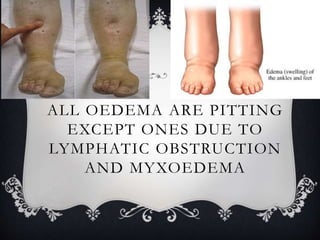
• Can be displaced with pressure (Pitting)
• Can not be displaced (non pitting) e.g. myxoedema
ALL OEDEMA ARE PITTING
EXCEPT ONES DUE TO
LYMPHATIC OBSTRUCTION
AND MYXOEDEMA
TYPES
 Based on site/ distribution:
• Localized
• Pulmonary effusion, ascites, hydrothorax, pericardial effusion, lymph
edema, peripheral venous obstruction.
• Generalized (usu. Transudative) (anasarca/ dropsy)
• Renal, cardiac, hepatic, famine(nutritional
 Based on fluid composition:
• Transudate-
• Non inflammatory, usu. Systemic.
• Exudate-
• Inflammatory
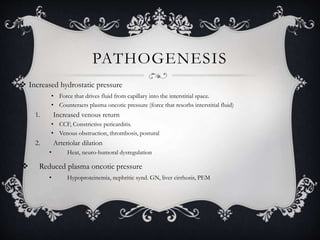
PATHOGENESIS
 Increased hydrostatic pressure
• Force that drives fluid from capillary into the interstitial space.
• Counteracts plasma oncotic pressure (force that resorbs interstitial fluid)
1. Increased venous return
• CCF, Constrictive pericarditis.
• Venous obstruction, thrombosis, postural
2. Arteriolar dilation
• Heat, neuro-humoral dysregulation
 Reduced plasma oncotic pressure
• Hypoproteinemia, nephritic synd. GN, liver cirrhosis, PEM
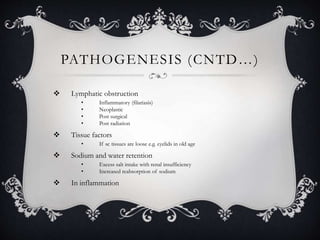
PATHOGENESIS (CNTD…)
 Lymphatic obstruction
• Inflammatory (filariasis)
• Neoplastic
• Post surgical
• Post radiation
 Tissue factors
• If sc tissues are loose e.g. eyelids in old age
 Sodium and water retention
• Excess salt intake with renal insufficiency
• Increased reabsorption of sodium
 In inflammation
7. oedema

7. oedema

  • 1.
  • 2.
    OEDEMA/ EDEMA  Abnormaland excessive accumulation of free fluid in interstitial spaces and serous cavities.  Site: • In body cavities- • Ascites, hydrothorax, pleural effusion, pericardial effusion, etc. • In interstitial space- • Lies free in the interstitial space. • Can be displaced with pressure (Pitting) • Can not be displaced (non pitting) e.g. myxoedema
  • 3.
    ALL OEDEMA AREPITTING EXCEPT ONES DUE TO LYMPHATIC OBSTRUCTION AND MYXOEDEMA
  • 4.
    TYPES  Based onsite/ distribution: • Localized • Pulmonary effusion, ascites, hydrothorax, pericardial effusion, lymph edema, peripheral venous obstruction. • Generalized (usu. Transudative) (anasarca/ dropsy) • Renal, cardiac, hepatic, famine(nutritional  Based on fluid composition: • Transudate- • Non inflammatory, usu. Systemic. • Exudate- • Inflammatory
  • 5.
    PATHOGENESIS  Increased hydrostaticpressure • Force that drives fluid from capillary into the interstitial space. • Counteracts plasma oncotic pressure (force that resorbs interstitial fluid) 1. Increased venous return • CCF, Constrictive pericarditis. • Venous obstruction, thrombosis, postural 2. Arteriolar dilation • Heat, neuro-humoral dysregulation  Reduced plasma oncotic pressure • Hypoproteinemia, nephritic synd. GN, liver cirrhosis, PEM
  • 6.
    PATHOGENESIS (CNTD…)  Lymphaticobstruction • Inflammatory (filariasis) • Neoplastic • Post surgical • Post radiation  Tissue factors • If sc tissues are loose e.g. eyelids in old age  Sodium and water retention • Excess salt intake with renal insufficiency • Increased reabsorption of sodium  In inflammation