Adoption of Innovation and
its model
• Present by:
• SONDARVA YAGNESH M
• M.Sc. Agriculture (Agril .Extension)
• Department of agricultural extension
• BACA, AAU ,ANAND
Adoption
• Adoption
Decision to make full use of an innovation as the best
course of action available.
• Adoption process (Micro process)
Decision making process, goes through a number of
mental stages before making a final decision to adopt
an innovation.
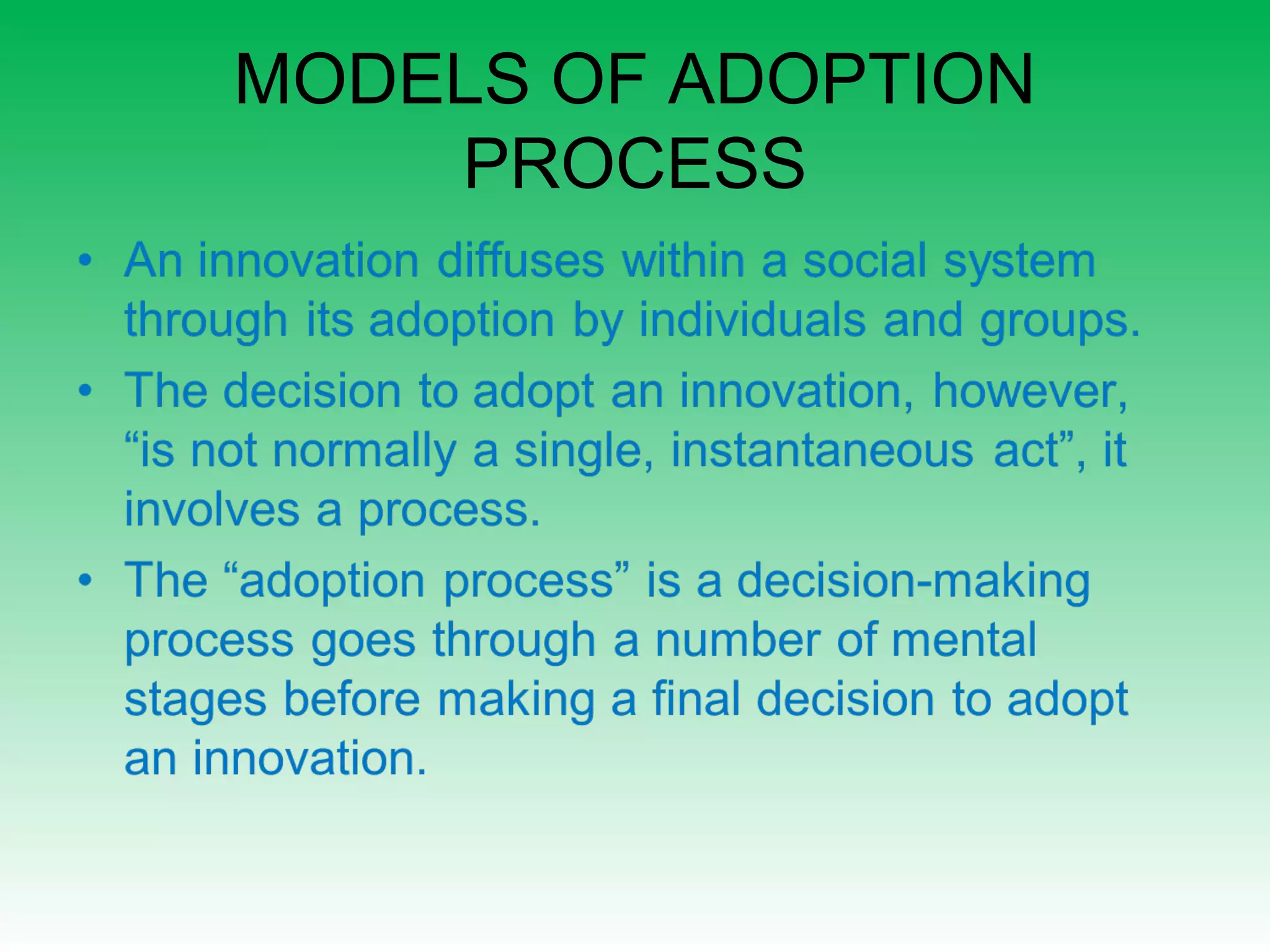
MODELS OF ADOPTION
PROCESS
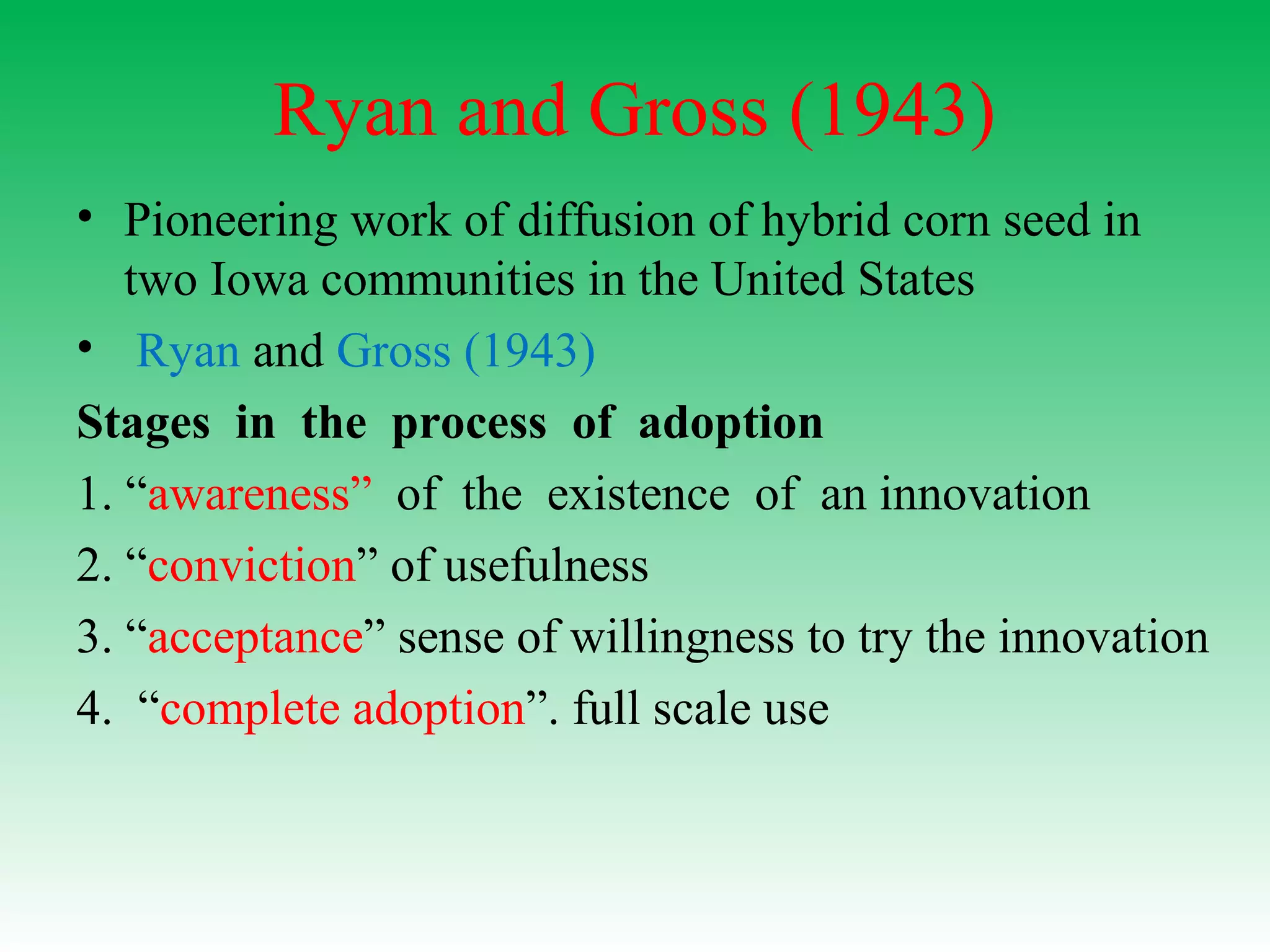
Ryan and Gross (1943)
• Pioneering work of diffusion of hybrid corn seed in
two Iowa communities in the United States
• Ryan and Gross (1943)
Stages in the process of adoption
1. “awareness” of the existence of an innovation
2. “conviction” of usefulness
3. “acceptance” sense of willingness to try the innovation
4. “complete adoption”. full scale use
Wilkening (1953)
• Adoption of innovation as a process composed of
learning, deciding and acting over a period of time.
• The adoption of a specific practice is not the result
of a single decision to act but series of action and
thought decision.
Four stages in adoption
1. Obtaining information
2. Conviction
3. Trial
4. Adoption.
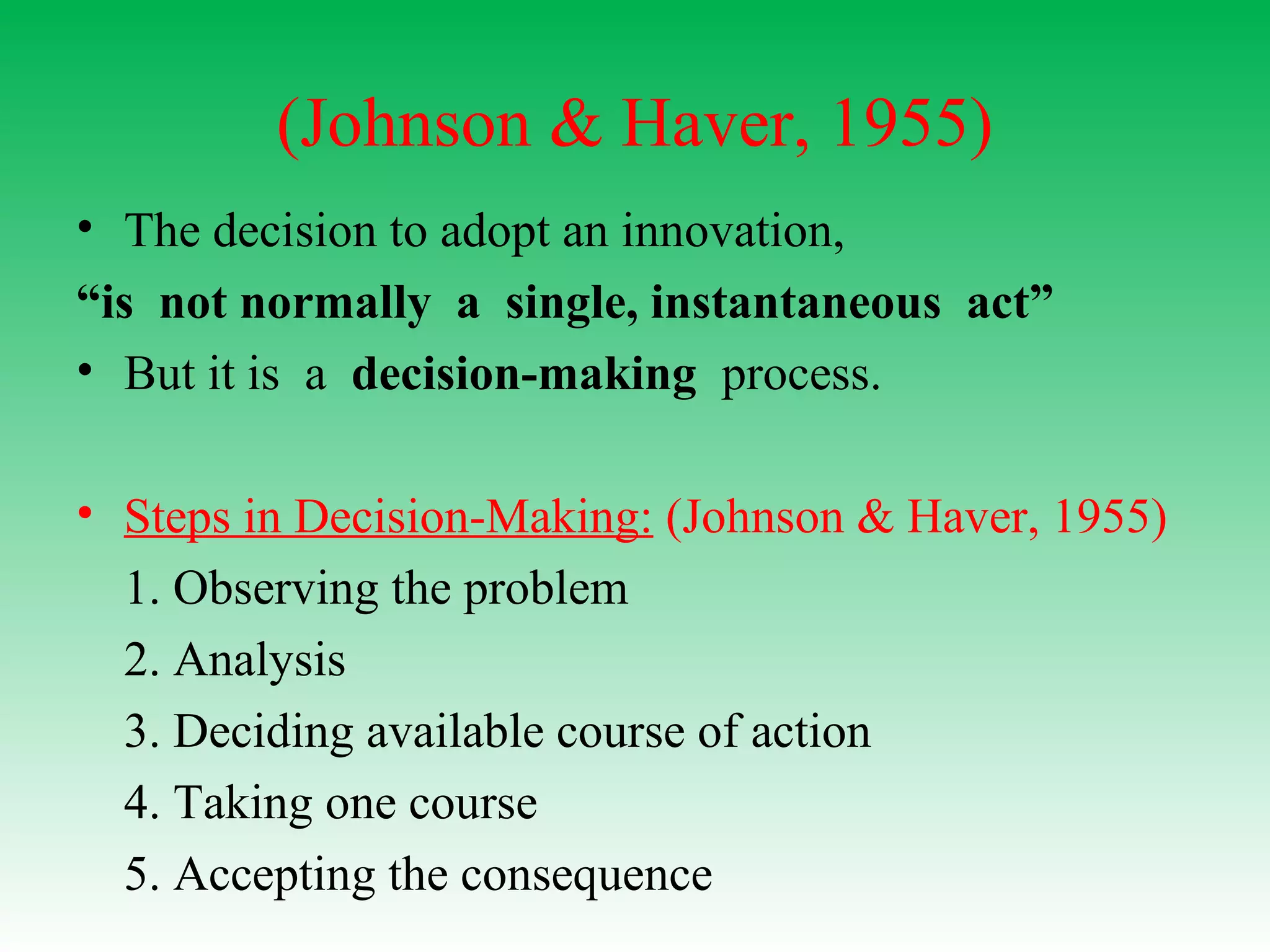
(Johnson & Haver, 1955)
• The decision to adopt an innovation,
“is not normally a single, instantaneous act”
• But it is a decision-making process.
• Steps in Decision-Making: (Johnson & Haver, 1955)
1. Observing the problem
2. Analysis
3. Deciding available course of action
4. Taking one course
5. Accepting the consequence
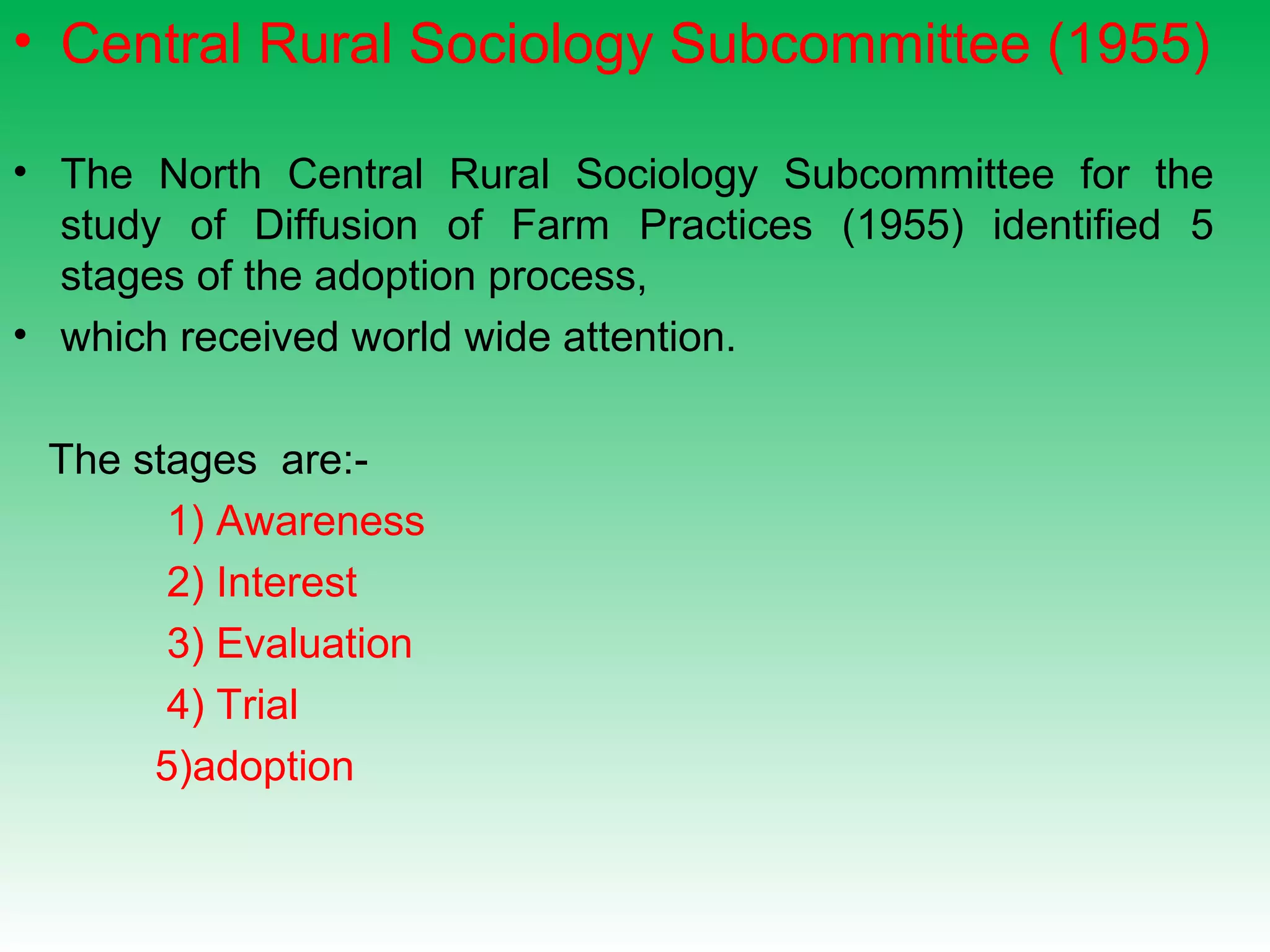
• Central Rural Sociology Subcommittee (1955)
• The North Central Rural Sociology Subcommittee for the
study of Diffusion of Farm Practices (1955) identified 5
stages of the adoption process,
• which received world wide attention.
The stages are:-
1) Awareness
2) Interest
3) Evaluation
4) Trial
5)adoption
STAGES OF ADOPTION PROCESS
The Stages in the Adoption Process
NAME OF
STAGE
WHAT HAPPENS
DURING THIS STAGE
EXAMPLE
Awareness
farmer is first exposed to
the product innovation.
Farmer sees an ad for a new hybrid variety
in the newspaper, radio or television
Interest
Farmers is interested in
the variety and searches
for additional
information.
Farmer more reads about the hybrid
variety on the news paper and other
sources , then goes to a agro center near
his farm and meet salesman
Evaluation
Farmer decides whether
or not to believe that this
product or service will
satisfy the need--a kind
of “mental trial.”
After talking with a knowledgeable
friend, relatives ,neighbor farmer decides
that his variety should be able to provide
yield than present one and is it suitable
for its condition or not with socio-
economical aspects
Table 15.11 The Stages in the Adoption
Process
Trial
Farmers uses the product
on a limited basis
Farmer take a small sample and grow on
small scale in field .
Adoption
(Rejection)
If trial is favorable,
farmer decides to use the
variety on a full, rather
than a limited basis--if
unfavorable, the farmer
decides o reject it.
Farmer finds that the hybrid variety is
high yielding and give good yield than
present one so the results are excellent;
consequently, he grow hybrid variety on
large scale in his field
NAME OF
STAGE
WHAT HAPPENS
DURING THIS STAGE
EXAMPLE
Awareness
• The farmer comes to know the existence of the
new idea but he doesn’t have full information
about the idea.
• At this stage farmer is aware of the idea, but lacks
detailed information about it.
• E.g. The farmers may know about hybrid variety by
the name but may not know what it is, detail
knowledge of it and how it give better yield ,
Interest
• The farmer develops interest in the innovation
• Seeks additional information
• Extension officer or from fellow farmers or from
any source, which he feels credible.
• Acquires more information on innovation
• Farmer wants to know
what the innovation is ?
how it works ?
what are its potentialities ?
Evaluation
• Mental application of the new idea in the present
and anticipated future situations
• Decides whether or not to try it.
• Judges the utility of the innovation.
• Assessment, whether the idea is applicable to own
situation.
• If applied what would be the result.
Trial
• Farmers may not take up any new idea at first
instance at large scale because doesn’t want to take
risk
• Farmer applies the new idea on a small scale
• Determine its utility or feasibility & applicability
• Practical evaluation of an innovation.
Adoption
• If satisfied with the performance of the new idea
• Uses the new idea continuously on a full scale.
• Innovation becomes a part of normal farming activity.
• The farmer takes final decision and applies the
innovation in a scale appropriate to own situation on
a continued basis.
Limitation of model
• These five stages are not necessarily a rigid pattern
which people follow.
• These stages are influenced by cultural differences and
social factors as well as by the kind of practice, place
and person.
• At any stage the recommendation can be thrown off.
• There can be jumping from one stage to another.
• If the farmers have confidence in the extension worker,
and his recommendations, they may jump form
“evaluation” to “adoption” stage.
Other model of adoption stages
• The stages of adoption are dynamic and not static.
(Singh, 1965)
• The five stages do not occur with all the adopters
• All the practices sequence is not always the same
• Some times one stage appears more than once
• In some cases some stages are short
• Some stages seem to be skipped
• May jump from evaluation to adoption stage
• No clear-cut differences: capsules and looks like a
unit act.
SING H & PAREEK (1965)
SEVEN STAAGE MODEL OF ADOPTION
PROCESS
1. Need
2. Awareness
3. Interest
4. Deliberation
5. Trial
6. Evaluation and
7. Adoption.
• NEED:
Difference between what is and what ought to be.
Farmer wishes to change his existing practice or to get
more yield/income.
• AWARENESS:
Farmer just comes to know about an innovation
without knowing the details of it.
• INTEREST:
Farmer makes an attempt to know more about the
innovation.
• DELIBERATION:
Possibility of application of the innovation under
own conditions.
Seeks advice of opinion leaders observe the
performance at different places and discusses with the
members of family.
Farmer then takes a decision to try out or reject the
idea.
• TRIAL:
Puts the practice on a limited scale to observe the
performance under own conditions.
• EVALUATION:
Farmer observes performance of the innovation on
various dimensions.
Collects data on the performance of the
innovation on others situation.
Compares performance of new with old one
Calculates input – output, risks, uncertainties etc.
• ADOPTION:
Farmer takes the decision to extend the use of
the innovation on a continued basis.
2 adoption process

2 adoption process

  • 1.
    Adoption of Innovationand its model • Present by: • SONDARVA YAGNESH M • M.Sc. Agriculture (Agril .Extension) • Department of agricultural extension • BACA, AAU ,ANAND
  • 2.
    Adoption • Adoption Decision tomake full use of an innovation as the best course of action available. • Adoption process (Micro process) Decision making process, goes through a number of mental stages before making a final decision to adopt an innovation.
  • 3.
  • 4.
    Ryan and Gross(1943) • Pioneering work of diffusion of hybrid corn seed in two Iowa communities in the United States • Ryan and Gross (1943) Stages in the process of adoption 1. “awareness” of the existence of an innovation 2. “conviction” of usefulness 3. “acceptance” sense of willingness to try the innovation 4. “complete adoption”. full scale use
  • 5.
    Wilkening (1953) • Adoptionof innovation as a process composed of learning, deciding and acting over a period of time. • The adoption of a specific practice is not the result of a single decision to act but series of action and thought decision. Four stages in adoption 1. Obtaining information 2. Conviction 3. Trial 4. Adoption.
  • 6.
    (Johnson & Haver,1955) • The decision to adopt an innovation, “is not normally a single, instantaneous act” • But it is a decision-making process. • Steps in Decision-Making: (Johnson & Haver, 1955) 1. Observing the problem 2. Analysis 3. Deciding available course of action 4. Taking one course 5. Accepting the consequence
  • 7.
    • Central RuralSociology Subcommittee (1955) • The North Central Rural Sociology Subcommittee for the study of Diffusion of Farm Practices (1955) identified 5 stages of the adoption process, • which received world wide attention. The stages are:- 1) Awareness 2) Interest 3) Evaluation 4) Trial 5)adoption
  • 8.
  • 9.
    The Stages inthe Adoption Process NAME OF STAGE WHAT HAPPENS DURING THIS STAGE EXAMPLE Awareness farmer is first exposed to the product innovation. Farmer sees an ad for a new hybrid variety in the newspaper, radio or television Interest Farmers is interested in the variety and searches for additional information. Farmer more reads about the hybrid variety on the news paper and other sources , then goes to a agro center near his farm and meet salesman Evaluation Farmer decides whether or not to believe that this product or service will satisfy the need--a kind of “mental trial.” After talking with a knowledgeable friend, relatives ,neighbor farmer decides that his variety should be able to provide yield than present one and is it suitable for its condition or not with socio- economical aspects
  • 10.
    Table 15.11 TheStages in the Adoption Process Trial Farmers uses the product on a limited basis Farmer take a small sample and grow on small scale in field . Adoption (Rejection) If trial is favorable, farmer decides to use the variety on a full, rather than a limited basis--if unfavorable, the farmer decides o reject it. Farmer finds that the hybrid variety is high yielding and give good yield than present one so the results are excellent; consequently, he grow hybrid variety on large scale in his field NAME OF STAGE WHAT HAPPENS DURING THIS STAGE EXAMPLE
  • 11.
    Awareness • The farmercomes to know the existence of the new idea but he doesn’t have full information about the idea. • At this stage farmer is aware of the idea, but lacks detailed information about it. • E.g. The farmers may know about hybrid variety by the name but may not know what it is, detail knowledge of it and how it give better yield ,
  • 12.
    Interest • The farmerdevelops interest in the innovation • Seeks additional information • Extension officer or from fellow farmers or from any source, which he feels credible. • Acquires more information on innovation • Farmer wants to know what the innovation is ? how it works ? what are its potentialities ?
  • 13.
    Evaluation • Mental applicationof the new idea in the present and anticipated future situations • Decides whether or not to try it. • Judges the utility of the innovation. • Assessment, whether the idea is applicable to own situation. • If applied what would be the result.
  • 14.
    Trial • Farmers maynot take up any new idea at first instance at large scale because doesn’t want to take risk • Farmer applies the new idea on a small scale • Determine its utility or feasibility & applicability • Practical evaluation of an innovation.
  • 15.
    Adoption • If satisfiedwith the performance of the new idea • Uses the new idea continuously on a full scale. • Innovation becomes a part of normal farming activity. • The farmer takes final decision and applies the innovation in a scale appropriate to own situation on a continued basis.
  • 16.
    Limitation of model •These five stages are not necessarily a rigid pattern which people follow. • These stages are influenced by cultural differences and social factors as well as by the kind of practice, place and person. • At any stage the recommendation can be thrown off. • There can be jumping from one stage to another. • If the farmers have confidence in the extension worker, and his recommendations, they may jump form “evaluation” to “adoption” stage.
  • 17.
    Other model ofadoption stages • The stages of adoption are dynamic and not static. (Singh, 1965) • The five stages do not occur with all the adopters • All the practices sequence is not always the same • Some times one stage appears more than once • In some cases some stages are short • Some stages seem to be skipped • May jump from evaluation to adoption stage • No clear-cut differences: capsules and looks like a unit act.
  • 18.
    SING H &PAREEK (1965) SEVEN STAAGE MODEL OF ADOPTION PROCESS 1. Need 2. Awareness 3. Interest 4. Deliberation 5. Trial 6. Evaluation and 7. Adoption.
  • 19.
    • NEED: Difference betweenwhat is and what ought to be. Farmer wishes to change his existing practice or to get more yield/income. • AWARENESS: Farmer just comes to know about an innovation without knowing the details of it. • INTEREST: Farmer makes an attempt to know more about the innovation.
  • 20.
    • DELIBERATION: Possibility ofapplication of the innovation under own conditions. Seeks advice of opinion leaders observe the performance at different places and discusses with the members of family. Farmer then takes a decision to try out or reject the idea. • TRIAL: Puts the practice on a limited scale to observe the performance under own conditions.
  • 21.
    • EVALUATION: Farmer observesperformance of the innovation on various dimensions. Collects data on the performance of the innovation on others situation. Compares performance of new with old one Calculates input – output, risks, uncertainties etc. • ADOPTION: Farmer takes the decision to extend the use of the innovation on a continued basis.