
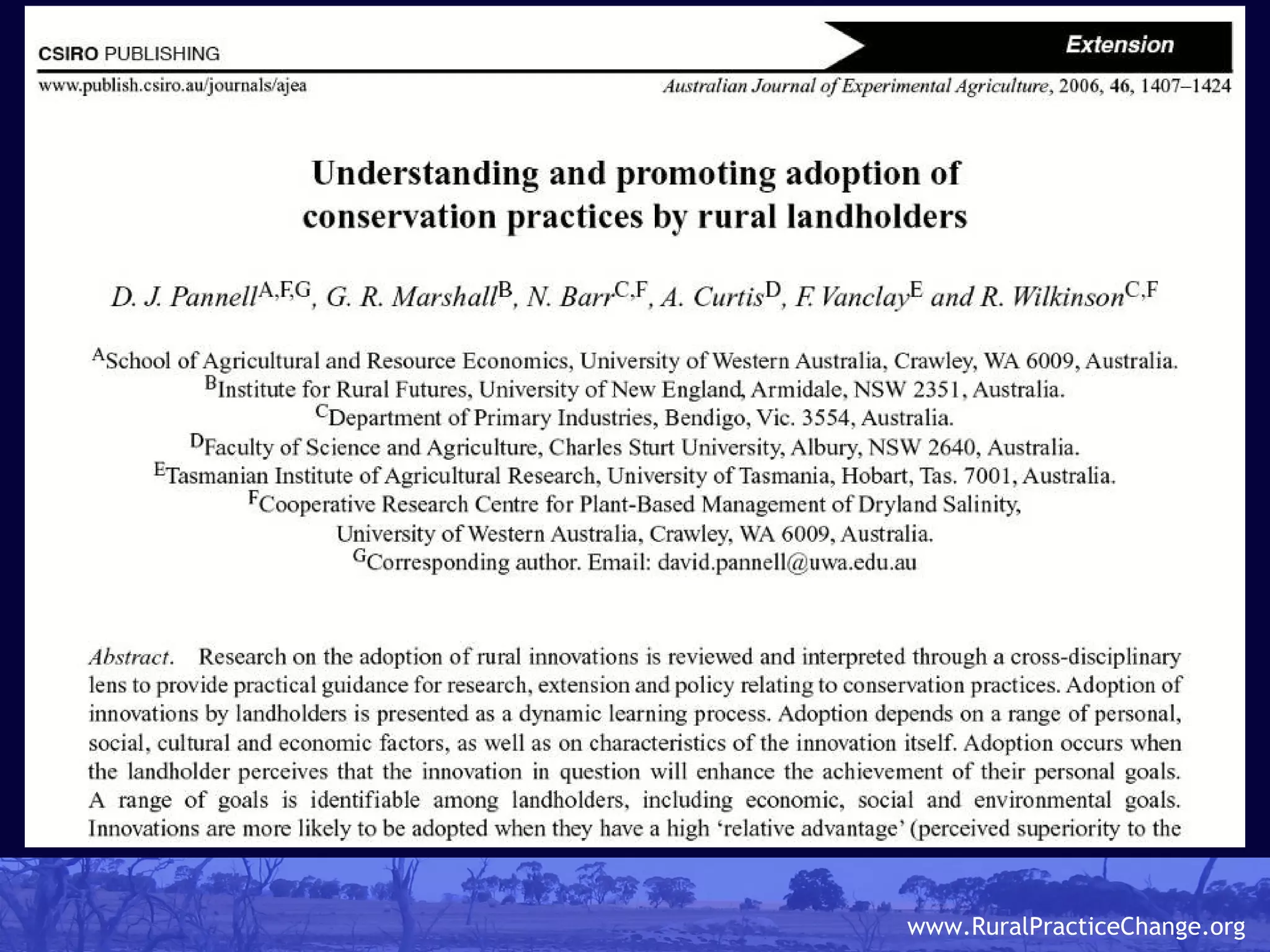

Understanding Practice Change by Rural Landholders David Pannell ARC Federation Fellow School of Agricultural and Resource Economics University of Western Australia
 
Key points Practice change depends on: The human dimension (learning, social processes, goals, perceptions, …) The technologies (relative advantage, trialability) Each practice has its own unique adoption story For policy, extension and research, it pays to anticipate adoptability
The human dimension The innovative practice 
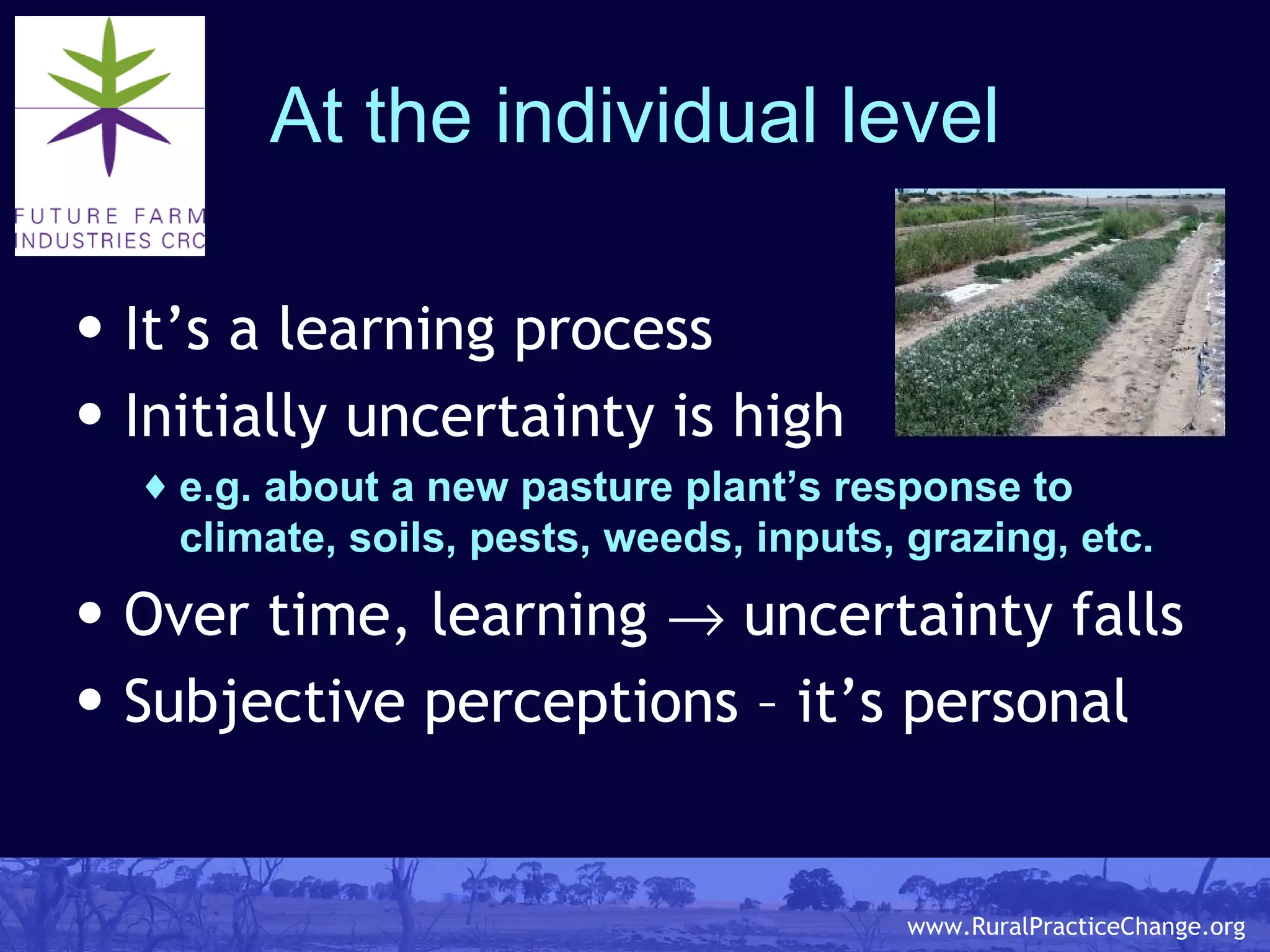
At the individual level It’s a learning process Initially uncertainty is high e.g. about a new pasture plant’s response to climate, soils, pests, weeds, inputs, grazing, etc. Over time, learning    uncertainty falls Subjective perceptions – it’s personal
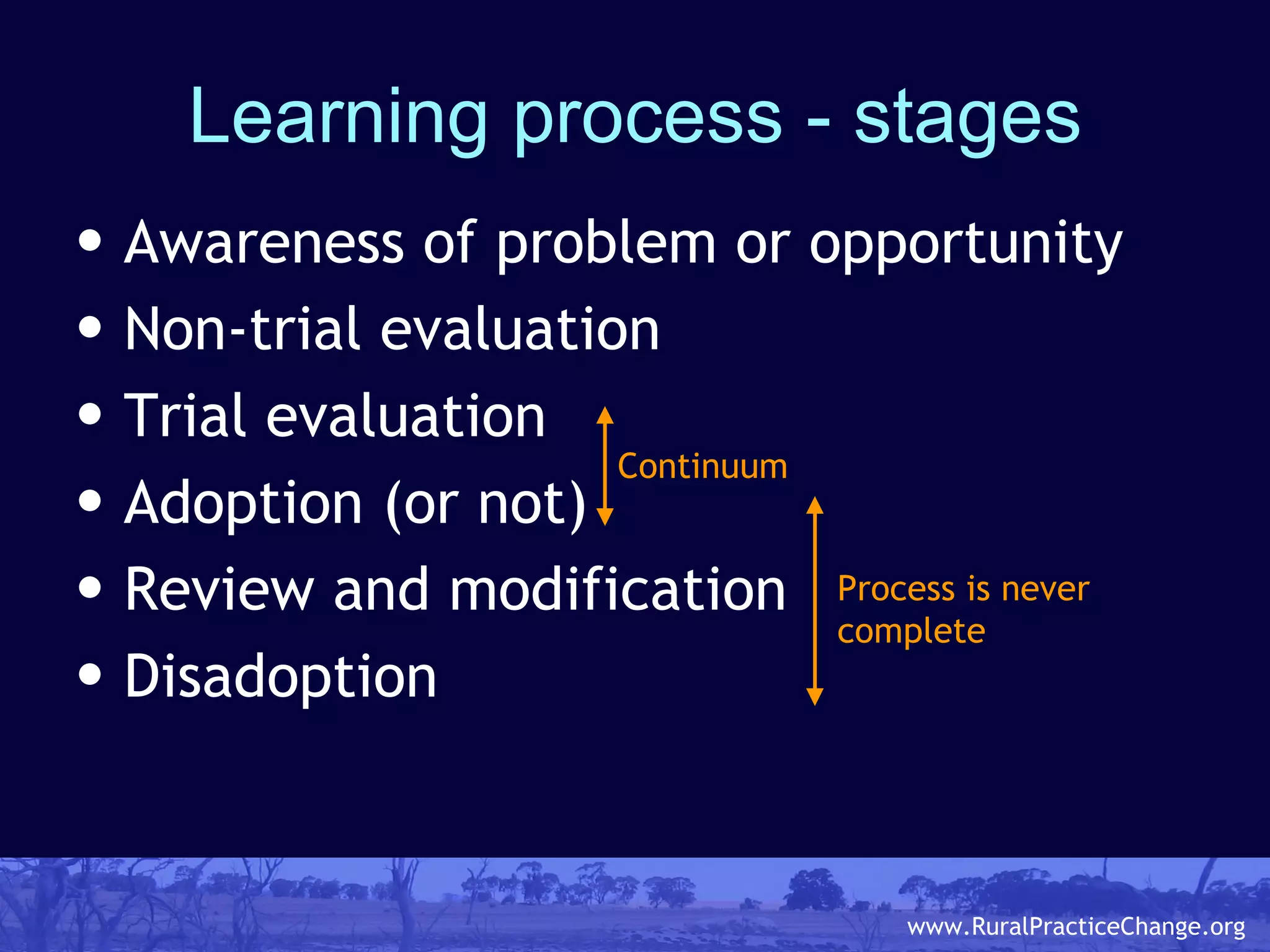
Learning process - stages Awareness of problem or opportunity Non-trial evaluation Trial evaluation Adoption (or not) Review and modification Disadoption Continuum Process is never  complete
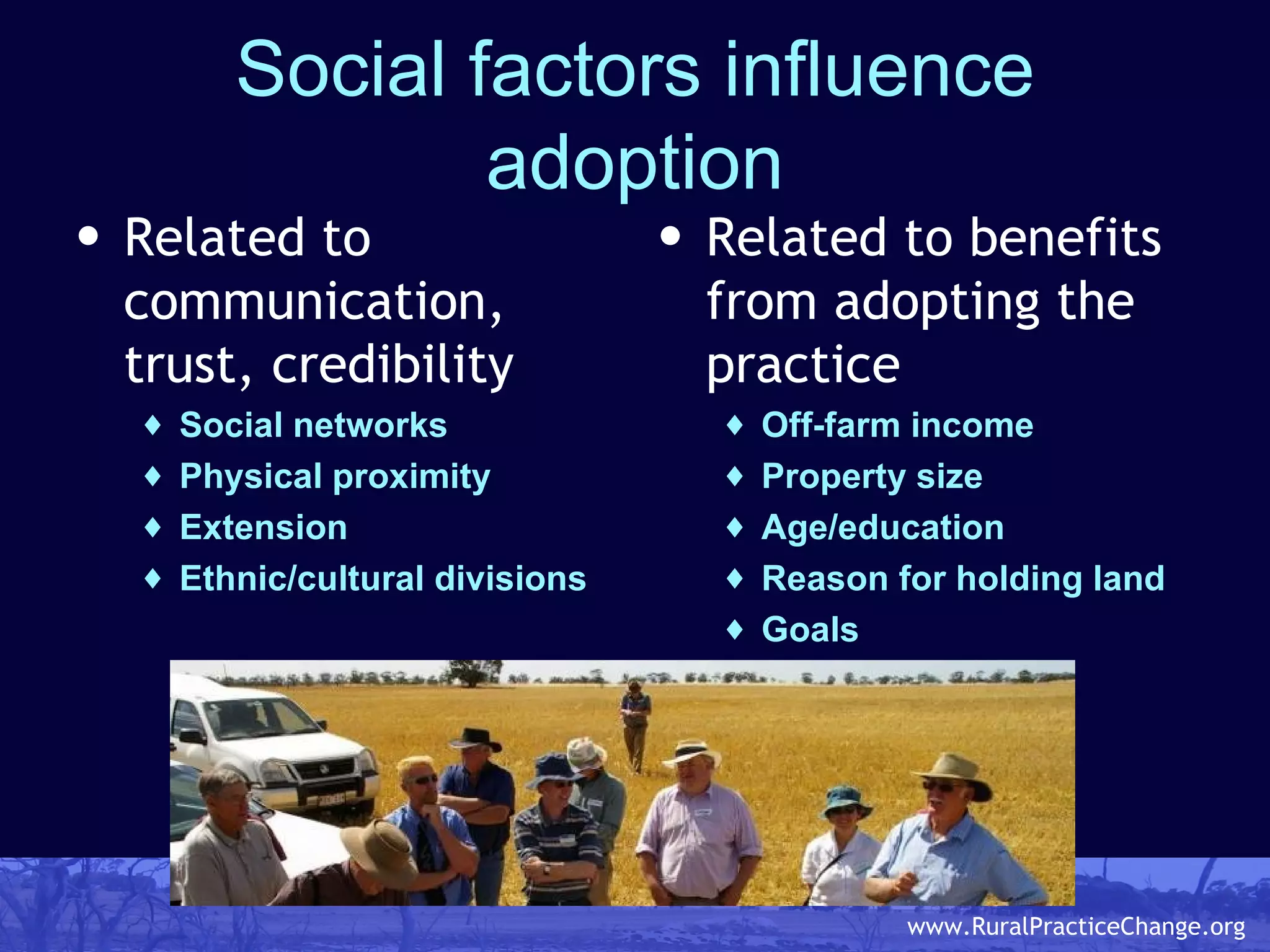
Social factors influence adoption Related to communication, trust, credibility Social networks Physical proximity Extension Ethnic/cultural divisions Related to benefits from adopting the practice Off-farm income Property size Age/education Reason for holding land Goals
A variety of goals (i)  material wealth & financial security (ii)  environmental protection and enhancement (iii) social approval and acceptance (iv) personal integrity, ethics (v)  balance of work and lifestyle
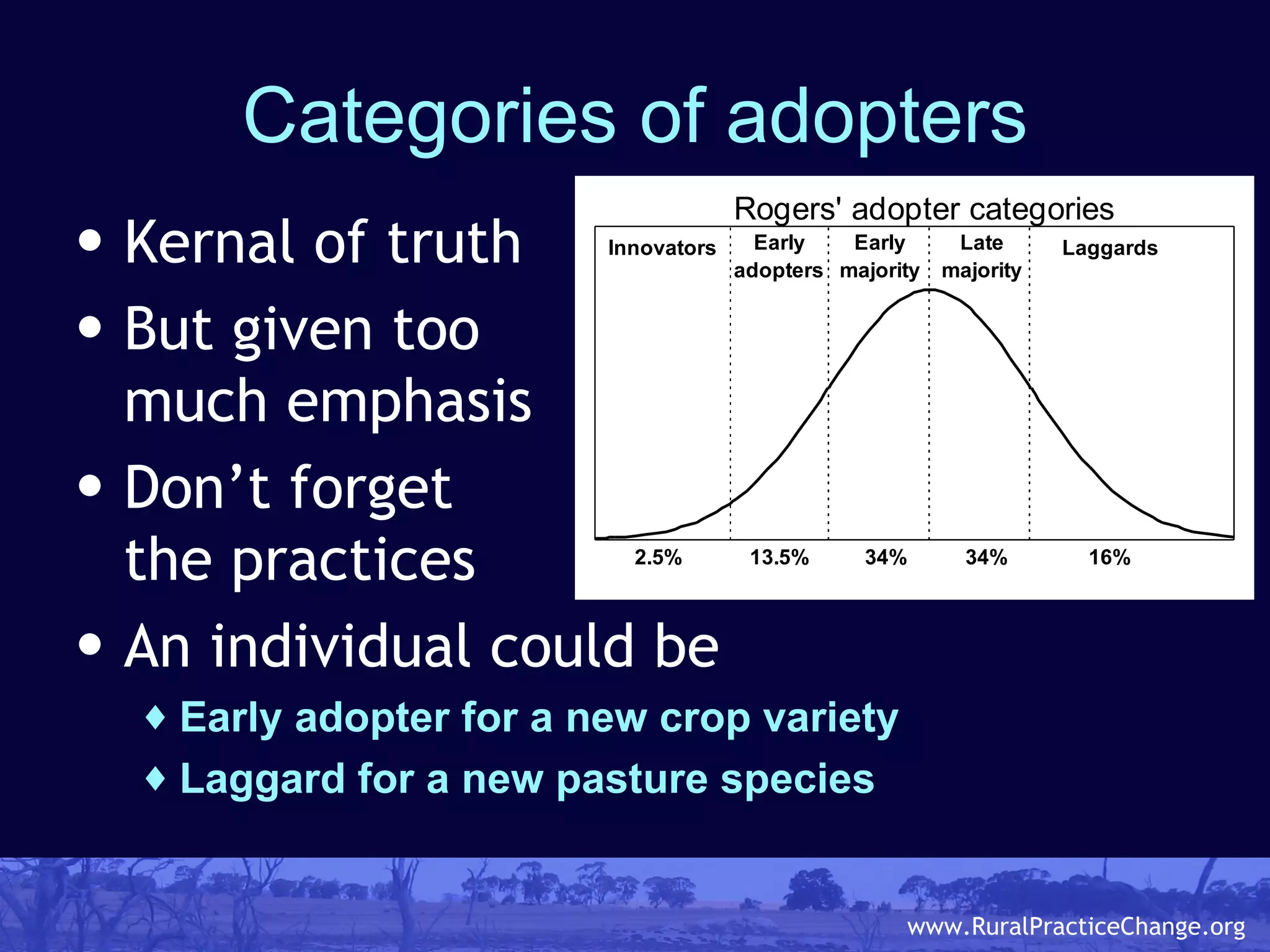
Categories of adopters Kernal of truth But given too much emphasis Don’t forget  the practices An individual could be Early adopter for a new crop variety Laggard for a new pasture species
The human dimension The innovative practice 
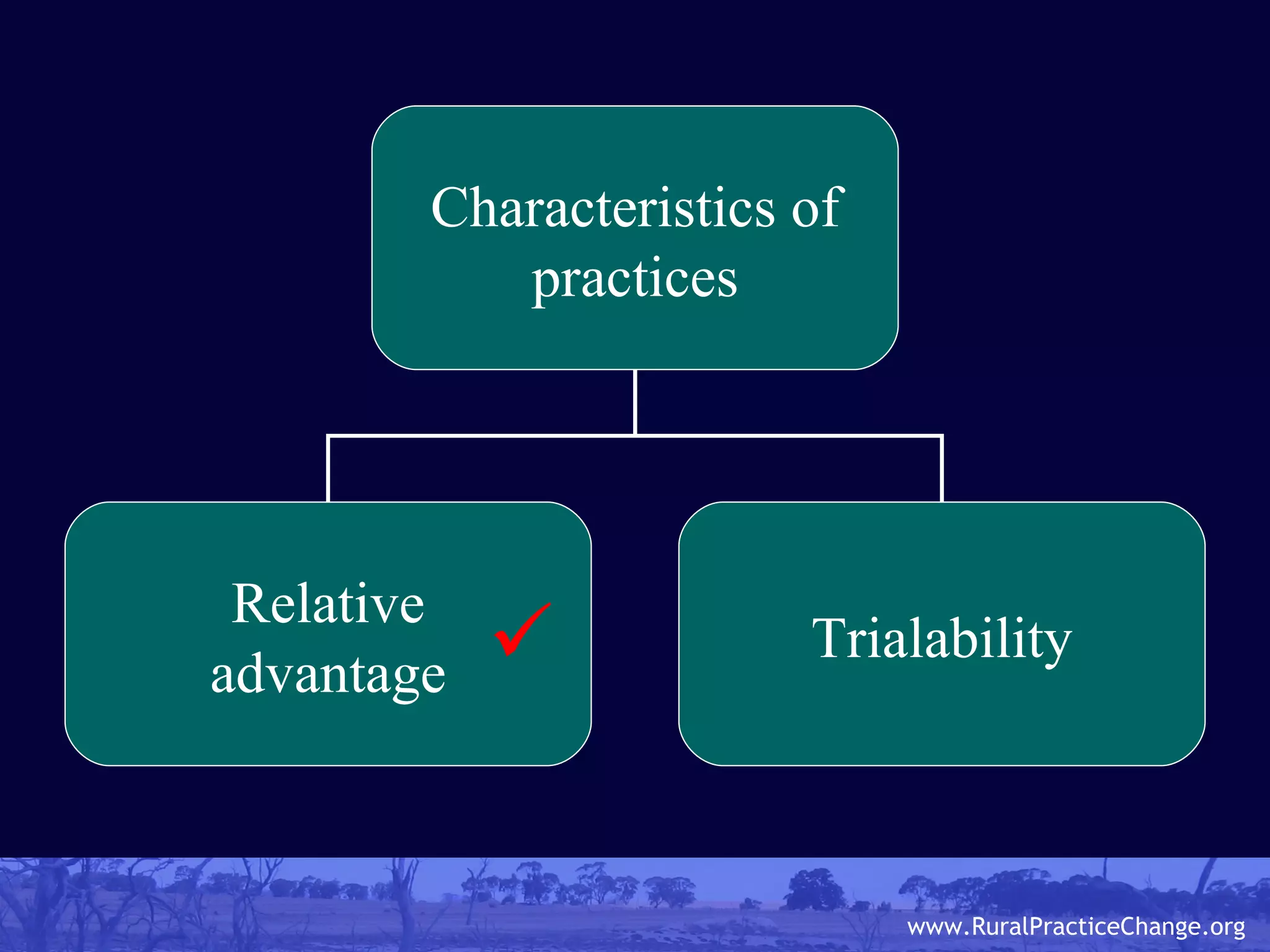
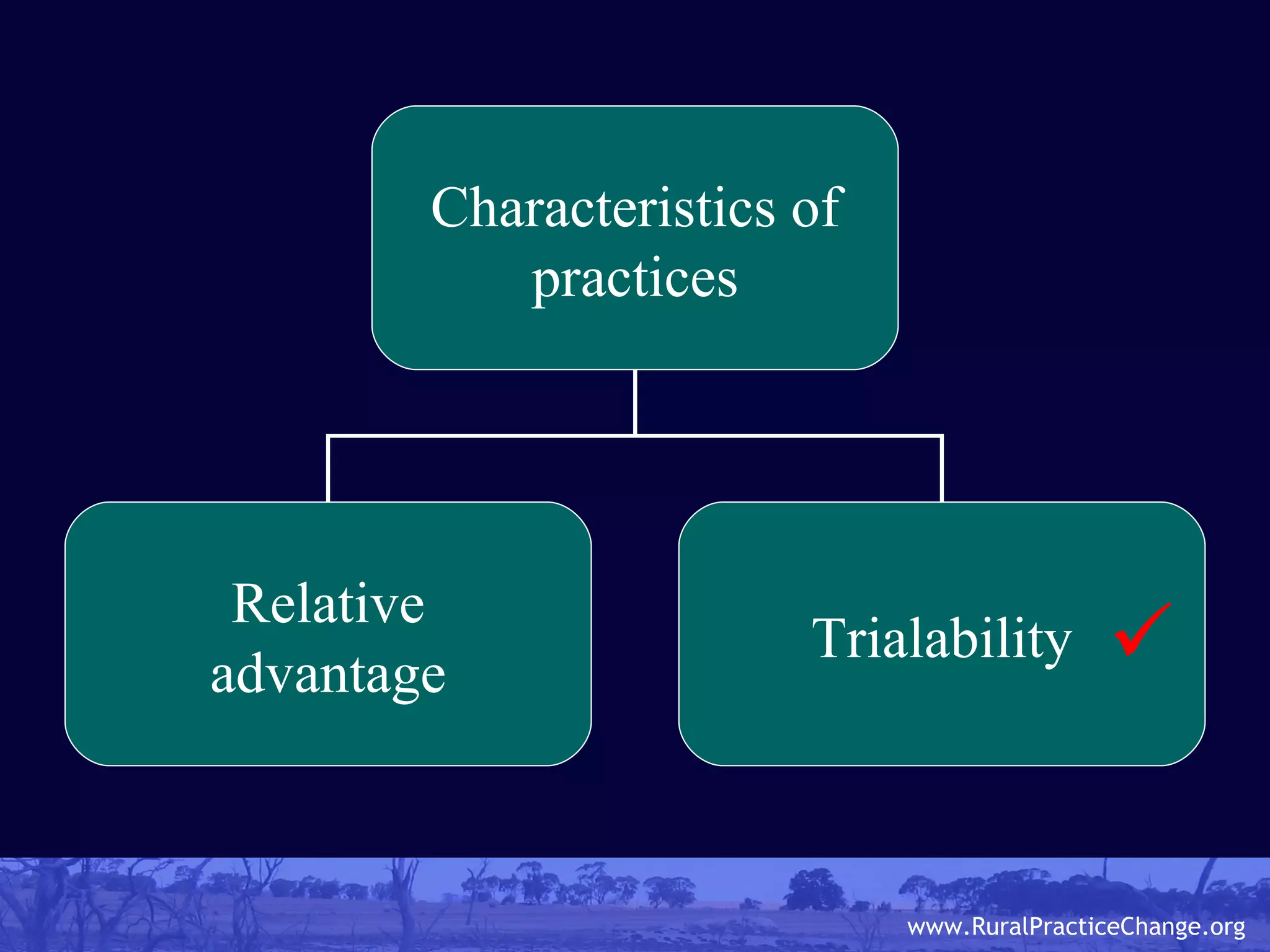
 Characteristics of practices Relative advantage Trialability
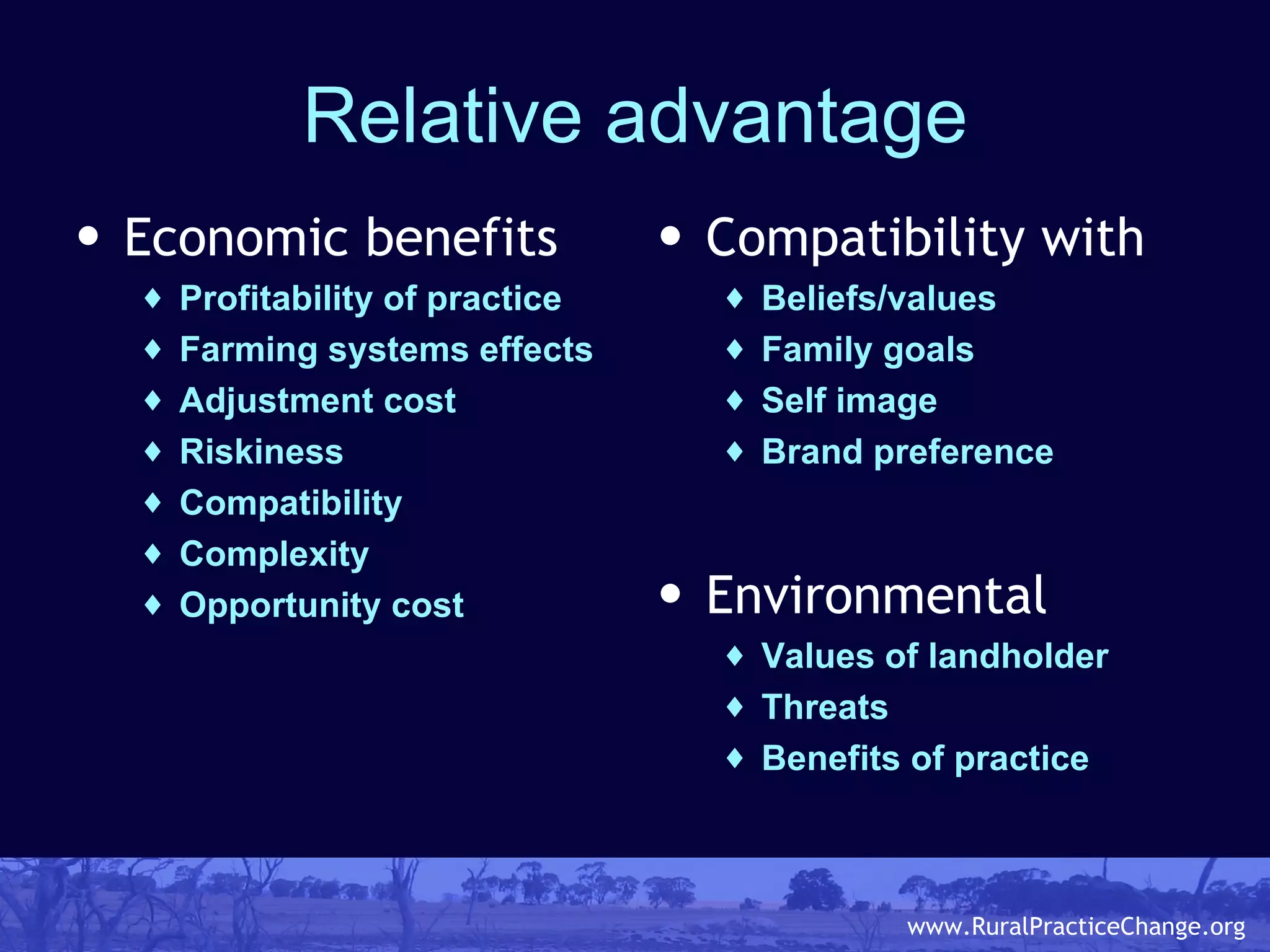
Relative advantage Economic benefits Profitability of practice Farming systems effects Adjustment cost Riskiness Compatibility Complexity Opportunity cost Compatibility with  Beliefs/values Family goals Self image Brand preference Environmental  Values of landholder Threats Benefits of practice
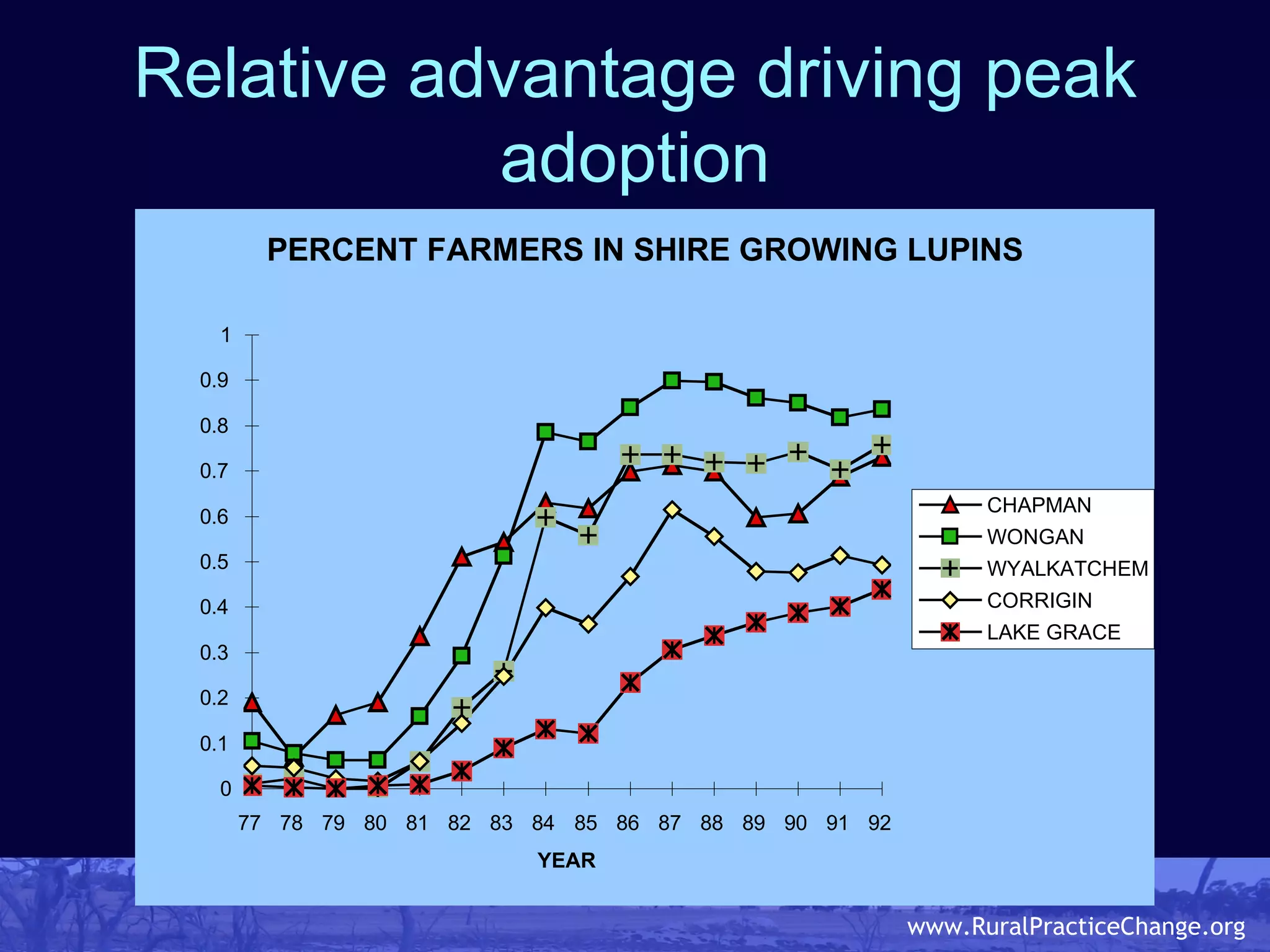
Relative advantage driving peak adoption
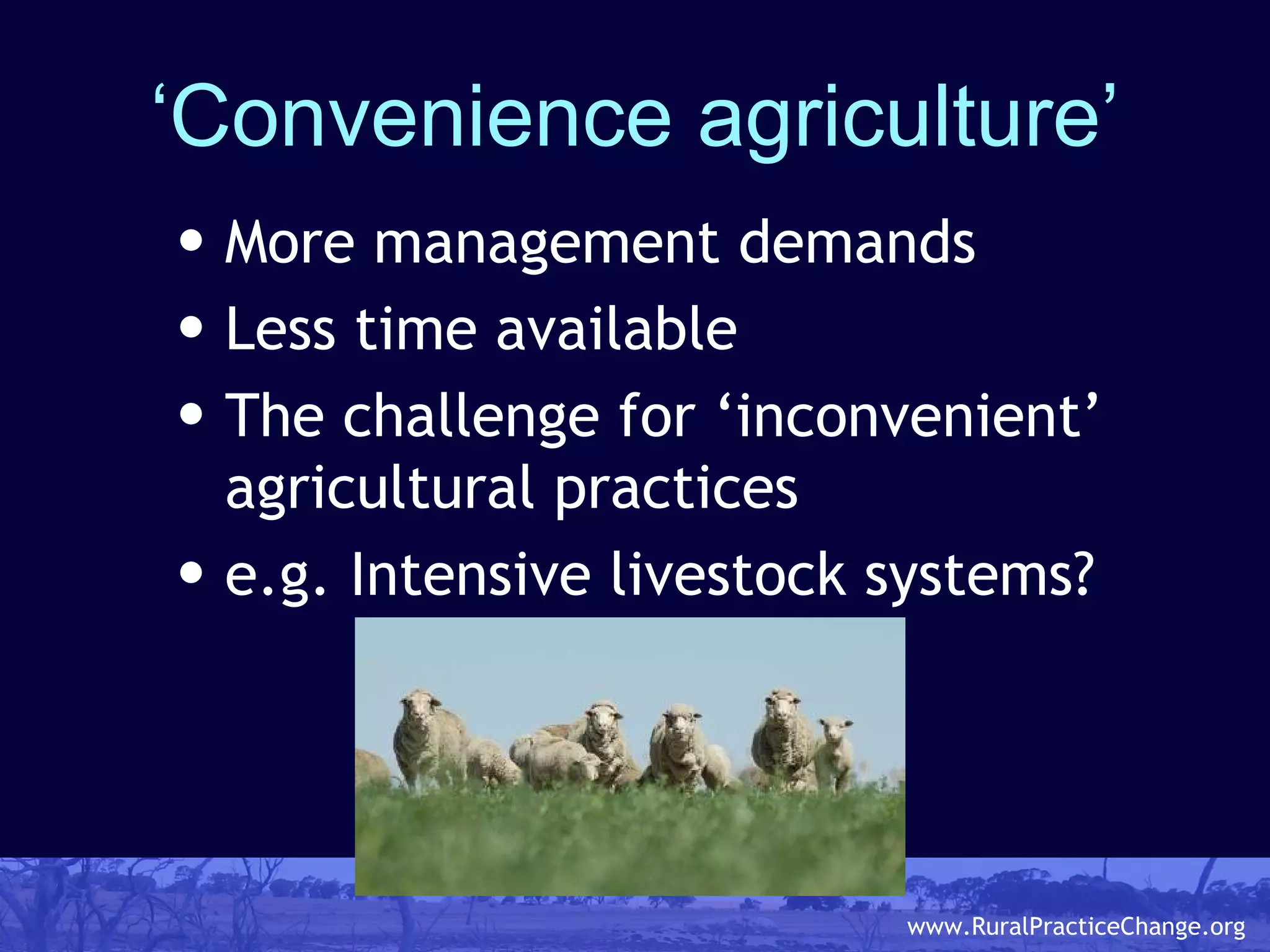
‘ Convenience agriculture’ More management demands Less time available The challenge for ‘inconvenient’ agricultural practices e.g. Intensive livestock systems?
 Characteristics of practices Relative advantage Trialability
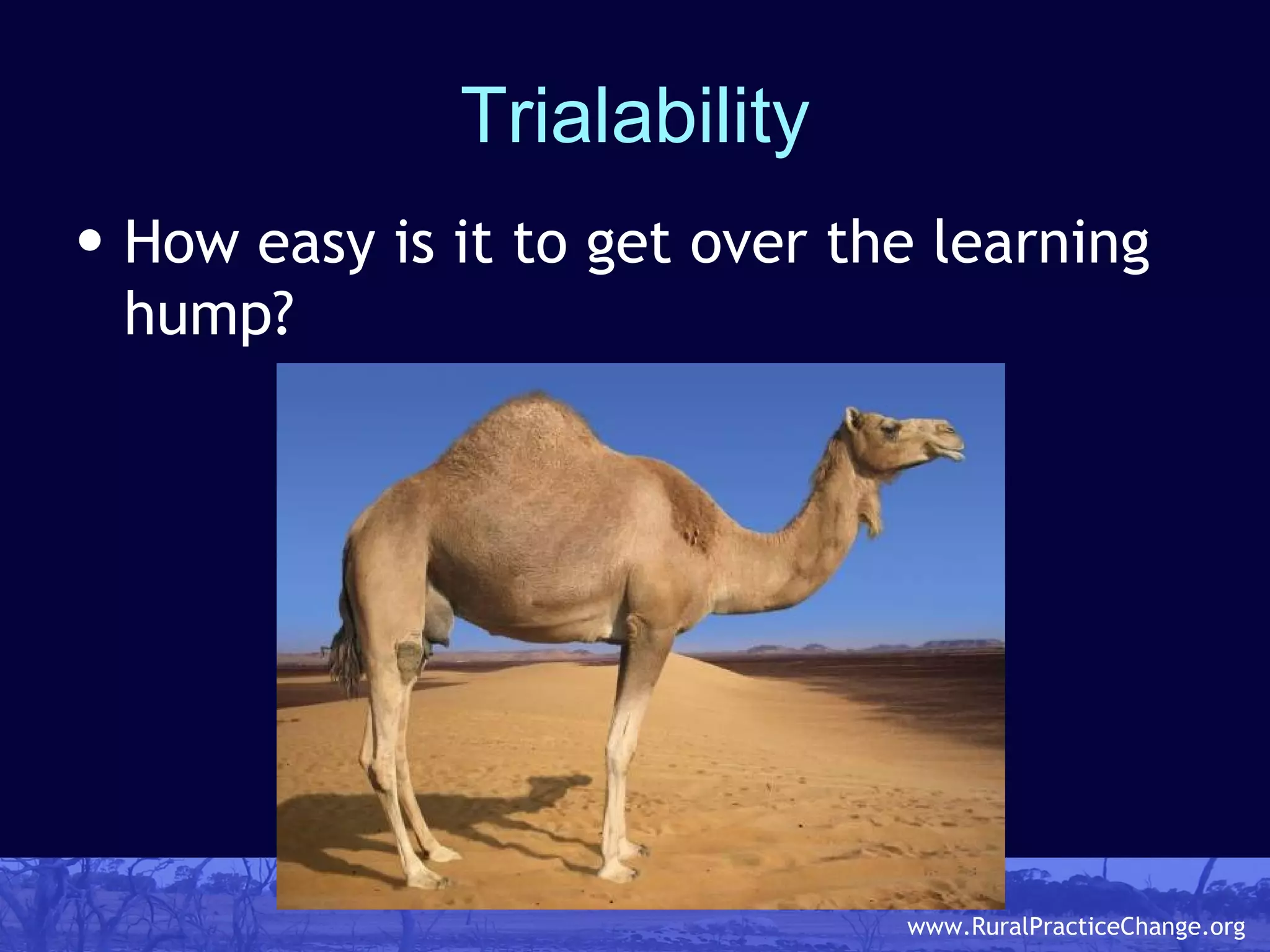
Trialability How easy is it to get over the learning hump?
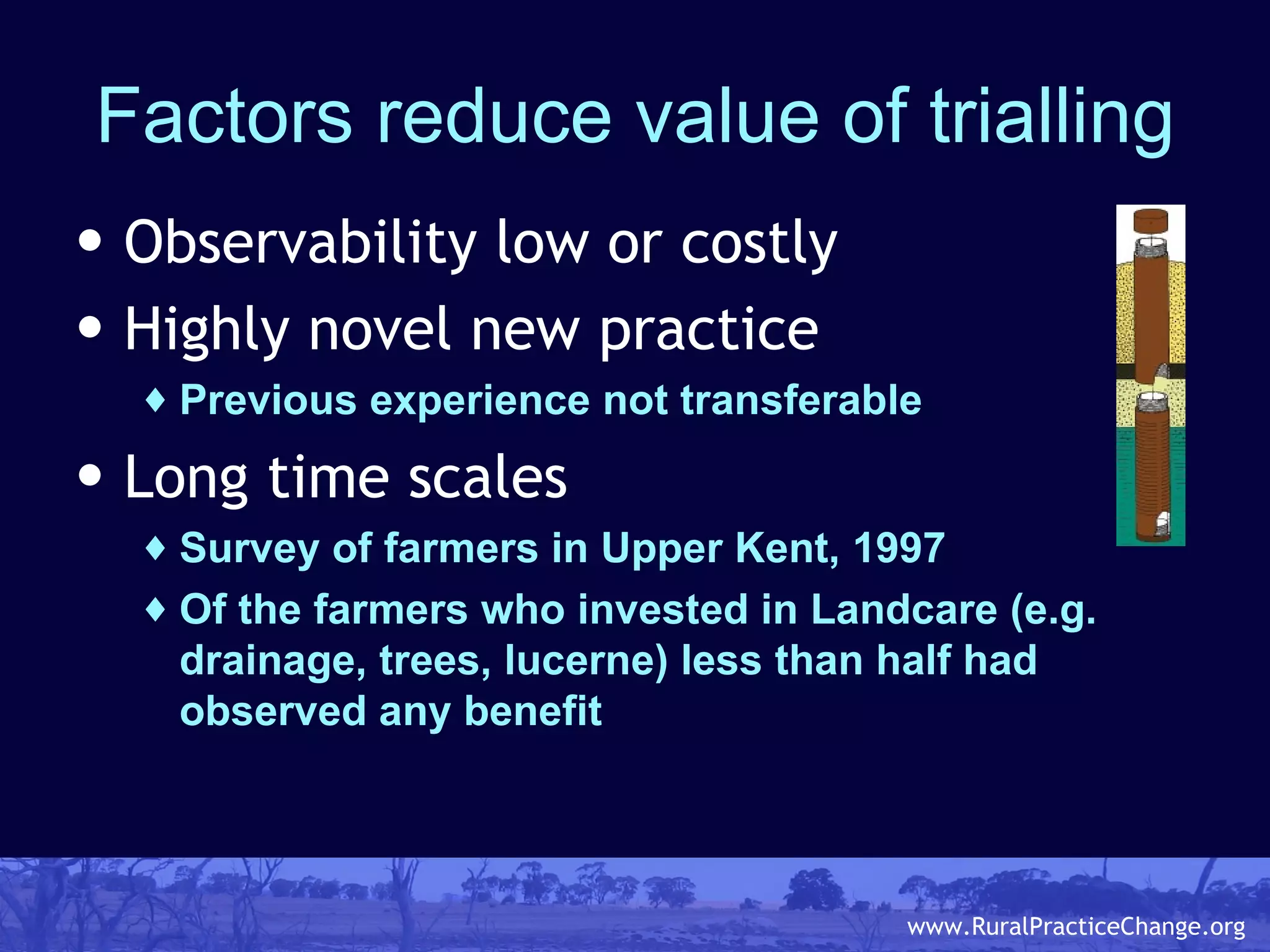
Factors reduce value of trialling Observability low or costly Highly novel new practice Previous experience not transferable Long time scales Survey of farmers in Upper Kent, 1997 Of the farmers who invested in Landcare (e.g. drainage, trees, lucerne) less than half had observed any benefit
Each practice has its own adoption story Influential factors Time frame Groups of adopters and non-adopters
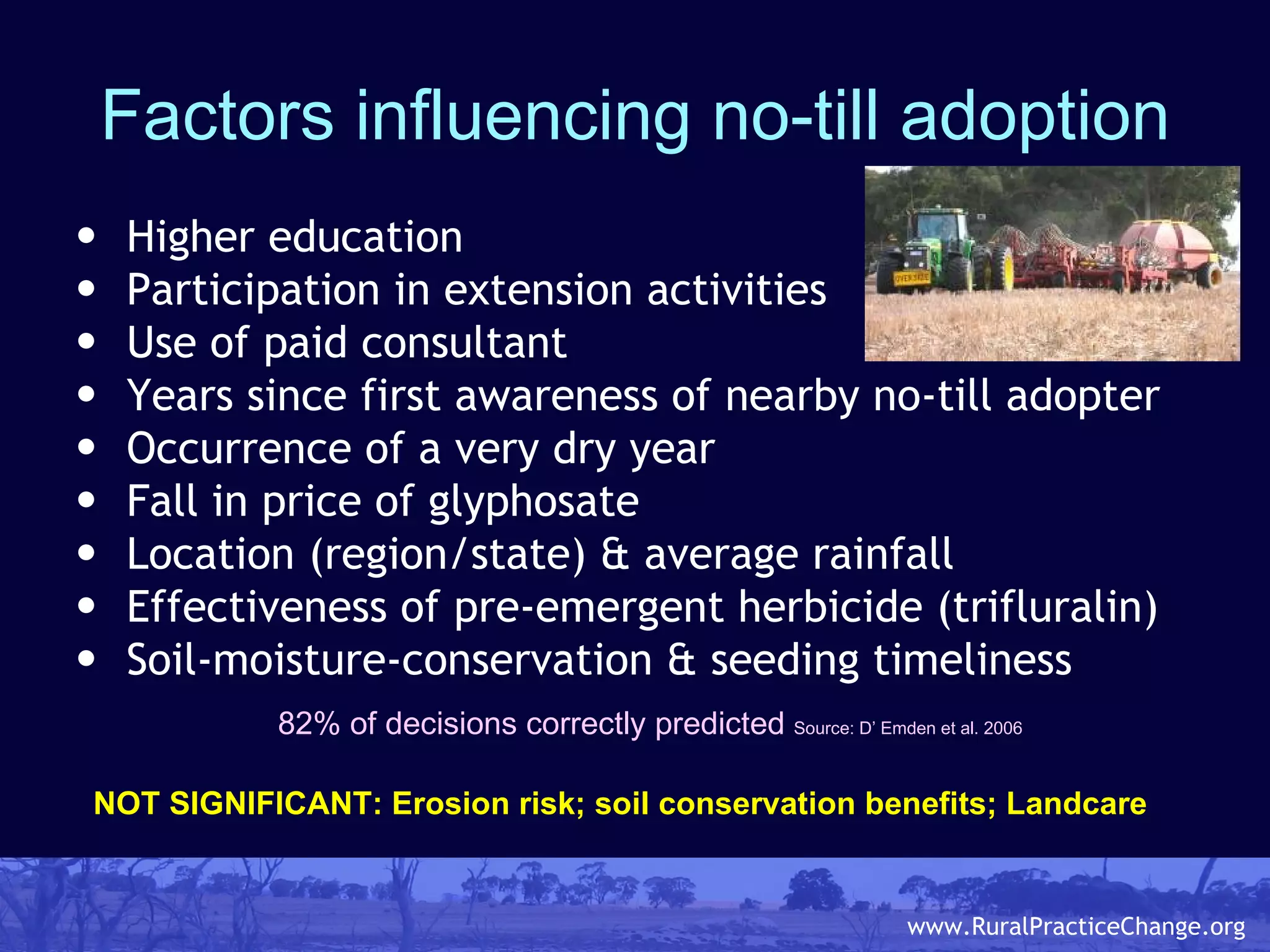
Factors influencing no-till adoption Higher education Participation in extension activities  Use of paid consultant Years since first awareness of nearby no-till adopter  Occurrence of a very dry year Fall in price of glyphosate Location (region/state) & average rainfall Effectiveness of pre-emergent herbicide (trifluralin) Soil-moisture-conservation & seeding timeliness  NOT SIGNIFICANT: Erosion risk; soil conservation benefits; Landcare 82% of decisions correctly predicted  Source: D’ Emden et al. 2006
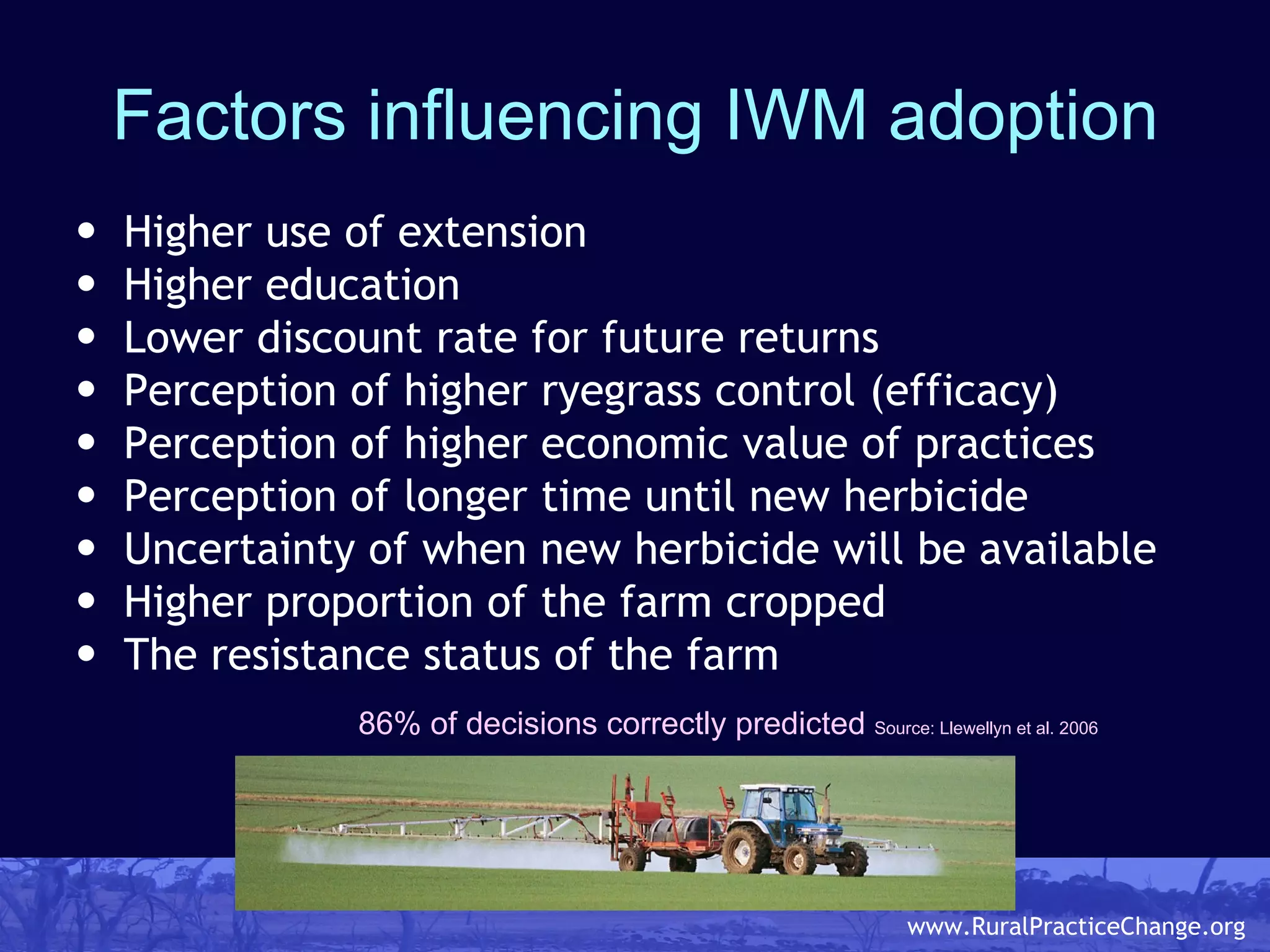
Factors influencing IWM adoption Higher use of extension Higher education  Lower discount rate for future returns  Perception of higher ryegrass control (efficacy)  Perception of higher economic value of practices Perception of longer time until new herbicide Uncertainty of when new herbicide will be available Higher proportion of the farm cropped  The resistance status of the farm   86% of decisions correctly predicted  Source: Llewellyn et al. 2006
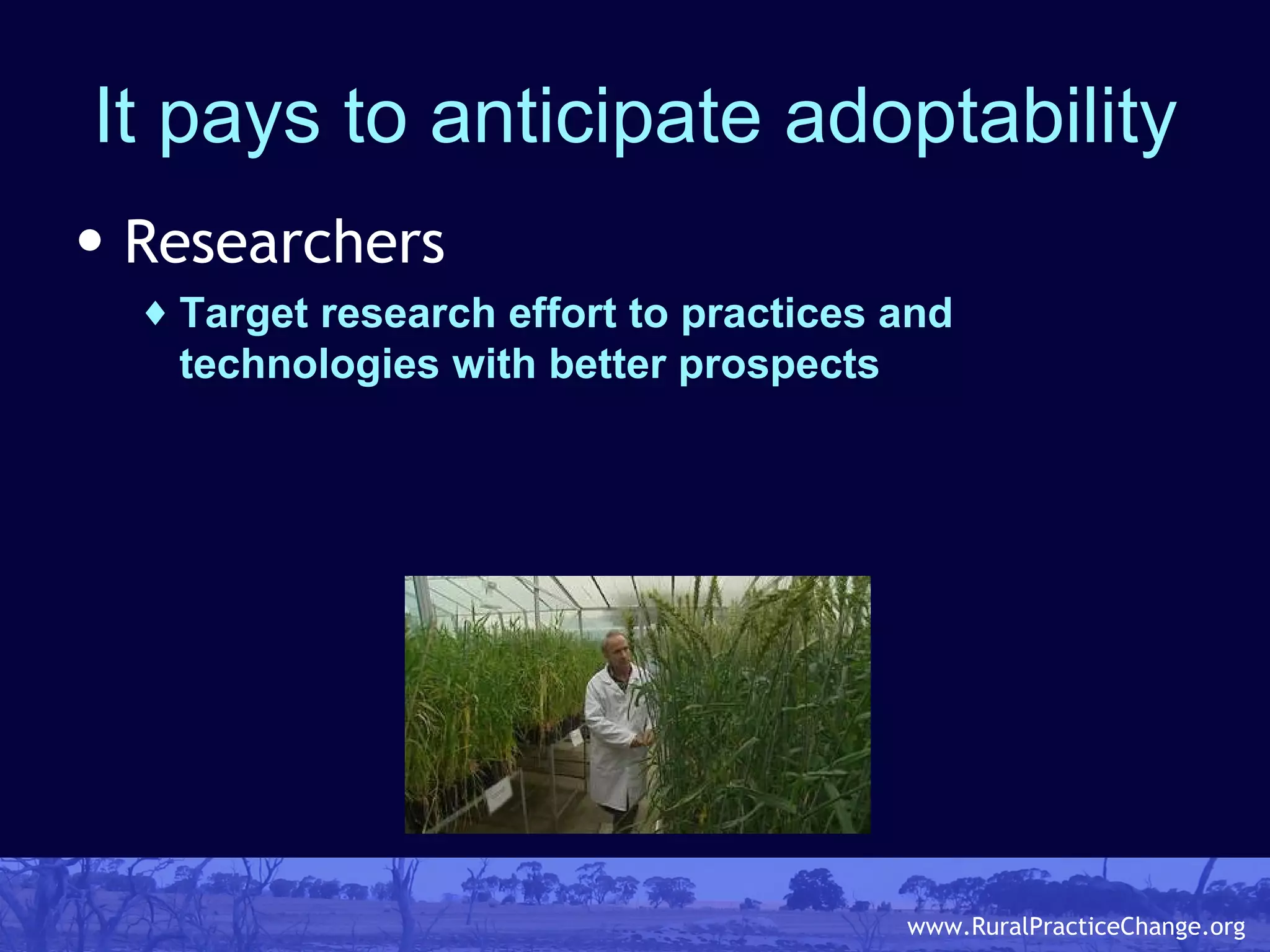
It pays to anticipate adoptability Researchers Target research effort to practices and technologies with better prospects
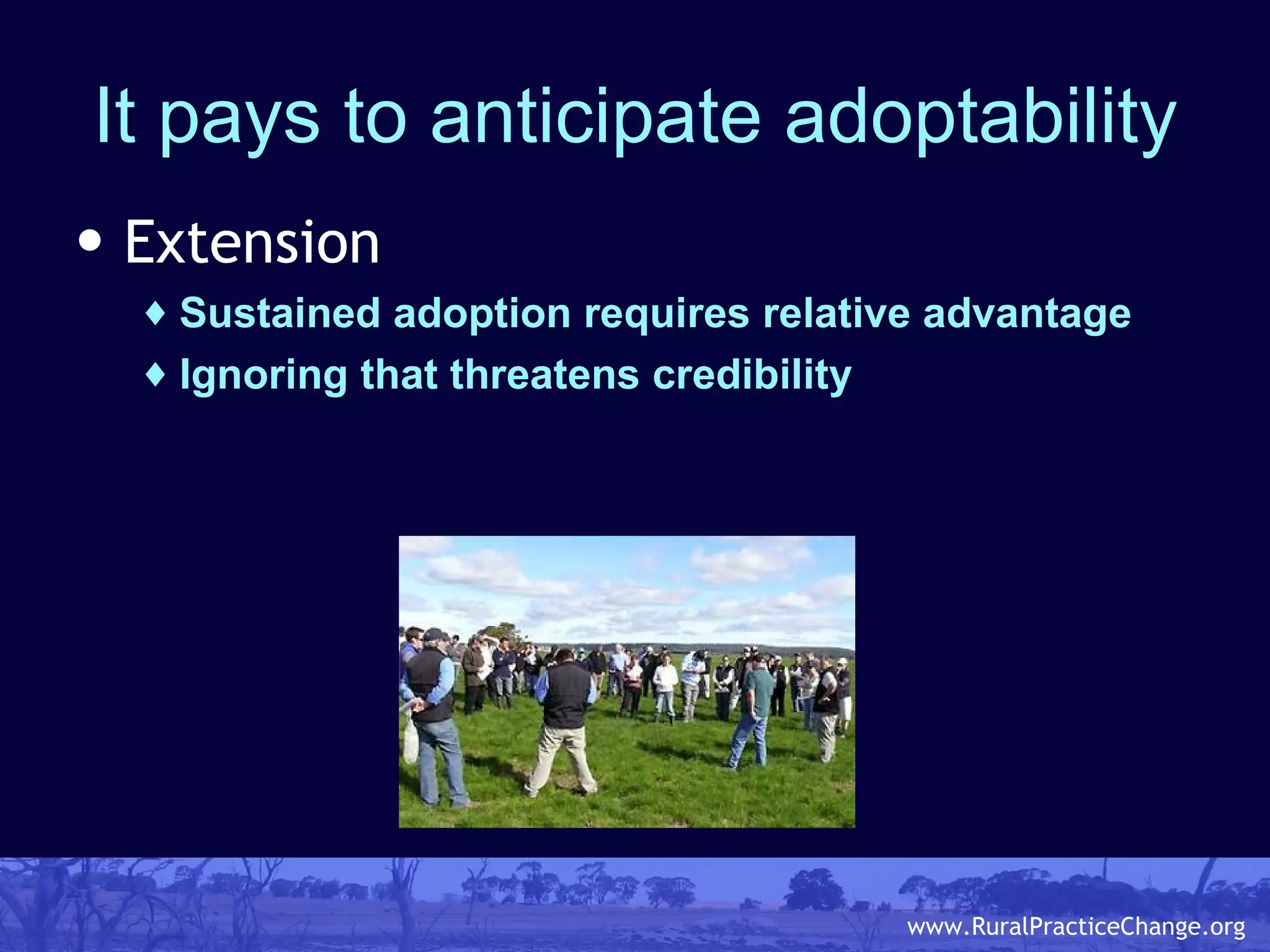
It pays to anticipate adoptability Extension Sustained adoption requires relative advantage Ignoring that threatens credibility
It pays to anticipate adoptability Policy Anticipate adoptability when considering policy responses (what mechanism, if any) Non-adoption is generally for good reasons, especially if it persists
Key points Practice change depends on: The human dimension (learning, social processes, goals, perceptions, …) The technologies (relative advantage, trialability) Each practice has its own unique adoption story For policy, extension and research, it pays to anticipate adoptability

Understanding Practice Change by Rural Landholders

  • 1.
    Understanding Practice Changeby Rural Landholders David Pannell ARC Federation Fellow School of Agricultural and Resource Economics University of Western Australia
  • 2.
  • 3.
    Key points Practicechange depends on: The human dimension (learning, social processes, goals, perceptions, …) The technologies (relative advantage, trialability) Each practice has its own unique adoption story For policy, extension and research, it pays to anticipate adoptability
  • 4.
    The human dimensionThe innovative practice 
  • 5.
    At the individuallevel It’s a learning process Initially uncertainty is high e.g. about a new pasture plant’s response to climate, soils, pests, weeds, inputs, grazing, etc. Over time, learning  uncertainty falls Subjective perceptions – it’s personal
  • 6.
    Learning process -stages Awareness of problem or opportunity Non-trial evaluation Trial evaluation Adoption (or not) Review and modification Disadoption Continuum Process is never complete
  • 7.
    Social factors influenceadoption Related to communication, trust, credibility Social networks Physical proximity Extension Ethnic/cultural divisions Related to benefits from adopting the practice Off-farm income Property size Age/education Reason for holding land Goals
  • 8.
    A variety ofgoals (i) material wealth & financial security (ii) environmental protection and enhancement (iii) social approval and acceptance (iv) personal integrity, ethics (v) balance of work and lifestyle
  • 9.
    Categories of adoptersKernal of truth But given too much emphasis Don’t forget the practices An individual could be Early adopter for a new crop variety Laggard for a new pasture species
  • 10.
    The human dimensionThe innovative practice 
  • 11.
     Characteristics ofpractices Relative advantage Trialability
  • 12.
    Relative advantage Economicbenefits Profitability of practice Farming systems effects Adjustment cost Riskiness Compatibility Complexity Opportunity cost Compatibility with Beliefs/values Family goals Self image Brand preference Environmental Values of landholder Threats Benefits of practice
  • 13.
  • 14.
    ‘ Convenience agriculture’More management demands Less time available The challenge for ‘inconvenient’ agricultural practices e.g. Intensive livestock systems?
  • 15.
     Characteristics ofpractices Relative advantage Trialability
  • 16.
    Trialability How easyis it to get over the learning hump?
  • 17.
    Factors reduce valueof trialling Observability low or costly Highly novel new practice Previous experience not transferable Long time scales Survey of farmers in Upper Kent, 1997 Of the farmers who invested in Landcare (e.g. drainage, trees, lucerne) less than half had observed any benefit
  • 18.
    Each practice hasits own adoption story Influential factors Time frame Groups of adopters and non-adopters
  • 19.
    Factors influencing no-tilladoption Higher education Participation in extension activities Use of paid consultant Years since first awareness of nearby no-till adopter Occurrence of a very dry year Fall in price of glyphosate Location (region/state) & average rainfall Effectiveness of pre-emergent herbicide (trifluralin) Soil-moisture-conservation & seeding timeliness NOT SIGNIFICANT: Erosion risk; soil conservation benefits; Landcare 82% of decisions correctly predicted Source: D’ Emden et al. 2006
  • 20.
    Factors influencing IWMadoption Higher use of extension Higher education Lower discount rate for future returns Perception of higher ryegrass control (efficacy) Perception of higher economic value of practices Perception of longer time until new herbicide Uncertainty of when new herbicide will be available Higher proportion of the farm cropped The resistance status of the farm 86% of decisions correctly predicted Source: Llewellyn et al. 2006
  • 21.
    It pays toanticipate adoptability Researchers Target research effort to practices and technologies with better prospects
  • 22.
    It pays toanticipate adoptability Extension Sustained adoption requires relative advantage Ignoring that threatens credibility
  • 23.
    It pays toanticipate adoptability Policy Anticipate adoptability when considering policy responses (what mechanism, if any) Non-adoption is generally for good reasons, especially if it persists
  • 24.
    Key points Practicechange depends on: The human dimension (learning, social processes, goals, perceptions, …) The technologies (relative advantage, trialability) Each practice has its own unique adoption story For policy, extension and research, it pays to anticipate adoptability