Amrita School of Agricultural Sciences
(Amrita Vishwa Vidyapeetham)
Coimbatore
THE DISCOVERY OF MICROORGANISMS
SUBMITTED BY,
MANUVANTHRA.A
CB.AG.U4AGR19036
COURSE TEACHER:
Dr. PARTHASARATHY S
ASSISTANT PROFESSOR
PLANT PATHOLOGY
INTRODUCTION:
• Discoveredby Robert Hooke and Antonie van Leeuwenhoek.
• Hooke presented the first published depiction of a
microoganism, the micro-fungus Mucor in “Micrographia” in
1665.
• Existence suspected from ancient times: Jain scriptures from
6th century BC
• 1st century BC - book On Agriculture by Marcus Terentius
Varro.
• 1677- Observed "little animals”- Leeuwenhoek
• 1796- First scientific small pox vaccination- Edward Jenner
• 1861- Disproved spontaneous generation- Louis Pasteur
• 1862- Supported Germ Theory of Disease- Louis Pasteur
• 1867- Practiced antiseptic surgery- Joseph Lister
• 1876- First proof of Germ Theory of Disease with
B.anthracis discovery- Robert Koch
• 1881- Growth of Bacteria on solid media - Robert Koch
• 1882- Developed acid-fast stain - Paul Ehrlich
• 1884- Developed Gram Stain - Christian Gram
• 1885- First Rabies vaccination - Louis Pasteur
• 1892- Discovered viruses - Dmitri Iosifovich Ivanovski
• 1899- Recognized viral dependence on cells for
reproduction - Martinus Beijerinck
• 1928- Discovered Penicillin - Alexander Flemming
• 1977- Developed a method to sequence DNA - W. Gilbert & F.
Sanger
Eras in microbiology:
1.Discovery era
 Anton Van Leeuwenhoek
2.Transition period
 Controversies over Spontaneous Generation theory
3.Golden age of microbiology
 Louis Pasteur
 Robert Koch
Robert Hooke (1635 – 1700):
• Invented the first microscope
• Observed cork cells
• Coined the term “cell” ( Latin: cellulae – small compartment)
Antony van Leeuwenhoek:
 Father of microbiology
 Observed, described, studied and conducted scientific
experiments with microorganisms - simple single
lensed microscopes
 Ground pieces of glass into fine lenses, placed them between
two silver or brass plates
 Magnified about 200 times
 Protozoa, algae, yeasts and bacteria – first described by him.
Published paper in Royal Society in 1677 . Contained special
description of microorganisms.
Material examined was the scrappings of his own teeth mixed
with pure rain water. Called it “animalcules”.
Spontaneous Generation Theory/ Abiogenesis:
• Held that living creatures could arise from non-living matter
and that such processes were commonplace and regular.
• Synthesized by Aristotle who compiled the work of earlier
natural philosophers, various ancient explanations for the
appearance of organisms.
• Francesco Redi and Lazzaro Spallanzani – challenged the
theory.
• Louis Pasteur and John Tyndall – Disproved it.
Louis Pasteur (1822-1895):
• Disproved Spontaneous Generation Theory and proved “ The
Germ Theory of Diseases”.
• Means ‘germs are responsible for the disease and not the inert
matter’.
• Developed ‘Pasteurization’ – a process in which water and certain
packaged and non-packaged foods (such as milk and fruit juice)
are treated with mild heat, usually to less than 100 °C , to
eliminate pathogens and extend shelf life.
Disproval of Spontaneous Generation Theory:
Goose Neck Experiment
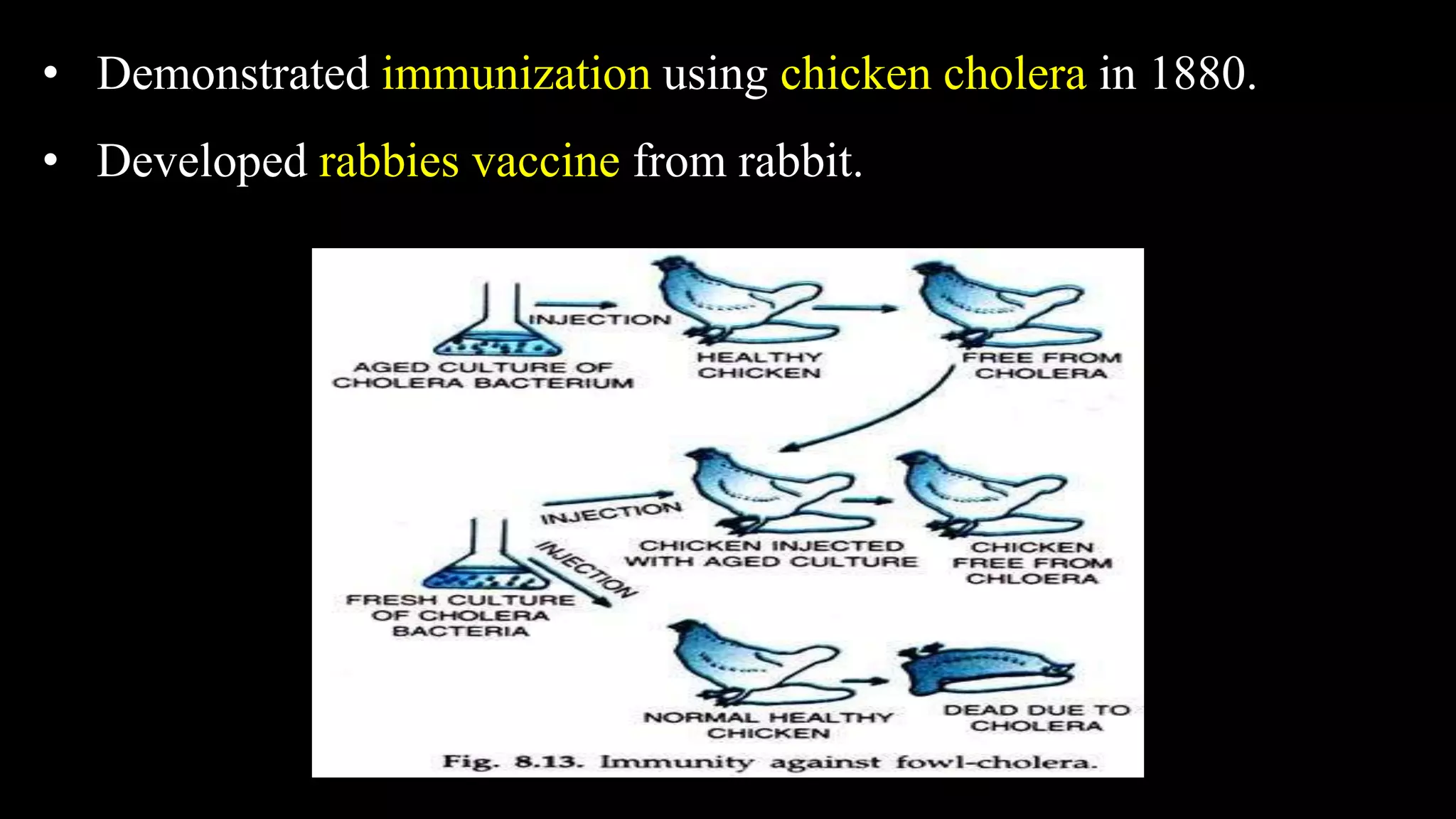
• Demonstrated immunization using chicken cholera in 1880.
• Developed rabbies vaccine from rabbit.
John Tyndall:
• Proved that dust carried germs and broth remained sterile
indefinitely in the absence of dust.
• Discovered ‘Tyndallization’ - Sterilization of a fluid by heating it
repeatedly to a point slightly below that of boiling - more resistant
spores are destroyed.
• Caused deterioration in its nutrient content.
• Increased shelf-life than Pasteurization.
Robert Koch:
• Isolated B.anthracis from cattle – causing ‘anthrax’
• Found the causes to various diseases such as tuberculosis,
cholera and typhus.
• Made it easier to see bacteria under a microscope by staining it.
• Found that he could transmit anthrax from one animal to another
by taking a small sample of blood from the infected animal and
injecting it into a healthy one.
• Also found that he could grow the bacteria in a nutrient broth - inject
it into a healthy animal - cause illness.
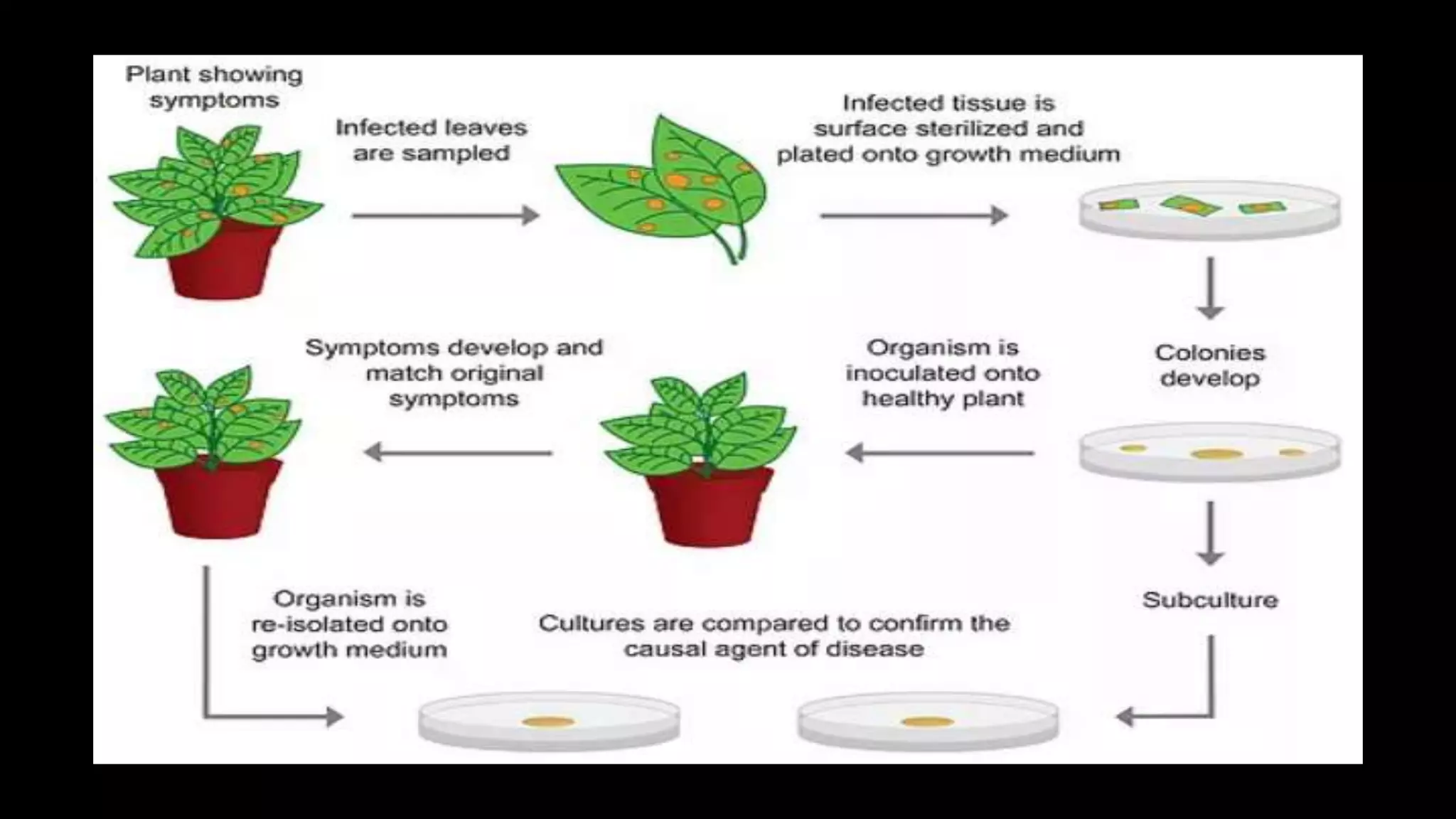
• Thus devised criteria for establishing a causal link between a
microorganism and a disease - Koch's postulates.
• Nobel Prize in 1905 for his work and research on the study of
diseases.
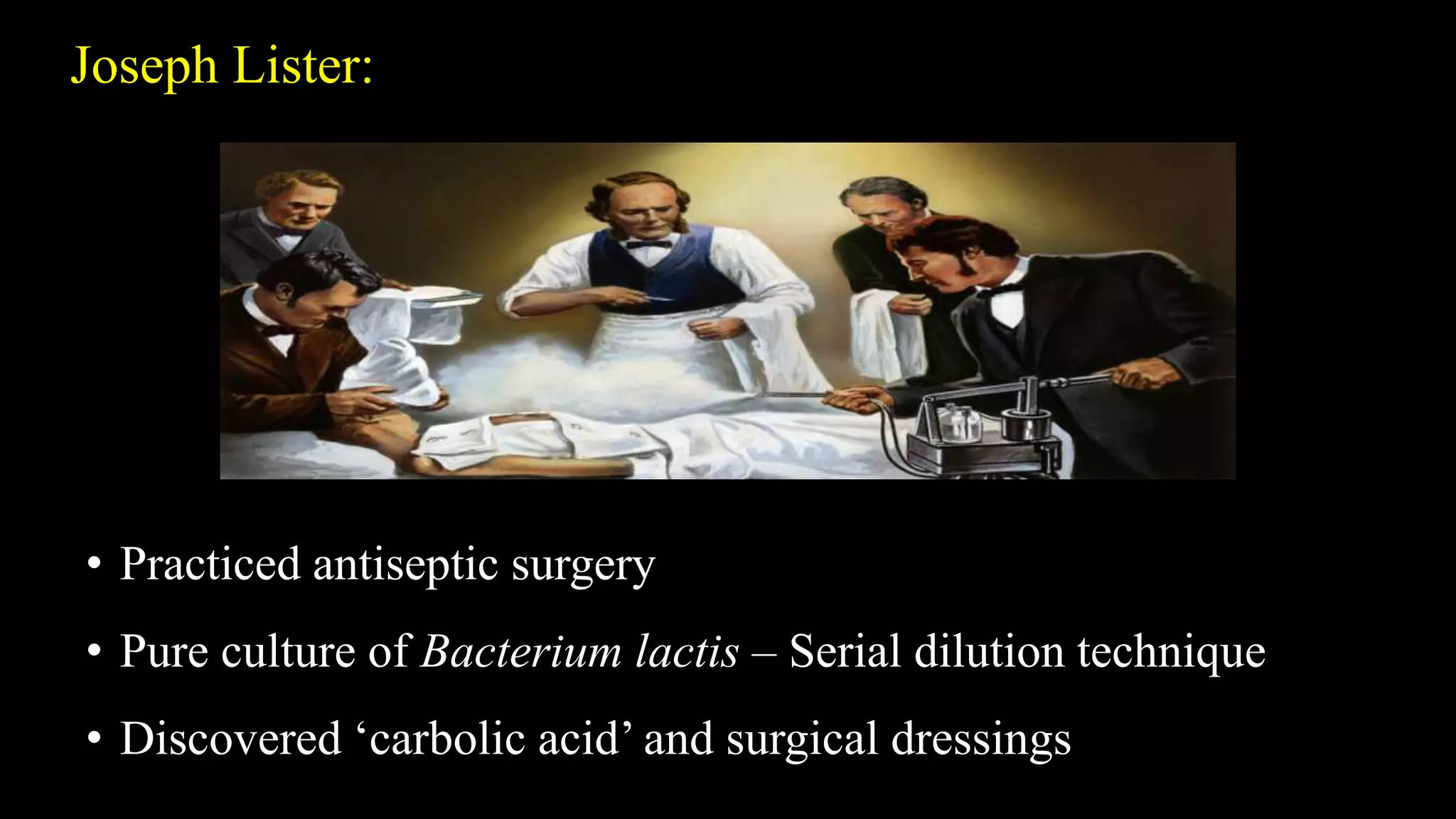
Joseph Lister:
• Practiced antiseptic surgery
• Pure culture of Bacterium lactis – Serial dilution technique
• Discovered ‘carbolic acid’ and surgical dressings
M.W. Beijerinck:
• Founded the discipline of virology with his discovery of viruses.
• Father of soil microbiology
• Discovered new types of bacteria from soil and described
biological nitrogen fixation, fermentation, Azotobacter (a group of
soil microorganisms), denitrifying bacteria and tobacco mosaic virus.
• Described virus as ‘contagium vivum fluidum’
• Enrichment of culture.
Alexander Fleming:
• Discovered penicillin - the first antibiotic from Penicillium
notatum which inhibits Staphylococcus aureus.
• Shared the Nobel Prize in Physiology or Medicine with Florey
and Chain.
Selman A. Waksman:
• Discovered ‘Streptomycin’- an antibiotic from soil bacterium
Streptomyces griseus.
• Coined the term ‘antibiotics’ – chemical substance of microbial
origin which in small quantities exert antimicrobial activity.
• Book – ‘Principles of Soil Microbiology’.
• Discovered important clinically applied antibiotics
a.Actinomycin in 1940
b.Streptomycin in 1944
c.Neomycin in 1949
.
Sergei Winogradsky:
• First to develop the concept of chemolithotrophy - essential
role played by microorganisms in geochemical processes.
• First isolation and description of both nitrifying and nitrogen-
fixing bacteria.
• Microorganisms involved in various biological cycles
• Discovered anaerobic nitrogen fixing bacterium Clostridium
pasteurianum
Discovery of Rhizobium:
• By Martinus Beijerinck.
• Isolated and cultivated a microorganism from the nodules of
legumes in 1888. Named it Bacillus radicicola.
• Now placed in Bergey’s Manual of Determinative
Bacteriology under the genus Rhizobium.
Discovery of Azospirillum:
• The genus Spirillum was first reported by Beijerinck (1925).
• Later reclassified as Azospirillum, because of its ability to fix
atmospheric nitrogen (the group of Dr. Johanna Döbereiner in
1970).
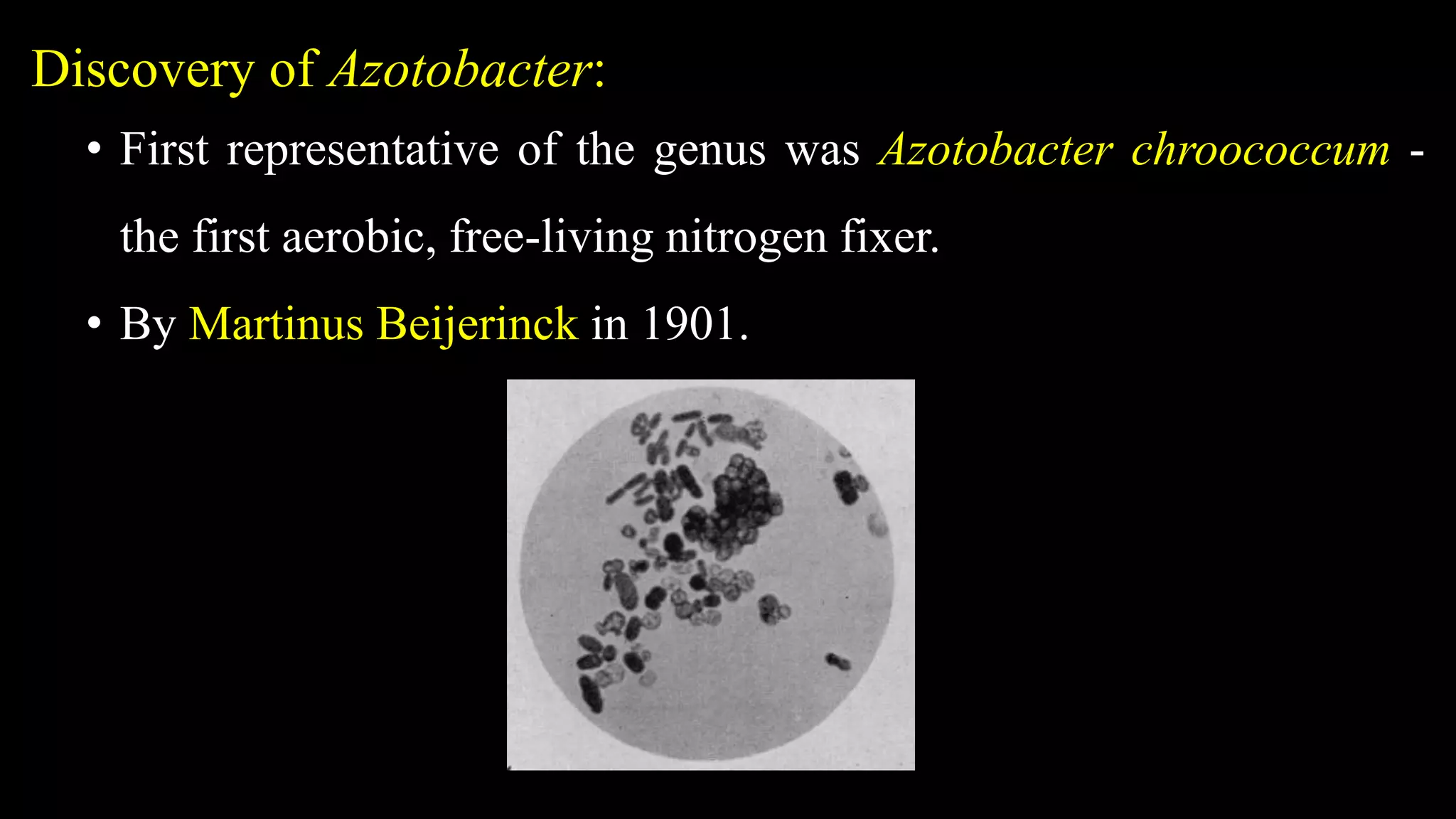
Discovery of Azotobacter:
• First representative of the genus was Azotobacter chroococcum -
the first aerobic, free-living nitrogen fixer.
• By Martinus Beijerinck in 1901.
Discovery of blue green algae:
• Dating back to the 12th century
• Cyanobacteria are thought to have converted the early oxygen-
poor, reducing atmosphere into an oxidizing one, causing
the Great Oxygenation Event and the "rusting of the Earth“.
• Konstantin Mereschkowski
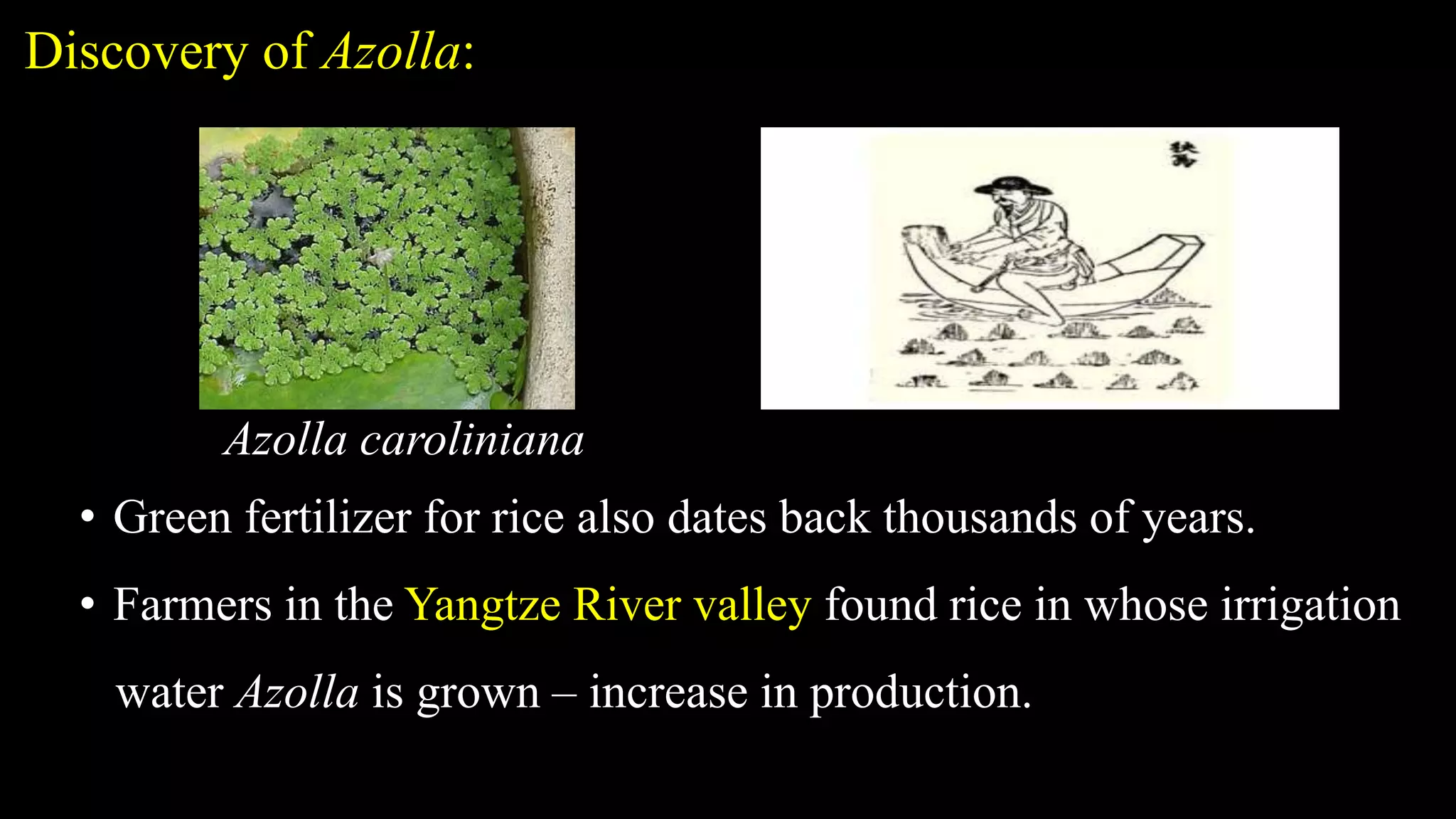
Discovery of Azolla:
Azolla caroliniana
• Green fertilizer for rice also dates back thousands of years.
• Farmers in the Yangtze River valley found rice in whose irrigation
water Azolla is grown – increase in production.
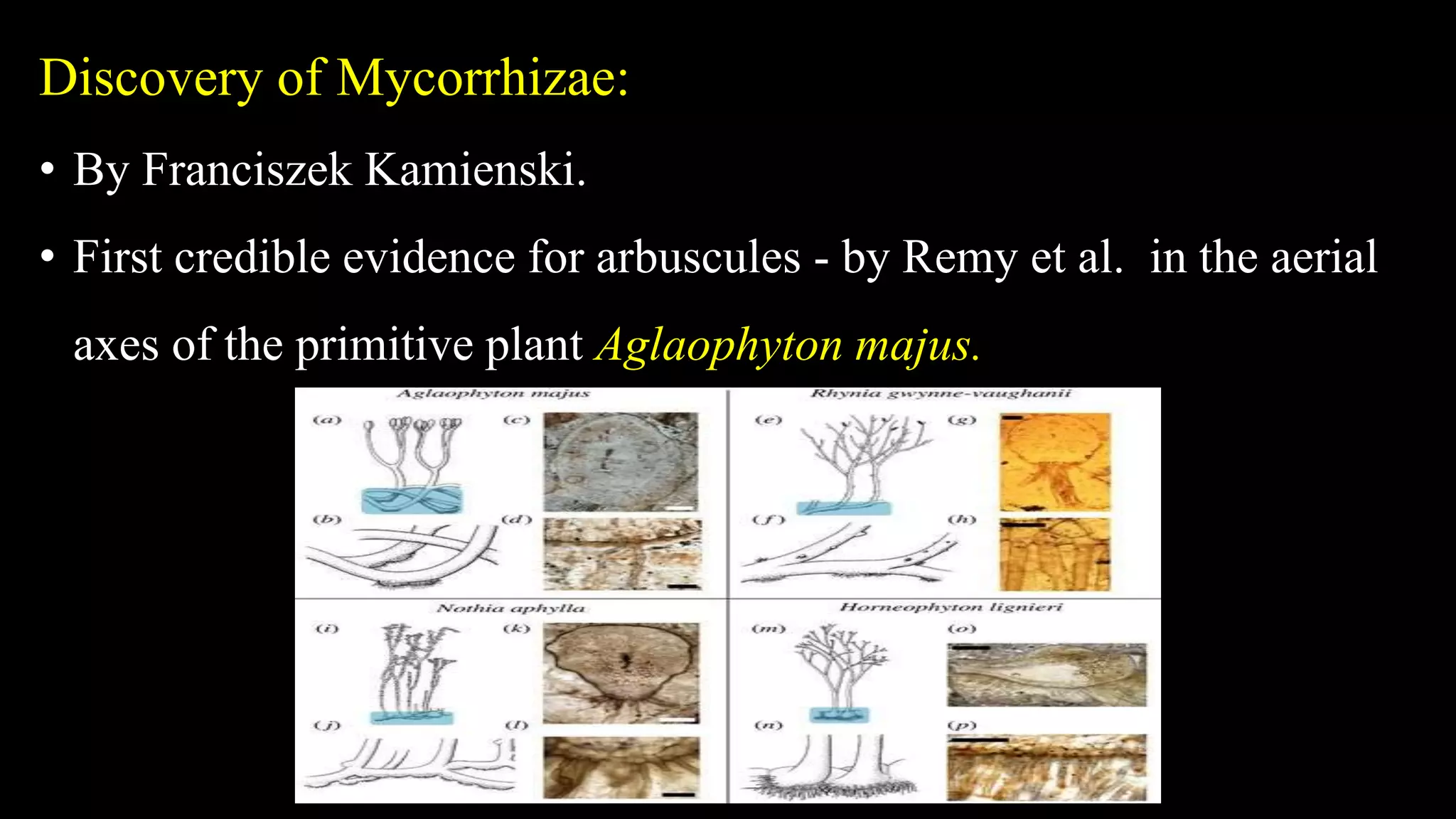
Discovery of Mycorrhizae:
• By Franciszek Kamienski.
• First credible evidence for arbuscules - by Remy et al. in the aerial
axes of the primitive plant Aglaophyton majus.
Reference:
• www.brittanica.com
• www.enotes.com
• www.biologydiscussion.com
• P.D. Sharma, Microbiology, Rastogi Publications
• Cecie Starr and Ralph Taggart, Biology- The Unity and Diversity of Life,
Wadsworth Publishing Company.
• Eldon D. Enger, Frederick C. Ross, David B. Bailey, Tata McGraw-
Concepts in Biology-Hill Edition
The Discovery of Microorganisms

The Discovery of Microorganisms

  • 1.
    Amrita School ofAgricultural Sciences (Amrita Vishwa Vidyapeetham) Coimbatore THE DISCOVERY OF MICROORGANISMS SUBMITTED BY, MANUVANTHRA.A CB.AG.U4AGR19036 COURSE TEACHER: Dr. PARTHASARATHY S ASSISTANT PROFESSOR PLANT PATHOLOGY
  • 2.
    INTRODUCTION: • Discoveredby RobertHooke and Antonie van Leeuwenhoek. • Hooke presented the first published depiction of a microoganism, the micro-fungus Mucor in “Micrographia” in 1665. • Existence suspected from ancient times: Jain scriptures from 6th century BC • 1st century BC - book On Agriculture by Marcus Terentius Varro.
  • 3.
    • 1677- Observed"little animals”- Leeuwenhoek • 1796- First scientific small pox vaccination- Edward Jenner • 1861- Disproved spontaneous generation- Louis Pasteur • 1862- Supported Germ Theory of Disease- Louis Pasteur • 1867- Practiced antiseptic surgery- Joseph Lister • 1876- First proof of Germ Theory of Disease with B.anthracis discovery- Robert Koch • 1881- Growth of Bacteria on solid media - Robert Koch • 1882- Developed acid-fast stain - Paul Ehrlich
  • 4.
    • 1884- DevelopedGram Stain - Christian Gram • 1885- First Rabies vaccination - Louis Pasteur • 1892- Discovered viruses - Dmitri Iosifovich Ivanovski • 1899- Recognized viral dependence on cells for reproduction - Martinus Beijerinck • 1928- Discovered Penicillin - Alexander Flemming • 1977- Developed a method to sequence DNA - W. Gilbert & F. Sanger
  • 5.
    Eras in microbiology: 1.Discoveryera  Anton Van Leeuwenhoek 2.Transition period  Controversies over Spontaneous Generation theory 3.Golden age of microbiology  Louis Pasteur  Robert Koch
  • 6.
    Robert Hooke (1635– 1700): • Invented the first microscope • Observed cork cells • Coined the term “cell” ( Latin: cellulae – small compartment)
  • 7.
    Antony van Leeuwenhoek: Father of microbiology  Observed, described, studied and conducted scientific experiments with microorganisms - simple single lensed microscopes  Ground pieces of glass into fine lenses, placed them between two silver or brass plates  Magnified about 200 times  Protozoa, algae, yeasts and bacteria – first described by him.
  • 8.
    Published paper inRoyal Society in 1677 . Contained special description of microorganisms. Material examined was the scrappings of his own teeth mixed with pure rain water. Called it “animalcules”.
  • 9.
    Spontaneous Generation Theory/Abiogenesis: • Held that living creatures could arise from non-living matter and that such processes were commonplace and regular. • Synthesized by Aristotle who compiled the work of earlier natural philosophers, various ancient explanations for the appearance of organisms. • Francesco Redi and Lazzaro Spallanzani – challenged the theory. • Louis Pasteur and John Tyndall – Disproved it.
  • 11.
    Louis Pasteur (1822-1895): •Disproved Spontaneous Generation Theory and proved “ The Germ Theory of Diseases”. • Means ‘germs are responsible for the disease and not the inert matter’. • Developed ‘Pasteurization’ – a process in which water and certain packaged and non-packaged foods (such as milk and fruit juice) are treated with mild heat, usually to less than 100 °C , to eliminate pathogens and extend shelf life.
  • 12.
    Disproval of SpontaneousGeneration Theory: Goose Neck Experiment
  • 13.
    • Demonstrated immunizationusing chicken cholera in 1880. • Developed rabbies vaccine from rabbit.
  • 14.
    John Tyndall: • Provedthat dust carried germs and broth remained sterile indefinitely in the absence of dust. • Discovered ‘Tyndallization’ - Sterilization of a fluid by heating it repeatedly to a point slightly below that of boiling - more resistant spores are destroyed. • Caused deterioration in its nutrient content. • Increased shelf-life than Pasteurization.
  • 15.
    Robert Koch: • IsolatedB.anthracis from cattle – causing ‘anthrax’ • Found the causes to various diseases such as tuberculosis, cholera and typhus. • Made it easier to see bacteria under a microscope by staining it. • Found that he could transmit anthrax from one animal to another by taking a small sample of blood from the infected animal and injecting it into a healthy one.
  • 16.
    • Also foundthat he could grow the bacteria in a nutrient broth - inject it into a healthy animal - cause illness. • Thus devised criteria for establishing a causal link between a microorganism and a disease - Koch's postulates. • Nobel Prize in 1905 for his work and research on the study of diseases.
  • 18.
    Joseph Lister: • Practicedantiseptic surgery • Pure culture of Bacterium lactis – Serial dilution technique • Discovered ‘carbolic acid’ and surgical dressings
  • 19.
    M.W. Beijerinck: • Foundedthe discipline of virology with his discovery of viruses. • Father of soil microbiology • Discovered new types of bacteria from soil and described biological nitrogen fixation, fermentation, Azotobacter (a group of soil microorganisms), denitrifying bacteria and tobacco mosaic virus. • Described virus as ‘contagium vivum fluidum’ • Enrichment of culture.
  • 20.
    Alexander Fleming: • Discoveredpenicillin - the first antibiotic from Penicillium notatum which inhibits Staphylococcus aureus. • Shared the Nobel Prize in Physiology or Medicine with Florey and Chain. Selman A. Waksman: • Discovered ‘Streptomycin’- an antibiotic from soil bacterium Streptomyces griseus. • Coined the term ‘antibiotics’ – chemical substance of microbial
  • 21.
    origin which insmall quantities exert antimicrobial activity. • Book – ‘Principles of Soil Microbiology’. • Discovered important clinically applied antibiotics a.Actinomycin in 1940 b.Streptomycin in 1944 c.Neomycin in 1949 .
  • 22.
    Sergei Winogradsky: • Firstto develop the concept of chemolithotrophy - essential role played by microorganisms in geochemical processes. • First isolation and description of both nitrifying and nitrogen- fixing bacteria. • Microorganisms involved in various biological cycles • Discovered anaerobic nitrogen fixing bacterium Clostridium pasteurianum
  • 23.
    Discovery of Rhizobium: •By Martinus Beijerinck. • Isolated and cultivated a microorganism from the nodules of legumes in 1888. Named it Bacillus radicicola. • Now placed in Bergey’s Manual of Determinative Bacteriology under the genus Rhizobium.
  • 24.
    Discovery of Azospirillum: •The genus Spirillum was first reported by Beijerinck (1925). • Later reclassified as Azospirillum, because of its ability to fix atmospheric nitrogen (the group of Dr. Johanna Döbereiner in 1970).
  • 25.
    Discovery of Azotobacter: •First representative of the genus was Azotobacter chroococcum - the first aerobic, free-living nitrogen fixer. • By Martinus Beijerinck in 1901.
  • 26.
    Discovery of bluegreen algae: • Dating back to the 12th century • Cyanobacteria are thought to have converted the early oxygen- poor, reducing atmosphere into an oxidizing one, causing the Great Oxygenation Event and the "rusting of the Earth“. • Konstantin Mereschkowski
  • 27.
    Discovery of Azolla: Azollacaroliniana • Green fertilizer for rice also dates back thousands of years. • Farmers in the Yangtze River valley found rice in whose irrigation water Azolla is grown – increase in production.
  • 28.
    Discovery of Mycorrhizae: •By Franciszek Kamienski. • First credible evidence for arbuscules - by Remy et al. in the aerial axes of the primitive plant Aglaophyton majus.
  • 29.
    Reference: • www.brittanica.com • www.enotes.com •www.biologydiscussion.com • P.D. Sharma, Microbiology, Rastogi Publications • Cecie Starr and Ralph Taggart, Biology- The Unity and Diversity of Life, Wadsworth Publishing Company. • Eldon D. Enger, Frederick C. Ross, David B. Bailey, Tata McGraw- Concepts in Biology-Hill Edition