TRANSCULTURAL NURSING
Presentation By
Reshma S R
1st Year Msc Nursing
P D Hinduja College Of Nursing
OBJECTIVES
 Define transcultural nursing
 Enumerate terminologies in transcultural nursing
 Underline the importance of transcultural nursing
 Narrate the theory of transcultural nursing
 Explain the transcultural nursing models
 Enlist the standards of transcultural nursing
 Recognises nurse’s role in providing culturally sensitive care
INTRODUCTION
Transcultural Nursing is a specialty within nursing focused on the
comparative study and analysis of different cultures and sub- cultures.
Various groups are examined with respect to their caring behaviour,
nursing care, health and illness values, beliefs and patterns of behaviour.
When caring for a patient from a culture different from your own, you
need to be aware of and respect his cultural preferences and beliefs;
otherwise, he may consider you insensitive and indifferent, possibly even
incompetent. But beware of assuming that all members of any one culture
act and behave in the same way; in other words, don't stereotype people.
DEFINITION
“It is a substantive area of study and practice that focuses on the
comparative cultural values of caring, the beliefs and practices of
individuals or groups of similar or different cultures”
- Madeleine Leininger, The pioneer of transcultural nursing-1995
TERMINOLOGIES IN TRANSCULTURAL NURSING
Stereotyping
Making assumption that an individual reflects all
characteristics associated with being a member in a group.
Stereotyping serves barrier to communication and
understanding and propagates discriminatory behaviour.
Discrimination
Refers to differential and negative treatment of individuals
on the bias of their races, ethnicity, or gender.
Assimilation
Process by which an individual develops new cultural
identity.
Acculturation
Occurs when people incorporate traits from another culture
Generalisations
Statements about common cultural pattern. Generalisations
may not hold true at the individual level.
Prejudice
It’s the preconceived judgement that is not based on sufficient
knowledge. It may be favourable or unfavourable.
Unfavourable prejudices may lead to stereotyping and
discriminatory behaviour toward group of people
Microculture
Microculture is a small culture group like gender, age, or
religious belief.
Ethnocentrism
It’s the belief in the superiority of one’s own culture and
lifestyle.
Culture
It’s the thoughts, communications, actions, customs, beliefs,
values, and institutions of racial, ethnic, religious, or social
group.
Macro culture
Macro culture is a large culture group like national, ethnic, or racial
groups.
Nationality
It refers to the country where one has membership, which may be
through birth, through inheritance of parents or through
naturalisation.
Religion
System of beliefs, practices, and ethical values about divine or
superhuman power worshiped as the creators and rulers of the
universe.
Subculture
Composed of people who have distinct identity and yet are related to
larger culture group.
Shares ethnic origin or physical characteristics within larger cultural
group.
E.g.- occupational group- nurses, Societal groups- feminists.
Bicultural
A person who has dual pattern of identification when crosses two
cultures.
E g: when a person’s father and mother from different counties, he
will be influenced by both cultures.
Race
Often used interchangeably with culture and ethnicity.
Race should not be interpreted as being primarily biological or
genetic in reference. Race and ethnicity may be thought of in terms
of social and cultural characteristics as well as ancestry.
E g: white/black/African/American, Indian, Chinese, Asian, Korean.
There is not scientific merit to concept of race, whereby social
meaning perceived physical differences resulting in inequality.
There is only one race called: human race.
Ethnicity
It’s interchangeably used with race.
It’s the relationship between individuals who believe that they have
distinctive characteristics that make them in a group.
Ethnicity changes may shift over time. Migration and intermarriage
show that people move into another ethnic group.
Diversity
The fact or state of being different.
Many factors account for diversity.
E g: sex, age, ethnicity, socioeconomic status, education, religion.
Diversity not only between two culture groups but also within
cultural group.
Culturally diverse nursing care
An optimal mode of health care delivery; it refers to the
variability of nursing approaches needed to provide
culturally appropriate care that incorporates an individual’s
cultural values, beliefs, and practices including sensitivity
to the environment from which the individual comes and to
which the individual may ultimately return.
Culturally responsive care
•The care should be centered on the clients cultural
perspectives and integrates clients values and beliefs into
plan of care.
•self awareness of his/ her own culture, attitude and beliefs
into plan of care and examine the biases and assumptions
they hold about different cultures
•self awareness, deliberate cultural assessment , and
incorporation of the clients culture into the plan of care
THE GOALS OF TRANSCULTURAL NURSING
 To give culturally congruent nursing care
 To provide culture specific and universal nursing care practices
for the health and well-being of people
 To aid them in facing adverse human conditions, illness or death
in culturally meaningful ways
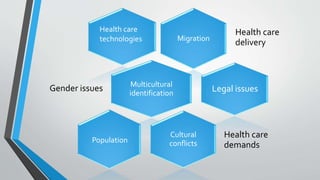
Migration
Health care
delivery
Multicultural
identification
Gender issues
Cultural
conflicts
Health care
demands
Health care
technologies
Legal issues
Population
LEININGER’S CULTURAL CARE
DIVERSITYAND UNIVERSALITY THEORY
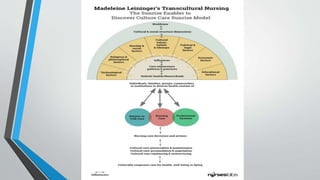
• Leininger produced the sunrise model to depict her theory of cultural
care diversity and universality.
• Leininger states that her theory is the only one focussed inequity of
culture care, examining what is universal among cultures and what
varies
• Leininger presents three interventional models
FOUNDER
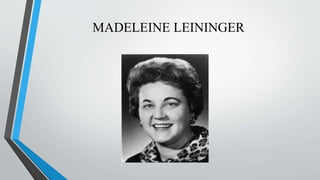
As the initiator of and the leader in the field of transcultural nursing, Madeleine
Leininger was the first professional nurse who finished a doctorate degree in
anthropology
Leininger first taught a transcultural nursing course at the University of
Colorado in 1966. In 1998, Leininger was honoured as a Living Legend of the
American Academy of Nursing
Leininger was the editor of the Journal of Transcultural Nursing, the official
publication of the Transcultural Nursing Society, from 1989 to 1995
She authored books about the field of transcultural nursing.[1]
HISTORY
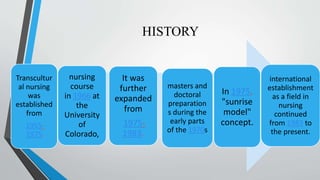
Transcultur
al nursing
was
established
from
1955-
1975.
In 1975,
"sunrise
model"
concept.
It was
further
expanded
from
1975-
1983.
international
establishment
as a field in
nursing
continued
from 1983 to
the present.
nursing
course
in 1966 at
the
University
of
Colorado,
masters and
doctoral
preparation
s during the
early parts
of the 1970s
TRANSCULTURAL NURSES
Nurses who practice the discipline of transcultural nursing are called
transcultural nurses. Transcultural nurses, in general, are nurses who act
as specialists, generalists, and consultants in order to study the
interrelationships of culturally constituted care from a nursing point of
view. They are nurses who provide knowledgeable, competent, and safe
care to people of diverse cultures to themselves and others.
Certification
Certification as a transcultural nurse is offered under a graduate study or track
programs by the Transcultural Nursing Society since 1988
Transcultural Nursing Society
The Transcultural Nursing Society is the official organization of transcultural
nurses. Chartered in 1974, the society is the publisher of the Journal of
Transcultural Nursing, a publication that had been in existence since 1989
Publications
Apart from the Journal of Transcultural Nursing, other publications related to
transcultural nursing include the Journal of Cultural Diversity (since 1994), and
the Journal of Multicultural Nursing (since 1994, currently published as the
Journal of Multicultural Nursing and Health: Official Journal of the Center for the
Study of Multiculturalism and Health Care )
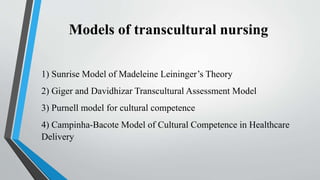
Models of transcultural nursing
1) Sunrise Model of Madeleine Leininger’s Theory
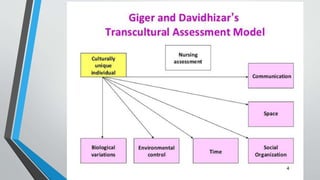
2) Giger and Davidhizar Transcultural Assessment Model
3) Purnell model for cultural competence
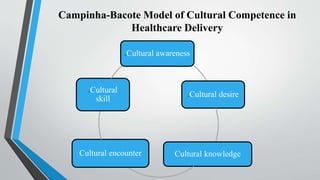
4) Campinha-Bacote Model of Cultural Competence in Healthcare
Delivery
MADELEINE LEININGER
Leininger’s Sunrise Model
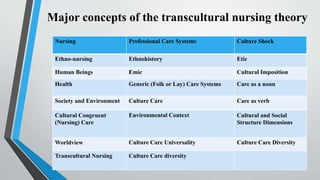
Major concepts of the transcultural nursing theory
Nursing Professional Care Systems Culture Shock
Ethno-nursing Ethnohistory Etic
Human Beings Emic Cultural Imposition
Health Generic (Folk or Lay) Care Systems Care as a noun
Society and Environment Culture Care Care as verb
Cultural Congruent
(Nursing) Care
Environmental Context Cultural and Social
Structure Dimensions
Worldview Culture Care Universality Culture Care Diversity
Transcultural Nursing Culture Care diversity
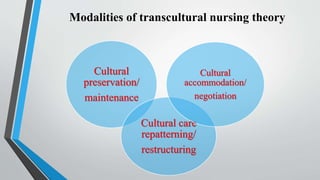
Modalities of transcultural nursing theory
Cultural
preservation/
maintenance
Cultural care
repatterning/
restructuring
Cultural
accommodation/
negotiation
Cultural Care Re-Patterning or Restructuring
Cultural Care Re-Patterning or Restructuring refers to
therapeutic actions taken by culturally competent nurses.
These actions help a patient to modify personal health
behaviours towards beneficial outcomes while respecting
the patient’s cultural values.
Cultural Care Preservation or Maintenance
Cultural Care Preservation or Maintenance refers to nursing
care activities that help people from particular cultures to
retain and use core cultural care values related to healthcare
concerns or conditions.
Cultural Care Accommodation or Negotiation
Cultural Care Accommodation or Negotiation refers to
creative nursing actions that help people of a particular
culture adapt or negotiate with others in the healthcare
community in an effort to attain the shared goal of an
optimal health outcome for patients of a designated culture.
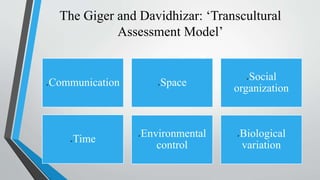
The Giger and Davidhizar: ‘Transcultural
Assessment Model’
Communication Space
Social
organization
Time Environmental
control
Biological
variation
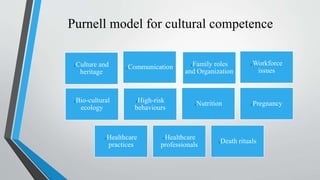
Purnell model for cultural competence
i.Culture and
heritage
i.Communication i.Family roles
and Organization
i.Workforce
issues
i.Bio-cultural
ecology
i.High-risk
behaviours
i.Nutrition i.Pregnancy
i.Healthcare
practices
i.Healthcare
professionals
i.Death rituals
Campinha-Bacote Model of Cultural Competence in
Healthcare Delivery
i.Cultural awareness
i.Cultural desire
Cultural knowledge
Cultural encounter
i.Cultural
skill
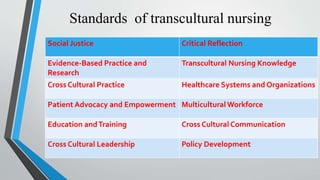
Standards of transcultural nursing
Social Justice Critical Reflection
Evidence-Based Practice and
Research
Transcultural Nursing Knowledge
Cross Cultural Practice Healthcare Systems and Organizations
Patient Advocacy and Empowerment Multicultural Workforce
Education andTraining Cross Cultural Communication
Cross Cultural Leadership Policy Development
Transcultural Nursing Society
Mission
The mission of the Transcultural Nursing Society (TCNS) is to enhance
the quality of culturally congruent, competent, and equitable care that
results in improved health and well being for people worldwide.
Vision
The TCNS seeks to provide nurses and other health care professionals
with the knowledge base necessary to ensure cultural competence in
practice, education, research, and administration.
Philosophy/Values
• Transcultural Nursing (TCN) is a theory based humanistic
discipline, designed to serve individuals, organizations,
communities, and societies. Human care/caring is defined within
the context of culture. Culturally competent care can only occur
when culture care values are known and serve as the foundation
for meaningful care.
• Scholarship is the foundation of the discipline of
TCN. Advanced educational preparation in TCN enhances the
practice of culturally competent care. Certification
documents evidence of the ability to provide culturally competent
care. To achieve our vision, the TCNS requires a stable financial
base.
Goals
• To advance cultural competence for nurses worldwide
• To advance the scholarship (substantive knowledge) of the
discipline
• To develop strategies for advocating social change for culturally
competent care
• To promote a sound financial non-profit corporation
•*Scholarship in nursing can be defined as those activities
that systematically advance the teaching, research, and
practice of nursing through rigorous inquiry that
• 1) is significant to the profession
•2) is creative
•3) can be documented
•4) can be replicated or elaborated
•5) can be peer-reviewed through various methods.
Nurses role
•Assessment
•Planning
•Implementation
•Evaluation
Research article-1
Mapping the literature of transcultural nursing
Sharon C. Murphy, MLS, RN, AHIP, Associate Librarian
ABSTRACT
Overview: No bibliometric studies of the literature of the field of transcultural nursing
have been published. This paper describes a citation analysis as part of the project
undertaken by the Nursing and Allied Health Resources Section of the Medical Library
Association to map the literature of nursing.
Objective: The purpose of this study was to identify the core literature and determine
which databases provided the most complete access to the transcultural nursing
literature.
Methods: Cited references from essential source journals were analyzed for a
three-year period. Eight major databases were compared for indexing coverage
of the identified core list of journals.
Results: This study identifies 138 core journals. Transcultural nursing relies on
journal literature from associated health sciences fields in addition to nursing.
Books provide an important format. Nearly all cited references were from the
previous 18 years. In comparing indexing coverage among 8 major databases, 3
databases rose to the top.
Conclusions: No single database can claim comprehensive indexing coverage
for this broad field. It is essential to search multiple databases. Based on this
study, PubMed/MEDLINE, Social Sciences Citation Index, and CINAHL
provide the best coverage. Collections supporting transcultural nursing require
robust access to literature beyond nursing publications.
Research article-2
Transcultural Nursing: Current Trends in Theoretical Works
Eun-OkIm1YaelimLee
ABSTRACT
Purpose: To explore the current trends in theoretical works related to
transcultural nursing through an integrated literature review.
Methods: The literature on theoretical works related to transcultural
nursing during the past 10 years was searched through multiple
databases and reviewed to determine themes reflecting the current
trends in theoretical works related to transcultural nursing.
Results: Through the review and analysis process, four themes
reflecting the current trends in theoretical works related to
transcultural nursing were found: (a) purposes of exploring,
defining and clarifying, and reflecting; (b) various theorizing
methods; (c) multiple sources of theorizing; and (d) clear linkages
to nursing practice and research.
Conclusion: Continuous efforts need to be made to further develop
the theoretical works related to transcultural nursing to reflect
changes in this ever-changing nursing world.
Conclusion
Nurses need to be aware of and sensitive to the cultural needs of
clients. The practice of nursing today demands that the nurse identify
and meet the cultural needs of diverse groups, understand the social
and cultural reality of the client, family, and community, develop
expertise to implement culturally acceptable strategies to provide
nursing care, and identify and use resources acceptable to the client.
Reference
1. Murphy, Sharon C. Mapping the literature of transcultural nursing, Transcultural nursing, Medical
Library Association, Health Sciences Library State University of New York, New York, April 2006
2. Sharon A. Gates, what works in promoting and maintaining diversity in nursing programs, Nursing
Forum. Wiley Online Library.2018
3. Linda K. Darnell, Shondell V. Hickson, Culturally Competent Patient-Centred Nursing Care, Nursing
Clinics of North America.2015
4. Sun Hee Kim, Kyung Won Kim, Kyung Eui Bae, Experiences of Nurses Who Provide Childbirth Care
for Women with Multi-cultural Background, Journal of Korean Public Health Nursing.2014
5. Scott J. Saccomano, Geraldine A. Abbatiello, Cultural considerations at the end of life, The Nurse
Practitioner.2014
6. Leninger M. Culture Care Theory: A Major Contribution to Advance Transcultural Nursing Knowledge
and PracticesJournal of Transcultural Nursing, Vol. 13 No. 3, July 2002
1.seminar transcultural nursing.pptx

1.seminar transcultural nursing.pptx

  • 1.
    TRANSCULTURAL NURSING Presentation By ReshmaS R 1st Year Msc Nursing P D Hinduja College Of Nursing
  • 2.
    OBJECTIVES  Define transculturalnursing  Enumerate terminologies in transcultural nursing  Underline the importance of transcultural nursing  Narrate the theory of transcultural nursing  Explain the transcultural nursing models  Enlist the standards of transcultural nursing  Recognises nurse’s role in providing culturally sensitive care
  • 4.
    INTRODUCTION Transcultural Nursing isa specialty within nursing focused on the comparative study and analysis of different cultures and sub- cultures. Various groups are examined with respect to their caring behaviour, nursing care, health and illness values, beliefs and patterns of behaviour. When caring for a patient from a culture different from your own, you need to be aware of and respect his cultural preferences and beliefs; otherwise, he may consider you insensitive and indifferent, possibly even incompetent. But beware of assuming that all members of any one culture act and behave in the same way; in other words, don't stereotype people.
  • 5.
    DEFINITION “It is asubstantive area of study and practice that focuses on the comparative cultural values of caring, the beliefs and practices of individuals or groups of similar or different cultures” - Madeleine Leininger, The pioneer of transcultural nursing-1995
  • 6.
  • 7.
    Stereotyping Making assumption thatan individual reflects all characteristics associated with being a member in a group. Stereotyping serves barrier to communication and understanding and propagates discriminatory behaviour. Discrimination Refers to differential and negative treatment of individuals on the bias of their races, ethnicity, or gender.
  • 8.
    Assimilation Process by whichan individual develops new cultural identity. Acculturation Occurs when people incorporate traits from another culture Generalisations Statements about common cultural pattern. Generalisations may not hold true at the individual level.
  • 9.
    Prejudice It’s the preconceivedjudgement that is not based on sufficient knowledge. It may be favourable or unfavourable. Unfavourable prejudices may lead to stereotyping and discriminatory behaviour toward group of people Microculture Microculture is a small culture group like gender, age, or religious belief.
  • 10.
    Ethnocentrism It’s the beliefin the superiority of one’s own culture and lifestyle. Culture It’s the thoughts, communications, actions, customs, beliefs, values, and institutions of racial, ethnic, religious, or social group.
  • 11.
    Macro culture Macro cultureis a large culture group like national, ethnic, or racial groups. Nationality It refers to the country where one has membership, which may be through birth, through inheritance of parents or through naturalisation.
  • 12.
    Religion System of beliefs,practices, and ethical values about divine or superhuman power worshiped as the creators and rulers of the universe. Subculture Composed of people who have distinct identity and yet are related to larger culture group. Shares ethnic origin or physical characteristics within larger cultural group. E.g.- occupational group- nurses, Societal groups- feminists.
  • 13.
    Bicultural A person whohas dual pattern of identification when crosses two cultures. E g: when a person’s father and mother from different counties, he will be influenced by both cultures.
  • 14.
    Race Often used interchangeablywith culture and ethnicity. Race should not be interpreted as being primarily biological or genetic in reference. Race and ethnicity may be thought of in terms of social and cultural characteristics as well as ancestry. E g: white/black/African/American, Indian, Chinese, Asian, Korean. There is not scientific merit to concept of race, whereby social meaning perceived physical differences resulting in inequality. There is only one race called: human race.
  • 15.
    Ethnicity It’s interchangeably usedwith race. It’s the relationship between individuals who believe that they have distinctive characteristics that make them in a group. Ethnicity changes may shift over time. Migration and intermarriage show that people move into another ethnic group.
  • 16.
    Diversity The fact orstate of being different. Many factors account for diversity. E g: sex, age, ethnicity, socioeconomic status, education, religion. Diversity not only between two culture groups but also within cultural group.
  • 17.
    Culturally diverse nursingcare An optimal mode of health care delivery; it refers to the variability of nursing approaches needed to provide culturally appropriate care that incorporates an individual’s cultural values, beliefs, and practices including sensitivity to the environment from which the individual comes and to which the individual may ultimately return.
  • 18.
    Culturally responsive care •Thecare should be centered on the clients cultural perspectives and integrates clients values and beliefs into plan of care. •self awareness of his/ her own culture, attitude and beliefs into plan of care and examine the biases and assumptions they hold about different cultures •self awareness, deliberate cultural assessment , and incorporation of the clients culture into the plan of care
  • 19.
    THE GOALS OFTRANSCULTURAL NURSING  To give culturally congruent nursing care  To provide culture specific and universal nursing care practices for the health and well-being of people  To aid them in facing adverse human conditions, illness or death in culturally meaningful ways
  • 20.
  • 21.
    LEININGER’S CULTURAL CARE DIVERSITYANDUNIVERSALITY THEORY • Leininger produced the sunrise model to depict her theory of cultural care diversity and universality. • Leininger states that her theory is the only one focussed inequity of culture care, examining what is universal among cultures and what varies • Leininger presents three interventional models
  • 22.
    FOUNDER As the initiatorof and the leader in the field of transcultural nursing, Madeleine Leininger was the first professional nurse who finished a doctorate degree in anthropology Leininger first taught a transcultural nursing course at the University of Colorado in 1966. In 1998, Leininger was honoured as a Living Legend of the American Academy of Nursing Leininger was the editor of the Journal of Transcultural Nursing, the official publication of the Transcultural Nursing Society, from 1989 to 1995 She authored books about the field of transcultural nursing.[1]
  • 23.
    HISTORY Transcultur al nursing was established from 1955- 1975. In 1975, "sunrise model" concept. Itwas further expanded from 1975- 1983. international establishment as a field in nursing continued from 1983 to the present. nursing course in 1966 at the University of Colorado, masters and doctoral preparation s during the early parts of the 1970s
  • 24.
    TRANSCULTURAL NURSES Nurses whopractice the discipline of transcultural nursing are called transcultural nurses. Transcultural nurses, in general, are nurses who act as specialists, generalists, and consultants in order to study the interrelationships of culturally constituted care from a nursing point of view. They are nurses who provide knowledgeable, competent, and safe care to people of diverse cultures to themselves and others.
  • 25.
    Certification Certification as atranscultural nurse is offered under a graduate study or track programs by the Transcultural Nursing Society since 1988 Transcultural Nursing Society The Transcultural Nursing Society is the official organization of transcultural nurses. Chartered in 1974, the society is the publisher of the Journal of Transcultural Nursing, a publication that had been in existence since 1989 Publications Apart from the Journal of Transcultural Nursing, other publications related to transcultural nursing include the Journal of Cultural Diversity (since 1994), and the Journal of Multicultural Nursing (since 1994, currently published as the Journal of Multicultural Nursing and Health: Official Journal of the Center for the Study of Multiculturalism and Health Care )
  • 26.
    Models of transculturalnursing 1) Sunrise Model of Madeleine Leininger’s Theory 2) Giger and Davidhizar Transcultural Assessment Model 3) Purnell model for cultural competence 4) Campinha-Bacote Model of Cultural Competence in Healthcare Delivery
  • 27.
  • 28.
  • 29.
    Major concepts ofthe transcultural nursing theory Nursing Professional Care Systems Culture Shock Ethno-nursing Ethnohistory Etic Human Beings Emic Cultural Imposition Health Generic (Folk or Lay) Care Systems Care as a noun Society and Environment Culture Care Care as verb Cultural Congruent (Nursing) Care Environmental Context Cultural and Social Structure Dimensions Worldview Culture Care Universality Culture Care Diversity Transcultural Nursing Culture Care diversity
  • 30.
    Modalities of transculturalnursing theory Cultural preservation/ maintenance Cultural care repatterning/ restructuring Cultural accommodation/ negotiation
  • 31.
    Cultural Care Re-Patterningor Restructuring Cultural Care Re-Patterning or Restructuring refers to therapeutic actions taken by culturally competent nurses. These actions help a patient to modify personal health behaviours towards beneficial outcomes while respecting the patient’s cultural values.
  • 32.
    Cultural Care Preservationor Maintenance Cultural Care Preservation or Maintenance refers to nursing care activities that help people from particular cultures to retain and use core cultural care values related to healthcare concerns or conditions.
  • 33.
    Cultural Care Accommodationor Negotiation Cultural Care Accommodation or Negotiation refers to creative nursing actions that help people of a particular culture adapt or negotiate with others in the healthcare community in an effort to attain the shared goal of an optimal health outcome for patients of a designated culture.
  • 34.
    The Giger andDavidhizar: ‘Transcultural Assessment Model’ Communication Space Social organization Time Environmental control Biological variation
  • 36.
    Purnell model forcultural competence i.Culture and heritage i.Communication i.Family roles and Organization i.Workforce issues i.Bio-cultural ecology i.High-risk behaviours i.Nutrition i.Pregnancy i.Healthcare practices i.Healthcare professionals i.Death rituals
  • 38.
    Campinha-Bacote Model ofCultural Competence in Healthcare Delivery i.Cultural awareness i.Cultural desire Cultural knowledge Cultural encounter i.Cultural skill
  • 39.
    Standards of transculturalnursing Social Justice Critical Reflection Evidence-Based Practice and Research Transcultural Nursing Knowledge Cross Cultural Practice Healthcare Systems and Organizations Patient Advocacy and Empowerment Multicultural Workforce Education andTraining Cross Cultural Communication Cross Cultural Leadership Policy Development
  • 40.
    Transcultural Nursing Society Mission Themission of the Transcultural Nursing Society (TCNS) is to enhance the quality of culturally congruent, competent, and equitable care that results in improved health and well being for people worldwide. Vision The TCNS seeks to provide nurses and other health care professionals with the knowledge base necessary to ensure cultural competence in practice, education, research, and administration.
  • 41.
    Philosophy/Values • Transcultural Nursing(TCN) is a theory based humanistic discipline, designed to serve individuals, organizations, communities, and societies. Human care/caring is defined within the context of culture. Culturally competent care can only occur when culture care values are known and serve as the foundation for meaningful care. • Scholarship is the foundation of the discipline of TCN. Advanced educational preparation in TCN enhances the practice of culturally competent care. Certification documents evidence of the ability to provide culturally competent care. To achieve our vision, the TCNS requires a stable financial base.
  • 42.
    Goals • To advancecultural competence for nurses worldwide • To advance the scholarship (substantive knowledge) of the discipline • To develop strategies for advocating social change for culturally competent care • To promote a sound financial non-profit corporation
  • 43.
    •*Scholarship in nursingcan be defined as those activities that systematically advance the teaching, research, and practice of nursing through rigorous inquiry that • 1) is significant to the profession •2) is creative •3) can be documented •4) can be replicated or elaborated •5) can be peer-reviewed through various methods.
  • 44.
  • 45.
    Research article-1 Mapping theliterature of transcultural nursing Sharon C. Murphy, MLS, RN, AHIP, Associate Librarian ABSTRACT Overview: No bibliometric studies of the literature of the field of transcultural nursing have been published. This paper describes a citation analysis as part of the project undertaken by the Nursing and Allied Health Resources Section of the Medical Library Association to map the literature of nursing. Objective: The purpose of this study was to identify the core literature and determine which databases provided the most complete access to the transcultural nursing literature.
  • 46.
    Methods: Cited referencesfrom essential source journals were analyzed for a three-year period. Eight major databases were compared for indexing coverage of the identified core list of journals. Results: This study identifies 138 core journals. Transcultural nursing relies on journal literature from associated health sciences fields in addition to nursing. Books provide an important format. Nearly all cited references were from the previous 18 years. In comparing indexing coverage among 8 major databases, 3 databases rose to the top. Conclusions: No single database can claim comprehensive indexing coverage for this broad field. It is essential to search multiple databases. Based on this study, PubMed/MEDLINE, Social Sciences Citation Index, and CINAHL provide the best coverage. Collections supporting transcultural nursing require robust access to literature beyond nursing publications.
  • 47.
    Research article-2 Transcultural Nursing:Current Trends in Theoretical Works Eun-OkIm1YaelimLee ABSTRACT Purpose: To explore the current trends in theoretical works related to transcultural nursing through an integrated literature review. Methods: The literature on theoretical works related to transcultural nursing during the past 10 years was searched through multiple databases and reviewed to determine themes reflecting the current trends in theoretical works related to transcultural nursing.
  • 48.
    Results: Through thereview and analysis process, four themes reflecting the current trends in theoretical works related to transcultural nursing were found: (a) purposes of exploring, defining and clarifying, and reflecting; (b) various theorizing methods; (c) multiple sources of theorizing; and (d) clear linkages to nursing practice and research. Conclusion: Continuous efforts need to be made to further develop the theoretical works related to transcultural nursing to reflect changes in this ever-changing nursing world.
  • 49.
    Conclusion Nurses need tobe aware of and sensitive to the cultural needs of clients. The practice of nursing today demands that the nurse identify and meet the cultural needs of diverse groups, understand the social and cultural reality of the client, family, and community, develop expertise to implement culturally acceptable strategies to provide nursing care, and identify and use resources acceptable to the client.
  • 50.
    Reference 1. Murphy, SharonC. Mapping the literature of transcultural nursing, Transcultural nursing, Medical Library Association, Health Sciences Library State University of New York, New York, April 2006 2. Sharon A. Gates, what works in promoting and maintaining diversity in nursing programs, Nursing Forum. Wiley Online Library.2018 3. Linda K. Darnell, Shondell V. Hickson, Culturally Competent Patient-Centred Nursing Care, Nursing Clinics of North America.2015 4. Sun Hee Kim, Kyung Won Kim, Kyung Eui Bae, Experiences of Nurses Who Provide Childbirth Care for Women with Multi-cultural Background, Journal of Korean Public Health Nursing.2014 5. Scott J. Saccomano, Geraldine A. Abbatiello, Cultural considerations at the end of life, The Nurse Practitioner.2014 6. Leninger M. Culture Care Theory: A Major Contribution to Advance Transcultural Nursing Knowledge and PracticesJournal of Transcultural Nursing, Vol. 13 No. 3, July 2002