Introduction
• Transcultural nursingis how professional nursing
interacts with the concept of culture Based in
Anthropology and Nursing, it is supported by nursing
theory, research, and practice.
• It focuses on global cultures and comparative cultural
caring, health, and nursing phenomena.
• It was established in 1955 as a formal area of inquiry
and practice.
• It is a body of knowledge that assists in providing
culturally appropriate nursing care
3.
The transcultural nursingis described as that which
incorporates all aspects of a person‘s culture in planning and
providing care,
Transcultural nursing encourages an appreciation of all
cultures and discourages imposing your cultural practices on
others
(According to Leininger)
4.
Transcultural Nursing
Transculturalnursing is a comparative study of
cultures to understand similarities (culture
universal) and difference (culture-specific) across
human groups (Leininger, 1991).
5.
• To provideconsistent quality of care to every patient, regardless
of their cultural, ethnic, racial or religious background.
• Encouraging family to participate in healthcare decision making.
Incorporating culture-specific values into health promotion
• To promote understanding, respect and appreciation for the
individuality and diversity of patients beliefs, values, spirituality
and culture regarding illness, its meaning, cause, treatment, and
outcome.
Purposes of Knowing the Patients Culture
and Religion For Health Care Personnel
6.
Role of Nursein Transcultural
Nursing
The nurse should begin the
assessment by attempting to
determine the client's cultural
heritage and language skills.
The client should be asked if any
of his health beliefs relate to the
cause of the illness or to the
problem. The nurse should then
determine what, if any, Home
remedies the person is taking to
treat the symptoms.
7.
• Nurses shouldevaluate their attitudes toward ethnic
nursing care. The nurse cannot act the same with all
clients and still hope to deliver effective,
individualized ,holistic care.
• Sometimes, inexperienced nurses are so self-conscious
about cultural differences and so afraid of making a
mistake that they impede(delay) the nursing process by
not asking questions about areas of difference.
8.
• The processof self-evaluation can help the nurse
become more comfortable when providing care to
clients from different backgrounds.
• Nurses have a responsibility to understand the influence
of culture, race & ethnicity on the development of social
emotional relationship child rearing practices & attitude
toward health.
• Religious practices greatly influence health promotion
belief in families.
9.
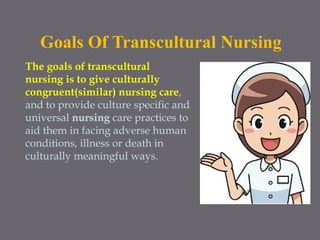
Goals Of TransculturalNursing
The goals of transcultural
nursing is to give culturally
congruent(similar) nursing care,
and to provide culture specific and
universal nursing care practices to
aid them in facing adverse human
conditions, illness or death in
culturally meaningful ways.
10.
Importance of transcultural
Nursing
1.Thereis a marked increase in the migration of people
within and between countries world wide.
2.There has been a rise in people expecting their
cultural belief, values, and lifeways to be understood
and respected by nurses and other health care
providers.
3.The increased use of health care technology
sometimes conflicts with cultural values of clients.
11.
4) World widethere are cultural conflicts, clashes, and
violence that have an impact health care as more
cultures interact with one another.
5) There was an increase in legal issues resulting from
cultural conflict, negligence, ignorance, and imposition
of health care practices.
6) There has been a rise in feminism and gender issues,
with new demands on health care systems to meet the
needs of woman and children
12.
Models of transculturalNursing
There are two popular models widely used in
the field
1:Leininger’s Sunrise Model
2:The Giger and Davidhizar: ‘Transcultural
Assessment Model.
13.
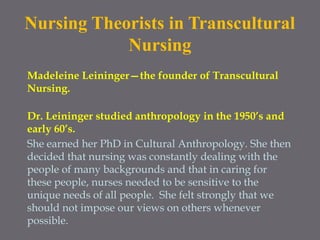
Nursing Theorists inTranscultural
Nursing
Madeleine Leininger—the founder of Transcultural
Nursing.
Dr. Leininger studied anthropology in the 1950’s and
early 60’s.
She earned her PhD in Cultural Anthropology. She then
decided that nursing was constantly dealing with the
people of many backgrounds and that in caring for
these people, nurses needed to be sensitive to the
unique needs of all people. She felt strongly that we
should not impose our views on others whenever
possible.
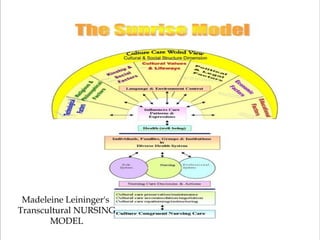
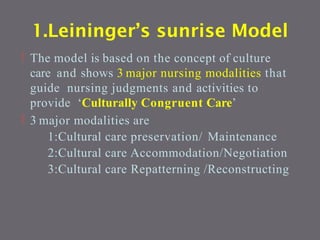
1.Leininger’s sunrise Model
The model is based on the concept of culture
care and shows 3 major nursing modalities that
guide nursing judgments and activities to
provide ‘Culturally Congruent Care’
3 major modalities are
1:Cultural care preservation/ Maintenance
2:Cultural care Accommodation/Negotiation
3:Cultural care Repatterning /Reconstructing
16.
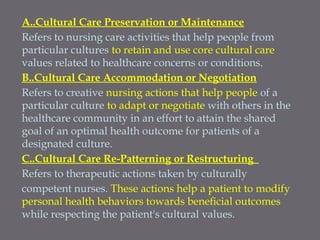
A..Cultural Care Preservationor Maintenance
Refers to nursing care activities that help people from
particular cultures to retain and use core cultural care
values related to healthcare concerns or conditions.
B..Cultural Care Accommodation or Negotiation
Refers to creative nursing actions that help people of a
particular culture to adapt or negotiate with others in the
healthcare community in an effort to attain the shared
goal of an optimal health outcome for patients of a
designated culture.
C..Cultural Care Re-Patterning or Restructuring
Refers to therapeutic actions taken by culturally
competent nurses. These actions help a patient to modify
personal health behaviors towards beneficial outcomes
while respecting the patient's cultural values.
17.
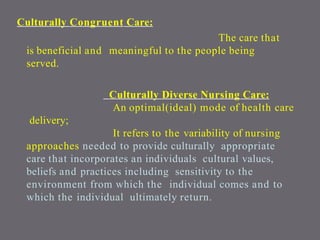
Culturally Congruent Care:
Thecare that
is beneficial and meaningful to the people being
served.
Culturally Diverse Nursing Care:
An optimal(ideal) mode of health care
delivery;
It refers to the variability of nursing
approaches needed to provide culturally appropriate
care that incorporates an individuals cultural values,
beliefs and practices including sensitivity to the
environment from which the individual comes and to
which the individual ultimately return.
18.
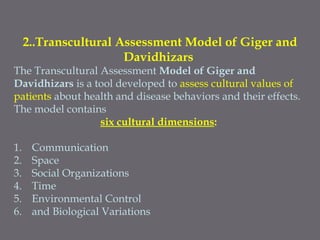
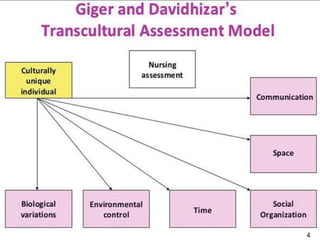
2..Transcultural Assessment Modelof Giger and
Davidhizars
The Transcultural Assessment Model of Giger and
Davidhizars is a tool developed to assess cultural values of
patients about health and disease behaviors and their effects.
The model contains
six cultural dimensions:
1. Communication
2. Space
3. Social Organizations
4. Time
5. Environmental Control
6. and Biological Variations
20.
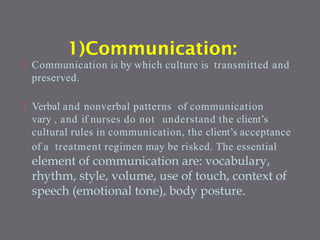
1)Communication:
Communication isby which culture is transmitted and
preserved.
Verbal and nonverbal patterns of communication
vary , and if nurses do not understand the client’s
cultural rules in communication, the client’s acceptance
of a treatment regimen may be risked. The essential
element of communication are: vocabulary,
rhythm, style, volume, use of touch, context of
speech (emotional tone), body posture.
21.
2)space:
Space refers todistance and intimacy techniques
applied when involving verbally or nonverbally to
others . All communication occurs in the context of
space . there are 4 distinct(different) zones of
interpersonal space:
1. intimate,
2. personal,
3. social and consultative, and public.
4. Rules concerning personal distance vary from
culture to culture
22.
3)Social organization
Socialorganization is a pattern of relationships
between individuals and social groups . Family
group is the most influential social organization.
Family structure, religious, values, beliefs, and role
assignments, may all relate to ethnicity and
culture .
For example mother will give her kidney to
transplant and father is responsible for meeting
financial expenses.
23.
4) Time Orientation
Timeis an important aspect of interpersonal
communication.
Time orientation of a culture reflects a
preference toward past, present, or future
thinking. It effects how a culture values time
and believes they can control it.
These differences in time orientation may
become important in health-care measures
such as long- term planning and explanations
of medication schedule.
24.
5: Environmental control
Environmentalcontrol refers to the ability of the person
to control nature.
Some groups perceive man as having control over nature;
others perceive humans to be dominated by nature,
while others see coordination in relationships between
humans and nature
For example, some Asians and Native Americans may
perceive that illness is because of other forces and that
medicine is only capable of relieving the symptoms rather
than curing the disease. These groups are likely to look
for naturalistic solutions, such as herbs and hot and cold
treatments to resolve or cure a cancerous condition
25.
6:Biological variation
It iswell and understood are the biological differences
that exist among people in various racial group.
(1) body structure
(2) skin colour
(3) other visible physical characteristics
(4) genetic variations
(5) susceptibility to disease
(6) nutritional preferences and deficiencies
(7) psychological characteristics
known fact that people differ culturally. less recognized
1. Cultural skillability to conduct a cultural assessment
to collect relevant cultural data regarding clients
presenting problem as well as conducting a culturally
based physical assessment.
2. Cultural encounter the process that encourages
nurses to directly engage in cross-cultural interactions
with patients from culturally diverse backgrounds.
28.
3. Cultural awarenessknowing other cultures exists and
knowing biases you may have; process of conducting a
self –examination of one’s own biases towards other
cultures and the in depth exploration of one’s cultural.
4. Cultural knowledge. process in which health care
professional find a sound info base on worldview of
different cultural / ethic groups, diseases and health
condition, and variations in drug metabolism among
different ethnic groups.
29.
5. Cultural desireThis component involves the
willingness/motivation to be open to others, to
accept and respect cultural differences and to
be willing to learn from others.



![ONFH[AVN HIP] -TRIPLE REGIME -A NOVAL SURGICAL CONCEPT .pptx](https://cdn.slidesharecdn.com/ss_thumbnails/onfhavnhip2026koaconcalicutdrgokuldevdrmashraf-260210064517-213ec005-thumbnail.jpg?width=640&height=640&fit=bounds)


![PERI-PROSTHETIC FRACTURE NAIL-PLATE CONSTRUCT [NPC].pptx](https://cdn.slidesharecdn.com/ss_thumbnails/drarunkumardrmohamedashrafperiprostheticfrasturenail-plateconstructnpc-260209164459-7e9d15a1-thumbnail.jpg?width=640&height=640&fit=bounds)
![CTEV [ clubfoot] DR ARUN LAL ,DR MOHAMED ASHRAF travancore medical college k...](https://cdn.slidesharecdn.com/ss_thumbnails/ctevclubfootdrarunlaldrmohamedashraftravancoremedicalcollegekollamkeralaindia-260208063247-18fc466c-thumbnail.jpg?width=640&height=640&fit=bounds)


