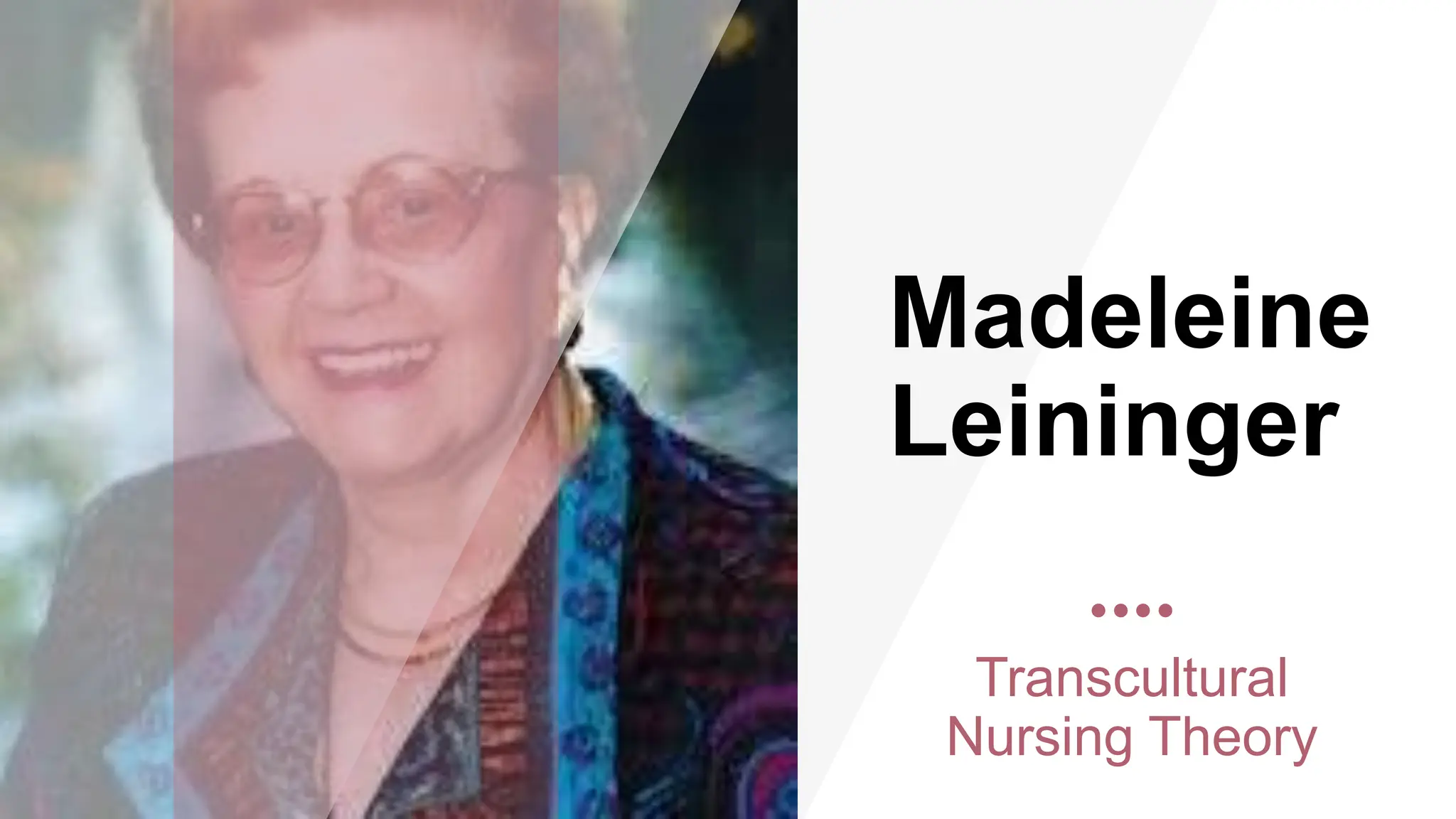
Madeleine
Leininger
Transcultural
Nursing Theory
Biography of
Madeleine
Leininger
Madeleine Leininger is a nursing
theorist who developed the
Transcultural Nursing Theory or
Culture Care Nursing Theory.
 She was an internationally known
educator, author, theorist,
administrator, researcher, consultant,
public speaker, and the developer of
the concept of transcultural nursing
that has a great impact on how to
deal with patients of different culture
and cultural background.
 She is a Certified Transcultural Nurse, a Fellow of
the Royal College of Nursing in Australia, and a
Fellow of the American Academy of Nursing. Her
theory is now a nursing discipline that is an integral
part of how nurses practice in the healthcare field
today.
Early Life
 Madeleine Leininger was born on July 13, 1925, in Sutton, Nebraska. She lived on a farm
with her four brothers and sisters and graduated from Sutton High School. After graduation
from Sutton High, she was in the U.S. Army Nursing Corps while pursuing a basic nursing
program. Her aunt, who had congenital heart disease, led her to pursue a career in
nursing.
Education
 In 1945, Madeleine Leininger, together with her sister, entered the Cadet Nurse Corps, a
federally-funded program to increase the number of nurses trained to meet anticipated
needs during World War II.
 She earned a nursing diploma from St. Anthony’s Hospital School of Nursing, followed by
undergraduate degrees at Mount St. Scholastica College and Creighton University.
 Leininger opened a psychiatric nursing service and educational program at Creighton
University in Omaha, Nebraska. She earned the equivalent of a BSN through her studies
in biological sciences, nursing administration, teaching, and curriculum during 1951-1954.
 She received a Master of Science in Nursing from the Catholic University of America in
1954.
 And in 1965, Leininger embarked upon a doctoral program in Cultural and Social
Anthropology at the University of Washington in Seattle and became the first professional
nurse to earn a Ph.D. in anthropology.
Career and Appointments of Madeleine Leininger
 In 1950, while working in a child guidance home she experienced what
she described as a cultural shock when she realized that children’s
recurrent behavioral patterns appeared to have a cultural basis. She
identified a lack of cultural and care knowledge as the missing link to
nursing.
 In 1954, she moved on to serve as Associate Professor of Nursing and
Director of the Graduate Program in Psychiatric Nursing at the University
of Cincinnati. She also studied in this university, pursuing further graduate
studies in curriculum, social sciences, and nursing.
 She was the first in the 1960s to coin the concept of “culturally congruent
care,” which was the goal of the Theory of Culture Care, and today the
concept is being used globally.
 She was appointed Professor of Nursing and Anthropology at the
University of Colorado — the first joint appointment of a nursing professor
and a second discipline in the United States.
Career and Appointments of Madeleine Leininger
 As for being a pioneer nurse anthropologist, Leininger was
appointed Dean of the University of Washington, School of
Nursing in 1969 and remained in that position until 1974. In
1973, under her leadership, the University of Washington was
recognized as the outstanding public institutional school of
nursing in the United States.
 Her appointment followed a trip to New Guinea in the 1960s that
opened her eyes to the need for nurses to understand their
patients’ culture and background to provide care. She is
considered by some to be the “Margaret Mead of nursing” and is
recognized worldwide as the founder of transcultural nursing, a
program that she created at the School in 1974.
 From 1974 to 1980, Leininger served as Dean, Professor of
Nursing, Adjunct Professor of Anthropology, and Director of the
Center for Nursing Research and the Doctoral and Transcultural
Nursing Programs at the University of Utah College Nursing.
6
Career and Appointments of Madeleine Leininger
 She was the first full-time President of the American
Association of Colleges of Nursing and one of the first
members of the American Academy of Nursing in 1975.
 Leininger’s professional career is recognized as an educator
and academic administrator from 1956 to 1995, a writer from
1961 to 1995, a lecturer from 1965 to 1995, a consultant from
1971 to 1992, and a leader in the field of transcultural nursing
from 1966 to 1995.
 She was Professor Emeritus of Nursing at Wayne State
University and an adjunct faculty member at the University of
Nebraska Medical Center in Omaha and retired as the former
in 1995.
7
Transcultural NursingTheory
 Through her
observations, while
working as a nurse,
Madeleine Leininger
identified a lack of cultural
and care knowledge as
the missing component to
a nurse’s understanding
of the many variations
required inpatient care to
support compliance,
healing, and wellness,
which led her to develop
the theory of
Transcultural Nursing
also known as Culture
Care Theory.
 This theory attempts
to provide culturally
congruent nursing
care through
“cognitively based
assistive, supportive,
facilitative, or enabling
acts or decisions that
are mostly tailor-made
to fit with the
individual, group’s, or
institution’s cultural
values, beliefs, and
lifeways.”
 Leininger’s theory’s
main focus is for
nursing care to fit with
or have beneficial
meaning and health
outcomes for people of
different or similar
cultural backgrounds.
With these, she has
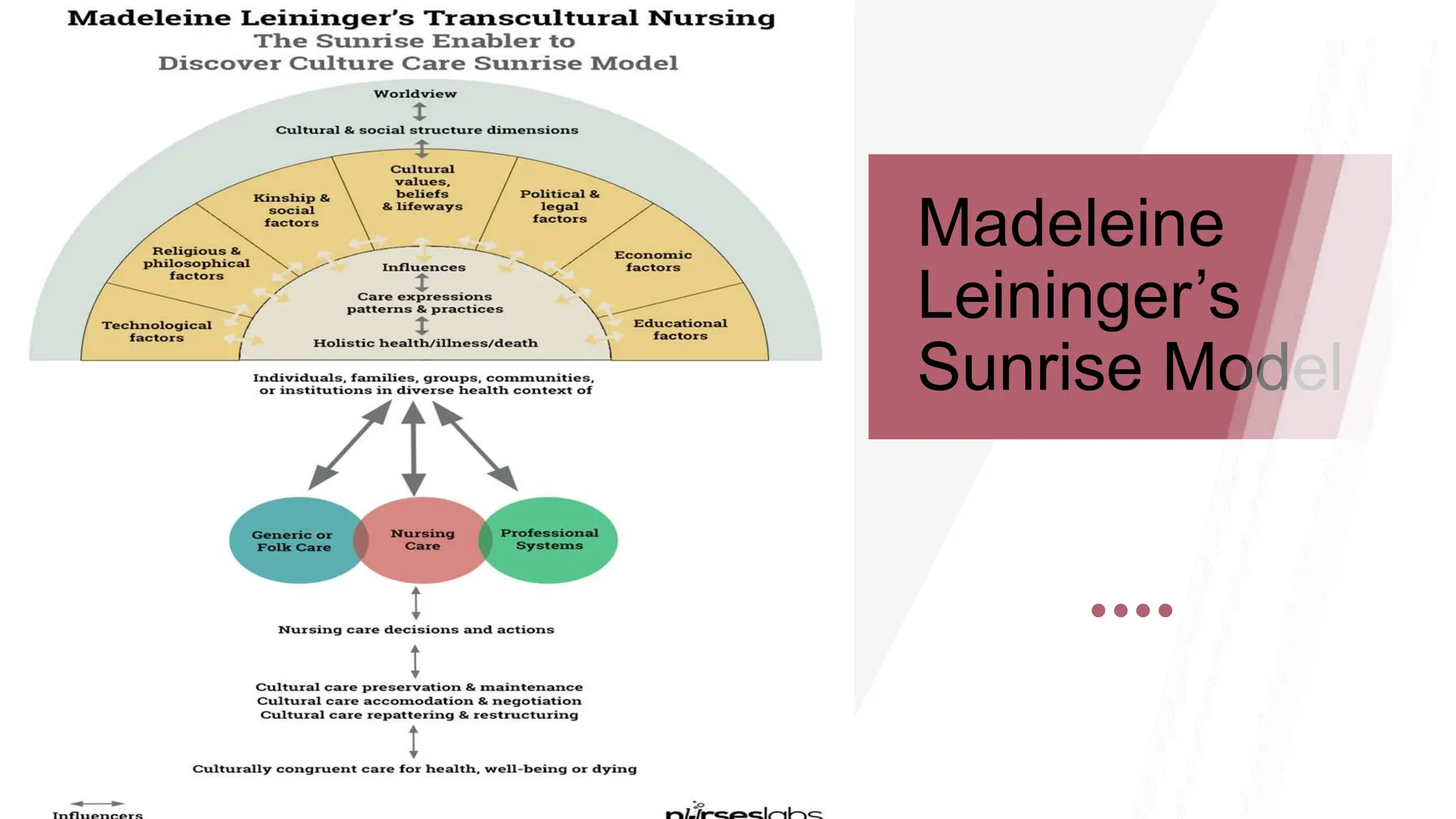
developed the Sunrise
Model in a logical order
to demonstrate the
interrelationships of the
concepts in her theory
of Culture Care
Diversity and
Universality.
8
Leininger’s Transcultural Nursing Theory
 Involves knowing and understanding different cultures concerning nursing
and health-illness caring practices, beliefs, and values to provide
meaningful and efficacious nursing care services to people’s cultural
values health-illness context.
 It focuses on the fact that different cultures have different caring
behaviors and different health and illness values, beliefs, and patterns of
behaviors.
 The cultural care worldview flows into knowledge about individuals,
families, groups, communities, and institutions in diverse health care
systems. This knowledge provides culturally specific meanings and
expressions about care and health. The next focus is on the generic or
folk system, professional care system(s), and nursing care. Information
about these systems includes the characteristics and the specific care
features of each. This information allows for the identification of
similarities and differences or cultural care universality and cultural
care diversity.
9
Description
 In 1995, Madeleine Leininger defined transcultural nursing as “a
substantive area of study and practiced focused on comparative
cultural care (caring) values, beliefs, and practices of individuals
or groups of similar or different cultures to provide culture-specific
and universal nursing care practices in promoting health or well-
being or to help people to face unfavorable human conditions,
illness, or death in culturally meaningful ways.”
 The Transcultural Nursing Theory first appeared in Leininger’s
Culture Care Diversity and Universality, published in 1991, but it
was developed in the 1950s. The theory was further developed in
her book Transcultural Nursing, which was published in 1995. In
the third edition of Transcultural Nursing, published in 2002, the
theory-based research and the Transcultural theory application
are explained.
10
Major Concepts of the Transcultural Nursing Theory
Transcultural Nursing
 Transcultural nursing is defined as a learned subfield or branch of nursing
that focuses upon the comparative study and analysis of cultures
concerning nursing and health-illness caring practices, beliefs, and
values to provide meaningful and efficacious nursing care services to
their cultural values and health-illness context.
Ethnonursing
 This is the study of nursing care beliefs, values, and practices as
cognitively perceived and known by a designated culture through their
direct experience, beliefs, and value system (Leininger, 1979).
Nursing
 Nursing is defined as a learned humanistic and scientific profession
and discipline which is focused on human care phenomena and
activities to assist, support, facilitate, or enable individuals or groups to
maintain or regain their well-being (or health) in culturally meaningful
and beneficial ways, or to help people face handicaps or death.
11
Major Concepts of the Transcultural Nursing Theory
Professional Nursing Care (Caring)
 Professional nursing care (caring) is defined as formal and cognitively
learned professional care knowledge and practice skills obtained through
educational institutions that are used to provide assistive, supportive,
enabling, or facilitative acts to or for another individual or group to
improve a human health condition (or well-being), disability, lifeway, or to
work with dying clients..
Cultural Congruent (Nursing) Care
 Cultural congruent (nursing) care is defined as those cognitively based
assistive, supportive, facilitative, or enabling acts or decisions that are
tailor-made to fit with the individual, group, or institutional, cultural
values, beliefs, and lifeways to provide or support meaningful,
beneficial, and satisfying health care, or well-being services.
Health
 It is a state of well-being that is culturally defined, valued, and
practiced. It reflects individuals’ (or groups) ‘ ability to perform their
daily role activities in culturally expressed, beneficial, and patterned
12
Major Concepts of the Transcultural Nursing Theory
Human Beings
 Such are believed to be caring and capable of being concerned about
others’ needs, well-being, and survival. Leininger also indicates that
nursing as a caring science should focus beyond traditional nurse-patient
interactions and dyads to include families, groups, communities, total
cultures, and institutions.
Society and Environment
 Leininger did not define these terms; she speaks instead of worldview,
social structure, and environmental context.
Worldview
 Worldview is how people look at the world, or the universe, and form a
“picture or value stance” about the world and their lives.
13
Major Concepts of the Transcultural Nursing Theory
Cultural and Social Structure Dimensions
 Cultural and social structure dimensions are defined as involving the
dynamic patterns and features of interrelated structural and
organizational factors of a particular culture (subculture or society) which
includes religious, kinship (social), political (and legal), economic,
educational, technological, and cultural values, ethnohistorical factors,
and how these factors may be interrelated and function to influence
human behavior in different environmental contexts.
Environmental Context
 Environmental context is the totality of an event, situation, or particular
experience that gives meaning to human expressions, interpretations,
and social interactions in particular physical, ecological, sociopolitical,
and/or cultural settings.
Culture
 Culture is learned, shared, and transmitted values, beliefs, norms, and
lifeways of a particular group that guides their thinking, decisions, and
actions in patterned ways.
14
Major Concepts of the Transcultural Nursing Theory
Culture Care
 Culture care is defined as the subjectively and objectively learned and
transmitted values, beliefs, and patterned lifeways that assist, support,
facilitate, or enable another individual or group to maintain their well-
being, health, improve their human condition lifeway, or deal with illness,
handicaps or death.
Culture Care Diversity
 Culture care diversity indicates the variabilities and/or differences in
meanings, patterns, values, lifeways, or symbols of care within or
between collectives related to assistive, supportive, or enabling human
care expressions.
Culture Care Universality
 Culture care universality indicates the common, similar, or dominant
uniform care meanings, patterns, values, lifeways, or symbols manifest
among many cultures and reflect assistive, supportive, facilitative, or
enabling ways to help people. (Leininger, 1991)
15
Major Concepts of the Transcultural Nursing Theory
Generic (Folk or Lay) Care Systems
 Generic (folk or lay) care systems are culturally learned and transmitted,
indigenous (or traditional), folk (home-based) knowledge and skills used
to provide assistive, supportive, enabling, or facilitative acts toward or for
another individual, group, or institution with evident or anticipated needs
to ameliorate or improve a human life way, health condition (or well-
being), or to deal with handicaps and death situations.
Subconcepts
 The following are the subconcepts of the Transcultural Nursing Theory
of Madeleine Leininger and their definitions:
Etic
Knowledge gained from direct experience or directly from those who
have experienced it. It is generic or folk knowledge.
16
Madeleine
Leininger’s
Sunrise Model
18
 The Sunrise Model is relevant because it enables nurses to develop critical
and complex thoughts about nursing practice. These thoughts should consider
and integrate cultural and social structure dimensions in each specific context,
besides nursing care’s biological and psychological aspects.
 The cultural care worldview flows into knowledge about individuals, families,
groups, communities, and institutions in diverse health care systems. This
knowledge provides culturally specific meanings and expressions concerning
care and health. The next focus is on the generic or folk system, professional
care systems, and nursing care. Information about these systems includes the
characteristics and the specific care features of each. This information allows
for the identification of similarities and differences or cultural care universality
and cultural care diversity.
 Next are nursing care decisions and actions which involve cultural care
preservation or maintenance, cultural care accommodation or negotiation, and
cultural care repatterning or restructuring. It is here that nursing care is
delivered.
Sunrise Model of Madeleine Leininger’s Theory
19
Three modes of nursing care decisions and actions
1. Cultural care preservation or Maintenance
 Cultural care preservation is also known as maintenance. It includes those
assistive, supporting, facilitative, or enabling professional actions and decisions
that help people of a particular culture to retain and/or preserve relevant care
values so that they can maintain their well-being, recover from illness, or face
handicaps and/or death.
2. Cultural care accommodation or Negotiation
 Cultural care accommodation, also known as negotiation, includes those assistive,
supportive, facilitative, or enabling creative professional actions and decisions that
help people of a designated culture to adapt to or negotiate with others for a
beneficial or satisfying health outcome with professional care providers.
3. Culture care repatterning or Restructuring
 Culture care repatterning or restructuring includes those assistive, supporting,
facilitative, or enabling professional actions and decisions that help clients reorder,
change, or greatly modify their lifeways for new, different, and beneficial health
care pattern while respecting the clients’ cultural values and beliefs and still
providing a beneficial or healthier lifeway than before the changes were
20
Assumptions
• Different cultures perceive, know, and practice care differently, yet there are some
commonalities about care among all world cultures.
• Values, beliefs, and practices for culturally related care are shaped by, and often
embedded in, “the worldview, language, religious (or spiritual), kinship (social),
political (or legal), educational, economic, technological, ethnohistorical, and
environmental context of the culture.
• While human care is universal across cultures, caring may be demonstrated through
diverse expressions, actions, patterns, lifestyles, and meanings.
• Cultural care is the broadest holistic means to know, explain, interpret, and predict
nursing care phenomena to guide nursing care practices.
• All cultures have generic or folk health care practices, that professional practices
vary across cultures, and that there will be cultural similarities and differences
between the care-receivers (generic) and the professional caregivers in any culture.
• Care is the distinct, dominant, unifying, and central focus of nursing, and while
curing and healing cannot occur effectively without care, care may occur without a
cure.
• Care and caring are essential for humans’ survival and their growth,
health, well-being, healing, and ability to deal with handicaps and death.
• Nursing, as a transcultural care discipline and profession, has a central
purpose of serving human beings in all areas of the world; that when
culturally based nursing care is beneficial and healthy, it contributes to
the well-being of the client(s) – whether individuals, groups, families,
communities, or institutions – as they function within the context of their
environments.
• Nursing care will be culturally congruent or beneficial only when the nurse
knows the clients. The clients’ patterns, expressions, and cultural values
are used in appropriate and meaningful ways by the nurse with the
clients.
• If clients receive nursing care that is not at least reasonably culturally
congruent (that is, compatible with and respectful of the clients’ lifeways,
beliefs, and values), the client will demonstrate signs of stress,
noncompliance, cultural conflicts, and/or ethical or moral concerns.
21
Analysis
 In Leininger’s nursing theory, it was stated that the nurse would help the client move
towards amelioration or improvement of their health practice or condition. This
statement would be of great difficulty for the nurse because instilling new ideas in a
different culture might present an intrusive intent for the “insiders.” Culture is a strong
set of practices developed over generations that would make it difficult to penetrate.
 According to transcultural nursing, nursing care aims to provide care congruent with
cultural values, beliefs, and practices.The whole activity of immersing yourself within a
different culture is time-consuming to understand their beliefs and practices fully.
Another is that it would be costly on the part of the nurse.
 Cultural knowledge plays a vital role for nurses on how to deal with the patients. To
start, it helps nurses to be aware of how the patient’s culture and faith system provide
resources for their experiences with illness, suffering, and even death. It helps nurses
understand and respect the diversity that is often present in a nurse’s patient load. It
also helps strengthen a nurse’s commitment to nursing based on nurse-patient
relationships and emphasizing the whole person rather than viewing the patient as
simply a set of symptoms or illness. Finally, using cultural knowledge to treat a patient
also helps a nurse be open-minded to treatments that can be considered non-
traditional, such as spiritually based therapies like meditation and anointing.
22
 Nowadays, nurses must be sensitive to their patients’ cultural
backgrounds when creating a nursing plan. This is especially important
since so many people’s culture is so integral in who they are as
individuals, and it is that culture that can greatly affect their health and
their reactions to treatments and care. With these, awareness of the
differences allows the nurse to design culture-specific nursing
interventions.
 Through Leininger’s theory, nurses can observe how a patient’s cultural
background is related to their health and use that knowledge to create a
nursing plan that will help the patient get healthy quickly while still being
sensitive to his or her cultural background. Care and caring are essential
for humans’ survival and their growth, health, well-being, healing, and
ability to deal with handicaps and death.
23
THANK YOU
FLORA M. TEL=EQUEN
pia2012mencio@gmail.com

Madeleine Leininger transcultural theory

  • 1.
  • 2.
    Biography of Madeleine Leininger Madeleine Leiningeris a nursing theorist who developed the Transcultural Nursing Theory or Culture Care Nursing Theory.
  • 3.
     She wasan internationally known educator, author, theorist, administrator, researcher, consultant, public speaker, and the developer of the concept of transcultural nursing that has a great impact on how to deal with patients of different culture and cultural background.  She is a Certified Transcultural Nurse, a Fellow of the Royal College of Nursing in Australia, and a Fellow of the American Academy of Nursing. Her theory is now a nursing discipline that is an integral part of how nurses practice in the healthcare field today.
  • 4.
    Early Life  MadeleineLeininger was born on July 13, 1925, in Sutton, Nebraska. She lived on a farm with her four brothers and sisters and graduated from Sutton High School. After graduation from Sutton High, she was in the U.S. Army Nursing Corps while pursuing a basic nursing program. Her aunt, who had congenital heart disease, led her to pursue a career in nursing. Education  In 1945, Madeleine Leininger, together with her sister, entered the Cadet Nurse Corps, a federally-funded program to increase the number of nurses trained to meet anticipated needs during World War II.  She earned a nursing diploma from St. Anthony’s Hospital School of Nursing, followed by undergraduate degrees at Mount St. Scholastica College and Creighton University.  Leininger opened a psychiatric nursing service and educational program at Creighton University in Omaha, Nebraska. She earned the equivalent of a BSN through her studies in biological sciences, nursing administration, teaching, and curriculum during 1951-1954.  She received a Master of Science in Nursing from the Catholic University of America in 1954.  And in 1965, Leininger embarked upon a doctoral program in Cultural and Social Anthropology at the University of Washington in Seattle and became the first professional nurse to earn a Ph.D. in anthropology.
  • 5.
    Career and Appointmentsof Madeleine Leininger  In 1950, while working in a child guidance home she experienced what she described as a cultural shock when she realized that children’s recurrent behavioral patterns appeared to have a cultural basis. She identified a lack of cultural and care knowledge as the missing link to nursing.  In 1954, she moved on to serve as Associate Professor of Nursing and Director of the Graduate Program in Psychiatric Nursing at the University of Cincinnati. She also studied in this university, pursuing further graduate studies in curriculum, social sciences, and nursing.  She was the first in the 1960s to coin the concept of “culturally congruent care,” which was the goal of the Theory of Culture Care, and today the concept is being used globally.  She was appointed Professor of Nursing and Anthropology at the University of Colorado — the first joint appointment of a nursing professor and a second discipline in the United States.
  • 6.
    Career and Appointmentsof Madeleine Leininger  As for being a pioneer nurse anthropologist, Leininger was appointed Dean of the University of Washington, School of Nursing in 1969 and remained in that position until 1974. In 1973, under her leadership, the University of Washington was recognized as the outstanding public institutional school of nursing in the United States.  Her appointment followed a trip to New Guinea in the 1960s that opened her eyes to the need for nurses to understand their patients’ culture and background to provide care. She is considered by some to be the “Margaret Mead of nursing” and is recognized worldwide as the founder of transcultural nursing, a program that she created at the School in 1974.  From 1974 to 1980, Leininger served as Dean, Professor of Nursing, Adjunct Professor of Anthropology, and Director of the Center for Nursing Research and the Doctoral and Transcultural Nursing Programs at the University of Utah College Nursing. 6
  • 7.
    Career and Appointmentsof Madeleine Leininger  She was the first full-time President of the American Association of Colleges of Nursing and one of the first members of the American Academy of Nursing in 1975.  Leininger’s professional career is recognized as an educator and academic administrator from 1956 to 1995, a writer from 1961 to 1995, a lecturer from 1965 to 1995, a consultant from 1971 to 1992, and a leader in the field of transcultural nursing from 1966 to 1995.  She was Professor Emeritus of Nursing at Wayne State University and an adjunct faculty member at the University of Nebraska Medical Center in Omaha and retired as the former in 1995. 7
  • 8.
    Transcultural NursingTheory  Throughher observations, while working as a nurse, Madeleine Leininger identified a lack of cultural and care knowledge as the missing component to a nurse’s understanding of the many variations required inpatient care to support compliance, healing, and wellness, which led her to develop the theory of Transcultural Nursing also known as Culture Care Theory.  This theory attempts to provide culturally congruent nursing care through “cognitively based assistive, supportive, facilitative, or enabling acts or decisions that are mostly tailor-made to fit with the individual, group’s, or institution’s cultural values, beliefs, and lifeways.”  Leininger’s theory’s main focus is for nursing care to fit with or have beneficial meaning and health outcomes for people of different or similar cultural backgrounds. With these, she has developed the Sunrise Model in a logical order to demonstrate the interrelationships of the concepts in her theory of Culture Care Diversity and Universality. 8
  • 9.
    Leininger’s Transcultural NursingTheory  Involves knowing and understanding different cultures concerning nursing and health-illness caring practices, beliefs, and values to provide meaningful and efficacious nursing care services to people’s cultural values health-illness context.  It focuses on the fact that different cultures have different caring behaviors and different health and illness values, beliefs, and patterns of behaviors.  The cultural care worldview flows into knowledge about individuals, families, groups, communities, and institutions in diverse health care systems. This knowledge provides culturally specific meanings and expressions about care and health. The next focus is on the generic or folk system, professional care system(s), and nursing care. Information about these systems includes the characteristics and the specific care features of each. This information allows for the identification of similarities and differences or cultural care universality and cultural care diversity. 9
  • 10.
    Description  In 1995,Madeleine Leininger defined transcultural nursing as “a substantive area of study and practiced focused on comparative cultural care (caring) values, beliefs, and practices of individuals or groups of similar or different cultures to provide culture-specific and universal nursing care practices in promoting health or well- being or to help people to face unfavorable human conditions, illness, or death in culturally meaningful ways.”  The Transcultural Nursing Theory first appeared in Leininger’s Culture Care Diversity and Universality, published in 1991, but it was developed in the 1950s. The theory was further developed in her book Transcultural Nursing, which was published in 1995. In the third edition of Transcultural Nursing, published in 2002, the theory-based research and the Transcultural theory application are explained. 10
  • 11.
    Major Concepts ofthe Transcultural Nursing Theory Transcultural Nursing  Transcultural nursing is defined as a learned subfield or branch of nursing that focuses upon the comparative study and analysis of cultures concerning nursing and health-illness caring practices, beliefs, and values to provide meaningful and efficacious nursing care services to their cultural values and health-illness context. Ethnonursing  This is the study of nursing care beliefs, values, and practices as cognitively perceived and known by a designated culture through their direct experience, beliefs, and value system (Leininger, 1979). Nursing  Nursing is defined as a learned humanistic and scientific profession and discipline which is focused on human care phenomena and activities to assist, support, facilitate, or enable individuals or groups to maintain or regain their well-being (or health) in culturally meaningful and beneficial ways, or to help people face handicaps or death. 11
  • 12.
    Major Concepts ofthe Transcultural Nursing Theory Professional Nursing Care (Caring)  Professional nursing care (caring) is defined as formal and cognitively learned professional care knowledge and practice skills obtained through educational institutions that are used to provide assistive, supportive, enabling, or facilitative acts to or for another individual or group to improve a human health condition (or well-being), disability, lifeway, or to work with dying clients.. Cultural Congruent (Nursing) Care  Cultural congruent (nursing) care is defined as those cognitively based assistive, supportive, facilitative, or enabling acts or decisions that are tailor-made to fit with the individual, group, or institutional, cultural values, beliefs, and lifeways to provide or support meaningful, beneficial, and satisfying health care, or well-being services. Health  It is a state of well-being that is culturally defined, valued, and practiced. It reflects individuals’ (or groups) ‘ ability to perform their daily role activities in culturally expressed, beneficial, and patterned 12
  • 13.
    Major Concepts ofthe Transcultural Nursing Theory Human Beings  Such are believed to be caring and capable of being concerned about others’ needs, well-being, and survival. Leininger also indicates that nursing as a caring science should focus beyond traditional nurse-patient interactions and dyads to include families, groups, communities, total cultures, and institutions. Society and Environment  Leininger did not define these terms; she speaks instead of worldview, social structure, and environmental context. Worldview  Worldview is how people look at the world, or the universe, and form a “picture or value stance” about the world and their lives. 13
  • 14.
    Major Concepts ofthe Transcultural Nursing Theory Cultural and Social Structure Dimensions  Cultural and social structure dimensions are defined as involving the dynamic patterns and features of interrelated structural and organizational factors of a particular culture (subculture or society) which includes religious, kinship (social), political (and legal), economic, educational, technological, and cultural values, ethnohistorical factors, and how these factors may be interrelated and function to influence human behavior in different environmental contexts. Environmental Context  Environmental context is the totality of an event, situation, or particular experience that gives meaning to human expressions, interpretations, and social interactions in particular physical, ecological, sociopolitical, and/or cultural settings. Culture  Culture is learned, shared, and transmitted values, beliefs, norms, and lifeways of a particular group that guides their thinking, decisions, and actions in patterned ways. 14
  • 15.
    Major Concepts ofthe Transcultural Nursing Theory Culture Care  Culture care is defined as the subjectively and objectively learned and transmitted values, beliefs, and patterned lifeways that assist, support, facilitate, or enable another individual or group to maintain their well- being, health, improve their human condition lifeway, or deal with illness, handicaps or death. Culture Care Diversity  Culture care diversity indicates the variabilities and/or differences in meanings, patterns, values, lifeways, or symbols of care within or between collectives related to assistive, supportive, or enabling human care expressions. Culture Care Universality  Culture care universality indicates the common, similar, or dominant uniform care meanings, patterns, values, lifeways, or symbols manifest among many cultures and reflect assistive, supportive, facilitative, or enabling ways to help people. (Leininger, 1991) 15
  • 16.
    Major Concepts ofthe Transcultural Nursing Theory Generic (Folk or Lay) Care Systems  Generic (folk or lay) care systems are culturally learned and transmitted, indigenous (or traditional), folk (home-based) knowledge and skills used to provide assistive, supportive, enabling, or facilitative acts toward or for another individual, group, or institution with evident or anticipated needs to ameliorate or improve a human life way, health condition (or well- being), or to deal with handicaps and death situations. Subconcepts  The following are the subconcepts of the Transcultural Nursing Theory of Madeleine Leininger and their definitions: Etic Knowledge gained from direct experience or directly from those who have experienced it. It is generic or folk knowledge. 16
  • 17.
  • 18.
    18  The SunriseModel is relevant because it enables nurses to develop critical and complex thoughts about nursing practice. These thoughts should consider and integrate cultural and social structure dimensions in each specific context, besides nursing care’s biological and psychological aspects.  The cultural care worldview flows into knowledge about individuals, families, groups, communities, and institutions in diverse health care systems. This knowledge provides culturally specific meanings and expressions concerning care and health. The next focus is on the generic or folk system, professional care systems, and nursing care. Information about these systems includes the characteristics and the specific care features of each. This information allows for the identification of similarities and differences or cultural care universality and cultural care diversity.  Next are nursing care decisions and actions which involve cultural care preservation or maintenance, cultural care accommodation or negotiation, and cultural care repatterning or restructuring. It is here that nursing care is delivered. Sunrise Model of Madeleine Leininger’s Theory
  • 19.
    19 Three modes ofnursing care decisions and actions 1. Cultural care preservation or Maintenance  Cultural care preservation is also known as maintenance. It includes those assistive, supporting, facilitative, or enabling professional actions and decisions that help people of a particular culture to retain and/or preserve relevant care values so that they can maintain their well-being, recover from illness, or face handicaps and/or death. 2. Cultural care accommodation or Negotiation  Cultural care accommodation, also known as negotiation, includes those assistive, supportive, facilitative, or enabling creative professional actions and decisions that help people of a designated culture to adapt to or negotiate with others for a beneficial or satisfying health outcome with professional care providers. 3. Culture care repatterning or Restructuring  Culture care repatterning or restructuring includes those assistive, supporting, facilitative, or enabling professional actions and decisions that help clients reorder, change, or greatly modify their lifeways for new, different, and beneficial health care pattern while respecting the clients’ cultural values and beliefs and still providing a beneficial or healthier lifeway than before the changes were
  • 20.
    20 Assumptions • Different culturesperceive, know, and practice care differently, yet there are some commonalities about care among all world cultures. • Values, beliefs, and practices for culturally related care are shaped by, and often embedded in, “the worldview, language, religious (or spiritual), kinship (social), political (or legal), educational, economic, technological, ethnohistorical, and environmental context of the culture. • While human care is universal across cultures, caring may be demonstrated through diverse expressions, actions, patterns, lifestyles, and meanings. • Cultural care is the broadest holistic means to know, explain, interpret, and predict nursing care phenomena to guide nursing care practices. • All cultures have generic or folk health care practices, that professional practices vary across cultures, and that there will be cultural similarities and differences between the care-receivers (generic) and the professional caregivers in any culture. • Care is the distinct, dominant, unifying, and central focus of nursing, and while curing and healing cannot occur effectively without care, care may occur without a cure.
  • 21.
    • Care andcaring are essential for humans’ survival and their growth, health, well-being, healing, and ability to deal with handicaps and death. • Nursing, as a transcultural care discipline and profession, has a central purpose of serving human beings in all areas of the world; that when culturally based nursing care is beneficial and healthy, it contributes to the well-being of the client(s) – whether individuals, groups, families, communities, or institutions – as they function within the context of their environments. • Nursing care will be culturally congruent or beneficial only when the nurse knows the clients. The clients’ patterns, expressions, and cultural values are used in appropriate and meaningful ways by the nurse with the clients. • If clients receive nursing care that is not at least reasonably culturally congruent (that is, compatible with and respectful of the clients’ lifeways, beliefs, and values), the client will demonstrate signs of stress, noncompliance, cultural conflicts, and/or ethical or moral concerns. 21
  • 22.
    Analysis  In Leininger’snursing theory, it was stated that the nurse would help the client move towards amelioration or improvement of their health practice or condition. This statement would be of great difficulty for the nurse because instilling new ideas in a different culture might present an intrusive intent for the “insiders.” Culture is a strong set of practices developed over generations that would make it difficult to penetrate.  According to transcultural nursing, nursing care aims to provide care congruent with cultural values, beliefs, and practices.The whole activity of immersing yourself within a different culture is time-consuming to understand their beliefs and practices fully. Another is that it would be costly on the part of the nurse.  Cultural knowledge plays a vital role for nurses on how to deal with the patients. To start, it helps nurses to be aware of how the patient’s culture and faith system provide resources for their experiences with illness, suffering, and even death. It helps nurses understand and respect the diversity that is often present in a nurse’s patient load. It also helps strengthen a nurse’s commitment to nursing based on nurse-patient relationships and emphasizing the whole person rather than viewing the patient as simply a set of symptoms or illness. Finally, using cultural knowledge to treat a patient also helps a nurse be open-minded to treatments that can be considered non- traditional, such as spiritually based therapies like meditation and anointing. 22
  • 23.
     Nowadays, nursesmust be sensitive to their patients’ cultural backgrounds when creating a nursing plan. This is especially important since so many people’s culture is so integral in who they are as individuals, and it is that culture that can greatly affect their health and their reactions to treatments and care. With these, awareness of the differences allows the nurse to design culture-specific nursing interventions.  Through Leininger’s theory, nurses can observe how a patient’s cultural background is related to their health and use that knowledge to create a nursing plan that will help the patient get healthy quickly while still being sensitive to his or her cultural background. Care and caring are essential for humans’ survival and their growth, health, well-being, healing, and ability to deal with handicaps and death. 23
  • 24.
    THANK YOU FLORA M.TEL=EQUEN pia2012mencio@gmail.com