Shoulder open and closed
kinematic chain
Syeda Nusrath Fatima (MPT)
INTRODUCTION
• Shoulder complex design enables great mobility of the upper
extremity.
Joints of shoulder complex-
i. Glenohumeral
ii. Acromioclavicular
iii. Sternoclavicular
iv. scapulothoracic
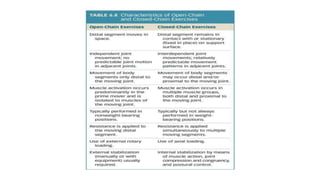
Kinematic chains:
Open kinematic chain-
One end of the series is free to move while the other is fixed, movement
can take place at one joint without causing motion at other joints in the
chain, although the segments will move in space.
Closed kinematic chain-
Both ends of the chain are fixed, movement at one joint not only moves
one or more other segments in space but will also create movement in
one or more other joints in the chain.
• Kinetic chain rehabilitation exercises use functional movement
patterns to facilitate scapular motion and then to strengthen scapular
musculature.
• Closed chain exercises is a co-contraction of both the agonist and the
antagonist muscle groups that help enhance stability of GH joint.
• Open chain exercises have increased stress forces against
glenohumeral joint
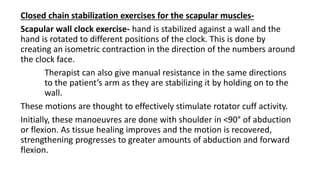
Closed chain stabilization exercises for the scapular muscles-
Scapular wall clock exercise- hand is stabilized against a wall and the
hand is rotated to different positions of the clock. This is done by
creating an isometric contraction in the direction of the numbers around
the clock face.
Therapist can also give manual resistance in the same directions
to the patient’s arm as they are stabilizing it by holding on to the
wall.
These motions are thought to effectively stimulate rotator cuff activity.
Initially, these manoeuvres are done with shoulder in <90° of abduction
or flexion. As tissue healing improves and the motion is recovered,
strengthening progresses to greater amounts of abduction and forward
flexion.
• Open chain exercises for the scapular stabilizers-
Open chain exercises are done with the distal end of the extremity no
longer stabilized against a fixed object.
Rotational exercises- should begin comfortably at patient’s side and
advance to 90° based on patient’s injury, level of discomfort and stage
of soft tissue healing.
Shoulder girdle functions in both open and closed chain activities.
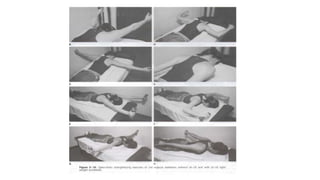
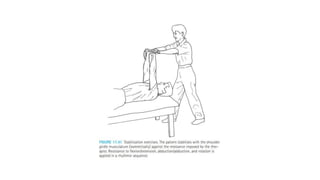
• Open chain stabilization exercises for the shoulder girdle-
Patient position- Supine holding a rod with elbows extended and
shoulders flexed to 90°
Therapist’s position- therapist stands near the patient’s head and grasps
the rod.
Procedure- patient is instructed to hold against or match the resistance
provided. Rod is pushed, pulled and rotated in various directions.
As the patient gains control, progress to sitting and then standing and
have the patient hold the arm in various positions as alternating
resistance is applied.
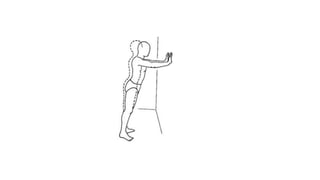
• Closed chain stabilization exercises-
Patient position- standing with shoulders flexed 90° and hands
supported against a wall or leaning into hands on a table.
Procedure- patient is asked to shift his body weight from one extremity
to the other (rock back and forth). Resistance is applied against the
shoulders.
progression- patient alternatively lift upper extremity and then
the other, so that one extremity bears the body weight and
stabilizes against the shifting load. Manual resistance is applied.
References
• Clinical orthopaedic rehabilitation- S. Brent Brotzman
• Therapeutic exercise- Carolyn Kisner
THANK YOU

Shoulder open and closed kinematic chain.pptx

  • 1.
    Shoulder open andclosed kinematic chain Syeda Nusrath Fatima (MPT)
  • 2.
    INTRODUCTION • Shoulder complexdesign enables great mobility of the upper extremity. Joints of shoulder complex- i. Glenohumeral ii. Acromioclavicular iii. Sternoclavicular iv. scapulothoracic
  • 3.
    Kinematic chains: Open kinematicchain- One end of the series is free to move while the other is fixed, movement can take place at one joint without causing motion at other joints in the chain, although the segments will move in space. Closed kinematic chain- Both ends of the chain are fixed, movement at one joint not only moves one or more other segments in space but will also create movement in one or more other joints in the chain.
  • 5.
    • Kinetic chainrehabilitation exercises use functional movement patterns to facilitate scapular motion and then to strengthen scapular musculature. • Closed chain exercises is a co-contraction of both the agonist and the antagonist muscle groups that help enhance stability of GH joint. • Open chain exercises have increased stress forces against glenohumeral joint
  • 6.
    Closed chain stabilizationexercises for the scapular muscles- Scapular wall clock exercise- hand is stabilized against a wall and the hand is rotated to different positions of the clock. This is done by creating an isometric contraction in the direction of the numbers around the clock face. Therapist can also give manual resistance in the same directions to the patient’s arm as they are stabilizing it by holding on to the wall. These motions are thought to effectively stimulate rotator cuff activity. Initially, these manoeuvres are done with shoulder in <90° of abduction or flexion. As tissue healing improves and the motion is recovered, strengthening progresses to greater amounts of abduction and forward flexion.
  • 8.
    • Open chainexercises for the scapular stabilizers- Open chain exercises are done with the distal end of the extremity no longer stabilized against a fixed object. Rotational exercises- should begin comfortably at patient’s side and advance to 90° based on patient’s injury, level of discomfort and stage of soft tissue healing.
  • 10.
    Shoulder girdle functionsin both open and closed chain activities. • Open chain stabilization exercises for the shoulder girdle- Patient position- Supine holding a rod with elbows extended and shoulders flexed to 90° Therapist’s position- therapist stands near the patient’s head and grasps the rod. Procedure- patient is instructed to hold against or match the resistance provided. Rod is pushed, pulled and rotated in various directions. As the patient gains control, progress to sitting and then standing and have the patient hold the arm in various positions as alternating resistance is applied.
  • 12.
    • Closed chainstabilization exercises- Patient position- standing with shoulders flexed 90° and hands supported against a wall or leaning into hands on a table. Procedure- patient is asked to shift his body weight from one extremity to the other (rock back and forth). Resistance is applied against the shoulders. progression- patient alternatively lift upper extremity and then the other, so that one extremity bears the body weight and stabilizes against the shifting load. Manual resistance is applied.
  • 14.
    References • Clinical orthopaedicrehabilitation- S. Brent Brotzman • Therapeutic exercise- Carolyn Kisner
  • 15.