Force and Motion Balanced and Unbalanced Force - Remind.ppt
1.
Force and Motion
Forceand Motion
Balanced and Unbalanced Forces
Balanced and Unbalanced Forces
Velocity and Acceleration
Velocity and Acceleration
2.
Motion
Motion
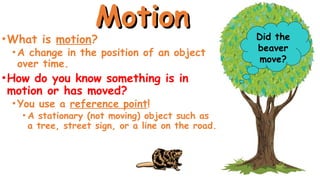
•What is motion?
•Achange in the position of an object
over time.
•How do you know something is in
motion or has moved?
•You use a reference point!
• A stationary (not moving) object such as
a tree, street sign, or a line on the road.
Did the
beaver
move?
3.
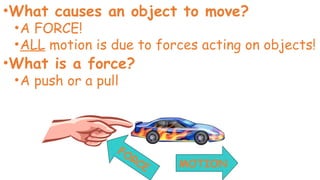
•What causes anobject to move?
•A FORCE!
•ALL motion is due to forces acting on objects!
•What is a force?
•A push or a pull
FORCE MOTION
4.
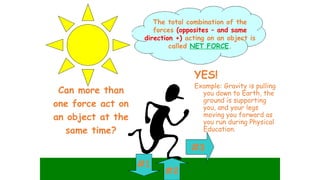
Can more than
oneforce act on
an object at the
same time?
#2
#3
#1
YES!
Example: Gravity is pulling
you down to Earth, the
ground is supporting
you, and your legs
moving you forward as
you run during Physical
Education.
The total combination of the
forces (opposites – and same
direction +) acting on an object is
called NET FORCE.
5.
Balanced Forces
Balanced Forces
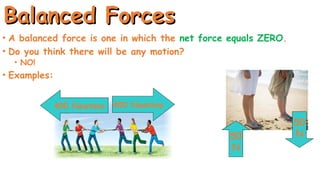
•A balanced force is one in which the net force equals ZERO.
• Do you think there will be any motion?
• NO!
• Examples:
50
N
50
N
400 Newtons
400 Newtons
6.
Unbalanced Forces
Unbalanced Forces
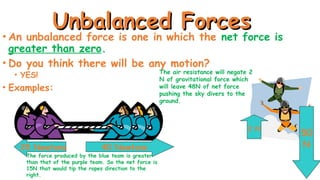
•An unbalanced force is one in which the net force is
greater than zero.
• Do you think there will be any motion?
• YES!
• Examples:
25 Newtons 40 Newtons
2 N
50
N
The air resistance will negate 2
N of gravitational force which
will leave 48N of net force
pushing the sky divers to the
ground.
The force produced by the blue team is greater
than that of the purple team. So the net force is
15N that would tip the ropes direction to the
right.
7.
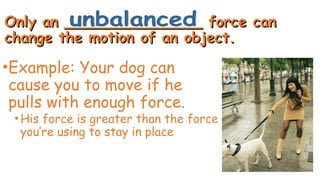
Only an _______________force can
Only an _______________ force can
change the motion of an object.
change the motion of an object.
•Example: Your dog can
cause you to move if he
pulls with enough force.
•His force is greater than the force
you’re using to stay in place
8.
What would happenif an unbalanced force
What would happen if an unbalanced force
acted on an object that’s already in
acted on an object that’s already in
motion?
motion?
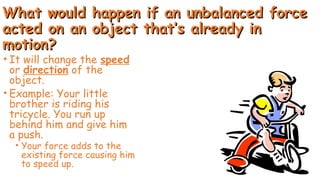
• It will change the speed
or direction of the
object.
• Example: Your little
brother is riding his
tricycle. You run up
behind him and give him
a push.
• Your force adds to the
existing force causing him
to speed up.
9.
Unbalanced forces canact in the
Unbalanced forces can act in the same
same
direction.
direction.
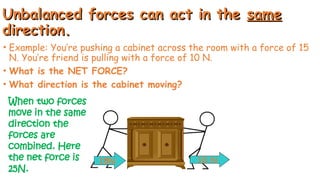
• Example: You’re pushing a cabinet across the room with a force of 15
N. You’re friend is pulling with a force of 10 N.
• What is the NET FORCE?
• What direction is the cabinet moving?
15N 10 N
When two forces
move in the same
direction the
forces are
combined. Here
the net force is
25N.
10.
Unbalanced forces canact in
Unbalanced forces can act in opposite
opposite
directions.
directions.
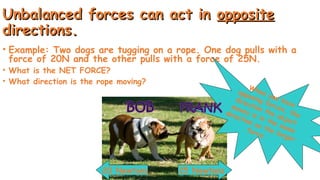
• Example: Two dogs are tugging on a rope. One dog pulls with a
force of 20N and the other pulls with a force of 25N.
• What is the NET FORCE?
• What direction is the rope moving?
25 Newtons
20 Newtons
When you have
opposing forces, the
direction the object
moves is in the same
direction as the larger
force.
11.
Motion and Force
Motion:A change in the position of an object over time. A reference point
enables a person to determine that something has moved or changed
position.
*Remember Benny the beaver, we knew he moved because he got closer to
our tree, the reference point.
ALL motion is caused by a force or forces.
Force: A force is a push or pull on an object causing a change in speed or
direction.
NET FORCE: The total combination of the forces acting on an object is called
NET FORCE.
Opposites forces will take away from each other(counteract their force due to
opposing direction); the larger forces newton's are always above the smaller
forces newton's 50N- 40N= 10 N net force. Forces moving in the same
direction will be added together; 50N + 40 N= 90N net force
12.
Balanced and UnbalancedForces
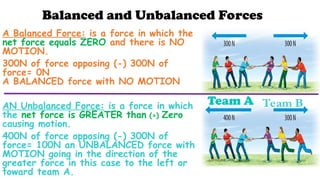
A Balanced Force: is a force in which the
net force equals ZERO and there is NO
MOTION.
300N of force opposing (-) 300N of
force= 0N
A BALANCED force with NO MOTION
AN Unbalanced Force: is a force in which
the net force is GREATER than (>) Zero
causing motion.
400N of force opposing (-) 300N of
force= 100N an UNBALANCED force with
MOTION going in the direction of the
greater force in this case to the left or
toward team A.
Team B
13.
*Special information toremember about
Unbalanced Forces
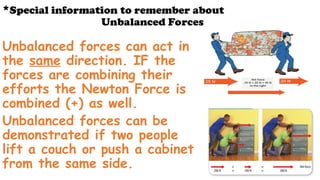
Unbalanced forces can act in
the same direction. IF the
forces are combining their
efforts the Newton Force is
combined (+) as well.
Unbalanced forces can be
demonstrated if two people
lift a couch or push a cabinet
from the same side.
14.
Newton’s 3 Lawsof Motion
1st
Law of Motion:
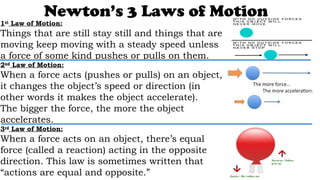
Things that are still stay still and things that are
moving keep moving with a steady speed unless
a force of some kind pushes or pulls on them.
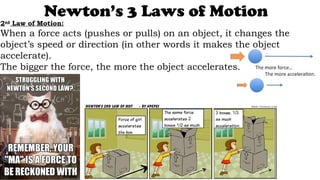
2nd
Law of Motion:
When a force acts (pushes or pulls) on an object,
it changes the object’s speed or direction (in
other words it makes the object accelerate).
The bigger the force, the more the object
accelerates.
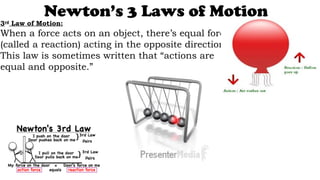
3rd
Law of Motion:
When a force acts on an object, there’s equal
force (called a reaction) acting in the opposite
direction. This law is sometimes written that
“actions are equal and opposite.”
15.
Newton’s 3 Lawsof Motion
1st
Law of Motion:
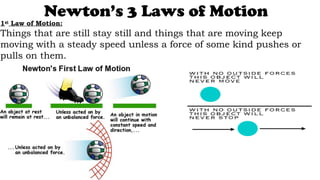
Things that are still stay still and things that are moving keep
moving with a steady speed unless a force of some kind pushes or
pulls on them.
16.
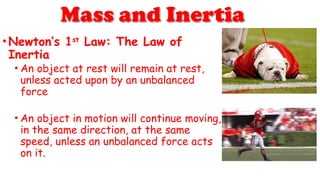
•Newton’s 1st
Law: TheLaw of
Inertia
• An object at rest will remain at rest,
unless acted upon by an unbalanced
force
• An object in motion will continue moving,
in the same direction, at the same
speed, unless an unbalanced force acts
on it.
17.
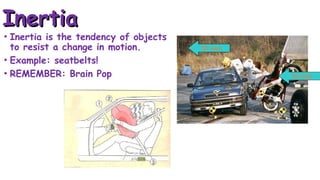
Inertia
Inertia
• Inertia isthe tendency of objects
to resist a change in motion.
• Example: seatbelts!
• REMEMBER: Brain Pop 50 mph
50 mph
19.
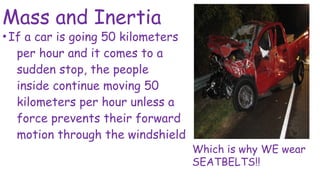
Mass and Inertia
•Ifa car is going 50 kilometers
per hour and it comes to a
sudden stop, the people
inside continue moving 50
kilometers per hour unless a
force prevents their forward
motion through the windshield
Which is why WE wear
SEATBELTS!!
20.
Newton’s 3 Lawsof Motion
2nd
Law of Motion:
When a force acts (pushes or pulls) on an object, it changes the
object’s speed or direction (in other words it makes the object
accelerate).
The bigger the force, the more the object accelerates.
21.
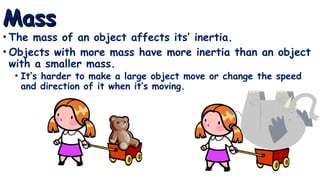
Mass
Mass
• The massof an object affects its’ inertia.
• Objects with more mass have more inertia than an object
with a smaller mass.
• It’s harder to make a large object move or change the speed
and direction of it when it’s moving.
Newton’s 3 Lawsof Motion
3rd
Law of Motion:
When a force acts on an object, there’s equal force
(called a reaction) acting in the opposite direction.
This law is sometimes written that “actions are
equal and opposite.”
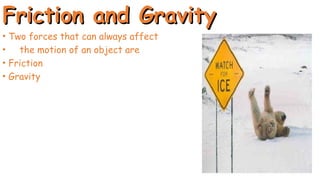
Friction and Gravity
Frictionand Gravity
• Two forces that can always affect
• the motion of an object are
• Friction
• Gravity
26.
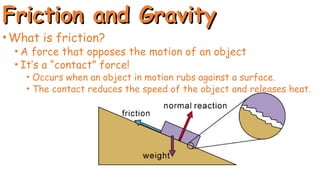
Friction and Gravity
Frictionand Gravity
•What is friction?
• A force that opposes the motion of an object
• It’s a “contact” force!
• Occurs when an object in motion rubs against a surface.
• The contact reduces the speed of the object and releases heat.
27.
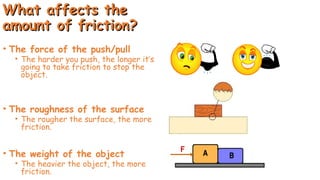
What affects the
Whataffects the
amount of friction?
amount of friction?
• The force of the push/pull
• The harder you push, the longer it’s
going to take friction to stop the
object.
• The roughness of the surface
• The rougher the surface, the more
friction.
• The weight of the object
• The heavier the object, the more
friction.
28.
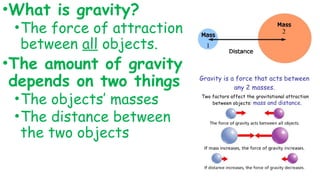
•What is gravity?
•Theforce of attraction
between all objects.
•The amount of gravity
depends on two things:
•The objects’ masses
•The distance between
the two objects
29.
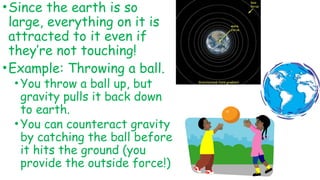
•Since the earthis so
large, everything on it is
attracted to it even if
they’re not touching!
•Example: Throwing a ball.
•You throw a ball up, but
gravity pulls it back down
to earth.
•You can counteract gravity
by catching the ball before
it hits the ground (you
provide the outside force!)
31.
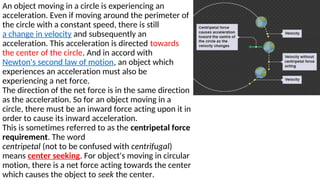
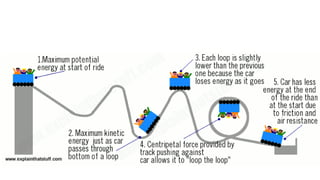
An object movingin a circle is experiencing an
acceleration. Even if moving around the perimeter of
the circle with a constant speed, there is still
a change in velocity and subsequently an
acceleration. This acceleration is directed towards
the center of the circle. And in accord with
Newton's second law of motion, an object which
experiences an acceleration must also be
experiencing a net force.
The direction of the net force is in the same direction
as the acceleration. So for an object moving in a
circle, there must be an inward force acting upon it in
order to cause its inward acceleration.
This is sometimes referred to as the centripetal force
requirement. The word
centripetal (not to be confused with centrifugal)
means center seeking. For object's moving in circular
motion, there is a net force acting towards the center
which causes the object to seek the center.


![GENERAL BEHAVIOR OF LIGHT [Autosaved].ppt](https://cdn.slidesharecdn.com/ss_thumbnails/generalbehavioroflightautosaved-260127030455-9b712450-thumbnail.jpg?width=640&height=640&fit=bounds)


