Introduction to Nervous System
RASHID KHAN MOHMAND
BS ANESTHESIA TECHNOLOGY
ANESTHESIA LECTURER
Definition
 The nervous system is the part of a body that coordinates its
actions by transmitting signals to and from different parts of
body
 The nervous system detects environmental changes that impact
the body, then works along with the endocrine system to
respond to such events
 So that nervous system controls all the activities of the body.
 It is quicker than othercontrol system in the body, like endocrine
system
Definition
 Nerve impulses can be initiated in response to stimuli from:
 outside the body, e.g. touch, light waves,temperature up or down
 inside the body, e.g. a change in the concentration of carbon dioxide in the
blood alters respiration; a thought may result in voluntary movement
 Transmission of nerve signals is both electrical and chemical. The action
potential travelling down the nerve axon is an electrical signal, but because
nerves do not come into direct contact with each other, the signal between a
nerve cell and the next cell in the chain is chemical
Classification
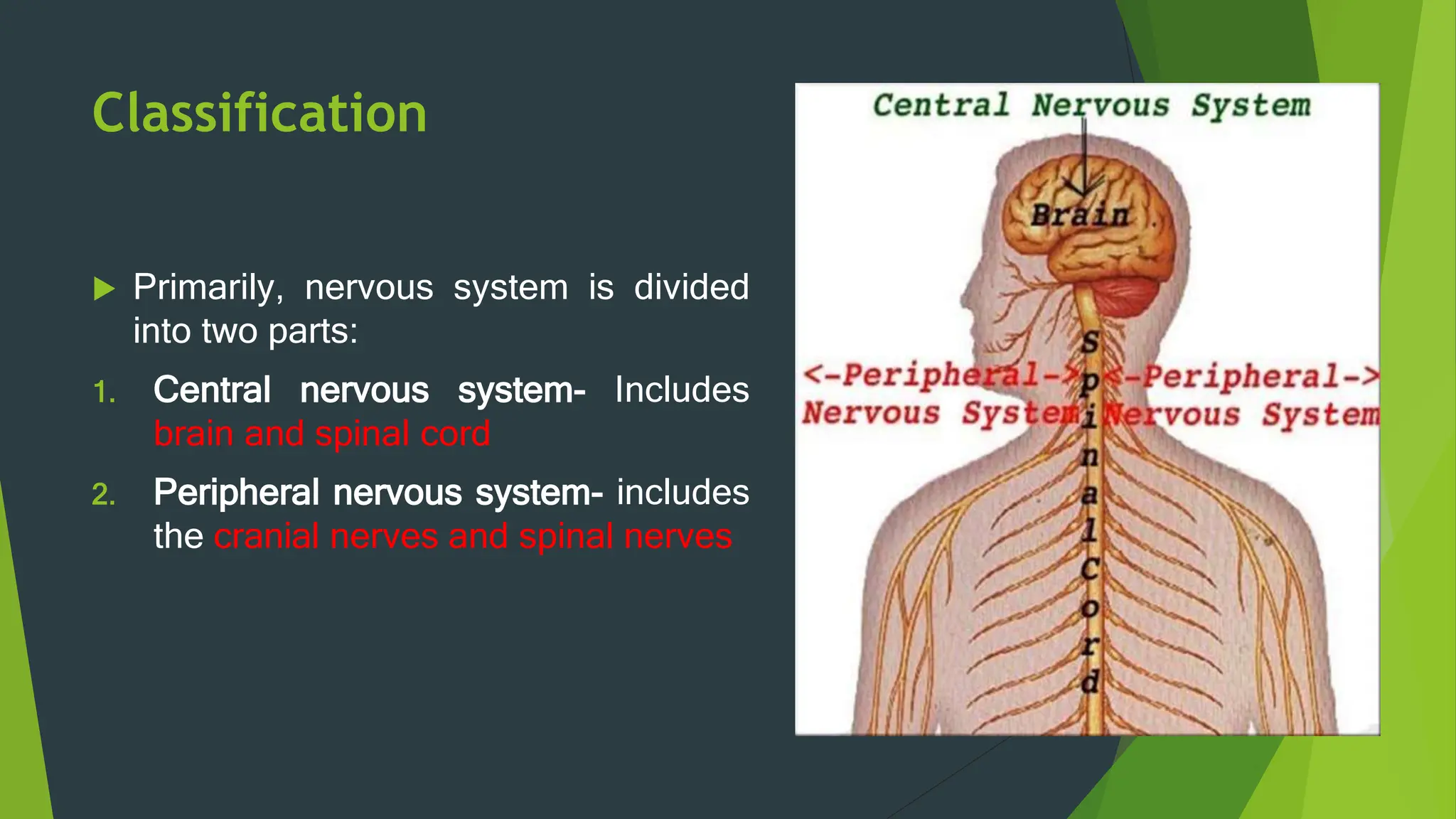
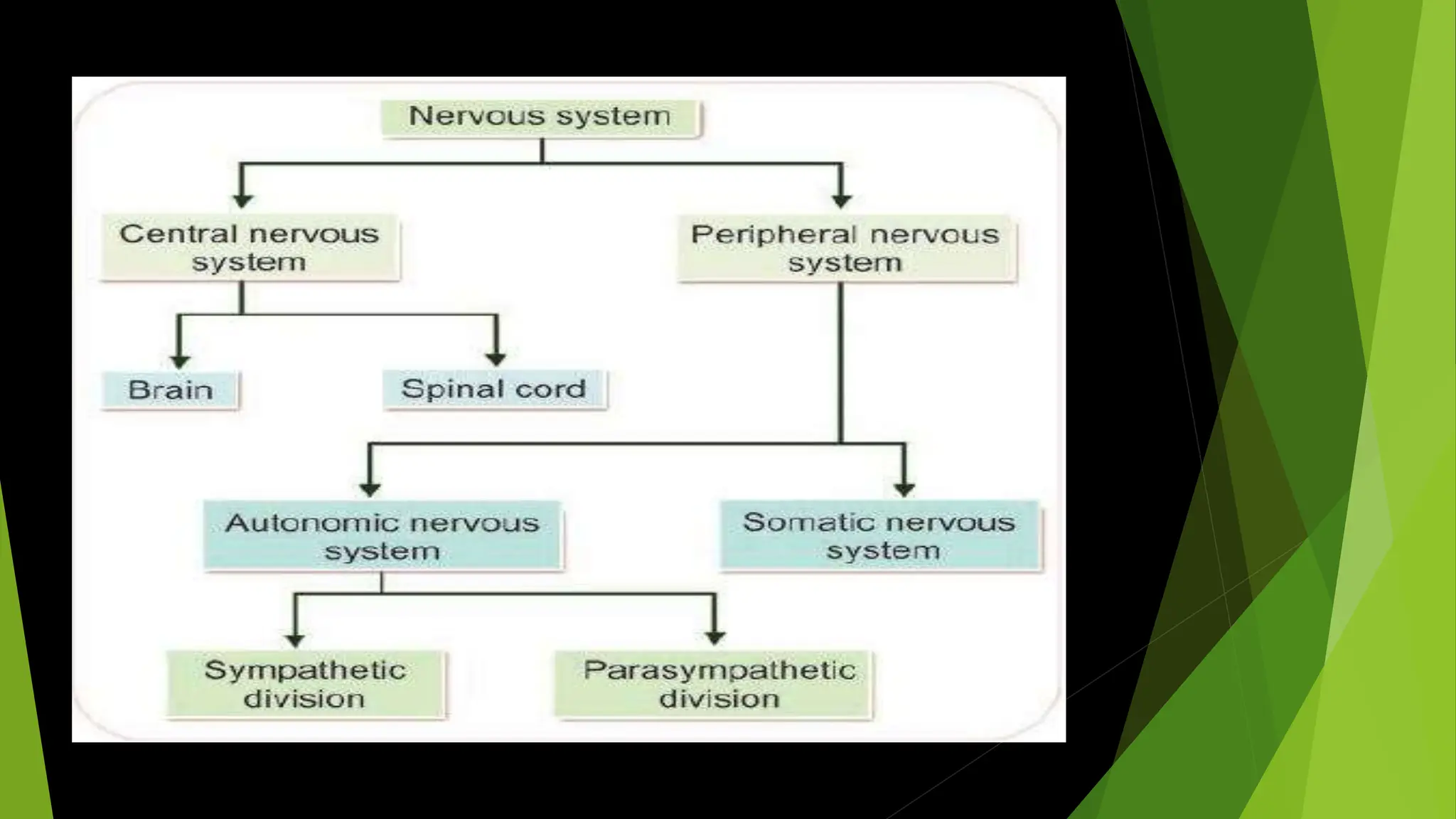
 Primarily, nervous system is divided
into two parts:
1. Central nervous system- Includes
brain and spinal cord
2. Peripheral nervous system- includes
the cranial nerves and spinal nerves
CENTRAL NERVOUS SYSTEM (CNS)
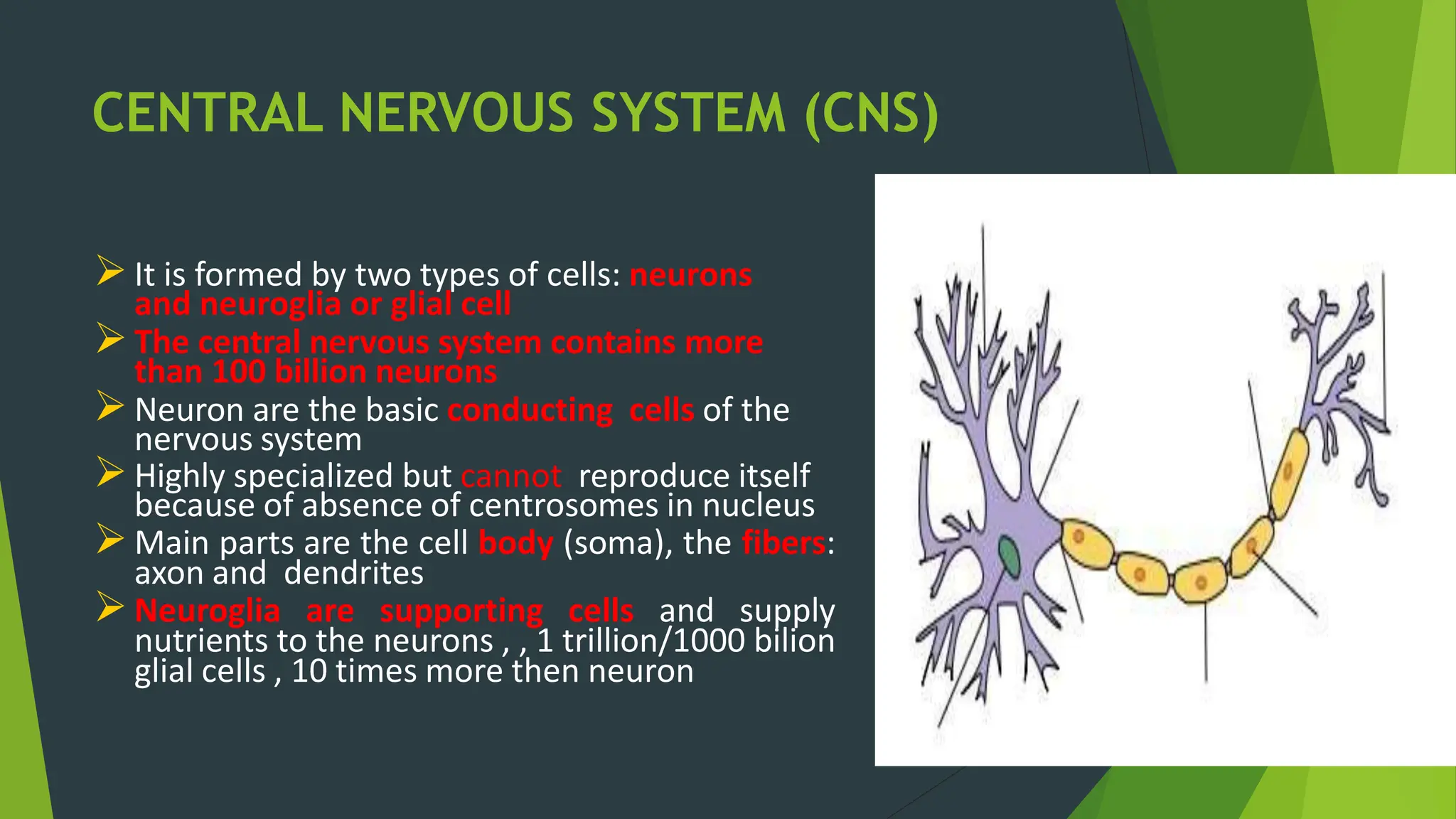
It is formed by two types of cells: neurons
and neuroglia or glial cell
The central nervous system contains more
than 100 billion neurons
Neuron are the basic conducting cells of the
nervous system
Highly specialized but cannot reproduce itself
because of absence of centrosomes in nucleus
Main parts are the cell body (soma), the fibers:
axon and dendrites
Neuroglia are supporting cells and supply
nutrients to the neurons , , 1 trillion/1000 bilion
glial cells , 10 times more then neuron
Layers of CNS
 CNS arranged in two layers:
1. Gray matter
 Nerve cell bodies and the proximal parts of nerve fibers, arising
from nerve cell body... with many cell bodies and dendrites
 In brain it is outer part while in spinal cord it is inside
2. White matter
 Distal parts of nerve fibers .... with many axons
 In brain it is inner part while in spinal cord it is outside
GRAY MATTER VS WHITE MATTER ...BRAIN
CNS Cont’d….
 Brain is situated in the skull
 It is continued as spinal cord in the vertebral canal through the
foramen magnum of the skull bone
 Brain and spinal cord are surrounded by three layers; called
meninges
1. The outer-dura mater
2. Middle arachnoid mater
3. Inner pia mater
Meninges
 There are three potential spaces present b/w these layers:
1. Space between arachnoid mater and pia mater is known as
subarachnoid space. This space is filled with a fluid called
cerebrospinal fluid (CSF). Brain and spinal cord are actually
suspended in the cerebrospinal fluid
2. Space between arachnoid mater and dura mater is known as
Subdural space. It have no fluid
3. Space present outside the dura mater and is known as epidural
space. It have also no fluid
Parts of Brain
PERIPHERAL NERVOUS SYSTEM (PNS)
 It is formed by neurons and their processes present in all regions
of the body
 It consists of cranial nerves, arising from brain (12 pairs) and
spinal nerves, (31 pairs) arising from the spinal cord.
 It divided into two subdivisions:
1. Somatic nervous system
2. Autonomic nervous system
PNS Cont’d….
1. Somatic Nervous System
 It is concerned with somatic functions
 Like nerves supplying the skeletal muscles, responsible for muscular activities and
movements of the body
2. Autonomic Nervous System
 It is concerned with regulation of viscera
 So, it is also called involuntary nervous system
 It consists of two divisions i.e. sympathetic division/thoracolumbar outflow T1 to
T12,L1,L2 and parasympathetic division/Craniosacral outflow - brain(III, VII,
IX and X) and S2–S4
Function of CNS
1. Sensing the world
 Vision, Hearing, Smell, Taste, Touch
2. Transmitting information
3. Processing information
4. Producing a response
1.CNS.central nervous system slideshare.pptx

1.CNS.central nervous system slideshare.pptx

  • 1.
    Introduction to NervousSystem RASHID KHAN MOHMAND BS ANESTHESIA TECHNOLOGY ANESTHESIA LECTURER
  • 2.
    Definition  The nervoussystem is the part of a body that coordinates its actions by transmitting signals to and from different parts of body  The nervous system detects environmental changes that impact the body, then works along with the endocrine system to respond to such events  So that nervous system controls all the activities of the body.  It is quicker than othercontrol system in the body, like endocrine system
  • 3.
    Definition  Nerve impulsescan be initiated in response to stimuli from:  outside the body, e.g. touch, light waves,temperature up or down  inside the body, e.g. a change in the concentration of carbon dioxide in the blood alters respiration; a thought may result in voluntary movement  Transmission of nerve signals is both electrical and chemical. The action potential travelling down the nerve axon is an electrical signal, but because nerves do not come into direct contact with each other, the signal between a nerve cell and the next cell in the chain is chemical
  • 4.
    Classification  Primarily, nervoussystem is divided into two parts: 1. Central nervous system- Includes brain and spinal cord 2. Peripheral nervous system- includes the cranial nerves and spinal nerves
  • 6.
    CENTRAL NERVOUS SYSTEM(CNS) It is formed by two types of cells: neurons and neuroglia or glial cell The central nervous system contains more than 100 billion neurons Neuron are the basic conducting cells of the nervous system Highly specialized but cannot reproduce itself because of absence of centrosomes in nucleus Main parts are the cell body (soma), the fibers: axon and dendrites Neuroglia are supporting cells and supply nutrients to the neurons , , 1 trillion/1000 bilion glial cells , 10 times more then neuron
  • 7.
    Layers of CNS CNS arranged in two layers: 1. Gray matter  Nerve cell bodies and the proximal parts of nerve fibers, arising from nerve cell body... with many cell bodies and dendrites  In brain it is outer part while in spinal cord it is inside 2. White matter  Distal parts of nerve fibers .... with many axons  In brain it is inner part while in spinal cord it is outside
  • 8.
    GRAY MATTER VSWHITE MATTER ...BRAIN
  • 9.
    CNS Cont’d….  Brainis situated in the skull  It is continued as spinal cord in the vertebral canal through the foramen magnum of the skull bone  Brain and spinal cord are surrounded by three layers; called meninges 1. The outer-dura mater 2. Middle arachnoid mater 3. Inner pia mater
  • 11.
    Meninges  There arethree potential spaces present b/w these layers: 1. Space between arachnoid mater and pia mater is known as subarachnoid space. This space is filled with a fluid called cerebrospinal fluid (CSF). Brain and spinal cord are actually suspended in the cerebrospinal fluid 2. Space between arachnoid mater and dura mater is known as Subdural space. It have no fluid 3. Space present outside the dura mater and is known as epidural space. It have also no fluid
  • 12.
  • 13.
    PERIPHERAL NERVOUS SYSTEM(PNS)  It is formed by neurons and their processes present in all regions of the body  It consists of cranial nerves, arising from brain (12 pairs) and spinal nerves, (31 pairs) arising from the spinal cord.  It divided into two subdivisions: 1. Somatic nervous system 2. Autonomic nervous system
  • 14.
    PNS Cont’d…. 1. SomaticNervous System  It is concerned with somatic functions  Like nerves supplying the skeletal muscles, responsible for muscular activities and movements of the body 2. Autonomic Nervous System  It is concerned with regulation of viscera  So, it is also called involuntary nervous system  It consists of two divisions i.e. sympathetic division/thoracolumbar outflow T1 to T12,L1,L2 and parasympathetic division/Craniosacral outflow - brain(III, VII, IX and X) and S2–S4
  • 16.
    Function of CNS 1.Sensing the world  Vision, Hearing, Smell, Taste, Touch 2. Transmitting information 3. Processing information 4. Producing a response