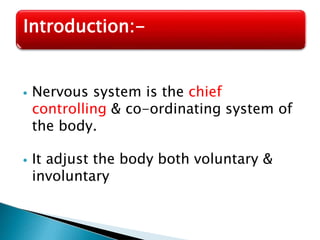
⦁ Nervous system is the chief
controlling & co-ordinating system of
the body.
⦁ It adjust the body both voluntary &
involuntary
Introduction:-
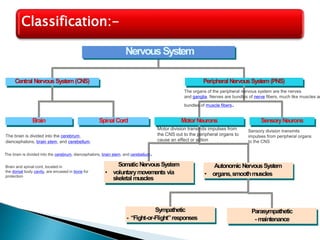
Central NervousSystem(CNS)
Brain Spinal Cord
Peripheral NervousSystem (PNS)
SensoryNeurons
MotorNeurons
SomaticNervousSystem
• voluntarymovements via
skeletal muscles
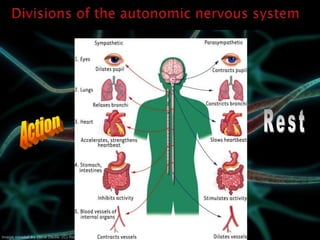
AutonomicNervousSystem
• organs,smoothmuscles
Sympathetic
- “Fight-or-Flight”responses
Parasympathetic
- maintenance
NervousSystem
Classification:-
The brain is divided into the cerebrum,
diencephalons, brain stem, and cerebellum.
The brain is divided into the cerebrum, diencephalons, brain stem, and cerebellum.
Brain and spinal cord, located in
the dorsal body cavity, are encased in bone for
protection
Motor division transmits impulses from
the CNS out to the peripheral organs to
cause an effect or action
Sensory division transmits
impulses from peripheral organs
to the CNS
The organs of the peripheral nervous system are the nerves
and ganglia. Nerves are bundles of nerve fibers, much like muscles ar
bundles of muscle fibers.
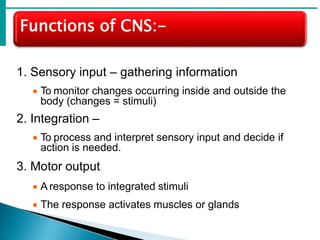
Functions of CNS:-
1. Sensory input – gathering information
• To monitor changes occurring inside and outside the
body (changes = stimuli)
2. Integration –
• To process and interpret sensory input and decide if
action is needed.
3. Motor output
• A response to integrated stimuli
• The response activates muscles or glands
⦁ Two main kind of cell are present in
NS.
➢ Neurones (The basic structural and functional unit of the
nervous system)
➢ Neuroglia (support/maintain neurons)
Neurones:-
⦁ Is the basic functional unit of NS.
⦁ It is a cell that receive, intimate & transmits the
information
⦁ Communicate with other neurons through
chemical signals.
⦁ Approx. 100 billion located in the CNS
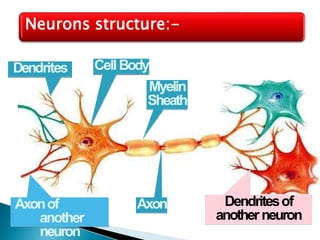
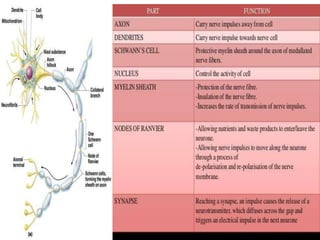
Neurons structure:-
Axonof
another
neuron
CellBody
Dendrites
Axon
Myelin
Sheath
Dendritesof
anotherneuron
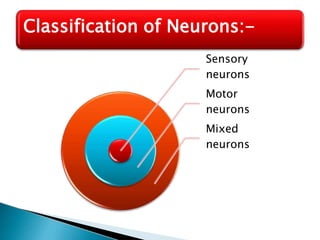
Sensory
neurons
Motor
neurons
Mixed
neurons
Classification of Neurons:-
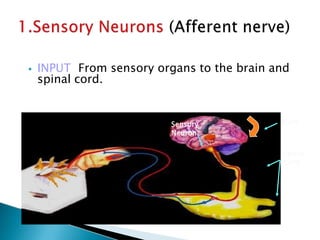
Spinal
Cord
Brain
Sensory
Neuron
⦁ INPUT From sensory organs to the brain and
spinal cord.
Spinal
Cord
Brain
Sensory
Neuron
Motor
Neuron
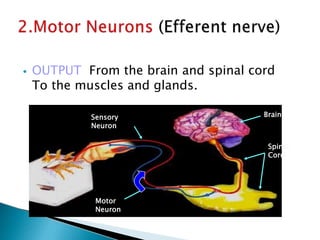
⦁ OUTPUT From the brain and spinal cord
To the muscles and glands.
Spinal
Cord
Brain
Sensory
Neuron
Motor
Neuron
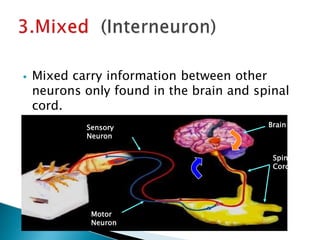
⦁ Mixed carry information between other
neurons only found in the brain and spinal
cord.
Neurotransmitter:-in the brain & spinal cord
⦁ Neurotransmitters are chemicals that
convey information to the target cells.
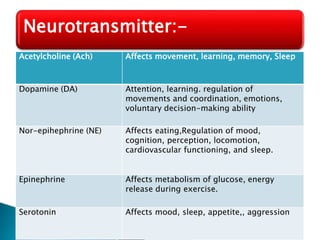
Acetylcholine (Ach) Affects movement, learning, memory, Sleep
Dopamine (DA) Attention, learning. regulation of
movements and coordination, emotions,
voluntary decision-making ability
Nor-epihephrine (NE) Affects eating,Regulation of mood,
cognition, perception, locomotion,
cardiovascular functioning, and sleep.
Epinephrine Affects metabolism of glucose, energy
release during exercise.
Serotonin Affects mood, sleep, appetite,, aggression
Neurotransmitter:-
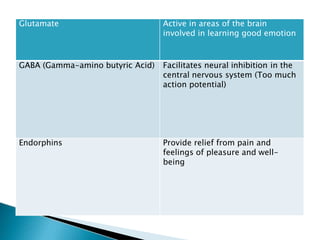
Glutamate Active in areas of the brain
involved in learning good emotion
GABA (Gamma-amino butyric Acid) Facilitates neural inhibition in the
central nervous system (Too much
action potential)
Endorphins Provide relief from pain and
feelings of pleasure and well-
being

The nervous system (1)

  • 2.
    ⦁ Nervous systemis the chief controlling & co-ordinating system of the body. ⦁ It adjust the body both voluntary & involuntary Introduction:-
  • 3.
    Central NervousSystem(CNS) Brain SpinalCord Peripheral NervousSystem (PNS) SensoryNeurons MotorNeurons SomaticNervousSystem • voluntarymovements via skeletal muscles AutonomicNervousSystem • organs,smoothmuscles Sympathetic - “Fight-or-Flight”responses Parasympathetic - maintenance NervousSystem Classification:- The brain is divided into the cerebrum, diencephalons, brain stem, and cerebellum. The brain is divided into the cerebrum, diencephalons, brain stem, and cerebellum. Brain and spinal cord, located in the dorsal body cavity, are encased in bone for protection Motor division transmits impulses from the CNS out to the peripheral organs to cause an effect or action Sensory division transmits impulses from peripheral organs to the CNS The organs of the peripheral nervous system are the nerves and ganglia. Nerves are bundles of nerve fibers, much like muscles ar bundles of muscle fibers.
  • 4.
    Functions of CNS:- 1.Sensory input – gathering information • To monitor changes occurring inside and outside the body (changes = stimuli) 2. Integration – • To process and interpret sensory input and decide if action is needed. 3. Motor output • A response to integrated stimuli • The response activates muscles or glands
  • 5.
    ⦁ Two mainkind of cell are present in NS. ➢ Neurones (The basic structural and functional unit of the nervous system) ➢ Neuroglia (support/maintain neurons)
  • 7.
    Neurones:- ⦁ Is thebasic functional unit of NS. ⦁ It is a cell that receive, intimate & transmits the information ⦁ Communicate with other neurons through chemical signals. ⦁ Approx. 100 billion located in the CNS
  • 8.
  • 10.
  • 11.
    Spinal Cord Brain Sensory Neuron ⦁ INPUT Fromsensory organs to the brain and spinal cord.
  • 12.
    Spinal Cord Brain Sensory Neuron Motor Neuron ⦁ OUTPUT Fromthe brain and spinal cord To the muscles and glands.
  • 13.
    Spinal Cord Brain Sensory Neuron Motor Neuron ⦁ Mixed carryinformation between other neurons only found in the brain and spinal cord.
  • 14.
    Neurotransmitter:-in the brain& spinal cord ⦁ Neurotransmitters are chemicals that convey information to the target cells.
  • 15.
    Acetylcholine (Ach) Affectsmovement, learning, memory, Sleep Dopamine (DA) Attention, learning. regulation of movements and coordination, emotions, voluntary decision-making ability Nor-epihephrine (NE) Affects eating,Regulation of mood, cognition, perception, locomotion, cardiovascular functioning, and sleep. Epinephrine Affects metabolism of glucose, energy release during exercise. Serotonin Affects mood, sleep, appetite,, aggression Neurotransmitter:-
  • 16.
    Glutamate Active inareas of the brain involved in learning good emotion GABA (Gamma-amino butyric Acid) Facilitates neural inhibition in the central nervous system (Too much action potential) Endorphins Provide relief from pain and feelings of pleasure and well- being