NERVOUS
SYSTEM
SALMA ASGHAR
M.Sc (NUTRITION
AND DIETETICS)
•It is the master controlling and communicating system of the body.
•It controls and coordinates all the activities of the body
FUNCTIONS:
Sensory function: Gathers information from both inside and
outside the body.
Integration function: Processes the information in the brain
and spine.
Motor function: Transmit information to the processing areas
of the brain and spine.
CENTRAL NERVOUS SYSTEM (CNS)
~It includes brain and spinal cord.
~It is referred to as central because it combines information from the
entire body and co-ordinates activity across the whole organism.
~ These organs work together to integrate and co-ordinate sensory and
motor information for the purpose of controlling the various tissues,
organs and organ system of the body.
~It is formed by neurons and supporting cells called Neuroglia.
~Brain and Spinal cord are surrounded by three layers of meninges
called the outer dura mater, middle arachnoid mater and the inner pia
mater.
BRAIN:
~It is situated in the skull.
~It consists of-
• cerebrum
• cerebellum
• diencephalon
• medulla oblongata
•midbrain and
•pons
CEREBRUM:
~It forms bulk of the brain.
~It is divided into two hemisphere - left and right.
~The hemispheres are further divided into 4 lobes-
•Frontal ( Reasoning and thought)
•Parietal (Integrates sensory information)
•Temporal (Processes auditory information from ears)
•Occipital (Processes visual information from the eyes)
CEREBELLUM:
~Major functions of cerebellum are
-muscle contraction
-balance
-posture
-muscle tone
-maintenance of movements.
DIENCEPHALON:
~It includes thalamus and hypothalamus
THALAMUS:
~It directs sensory impulses to cerebrum.
HYPOTHALAMUS:
~It controls and regulates the functions of ANS
-Temperature, appetite, water balance, sleep, and blood
vessel constriction and dilation.
~It also plays a role in anger, pleasure, pain and affection.
MIDBRAIN:
~It is responsible for eye and auditory reflexes.
PONS:
~It is responsible for certain reflex actions.
MEDULLA OBLONGATA:
~It regulates - digestion, respiration, swallowing, coughing,
sneezing, blood pressure, heart and blood vessel function.
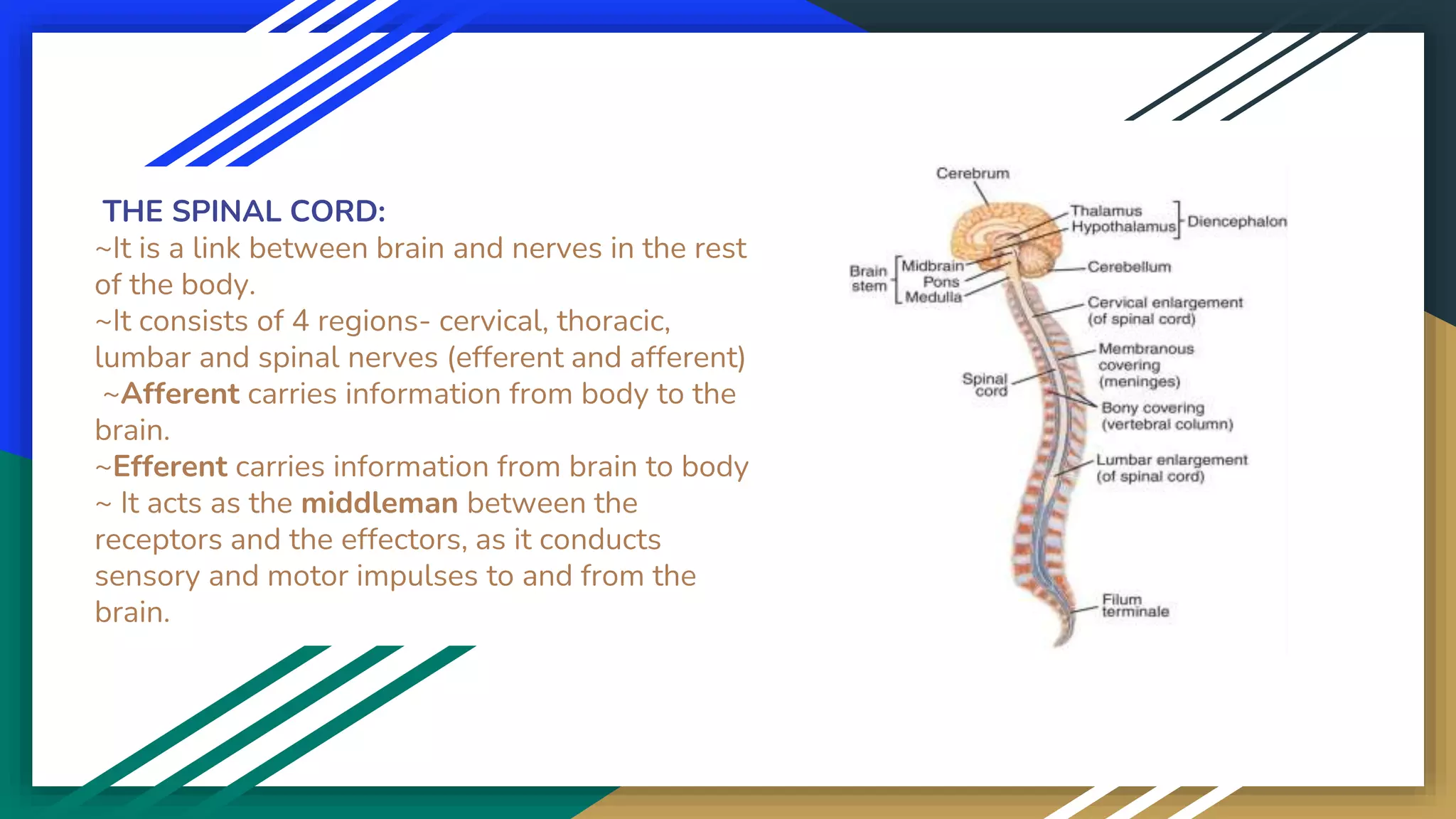
THE SPINAL CORD:
~It is a link between brain and nerves in the rest
of the body.
~It consists of 4 regions- cervical, thoracic,
lumbar and spinal nerves (efferent and afferent)
~Afferent carries information from body to the
brain.
~Efferent carries information from brain to body
~ It acts as the middleman between the
receptors and the effectors, as it conducts
sensory and motor impulses to and from the
brain.
PERIPHERAL NERVOUS SYSTEM:
~ It is formed by the nerves that are associated with the brain (cranial nerves)
and the spinal cord (spinal nerves).
~It connects CNS to the organs, limbs and skin.
~These nerves extend from the CNS to the outermost areas of the body.
~Cranial nerves-12 pairs in man.
~Spinal nerves-31 pairs in man.
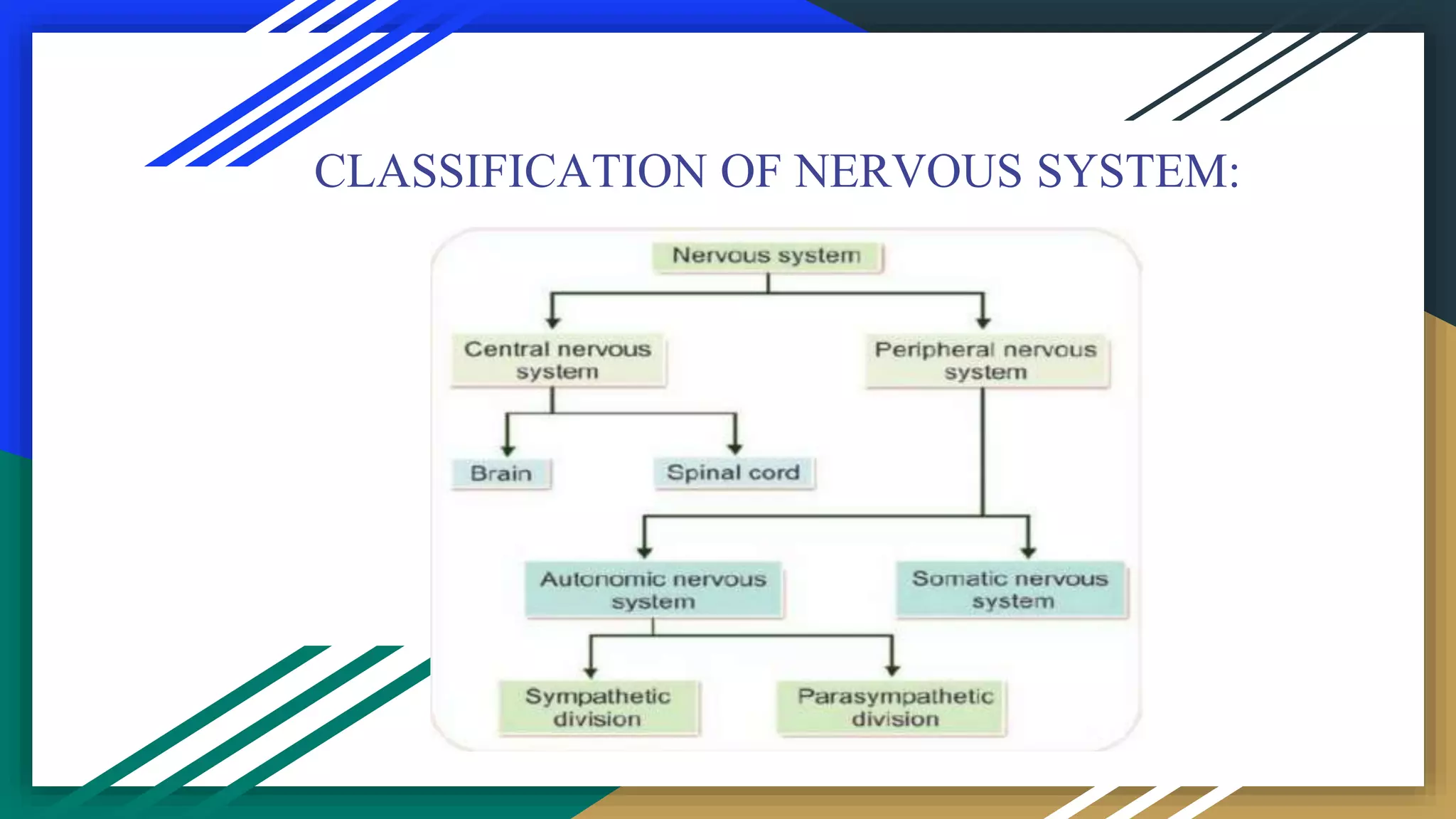
~ It is again divided into two subdivisions:
•SOMATIC NERVOUS SYSTEM
•AUTONOMIC NERVOUS SYSTEM
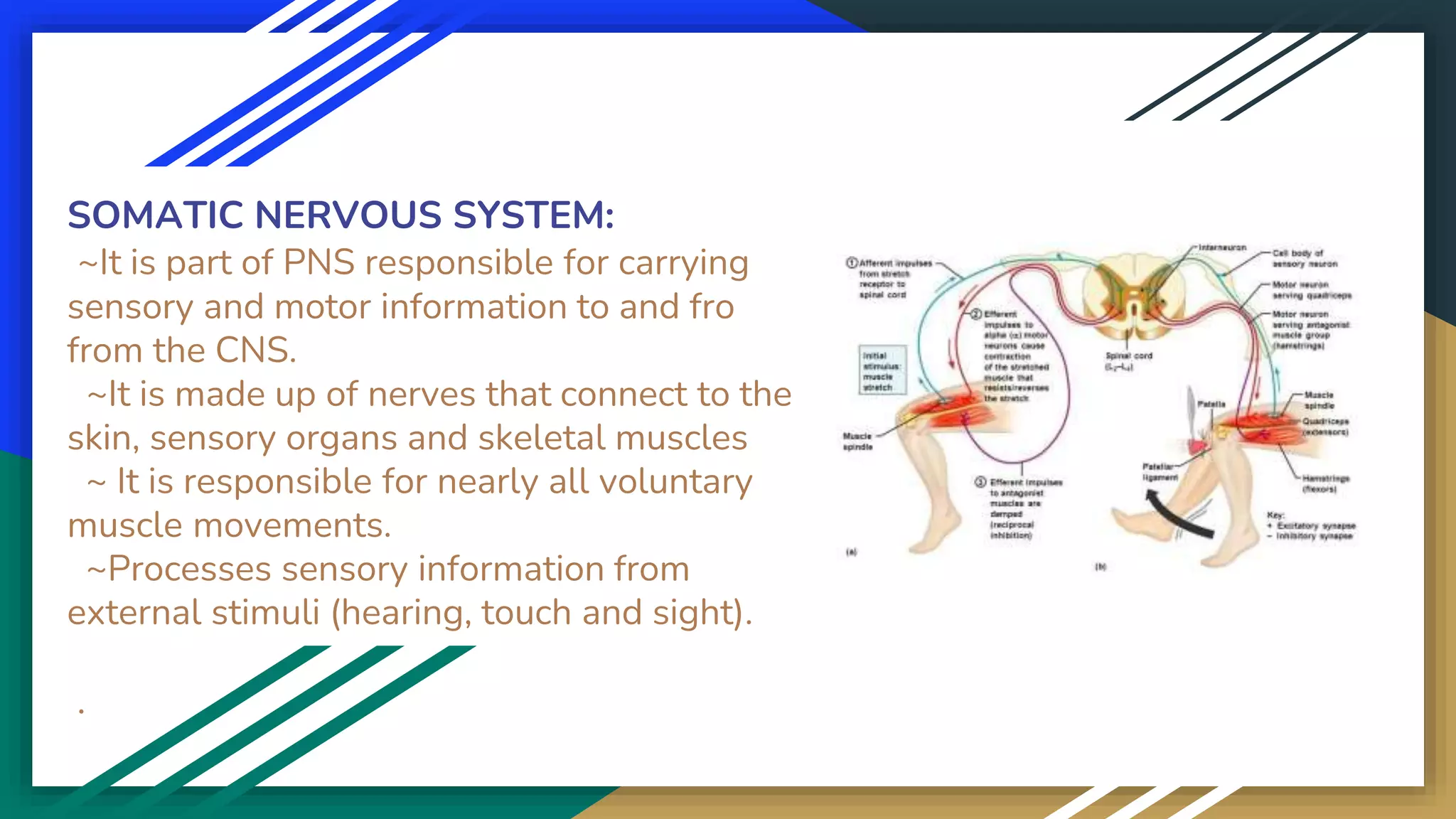
SOMATIC NERVOUS SYSTEM:
~It is part of PNS responsible for carrying
sensory and motor information to and fro
from the CNS.
~It is made up of nerves that connect to the
skin, sensory organs and skeletal muscles
~ It is responsible for nearly all voluntary
muscle movements.
~Processes sensory information from
external stimuli (hearing, touch and sight).
.
~The structures that allow this communication to happen
are- afferent sensory neuron
- efferent motor neuron
~ Afferent neurons take information from nerves to CNS.
~ Efferent neurons take information from CNS to muscle
fibres throughout the body.
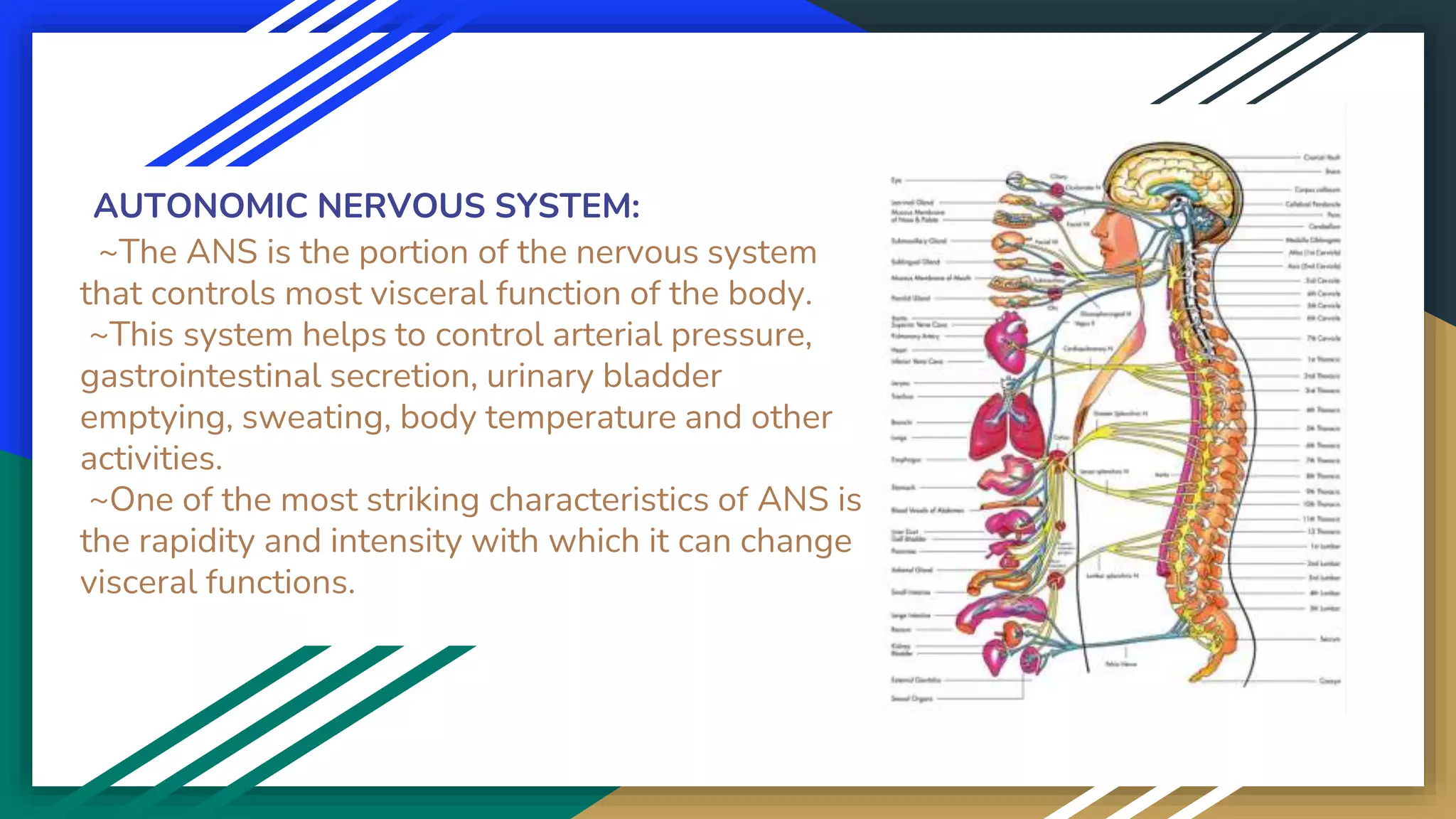
AUTONOMIC NERVOUS SYSTEM:
~The ANS is the portion of the nervous system
that controls most visceral function of the body.
~This system helps to control arterial pressure,
gastrointestinal secretion, urinary bladder
emptying, sweating, body temperature and other
activities.
~One of the most striking characteristics of ANS is
the rapidity and intensity with which it can change
visceral functions.
~ For instance, within 3-5 sec it can increase the heart rate to
twice the normal and within 10-15 sec the arterial pressure
can be doubled.
~At the other extent, the arterial pressure can be decreased
low enough within 10-15 sec to cause fainting.
~ Sweating can begin within seconds and urinary bladder
may empty involuntary also within seconds.
~ The ANS is activated mainly by centres located in the
spinal cord, brainstem and hypothalamus.
~ Autonomic nervous system
consists of two subdivisions:
• Sympathetic division
• Parasympathetic division
SYMPATHETIC DIVISION:
~It is otherwise called thoracolumbar outflow because, the preganglionic
neurons are situated in lateral gray horns of thoracic and first two lumbar
segments of Spinal cord.
~ Sympathetic division supplies smooth muscle fibres of all the visceral organs
such as blood vessels,heart, lungs, glands, gastrointestinal organs etc,.
~ Allow body to function under stress.
~Flight or fight.
~ Primes body for intense skeletal muscle activity.
PARASYMPATHETIC DIVISION:
~It is otherwise called Craniosacral outflow because, the fibres of this division
arise from the brain sacral segments of Spinal cord.
~Maintains functions
~Rest and digest.
~Counterbalances sympathetic functions.
THANK YOU

Classification of Nervous System

  • 1.
  • 2.
    •It is themaster controlling and communicating system of the body. •It controls and coordinates all the activities of the body FUNCTIONS: Sensory function: Gathers information from both inside and outside the body. Integration function: Processes the information in the brain and spine. Motor function: Transmit information to the processing areas of the brain and spine.
  • 4.
    CENTRAL NERVOUS SYSTEM(CNS) ~It includes brain and spinal cord. ~It is referred to as central because it combines information from the entire body and co-ordinates activity across the whole organism. ~ These organs work together to integrate and co-ordinate sensory and motor information for the purpose of controlling the various tissues, organs and organ system of the body. ~It is formed by neurons and supporting cells called Neuroglia. ~Brain and Spinal cord are surrounded by three layers of meninges called the outer dura mater, middle arachnoid mater and the inner pia mater.
  • 5.
    BRAIN: ~It is situatedin the skull. ~It consists of- • cerebrum • cerebellum • diencephalon • medulla oblongata •midbrain and •pons
  • 6.
    CEREBRUM: ~It forms bulkof the brain. ~It is divided into two hemisphere - left and right. ~The hemispheres are further divided into 4 lobes- •Frontal ( Reasoning and thought) •Parietal (Integrates sensory information) •Temporal (Processes auditory information from ears) •Occipital (Processes visual information from the eyes)
  • 7.
    CEREBELLUM: ~Major functions ofcerebellum are -muscle contraction -balance -posture -muscle tone -maintenance of movements.
  • 8.
    DIENCEPHALON: ~It includes thalamusand hypothalamus THALAMUS: ~It directs sensory impulses to cerebrum. HYPOTHALAMUS: ~It controls and regulates the functions of ANS -Temperature, appetite, water balance, sleep, and blood vessel constriction and dilation. ~It also plays a role in anger, pleasure, pain and affection.
  • 9.
    MIDBRAIN: ~It is responsiblefor eye and auditory reflexes. PONS: ~It is responsible for certain reflex actions. MEDULLA OBLONGATA: ~It regulates - digestion, respiration, swallowing, coughing, sneezing, blood pressure, heart and blood vessel function.
  • 10.
    THE SPINAL CORD: ~Itis a link between brain and nerves in the rest of the body. ~It consists of 4 regions- cervical, thoracic, lumbar and spinal nerves (efferent and afferent) ~Afferent carries information from body to the brain. ~Efferent carries information from brain to body ~ It acts as the middleman between the receptors and the effectors, as it conducts sensory and motor impulses to and from the brain.
  • 11.
    PERIPHERAL NERVOUS SYSTEM: ~It is formed by the nerves that are associated with the brain (cranial nerves) and the spinal cord (spinal nerves). ~It connects CNS to the organs, limbs and skin. ~These nerves extend from the CNS to the outermost areas of the body. ~Cranial nerves-12 pairs in man. ~Spinal nerves-31 pairs in man. ~ It is again divided into two subdivisions: •SOMATIC NERVOUS SYSTEM •AUTONOMIC NERVOUS SYSTEM
  • 12.
    SOMATIC NERVOUS SYSTEM: ~Itis part of PNS responsible for carrying sensory and motor information to and fro from the CNS. ~It is made up of nerves that connect to the skin, sensory organs and skeletal muscles ~ It is responsible for nearly all voluntary muscle movements. ~Processes sensory information from external stimuli (hearing, touch and sight). .
  • 13.
    ~The structures thatallow this communication to happen are- afferent sensory neuron - efferent motor neuron ~ Afferent neurons take information from nerves to CNS. ~ Efferent neurons take information from CNS to muscle fibres throughout the body.
  • 14.
    AUTONOMIC NERVOUS SYSTEM: ~TheANS is the portion of the nervous system that controls most visceral function of the body. ~This system helps to control arterial pressure, gastrointestinal secretion, urinary bladder emptying, sweating, body temperature and other activities. ~One of the most striking characteristics of ANS is the rapidity and intensity with which it can change visceral functions.
  • 15.
    ~ For instance,within 3-5 sec it can increase the heart rate to twice the normal and within 10-15 sec the arterial pressure can be doubled. ~At the other extent, the arterial pressure can be decreased low enough within 10-15 sec to cause fainting. ~ Sweating can begin within seconds and urinary bladder may empty involuntary also within seconds. ~ The ANS is activated mainly by centres located in the spinal cord, brainstem and hypothalamus.
  • 16.
    ~ Autonomic nervoussystem consists of two subdivisions: • Sympathetic division • Parasympathetic division
  • 17.
    SYMPATHETIC DIVISION: ~It isotherwise called thoracolumbar outflow because, the preganglionic neurons are situated in lateral gray horns of thoracic and first two lumbar segments of Spinal cord. ~ Sympathetic division supplies smooth muscle fibres of all the visceral organs such as blood vessels,heart, lungs, glands, gastrointestinal organs etc,. ~ Allow body to function under stress. ~Flight or fight. ~ Primes body for intense skeletal muscle activity.
  • 18.
    PARASYMPATHETIC DIVISION: ~It isotherwise called Craniosacral outflow because, the fibres of this division arise from the brain sacral segments of Spinal cord. ~Maintains functions ~Rest and digest. ~Counterbalances sympathetic functions.
  • 19.