Q1b Key Concepts
Representation
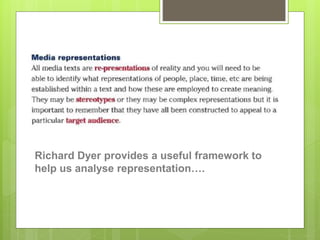
Richard Dyer provides a useful framework to
help us analyse representation….
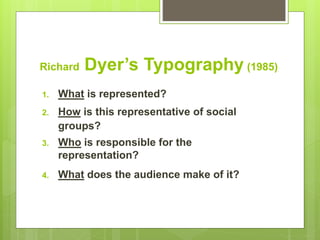
Richard Dyer’s Typography (1985)
1. What is represented?
2. How is this representative of social
groups?
3. Who is responsible for the
representation?
4. What does the audience make of it?
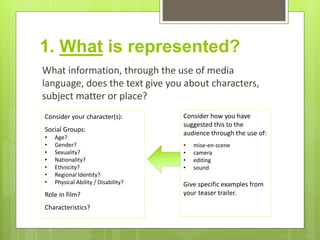
1. What is represented?
What information, through the use of media
language, does the text give you about characters,
subject matter or place?
Consider your character(s):
Social Groups:
• Age?
• Gender?
• Sexuality?
• Nationality?
• Ethnicity?
• Regional Identity?
• Physical Ability / Disability?
Role in film?
Characteristics?
Consider how you have
suggested this to the
audience through the use of:
• mise-en-scene
• camera
• editing
• sound
Give specific examples from
your teaser trailer.
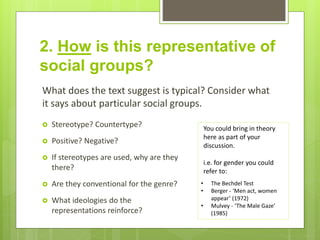
2. How is this representative of
social groups?
 Stereotype? Countertype?
 Positive? Negative?
 If stereotypes are used, why are they
there?
 Are they conventional for the genre?
 What ideologies do the
representations reinforce?
What does the text suggest is typical? Consider what
it says about particular social groups.
You could bring in theory
here as part of your
discussion.
i.e. for gender you could
refer to:
• The Bechdel Test
• Berger - ‘Men act, women
appear’ (1972)
• Mulvey - ‘The Male Gaze’
(1985)
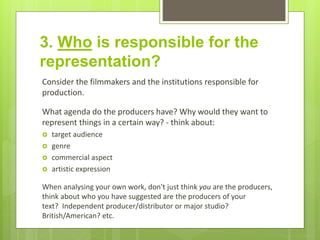
3. Who is responsible for the
representation?
Consider the filmmakers and the institutions responsible for
production.
What agenda do the producers have? Why would they want to
represent things in a certain way? - think about:
 target audience
 genre
 commercial aspect
 artistic expression
When analysing your own work, don't just think you are the producers,
think about who you have suggested are the producers of your
text? Independent producer/distributor or major studio?
British/American? etc.
4. What does the audience
make of it?
Taking all of the above into account what might the
audience response be?
As we know not everyone will respond to the text in
the same way so there is not one answer to this!
Consider different audiences.
It is useful to look at the concept of audience to help
address question 4. See Audience resources.
Dyer also states that
‘Stereotypes legitimise inequality’
The use of stereotypes indirectly promotes
inequality
How we treat others is determined by how
we see them
How we seem them comes from
representation

Representation - Dyer

  • 1.
  • 2.
    Richard Dyer providesa useful framework to help us analyse representation….
  • 3.
    Richard Dyer’s Typography(1985) 1. What is represented? 2. How is this representative of social groups? 3. Who is responsible for the representation? 4. What does the audience make of it?
  • 4.
    1. What isrepresented? What information, through the use of media language, does the text give you about characters, subject matter or place? Consider your character(s): Social Groups: • Age? • Gender? • Sexuality? • Nationality? • Ethnicity? • Regional Identity? • Physical Ability / Disability? Role in film? Characteristics? Consider how you have suggested this to the audience through the use of: • mise-en-scene • camera • editing • sound Give specific examples from your teaser trailer.
  • 5.
    2. How isthis representative of social groups?  Stereotype? Countertype?  Positive? Negative?  If stereotypes are used, why are they there?  Are they conventional for the genre?  What ideologies do the representations reinforce? What does the text suggest is typical? Consider what it says about particular social groups. You could bring in theory here as part of your discussion. i.e. for gender you could refer to: • The Bechdel Test • Berger - ‘Men act, women appear’ (1972) • Mulvey - ‘The Male Gaze’ (1985)
  • 6.
    3. Who isresponsible for the representation? Consider the filmmakers and the institutions responsible for production. What agenda do the producers have? Why would they want to represent things in a certain way? - think about:  target audience  genre  commercial aspect  artistic expression When analysing your own work, don't just think you are the producers, think about who you have suggested are the producers of your text? Independent producer/distributor or major studio? British/American? etc.
  • 7.
    4. What doesthe audience make of it? Taking all of the above into account what might the audience response be? As we know not everyone will respond to the text in the same way so there is not one answer to this! Consider different audiences. It is useful to look at the concept of audience to help address question 4. See Audience resources.
  • 8.
    Dyer also statesthat ‘Stereotypes legitimise inequality’ The use of stereotypes indirectly promotes inequality How we treat others is determined by how we see them How we seem them comes from representation