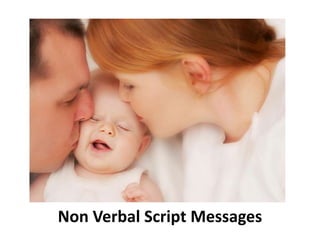
Non Verbal Script Messages
Prepared By
Manu Melwin Joy
Research Scholar
School of Management Studies
CUSAT, Kerala, India.
Phone – 9744551114
Mail – manu_melwinjoy@yahoo.com
Kindly restrict the use of slides for personal purpose.
Please seek permission to reproduce the same in public
forms and presentations.
Non Verbal Messages
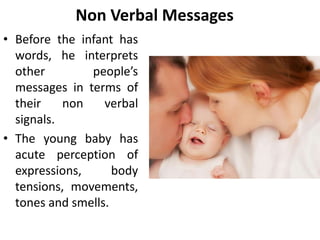
• Before the infant has
words, he interprets
other people’s
messages in terms of
their non verbal
signals.
• The young baby has
acute perception of
expressions, body
tensions, movements,
tones and smells.
Non Verbal Messages
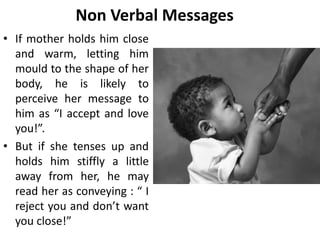
• If mother holds him close
and warm, letting him
mould to the shape of her
body, he is likely to
perceive her message to
him as “I accept and love
you!”.
• But if she tenses up and
holds him stiffly a little
away from her, he may
read her as conveying : “ I
reject you and don’t want
you close!”
Non Verbal Messages
• Sometimes, the infant may
construe script messages from
events around her that are not
of the parent’s making.
• Loud noises, sudden
movements, separation from
the parents such as stay in the
hospital, may all appear to the
bay as life threatening.
• Because she assumes that her
parents are in charge of the
reality, she may conclude that
the threats also come from
them.
Non Verbal Messages
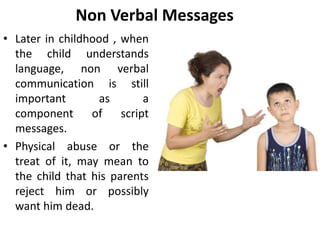
• Later in childhood , when
the child understands
language, non verbal
communication is still
important as a
component of script
messages.
• Physical abuse or the
treat of it, may mean to
the child that his parents
reject him or possibly
want him dead.
Non Verbal Messages
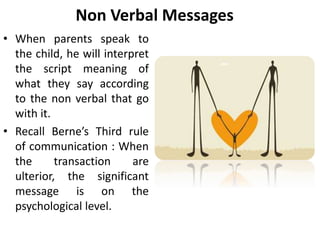
• When parents speak to
the child, he will interpret
the script meaning of
what they say according
to the non verbal that go
with it.
• Recall Berne’s Third rule
of communication : When
the transaction are
ulterior, the significant
message is on the
psychological level.
Non Verbal Messages
• Picture a school child coming
home with the new reading book
she is just been given by the
teacher.
• She starts reading it to her
parents and stumbles over a
word she hasn’t met before.
• Father says : “ You got that word
wrong”.
• With those words could go many
different sets of non verbal
messages.
• Each of these would carry its
own meaning to the child in
terms of possible script decision.
Non Verbal Messages
• Father might speak in a harsh, loud voice, while curling
his lip and screwing his face up.
• At the same time, he might knock the book out of her
hand or even deal her a blow.
• To the child, his message reads: “I don’t want you around
and would prefer you dead.”
Non Verbal Messages
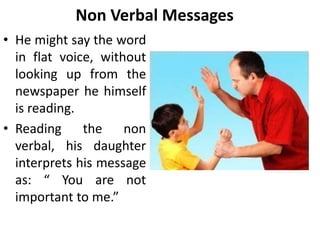
• He might say the word
in flat voice, without
looking up from the
newspaper he himself
is reading.
• Reading the non
verbal, his daughter
interprets his message
as: “ You are not
important to me.”
Non Verbal Messages
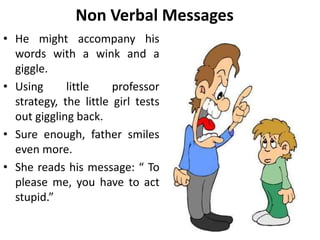
• He might accompany his
words with a wink and a
giggle.
• Using little professor
strategy, the little girl tests
out giggling back.
• Sure enough, father smiles
even more.
• She reads his message: “ To
please me, you have to act
stupid.”
Non Verbal Messages
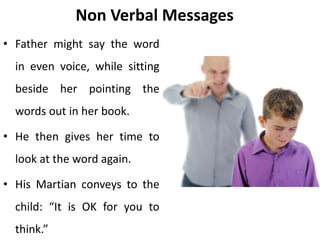
• Father might say the word
in even voice, while sitting
beside her pointing the
words out in her book.
• He then gives her time to
look at the word again.
• His Martian conveys to the
child: “It is OK for you to
think.”
Thank You
Other TA topics available on slideshare
1. Strokes - http://www.slideshare.net/manumjoy/strokes-24081607.
2. Games People Play - http://www.slideshare.net/manumjoy/psychological-
games-people-play.
3. Structural Analysis - http://www.slideshare.net/manumjoy/the-ego-state-model.
4. What is TA? - http://www.slideshare.net/manumjoy/what-ta-is
5. Cycles of Development - http://www.slideshare.net/manumjoy/cycles-of-
developement-pamela-levin-transactional-analysis.
6. Stages of Cure - http://www.slideshare.net/manumjoy/stages-of-cure.
7. Transactions - http://www.slideshare.net/manumjoy/transactions-33677298.
8. Time Structuring - http://www.slideshare.net/manumjoy/time-structuring.
9. Life Position - http://www.slideshare.net/manumjoy/life-position.
10. Autonomy - http://www.slideshare.net/manumjoy/autonomy-33690557.
11. Structural Pathology - http://www.slideshare.net/manumjoy/structural-pathology.
12. Game Analysis - http://www.slideshare.net/manumjoy/game-analysis-33725636.
13. Integrated Adult - http://www.slideshare.net/manumjoy/integrated-adult.
14. Stroke Economy - http://www.slideshare.net/manumjoy/stroke-economy-
33826702.

Non verbal script messages

  • 1.
  • 2.
    Prepared By Manu MelwinJoy Research Scholar School of Management Studies CUSAT, Kerala, India. Phone – 9744551114 Mail – manu_melwinjoy@yahoo.com Kindly restrict the use of slides for personal purpose. Please seek permission to reproduce the same in public forms and presentations.
  • 3.
    Non Verbal Messages •Before the infant has words, he interprets other people’s messages in terms of their non verbal signals. • The young baby has acute perception of expressions, body tensions, movements, tones and smells.
  • 4.
    Non Verbal Messages •If mother holds him close and warm, letting him mould to the shape of her body, he is likely to perceive her message to him as “I accept and love you!”. • But if she tenses up and holds him stiffly a little away from her, he may read her as conveying : “ I reject you and don’t want you close!”
  • 5.
    Non Verbal Messages •Sometimes, the infant may construe script messages from events around her that are not of the parent’s making. • Loud noises, sudden movements, separation from the parents such as stay in the hospital, may all appear to the bay as life threatening. • Because she assumes that her parents are in charge of the reality, she may conclude that the threats also come from them.
  • 6.
    Non Verbal Messages •Later in childhood , when the child understands language, non verbal communication is still important as a component of script messages. • Physical abuse or the treat of it, may mean to the child that his parents reject him or possibly want him dead.
  • 7.
    Non Verbal Messages •When parents speak to the child, he will interpret the script meaning of what they say according to the non verbal that go with it. • Recall Berne’s Third rule of communication : When the transaction are ulterior, the significant message is on the psychological level.
  • 8.
    Non Verbal Messages •Picture a school child coming home with the new reading book she is just been given by the teacher. • She starts reading it to her parents and stumbles over a word she hasn’t met before. • Father says : “ You got that word wrong”. • With those words could go many different sets of non verbal messages. • Each of these would carry its own meaning to the child in terms of possible script decision.
  • 9.
    Non Verbal Messages •Father might speak in a harsh, loud voice, while curling his lip and screwing his face up. • At the same time, he might knock the book out of her hand or even deal her a blow. • To the child, his message reads: “I don’t want you around and would prefer you dead.”
  • 10.
    Non Verbal Messages •He might say the word in flat voice, without looking up from the newspaper he himself is reading. • Reading the non verbal, his daughter interprets his message as: “ You are not important to me.”
  • 11.
    Non Verbal Messages •He might accompany his words with a wink and a giggle. • Using little professor strategy, the little girl tests out giggling back. • Sure enough, father smiles even more. • She reads his message: “ To please me, you have to act stupid.”
  • 12.
    Non Verbal Messages •Father might say the word in even voice, while sitting beside her pointing the words out in her book. • He then gives her time to look at the word again. • His Martian conveys to the child: “It is OK for you to think.”
  • 13.
  • 14.
    Other TA topicsavailable on slideshare 1. Strokes - http://www.slideshare.net/manumjoy/strokes-24081607. 2. Games People Play - http://www.slideshare.net/manumjoy/psychological- games-people-play. 3. Structural Analysis - http://www.slideshare.net/manumjoy/the-ego-state-model. 4. What is TA? - http://www.slideshare.net/manumjoy/what-ta-is 5. Cycles of Development - http://www.slideshare.net/manumjoy/cycles-of- developement-pamela-levin-transactional-analysis. 6. Stages of Cure - http://www.slideshare.net/manumjoy/stages-of-cure. 7. Transactions - http://www.slideshare.net/manumjoy/transactions-33677298. 8. Time Structuring - http://www.slideshare.net/manumjoy/time-structuring. 9. Life Position - http://www.slideshare.net/manumjoy/life-position. 10. Autonomy - http://www.slideshare.net/manumjoy/autonomy-33690557. 11. Structural Pathology - http://www.slideshare.net/manumjoy/structural-pathology. 12. Game Analysis - http://www.slideshare.net/manumjoy/game-analysis-33725636. 13. Integrated Adult - http://www.slideshare.net/manumjoy/integrated-adult. 14. Stroke Economy - http://www.slideshare.net/manumjoy/stroke-economy- 33826702.