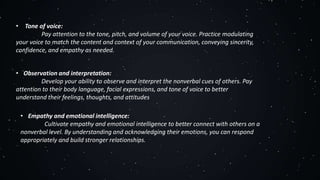
Non-verbal communication involves conveying information without words through facial expressions, gestures, body language, appearance, and other means. It has advantages like providing clarity, reducing time wasted, and allowing communication when speaking is not possible, though meanings can vary across cultures. Some types of non-verbal communication include facial expressions, gestures, tone of voice, proxemics, eye gaze, haptics, and appearance. People can improve non-verbal skills through awareness of their own body language, practicing varied facial expressions, using appropriate gestures, modulating their tone of voice, observing others, and developing empathy.