The Plate Tectonics
Theory
Prepared by: T. Khai
The Plate Tectonics Theory
• This theory proposes that the
Earth's outer shell consists of
individual plates which interact
in various ways and thereby
produce earthquakes,
volcanoes, mountains and
crust itself.
The Plate Tectonics Theory
• The lithosphere is broken
into numerous segments
called plates that are in
motion and are continually
changing in shape and size.
Three Types of Plate Boundaries
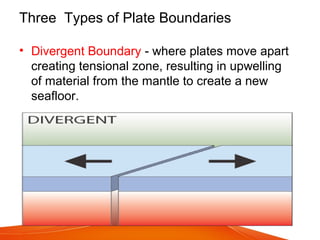
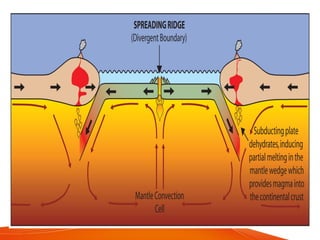
• Divergent Boundary - where plates move apart
creating tensional zone, resulting in upwelling
of material from the mantle to create a new
seafloor.
Seafloor spreading- the
plates move away from
the ridge axis, fractures
created are immediately
filled with molten rock
that oozes up from the
hot asthenosphere.
• This material cools slowly to
produce new slivers of
seafloor. As the plates
separate, new materials from
the mantle ooze up to fill the
gap. These materials will
slowly cool to produce new
ocean floor.
• Mid Oceanic Ridges - are
characterized by an
elevated position, extensive
faulting and numerous
volcanic structures that
have developed on newly
formed crust.
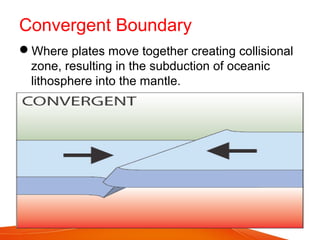
Convergent Boundary
Where plates move together creating collisional
zone, resulting in the subduction of oceanic
lithosphere into the mantle.
3 Types of Convergence
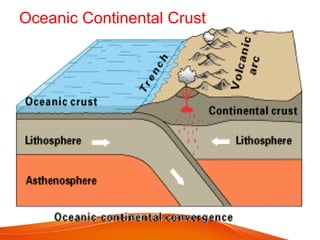
1. Oceanic Continental
• leading edge of a plate capped with
continental crust converges with a plate
capped with oceanic crust
• the plate with a less dense (caused by
addition of volatile material such as water)
continental material remains floating or
rise while denser oceanic slab sinks or
undergo subduction into the
asthenosphere.
• subducted crusts melts forms magma
since the mantle is hotter than the crust.
• produce continental volcanic arcs (such as
in Hawaii) and oceanic trench ( such as
Philippine Trench which has submarine
valleys and deepest - 10540 meters- part
of the ocean)
• continous grinding of the plates or crusts
causes shallow earthquakes, it is also
because of the sinking of the oceanic
crust.
Oceanic Continental Crust
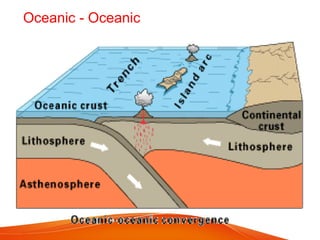
2. Oceanic - Oceanic
• two oceanic slabs converge,
one descends beneath the
other, initiating volcanic activity
similar to oceanic-continental
convergence but the
volcanoes here form on the
ocean floor rather than in a
continent.
• causes trenches to formed and
these trenches cause
earthquakes which in turn
produce tsunamis (harbor
wave - which is a series of
ocean waves with very long
wavelenghts, hundreds of km,
caused by large-scale
disturbances of the ocean)
Oceanic - Oceanic
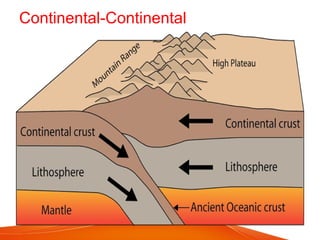
3. Continental-Continental
• two plates carrying continental crust
converge, neither plate will subduct
beneath the other because of low
density, resulting in collision between
two continental blocks.
• no trench, no volcano, and definitely
no island arc are created during the
process.
• instead of subduction between
two colliding continental plates,
pressure is released by pushing
the crusts upwardand forming
Mountain Range.
• collision of continental plates is
also associated with shallow
earthquake activities.
Continental-Continental
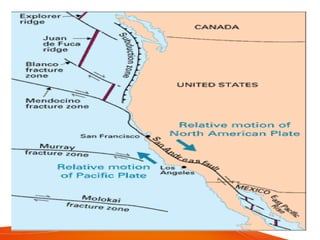
Transform Fault Boundary
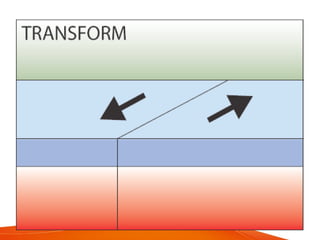
• where plates grind past each other without
the production or destruction of
lithosphere
• this type of boundary was discovered in
1965 by a Canadian Researcher who
suggested that these large faults connect
the global active belts (convergent and
divergent boundaries) into a continous
network that divides the earth's outer shell
into rigid plates.
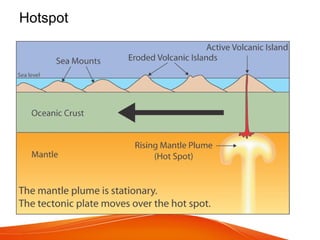
Hotspot
• Hot mantle plumes breaching
the surface in the middle of a
tectonic plate.

The Plate Tectonics Theory

  • 1.
  • 2.
    The Plate TectonicsTheory • This theory proposes that the Earth's outer shell consists of individual plates which interact in various ways and thereby produce earthquakes, volcanoes, mountains and crust itself.
  • 3.
    The Plate TectonicsTheory • The lithosphere is broken into numerous segments called plates that are in motion and are continually changing in shape and size.
  • 4.
    Three Types ofPlate Boundaries • Divergent Boundary - where plates move apart creating tensional zone, resulting in upwelling of material from the mantle to create a new seafloor.
  • 6.
    Seafloor spreading- the platesmove away from the ridge axis, fractures created are immediately filled with molten rock that oozes up from the hot asthenosphere.
  • 7.
    • This materialcools slowly to produce new slivers of seafloor. As the plates separate, new materials from the mantle ooze up to fill the gap. These materials will slowly cool to produce new ocean floor.
  • 8.
    • Mid OceanicRidges - are characterized by an elevated position, extensive faulting and numerous volcanic structures that have developed on newly formed crust.
  • 9.
    Convergent Boundary Where platesmove together creating collisional zone, resulting in the subduction of oceanic lithosphere into the mantle.
  • 10.
    3 Types ofConvergence 1. Oceanic Continental • leading edge of a plate capped with continental crust converges with a plate capped with oceanic crust • the plate with a less dense (caused by addition of volatile material such as water) continental material remains floating or rise while denser oceanic slab sinks or undergo subduction into the asthenosphere.
  • 11.
    • subducted crustsmelts forms magma since the mantle is hotter than the crust. • produce continental volcanic arcs (such as in Hawaii) and oceanic trench ( such as Philippine Trench which has submarine valleys and deepest - 10540 meters- part of the ocean) • continous grinding of the plates or crusts causes shallow earthquakes, it is also because of the sinking of the oceanic crust.
  • 12.
  • 13.
    2. Oceanic -Oceanic • two oceanic slabs converge, one descends beneath the other, initiating volcanic activity similar to oceanic-continental convergence but the volcanoes here form on the ocean floor rather than in a continent.
  • 14.
    • causes trenchesto formed and these trenches cause earthquakes which in turn produce tsunamis (harbor wave - which is a series of ocean waves with very long wavelenghts, hundreds of km, caused by large-scale disturbances of the ocean)
  • 15.
  • 16.
    3. Continental-Continental • twoplates carrying continental crust converge, neither plate will subduct beneath the other because of low density, resulting in collision between two continental blocks. • no trench, no volcano, and definitely no island arc are created during the process.
  • 17.
    • instead ofsubduction between two colliding continental plates, pressure is released by pushing the crusts upwardand forming Mountain Range. • collision of continental plates is also associated with shallow earthquake activities.
  • 18.
  • 19.
    Transform Fault Boundary •where plates grind past each other without the production or destruction of lithosphere • this type of boundary was discovered in 1965 by a Canadian Researcher who suggested that these large faults connect the global active belts (convergent and divergent boundaries) into a continous network that divides the earth's outer shell into rigid plates.
  • 23.
  • 24.
    • Hot mantleplumes breaching the surface in the middle of a tectonic plate.