BREAST
FEEDING
J.DASARATHA
I/C DIVISION OF NEONATALOGY
RDT CHILDREN’S HOSPITAL,
BATHALAPALLI
Why to breastfeed?
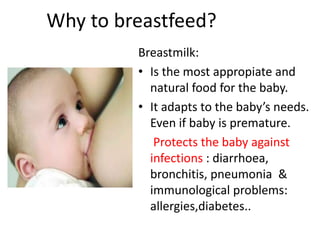
Breastmilk:
• Is the most appropiate and
natural food for the baby.
• It adapts to the baby’s needs.
Even if baby is premature.
Protects the baby against
infections : diarrhoea,
bronchitis, pneumonia &
immunological problems:
allergies,diabetes..
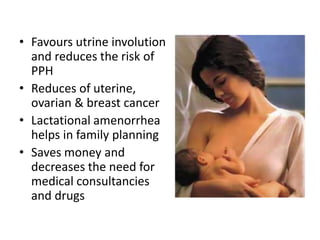
• Favours utrine involution
and reduces the risk of
PPH
• Reduces of uterine,
ovarian & breast cancer
• Lactational amenorrhea
helps in family planning
• Saves money and
decreases the need for
medical consultancies
and drugs
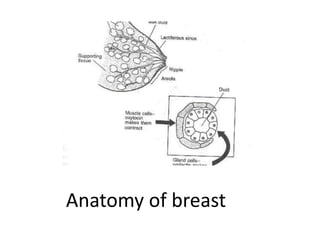
Anatomy of breast
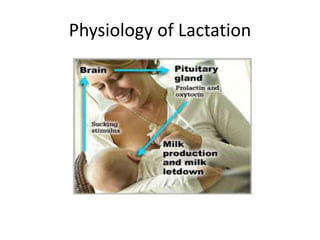
Physiology of Lactation
Murru Palu Bangaram
Colostrum
• Contains a large
amount of proteins
and vitamins, apart of
many more
inmmunoglobulins
• Even in small amounts
it is enough to feed
the newborn baby
Transitional milk: 3rd and 10th day post-partum
Mature milk: It’s composition changes during the
course of the same feeding:
Fore milk: more proteins, lactose, water and
vitamins
Hind milk: more creamy rich in fats and calories
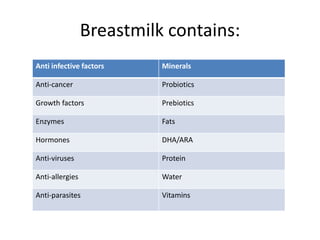
Breastmilk contains:
Anti infective factors Minerals
Anti-cancer Probiotics
Growth factors Prebiotics
Enzymes Fats
Hormones DHA/ARA
Anti-viruses Protein
Anti-allergies Water
Anti-parasites Vitamins
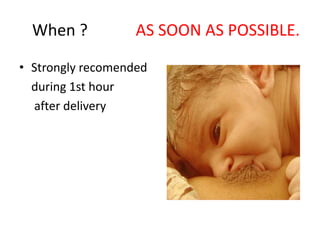
When ? AS SOON AS POSSIBLE.
• Strongly recomended
during 1st hour
after delivery
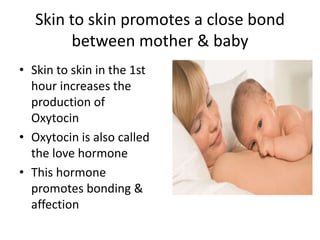
Skin to skin promotes a close bond
between mother & baby
• Skin to skin in the 1st
hour increases the
production of
Oxytocin
• Oxytocin is also called
the love hormone
• This hormone
promotes bonding &
affection
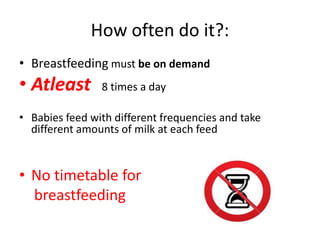
How often do it?:
• Breastfeeding must be on demand
• Atleast 8 times a day
• Babies feed with different frequencies and take
different amounts of milk at each feed
• No timetable for
breastfeeding
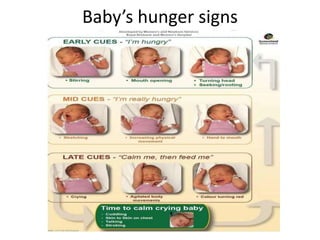
Baby’s hunger signs
• Allow suckling until he/she spontaneously
releases the nipple.
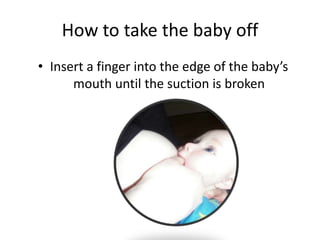
How to take the baby off
• Insert a finger into the edge of the baby’s
mouth until the suction is broken
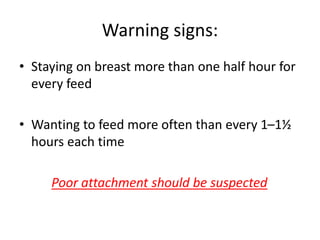
Warning signs:
• Staying on breast more than one half hour for
every feed
• Wanting to feed more often than every 1–1½
hours each time
Poor attachment should be suspected
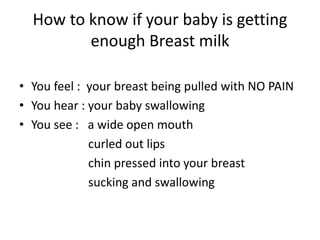
How to know if your baby is getting
enough Breast milk
• You feel : your breast being pulled with NO PAIN
• You hear : your baby swallowing
• You see : a wide open mouth
curled out lips
chin pressed into your breast
sucking and swallowing
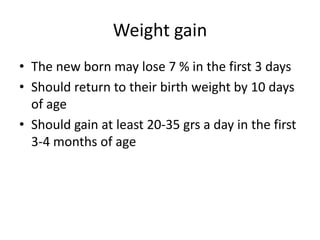
Weight gain
• The new born may lose 7 % in the first 3 days
• Should return to their birth weight by 10 days
of age
• Should gain at least 20-35 grs a day in the first
3-4 months of age
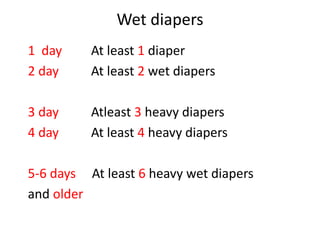
Wet diapers
1 day At least 1 diaper
2 day At least 2 wet diapers
3 day Atleast 3 heavy diapers
4 day At least 4 heavy diapers
5-6 days At least 6 heavy wet diapers
and older
For how long ?
WHO recommendations :
Breastfeed exclusively up to 6 months and
with complementary foods up to 2 years of
years or beyond
How to breastfeed?:
Skilled assistance
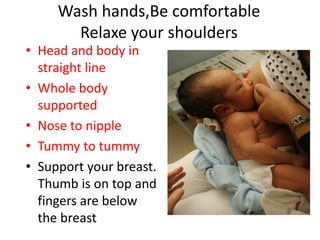
Wash hands,Be comfortable
Relaxe your shoulders
• Head and body in
straight line
• Whole body
supported
• Nose to nipple
• Tummy to tummy
• Support your breast.
Thumb is on top and
fingers are below
the breast
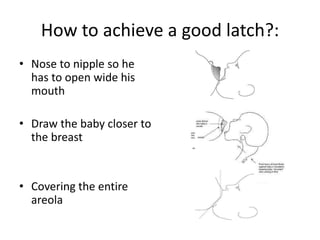
How to achieve a good latch?:
• Nose to nipple so he
has to open wide his
mouth
• Draw the baby closer to
the breast
• Covering the entire
areola
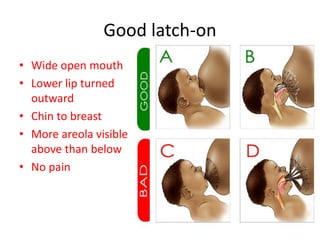
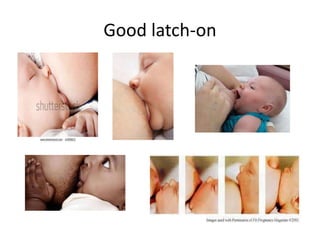
Good latch-on
• Wide open mouth
• Lower lip turned
outward
• Chin to breast
• More areola visible
above than below
• No pain
Good latch-on
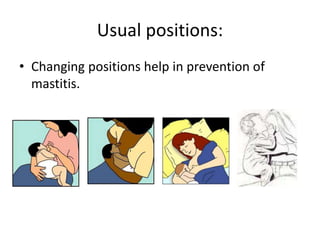
Usual positions:
• Changing positions help in prevention of
mastitis.
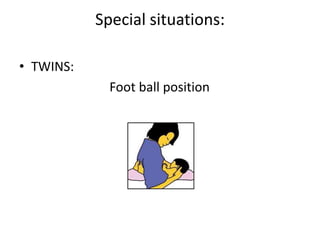
Special situations:
• TWINS:
Foot ball position
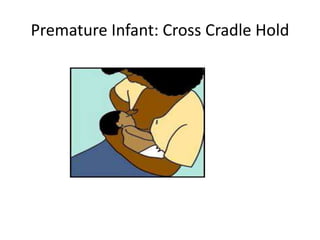
Premature Infant: Cross Cradle Hold
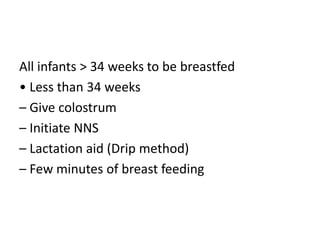
All infants > 34 weeks to be breastfed
• Less than 34 weeks
– Give colostrum
– Initiate NNS
– Lactation aid (Drip method)
– Few minutes of breast feeding
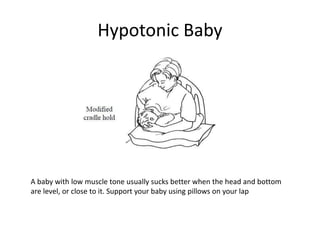
Hypotonic Baby
A baby with low muscle tone usually sucks better when the head and bottom
are level, or close to it. Support your baby using pillows on your lap
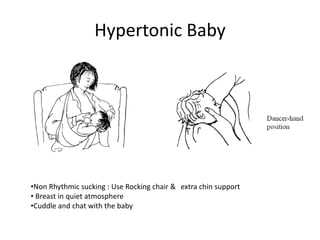
Hypertonic Baby
•Non Rhythmic sucking : Use Rocking chair &
• Breast in quiet atmosphere
•Cuddle and chat with the baby
extra chin support
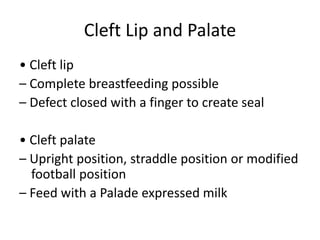
Cleft Lip and Palate
• Cleft lip
– Complete breastfeeding possible
– Defect closed with a finger to create seal
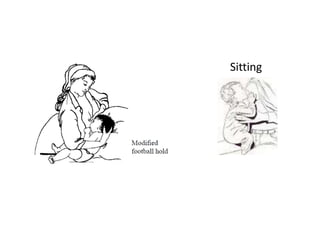
• Cleft palate
– Upright position, straddle position or modified
football position
– Feed with a Palade expressed milk
Sitting
Maternal Illness
• HIV : Promote Exclusive breastfeeding unless
AFASS criteria is met
• Hepatitis B : Breastfeed after Vaccine and or
HepaB IV IG
• Active Tuberculosis: Breastfeed along with
Chemo and BCG after stopping Chemo to baby
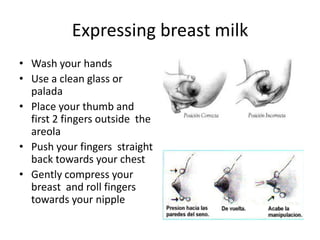
Expressing breast milk
• Wash your hands
• Use a clean glass or
palada
• Place your thumb and
first 2 fingers outside the
areola
• Push your fingers straight
back towards your chest
• Gently compress your
breast and roll fingers
towards your nipple
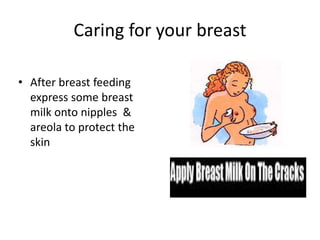
Caring for your breast
• After breast feeding
express some breast
milk onto nipples &
areola to protect the
skin
Dificulties during breast-feeding
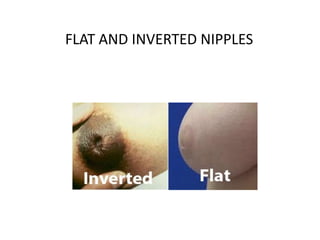
FLAT AND INVERTED NIPPLES
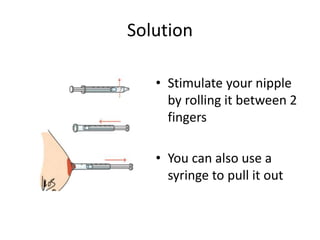
Solution
• Stimulate your nipple
by rolling it between 2
fingers
• You can also use a
syringe to pull it out
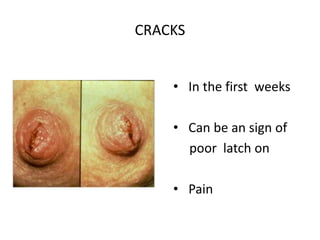
CRACKS
• In the first weeks
• Can be an sign of
poor latch on
• Pain
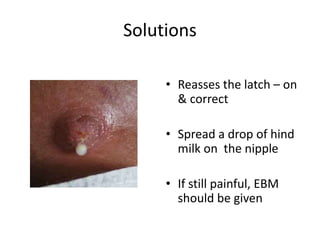
Solutions
• Reasses the latch – on
& correct
• Spread a drop of hind
milk on the nipple
• If still painful, EBM
should be given
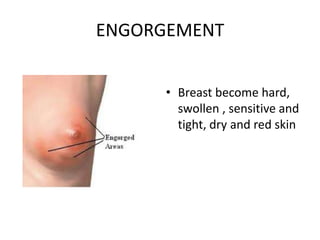
ENGORGEMENT
• Breast become hard,
swollen , sensitive and
tight, dry and red skin
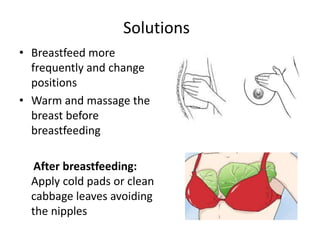
• Breastfeed more
frequently and change
positions
• Warm and massage the
breast before
breastfeeding
After breastfeeding:
Apply cold pads or clean
cabbage leaves avoiding
the nipples
Solutions
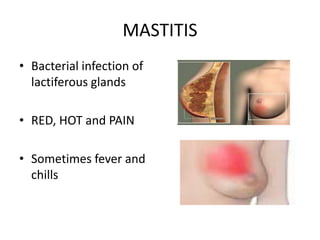
MASTITIS
• Bacterial infection of
lactiferous glands
• RED, HOT and PAIN
• Sometimes fever and
chills
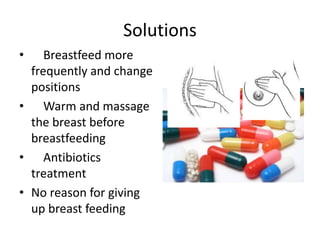
Solutions
• Breastfeed more
frequently and change
positions
• Warm and massage
the breast before
breastfeeding
• Antibiotics
treatment
• No reason for giving
up breast feeding
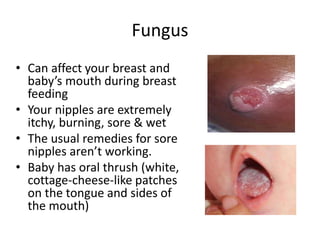
Fungus
• Can affect your breast and
baby’s mouth during breast
feeding
• Your nipples are extremely
itchy, burning, sore & wet
• The usual remedies for sore
nipples aren’t working.
• Baby has oral thrush (white,
cottage-cheese-like patches
on the tongue and sides of
the mouth)
Solutions
• Improve hygienic
conditions
• Reasses latch-on
• Apply an antifungical
cream
• Analgesic if needed
THANK YOU
L atch on
A s soon as possible
T ummy to tummy
C olostrum is gold
H is/her Right
O n demand
N o to bottle
Breast feeding - Baby's Right

Breast feeding - Baby's Right

  • 1.
    BREAST FEEDING J.DASARATHA I/C DIVISION OFNEONATALOGY RDT CHILDREN’S HOSPITAL, BATHALAPALLI
  • 2.
    Why to breastfeed? Breastmilk: •Is the most appropiate and natural food for the baby. • It adapts to the baby’s needs. Even if baby is premature. Protects the baby against infections : diarrhoea, bronchitis, pneumonia & immunological problems: allergies,diabetes..
  • 3.
    • Favours utrineinvolution and reduces the risk of PPH • Reduces of uterine, ovarian & breast cancer • Lactational amenorrhea helps in family planning • Saves money and decreases the need for medical consultancies and drugs
  • 4.
  • 5.
  • 9.
  • 10.
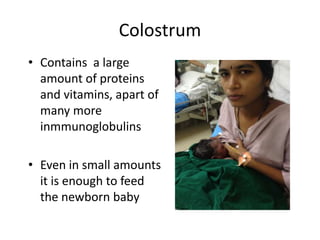
    Colostrum • Contains alarge amount of proteins and vitamins, apart of many more inmmunoglobulins • Even in small amounts it is enough to feed the newborn baby
  • 11.
    Transitional milk: 3rdand 10th day post-partum Mature milk: It’s composition changes during the course of the same feeding: Fore milk: more proteins, lactose, water and vitamins Hind milk: more creamy rich in fats and calories
  • 12.
    Breastmilk contains: Anti infectivefactors Minerals Anti-cancer Probiotics Growth factors Prebiotics Enzymes Fats Hormones DHA/ARA Anti-viruses Protein Anti-allergies Water Anti-parasites Vitamins
  • 13.
    When ? ASSOON AS POSSIBLE. • Strongly recomended during 1st hour after delivery
  • 14.
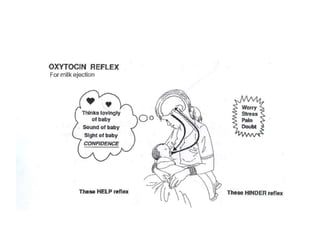
    Skin to skinpromotes a close bond between mother & baby • Skin to skin in the 1st hour increases the production of Oxytocin • Oxytocin is also called the love hormone • This hormone promotes bonding & affection
  • 16.
    How often doit?: • Breastfeeding must be on demand • Atleast 8 times a day • Babies feed with different frequencies and take different amounts of milk at each feed • No timetable for breastfeeding
  • 17.
  • 18.
    • Allow sucklinguntil he/she spontaneously releases the nipple.
  • 19.
    How to takethe baby off • Insert a finger into the edge of the baby’s mouth until the suction is broken
  • 20.
    Warning signs: • Stayingon breast more than one half hour for every feed • Wanting to feed more often than every 1–1½ hours each time Poor attachment should be suspected
  • 21.
    How to knowif your baby is getting enough Breast milk • You feel : your breast being pulled with NO PAIN • You hear : your baby swallowing • You see : a wide open mouth curled out lips chin pressed into your breast sucking and swallowing
  • 22.
    Weight gain • Thenew born may lose 7 % in the first 3 days • Should return to their birth weight by 10 days of age • Should gain at least 20-35 grs a day in the first 3-4 months of age
  • 23.
    Wet diapers 1 dayAt least 1 diaper 2 day At least 2 wet diapers 3 day Atleast 3 heavy diapers 4 day At least 4 heavy diapers 5-6 days At least 6 heavy wet diapers and older
  • 24.
    For how long? WHO recommendations : Breastfeed exclusively up to 6 months and with complementary foods up to 2 years of years or beyond
  • 25.
  • 26.
    Wash hands,Be comfortable Relaxeyour shoulders • Head and body in straight line • Whole body supported • Nose to nipple • Tummy to tummy • Support your breast. Thumb is on top and fingers are below the breast
  • 27.
    How to achievea good latch?: • Nose to nipple so he has to open wide his mouth • Draw the baby closer to the breast • Covering the entire areola
  • 28.
    Good latch-on • Wideopen mouth • Lower lip turned outward • Chin to breast • More areola visible above than below • No pain
  • 29.
  • 30.
    Usual positions: • Changingpositions help in prevention of mastitis.
  • 31.
  • 33.
  • 34.
    All infants >34 weeks to be breastfed • Less than 34 weeks – Give colostrum – Initiate NNS – Lactation aid (Drip method) – Few minutes of breast feeding
  • 36.
    Hypotonic Baby A babywith low muscle tone usually sucks better when the head and bottom are level, or close to it. Support your baby using pillows on your lap
  • 37.
    Hypertonic Baby •Non Rhythmicsucking : Use Rocking chair & • Breast in quiet atmosphere •Cuddle and chat with the baby extra chin support
  • 38.
    Cleft Lip andPalate • Cleft lip – Complete breastfeeding possible – Defect closed with a finger to create seal • Cleft palate – Upright position, straddle position or modified football position – Feed with a Palade expressed milk
  • 39.
  • 40.
    Maternal Illness • HIV: Promote Exclusive breastfeeding unless AFASS criteria is met • Hepatitis B : Breastfeed after Vaccine and or HepaB IV IG • Active Tuberculosis: Breastfeed along with Chemo and BCG after stopping Chemo to baby
  • 41.
    Expressing breast milk •Wash your hands • Use a clean glass or palada • Place your thumb and first 2 fingers outside the areola • Push your fingers straight back towards your chest • Gently compress your breast and roll fingers towards your nipple
  • 43.
    Caring for yourbreast • After breast feeding express some breast milk onto nipples & areola to protect the skin
  • 44.
  • 45.
  • 46.
    Solution • Stimulate yournipple by rolling it between 2 fingers • You can also use a syringe to pull it out
  • 47.
    CRACKS • In thefirst weeks • Can be an sign of poor latch on • Pain
  • 48.
    Solutions • Reasses thelatch – on & correct • Spread a drop of hind milk on the nipple • If still painful, EBM should be given
  • 49.
    ENGORGEMENT • Breast becomehard, swollen , sensitive and tight, dry and red skin
  • 50.
    • Breastfeed more frequentlyand change positions • Warm and massage the breast before breastfeeding After breastfeeding: Apply cold pads or clean cabbage leaves avoiding the nipples Solutions
  • 51.
    MASTITIS • Bacterial infectionof lactiferous glands • RED, HOT and PAIN • Sometimes fever and chills
  • 52.
    Solutions • Breastfeed more frequentlyand change positions • Warm and massage the breast before breastfeeding • Antibiotics treatment • No reason for giving up breast feeding
  • 53.
    Fungus • Can affectyour breast and baby’s mouth during breast feeding • Your nipples are extremely itchy, burning, sore & wet • The usual remedies for sore nipples aren’t working. • Baby has oral thrush (white, cottage-cheese-like patches on the tongue and sides of the mouth)
  • 54.
    Solutions • Improve hygienic conditions •Reasses latch-on • Apply an antifungical cream • Analgesic if needed
  • 55.
    THANK YOU L atchon A s soon as possible T ummy to tummy C olostrum is gold H is/her Right O n demand N o to bottle

Editor's Notes

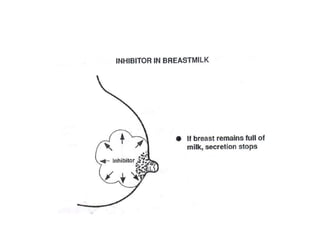
  • #7 Feedback inhibitor of lactation (FIL)
  • #13 PABA- malaria, BSSL- giardiasis, LACTOFERRIN- Ecoli;