BABY BATH
INTRODUCTION
Child rearing practices during the first year
vary from country to country. The amount of bathing
that is done is also inconsistent across
cultures.Unless contra indicated most infants and
children can be bathed in a basin at the bedside or on
the bed,or in a standard bath tub located on the unit
which is often conveniently adapted for pediatric use.
DEFINITION
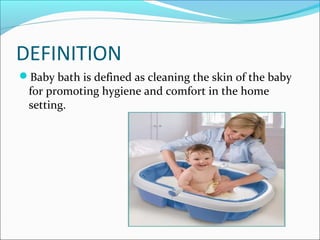
Baby bath is defined as cleaning the skin of the baby
for promoting hygiene and comfort in the home
setting.
OBJECTIVES
1.To keep the baby’s skin clean.
2.To refresh the baby.
3.To stimulate the circulation.
4.To prevent any skin infection.
5.To closely observe the body for evidence of any
abnormalities and to note infant’ growth and
development.
6.To induce sleep.
ASSESSMENT OF THE SKIN BEFORE
BATH
Colour
Moisture
Temperature
Texture
Turgur
Vascularity
Edema
Pruritis
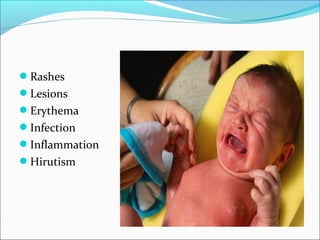
Rashes
Lesions
Erythema
Infection
Inflammation
Hirutism
TYPES OF BATH
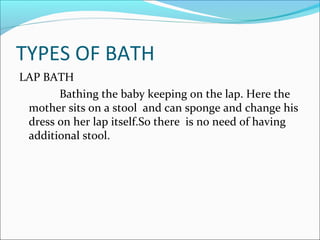
LAP BATH
Bathing the baby keeping on the lap. Here the
mother sits on a stool and can sponge and change his
dress on her lap itself.So there is no need of having
additional stool.
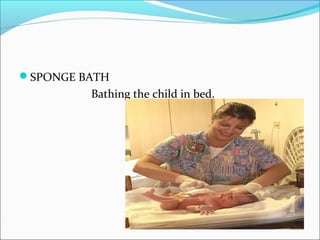
SPONGE BATH
Bathing the child in bed.
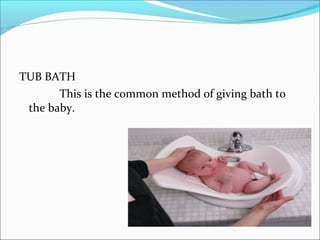
TUB BATH
This is the common method of giving bath to
the baby.
GENERAL INSTRUCTIONS FOR
GIVING BATH
Use warm room and warm water.
Bath quickly and gently.
Dry quickly and gently.
Never leave the baby unattended in a bath tub or
table.
The infant is given bath after the cord falls and
umbilicus is well healed.(within 7th
-10th
day.)
The ideal time for bathing a baby is before the
second feeding;taking care that the baby is not tired
or hungry.
Baby should not be bathed within an hour he is fed
because moving may cause vomit .
There should be a fixed time for bath,which will help
the baby to form a habit on an orderly schedules.
The newborn’s temperature regulating system is
underdeveloped,So meassure the temperature of
water to avoid overheating or chillness.98 -100 or 37
-38 )
The clothing should be selected based on the
environment and weather.
The soap used should be mild and without
hexachlorophene base and avoid using talcum
powders,because it containes zink stearate which
irritates the respiratory tract.
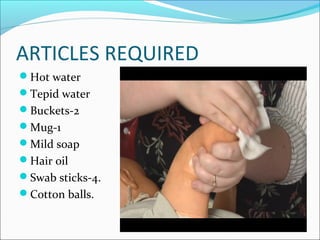
ARTICLES REQUIRED
Hot water
Tepid water
Buckets-2
Mug-1
Mild soap
Hair oil
Swab sticks-4.
Cotton balls.
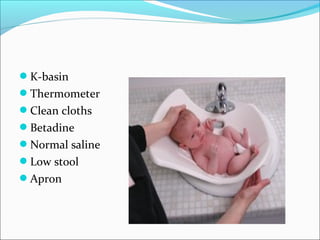
K-basin
Thermometer
Clean cloths
Betadine
Normal saline
Low stool
Apron
PRELIMINARY ASSESSMENT OF THE
CHILD AND SITUATION
Identify the child and check doctor’order for any
specific instruction about bathing the baby.
Get further instructions from the ward sister.
Assess the general condition of the baby and need for
bathing.
Find out from the mother whether the child had his
feeding within the previous one hour.
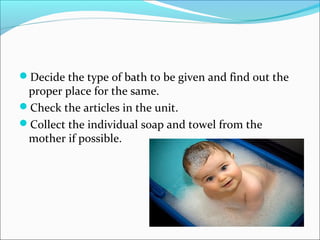
Decide the type of bath to be given and find out the
proper place for the same.
Check the articles in the unit.
Collect the individual soap and towel from the
mother if possible.
PREPARATION OF THE
ENVIRONMENT AND EQUIPMENT
Close windows to keep off draught and to provide
privacy.
Collect all the articles in readiness before beginning
the procedure.
Keep the table against the wall, place the tub or basin
on one end of the table and the tray with articles on
the other end conveniently so that the baby will be
protected on 3 sides and there is less chance of the
baby’s rolling of the table.
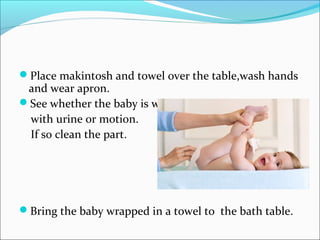
Place makintosh and towel over the table,wash hands
and wear apron.
See whether the baby is wet
with urine or motion.
If so clean the part.
Bring the baby wrapped in a towel to the bath table.
NURSING ACTION RATIONALE
1.Explain procedure to 1.To reduce anxiety
the mother and and to win
encourage her co-operation.
Participation.
NURSING ACTION RATIONALE
2.Pour water into the tub 2 . Prevents chances
and adjust temperature of hypothermia
by checking with the or scalding.
elbow or dorsal side
of the palm.
Nursing action Rationale
3.Undress the baby. 3.To made ready for bath
4.Place the head of the 4.Safeguards the baby
baby on your non- from slipping.
dominant palm and
support the body with
the forearm.
NURSING ACTION RATIONAL
5.Close ears with the 5.Prevents entry of
thump and middle water.
finger of the non-
dominant hand.
NURSING ACTION RATIONALE
6.Wipe the eyes from 6. It prevents entry of
inner canthus to outer debris and micro-
canthus with organisms into the
cotton swabs . lacrimal gland.
7.Dip hand in water and 7.Follows the principle
wipe face taking care less contaminated to
that no water goes into most contaminated
the mouth of infant. area.
NURSING ACTION RATIONALE
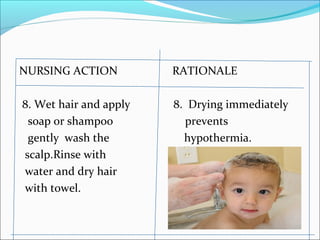
8. Wet hair and apply 8. Drying immediately
soap or shampoo prevents
gently wash the hypothermia.
scalp.Rinse with
water and dry hair
with towel.
NURSING ACTION RATIONALE
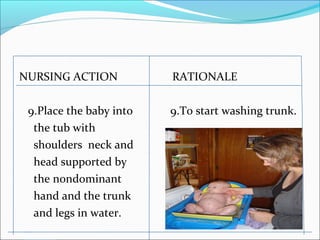
9.Place the baby into 9.To start washing trunk.
the tub with
shoulders neck and
head supported by
the nondominant
hand and the trunk
and legs in water.
NURSING ACTION RATIONALE
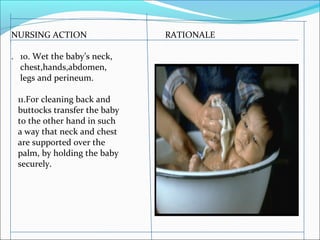
. 10. Wet the baby’s neck,
chest,hands,abdomen,
legs and perineum.
11.For cleaning back and
buttocks transfer the baby
to the other hand in such
a way that neck and chest
are supported over the
palm, by holding the baby
securely.
NURSING ACTION RATIONALE
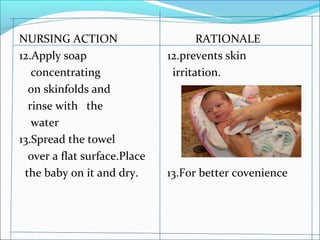
12.Apply soap 12.prevents skin
concentrating irritation.
on skinfolds and
rinse with the
water
13.Spread the towel
over a flat surface.Place
the baby on it and dry. 13.For better covenience
NURSING ACTION RATIONALE
14.With the swab stick 14. To prevent
swab the inner and umbilical
outer circle of cord. infection.
15.Dress the baby 15.To prevent from
. and cover in the hypothermia.
blanket or towel.
CONTRA INDICATIONS OF BABY
BATH
Hypothermia.
Convulsions.
Bronchopneumonia.
Congenital cyanotic heart desease.
Fresh burns.
Critical illness.
Premature infants.
AFTER CARE
Wash and replace the articles in the proper place.
Record the type of bath,any abnormal findings on the
skin with date and time.
Hand over the baby to the mother for feeding.
Before discharge demonstrate it to the mother,so that
she can bath her infant at home.
CONCLUSION
Bathing provides a opportunity to the nurse to
identify any developmental peculiarities and
superficial skin infections which should be brought to
the notice of physician.
BIBLIOGRAPHY
1.Adelli Pilliteri, ‘MATERNAL NEWBORN
NURSING,CARE OF GROWING FAMILY’ 2ND
ED.
(1976)Little Brown and company,Philadelphia.
2.Adelli Pillitteri,CHILD HEALTH NURSING,CARE OF
THE CHILD AND FAMILY,Lippincot,(1999)Los
Angels.Californi.
3.Dorothi .R.Marlow ,Barbara.a.Reeding ‘TEXT BOOK
OF PEDIATRIC NURSING(1988)W.B.Saunder’s
company,Philadelphia.
4.Hockenberry Wilson ‘wong’s nursing care of infants
and childre’8th
ed.(2007),mosby publishers.
5.C.P.Thresiamma,FUNDAMENTALS OF NURSING
PROCEDURE MANNUAL FOR GENERAL NURSING
AND MIDWIFERY COURSE,(2003),2nd
ed.jaypee
publishers,Newdelhi.
6.O.P.Ghai,Paul v.k,Piyush Guptha,’GHAI ESSENTIALS
OF PEDIATRICS(2005),6th
ed.CBC publishers,New
Delhi.
7.Annamma Jacob, ‘CLINICAL NURSING
PROCEDURES,THE ART OF nursing’2nd
ed.Jaypee
Publishers,newdelhi.
8. Meharban Singh ’Care If New Born’(2004)6th
ed.Sagar
publications,newdeihi.
9.CMC ‘procedure mannual’Vellore.

Baby bath

  • 1.
    BABY BATH INTRODUCTION Child rearingpractices during the first year vary from country to country. The amount of bathing that is done is also inconsistent across cultures.Unless contra indicated most infants and children can be bathed in a basin at the bedside or on the bed,or in a standard bath tub located on the unit which is often conveniently adapted for pediatric use.
  • 2.
    DEFINITION Baby bath isdefined as cleaning the skin of the baby for promoting hygiene and comfort in the home setting.
  • 3.
    OBJECTIVES 1.To keep thebaby’s skin clean. 2.To refresh the baby. 3.To stimulate the circulation. 4.To prevent any skin infection. 5.To closely observe the body for evidence of any abnormalities and to note infant’ growth and development. 6.To induce sleep.
  • 4.
    ASSESSMENT OF THESKIN BEFORE BATH Colour Moisture Temperature Texture Turgur Vascularity Edema Pruritis
  • 5.
  • 6.
    TYPES OF BATH LAPBATH Bathing the baby keeping on the lap. Here the mother sits on a stool and can sponge and change his dress on her lap itself.So there is no need of having additional stool.
  • 7.
  • 8.
    TUB BATH This isthe common method of giving bath to the baby.
  • 9.
    GENERAL INSTRUCTIONS FOR GIVINGBATH Use warm room and warm water. Bath quickly and gently. Dry quickly and gently. Never leave the baby unattended in a bath tub or table. The infant is given bath after the cord falls and umbilicus is well healed.(within 7th -10th day.)
  • 10.
    The ideal timefor bathing a baby is before the second feeding;taking care that the baby is not tired or hungry. Baby should not be bathed within an hour he is fed because moving may cause vomit . There should be a fixed time for bath,which will help the baby to form a habit on an orderly schedules.
  • 11.
    The newborn’s temperatureregulating system is underdeveloped,So meassure the temperature of water to avoid overheating or chillness.98 -100 or 37 -38 ) The clothing should be selected based on the environment and weather. The soap used should be mild and without hexachlorophene base and avoid using talcum powders,because it containes zink stearate which irritates the respiratory tract.
  • 12.
    ARTICLES REQUIRED Hot water Tepidwater Buckets-2 Mug-1 Mild soap Hair oil Swab sticks-4. Cotton balls.
  • 13.
  • 14.
    PRELIMINARY ASSESSMENT OFTHE CHILD AND SITUATION Identify the child and check doctor’order for any specific instruction about bathing the baby. Get further instructions from the ward sister. Assess the general condition of the baby and need for bathing. Find out from the mother whether the child had his feeding within the previous one hour.
  • 15.
    Decide the typeof bath to be given and find out the proper place for the same. Check the articles in the unit. Collect the individual soap and towel from the mother if possible.
  • 16.
    PREPARATION OF THE ENVIRONMENTAND EQUIPMENT Close windows to keep off draught and to provide privacy. Collect all the articles in readiness before beginning the procedure. Keep the table against the wall, place the tub or basin on one end of the table and the tray with articles on the other end conveniently so that the baby will be protected on 3 sides and there is less chance of the baby’s rolling of the table.
  • 17.
    Place makintosh andtowel over the table,wash hands and wear apron. See whether the baby is wet with urine or motion. If so clean the part. Bring the baby wrapped in a towel to the bath table.
  • 18.
    NURSING ACTION RATIONALE 1.Explainprocedure to 1.To reduce anxiety the mother and and to win encourage her co-operation. Participation.
  • 19.
    NURSING ACTION RATIONALE 2.Pourwater into the tub 2 . Prevents chances and adjust temperature of hypothermia by checking with the or scalding. elbow or dorsal side of the palm.
  • 20.
    Nursing action Rationale 3.Undressthe baby. 3.To made ready for bath 4.Place the head of the 4.Safeguards the baby baby on your non- from slipping. dominant palm and support the body with the forearm.
  • 21.
    NURSING ACTION RATIONAL 5.Closeears with the 5.Prevents entry of thump and middle water. finger of the non- dominant hand.
  • 22.
    NURSING ACTION RATIONALE 6.Wipethe eyes from 6. It prevents entry of inner canthus to outer debris and micro- canthus with organisms into the cotton swabs . lacrimal gland. 7.Dip hand in water and 7.Follows the principle wipe face taking care less contaminated to that no water goes into most contaminated the mouth of infant. area.
  • 23.
    NURSING ACTION RATIONALE 8.Wet hair and apply 8. Drying immediately soap or shampoo prevents gently wash the hypothermia. scalp.Rinse with water and dry hair with towel.
  • 24.
    NURSING ACTION RATIONALE 9.Placethe baby into 9.To start washing trunk. the tub with shoulders neck and head supported by the nondominant hand and the trunk and legs in water.
  • 25.
    NURSING ACTION RATIONALE .10. Wet the baby’s neck, chest,hands,abdomen, legs and perineum. 11.For cleaning back and buttocks transfer the baby to the other hand in such a way that neck and chest are supported over the palm, by holding the baby securely.
  • 26.
    NURSING ACTION RATIONALE 12.Applysoap 12.prevents skin concentrating irritation. on skinfolds and rinse with the water 13.Spread the towel over a flat surface.Place the baby on it and dry. 13.For better covenience
  • 27.
    NURSING ACTION RATIONALE 14.Withthe swab stick 14. To prevent swab the inner and umbilical outer circle of cord. infection. 15.Dress the baby 15.To prevent from . and cover in the hypothermia. blanket or towel.
  • 28.
    CONTRA INDICATIONS OFBABY BATH Hypothermia. Convulsions. Bronchopneumonia. Congenital cyanotic heart desease. Fresh burns. Critical illness. Premature infants.
  • 29.
    AFTER CARE Wash andreplace the articles in the proper place. Record the type of bath,any abnormal findings on the skin with date and time. Hand over the baby to the mother for feeding. Before discharge demonstrate it to the mother,so that she can bath her infant at home.
  • 30.
    CONCLUSION Bathing provides aopportunity to the nurse to identify any developmental peculiarities and superficial skin infections which should be brought to the notice of physician.
  • 31.
    BIBLIOGRAPHY 1.Adelli Pilliteri, ‘MATERNALNEWBORN NURSING,CARE OF GROWING FAMILY’ 2ND ED. (1976)Little Brown and company,Philadelphia. 2.Adelli Pillitteri,CHILD HEALTH NURSING,CARE OF THE CHILD AND FAMILY,Lippincot,(1999)Los Angels.Californi. 3.Dorothi .R.Marlow ,Barbara.a.Reeding ‘TEXT BOOK OF PEDIATRIC NURSING(1988)W.B.Saunder’s company,Philadelphia. 4.Hockenberry Wilson ‘wong’s nursing care of infants and childre’8th ed.(2007),mosby publishers.
  • 32.
    5.C.P.Thresiamma,FUNDAMENTALS OF NURSING PROCEDUREMANNUAL FOR GENERAL NURSING AND MIDWIFERY COURSE,(2003),2nd ed.jaypee publishers,Newdelhi. 6.O.P.Ghai,Paul v.k,Piyush Guptha,’GHAI ESSENTIALS OF PEDIATRICS(2005),6th ed.CBC publishers,New Delhi. 7.Annamma Jacob, ‘CLINICAL NURSING PROCEDURES,THE ART OF nursing’2nd ed.Jaypee Publishers,newdelhi. 8. Meharban Singh ’Care If New Born’(2004)6th ed.Sagar publications,newdeihi. 9.CMC ‘procedure mannual’Vellore.