Displacement Short Range Order and the
Determination of Higher Order Correlation


 Y. S. Puzyrev, D. M. Nicholson, R. I. Barabash, G. Stocks, G. Ice
                 Oak Ridge National Laboratory
                          R. McQueeney
                    Ames National Laboratory
                           Yingzhou Du
                      Iowa State University
Outline
• Short Range Order and Diffuse Scattering
• Experimental Method
• Data Analysis and Atomic Structure
• Pair and Many-body Correlations
• Displacement SRO and Higher Order Correlations in
  One-dimensional Model
• First Principles Calculation of Atomic Displacement in

     Fe46.5 Ni53.5                  Fe80.0Ga20.0
Diffuse scattering poised for a revolution!
•   Synchrotron sources /new tools enable new
    applications
     – Rapid measurements for combinatorial
        and dynamics
     – High energy for simplified data analysis
     – Small (dangerous) samples

•   Advanced neutron instruments emerging
     – Low Z elements
     – Magnetic scattering
     – Different contrast

•   New theories provide direct link beween
    experiments and first-principles calculations
                                                      Experiment        Theory

Major controversies have split leading scientists in once staid community!
Diffuse scattering due to local (short ranged)
                correlations/ fluctuations
•   Thermal diffuse scattering (TDS)

•   Point defect
     – Site substitution
     – Vacancy
     – Interstitial

•   Precipitate

•   Dislocations

•   Truncated surface- more


       All have in common reduced correlation length!
Bragg reflection occurs when scattering amplitudes
                 add constructively


• Orientation of sample

• Wavelength

• Bragg Peaks sharp! ~1/N
  (arc seconds)


                                            h ˆ
  Think in terms of momentum transfer   p0 = d0
                                           l
Length scales are inverted!

• Big real small reciprocal

• Small real big reciprocal

• We will see same effect in
  correlation length scales
    – Long real-space correlation
      lengths scattering close to
      Bragg peaks


  If you remember nothing else!
Krivoglaz classified defects by effect on Bragg Peak


                                           Intensity
• Defects of 1st kind                                    No defects
    –   Bragg width unchanged
    –   Bragg intensity decreased
    –   Diffuse redistributed in reciprocal space
    –   Displacements remain finite                     Defects of 1st kind


• Defects of 2nd kind
    – No longer distinct Bragg peaks
                                                       Defects of 2nd kind
    – Displacements continue to grow with
      crystal size
Thermal motion-Temperature Diffuse Scattering-
              (TDS) -defect of 1st kind

 • Atoms coupled through atomic
   bonding

 • Uncorrelated displacements at
   distant sites
    – (finite)

 • Phonons (wave description)
     –   Amplitude
     –   Period
     –   Propagation direction
     –   Polarization
         (transverse/compressional)

Sophisticated theories from
James, Born Von Karmen, Krivoglaz
A little math helps for party conversation

  • Decrease in Bragg intensity
    scales like e-2M, where
                           sin2 q
         2M = 16p u2   2
                       s
                             l
                                                Low Temperature
  • Small        Big reflections

  • e-2M shrinks (bigger effect)
    with (q)


                                                    High temperature
Displacements, us depend on Debye Temperature   D   –
Bigger   D   smaller displacements !
TDS makes beautiful patterns reciprocal space
                                    sodium              Rock salt
• Iso- intensity contours
    – Butterfly
    – Ovoid
    – Star


• Transmission images
  reflect symmetry of             Experiment   Theory
  reciprocal space and
  TDS patterns


 Chiang et al. Phys. Rev. Lett.
 83 3317 (1999)
Often TDS mixed with additional diffuse scattering


• Experiment


• Strain contribution


• Combined
  theoretical TDS and
  strain diffuse
  scattering


  TDS must often be removed to reveal other diffuse scattering
Alloys can have another type 1
                  defect-site substitution
                                       Each Au has 8 Cu near-neighbors

• Long range
   – Ordering (unlike neighbors)
                                                          Cu3Au
   – Phase separation (like
     neighbors)                                           L12

• Short ranged
   – Ordering
                                                           CuAu
   – Clustering (like neighbors)
                                                           L10


                                       Alternating planes of Au and Cu
Redistribution depends on kind of correlation


Clustering intensity
   fundamental sites


Random causes
Laue monotonic


Short-range ordering
  superstructure sites
Neutron/ X-rays Complimentary For
                 Short-range Order Measurements

•   Chemical order diffuse scattering
    proportional to contrast (fA-fB)2

•   Neutron scattering cross sections
     – Vary wildly with isotope
     – Can have + and – sign
     – Low Z , high Z comparable


•   X-ray scattering cross section
     – Monotonic like Z2
     – Alter by anomalous scattering
Neutrons can select isotope to
                         eliminate Bragg scattering


• Total scattering cafa2+ cbfb2 = 3                            +1        +1        +1
                                                                    -3        +1
                                                               +1        +1        -3
• Bragg scattering (cafa+ cbfb = 0
                              )2      +1        +1        +1
                                           -3        +1

• Laue (diffuse) scattering           +1        +1        -3             0         0
                                                               0
    cacb(fa- -fb)2 =3                                               0         0
                                                               0         0         0


 Isotopic purity important as different isotopes have distinct
 scattering cross sections- only one experiment ever done!
X-ray anomalous scattering can change x-ray contrast


                        • Chemical SRO scattering scales like (fa-fb)2
                        • Static displacements scale like (fa-fb)
                        • TDS scales like ~faverage2
Atomic size (static displacements) affect phase stability/
properties

 • Ionic materials (Goldschmidt)
     – Ratio of Components
     – Ratio of radii
     – Influence of polarization
                                                                      FeFe
                                                                     r 110
 • Metals and alloy phases (Hume-Rothery)            c
     – Ratio of radii                                    r FeNi
                                                           110
     – Valence electron concentration
     – Electrochemical factor                                      NiNi
                                                                  r 110       a
                                                                          a


    Grand challenge -include deviations from lattice in modeling of alloys
Measurement and theory of atomic size are hard!
• Theory- violates repeat lattice
  approximation- every unit cell
  different!

• Experiment
    – EXAFS marginal (0.02 nm) in
      dilute samples
    – Long-ranged samples have
      balanced forces


                           Important!
Systematic study of bond distances in Fe-Ni alloys
               raises interesting questions


• Why is the Fe-Fe bond
  distance stable?

• Why does Ni-Ni bond
  swell with Fe
  concentration?

• Are second near neighbor
  bond distances
  determined by first
  neighbor bonding?
Diffuse x-ray scattering measurements of AgPd alloy finds
                 surprising lack of local ordering

• Negative deviation from Vegard’s
  law indicates ordering.


• First principle theory predicts
  ordering.- Good system for theory.

• Semi-empirical theory predicts
  clustering.
High-energy x-ray measurements revolutionize
               studies of phase stability
 • Data in seconds instead
   of days

 • Minimum absorption
   and stability corrections

 • New analysis provides
                                           Crystal growth
   direct link to first-
   principle                                Experimental
                                            measurement of short
                                            range structures
Max Planck integrates diffuse x-                                   Data analysis
ray scattering elements!           Rapid measurement
                                   ESRF
Measurements show competing tendencies to order
                                Au3Ni -001 plane
• Both L12 and Z1 present

• Compare with first
  principles calculations


                            Reichert et al. Phys. Rev. Lett. 95 235703 (2005)
New directions in diffuse scattering


• Microdiffuse x-ray scattering
   – Combinatorial
   – Easy sample preparation

• Diffuse neutron data from
  every sample

• Interpretation more closely
  tied to theory
   – Modeling of scattering x-
      ray/neutron intensity


                                  Experiment       Model
Intense synchrotron/neutron sources realize the promise
        envisioned by pioneers of diffuse x-ray scattering
    •    M. Born and T. Von Karman 1912-1946- TDS
    •    Andre Guiner (30’s-40’s)-qualitative size
    •    I. M. Lifshitz J. Exp. Theoret. Phys. (USSR) 8 959
         (1937)
    •    K. Huang Proc. Roy. Soc. 190A 102 (1947)-long
         ranged strain fields
    •    J. M Cowley (1950) J. Appl. Phys.-local atomic
         size
    •    Warren, Averbach and Roberts J. App. Phys 22
         1493 (1954) -SRO
    •    Krivoglaz JETP 34 139 1958 chemical and spatial
         fluctuations


    Other references:
•       X-ray Diffraction- B.E. Warren Dover Publications New York 1990.
•       http://www.uni-wuerzburg.de/mineralogie/crystal/teaching/dif_a.html
•       Krivoglaz vol. I and Vol II.
Diffuse scattering done by real people-small community
                                  S. Cowley, Arizona St.
            • Warren school
                                     Bernie Borie,ORNL                       Cullie Sparks
                                                                             ORNL
                                 Jerry Cohen, Northwestern


                                 B. Schoenfeld, ETH Zurich

A. Gunier                             W. Schweika, KFA Jülich

                                       Simon Moss,U. Of Houston

            • Krivoglaz school
                                   Peisl, U. München


                                     Gitgarts,Minsk        Rosa Barabash
                                                           IMP, ORNL       Gene Ice
                                    Rya Boshupka, IMP                      ORNL
Advanced Photon Source
Argonne National Laboratory, Chicago IL
Upcomingin 2015: NSLS 2 in Brookhaven
Diffuse Scattering
                                                   2
                                   *
                                           
                                         k rp rq
                                                                                  
        I total   k             fp f e
                                   q                     I Bragg   k   I diffuse   k
                         p ,q

         f p - atomic scattering factor of atom p
                                                                    
             I diffuse   k      I SRO    k    I static   k     ITDS    k
Real Space                                                   Reciprocal Space
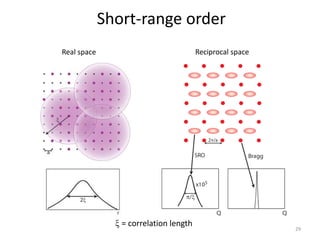
Short-range order
Real space                             Reciprocal space


                = correlation length
                                                          29
Short-range atomic ordering in Galfenol
• Position of doped Ga atoms influences
  magnetostriction
    – Quenched material has larger MS
    – MS is suppressed in D03 ordered samples
    – Proposed that uniaxial Ga pairing enhances MS
      (R. Wu, JAP 91, 7358, 2002)


• Ga atom distributions measured using X-ray
  scattering
    – Long-range order (Ga ordering, D03, B2, L12)
    – Short-range order (Ga clustering, pairing)


• Can study variation of Ga clustering with …
    –   Sample composition
    –   Heat treatment
    –   Temperature
    –   Stress/strain state
    –   Magnetic field                                     30
Fe-Ga structures and
    reflection conditions


Reflection      A2 (BCC)   B2 (SC)   D03 (FCC)
   (1,0,0)         X                   

   (2,0,0)                            

   (1,1,0)                            

   (1,1,1)         X                   

(1/2,1/2,1/2)      X         X          

 (1/2,1/2,0)       X         X          X


                                                 31
Experimental Method

•   Measurements performed at UNI-CAT
                                         (Sector 33ID-D APS)
     –   Absorption edge energy monochromatic x-rays
           •   (E=7.1 and 10.32 keV)
     –   Measure weak diffuse scattering signal
     –   Point detector for quantitative data


•   Sample Fe80Ga20
     –   Crystals prepared at Ames Lab by Bridgman technique
     –   Samples cut Size ~ 5x5x0.5 mm
     –   “Quenched” - rapidly cooled
     –   Etched for x-ray scattering
Data

                                                   100000
                                                                   (100)     26% quenched            (111)
                                                                                 LRO
                                                        10000


                                       Counts/monitor
                                                         1000              18.7% slow-cooled
                                                                                 SRO

                                                          100


                                                           10


                                                            1


                                                          0.1
                                                            -0.5       0.0        0.5          1.0           1.5    2.0
                                                                                     [1,L,L]

Thermal diffuse   Short-range
scattering        order
                                  Thermal diffuse                                      Short-range order


                                                                                                                   33
Conversion of the Data to Electron Units


• Scattering factors, - corrected for x-ray absorption fine structure (XAFS) and
Lorentzian hole width of an inner shell.
• Compton and Resonant Raman inelastic scattering is separated and removed from
integrated intensities.
•Ni standard integrated intensities are obtained to compute conversion factor.
Short-Range Order Parameters

 Anomalous (resonant) scattering


Warren-Cowley Short-Range Order Parameters

          AB
        Plmn           AB
lmn   1      , where Plmn   probability to find atom Ain shell ' lmn ' away from B
         cA
Large Scattering Factor Contrast
12 eV below Fe absorption edge
         E = 7.100 keV


                                   Small Scattering Factor Contrast
                                   50 eV below Ga absorption edge
                                            E = 10.320 keV
Large atomic displacements are instrumental for
   understanding of occurrence of DO3 phase
Magnetistriction Effect
           Experiment at high energy E= 80-120 keV, R. McQueeney
•   Correlation lengths                                                           1.00                                                 1.0
                                                                                         Fe100-xGax                                    1.1
     – Slow-cooled more ordered than                                              0.75                                                 1.3
                                                                                                                                       1.6
       quenched                                                                   0.50                                                 2.0
                                                                                                                                       2.7
     – At low x,   ~ 2-4 unit cells                                               0.25                                                 4.0


                                                 SRO Peak Width (Units of 2 /a)
                                                                                                                                       8.0
•
                                                                                         (1/2,1/2,1/2)          (3/2,1/2,1/2)


                                                                                                                                             Correlation Length (Unit Cells)
    Slow-cooled                                                                   0.00
                                                                                                                                       1.1
     – dramatic increase in correlation length
                                                                                                                      (100)SC
                                                                                                                      (100)Q
                                                                                  0.75                                (011)SC
                                                                                                                                       1.3
                                                                                                                      (011)Q
                                                                                                                                       1.6
       above 17.7%                                                                0.50
                                                                                                                      (111)SC
                                                                                                                      (111)Q
                                                                                                                                       2.0

•
                                                                                                                                       2.7
    Quenched                                                                      0.25                                                 4.0
                                                                                         (100)                  (3/2,3/2,3/2)          8.0
     – Gradual increase in correlation length                                     0.00
                                                                                                                                       1.1
•   Anisotropy                                                                    0.75                                                 1.3
                                                                                                                                       1.6
     – Long correlation lengths along (111)                                       0.50                                                 2.0
                                                                                                                                       2.7
     – Anisotropy disappears at high Ga%                                          0.25                                                 4.0
                                                                                         (111)                   (5/2,1/2,1/2)         8.0
                                                                                  0.00
                                                                                      12 13 14 15 16 17 18 19 20 13 14 15 16 17 18 19 20
                                                                                                  x, Ga Composition (%)
•   Atomic displacements – increase
    before magnetostriction decreases
X-ray diffraction diffuse scattering experiment
Warren-Cowley SRO parameters
Atomic displacements                                              lmn   lmn
    where lmn include 20 or more shells

Based on this information one can reconstruct
atomic configuration

If interactions are accurately described by
Pair Hamiltonian, the higher order correlations
are reproduced correctly from pair correlations
which can be shown using DFT


 Classical DFT: R. Evans, Advances in Physics 28, 2, 143 (1979)
Test multi-atom real-space correlations in Reverse Monte-
           Carlo model against equilibrium configurations

                                                      Create equilibrium configurations
                                                          With realistic interactions
•   Set 1 - pair interactions
    to 4th neighbor
                                                            Determine pair and higher
•   Set 2 -pair +multi-atom                                    Order correlations
    interactions

                                Construct a configuration
                                By Reverse Monte-Carlo
                                 From pair correlations
                                                                  Compare
                                Determine pair and higher        correlations
                                   Order correlations
Nearest Neighbor distribution


               •   Pair correlations determine all higher order correlations
•Equilibrium       for pair potential Hamiltonians.
•Constructed   •   For many body Hamiltonians they do not.
•Random        •   Derivatives provide information about higher order
                   correlations: pressure, magnetic field, stress,…
SRO in 1D Model with PBC

      •Show that displacements SRO limits higher order correlations

      •Simple analytical model

                                   Iso- g (r )        process used to check realizability of
                                                      pair correlation function


                                 Inappropriateness of so called “reverse Monte Carlo
                                 Method” that uses a candidate pair correlation function
                                 as a means to suggest typical many-body configuraitons


F. H. Stillinger,S. Torquato, “Pair Correlation Function Realizability”, J. Phys. Chem. B 108, 19589
Lattice Model

   n, N      configuration of n particles distributed on N sites

                                                             For example
Class collects all members that differ only by

   •Translation

   •Inversion                                                       j


m j number of configurations
                                                                   N 11
w j weight
                                                                   n 3
Enumeration of states

                                                Given
The weights have to be positive                 g (r )

                                   The solution of linear equations

   1   2   2w1 2w2 2w3          k • Exists and not unique
                                       •1,2, n dimensional manifold
   1   3   2w2 2w4     w5   k
           w1 2w3 2w5       k      • Exists and unique
   1   4

etc...                             • Doesn’t exist
Displacements SRO in 1D Model with PBC

    • Suppose that there is an average ‘lattice’ and
    introduce displacements off the ideal positions

    • Create a simple RULE for the displacement
    dependence on chemical environment
                                                    Displacement table
                                                          101 N
                           Displace 0 in the
                                                          001 R
1                          middle to the right if         100 L
        j   ,    j
                           0 is to the left and 1         111 N
0
                           is to the right                011 L
    0
                                                          110 R
                                                          000 N
Displacements SRO in 1D Model with PBC


 d1d4 = w1 + w3 + 2w5 = f       This puts additional restrictions
                                On the possible configurations
etc...
 s 1s 2 = 2w1 + 2w2 + 2w3 = k   The displacements in the real
                                system must give an indication
 s 1s 3 = 2w2 + 2w4 + w5 = k    whether the particular local
                                environment is realizable or not,
 s 1s 4 = w1 + 2w3 + 2w5 = k    i.e. restrict the higher order
                                correlations in the system
etc...
Average correlations: point, pair, triplet


            1               A
i
             1              B
                 N
        1                           2c 1
            N   i 1
                            i

                      N
    2
            1                               4(c 2 c 1 c       ) 2c 1
    j            N              i    i j                  j
                      i 1
                                                                           ö-1
                      N
                                                      æ              V (q)
                                                 a ( q ) = ç1+ 2cA cB       ÷
    3
            1
    j ,k         N              i    i j   i k
                      i 1
                                                           è           kB T ø
Real alloy system

Fe46.5 Ni53.5
                N
  2
        1                          Configurations with the same pair correlations
  j         N   i 1
                      i   i j


                                              Vary triplet correlations

 1-st

                                    Compute displacements from first principles


                                         Compare the displacements with
                                               Measured values
Configurations with triplet correlation variation

     P AAA
      11        0.1          A     Ni         P AAA
                                               11         0.4
                            Reverse
                           Monte-Carlo

                            128 atom
                              VASP
                          Displacements


                           Experiment


Fe 4.09e-4 Ni 1.70e-4   Fe 0.028 Ni 0.012   Fe 7.09e-4 Ni 0.70e-4
Conclusion

• One-dimensional model shows that displacement SRO
  further restricts higher order correlations


• For realistic system calculation of displacements can
  give qualitative prediction of higher order
  correlations.

лекция 2 атомные смещения в бинарных сплавах

  • 1.
    Displacement Short RangeOrder and the Determination of Higher Order Correlation Y. S. Puzyrev, D. M. Nicholson, R. I. Barabash, G. Stocks, G. Ice Oak Ridge National Laboratory R. McQueeney Ames National Laboratory Yingzhou Du Iowa State University
  • 2.
    Outline • Short RangeOrder and Diffuse Scattering • Experimental Method • Data Analysis and Atomic Structure • Pair and Many-body Correlations • Displacement SRO and Higher Order Correlations in One-dimensional Model • First Principles Calculation of Atomic Displacement in Fe46.5 Ni53.5 Fe80.0Ga20.0
  • 3.
    Diffuse scattering poisedfor a revolution! • Synchrotron sources /new tools enable new applications – Rapid measurements for combinatorial and dynamics – High energy for simplified data analysis – Small (dangerous) samples • Advanced neutron instruments emerging – Low Z elements – Magnetic scattering – Different contrast • New theories provide direct link beween experiments and first-principles calculations Experiment Theory Major controversies have split leading scientists in once staid community!
  • 4.
    Diffuse scattering dueto local (short ranged) correlations/ fluctuations • Thermal diffuse scattering (TDS) • Point defect – Site substitution – Vacancy – Interstitial • Precipitate • Dislocations • Truncated surface- more All have in common reduced correlation length!
  • 5.
    Bragg reflection occurswhen scattering amplitudes add constructively • Orientation of sample • Wavelength • Bragg Peaks sharp! ~1/N (arc seconds) h ˆ Think in terms of momentum transfer p0 = d0 l
  • 6.
    Length scales areinverted! • Big real small reciprocal • Small real big reciprocal • We will see same effect in correlation length scales – Long real-space correlation lengths scattering close to Bragg peaks If you remember nothing else!
  • 7.
    Krivoglaz classified defectsby effect on Bragg Peak Intensity • Defects of 1st kind No defects – Bragg width unchanged – Bragg intensity decreased – Diffuse redistributed in reciprocal space – Displacements remain finite Defects of 1st kind • Defects of 2nd kind – No longer distinct Bragg peaks Defects of 2nd kind – Displacements continue to grow with crystal size
  • 8.
    Thermal motion-Temperature DiffuseScattering- (TDS) -defect of 1st kind • Atoms coupled through atomic bonding • Uncorrelated displacements at distant sites – (finite) • Phonons (wave description) – Amplitude – Period – Propagation direction – Polarization (transverse/compressional) Sophisticated theories from James, Born Von Karmen, Krivoglaz
  • 9.
    A little mathhelps for party conversation • Decrease in Bragg intensity scales like e-2M, where sin2 q 2M = 16p u2 2 s l Low Temperature • Small Big reflections • e-2M shrinks (bigger effect) with (q) High temperature Displacements, us depend on Debye Temperature D – Bigger D smaller displacements !
  • 10.
    TDS makes beautifulpatterns reciprocal space sodium Rock salt • Iso- intensity contours – Butterfly – Ovoid – Star • Transmission images reflect symmetry of Experiment Theory reciprocal space and TDS patterns Chiang et al. Phys. Rev. Lett. 83 3317 (1999)
  • 11.
    Often TDS mixedwith additional diffuse scattering • Experiment • Strain contribution • Combined theoretical TDS and strain diffuse scattering TDS must often be removed to reveal other diffuse scattering
  • 12.
    Alloys can haveanother type 1 defect-site substitution Each Au has 8 Cu near-neighbors • Long range – Ordering (unlike neighbors) Cu3Au – Phase separation (like neighbors) L12 • Short ranged – Ordering CuAu – Clustering (like neighbors) L10 Alternating planes of Au and Cu
  • 13.
    Redistribution depends onkind of correlation Clustering intensity fundamental sites Random causes Laue monotonic Short-range ordering superstructure sites
  • 14.
    Neutron/ X-rays ComplimentaryFor Short-range Order Measurements • Chemical order diffuse scattering proportional to contrast (fA-fB)2 • Neutron scattering cross sections – Vary wildly with isotope – Can have + and – sign – Low Z , high Z comparable • X-ray scattering cross section – Monotonic like Z2 – Alter by anomalous scattering
  • 15.
    Neutrons can selectisotope to eliminate Bragg scattering • Total scattering cafa2+ cbfb2 = 3 +1 +1 +1 -3 +1 +1 +1 -3 • Bragg scattering (cafa+ cbfb = 0 )2 +1 +1 +1 -3 +1 • Laue (diffuse) scattering +1 +1 -3 0 0 0 cacb(fa- -fb)2 =3 0 0 0 0 0 Isotopic purity important as different isotopes have distinct scattering cross sections- only one experiment ever done!
  • 16.
    X-ray anomalous scatteringcan change x-ray contrast • Chemical SRO scattering scales like (fa-fb)2 • Static displacements scale like (fa-fb) • TDS scales like ~faverage2
  • 17.
    Atomic size (staticdisplacements) affect phase stability/ properties • Ionic materials (Goldschmidt) – Ratio of Components – Ratio of radii – Influence of polarization FeFe r 110 • Metals and alloy phases (Hume-Rothery) c – Ratio of radii r FeNi 110 – Valence electron concentration – Electrochemical factor NiNi r 110 a a Grand challenge -include deviations from lattice in modeling of alloys
  • 18.
    Measurement and theoryof atomic size are hard! • Theory- violates repeat lattice approximation- every unit cell different! • Experiment – EXAFS marginal (0.02 nm) in dilute samples – Long-ranged samples have balanced forces Important!
  • 19.
    Systematic study ofbond distances in Fe-Ni alloys raises interesting questions • Why is the Fe-Fe bond distance stable? • Why does Ni-Ni bond swell with Fe concentration? • Are second near neighbor bond distances determined by first neighbor bonding?
  • 20.
    Diffuse x-ray scatteringmeasurements of AgPd alloy finds surprising lack of local ordering • Negative deviation from Vegard’s law indicates ordering. • First principle theory predicts ordering.- Good system for theory. • Semi-empirical theory predicts clustering.
  • 21.
    High-energy x-ray measurementsrevolutionize studies of phase stability • Data in seconds instead of days • Minimum absorption and stability corrections • New analysis provides Crystal growth direct link to first- principle Experimental measurement of short range structures Max Planck integrates diffuse x- Data analysis ray scattering elements! Rapid measurement ESRF
  • 22.
    Measurements show competingtendencies to order Au3Ni -001 plane • Both L12 and Z1 present • Compare with first principles calculations Reichert et al. Phys. Rev. Lett. 95 235703 (2005)
  • 23.
    New directions indiffuse scattering • Microdiffuse x-ray scattering – Combinatorial – Easy sample preparation • Diffuse neutron data from every sample • Interpretation more closely tied to theory – Modeling of scattering x- ray/neutron intensity Experiment Model
  • 24.
    Intense synchrotron/neutron sourcesrealize the promise envisioned by pioneers of diffuse x-ray scattering • M. Born and T. Von Karman 1912-1946- TDS • Andre Guiner (30’s-40’s)-qualitative size • I. M. Lifshitz J. Exp. Theoret. Phys. (USSR) 8 959 (1937) • K. Huang Proc. Roy. Soc. 190A 102 (1947)-long ranged strain fields • J. M Cowley (1950) J. Appl. Phys.-local atomic size • Warren, Averbach and Roberts J. App. Phys 22 1493 (1954) -SRO • Krivoglaz JETP 34 139 1958 chemical and spatial fluctuations Other references: • X-ray Diffraction- B.E. Warren Dover Publications New York 1990. • http://www.uni-wuerzburg.de/mineralogie/crystal/teaching/dif_a.html • Krivoglaz vol. I and Vol II.
  • 25.
    Diffuse scattering doneby real people-small community S. Cowley, Arizona St. • Warren school Bernie Borie,ORNL Cullie Sparks ORNL Jerry Cohen, Northwestern B. Schoenfeld, ETH Zurich A. Gunier W. Schweika, KFA Jülich Simon Moss,U. Of Houston • Krivoglaz school Peisl, U. München Gitgarts,Minsk Rosa Barabash IMP, ORNL Gene Ice Rya Boshupka, IMP ORNL
  • 26.
    Advanced Photon Source ArgonneNational Laboratory, Chicago IL
  • 27.
    Upcomingin 2015: NSLS2 in Brookhaven
  • 28.
    Diffuse Scattering 2  *    k rp rq   I total k fp f e q I Bragg k I diffuse k p ,q f p - atomic scattering factor of atom p     I diffuse k I SRO k I static k ITDS k Real Space Reciprocal Space
  • 29.
    Short-range order Real space Reciprocal space = correlation length 29
  • 30.
    Short-range atomic orderingin Galfenol • Position of doped Ga atoms influences magnetostriction – Quenched material has larger MS – MS is suppressed in D03 ordered samples – Proposed that uniaxial Ga pairing enhances MS (R. Wu, JAP 91, 7358, 2002) • Ga atom distributions measured using X-ray scattering – Long-range order (Ga ordering, D03, B2, L12) – Short-range order (Ga clustering, pairing) • Can study variation of Ga clustering with … – Sample composition – Heat treatment – Temperature – Stress/strain state – Magnetic field 30
  • 31.
    Fe-Ga structures and reflection conditions Reflection A2 (BCC) B2 (SC) D03 (FCC) (1,0,0) X   (2,0,0)    (1,1,0)    (1,1,1) X   (1/2,1/2,1/2) X X  (1/2,1/2,0) X X X 31
  • 32.
    Experimental Method • Measurements performed at UNI-CAT (Sector 33ID-D APS) – Absorption edge energy monochromatic x-rays • (E=7.1 and 10.32 keV) – Measure weak diffuse scattering signal – Point detector for quantitative data • Sample Fe80Ga20 – Crystals prepared at Ames Lab by Bridgman technique – Samples cut Size ~ 5x5x0.5 mm – “Quenched” - rapidly cooled – Etched for x-ray scattering
  • 33.
    Data 100000 (100) 26% quenched (111) LRO 10000 Counts/monitor 1000 18.7% slow-cooled SRO 100 10 1 0.1 -0.5 0.0 0.5 1.0 1.5 2.0 [1,L,L] Thermal diffuse Short-range scattering order Thermal diffuse Short-range order 33
  • 34.
    Conversion of theData to Electron Units • Scattering factors, - corrected for x-ray absorption fine structure (XAFS) and Lorentzian hole width of an inner shell. • Compton and Resonant Raman inelastic scattering is separated and removed from integrated intensities. •Ni standard integrated intensities are obtained to compute conversion factor.
  • 35.
    Short-Range Order Parameters Anomalous (resonant) scattering Warren-Cowley Short-Range Order Parameters AB Plmn AB lmn 1 , where Plmn probability to find atom Ain shell ' lmn ' away from B cA
  • 36.
    Large Scattering FactorContrast 12 eV below Fe absorption edge E = 7.100 keV Small Scattering Factor Contrast 50 eV below Ga absorption edge E = 10.320 keV
  • 37.
    Large atomic displacementsare instrumental for understanding of occurrence of DO3 phase
  • 38.
    Magnetistriction Effect Experiment at high energy E= 80-120 keV, R. McQueeney • Correlation lengths 1.00 1.0 Fe100-xGax 1.1 – Slow-cooled more ordered than 0.75 1.3 1.6 quenched 0.50 2.0 2.7 – At low x, ~ 2-4 unit cells 0.25 4.0 SRO Peak Width (Units of 2 /a) 8.0 • (1/2,1/2,1/2) (3/2,1/2,1/2) Correlation Length (Unit Cells) Slow-cooled 0.00 1.1 – dramatic increase in correlation length (100)SC (100)Q 0.75 (011)SC 1.3 (011)Q 1.6 above 17.7% 0.50 (111)SC (111)Q 2.0 • 2.7 Quenched 0.25 4.0 (100) (3/2,3/2,3/2) 8.0 – Gradual increase in correlation length 0.00 1.1 • Anisotropy 0.75 1.3 1.6 – Long correlation lengths along (111) 0.50 2.0 2.7 – Anisotropy disappears at high Ga% 0.25 4.0 (111) (5/2,1/2,1/2) 8.0 0.00 12 13 14 15 16 17 18 19 20 13 14 15 16 17 18 19 20 x, Ga Composition (%) • Atomic displacements – increase before magnetostriction decreases
  • 39.
    X-ray diffraction diffusescattering experiment Warren-Cowley SRO parameters Atomic displacements lmn lmn where lmn include 20 or more shells Based on this information one can reconstruct atomic configuration If interactions are accurately described by Pair Hamiltonian, the higher order correlations are reproduced correctly from pair correlations which can be shown using DFT Classical DFT: R. Evans, Advances in Physics 28, 2, 143 (1979)
  • 40.
    Test multi-atom real-spacecorrelations in Reverse Monte- Carlo model against equilibrium configurations Create equilibrium configurations With realistic interactions • Set 1 - pair interactions to 4th neighbor Determine pair and higher • Set 2 -pair +multi-atom Order correlations interactions Construct a configuration By Reverse Monte-Carlo From pair correlations Compare Determine pair and higher correlations Order correlations
  • 41.
    Nearest Neighbor distribution • Pair correlations determine all higher order correlations •Equilibrium for pair potential Hamiltonians. •Constructed • For many body Hamiltonians they do not. •Random • Derivatives provide information about higher order correlations: pressure, magnetic field, stress,…
  • 42.
    SRO in 1DModel with PBC •Show that displacements SRO limits higher order correlations •Simple analytical model Iso- g (r ) process used to check realizability of pair correlation function Inappropriateness of so called “reverse Monte Carlo Method” that uses a candidate pair correlation function as a means to suggest typical many-body configuraitons F. H. Stillinger,S. Torquato, “Pair Correlation Function Realizability”, J. Phys. Chem. B 108, 19589
  • 43.
    Lattice Model n, N configuration of n particles distributed on N sites For example Class collects all members that differ only by •Translation •Inversion j m j number of configurations N 11 w j weight n 3
  • 44.
    Enumeration of states Given The weights have to be positive g (r ) The solution of linear equations 1 2 2w1 2w2 2w3 k • Exists and not unique •1,2, n dimensional manifold 1 3 2w2 2w4 w5 k w1 2w3 2w5 k • Exists and unique 1 4 etc... • Doesn’t exist
  • 45.
    Displacements SRO in1D Model with PBC • Suppose that there is an average ‘lattice’ and introduce displacements off the ideal positions • Create a simple RULE for the displacement dependence on chemical environment Displacement table 101 N Displace 0 in the 001 R 1 middle to the right if 100 L j , j 0 is to the left and 1 111 N 0 is to the right 011 L 0 110 R 000 N
  • 46.
    Displacements SRO in1D Model with PBC d1d4 = w1 + w3 + 2w5 = f This puts additional restrictions On the possible configurations etc... s 1s 2 = 2w1 + 2w2 + 2w3 = k The displacements in the real system must give an indication s 1s 3 = 2w2 + 2w4 + w5 = k whether the particular local environment is realizable or not, s 1s 4 = w1 + 2w3 + 2w5 = k i.e. restrict the higher order correlations in the system etc...
  • 47.
    Average correlations: point,pair, triplet 1 A i 1 B N 1 2c 1 N i 1 i N 2 1 4(c 2 c 1 c ) 2c 1 j N i i j j i 1  ö-1 N  æ V (q) a ( q ) = ç1+ 2cA cB ÷ 3 1 j ,k N i i j i k i 1 è kB T ø
  • 48.
    Real alloy system Fe46.5Ni53.5 N 2 1 Configurations with the same pair correlations j N i 1 i i j Vary triplet correlations 1-st Compute displacements from first principles Compare the displacements with Measured values
  • 49.
    Configurations with tripletcorrelation variation P AAA 11 0.1 A Ni P AAA 11 0.4 Reverse Monte-Carlo 128 atom VASP Displacements Experiment Fe 4.09e-4 Ni 1.70e-4 Fe 0.028 Ni 0.012 Fe 7.09e-4 Ni 0.70e-4
  • 50.
    Conclusion • One-dimensional modelshows that displacement SRO further restricts higher order correlations • For realistic system calculation of displacements can give qualitative prediction of higher order correlations.