The effect of electronic doping on the
magnetisation and thermopower
properties of Ba2FeMoO6
      Jibu Stephen a,b,c, Grant Williams b,c, Ben Ruck b,c, K. Rutherford a
      Industrial Research, Lower Hutt, New Zealand
      The MacDiarmid Institute
      Victoria University of Wellington

                  Outline
                  [1] Double Perovskite Ba2FeMoO6
                  [2] ASD & Magnetisation
                  [3] Magnetoresistance
                  [4] Thermopower


  a                            b                         c
Double perovskites
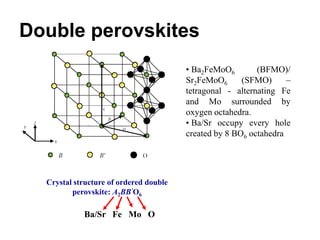
                                        • Ba2FeMoO6        (BFMO)/
                                        Sr2FeMoO6      (SFMO)      –
                                        tetragonal - alternating Fe
                                        and Mo surrounded by
                                        oxygen octahedra.
                                        • Ba/Sr occupy every hole
                                        created by 8 BO6 octahedra


  Crystal structure of ordered double
         perovskite: A2BB’O6

            Ba/Sr Fe Mo O
Double perovskites
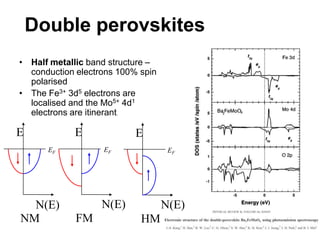
• Half metallic band structure –
  conduction electrons 100% spin
  polarised
• The Fe3+ 3d5 electrons are
  localised and the Mo5+ 4d1
  electrons are itinerant.

E           E              E
      EF           EF               EF


  N(E)             N(E)            N(E)
NM           FM             HM
Double perovskites
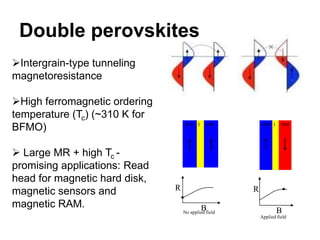
Intergrain-type tunneling
magnetoresistance

High ferromagnetic ordering
temperature (Tc) (~310 K for
                                   HM     I   HM          HM I      HM
BFMO)

 Large MR + high Tc -
promising applications: Read
head for magnetic hard disk,
magnetic sensors and           R                      R
magnetic RAM.                                 B
                                   No applied field               B
                                                          Applied field
Synthesis
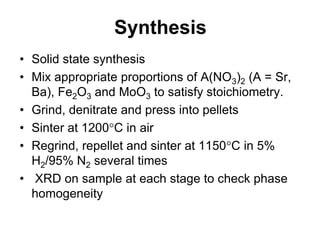
• Solid state synthesis
• Mix appropriate proportions of A(NO3)2 (A = Sr,
  Ba), Fe2O3 and MoO3 to satisfy stoichiometry.
• Grind, denitrate and press into pellets
• Sinter at 1200 C in air
• Regrind, repellet and sinter at 1150 C in 5%
  H2/95% N2 several times
• XRD on sample at each stage to check phase
  homogeneity
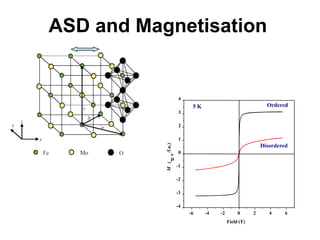
ASD and Magnetisation


                    4
                          5K                               Ordered
                    3

                    2

                    1


           /f.u.)
                                                         Disordered
                    0


                B
           M (
                    -1

                    -2

                    -3

                    -4
                         -6    -4   -2        0      2      4     6
                                         Field (T)
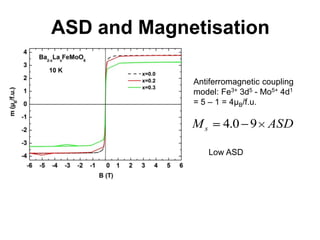
ASD and Magnetisation

             Antiferromagnetic coupling
             model: Fe3+ 3d5 - Mo5+ 4d1
             = 5 – 1 = 4μB/f.u.

             Ms     4.0 9 ASD

                  Low ASD
Magnetoresistance
MR = Δρ/ρ = [(ρ(0) - ρ(H))/ρ(0)]

Magnetoresistance     model    in   polycrystalline
samples,
      ∆ρ/ρ = −P2mgb(H)2 / (1 + P2mgb(H)2 )

P - degree of spin polarisation
mgb(H) - magnetisation from a disordered region
near the grain boundaries
H - applied field.


             mb mgb mgb mb


                                          E. K. Hemery, G. V. M. Williams, and H. J. Trodahl, Physica B 390, 175 (2007).
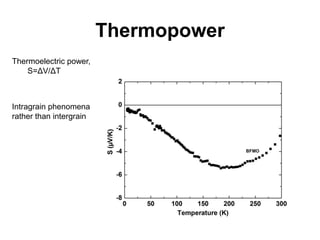
Thermopower
Thermoelectric power,
    S=ΔV/ΔT


Intragrain phenomena
rather than intergrain
Thermopower
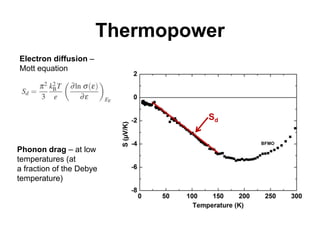
Electron diffusion –
Mott equation


                                Sd


Phonon drag – at low
temperatures (at
a fraction of the Debye
temperature)
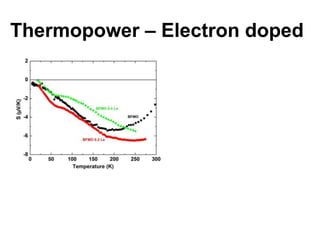
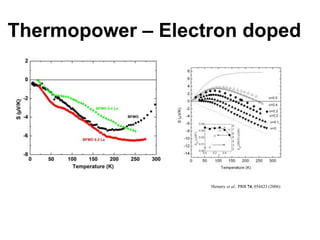
Thermopower – Electron doped


                   Hemery et al., PRB 74, 054423 (2006)
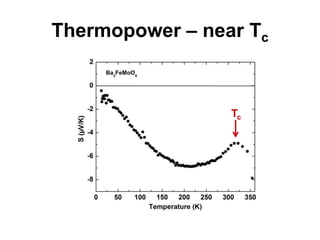
Thermopower – near Tc


                 Tc
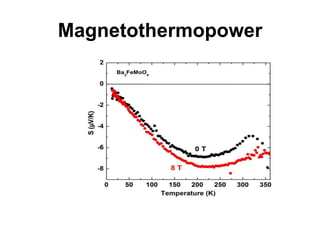
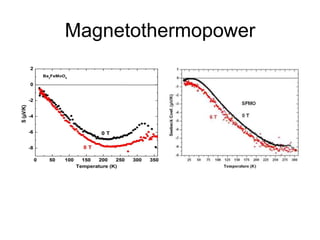
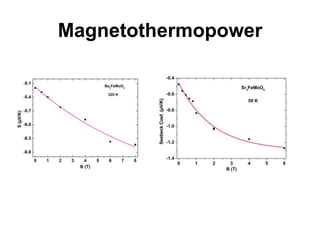
Magnetothermopower
Magnetothermopower
Magnetothermopower
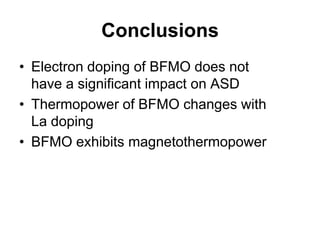
Conclusions
• Electron doping of BFMO does not
  have a significant impact on ASD
• Thermopower of BFMO changes with
  La doping
• BFMO exhibits magnetothermopower

14.00 o8 j stephen

  • 1.
    The effect ofelectronic doping on the magnetisation and thermopower properties of Ba2FeMoO6 Jibu Stephen a,b,c, Grant Williams b,c, Ben Ruck b,c, K. Rutherford a Industrial Research, Lower Hutt, New Zealand The MacDiarmid Institute Victoria University of Wellington Outline [1] Double Perovskite Ba2FeMoO6 [2] ASD & Magnetisation [3] Magnetoresistance [4] Thermopower a b c
  • 3.
    Double perovskites • Ba2FeMoO6 (BFMO)/ Sr2FeMoO6 (SFMO) – tetragonal - alternating Fe and Mo surrounded by oxygen octahedra. • Ba/Sr occupy every hole created by 8 BO6 octahedra Crystal structure of ordered double perovskite: A2BB’O6 Ba/Sr Fe Mo O
  • 4.
    Double perovskites • Halfmetallic band structure – conduction electrons 100% spin polarised • The Fe3+ 3d5 electrons are localised and the Mo5+ 4d1 electrons are itinerant. E E E EF EF EF N(E) N(E) N(E) NM FM HM
  • 5.
    Double perovskites Intergrain-type tunneling magnetoresistance Highferromagnetic ordering temperature (Tc) (~310 K for HM I HM HM I HM BFMO)  Large MR + high Tc - promising applications: Read head for magnetic hard disk, magnetic sensors and R R magnetic RAM. B No applied field B Applied field
  • 6.
    Synthesis • Solid statesynthesis • Mix appropriate proportions of A(NO3)2 (A = Sr, Ba), Fe2O3 and MoO3 to satisfy stoichiometry. • Grind, denitrate and press into pellets • Sinter at 1200 C in air • Regrind, repellet and sinter at 1150 C in 5% H2/95% N2 several times • XRD on sample at each stage to check phase homogeneity
  • 7.
    ASD and Magnetisation 4 5K Ordered 3 2 1 /f.u.) Disordered 0 B M ( -1 -2 -3 -4 -6 -4 -2 0 2 4 6 Field (T)
  • 8.
    ASD and Magnetisation Antiferromagnetic coupling model: Fe3+ 3d5 - Mo5+ 4d1 = 5 – 1 = 4μB/f.u. Ms 4.0 9 ASD Low ASD
  • 9.
    Magnetoresistance MR = Δρ/ρ= [(ρ(0) - ρ(H))/ρ(0)] Magnetoresistance model in polycrystalline samples, ∆ρ/ρ = −P2mgb(H)2 / (1 + P2mgb(H)2 ) P - degree of spin polarisation mgb(H) - magnetisation from a disordered region near the grain boundaries H - applied field. mb mgb mgb mb E. K. Hemery, G. V. M. Williams, and H. J. Trodahl, Physica B 390, 175 (2007).
  • 10.
    Thermopower Thermoelectric power, S=ΔV/ΔT Intragrain phenomena rather than intergrain
  • 11.
    Thermopower Electron diffusion – Mottequation Sd Phonon drag – at low temperatures (at a fraction of the Debye temperature)
  • 12.
  • 13.
    Thermopower – Electrondoped Hemery et al., PRB 74, 054423 (2006)
  • 14.
  • 15.
  • 16.
  • 17.
  • 18.
    Conclusions • Electron dopingof BFMO does not have a significant impact on ASD • Thermopower of BFMO changes with La doping • BFMO exhibits magnetothermopower