The Physics of White Dwarf Stars

                Denis J Sullivan
       Victoria University of Wellington

               October 18, 2011
White dwarf & pulsating WD brief history

  s   1915 Astronomers: identify white dwarfs (WDs) as unusual.


                                                                  2 / 28
White dwarf & pulsating WD brief history

  s   1915 Astronomers: identify white dwarfs (WDs) as unusual.

  s    ∼1925 Schr¨dinger, Heisenberg, Pauli, . . . quantum mechanics (QM)
                 o
      developed.


                                                                            2 / 28
White dwarf & pulsating WD brief history

  s   1915 Astronomers: identify white dwarfs (WDs) as unusual.

  s    ∼1925 Schr¨dinger, Heisenberg, Pauli, . . . quantum mechanics (QM)
                 o
      developed.

  s    1926 Fowler: uses QM to develop a WD theory –
      electron degeneracy pressure prevents gravitational collapse.


                                                                            2 / 28
White dwarf & pulsating WD brief history

  s   1915 Astronomers: identify white dwarfs (WDs) as unusual.

  s    ∼1925 Schr¨dinger, Heisenberg, Pauli, . . . quantum mechanics (QM)
                 o
      developed.

  s    1926 Fowler: uses QM to develop a WD theory –
      electron degeneracy pressure prevents gravitational collapse.

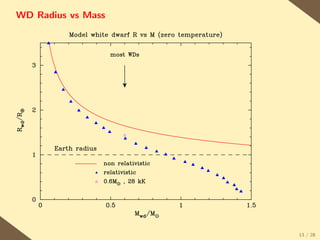
  s    1932 Chandrasekhar: combines special relativity (SR) with QM to
      obtain a WD theory that predicts a maximum mass (∼ 1.4M )
      Eddington not impressed.


                                                                            2 / 28
White dwarf & pulsating WD brief history

  s   1915 Astronomers: identify white dwarfs (WDs) as unusual.

  s    ∼1925 Schr¨dinger, Heisenberg, Pauli, . . . quantum mechanics (QM)
                 o
      developed.

  s    1926 Fowler: uses QM to develop a WD theory –
      electron degeneracy pressure prevents gravitational collapse.

  s    1932 Chandrasekhar: combines special relativity (SR) with QM to
      obtain a WD theory that predicts a maximum mass (∼ 1.4M )
      Eddington not impressed.

  s    1964 Landolt accidentally discovers first pulsating WD (DAV,
      HL Tau 76) – periodic variations ∼ 12.5 minutes in a potential WD flux
      standard (Landolt, ApJ, 1968).


                                                                              2 / 28
White dwarf & pulsating WD brief history

  s   1915 Astronomers: identify white dwarfs (WDs) as unusual.

  s    ∼1925 Schr¨dinger, Heisenberg, Pauli, . . . quantum mechanics (QM)
                 o
      developed.

  s    1926 Fowler: uses QM to develop a WD theory –
      electron degeneracy pressure prevents gravitational collapse.

  s    1932 Chandrasekhar: combines special relativity (SR) with QM to
      obtain a WD theory that predicts a maximum mass (∼ 1.4M )
      Eddington not impressed.

  s    1964 Landolt accidentally discovers first pulsating WD (DAV,
      HL Tau 76) – periodic variations ∼ 12.5 minutes in a potential WD flux
      standard (Landolt, ApJ, 1968).

  s    1970+ WD pulsations explained by gravity modes driven by
      mechanism in partial ionization H atmosphere.
      Note: more common pressure modes have periods: ∼ seconds
                                                                              2 / 28
WD History (continued)

  s    1979 First DOV degenerate pulsator discovered (PG 1159−035).
      (McGraw et al.) – explained by driving mechanism in partial ionized C
      and O layers.


                                                                              3 / 28
WD History (continued)

  s    1979 First DOV degenerate pulsator discovered (PG 1159−035).
      (McGraw et al.) – explained by driving mechanism in partial ionized C
      and O layers.

  s    1982 First helium atmosphere WD pulsator discovered (GD 358),
      following theoretical prediction of pulsation driving in He partial
      ionization zone (Winget et al.)


                                                                              3 / 28
WD History (continued)

  s    1979 First DOV degenerate pulsator discovered (PG 1159−035).
      (McGraw et al.) – explained by driving mechanism in partial ionized C
      and O layers.

  s    1982 First helium atmosphere WD pulsator discovered (GD 358),
      following theoretical prediction of pulsation driving in He partial
      ionization zone (Winget et al.)

  s    1985 Period change due to secular cooling measured from multi-site
      photometry on PG 1159 (Winget et al. 1985).


                                                                              3 / 28
WD History (continued)

  s    1979 First DOV degenerate pulsator discovered (PG 1159−035).
      (McGraw et al.) – explained by driving mechanism in partial ionized C
      and O layers.

  s    1982 First helium atmosphere WD pulsator discovered (GD 358),
      following theoretical prediction of pulsation driving in He partial
      ionization zone (Winget et al.)

  s    1985 Period change due to secular cooling measured from multi-site
      photometry on PG 1159 (Winget et al. 1985).

  s   1990 WET: the Whole Earth Telescope (Nather et al., ApJ 361)


                                                                              3 / 28
WD History (continued)

  s    1979 First DOV degenerate pulsator discovered (PG 1159−035).
      (McGraw et al.) – explained by driving mechanism in partial ionized C
      and O layers.

  s    1982 First helium atmosphere WD pulsator discovered (GD 358),
      following theoretical prediction of pulsation driving in He partial
      ionization zone (Winget et al.)

  s    1985 Period change due to secular cooling measured from multi-site
      photometry on PG 1159 (Winget et al. 1985).

  s   1990 WET: the Whole Earth Telescope (Nather et al., ApJ 361)

  s   1991 WET observations of PG 1159−035 (Winget et al., ApJ 378)


                                                                              3 / 28
WD History (continued)

  s    1979 First DOV degenerate pulsator discovered (PG 1159−035).
      (McGraw et al.) – explained by driving mechanism in partial ionized C
      and O layers.

  s    1982 First helium atmosphere WD pulsator discovered (GD 358),
      following theoretical prediction of pulsation driving in He partial
      ionization zone (Winget et al.)

  s    1985 Period change due to secular cooling measured from multi-site
      photometry on PG 1159 (Winget et al. 1985).

  s   1990 WET: the Whole Earth Telescope (Nather et al., ApJ 361)

  s   1991 WET observations of PG 1159−035 (Winget et al., ApJ 378)

  s   1994 WET observations of GD 358 (Winget et al., ApJ 430)


                                                                              3 / 28
WD History (continued)

  s    1979 First DOV degenerate pulsator discovered (PG 1159−035).
      (McGraw et al.) – explained by driving mechanism in partial ionized C
      and O layers.

  s    1982 First helium atmosphere WD pulsator discovered (GD 358),
      following theoretical prediction of pulsation driving in He partial
      ionization zone (Winget et al.)

  s    1985 Period change due to secular cooling measured from multi-site
      photometry on PG 1159 (Winget et al. 1985).

  s   1990 WET: the Whole Earth Telescope (Nather et al., ApJ 361)

  s   1991 WET observations of PG 1159−035 (Winget et al., ApJ 378)

  s   1994 WET observations of GD 358 (Winget et al., ApJ 430)

  s   WET continues . . . . . .


                                                                              3 / 28
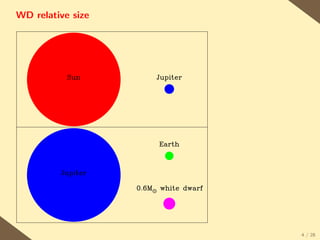
WD relative size


                   4 / 28
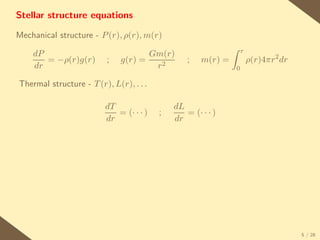
Stellar structure equations

Mechanical structure - P (r), ρ(r), m(r)
                                                                  r
    dP                               Gm(r)
       = −ρ(r)g(r)        ;   g(r) =             ;   m(r) =           ρ(r)4πr2 dr
    dr                                r2                      0

Thermal structure - T (r), L(r), . . .

                         dT                  dL
                            = (· · · )   ;      = (· · · )
                         dr                  dr


                                                                                    5 / 28
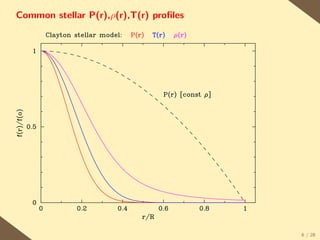
Common stellar P(r),ρ(r),T(r) profiles


                                        6 / 28
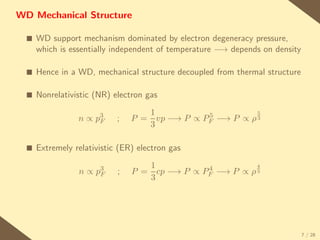
WD Mechanical Structure

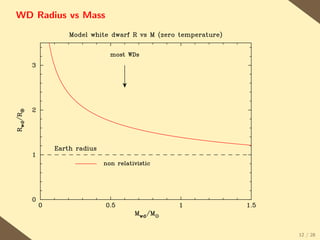
  s   WD support mechanism dominated by electron degeneracy pressure,
      which is essentially independent of temperature −→ depends on density


                                                                              7 / 28
WD Mechanical Structure

  s   WD support mechanism dominated by electron degeneracy pressure,
      which is essentially independent of temperature −→ depends on density

  s   Hence in a WD, mechanical structure decoupled from thermal structure


                                                                              7 / 28
WD Mechanical Structure

  s   WD support mechanism dominated by electron degeneracy pressure,
      which is essentially independent of temperature −→ depends on density

  s   Hence in a WD, mechanical structure decoupled from thermal structure

  s   Nonrelativistic (NR) electron gas

                       3           1           5          5
                 n∝   pF    ;   P = vp −→ P ∝ PF −→ P ∝ ρ 3
                                   3

  s   Extremely relativistic (ER) electron gas
                                   1                      4
                 n∝   p3
                       F    ;                  4
                                P = cp −→ P ∝ PF −→ P ∝ ρ 3
                                   3


                                                                              7 / 28
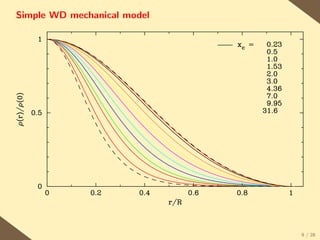
Simple WD mechanical model

The following relatively simple differential equation describing x(r)
(which is the electron momentum at the [local] fermi surface) quite accurately
characterises the density and pressure profiles of WDs.
                                                      3
                     d2 u       2 du          1       2
                            +        + u2 − 2             =0
                     dz 2       z dz       xc + 1

where
                                       1
                              x2 +1    2            pF (r)
                    u=                     and   x=
                              x2 + 1
                               c                     me c
Solve numerically for x(r):

                                x(r) −→ ρ(r), P (r)


                                                                             8 / 28
Simple WD mechanical model


                             9 / 28
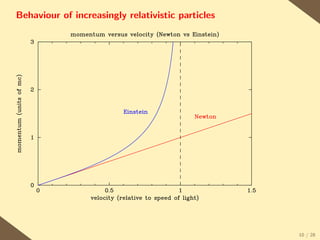
Behaviour of increasingly relativistic particles


                                                   10 / 28
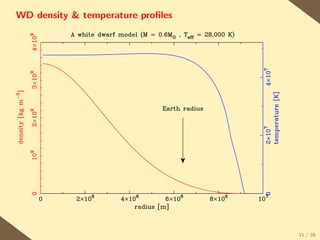
WD density & temperature profiles


                                   11 / 28
WD Radius vs Mass


                    12 / 28
WD Radius vs Mass


                    13 / 28
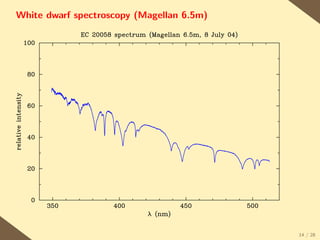
White dwarf spectroscopy (Magellan 6.5m)


                                           14 / 28
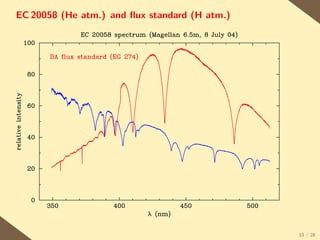
EC 20058 (He atm.) and flux standard (H atm.)


                                               15 / 28
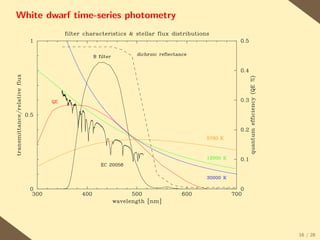
White dwarf time-series photometry


                                     16 / 28
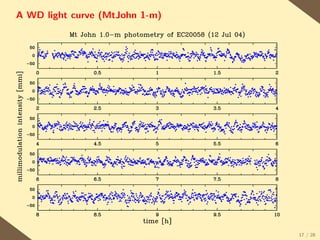
A WD light curve (MtJohn 1-m)


                                17 / 28
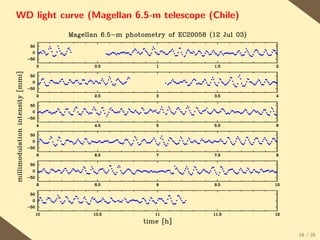
WD light curve (Magellan 6.5-m telescope (Chile)


                                                   18 / 28
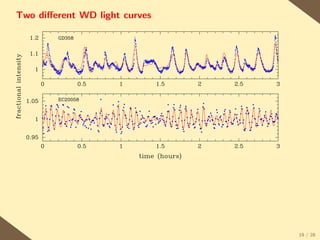
Two different WD light curves


                               19 / 28
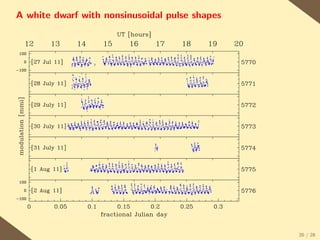
A white dwarf with nonsinusoidal pulse shapes


                                                20 / 28
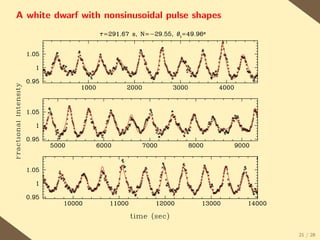
A white dwarf with nonsinusoidal pulse shapes


                                                21 / 28
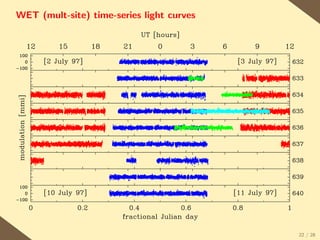
WET (mult-site) time-series light curves


                                           22 / 28
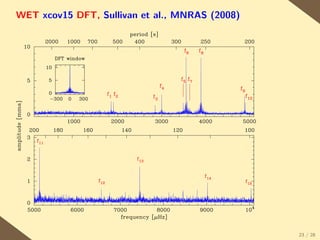
WET xcov15 DFT, Sullivan et al., MNRAS (2008)


                                                23 / 28
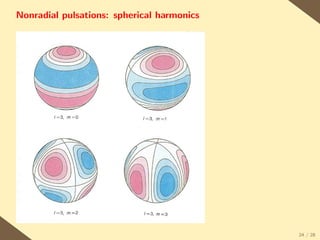
Nonradial pulsations: spherical harmonics


                                            24 / 28
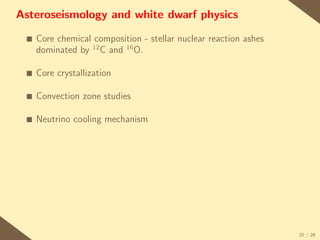
Asteroseismology and white dwarf physics

 s   Core chemical composition - stellar nuclear reaction ashes
     dominated by 12 C and 16 O.

 s   Core crystallization

 s   Convection zone studies

 s   Neutrino cooling mechanism


                                                                  25 / 28
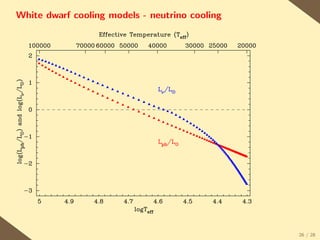
White dwarf cooling models - neutrino cooling


                                                26 / 28
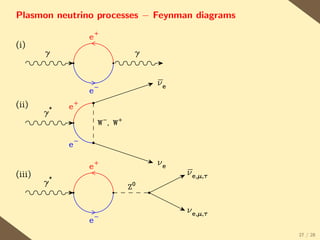
Plasmon neutrino processes − Feynman diagrams


                                                27 / 28
Neutrino physics in hot WD plasmas

  s   Basically, neutrinos produced by e− e+ annihilation
  s   But where do the positrons come from?
  s   Even at WD core temperatures, not enough energy for
      real e− ,e+ pairs
  s   However, plenty of short duration (real) virtual e− ,e+ pairs created
      courtesy energy-time uncertainty principle
  s   But, these pairs recombine with probability 0.99999 . . .
  s   However, this probability is not 1, and there is a ∼ 1 in 10−19 chance of
      forming neutrino-antineutrino pairs via W± , Z0 exchange/creation
      processes (the electroweak connection).
  s   Given the ν mass is ∼ zero, energy conservation permits formation of a
      two ν final state from a ∼ KeV photon, but momentum conservation
      requires more than a photon in initial state
  s   Possible other particles: nuclei, many particles −→ plasmons (this is the
      dominant mechanism)

                                                                              28 / 28

14.40 o7 d sullivan

  • 1.
    The Physics ofWhite Dwarf Stars Denis J Sullivan Victoria University of Wellington October 18, 2011
  • 2.
    White dwarf &pulsating WD brief history s 1915 Astronomers: identify white dwarfs (WDs) as unusual. 2 / 28
  • 3.
    White dwarf &pulsating WD brief history s 1915 Astronomers: identify white dwarfs (WDs) as unusual. s ∼1925 Schr¨dinger, Heisenberg, Pauli, . . . quantum mechanics (QM) o developed. 2 / 28
  • 4.
    White dwarf &pulsating WD brief history s 1915 Astronomers: identify white dwarfs (WDs) as unusual. s ∼1925 Schr¨dinger, Heisenberg, Pauli, . . . quantum mechanics (QM) o developed. s 1926 Fowler: uses QM to develop a WD theory – electron degeneracy pressure prevents gravitational collapse. 2 / 28
  • 5.
    White dwarf &pulsating WD brief history s 1915 Astronomers: identify white dwarfs (WDs) as unusual. s ∼1925 Schr¨dinger, Heisenberg, Pauli, . . . quantum mechanics (QM) o developed. s 1926 Fowler: uses QM to develop a WD theory – electron degeneracy pressure prevents gravitational collapse. s 1932 Chandrasekhar: combines special relativity (SR) with QM to obtain a WD theory that predicts a maximum mass (∼ 1.4M ) Eddington not impressed. 2 / 28
  • 6.
    White dwarf &pulsating WD brief history s 1915 Astronomers: identify white dwarfs (WDs) as unusual. s ∼1925 Schr¨dinger, Heisenberg, Pauli, . . . quantum mechanics (QM) o developed. s 1926 Fowler: uses QM to develop a WD theory – electron degeneracy pressure prevents gravitational collapse. s 1932 Chandrasekhar: combines special relativity (SR) with QM to obtain a WD theory that predicts a maximum mass (∼ 1.4M ) Eddington not impressed. s 1964 Landolt accidentally discovers first pulsating WD (DAV, HL Tau 76) – periodic variations ∼ 12.5 minutes in a potential WD flux standard (Landolt, ApJ, 1968). 2 / 28
  • 7.
    White dwarf &pulsating WD brief history s 1915 Astronomers: identify white dwarfs (WDs) as unusual. s ∼1925 Schr¨dinger, Heisenberg, Pauli, . . . quantum mechanics (QM) o developed. s 1926 Fowler: uses QM to develop a WD theory – electron degeneracy pressure prevents gravitational collapse. s 1932 Chandrasekhar: combines special relativity (SR) with QM to obtain a WD theory that predicts a maximum mass (∼ 1.4M ) Eddington not impressed. s 1964 Landolt accidentally discovers first pulsating WD (DAV, HL Tau 76) – periodic variations ∼ 12.5 minutes in a potential WD flux standard (Landolt, ApJ, 1968). s 1970+ WD pulsations explained by gravity modes driven by mechanism in partial ionization H atmosphere. Note: more common pressure modes have periods: ∼ seconds 2 / 28
  • 8.
    WD History (continued) s 1979 First DOV degenerate pulsator discovered (PG 1159−035). (McGraw et al.) – explained by driving mechanism in partial ionized C and O layers. 3 / 28
  • 9.
    WD History (continued) s 1979 First DOV degenerate pulsator discovered (PG 1159−035). (McGraw et al.) – explained by driving mechanism in partial ionized C and O layers. s 1982 First helium atmosphere WD pulsator discovered (GD 358), following theoretical prediction of pulsation driving in He partial ionization zone (Winget et al.) 3 / 28
  • 10.
    WD History (continued) s 1979 First DOV degenerate pulsator discovered (PG 1159−035). (McGraw et al.) – explained by driving mechanism in partial ionized C and O layers. s 1982 First helium atmosphere WD pulsator discovered (GD 358), following theoretical prediction of pulsation driving in He partial ionization zone (Winget et al.) s 1985 Period change due to secular cooling measured from multi-site photometry on PG 1159 (Winget et al. 1985). 3 / 28
  • 11.
    WD History (continued) s 1979 First DOV degenerate pulsator discovered (PG 1159−035). (McGraw et al.) – explained by driving mechanism in partial ionized C and O layers. s 1982 First helium atmosphere WD pulsator discovered (GD 358), following theoretical prediction of pulsation driving in He partial ionization zone (Winget et al.) s 1985 Period change due to secular cooling measured from multi-site photometry on PG 1159 (Winget et al. 1985). s 1990 WET: the Whole Earth Telescope (Nather et al., ApJ 361) 3 / 28
  • 12.
    WD History (continued) s 1979 First DOV degenerate pulsator discovered (PG 1159−035). (McGraw et al.) – explained by driving mechanism in partial ionized C and O layers. s 1982 First helium atmosphere WD pulsator discovered (GD 358), following theoretical prediction of pulsation driving in He partial ionization zone (Winget et al.) s 1985 Period change due to secular cooling measured from multi-site photometry on PG 1159 (Winget et al. 1985). s 1990 WET: the Whole Earth Telescope (Nather et al., ApJ 361) s 1991 WET observations of PG 1159−035 (Winget et al., ApJ 378) 3 / 28
  • 13.
    WD History (continued) s 1979 First DOV degenerate pulsator discovered (PG 1159−035). (McGraw et al.) – explained by driving mechanism in partial ionized C and O layers. s 1982 First helium atmosphere WD pulsator discovered (GD 358), following theoretical prediction of pulsation driving in He partial ionization zone (Winget et al.) s 1985 Period change due to secular cooling measured from multi-site photometry on PG 1159 (Winget et al. 1985). s 1990 WET: the Whole Earth Telescope (Nather et al., ApJ 361) s 1991 WET observations of PG 1159−035 (Winget et al., ApJ 378) s 1994 WET observations of GD 358 (Winget et al., ApJ 430) 3 / 28
  • 14.
    WD History (continued) s 1979 First DOV degenerate pulsator discovered (PG 1159−035). (McGraw et al.) – explained by driving mechanism in partial ionized C and O layers. s 1982 First helium atmosphere WD pulsator discovered (GD 358), following theoretical prediction of pulsation driving in He partial ionization zone (Winget et al.) s 1985 Period change due to secular cooling measured from multi-site photometry on PG 1159 (Winget et al. 1985). s 1990 WET: the Whole Earth Telescope (Nather et al., ApJ 361) s 1991 WET observations of PG 1159−035 (Winget et al., ApJ 378) s 1994 WET observations of GD 358 (Winget et al., ApJ 430) s WET continues . . . . . . 3 / 28
  • 15.
  • 16.
    Stellar structure equations Mechanicalstructure - P (r), ρ(r), m(r) r dP Gm(r) = −ρ(r)g(r) ; g(r) = ; m(r) = ρ(r)4πr2 dr dr r2 0 Thermal structure - T (r), L(r), . . . dT dL = (· · · ) ; = (· · · ) dr dr 5 / 28
  • 17.
  • 18.
    WD Mechanical Structure s WD support mechanism dominated by electron degeneracy pressure, which is essentially independent of temperature −→ depends on density 7 / 28
  • 19.
    WD Mechanical Structure s WD support mechanism dominated by electron degeneracy pressure, which is essentially independent of temperature −→ depends on density s Hence in a WD, mechanical structure decoupled from thermal structure 7 / 28
  • 20.
    WD Mechanical Structure s WD support mechanism dominated by electron degeneracy pressure, which is essentially independent of temperature −→ depends on density s Hence in a WD, mechanical structure decoupled from thermal structure s Nonrelativistic (NR) electron gas 3 1 5 5 n∝ pF ; P = vp −→ P ∝ PF −→ P ∝ ρ 3 3 s Extremely relativistic (ER) electron gas 1 4 n∝ p3 F ; 4 P = cp −→ P ∝ PF −→ P ∝ ρ 3 3 7 / 28
  • 21.
    Simple WD mechanicalmodel The following relatively simple differential equation describing x(r) (which is the electron momentum at the [local] fermi surface) quite accurately characterises the density and pressure profiles of WDs. 3 d2 u 2 du 1 2 + + u2 − 2 =0 dz 2 z dz xc + 1 where 1 x2 +1 2 pF (r) u= and x= x2 + 1 c me c Solve numerically for x(r): x(r) −→ ρ(r), P (r) 8 / 28
  • 22.
  • 23.
    Behaviour of increasinglyrelativistic particles 10 / 28
  • 24.
    WD density &temperature profiles 11 / 28
  • 25.
    WD Radius vsMass 12 / 28
  • 26.
    WD Radius vsMass 13 / 28
  • 27.
    White dwarf spectroscopy(Magellan 6.5m) 14 / 28
  • 28.
    EC 20058 (Heatm.) and flux standard (H atm.) 15 / 28
  • 29.
    White dwarf time-seriesphotometry 16 / 28
  • 30.
    A WD lightcurve (MtJohn 1-m) 17 / 28
  • 31.
    WD light curve(Magellan 6.5-m telescope (Chile) 18 / 28
  • 32.
    Two different WDlight curves 19 / 28
  • 33.
    A white dwarfwith nonsinusoidal pulse shapes 20 / 28
  • 34.
    A white dwarfwith nonsinusoidal pulse shapes 21 / 28
  • 35.
    WET (mult-site) time-serieslight curves 22 / 28
  • 36.
    WET xcov15 DFT,Sullivan et al., MNRAS (2008) 23 / 28
  • 37.
  • 38.
    Asteroseismology and whitedwarf physics s Core chemical composition - stellar nuclear reaction ashes dominated by 12 C and 16 O. s Core crystallization s Convection zone studies s Neutrino cooling mechanism 25 / 28
  • 39.
    White dwarf coolingmodels - neutrino cooling 26 / 28
  • 40.
    Plasmon neutrino processes− Feynman diagrams 27 / 28
  • 41.
    Neutrino physics inhot WD plasmas s Basically, neutrinos produced by e− e+ annihilation s But where do the positrons come from? s Even at WD core temperatures, not enough energy for real e− ,e+ pairs s However, plenty of short duration (real) virtual e− ,e+ pairs created courtesy energy-time uncertainty principle s But, these pairs recombine with probability 0.99999 . . . s However, this probability is not 1, and there is a ∼ 1 in 10−19 chance of forming neutrino-antineutrino pairs via W± , Z0 exchange/creation processes (the electroweak connection). s Given the ν mass is ∼ zero, energy conservation permits formation of a two ν final state from a ∼ KeV photon, but momentum conservation requires more than a photon in initial state s Possible other particles: nuclei, many particles −→ plasmons (this is the dominant mechanism) 28 / 28