Models and simulations of the
growth of carbon nanotubes
Shaun Hendy
Carbon nanotubes

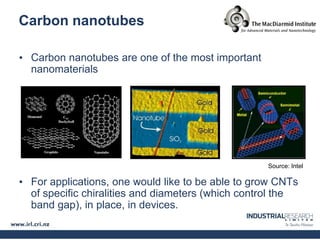
• Carbon nanotubes are one of the most important
  nanomaterials


                                                   Source: Intel

• For applications, one would like to be able to grow CNTs
  of specific chiralities and diameters (which control the
  band gap), in place, in devices.
Growth of carbon nanotubes

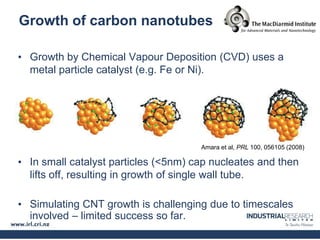
• Growth by Chemical Vapour Deposition (CVD) uses a
  metal particle catalyst (e.g. Fe or Ni).


                                      Amara et al, PRL 100, 056105 (2008)

• In small catalyst particles (<5nm) cap nucleates and then
  lifts off, resulting in growth of single wall tube.

• Simulating CNT growth is challenging due to timescales
  involved – limited success so far.
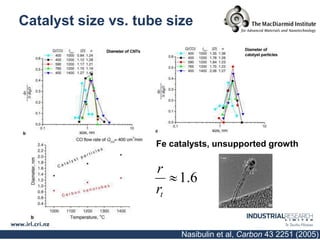
Catalyst size vs. tube size


                     Fe catalysts, unsupported growth

                     r
                          1 .6
                     rt


                          Nasibulin et al, Carbon 43 2251 (2005)
Focus on cap

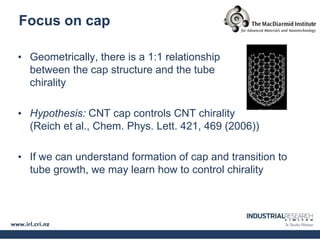
• Geometrically, there is a 1:1 relationship
  between the cap structure and the tube
  chirality

• Hypothesis: CNT cap controls CNT chirality
  (Reich et al., Chem. Phys. Lett. 421, 469 (2006))

• If we can understand formation of cap and transition to
  tube growth, we may learn how to control chirality
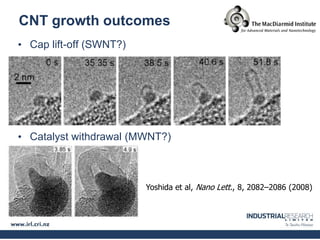
CNT growth outcomes
• Cap lift-off (SWNT?)


• Catalyst withdrawal (MWNT?)


                         Yoshida et al, Nano Lett., 8, 2082–2086 (2008)
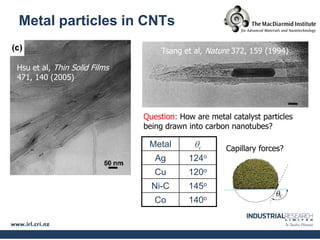
Metal particles in CNTs
                                   Tsang et al, Nature 372, 159 (1994)

Hsu et al, Thin Solid Films
471, 140 (2005)


                              Question: How are metal catalyst particles
                              being drawn into carbon nanotubes?

                               Metal         c       Capillary forces?
                                 Ag       124o
                                 Cu       120o
                                Ni-C      145o
                                 Co       140o
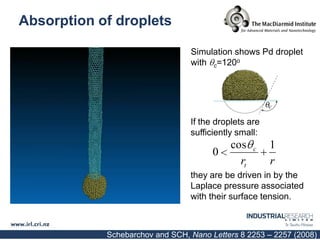
Absorption of droplets

                                 Simulation shows Pd droplet
                                 with c=120o


                                 If the droplets are
                                 sufficiently small:
                                            cos    c   1
                                       0
                                              rt       r
                                 they are be driven in by the
                                 Laplace pressure associated
                                 with their surface tension.


            Schebarchov and SCH, Nano Letters 8 2253 – 2257 (2008)
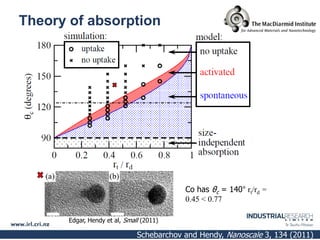
Theory of absorption


                                           Co has θc = 140° rt/rd =
                                           0.45 < 0.77

       Edgar, Hendy et al, Small (2011)

                               Schebarchov and Hendy, Nanoscale 3, 134 (2011)
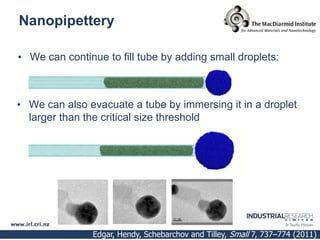
Nanopipettery

• We can continue to fill tube by adding small droplets:


• We can also evacuate a tube by immersing it in a droplet
  larger than the critical size threshold


                Edgar, Hendy, Schebarchov and Tilley, Small 7, 737–774 (2011)
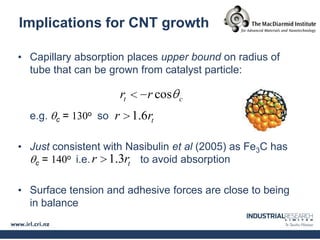
Implications for CNT growth

• Capillary absorption places upper bound on radius of
  tube that can be grown from catalyst particle:

                           rt      r cos   c

  e.g.   c   = 130o so r        1.6rt

• Just consistent with Nasibulin et al (2005) as Fe3C has
   c = 140o i.e. r 1.3rt to avoid absorption

• Surface tension and adhesive forces are close to being
  in balance
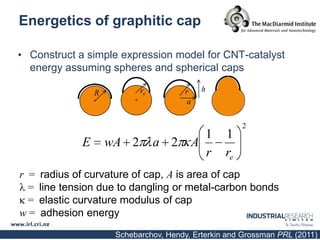
Energetics of graphitic cap

• Construct a simple expression model for CNT-catalyst
  energy assuming spheres and spherical caps

                  R          re          r     h
                                          a


                                                         2
                                                1   1
              E       wA 2        a 2         A
                                                r   re
r =   radius of curvature of cap, A is area of cap
  =   line tension due to dangling or metal-carbon bonds
  =   elastic curvature modulus of cap
w=     adhesion energy
                       Schebarchov, Hendy, Erterkin and Grossman PRL (2011)
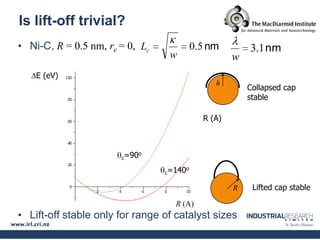
Is lift-off trivial?
• Ni-C, R = 0.5 nm, re = 0, Lc                0.5 nm        3.1 nm
                                   w                    w
    E (eV)
                                                   h
                                                            Collapsed cap
                                                            stable

                                                R (A)


                       c=90
                              o


                                  c=140
                                          o


                                                        R    Lifted cap stable

                                    R (A)
• Lift-off stable only for range of catalyst sizes
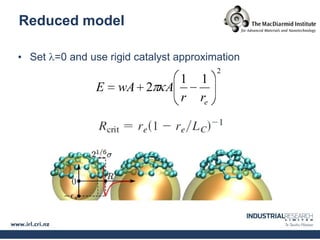
Reduced model

• Set =0 and use rigid catalyst approximation
                                          2
                           1         1
               E    wA 2 A
                           r         re
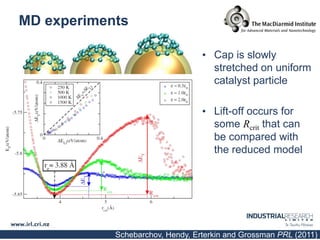
MD experiments

                                  • Cap is slowly
                                    stretched on uniform
                                    catalyst particle

                                  • Lift-off occurs for
                                    some Rcrit that can
                                    be compared with
                                    the reduced model


            Schebarchov, Hendy, Erterkin and Grossman PRL (2011)
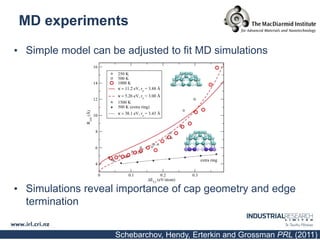
MD experiments

• Simple model can be adjusted to fit MD simulations


• Simulations reveal importance of cap geometry and edge
  termination


                    Schebarchov, Hendy, Erterkin and Grossman PRL (2011)
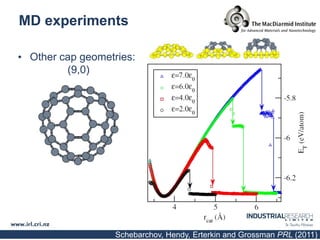
MD experiments

• Other cap geometries:
         (9,0)


                   Schebarchov, Hendy, Erterkin and Grossman PRL (2011)
Conclusions

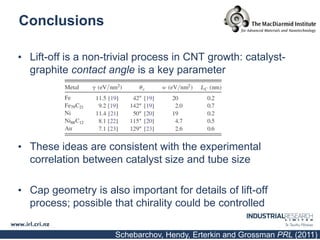
• Lift-off is a non-trivial process in CNT growth: catalyst-
  graphite contact angle is a key parameter


• These ideas are consistent with the experimental
  correlation between catalyst size and tube size

• Cap geometry is also important for details of lift-off
  process; possible that chirality could be controlled

                     Schebarchov, Hendy, Erterkin and Grossman PRL (2011)
Acknowledgements
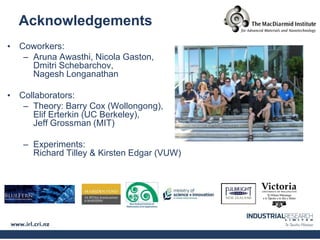
• Coworkers:
   – Aruna Awasthi, Nicola Gaston,
     Dmitri Schebarchov,
     Nagesh Longanathan

• Collaborators:
   – Theory: Barry Cox (Wollongong),
     Elif Erterkin (UC Berkeley),
     Jeff Grossman (MIT)

   – Experiments:
     Richard Tilley & Kirsten Edgar (VUW)

12.45 o14 s hendy

  • 1.
    Models and simulationsof the growth of carbon nanotubes Shaun Hendy
  • 2.
    Carbon nanotubes • Carbonnanotubes are one of the most important nanomaterials Source: Intel • For applications, one would like to be able to grow CNTs of specific chiralities and diameters (which control the band gap), in place, in devices.
  • 3.
    Growth of carbonnanotubes • Growth by Chemical Vapour Deposition (CVD) uses a metal particle catalyst (e.g. Fe or Ni). Amara et al, PRL 100, 056105 (2008) • In small catalyst particles (<5nm) cap nucleates and then lifts off, resulting in growth of single wall tube. • Simulating CNT growth is challenging due to timescales involved – limited success so far.
  • 4.
    Catalyst size vs.tube size Fe catalysts, unsupported growth r 1 .6 rt Nasibulin et al, Carbon 43 2251 (2005)
  • 5.
    Focus on cap •Geometrically, there is a 1:1 relationship between the cap structure and the tube chirality • Hypothesis: CNT cap controls CNT chirality (Reich et al., Chem. Phys. Lett. 421, 469 (2006)) • If we can understand formation of cap and transition to tube growth, we may learn how to control chirality
  • 6.
    CNT growth outcomes •Cap lift-off (SWNT?) • Catalyst withdrawal (MWNT?) Yoshida et al, Nano Lett., 8, 2082–2086 (2008)
  • 7.
    Metal particles inCNTs Tsang et al, Nature 372, 159 (1994) Hsu et al, Thin Solid Films 471, 140 (2005) Question: How are metal catalyst particles being drawn into carbon nanotubes? Metal c Capillary forces? Ag 124o Cu 120o Ni-C 145o Co 140o
  • 8.
    Absorption of droplets Simulation shows Pd droplet with c=120o If the droplets are sufficiently small: cos c 1 0 rt r they are be driven in by the Laplace pressure associated with their surface tension. Schebarchov and SCH, Nano Letters 8 2253 – 2257 (2008)
  • 9.
    Theory of absorption Co has θc = 140° rt/rd = 0.45 < 0.77 Edgar, Hendy et al, Small (2011) Schebarchov and Hendy, Nanoscale 3, 134 (2011)
  • 10.
    Nanopipettery • We cancontinue to fill tube by adding small droplets: • We can also evacuate a tube by immersing it in a droplet larger than the critical size threshold Edgar, Hendy, Schebarchov and Tilley, Small 7, 737–774 (2011)
  • 11.
    Implications for CNTgrowth • Capillary absorption places upper bound on radius of tube that can be grown from catalyst particle: rt r cos c e.g. c = 130o so r 1.6rt • Just consistent with Nasibulin et al (2005) as Fe3C has c = 140o i.e. r 1.3rt to avoid absorption • Surface tension and adhesive forces are close to being in balance
  • 12.
    Energetics of graphiticcap • Construct a simple expression model for CNT-catalyst energy assuming spheres and spherical caps R re r h a 2 1 1 E wA 2 a 2 A r re r = radius of curvature of cap, A is area of cap = line tension due to dangling or metal-carbon bonds = elastic curvature modulus of cap w= adhesion energy Schebarchov, Hendy, Erterkin and Grossman PRL (2011)
  • 13.
    Is lift-off trivial? •Ni-C, R = 0.5 nm, re = 0, Lc 0.5 nm 3.1 nm w w E (eV) h Collapsed cap stable R (A) c=90 o c=140 o R Lifted cap stable R (A) • Lift-off stable only for range of catalyst sizes
  • 14.
    Reduced model • Set=0 and use rigid catalyst approximation 2 1 1 E wA 2 A r re
  • 15.
    MD experiments • Cap is slowly stretched on uniform catalyst particle • Lift-off occurs for some Rcrit that can be compared with the reduced model Schebarchov, Hendy, Erterkin and Grossman PRL (2011)
  • 16.
    MD experiments • Simplemodel can be adjusted to fit MD simulations • Simulations reveal importance of cap geometry and edge termination Schebarchov, Hendy, Erterkin and Grossman PRL (2011)
  • 17.
    MD experiments • Othercap geometries: (9,0) Schebarchov, Hendy, Erterkin and Grossman PRL (2011)
  • 18.
    Conclusions • Lift-off isa non-trivial process in CNT growth: catalyst- graphite contact angle is a key parameter • These ideas are consistent with the experimental correlation between catalyst size and tube size • Cap geometry is also important for details of lift-off process; possible that chirality could be controlled Schebarchov, Hendy, Erterkin and Grossman PRL (2011)
  • 19.
    Acknowledgements • Coworkers: – Aruna Awasthi, Nicola Gaston, Dmitri Schebarchov, Nagesh Longanathan • Collaborators: – Theory: Barry Cox (Wollongong), Elif Erterkin (UC Berkeley), Jeff Grossman (MIT) – Experiments: Richard Tilley & Kirsten Edgar (VUW)