16 Tenses
Introduce
Hello everyone! My name is Wilson. Today,
 I’ll explain you about the 16 tenses.
Present Simple
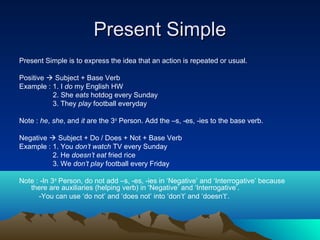
Present Simple is to express the idea that an action is repeated or usual.

Positive  Subject + Base Verb
Example : 1. I do my English HW
          2. She eats hotdog every Sunday
          3. They play football everyday

Note : he, she, and it are the 3rd Person. Add the –s, -es, -ies to the base verb.

Negative  Subject + Do / Does + Not + Base Verb
Example : 1. You don’t watch TV every Sunday
          2. He doesn’t eat fried rice
          3. We don’t play football every Friday

Note : -In 3rd Person, do not add –s, -es, -ies in ‘Negative’ and ‘Interrogative’ because
   there are auxiliaries (helping verb) in ‘Negative’ and ‘Interrogative’.
      -You can use ‘do not’ and ‘does not’ into ‘don’t’ and ‘doesn’t’.
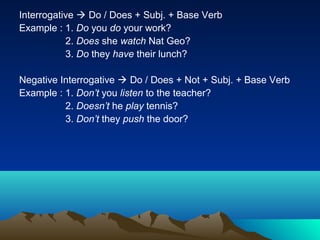
Interrogative  Do / Does + Subj. + Base Verb
Example : 1. Do you do your work?
           2. Does she watch Nat Geo?
           3. Do they have their lunch?

Negative Interrogative  Do / Does + Not + Subj. + Base Verb
Example : 1. Don’t you listen to the teacher?
          2. Doesn’t he play tennis?
          3. Don’t they push the door?
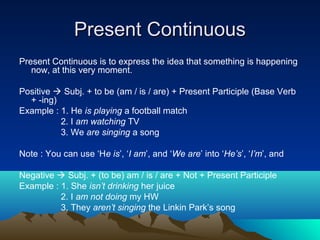
Present Continuous
Present Continuous is to express the idea that something is happening
   now, at this very moment.

Positive  Subj. + to be (am / is / are) + Present Participle (Base Verb
  + -ing)
Example : 1. He is playing a football match
          2. I am watching TV
          3. We are singing a song

Note : You can use ‘He is’, ‘I am’, and ‘We are’ into ‘He’s’, ‘I’m’, and

Negative  Subj. + (to be) am / is / are + Not + Present Participle
Example : 1. She isn’t drinking her juice
          2. I am not doing my HW
          3. They aren’t singing the Linkin Park’s song
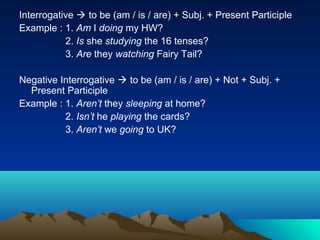
Interrogative  to be (am / is / are) + Subj. + Present Participle
Example : 1. Am I doing my HW?
           2. Is she studying the 16 tenses?
           3. Are they watching Fairy Tail?

Negative Interrogative  to be (am / is / are) + Not + Subj. +
  Present Participle
Example : 1. Aren’t they sleeping at home?
          2. Isn’t he playing the cards?
          3. Aren’t we going to UK?
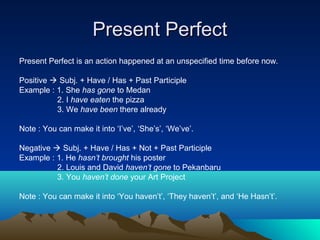
Present Perfect
Present Perfect is an action happened at an unspecified time before now.

Positive  Subj. + Have / Has + Past Participle
Example : 1. She has gone to Medan
          2. I have eaten the pizza
          3. We have been there already

Note : You can make it into ‘I’ve’, ‘She’s’, ‘We’ve’.

Negative  Subj. + Have / Has + Not + Past Participle
Example : 1. He hasn’t brought his poster
          2. Louis and David haven’t gone to Pekanbaru
          3. You haven’t done your Art Project

Note : You can make it into ‘You haven’t’, ‘They haven’t’, and ‘He Hasn’t’.
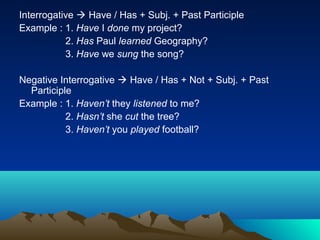
Interrogative  Have / Has + Subj. + Past Participle
Example : 1. Have I done my project?
           2. Has Paul learned Geography?
           3. Have we sung the song?

Negative Interrogative  Have / Has + Not + Subj. + Past
  Participle
Example : 1. Haven’t they listened to me?
           2. Hasn’t she cut the tree?
           3. Haven’t you played football?
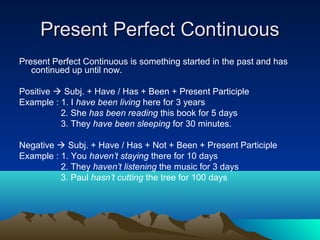
Present Perfect Continuous
Present Perfect Continuous is something started in the past and has
   continued up until now.

Positive  Subj. + Have / Has + Been + Present Participle
Example : 1. I have been living here for 3 years
          2. She has been reading this book for 5 days
          3. They have been sleeping for 30 minutes.

Negative  Subj. + Have / Has + Not + Been + Present Participle
Example : 1. You haven’t staying there for 10 days
          2. They haven’t listening the music for 3 days
          3. Paul hasn’t cutting the tree for 100 days
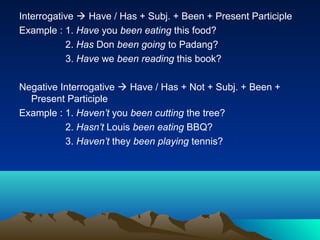
Interrogative  Have / Has + Subj. + Been + Present Participle
Example : 1. Have you been eating this food?
           2. Has Don been going to Padang?
           3. Have we been reading this book?

Negative Interrogative  Have / Has + Not + Subj. + Been +
  Present Participle
Example : 1. Haven’t you been cutting the tree?
          2. Hasn’t Louis been eating BBQ?
          3. Haven’t they been playing tennis?
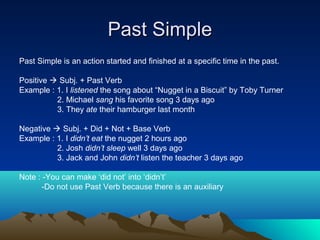
Past Simple
Past Simple is an action started and finished at a specific time in the past.

Positive  Subj. + Past Verb
Example : 1. I listened the song about “Nugget in a Biscuit” by Toby Turner
          2. Michael sang his favorite song 3 days ago
          3. They ate their hamburger last month

Negative  Subj. + Did + Not + Base Verb
Example : 1. I didn’t eat the nugget 2 hours ago
          2. Josh didn’t sleep well 3 days ago
          3. Jack and John didn’t listen the teacher 3 days ago

Note : -You can make ‘did not’ into ‘didn’t’
      -Do not use Past Verb because there is an auxiliary
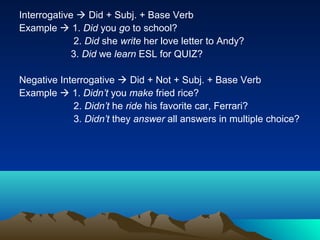
Interrogative  Did + Subj. + Base Verb
Example  1. Did you go to school?
             2. Did she write her love letter to Andy?
             3. Did we learn ESL for QUIZ?

Negative Interrogative  Did + Not + Subj. + Base Verb
Example  1. Didn’t you make fried rice?
            2. Didn’t he ride his favorite car, Ferrari?
            3. Didn’t they answer all answers in multiple choice?
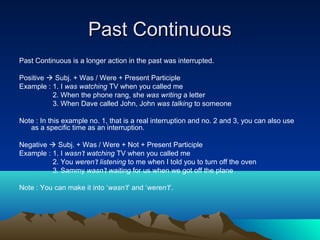
Past Continuous
Past Continuous is a longer action in the past was interrupted.

Positive  Subj. + Was / Were + Present Participle
Example : 1. I was watching TV when you called me
          2. When the phone rang, she was writing a letter
          3. When Dave called John, John was talking to someone

Note : In this example no. 1, that is a real interruption and no. 2 and 3, you can also use
   as a specific time as an interruption.

Negative  Subj. + Was / Were + Not + Present Participle
Example : 1. I wasn’t watching TV when you called me
          2. You weren’t listening to me when I told you to turn off the oven
          3. Sammy wasn’t waiting for us when we got off the plane

Note : You can make it into ‘wasn’t’ and ‘weren’t’.
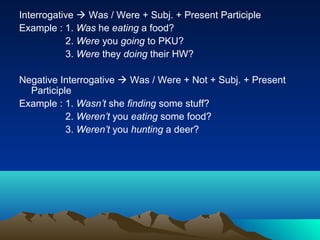
Interrogative  Was / Were + Subj. + Present Participle
Example : 1. Was he eating a food?
           2. Were you going to PKU?
           3. Were they doing their HW?

Negative Interrogative  Was / Were + Not + Subj. + Present
  Participle
Example : 1. Wasn’t she finding some stuff?
           2. Weren’t you eating some food?
           3. Weren’t you hunting a deer?
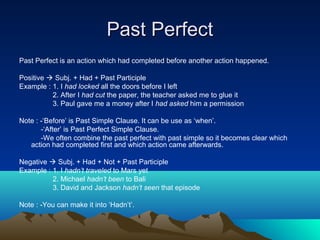
Past Perfect
Past Perfect is an action which had completed before another action happened.

Positive  Subj. + Had + Past Participle
Example : 1. I had locked all the doors before I left
          2. After I had cut the paper, the teacher asked me to glue it
          3. Paul gave me a money after I had asked him a permission

Note : -‘Before’ is Past Simple Clause. It can be use as ‘when’.
       -‘After’ is Past Perfect Simple Clause.
       -We often combine the past perfect with past simple so it becomes clear which
   action had completed first and which action came afterwards.

Negative  Subj. + Had + Not + Past Participle
Example : 1. I hadn’t traveled to Mars yet
          2. Michael hadn’t been to Bali
          3. David and Jackson hadn’t seen that episode

Note : -You can make it into ‘Hadn’t’.
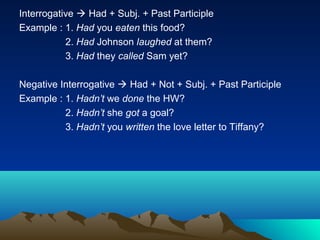
Interrogative  Had + Subj. + Past Participle
Example : 1. Had you eaten this food?
           2. Had Johnson laughed at them?
           3. Had they called Sam yet?

Negative Interrogative  Had + Not + Subj. + Past Participle
Example : 1. Hadn’t we done the HW?
          2. Hadn’t she got a goal?
          3. Hadn’t you written the love letter to Tiffany?
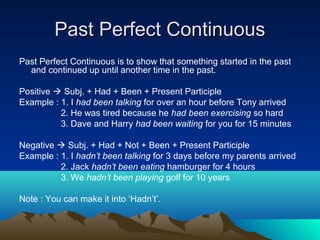
Past Perfect Continuous
Past Perfect Continuous is to show that something started in the past
  and continued up until another time in the past.

Positive  Subj. + Had + Been + Present Participle
Example : 1. I had been talking for over an hour before Tony arrived
          2. He was tired because he had been exercising so hard
          3. Dave and Harry had been waiting for you for 15 minutes

Negative  Subj. + Had + Not + Been + Present Participle
Example : 1. I hadn’t been talking for 3 days before my parents arrived
          2. Jack hadn’t been eating hamburger for 4 hours
          3. We hadn’t been playing golf for 10 years

Note : You can make it into ‘Hadn’t’.
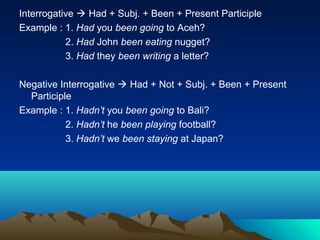
Interrogative  Had + Subj. + Been + Present Participle
Example : 1. Had you been going to Aceh?
           2. Had John been eating nugget?
           3. Had they been writing a letter?

Negative Interrogative  Had + Not + Subj. + Been + Present
  Participle
Example : 1. Hadn’t you been going to Bali?
           2. Hadn’t he been playing football?
           3. Hadn’t we been staying at Japan?
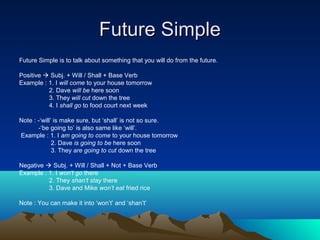
Future Simple
Future Simple is to talk about something that you will do from the future.

Positive  Subj. + Will / Shall + Base Verb
Example : 1. I will come to your house tomorrow
          2. Dave will be here soon
          3. They will cut down the tree
          4. I shall go to food court next week

Note : -‘will’ is make sure, but ‘shall’ is not so sure.
       -‘be going to’ is also same like ‘will’.
Example : 1. I am going to come to your house tomorrow
              2. Dave is going to be here soon
              3. They are going to cut down the tree

Negative  Subj. + Will / Shall + Not + Base Verb
Example : 1. I won’t go there
          2. They shan’t stay there
          3. Dave and Mike won’t eat fried rice

Note : You can make it into ‘won’t’ and ‘shan’t’
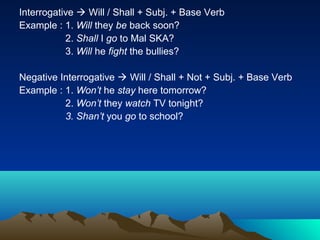
Interrogative  Will / Shall + Subj. + Base Verb
Example : 1. Will they be back soon?
           2. Shall I go to Mal SKA?
           3. Will he fight the bullies?

Negative Interrogative  Will / Shall + Not + Subj. + Base Verb
Example : 1. Won’t he stay here tomorrow?
          2. Won’t they watch TV tonight?
          3. Shan’t you go to school?
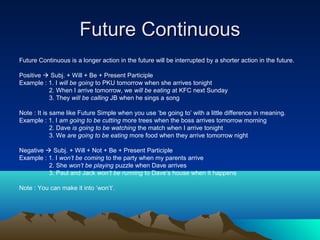
Future Continuous
Future Continuous is a longer action in the future will be interrupted by a shorter action in the future.

Positive  Subj. + Will + Be + Present Participle
Example : 1. I will be going to PKU tomorrow when she arrives tonight
          2. When I arrive tomorrow, we will be eating at KFC next Sunday
          3. They will be calling JB when he sings a song

Note : It is same like Future Simple when you use ‘be going to’ with a little difference in meaning.
Example : 1. I am going to be cutting more trees when the boss arrives tomorrow morning
             2. Dave is going to be watching the match when I arrive tonight
             3. We are going to be eating more food when they arrive tomorrow night

Negative  Subj. + Will + Not + Be + Present Participle
Example : 1. I won’t be coming to the party when my parents arrive
          2. She won’t be playing puzzle when Dave arrives
          3. Paul and Jack won’t be running to Dave’s house when it happens

Note : You can make it into ‘won’t’.
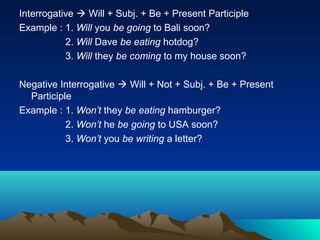
Interrogative  Will + Subj. + Be + Present Participle
Example : 1. Will you be going to Bali soon?
           2. Will Dave be eating hotdog?
           3. Will they be coming to my house soon?

Negative Interrogative  Will + Not + Subj. + Be + Present
  Participle
Example : 1. Won’t they be eating hamburger?
           2. Won’t he be going to USA soon?
           3. Won’t you be writing a letter?
Future Perfect
Future Perfect is something will occur before another action in the future.

Positive  Subj. + Will + Have + Past Participle
Example : 1. I will have received my promotion by next November
          2. She will have finished this test by 3 o’clock
          3. They will have read this book by next week

Note : There will be ‘going to have’ in Future Perfect.
Example : 1. I am going to have received my promotion by next November
          2. She is going to have finished this test by 3 o’clock
          3. They are going to have read this book by next week

Negative  Subj. + Will + Not + Have + Past Participle
Example : 1. I won’t have finished my task by tomorrow
          2. By next week, she won’t have written her love letter to Dave
          3. By next December, Michael and Jackson won’t have decorated the Christmas tree

Note : You can make it into ‘won’t’
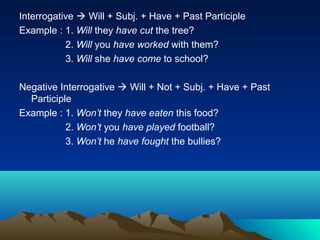
Interrogative  Will + Subj. + Have + Past Participle
Example : 1. Will they have cut the tree?
           2. Will you have worked with them?
           3. Will she have come to school?

Negative Interrogative  Will + Not + Subj. + Have + Past
  Participle
Example : 1. Won’t they have eaten this food?
           2. Won’t you have played football?
           3. Won’t he have fought the bullies?
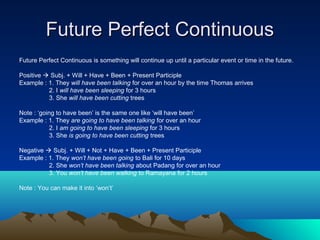
Future Perfect Continuous
Future Perfect Continuous is something will continue up until a particular event or time in the future.

Positive  Subj. + Will + Have + Been + Present Participle
Example : 1. They will have been talking for over an hour by the time Thomas arrives
          2. I will have been sleeping for 3 hours
          3. She will have been cutting trees

Note : ‘going to have been’ is the same one like ‘will have been’
Example : 1. They are going to have been talking for over an hour
            2. I am going to have been sleeping for 3 hours
            3. She is going to have been cutting trees

Negative  Subj. + Will + Not + Have + Been + Present Participle
Example : 1. They won’t have been going to Bali for 10 days
          2. She won’t have been talking about Padang for over an hour
          3. You won’t have been walking to Ramayana for 2 hours

Note : You can make it into ‘won’t’
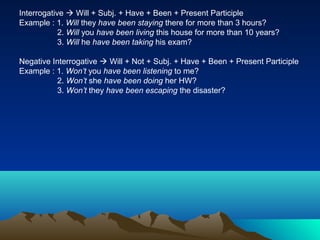
Interrogative  Will + Subj. + Have + Been + Present Participle
Example : 1. Will they have been staying there for more than 3 hours?
            2. Will you have been living this house for more than 10 years?
            3. Will he have been taking his exam?

Negative Interrogative  Will + Not + Subj. + Have + Been + Present Participle
Example : 1. Won’t you have been listening to me?
          2. Won’t she have been doing her HW?
          3. Won’t they have been escaping the disaster?
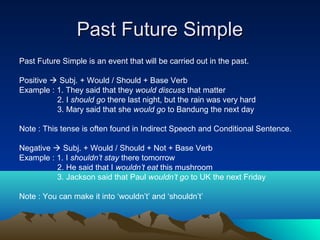
Past Future Simple
Past Future Simple is an event that will be carried out in the past.

Positive  Subj. + Would / Should + Base Verb
Example : 1. They said that they would discuss that matter
          2. I should go there last night, but the rain was very hard
          3. Mary said that she would go to Bandung the next day

Note : This tense is often found in Indirect Speech and Conditional Sentence.

Negative  Subj. + Would / Should + Not + Base Verb
Example : 1. I shouldn’t stay there tomorrow
          2. He said that I wouldn’t eat this mushroom
          3. Jackson said that Paul wouldn’t go to UK the next Friday

Note : You can make it into ‘wouldn’t’ and ‘shouldn’t’
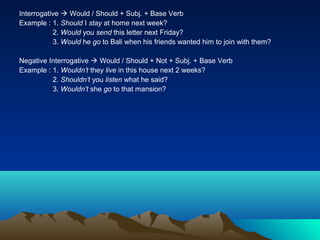
Interrogative  Would / Should + Subj. + Base Verb
Example : 1. Should I stay at home next week?
           2. Would you send this letter next Friday?
           3. Would he go to Bali when his friends wanted him to join with them?

Negative Interrogative  Would / Should + Not + Subj. + Base Verb
Example : 1. Wouldn’t they live in this house next 2 weeks?
          2. Shouldn’t you listen what he said?
          3. Wouldn’t she go to that mansion?
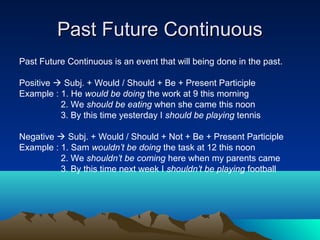
Past Future Continuous
Past Future Continuous is an event that will being done in the past.

Positive  Subj. + Would / Should + Be + Present Participle
Example : 1. He would be doing the work at 9 this morning
          2. We should be eating when she came this noon
          3. By this time yesterday I should be playing tennis

Negative  Subj. + Would / Should + Not + Be + Present Participle
Example : 1. Sam wouldn’t be doing the task at 12 this noon
          2. We shouldn’t be coming here when my parents came
          3. By this time next week I shouldn’t be playing football
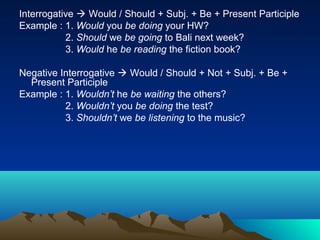
Interrogative  Would / Should + Subj. + Be + Present Participle
Example : 1. Would you be doing your HW?
           2. Should we be going to Bali next week?
           3. Would he be reading the fiction book?

Negative Interrogative  Would / Should + Not + Subj. + Be +
  Present Participle
Example : 1. Wouldn’t he be waiting the others?
          2. Wouldn’t you be doing the test?
          3. Shouldn’t we be listening to the music?
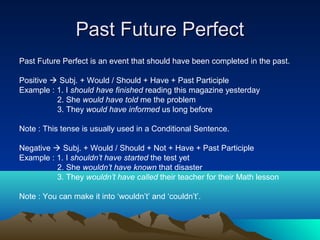
Past Future Perfect
Past Future Perfect is an event that should have been completed in the past.

Positive  Subj. + Would / Should + Have + Past Participle
Example : 1. I should have finished reading this magazine yesterday
          2. She would have told me the problem
          3. They would have informed us long before

Note : This tense is usually used in a Conditional Sentence.

Negative  Subj. + Would / Should + Not + Have + Past Participle
Example : 1. I shouldn’t have started the test yet
          2. She wouldn’t have known that disaster
          3. They wouldn’t have called their teacher for their Math lesson

Note : You can make it into ‘wouldn’t’ and ‘couldn’t’.
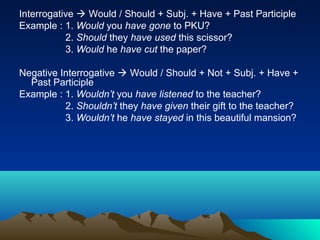
Interrogative  Would / Should + Subj. + Have + Past Participle
Example : 1. Would you have gone to PKU?
           2. Should they have used this scissor?
           3. Would he have cut the paper?

Negative Interrogative  Would / Should + Not + Subj. + Have +
  Past Participle
Example : 1. Wouldn’t you have listened to the teacher?
          2. Shouldn’t they have given their gift to the teacher?
          3. Wouldn’t he have stayed in this beautiful mansion?
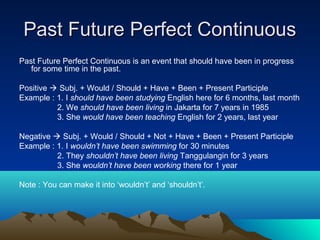
Past Future Perfect Continuous
Past Future Perfect Continuous is an event that should have been in progress
   for some time in the past.

Positive  Subj. + Would / Should + Have + Been + Present Participle
Example : 1. I should have been studying English here for 6 months, last month
          2. We should have been living in Jakarta for 7 years in 1985
          3. She would have been teaching English for 2 years, last year

Negative  Subj. + Would / Should + Not + Have + Been + Present Participle
Example : 1. I wouldn’t have been swimming for 30 minutes
          2. They shouldn’t have been living Tanggulangin for 3 years
          3. She wouldn’t have been working there for 1 year

Note : You can make it into ‘wouldn’t’ and ‘shouldn’t’.
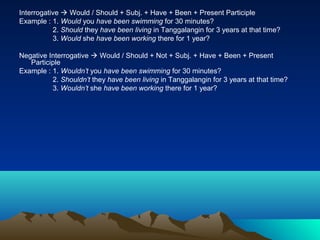
Interrogative  Would / Should + Subj. + Have + Been + Present Participle
Example : 1. Would you have been swimming for 30 minutes?
           2. Should they have been living in Tanggalangin for 3 years at that time?
           3. Would she have been working there for 1 year?

Negative Interrogative  Would / Should + Not + Subj. + Have + Been + Present
   Participle
Example : 1. Wouldn’t you have been swimming for 30 minutes?
          2. Shouldn’t they have been living in Tanggalangin for 3 years at that time?
          3. Wouldn’t she have been working there for 1 year?

16 tenses

  • 1.
  • 2.
    Introduce Hello everyone! Myname is Wilson. Today, I’ll explain you about the 16 tenses.
  • 3.
    Present Simple Present Simpleis to express the idea that an action is repeated or usual. Positive  Subject + Base Verb Example : 1. I do my English HW 2. She eats hotdog every Sunday 3. They play football everyday Note : he, she, and it are the 3rd Person. Add the –s, -es, -ies to the base verb. Negative  Subject + Do / Does + Not + Base Verb Example : 1. You don’t watch TV every Sunday 2. He doesn’t eat fried rice 3. We don’t play football every Friday Note : -In 3rd Person, do not add –s, -es, -ies in ‘Negative’ and ‘Interrogative’ because there are auxiliaries (helping verb) in ‘Negative’ and ‘Interrogative’. -You can use ‘do not’ and ‘does not’ into ‘don’t’ and ‘doesn’t’.
  • 4.
    Interrogative  Do/ Does + Subj. + Base Verb Example : 1. Do you do your work? 2. Does she watch Nat Geo? 3. Do they have their lunch? Negative Interrogative  Do / Does + Not + Subj. + Base Verb Example : 1. Don’t you listen to the teacher? 2. Doesn’t he play tennis? 3. Don’t they push the door?
  • 5.
    Present Continuous Present Continuousis to express the idea that something is happening now, at this very moment. Positive  Subj. + to be (am / is / are) + Present Participle (Base Verb + -ing) Example : 1. He is playing a football match 2. I am watching TV 3. We are singing a song Note : You can use ‘He is’, ‘I am’, and ‘We are’ into ‘He’s’, ‘I’m’, and Negative  Subj. + (to be) am / is / are + Not + Present Participle Example : 1. She isn’t drinking her juice 2. I am not doing my HW 3. They aren’t singing the Linkin Park’s song
  • 6.
    Interrogative  tobe (am / is / are) + Subj. + Present Participle Example : 1. Am I doing my HW? 2. Is she studying the 16 tenses? 3. Are they watching Fairy Tail? Negative Interrogative  to be (am / is / are) + Not + Subj. + Present Participle Example : 1. Aren’t they sleeping at home? 2. Isn’t he playing the cards? 3. Aren’t we going to UK?
  • 7.
    Present Perfect Present Perfectis an action happened at an unspecified time before now. Positive  Subj. + Have / Has + Past Participle Example : 1. She has gone to Medan 2. I have eaten the pizza 3. We have been there already Note : You can make it into ‘I’ve’, ‘She’s’, ‘We’ve’. Negative  Subj. + Have / Has + Not + Past Participle Example : 1. He hasn’t brought his poster 2. Louis and David haven’t gone to Pekanbaru 3. You haven’t done your Art Project Note : You can make it into ‘You haven’t’, ‘They haven’t’, and ‘He Hasn’t’.
  • 8.
    Interrogative  Have/ Has + Subj. + Past Participle Example : 1. Have I done my project? 2. Has Paul learned Geography? 3. Have we sung the song? Negative Interrogative  Have / Has + Not + Subj. + Past Participle Example : 1. Haven’t they listened to me? 2. Hasn’t she cut the tree? 3. Haven’t you played football?
  • 9.
    Present Perfect Continuous PresentPerfect Continuous is something started in the past and has continued up until now. Positive  Subj. + Have / Has + Been + Present Participle Example : 1. I have been living here for 3 years 2. She has been reading this book for 5 days 3. They have been sleeping for 30 minutes. Negative  Subj. + Have / Has + Not + Been + Present Participle Example : 1. You haven’t staying there for 10 days 2. They haven’t listening the music for 3 days 3. Paul hasn’t cutting the tree for 100 days
  • 10.
    Interrogative  Have/ Has + Subj. + Been + Present Participle Example : 1. Have you been eating this food? 2. Has Don been going to Padang? 3. Have we been reading this book? Negative Interrogative  Have / Has + Not + Subj. + Been + Present Participle Example : 1. Haven’t you been cutting the tree? 2. Hasn’t Louis been eating BBQ? 3. Haven’t they been playing tennis?
  • 11.
    Past Simple Past Simpleis an action started and finished at a specific time in the past. Positive  Subj. + Past Verb Example : 1. I listened the song about “Nugget in a Biscuit” by Toby Turner 2. Michael sang his favorite song 3 days ago 3. They ate their hamburger last month Negative  Subj. + Did + Not + Base Verb Example : 1. I didn’t eat the nugget 2 hours ago 2. Josh didn’t sleep well 3 days ago 3. Jack and John didn’t listen the teacher 3 days ago Note : -You can make ‘did not’ into ‘didn’t’ -Do not use Past Verb because there is an auxiliary
  • 12.
    Interrogative  Did+ Subj. + Base Verb Example  1. Did you go to school? 2. Did she write her love letter to Andy? 3. Did we learn ESL for QUIZ? Negative Interrogative  Did + Not + Subj. + Base Verb Example  1. Didn’t you make fried rice? 2. Didn’t he ride his favorite car, Ferrari? 3. Didn’t they answer all answers in multiple choice?
  • 13.
    Past Continuous Past Continuousis a longer action in the past was interrupted. Positive  Subj. + Was / Were + Present Participle Example : 1. I was watching TV when you called me 2. When the phone rang, she was writing a letter 3. When Dave called John, John was talking to someone Note : In this example no. 1, that is a real interruption and no. 2 and 3, you can also use as a specific time as an interruption. Negative  Subj. + Was / Were + Not + Present Participle Example : 1. I wasn’t watching TV when you called me 2. You weren’t listening to me when I told you to turn off the oven 3. Sammy wasn’t waiting for us when we got off the plane Note : You can make it into ‘wasn’t’ and ‘weren’t’.
  • 14.
    Interrogative  Was/ Were + Subj. + Present Participle Example : 1. Was he eating a food? 2. Were you going to PKU? 3. Were they doing their HW? Negative Interrogative  Was / Were + Not + Subj. + Present Participle Example : 1. Wasn’t she finding some stuff? 2. Weren’t you eating some food? 3. Weren’t you hunting a deer?
  • 15.
    Past Perfect Past Perfectis an action which had completed before another action happened. Positive  Subj. + Had + Past Participle Example : 1. I had locked all the doors before I left 2. After I had cut the paper, the teacher asked me to glue it 3. Paul gave me a money after I had asked him a permission Note : -‘Before’ is Past Simple Clause. It can be use as ‘when’. -‘After’ is Past Perfect Simple Clause. -We often combine the past perfect with past simple so it becomes clear which action had completed first and which action came afterwards. Negative  Subj. + Had + Not + Past Participle Example : 1. I hadn’t traveled to Mars yet 2. Michael hadn’t been to Bali 3. David and Jackson hadn’t seen that episode Note : -You can make it into ‘Hadn’t’.
  • 16.
    Interrogative  Had+ Subj. + Past Participle Example : 1. Had you eaten this food? 2. Had Johnson laughed at them? 3. Had they called Sam yet? Negative Interrogative  Had + Not + Subj. + Past Participle Example : 1. Hadn’t we done the HW? 2. Hadn’t she got a goal? 3. Hadn’t you written the love letter to Tiffany?
  • 17.
    Past Perfect Continuous PastPerfect Continuous is to show that something started in the past and continued up until another time in the past. Positive  Subj. + Had + Been + Present Participle Example : 1. I had been talking for over an hour before Tony arrived 2. He was tired because he had been exercising so hard 3. Dave and Harry had been waiting for you for 15 minutes Negative  Subj. + Had + Not + Been + Present Participle Example : 1. I hadn’t been talking for 3 days before my parents arrived 2. Jack hadn’t been eating hamburger for 4 hours 3. We hadn’t been playing golf for 10 years Note : You can make it into ‘Hadn’t’.
  • 18.
    Interrogative  Had+ Subj. + Been + Present Participle Example : 1. Had you been going to Aceh? 2. Had John been eating nugget? 3. Had they been writing a letter? Negative Interrogative  Had + Not + Subj. + Been + Present Participle Example : 1. Hadn’t you been going to Bali? 2. Hadn’t he been playing football? 3. Hadn’t we been staying at Japan?
  • 19.
    Future Simple Future Simpleis to talk about something that you will do from the future. Positive  Subj. + Will / Shall + Base Verb Example : 1. I will come to your house tomorrow 2. Dave will be here soon 3. They will cut down the tree 4. I shall go to food court next week Note : -‘will’ is make sure, but ‘shall’ is not so sure. -‘be going to’ is also same like ‘will’. Example : 1. I am going to come to your house tomorrow 2. Dave is going to be here soon 3. They are going to cut down the tree Negative  Subj. + Will / Shall + Not + Base Verb Example : 1. I won’t go there 2. They shan’t stay there 3. Dave and Mike won’t eat fried rice Note : You can make it into ‘won’t’ and ‘shan’t’
  • 20.
    Interrogative  Will/ Shall + Subj. + Base Verb Example : 1. Will they be back soon? 2. Shall I go to Mal SKA? 3. Will he fight the bullies? Negative Interrogative  Will / Shall + Not + Subj. + Base Verb Example : 1. Won’t he stay here tomorrow? 2. Won’t they watch TV tonight? 3. Shan’t you go to school?
  • 21.
    Future Continuous Future Continuousis a longer action in the future will be interrupted by a shorter action in the future. Positive  Subj. + Will + Be + Present Participle Example : 1. I will be going to PKU tomorrow when she arrives tonight 2. When I arrive tomorrow, we will be eating at KFC next Sunday 3. They will be calling JB when he sings a song Note : It is same like Future Simple when you use ‘be going to’ with a little difference in meaning. Example : 1. I am going to be cutting more trees when the boss arrives tomorrow morning 2. Dave is going to be watching the match when I arrive tonight 3. We are going to be eating more food when they arrive tomorrow night Negative  Subj. + Will + Not + Be + Present Participle Example : 1. I won’t be coming to the party when my parents arrive 2. She won’t be playing puzzle when Dave arrives 3. Paul and Jack won’t be running to Dave’s house when it happens Note : You can make it into ‘won’t’.
  • 22.
    Interrogative  Will+ Subj. + Be + Present Participle Example : 1. Will you be going to Bali soon? 2. Will Dave be eating hotdog? 3. Will they be coming to my house soon? Negative Interrogative  Will + Not + Subj. + Be + Present Participle Example : 1. Won’t they be eating hamburger? 2. Won’t he be going to USA soon? 3. Won’t you be writing a letter?
  • 23.
    Future Perfect Future Perfectis something will occur before another action in the future. Positive  Subj. + Will + Have + Past Participle Example : 1. I will have received my promotion by next November 2. She will have finished this test by 3 o’clock 3. They will have read this book by next week Note : There will be ‘going to have’ in Future Perfect. Example : 1. I am going to have received my promotion by next November 2. She is going to have finished this test by 3 o’clock 3. They are going to have read this book by next week Negative  Subj. + Will + Not + Have + Past Participle Example : 1. I won’t have finished my task by tomorrow 2. By next week, she won’t have written her love letter to Dave 3. By next December, Michael and Jackson won’t have decorated the Christmas tree Note : You can make it into ‘won’t’
  • 24.
    Interrogative  Will+ Subj. + Have + Past Participle Example : 1. Will they have cut the tree? 2. Will you have worked with them? 3. Will she have come to school? Negative Interrogative  Will + Not + Subj. + Have + Past Participle Example : 1. Won’t they have eaten this food? 2. Won’t you have played football? 3. Won’t he have fought the bullies?
  • 25.
    Future Perfect Continuous FuturePerfect Continuous is something will continue up until a particular event or time in the future. Positive  Subj. + Will + Have + Been + Present Participle Example : 1. They will have been talking for over an hour by the time Thomas arrives 2. I will have been sleeping for 3 hours 3. She will have been cutting trees Note : ‘going to have been’ is the same one like ‘will have been’ Example : 1. They are going to have been talking for over an hour 2. I am going to have been sleeping for 3 hours 3. She is going to have been cutting trees Negative  Subj. + Will + Not + Have + Been + Present Participle Example : 1. They won’t have been going to Bali for 10 days 2. She won’t have been talking about Padang for over an hour 3. You won’t have been walking to Ramayana for 2 hours Note : You can make it into ‘won’t’
  • 26.
    Interrogative  Will+ Subj. + Have + Been + Present Participle Example : 1. Will they have been staying there for more than 3 hours? 2. Will you have been living this house for more than 10 years? 3. Will he have been taking his exam? Negative Interrogative  Will + Not + Subj. + Have + Been + Present Participle Example : 1. Won’t you have been listening to me? 2. Won’t she have been doing her HW? 3. Won’t they have been escaping the disaster?
  • 27.
    Past Future Simple PastFuture Simple is an event that will be carried out in the past. Positive  Subj. + Would / Should + Base Verb Example : 1. They said that they would discuss that matter 2. I should go there last night, but the rain was very hard 3. Mary said that she would go to Bandung the next day Note : This tense is often found in Indirect Speech and Conditional Sentence. Negative  Subj. + Would / Should + Not + Base Verb Example : 1. I shouldn’t stay there tomorrow 2. He said that I wouldn’t eat this mushroom 3. Jackson said that Paul wouldn’t go to UK the next Friday Note : You can make it into ‘wouldn’t’ and ‘shouldn’t’
  • 28.
    Interrogative  Would/ Should + Subj. + Base Verb Example : 1. Should I stay at home next week? 2. Would you send this letter next Friday? 3. Would he go to Bali when his friends wanted him to join with them? Negative Interrogative  Would / Should + Not + Subj. + Base Verb Example : 1. Wouldn’t they live in this house next 2 weeks? 2. Shouldn’t you listen what he said? 3. Wouldn’t she go to that mansion?
  • 29.
    Past Future Continuous PastFuture Continuous is an event that will being done in the past. Positive  Subj. + Would / Should + Be + Present Participle Example : 1. He would be doing the work at 9 this morning 2. We should be eating when she came this noon 3. By this time yesterday I should be playing tennis Negative  Subj. + Would / Should + Not + Be + Present Participle Example : 1. Sam wouldn’t be doing the task at 12 this noon 2. We shouldn’t be coming here when my parents came 3. By this time next week I shouldn’t be playing football
  • 30.
    Interrogative  Would/ Should + Subj. + Be + Present Participle Example : 1. Would you be doing your HW? 2. Should we be going to Bali next week? 3. Would he be reading the fiction book? Negative Interrogative  Would / Should + Not + Subj. + Be + Present Participle Example : 1. Wouldn’t he be waiting the others? 2. Wouldn’t you be doing the test? 3. Shouldn’t we be listening to the music?
  • 31.
    Past Future Perfect PastFuture Perfect is an event that should have been completed in the past. Positive  Subj. + Would / Should + Have + Past Participle Example : 1. I should have finished reading this magazine yesterday 2. She would have told me the problem 3. They would have informed us long before Note : This tense is usually used in a Conditional Sentence. Negative  Subj. + Would / Should + Not + Have + Past Participle Example : 1. I shouldn’t have started the test yet 2. She wouldn’t have known that disaster 3. They wouldn’t have called their teacher for their Math lesson Note : You can make it into ‘wouldn’t’ and ‘couldn’t’.
  • 32.
    Interrogative  Would/ Should + Subj. + Have + Past Participle Example : 1. Would you have gone to PKU? 2. Should they have used this scissor? 3. Would he have cut the paper? Negative Interrogative  Would / Should + Not + Subj. + Have + Past Participle Example : 1. Wouldn’t you have listened to the teacher? 2. Shouldn’t they have given their gift to the teacher? 3. Wouldn’t he have stayed in this beautiful mansion?
  • 33.
    Past Future PerfectContinuous Past Future Perfect Continuous is an event that should have been in progress for some time in the past. Positive  Subj. + Would / Should + Have + Been + Present Participle Example : 1. I should have been studying English here for 6 months, last month 2. We should have been living in Jakarta for 7 years in 1985 3. She would have been teaching English for 2 years, last year Negative  Subj. + Would / Should + Not + Have + Been + Present Participle Example : 1. I wouldn’t have been swimming for 30 minutes 2. They shouldn’t have been living Tanggulangin for 3 years 3. She wouldn’t have been working there for 1 year Note : You can make it into ‘wouldn’t’ and ‘shouldn’t’.
  • 34.
    Interrogative  Would/ Should + Subj. + Have + Been + Present Participle Example : 1. Would you have been swimming for 30 minutes? 2. Should they have been living in Tanggalangin for 3 years at that time? 3. Would she have been working there for 1 year? Negative Interrogative  Would / Should + Not + Subj. + Have + Been + Present Participle Example : 1. Wouldn’t you have been swimming for 30 minutes? 2. Shouldn’t they have been living in Tanggalangin for 3 years at that time? 3. Wouldn’t she have been working there for 1 year?