P RIVATE SCH OOL
        IBE ROAME RICA NO
              ENGLISH TENSES
                             NAME:
                VANESSA SOLANO

                     COURSE:
               6TO “CONTABILIDAD”

                     TEACHER:
                   OMAR INTRIAGO

 SANTO DOMINGO, DECEMBER
        26/12/2012

                       SIMPLE PRESENT

Definition:
The present simple or simple present is one of the most common
ways of expressing present time in English. The present simple is
used to describe things that are generally true, to describe things
that happen on a regular basis or to describe a series of events or
actions. It is also used in film reviews and plot summaries.


                                   1
We often use the simple present with adverbs of frequency like:
always usually, often, sometimes, never; and expressions of
frequency, for instance: everyday, once a month, every year.


The present simple is also used to talk about fixed arrangements in
the future; or to express the future after the conjunctions: as soon
as, after, when.

Structure:
              subject + auxiliaryverb + mainverb
                              do          base


There are three important exceptions:

   1. For positive sentences, we do not normally use the auxiliary.
   2. For the 3rd person singular (he, she, it), we add s to the main
      verb or es to the auxiliary.
   3. For the verb to be, we do not use an auxiliary, even for
      questions and negatives.

Examples:

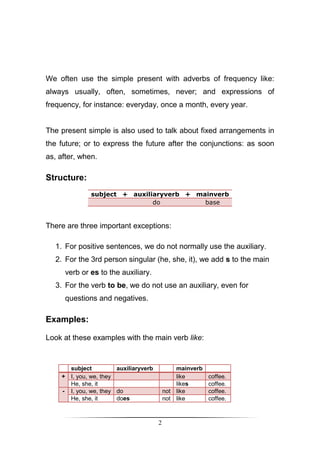
Look at these examples with the main verb like:


      subject          auxiliaryverb           mainverb
    + I, you, we, they                         like       coffee.
      He, she, it                              likes      coffee.
    - I, you, we, they do                  not like       coffee.
      He, she, it      does                not like       coffee.


                                       2
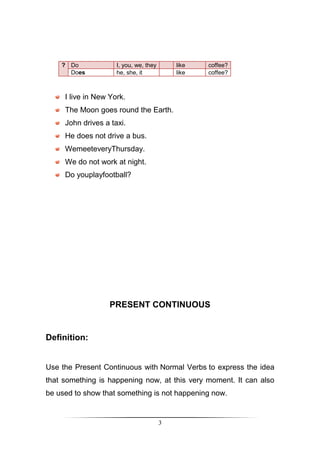
? Do             I, you, we, they       like   coffee?
      Does           he, she, it            like   coffee?


     I live in New York.
     The Moon goes round the Earth.
     John drives a taxi.
     He does not drive a bus.
     WemeeteveryThursday.
     We do not work at night.
     Do youplayfootball?


                   PRESENT CONTINUOUS


Definition:


Use the Present Continuous with Normal Verbs to express the idea
that something is happening now, at this very moment. It can also
be used to show that something is not happening now.


                                        3
We use the present continuous tense to talk about:

     action happening now
     action in thefuture

Structure:


The structure of the present continuous tense is:


             subject + auxiliaryverb + mainverb
                             be        base + ing


Examples:

Look at theseexamples:


         subject    auxiliaryverb     mainverb
       + I          am                speaking       toyou.
       + You        are               reading        this.
       - She        is            not staying        in London.
       - We         are           not playing        football.
       ? Is         he                watching       TV?
       ? Are        they              waiting        for John?


                                  4
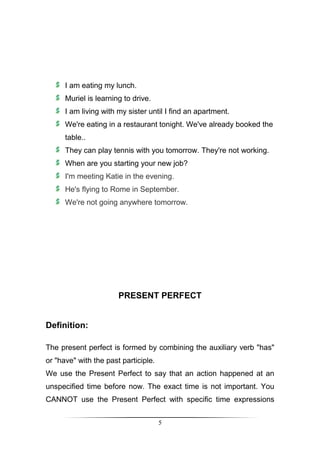
I am eating my lunch.
      Muriel is learning to drive.
      I am living with my sister until I find an apartment.
      We're eating in a restaurant tonight. We've already booked the
      table..
      They can play tennis with you tomorrow. They're not working.
      When are you starting your new job?
      I'm meeting Katie in the evening.
      He's flying to Rome in September.
      We're not going anywhere tomorrow.


                       PRESENT PERFECT


Definition:

The present perfect is formed by combining the auxiliary verb "has"
or "have" with the past participle.
We use the Present Perfect to say that an action happened at an
unspecified time before now. The exact time is not important. You
CANNOT use the Present Perfect with specific time expressions


                                      5
such as: yesterday, one year ago, last week, when I was a child,
when I lived in Japan, at that moment, that day, one day, etc. We
CAN use the Present Perfect with unspecific expressions such as:
ever, never, once, many times, several times, before, so far,
already, yet, etc.


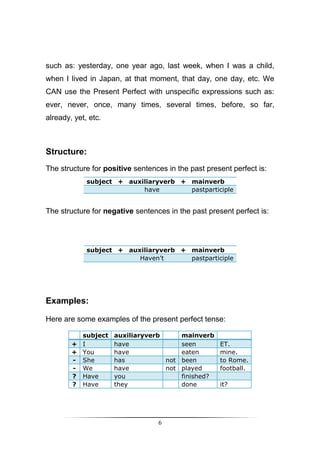
Structure:
The structure for positive sentences in the past present perfect is:
             subject + auxiliaryverb + mainverb
                           have        pastparticiple


The structure for negative sentences in the past present perfect is:


             subject + auxiliaryverb + mainverb
                          Haven’t      pastparticiple


Examples:

Here are some examples of the present perfect tense:

          subject    auxiliaryverb     mainverb
        + I          have              seen          ET.
        + You        have              eaten         mine.
        - She        has           not been          to Rome.
        - We         have          not played        football.
        ? Have       you               finished?
        ? Have       they              done          it?


                                  6
You have seen that movie many times.
     Have you seen that movie many times?
     You have not seen that movie many times.
     I have seen that movie twenty times.
     I think I have met him once before.
     There have been many earthquakes in California.
     People have traveled to the Moon.
     People have not traveled to Mars.
     Have you read the book yet?
     Nobody has ever climbed that mountain.
     A: Has there ever been a war in the United States?
B: Yes, there has been a war in the United States.


                          SIMPLE PAST

Definition:
We use the Past Simple to talk about actions that happened at a
specific time in the past. The actions can be short or long. There can
be a few actions happening one ofter another.
Also use simple past when:
     action in the past taking place once, never or several times
     He visited his parents every weekend.


                                  7
actions in the past taking place one after the other
     Example: He came in, took off his coat and sat down.
     action in the past taking place in the middle of another action
     When I was having breakfast, the phone suddenly rang.
     if sentences type II (If I talked, …)
     If I had a lot of money, I would share it with you.

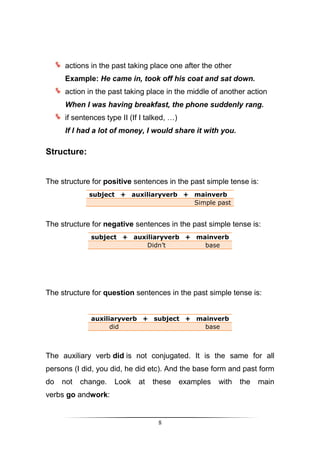
Structure:


The structure for positive sentences in the past simple tense is:
             subject + auxiliaryverb + mainverb
                                       Simple past


The structure for negative sentences in the past simple tense is:
             subject + auxiliaryverb + mainverb
                           Didn’t        base


The structure for question sentences in the past simple tense is:


             auxiliaryverb + subject + mainverb
                   did                   base


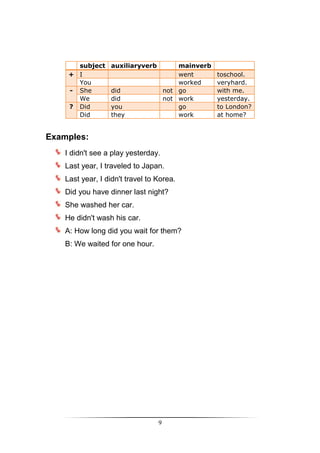
The auxiliary verb did is not conjugated. It is the same for all
persons (I did, you did, he did etc). And the base form and past form
do   not   change.   Look    at   these      examples   with   the   main
verbs go andwork:


                                   8
subject    auxiliaryverb           mainverb
     + I                                  went       toschool.
       You                                worked     veryhard.
     - She        did                 not go         with me.
       We         did                 not work       yesterday.
     ? Did        you                     go         to London?
       Did        they                    work       at home?


Examples:
    I didn't see a play yesterday.
    Last year, I traveled to Japan.
    Last year, I didn't travel to Korea.
    Did you have dinner last night?
    She washed her car.
    He didn't wash his car.
    A: How long did you wait for them?
    B: We waited for one hour.


                                  9
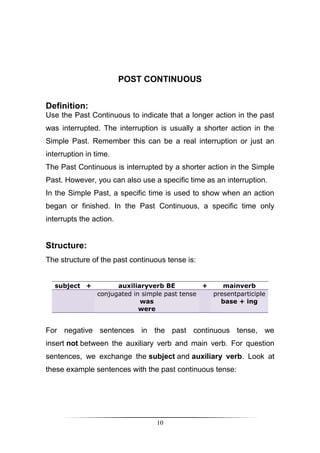
POST CONTINUOUS


Definition:
Use the Past Continuous to indicate that a longer action in the past
was interrupted. The interruption is usually a shorter action in the
Simple Past. Remember this can be a real interruption or just an
interruption in time.
The Past Continuous is interrupted by a shorter action in the Simple
Past. However, you can also use a specific time as an interruption.
In the Simple Past, a specific time is used to show when an action
began or finished. In the Past Continuous, a specific time only
interrupts the action.


Structure:
The structure of the past continuous tense is:


  subject +           auxiliaryverb BE          +    mainverb
                conjugated in simple past tense   presentparticiple
                             was                    base + ing
                             were


For negative sentences in the past continuous tense, we
insert not between the auxiliary verb and main verb. For question
sentences, we exchange the subject and auxiliary verb. Look at
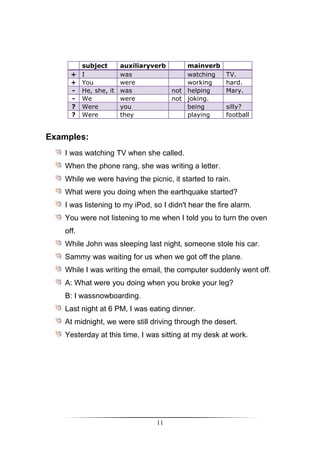
these example sentences with the past continuous tense:


                                  10
subject     auxiliaryverb     mainverb
      + I           was               watching         TV.
      + You         were              working          hard.
      - He, she, it was           not helping          Mary.
      - We          were          not joking.
      ? Were        you               being            silly?
      ? Were        they              playing          football


Examples:
    I was watching TV when she called.
    When the phone rang, she was writing a letter.
    While we were having the picnic, it started to rain.
    What were you doing when the earthquake started?
    I was listening to my iPod, so I didn't hear the fire alarm.
    You were not listening to me when I told you to turn the oven
    off.
    While John was sleeping last night, someone stole his car.
    Sammy was waiting for us when we got off the plane.
    While I was writing the email, the computer suddenly went off.
    A: What were you doing when you broke your leg?
    B: I wassnowboarding.
    Last night at 6 PM, I was eating dinner.
    At midnight, we were still driving through the desert.
    Yesterday at this time, I was sitting at my desk at work.


                                 11
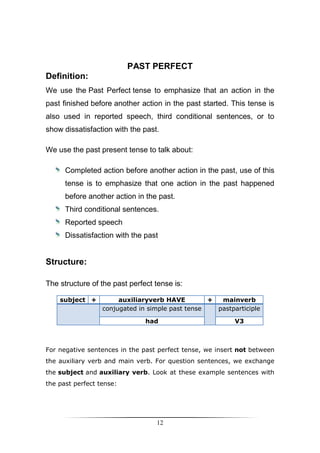
PAST PERFECT
Definition:
We use the Past Perfect tense to emphasize that an action in the
past finished before another action in the past started. This tense is
also used in reported speech, third conditional sentences, or to
show dissatisfaction with the past.

We use the past present tense to talk about:

      Completed action before another action in the past, use of this
      tense is to emphasize that one action in the past happened
      before another action in the past.
      Third conditional sentences.
      Reported speech
      Dissatisfaction with the past


Structure:

The structure of the past perfect tense is:

    subject +          auxiliaryverb HAVE         +  mainverb
                  conjugated in simple past tense   pastparticiple

                               had                        V3


For negative sentences in the past perfect tense, we insert not between
the auxiliary verb and main verb. For question sentences, we exchange
the subject and auxiliary verb. Look at these example sentences with
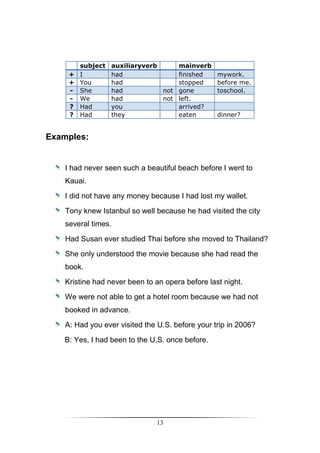
the past perfect tense:


                                  12
subject    auxiliaryverb     mainverb
     + I          had               finished      mywork.
     + You        had               stopped       before me.
     - She        had           not gone          toschool.
     - We         had           not left.
     ? Had        you               arrived?
     ? Had        they              eaten         dinner?


Examples:


    I had never seen such a beautiful beach before I went to
    Kauai.
    I did not have any money because I had lost my wallet.
    Tony knew Istanbul so well because he had visited the city
    several times.
    Had Susan ever studied Thai before she moved to Thailand?
    She only understood the movie because she had read the
    book.
    Kristine had never been to an opera before last night.
    We were not able to get a hotel room because we had not
    booked in advance.
    A: Had you ever visited the U.S. before your trip in 2006?
   B: Yes, I had been to the U.S. once before.


                               13
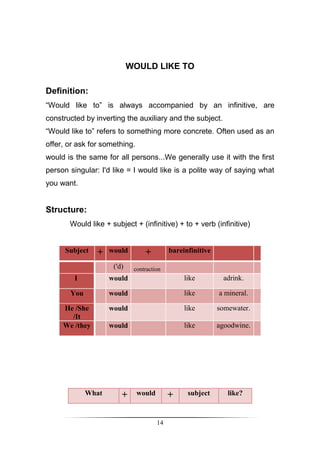
WOULD LIKE TO

Definition:
“Would like to” is always accompanied by an infinitive, are
constructed by inverting the auxiliary and the subject.
“Would like to” refers to something more concrete. Often used as an
offer, or ask for something.
would is the same for all persons...We generally use it with the first
person singular: I'd like = I would like is a polite way of saying what
you want.


Structure:
       Would like + subject + (infinitive) + to + verb (infinitive)


      Subject   +   would        +          bareinfinitive

                     ('d)    contraction
         I          would                        like         adrink.

       You          would                        like        a mineral.

     He /She        would                        like        somewater.
       /It
     We /they       would                        like        agoodwine.


             What       +      would        +     subject       like?


                                       14
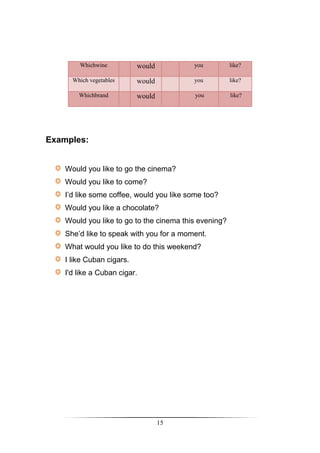
Whichwine          would          you          like?

      Which vegetables     would          you          like?

        Whichbrand         would           you         like?


Examples:


    Would you like to go the cinema?
    Would you like to come?
    I’d like some coffee, would you like some too?
    Would you like a chocolate?
    Would you like to go to the cinema this evening?
    She’d like to speak with you for a moment.
    What would you like to do this weekend?
    I like Cuban cigars.
    I'd like a Cuban cigar.


                                   15
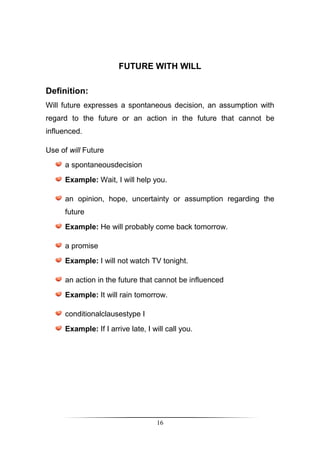
FUTURE WITH WILL

Definition:
Will future expresses a spontaneous decision, an assumption with
regard to the future or an action in the future that cannot be
influenced.

Use of will Future
     a spontaneousdecision
     Example: Wait, I will help you.

     an opinion, hope, uncertainty or assumption regarding the
     future
     Example: He will probably come back tomorrow.

     a promise
     Example: I will not watch TV tonight.

     an action in the future that cannot be influenced
     Example: It will rain tomorrow.

     conditionalclausestype I
     Example: If I arrive late, I will call you.


                                   16
Structure:
Positive

           Subject + [WILL + Infinitive verb] + Complement

Negative


  Subject + [WILL NOT (WON'T)+ Infinitive verb] + Complement


Question
 Question Word + [WILL + Subject + Infinitive verb] + Complement


Examples:


     Tom will never get married.
     She will pay you next week.
     It won’t rain today
     Seth and Tom won’t come to class today.
     I won’t be late anymore.
     What will youstudy?
     Will Maria live in Spain?
     How long will Mark stay in Peru?


                                   17
FUTURE: BE GOING TO

Definition:
Going to future expresses a conclusion regarding the immediate
future or an action in the near future that has already been planned
or prepared.


Structure:


                     Subject + to be + going to + infinitive


Positive

   Subject              VerbTo be              Goingto           Infinitive
   I                    Am                                       dance
   He / She / It        Is                     Goingto           Study
   We / You / They      Are                                      Go shopping


Negative

   Subject              VerbTo be + not         Goingto           Infinitive
   I                    Am not                                    Clean
   He / She / It        Isnot (isn’t)           Goingto           Cook
   We / You / They      Are not (aren’t)                          travel


Question

   Question Word      VerbTo Be            Subject           Goingto          Infinitive
   What               Am not               I                                  Do
   Where              Isnot (isn’t)        He / She / It     Goingto          Go
   —————–             Are not (aren’t)     We / You / They                    travel


                                             18
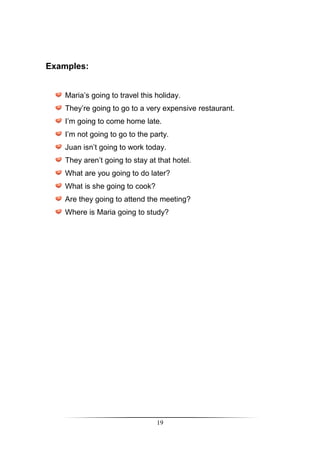
Examples:


    Maria’s going to travel this holiday.
    They’re going to go to a very expensive restaurant.
    I’m going to come home late.
    I’m not going to go to the party.
    Juan isn’t going to work today.
    They aren’t going to stay at that hotel.
    What are you going to do later?
    What is she going to cook?
    Are they going to attend the meeting?
    Where is Maria going to study?


                                 19
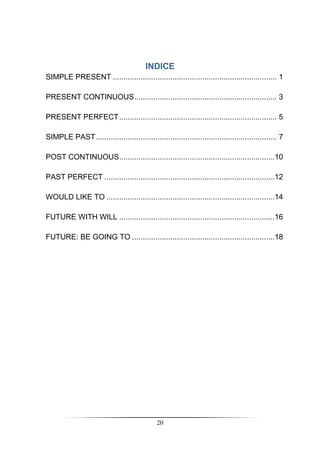
INDICE
SIMPLE PRESENT ............................................................................. 1

PRESENT CONTINUOUS................................................................... 3

PRESENT PERFECT .......................................................................... 5

SIMPLE PAST ..................................................................................... 7

POST CONTINUOUS .........................................................................10

PAST PERFECT ................................................................................12

WOULD LIKE TO ...............................................................................14

FUTURE WITH WILL .........................................................................16

FUTURE: BE GOING TO ...................................................................18


                                              20

Colegio particular (autoguardado)

  • 1.
    P RIVATE SCHOOL IBE ROAME RICA NO ENGLISH TENSES NAME: VANESSA SOLANO COURSE: 6TO “CONTABILIDAD” TEACHER: OMAR INTRIAGO SANTO DOMINGO, DECEMBER 26/12/2012 SIMPLE PRESENT Definition: The present simple or simple present is one of the most common ways of expressing present time in English. The present simple is used to describe things that are generally true, to describe things that happen on a regular basis or to describe a series of events or actions. It is also used in film reviews and plot summaries. 1
  • 2.
    We often usethe simple present with adverbs of frequency like: always usually, often, sometimes, never; and expressions of frequency, for instance: everyday, once a month, every year. The present simple is also used to talk about fixed arrangements in the future; or to express the future after the conjunctions: as soon as, after, when. Structure: subject + auxiliaryverb + mainverb do base There are three important exceptions: 1. For positive sentences, we do not normally use the auxiliary. 2. For the 3rd person singular (he, she, it), we add s to the main verb or es to the auxiliary. 3. For the verb to be, we do not use an auxiliary, even for questions and negatives. Examples: Look at these examples with the main verb like: subject auxiliaryverb mainverb + I, you, we, they like coffee. He, she, it likes coffee. - I, you, we, they do not like coffee. He, she, it does not like coffee. 2
  • 3.
    ? Do I, you, we, they like coffee? Does he, she, it like coffee? I live in New York. The Moon goes round the Earth. John drives a taxi. He does not drive a bus. WemeeteveryThursday. We do not work at night. Do youplayfootball? PRESENT CONTINUOUS Definition: Use the Present Continuous with Normal Verbs to express the idea that something is happening now, at this very moment. It can also be used to show that something is not happening now. 3
  • 4.
    We use thepresent continuous tense to talk about: action happening now action in thefuture Structure: The structure of the present continuous tense is: subject + auxiliaryverb + mainverb be base + ing Examples: Look at theseexamples: subject auxiliaryverb mainverb + I am speaking toyou. + You are reading this. - She is not staying in London. - We are not playing football. ? Is he watching TV? ? Are they waiting for John? 4
  • 5.
    I am eatingmy lunch. Muriel is learning to drive. I am living with my sister until I find an apartment. We're eating in a restaurant tonight. We've already booked the table.. They can play tennis with you tomorrow. They're not working. When are you starting your new job? I'm meeting Katie in the evening. He's flying to Rome in September. We're not going anywhere tomorrow. PRESENT PERFECT Definition: The present perfect is formed by combining the auxiliary verb "has" or "have" with the past participle. We use the Present Perfect to say that an action happened at an unspecified time before now. The exact time is not important. You CANNOT use the Present Perfect with specific time expressions 5
  • 6.
    such as: yesterday,one year ago, last week, when I was a child, when I lived in Japan, at that moment, that day, one day, etc. We CAN use the Present Perfect with unspecific expressions such as: ever, never, once, many times, several times, before, so far, already, yet, etc. Structure: The structure for positive sentences in the past present perfect is: subject + auxiliaryverb + mainverb have pastparticiple The structure for negative sentences in the past present perfect is: subject + auxiliaryverb + mainverb Haven’t pastparticiple Examples: Here are some examples of the present perfect tense: subject auxiliaryverb mainverb + I have seen ET. + You have eaten mine. - She has not been to Rome. - We have not played football. ? Have you finished? ? Have they done it? 6
  • 7.
    You have seenthat movie many times. Have you seen that movie many times? You have not seen that movie many times. I have seen that movie twenty times. I think I have met him once before. There have been many earthquakes in California. People have traveled to the Moon. People have not traveled to Mars. Have you read the book yet? Nobody has ever climbed that mountain. A: Has there ever been a war in the United States? B: Yes, there has been a war in the United States. SIMPLE PAST Definition: We use the Past Simple to talk about actions that happened at a specific time in the past. The actions can be short or long. There can be a few actions happening one ofter another. Also use simple past when: action in the past taking place once, never or several times He visited his parents every weekend. 7
  • 8.
    actions in thepast taking place one after the other Example: He came in, took off his coat and sat down. action in the past taking place in the middle of another action When I was having breakfast, the phone suddenly rang. if sentences type II (If I talked, …) If I had a lot of money, I would share it with you. Structure: The structure for positive sentences in the past simple tense is: subject + auxiliaryverb + mainverb Simple past The structure for negative sentences in the past simple tense is: subject + auxiliaryverb + mainverb Didn’t base The structure for question sentences in the past simple tense is: auxiliaryverb + subject + mainverb did base The auxiliary verb did is not conjugated. It is the same for all persons (I did, you did, he did etc). And the base form and past form do not change. Look at these examples with the main verbs go andwork: 8
  • 9.
    subject auxiliaryverb mainverb + I went toschool. You worked veryhard. - She did not go with me. We did not work yesterday. ? Did you go to London? Did they work at home? Examples: I didn't see a play yesterday. Last year, I traveled to Japan. Last year, I didn't travel to Korea. Did you have dinner last night? She washed her car. He didn't wash his car. A: How long did you wait for them? B: We waited for one hour. 9
  • 10.
    POST CONTINUOUS Definition: Use thePast Continuous to indicate that a longer action in the past was interrupted. The interruption is usually a shorter action in the Simple Past. Remember this can be a real interruption or just an interruption in time. The Past Continuous is interrupted by a shorter action in the Simple Past. However, you can also use a specific time as an interruption. In the Simple Past, a specific time is used to show when an action began or finished. In the Past Continuous, a specific time only interrupts the action. Structure: The structure of the past continuous tense is: subject + auxiliaryverb BE + mainverb conjugated in simple past tense presentparticiple was base + ing were For negative sentences in the past continuous tense, we insert not between the auxiliary verb and main verb. For question sentences, we exchange the subject and auxiliary verb. Look at these example sentences with the past continuous tense: 10
  • 11.
    subject auxiliaryverb mainverb + I was watching TV. + You were working hard. - He, she, it was not helping Mary. - We were not joking. ? Were you being silly? ? Were they playing football Examples: I was watching TV when she called. When the phone rang, she was writing a letter. While we were having the picnic, it started to rain. What were you doing when the earthquake started? I was listening to my iPod, so I didn't hear the fire alarm. You were not listening to me when I told you to turn the oven off. While John was sleeping last night, someone stole his car. Sammy was waiting for us when we got off the plane. While I was writing the email, the computer suddenly went off. A: What were you doing when you broke your leg? B: I wassnowboarding. Last night at 6 PM, I was eating dinner. At midnight, we were still driving through the desert. Yesterday at this time, I was sitting at my desk at work. 11
  • 12.
    PAST PERFECT Definition: We usethe Past Perfect tense to emphasize that an action in the past finished before another action in the past started. This tense is also used in reported speech, third conditional sentences, or to show dissatisfaction with the past. We use the past present tense to talk about: Completed action before another action in the past, use of this tense is to emphasize that one action in the past happened before another action in the past. Third conditional sentences. Reported speech Dissatisfaction with the past Structure: The structure of the past perfect tense is: subject + auxiliaryverb HAVE + mainverb conjugated in simple past tense pastparticiple had V3 For negative sentences in the past perfect tense, we insert not between the auxiliary verb and main verb. For question sentences, we exchange the subject and auxiliary verb. Look at these example sentences with the past perfect tense: 12
  • 13.
    subject auxiliaryverb mainverb + I had finished mywork. + You had stopped before me. - She had not gone toschool. - We had not left. ? Had you arrived? ? Had they eaten dinner? Examples: I had never seen such a beautiful beach before I went to Kauai. I did not have any money because I had lost my wallet. Tony knew Istanbul so well because he had visited the city several times. Had Susan ever studied Thai before she moved to Thailand? She only understood the movie because she had read the book. Kristine had never been to an opera before last night. We were not able to get a hotel room because we had not booked in advance. A: Had you ever visited the U.S. before your trip in 2006? B: Yes, I had been to the U.S. once before. 13
  • 14.
    WOULD LIKE TO Definition: “Wouldlike to” is always accompanied by an infinitive, are constructed by inverting the auxiliary and the subject. “Would like to” refers to something more concrete. Often used as an offer, or ask for something. would is the same for all persons...We generally use it with the first person singular: I'd like = I would like is a polite way of saying what you want. Structure: Would like + subject + (infinitive) + to + verb (infinitive) Subject + would + bareinfinitive ('d) contraction I would like adrink. You would like a mineral. He /She would like somewater. /It We /they would like agoodwine. What + would + subject like? 14
  • 15.
    Whichwine would you like? Which vegetables would you like? Whichbrand would you like? Examples: Would you like to go the cinema? Would you like to come? I’d like some coffee, would you like some too? Would you like a chocolate? Would you like to go to the cinema this evening? She’d like to speak with you for a moment. What would you like to do this weekend? I like Cuban cigars. I'd like a Cuban cigar. 15
  • 16.
    FUTURE WITH WILL Definition: Willfuture expresses a spontaneous decision, an assumption with regard to the future or an action in the future that cannot be influenced. Use of will Future a spontaneousdecision Example: Wait, I will help you. an opinion, hope, uncertainty or assumption regarding the future Example: He will probably come back tomorrow. a promise Example: I will not watch TV tonight. an action in the future that cannot be influenced Example: It will rain tomorrow. conditionalclausestype I Example: If I arrive late, I will call you. 16
  • 17.
    Structure: Positive Subject + [WILL + Infinitive verb] + Complement Negative Subject + [WILL NOT (WON'T)+ Infinitive verb] + Complement Question Question Word + [WILL + Subject + Infinitive verb] + Complement Examples: Tom will never get married. She will pay you next week. It won’t rain today Seth and Tom won’t come to class today. I won’t be late anymore. What will youstudy? Will Maria live in Spain? How long will Mark stay in Peru? 17
  • 18.
    FUTURE: BE GOINGTO Definition: Going to future expresses a conclusion regarding the immediate future or an action in the near future that has already been planned or prepared. Structure: Subject + to be + going to + infinitive Positive Subject VerbTo be Goingto Infinitive I Am dance He / She / It Is Goingto Study We / You / They Are Go shopping Negative Subject VerbTo be + not Goingto Infinitive I Am not Clean He / She / It Isnot (isn’t) Goingto Cook We / You / They Are not (aren’t) travel Question Question Word VerbTo Be Subject Goingto Infinitive What Am not I Do Where Isnot (isn’t) He / She / It Goingto Go —————– Are not (aren’t) We / You / They travel 18
  • 19.
    Examples: Maria’s going to travel this holiday. They’re going to go to a very expensive restaurant. I’m going to come home late. I’m not going to go to the party. Juan isn’t going to work today. They aren’t going to stay at that hotel. What are you going to do later? What is she going to cook? Are they going to attend the meeting? Where is Maria going to study? 19
  • 20.
    INDICE SIMPLE PRESENT .............................................................................1 PRESENT CONTINUOUS................................................................... 3 PRESENT PERFECT .......................................................................... 5 SIMPLE PAST ..................................................................................... 7 POST CONTINUOUS .........................................................................10 PAST PERFECT ................................................................................12 WOULD LIKE TO ...............................................................................14 FUTURE WITH WILL .........................................................................16 FUTURE: BE GOING TO ...................................................................18 20