Name: Elena Párraga Alcántara
USE 1:  Repeated Actions     USE 2:  Facts or Generalizations     
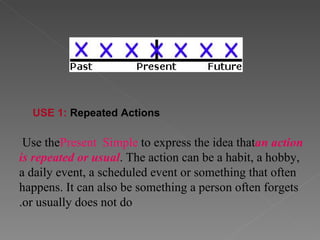
Use the  Present   Simple  to express the idea that  an action is repeated or usual . The action can be a habit, a hobby, a daily event, a scheduled event or something that often happens. It can also be something a person often forgets or usually does not do. USE 1:  Repeated Actions    
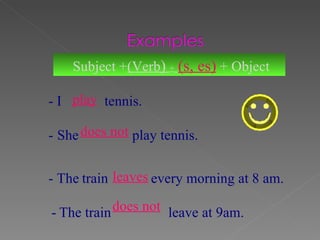
- I  tennis.  -   She  play tennis. - The   train  every morning at 8 am.   -   The train  leave at 9am. Subject +  (Verb )   +   (s, es)  + Object play does not leaves does not
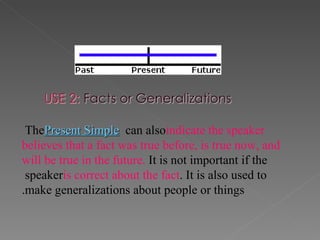
The  Present Simple  can also  indicate the speaker believes that a fact was true before, is true now, and will be true in the future.  It is not important if the speaker  is correct about the fact . It is also used to make generalizations about people or things.
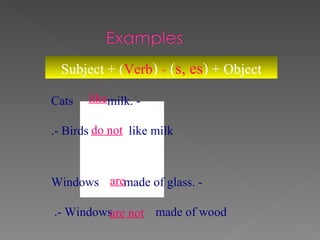
- Cats  milk. - Birds  like milk. - Windows  made of glass. - Windows  made of wood.   Subject + ( Verb )   +   ( s, es )  + Object like do not are are not .
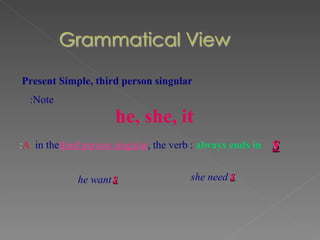
Present Simple, third person singular Note: he, she, it in the  third person singular  the verb, always ends in   : s he want s she need s A :
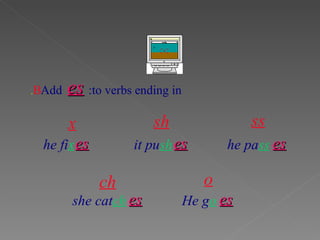
Add es to verbs ending in: ss x sh ch he pa ss she cat ch he fi x it pu sh B .   o es es es es He g o es
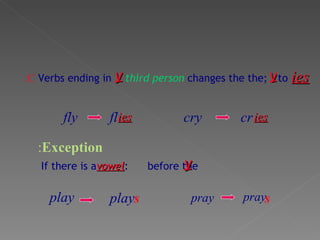
Verbs ending in y ;the  third person  changes the to ies fly fl cry C: y ies cr ies Exception : If there is a  vowel  before the  : y s pray play play pray s
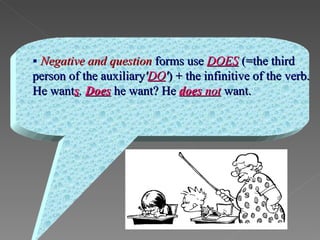
   Negative and question   forms use   DOES   (=the third person of the   auxiliary ' DO ' ) + the infinitive of the verb. He want s .  Does   he want? He   does  not   want.
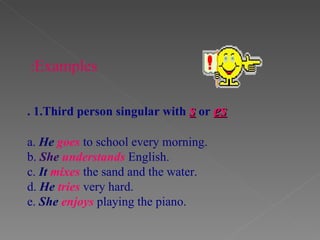
.  1.Third person singular with  s  or  es a.   He  goes  to school every morning. b.   She  understands  English. c.  It  mixes  the sand and the water. d.  He  tries   very hard. e.  She  enjoys  playing the piano.  Examples:
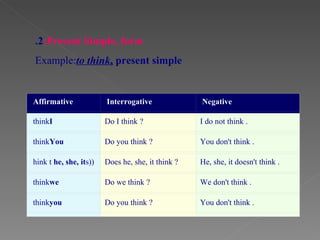
2.  Present Simple, form: Example:  to think ,  present simple Affirmative  Interrogative  Negative  think  I ? Do I think . I do not think think  You ? Do you think . You don't think (s) hink t  he, she, it   ? Does he, she, it think . He, she, it doesn't think think  we ? Do we think . We don't think think  you ? Do you think . You don't think
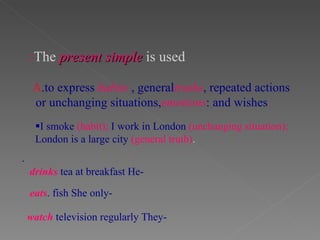
The   present simple   is used : A .to express   habits , general  truths , repeated actions or unchanging situations,  emotions  and wishes:  I smoke  (habit);  I work in London  (unchanging situation);  London is a large city  (general truth) . . -He  drinks  tea at breakfast -She only  eats  fish. -They  watch  television regularly
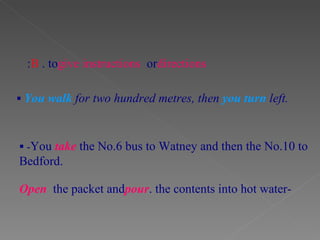
   You walk  for two hundred metres, then  you turn  left. B . to  give instructions  or  directions :    - You  take  the No.6 bus to Watney and then the No.10 to Bedford. - Open  the packet and  pour  the contents into hot water.
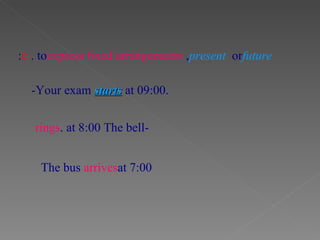
-Your exam  starts  at 09:00. c . to  express fixed arrangements ,  present  or  future : -The bell  rings  at 8:00. The bus  arrives  at 7:00
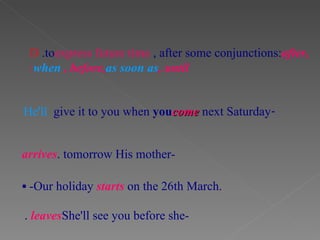
D .to  express future time , after some conjunctions:  after,  when , before,  as soon as , until : - He'll  give it to you when  you  come  next Saturday   -His mother  arrives  tomorrow.    -Our holiday  starts   on the 26th March. -She'll see you before she   leaves .
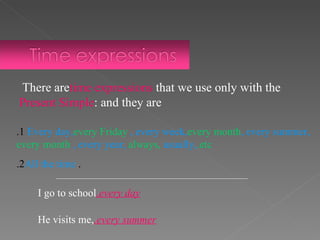
1. Every day,  every Friday , every week,  every month , every summer,  every month , every year,  always,  usually,  etc. .   2. All the time There are  time expressions  that we use only with the  Present Simple  and they are: I go to school  every day. He visits me,  every summer.

Powerpoint Present Simple

  • 1.
  • 2.
    USE 1: Repeated Actions     USE 2: Facts or Generalizations     
  • 3.
    Use the Present Simple to express the idea that an action is repeated or usual . The action can be a habit, a hobby, a daily event, a scheduled event or something that often happens. It can also be something a person often forgets or usually does not do. USE 1: Repeated Actions    
  • 4.
    - I tennis. - She play tennis. - The train every morning at 8 am. - The train leave at 9am. Subject + (Verb ) + (s, es) + Object play does not leaves does not
  • 5.
    The PresentSimple can also indicate the speaker believes that a fact was true before, is true now, and will be true in the future. It is not important if the speaker is correct about the fact . It is also used to make generalizations about people or things.
  • 6.
    - Cats milk. - Birds like milk. - Windows made of glass. - Windows made of wood. Subject + ( Verb ) + ( s, es ) + Object like do not are are not .
  • 7.
    Present Simple, thirdperson singular Note: he, she, it in the third person singular the verb, always ends in : s he want s she need s A :
  • 8.
    Add es toverbs ending in: ss x sh ch he pa ss she cat ch he fi x it pu sh B . o es es es es He g o es
  • 9.
    Verbs ending iny ;the third person changes the to ies fly fl cry C: y ies cr ies Exception : If there is a vowel before the : y s pray play play pray s
  • 10.
       Negativeand question forms use DOES (=the third person of the auxiliary ' DO ' ) + the infinitive of the verb. He want s . Does he want? He does not want.
  • 11.
    . 1.Thirdperson singular with s or es a. He goes to school every morning. b. She understands English. c. It mixes the sand and the water. d. He tries very hard. e. She enjoys playing the piano. Examples:
  • 12.
    2. PresentSimple, form: Example: to think , present simple Affirmative Interrogative Negative think I ? Do I think . I do not think think You ? Do you think . You don't think (s) hink t he, she, it ? Does he, she, it think . He, she, it doesn't think think we ? Do we think . We don't think think you ? Do you think . You don't think
  • 13.
    The present simple is used : A .to express habits , general truths , repeated actions or unchanging situations, emotions and wishes:  I smoke (habit); I work in London (unchanging situation); London is a large city (general truth) . . -He drinks tea at breakfast -She only eats fish. -They watch television regularly
  • 14.
       Youwalk for two hundred metres, then you turn left. B . to give instructions or directions :    - You take the No.6 bus to Watney and then the No.10 to Bedford. - Open the packet and pour the contents into hot water.
  • 15.
    -Your exam starts at 09:00. c . to express fixed arrangements , present or future : -The bell rings at 8:00. The bus arrives at 7:00
  • 16.
    D .to express future time , after some conjunctions: after, when , before, as soon as , until : - He'll give it to you when you come next Saturday -His mother arrives tomorrow.    -Our holiday starts on the 26th March. -She'll see you before she leaves .
  • 17.
    1. Every day, every Friday , every week, every month , every summer, every month , every year, always, usually, etc. . 2. All the time There are time expressions that we use only with the Present Simple and they are: I go to school every day. He visits me, every summer.