TDC 1
Pedagogical Grammar
Class 16
Noun Clauses
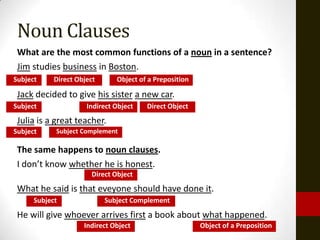
 What are the most common functions of a noun in a sentence?
 Jim studies business in Boston.
Subject     Direct Object      Object of a Preposition

 Jack decided to give his sister a new car.
Subject               Indirect Object   Direct Object
 Julia is a great teacher.
Subject     Subject Complement

 The same happens to noun clauses.
 I don’t know whether he is honest.
                       Direct Object
 What he said is that eveyone should have done it.
      Subject               Subject Complement
 He will give whoever arrives first a book about what happened.
                     Indirect Object                     Object of a Preposition
Noun Clauses
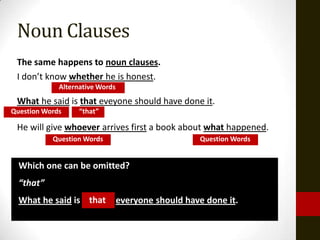
 The same happens to noun clauses.
 I don’t know whether he is honest.
             Alternative Words
 What he said is that eveyone should have done it.
Question Words     “that”

 He will give whoever arrives first a book about what happened.
           Question Words                           Question Words


  Which one can be omitted?
  “that”
  What he said is that           everyone should have done it.
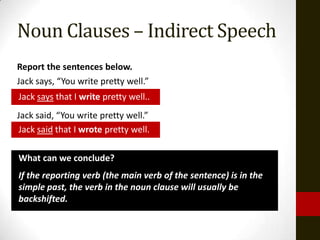
Noun Clauses – Indirect Speech
Report the sentences below.
Jack says, “You write pretty well.”
Jack says that I write pretty well..
Jack said, “You write pretty well.”
Jack said that I wrote pretty well.

What can we conclude?
If the reporting verb (the main verb of the sentence) is in the
simple past, the verb in the noun clause will usually be
backshifted.
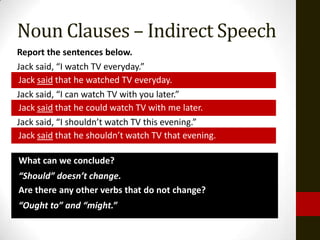
Noun Clauses – Indirect Speech
Report the sentences below.
Jack said, “I watch TV everyday.”
Jack said that he watched TV everyday.
Jack said, “I can watch TV with you later.”
Jack said that he could watch TV with me later.
Jack said, “I shouldn’t watch TV this evening.”
Jack said that he shouldn’t watch TV that evening.

What can we conclude?
“Should” doesn’t change.
Are there any other verbs that do not change?
“Ought to” and “might.”
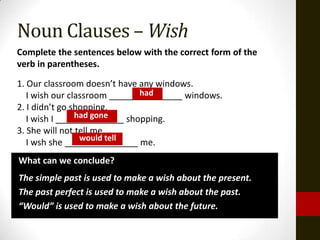
Noun Clauses – Wish
Complete the sentences below with the correct form of the
verb in parentheses.

1. Our classroom doesn’t have any windows.
                              had
   I wish our classroom _______________ windows.
2. I didn’t go shopping.
                had gone
   I wish I ______________ shopping.
3. She will not tell me.
                 would tell
   I wsh she _______________ me.
What can we conclude?
The simple past is used to make a wish about the present.
The past perfect is used to make a wish about the past.
“Would” is used to make a wish about the future.
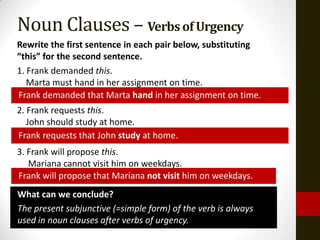
Noun Clauses – Verbs of Urgency
Rewrite the first sentence in each pair below, substituting
“this” for the second sentence.
1. Frank demanded this.
   Marta must hand in her assignment on time.
Frank demanded that Marta hand in her assignment on time.
2. Frank requests this.
   John should study at home.
Frank requests that John study at home.
3. Frank will propose this.
   Mariana cannot visit him on weekdays.
Frank will propose that Mariana not visit him on weekdays.
What can we conclude?
The present subjunctive (=simple form) of the verb is always
used in noun clauses after verbs of urgency.
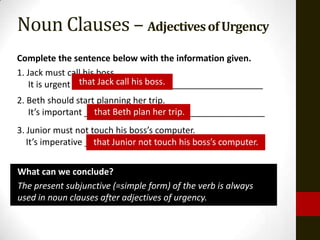
Noun Clauses – Adjectives of Urgency
Complete the sentence below with the information given.
1. Jack must call his boss.
                 that Jack call his boss.
   It is urgent _______________________________________
2. Beth should start planning her trip.
                    that Beth plan her trip.
   It’s important _____________________________________
3. Junior must not touch his boss’s computer.
   It’s imperative _____________________________________
                     that Junior not touch his boss’s computer.


What can we conclude?
The present subjunctive (=simple form) of the verb is always
used in noun clauses after adjectives of urgency.
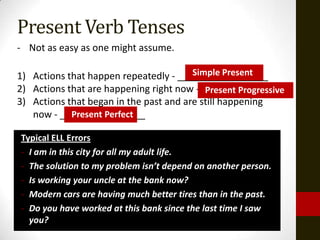
Present Verb Tenses
- Not as easy as one might assume.

                                        Simple Present
1) Actions that happen repeatedly - _________________
2) Actions that are happening right now - _____________
                                           Present Progressive
3) Actions that began in the past and are still happening
   now - ________________
            Present Perfect

Typical ELL Errors
- I am in this city for all my adult life.
- The solution to my problem isn’t depend on another person.
- Is working your uncle at the bank now?
- Modern cars are having much better tires than in the past.
- Do you have worked at this bank since the last time I saw
  you?
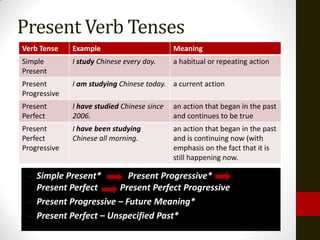
Present Verb Tenses
Verb Tense    Example                        Meaning
Simple        I study Chinese every day.     a habitual or repeating action
Present
Present       I am studying Chinese today. a current action
Progressive
Present       I have studied Chinese since   an action that began in the past
Perfect       2006.                          and continues to be true
Present       I have been studying           an action that began in the past
Perfect       Chinese all morning.           and is continuing now (with
Progressive                                  emphasis on the fact that it is
                                             still happening now.

 - Simple Present*        Present Progressive*
   Present Perfect     Present Perfect Progressive
 - Present Progressive – Future Meaning*
 - Present Perfect – Unspecified Past*
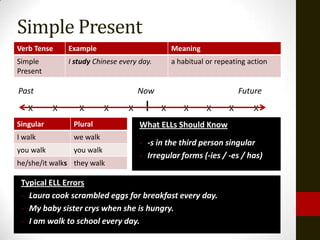
Simple Present
Verb Tense     Example                          Meaning
Simple         I study Chinese every day.       a habitual or repeating action
Present

Past                                 Now                              Future
   X       X      X        X     X     I    X      X       X      X      X
Singular        Plural               What ELLs Should Know
I walk          we walk
                                     - -s in the third person singular
you walk        you walk
                                     - Irregular forms (-ies / -es / has)
he/she/it walks they walk

 Typical ELL Errors
 - Laura cook scrambled eggs for breakfast every day.
 - My baby sister crys when she is hungry.
 - I am walk to school every day.
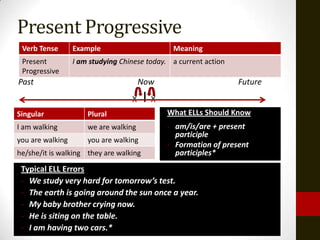
Present Progressive
 Verb Tense       Example                      Meaning
 Present          I am studying Chinese today. a current action
 Progressive
Past                                   Now                        Future
                                   X    IX
Singular              Plural                  What ELLs Should Know
I am walking          we are walking          - am/is/are + present
                                                participle
you are walking       you are walking
                                              - Formation of present
he/she/it is walking they are walking           participles*
 Typical ELL Errors
 - We study very hard for tomorrow’s test.
 - The earth is going around the sun once a year.
 - My baby brother crying now.
 - He is siting on the table.
 - I am having two cars.*
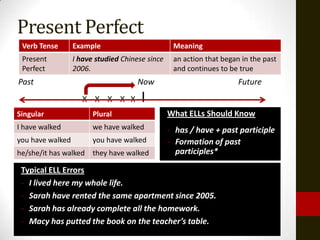
Present Perfect
 Verb Tense       Example                         Meaning
 Present          I have studied Chinese since    an action that began in the past
 Perfect          2006.                           and continues to be true
Past                                  Now                             Future
                    X X X X X          I
Singular                Plural                   What ELLs Should Know
I have walked           we have walked           - has / have + past participle
you have walked         you have walked          - Formation of past
he/she/it has walked they have walked              participles*

 Typical ELL Errors
 - I lived here my whole life.
 - Sarah have rented the same apartment since 2005.
 - Sarah has already complete all the homework.
 - Macy has putted the book on the teacher’s table.
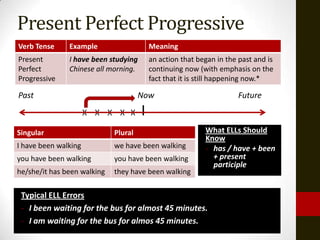
Present Perfect Progressive
Verb Tense     Example                    Meaning
Present        I have been studying       an action that began in the past and is
Perfect        Chinese all morning.       continuing now (with emphasis on the
Progressive                               fact that it is still happening now.*

Past                                  Now                             Future
                      X X X X X       I
Singular                     Plural                        What ELLs Should
                                                           Know
I have been walking          we have been walking          - has / have + been
you have been walking        you have been walking           + present
                                                             participle
he/she/it has been walking   they have been walking

 Typical ELL Errors
 - I been waiting for the bus for almost 45 minutes.
 - I am waiting for the bus for almos 45 minutes.
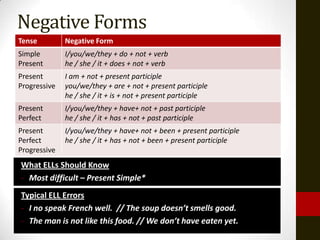
Negative Forms
Tense         Negative Form
Simple        I/you/we/they + do + not + verb
Present       he / she / it + does + not + verb
Present       I am + not + present participle
Progressive   you/we/they + are + not + present participle
              he / she / it + is + not + present participle
Present       I/you/we/they + have+ not + past participle
Perfect       he / she / it + has + not + past participle
Present       I/you/we/they + have+ not + been + present participle
Perfect       he / she / it + has + not + been + present participle
Progressive
What ELLs Should Know
- Most difficult – Present Simple*
Typical ELL Errors
- I no speak French well. // The soup doesn’t smells good.
- The man is not like this food. // We don’t have eaten yet.
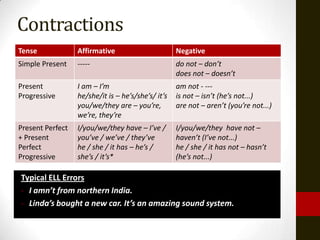
Contractions
Tense             Affirmative                       Negative
Simple Present    -----                             do not – don’t
                                                    does not – doesn’t
Present           I am – I’m                        am not - ---
Progressive       he/she/it is – he’s/she’s/ it’s   is not – isn’t (he’s not...)
                  you/we/they are – you’re,         are not – aren’t (you’re not...)
                  we’re, they’re
Present Perfect   I/you/we/they have – I’ve /       I/you/we/they have not –
+ Present         you’ve / we’ve / they’ve          haven’t (I’ve not...)
Perfect           he / she / it has – he’s /        he / she / it has not – hasn’t
Progressive       she’s / it’s*                     (he’s not...)

Typical ELL Errors
- I amn’t from northern India.
- Linda’s bought a new car. It’s an amazing sound system.
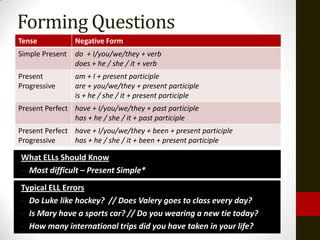
Forming Questions
Tense            Negative Form
Simple Present   do + I/you/we/they + verb
                 does + he / she / it + verb
Present          am + I + present participle
Progressive      are + you/we/they + present participle
                 is + he / she / it + present participle
Present Perfect have + I/you/we/they + past participle
                has + he / she / it + past participle
Present Perfect have + I/you/we/they + been + present participle
Progressive     has + he / she / it + been + present participle

What ELLs Should Know
- Most difficult – Present Simple*
Typical ELL Errors
- Do Luke like hockey? // Does Valery goes to class every day?
- Is Mary have a sports car? // Do you wearing a new tie today?
- How many international trips did you have taken in your life?
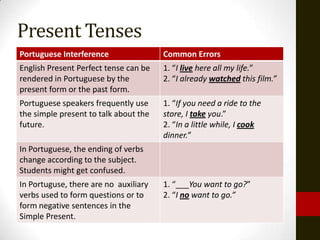
Present Tenses
Portuguese Interference                Common Errors
English Present Perfect tense can be   1. “I live here all my life.”
rendered in Portuguese by the          2. “I already watched this film.”
present form or the past form.
Portuguese speakers frequently use     1. “If you need a ride to the
the simple present to talk about the   store, I take you.”
future.                                2. “In a little while, I cook
                                       dinner.”
In Portuguese, the ending of verbs
change according to the subject.
Students might get confused.
In Portuguse, there are no auxiliary   1. “___You want to go?”
verbs used to form questions or to     2. “I no want to go.”
form negative sentences in the
Simple Present.
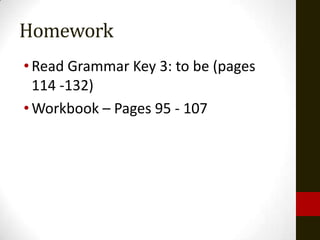
Homework
• Read Grammar Key 3: to be (pages
  114 -132)
• Workbook – Pages 95 - 107

TDC 1 - Class 16

  • 1.
  • 2.
    Noun Clauses Whatare the most common functions of a noun in a sentence? Jim studies business in Boston. Subject Direct Object Object of a Preposition Jack decided to give his sister a new car. Subject Indirect Object Direct Object Julia is a great teacher. Subject Subject Complement The same happens to noun clauses. I don’t know whether he is honest. Direct Object What he said is that eveyone should have done it. Subject Subject Complement He will give whoever arrives first a book about what happened. Indirect Object Object of a Preposition
  • 3.
    Noun Clauses Thesame happens to noun clauses. I don’t know whether he is honest. Alternative Words What he said is that eveyone should have done it. Question Words “that” He will give whoever arrives first a book about what happened. Question Words Question Words Which one can be omitted? “that” What he said is that everyone should have done it.
  • 4.
    Noun Clauses –Indirect Speech Report the sentences below. Jack says, “You write pretty well.” Jack says that I write pretty well.. Jack said, “You write pretty well.” Jack said that I wrote pretty well. What can we conclude? If the reporting verb (the main verb of the sentence) is in the simple past, the verb in the noun clause will usually be backshifted.
  • 5.
    Noun Clauses –Indirect Speech Report the sentences below. Jack said, “I watch TV everyday.” Jack said that he watched TV everyday. Jack said, “I can watch TV with you later.” Jack said that he could watch TV with me later. Jack said, “I shouldn’t watch TV this evening.” Jack said that he shouldn’t watch TV that evening. What can we conclude? “Should” doesn’t change. Are there any other verbs that do not change? “Ought to” and “might.”
  • 6.
    Noun Clauses –Wish Complete the sentences below with the correct form of the verb in parentheses. 1. Our classroom doesn’t have any windows. had I wish our classroom _______________ windows. 2. I didn’t go shopping. had gone I wish I ______________ shopping. 3. She will not tell me. would tell I wsh she _______________ me. What can we conclude? The simple past is used to make a wish about the present. The past perfect is used to make a wish about the past. “Would” is used to make a wish about the future.
  • 7.
    Noun Clauses –Verbs of Urgency Rewrite the first sentence in each pair below, substituting “this” for the second sentence. 1. Frank demanded this. Marta must hand in her assignment on time. Frank demanded that Marta hand in her assignment on time. 2. Frank requests this. John should study at home. Frank requests that John study at home. 3. Frank will propose this. Mariana cannot visit him on weekdays. Frank will propose that Mariana not visit him on weekdays. What can we conclude? The present subjunctive (=simple form) of the verb is always used in noun clauses after verbs of urgency.
  • 8.
    Noun Clauses –Adjectives of Urgency Complete the sentence below with the information given. 1. Jack must call his boss. that Jack call his boss. It is urgent _______________________________________ 2. Beth should start planning her trip. that Beth plan her trip. It’s important _____________________________________ 3. Junior must not touch his boss’s computer. It’s imperative _____________________________________ that Junior not touch his boss’s computer. What can we conclude? The present subjunctive (=simple form) of the verb is always used in noun clauses after adjectives of urgency.
  • 9.
    Present Verb Tenses -Not as easy as one might assume. Simple Present 1) Actions that happen repeatedly - _________________ 2) Actions that are happening right now - _____________ Present Progressive 3) Actions that began in the past and are still happening now - ________________ Present Perfect Typical ELL Errors - I am in this city for all my adult life. - The solution to my problem isn’t depend on another person. - Is working your uncle at the bank now? - Modern cars are having much better tires than in the past. - Do you have worked at this bank since the last time I saw you?
  • 10.
    Present Verb Tenses VerbTense Example Meaning Simple I study Chinese every day. a habitual or repeating action Present Present I am studying Chinese today. a current action Progressive Present I have studied Chinese since an action that began in the past Perfect 2006. and continues to be true Present I have been studying an action that began in the past Perfect Chinese all morning. and is continuing now (with Progressive emphasis on the fact that it is still happening now. - Simple Present* Present Progressive* Present Perfect Present Perfect Progressive - Present Progressive – Future Meaning* - Present Perfect – Unspecified Past*
  • 11.
    Simple Present Verb Tense Example Meaning Simple I study Chinese every day. a habitual or repeating action Present Past Now Future X X X X X I X X X X X Singular Plural What ELLs Should Know I walk we walk - -s in the third person singular you walk you walk - Irregular forms (-ies / -es / has) he/she/it walks they walk Typical ELL Errors - Laura cook scrambled eggs for breakfast every day. - My baby sister crys when she is hungry. - I am walk to school every day.
  • 12.
    Present Progressive VerbTense Example Meaning Present I am studying Chinese today. a current action Progressive Past Now Future X IX Singular Plural What ELLs Should Know I am walking we are walking - am/is/are + present participle you are walking you are walking - Formation of present he/she/it is walking they are walking participles* Typical ELL Errors - We study very hard for tomorrow’s test. - The earth is going around the sun once a year. - My baby brother crying now. - He is siting on the table. - I am having two cars.*
  • 13.
    Present Perfect VerbTense Example Meaning Present I have studied Chinese since an action that began in the past Perfect 2006. and continues to be true Past Now Future X X X X X I Singular Plural What ELLs Should Know I have walked we have walked - has / have + past participle you have walked you have walked - Formation of past he/she/it has walked they have walked participles* Typical ELL Errors - I lived here my whole life. - Sarah have rented the same apartment since 2005. - Sarah has already complete all the homework. - Macy has putted the book on the teacher’s table.
  • 14.
    Present Perfect Progressive VerbTense Example Meaning Present I have been studying an action that began in the past and is Perfect Chinese all morning. continuing now (with emphasis on the Progressive fact that it is still happening now.* Past Now Future X X X X X I Singular Plural What ELLs Should Know I have been walking we have been walking - has / have + been you have been walking you have been walking + present participle he/she/it has been walking they have been walking Typical ELL Errors - I been waiting for the bus for almost 45 minutes. - I am waiting for the bus for almos 45 minutes.
  • 15.
    Negative Forms Tense Negative Form Simple I/you/we/they + do + not + verb Present he / she / it + does + not + verb Present I am + not + present participle Progressive you/we/they + are + not + present participle he / she / it + is + not + present participle Present I/you/we/they + have+ not + past participle Perfect he / she / it + has + not + past participle Present I/you/we/they + have+ not + been + present participle Perfect he / she / it + has + not + been + present participle Progressive What ELLs Should Know - Most difficult – Present Simple* Typical ELL Errors - I no speak French well. // The soup doesn’t smells good. - The man is not like this food. // We don’t have eaten yet.
  • 16.
    Contractions Tense Affirmative Negative Simple Present ----- do not – don’t does not – doesn’t Present I am – I’m am not - --- Progressive he/she/it is – he’s/she’s/ it’s is not – isn’t (he’s not...) you/we/they are – you’re, are not – aren’t (you’re not...) we’re, they’re Present Perfect I/you/we/they have – I’ve / I/you/we/they have not – + Present you’ve / we’ve / they’ve haven’t (I’ve not...) Perfect he / she / it has – he’s / he / she / it has not – hasn’t Progressive she’s / it’s* (he’s not...) Typical ELL Errors - I amn’t from northern India. - Linda’s bought a new car. It’s an amazing sound system.
  • 17.
    Forming Questions Tense Negative Form Simple Present do + I/you/we/they + verb does + he / she / it + verb Present am + I + present participle Progressive are + you/we/they + present participle is + he / she / it + present participle Present Perfect have + I/you/we/they + past participle has + he / she / it + past participle Present Perfect have + I/you/we/they + been + present participle Progressive has + he / she / it + been + present participle What ELLs Should Know - Most difficult – Present Simple* Typical ELL Errors - Do Luke like hockey? // Does Valery goes to class every day? - Is Mary have a sports car? // Do you wearing a new tie today? - How many international trips did you have taken in your life?
  • 18.
    Present Tenses Portuguese Interference Common Errors English Present Perfect tense can be 1. “I live here all my life.” rendered in Portuguese by the 2. “I already watched this film.” present form or the past form. Portuguese speakers frequently use 1. “If you need a ride to the the simple present to talk about the store, I take you.” future. 2. “In a little while, I cook dinner.” In Portuguese, the ending of verbs change according to the subject. Students might get confused. In Portuguse, there are no auxiliary 1. “___You want to go?” verbs used to form questions or to 2. “I no want to go.” form negative sentences in the Simple Present.
  • 19.
    Homework • Read GrammarKey 3: to be (pages 114 -132) • Workbook – Pages 95 - 107