ONLINE COURSE: “IMPROVING GRAMMAR FOR TOEFL 
TEST” 
UNIT ONE: VERB TENSES
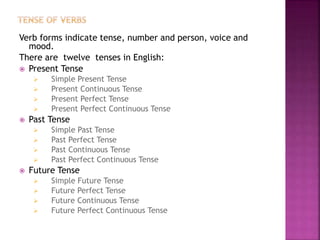
Verb forms indicate tense, number and person, voice and 
mood. 
There are twelve tenses in English: 
 Present Tense 
 Simple Present Tense 
 Present Continuous Tense 
 Present Perfect Tense 
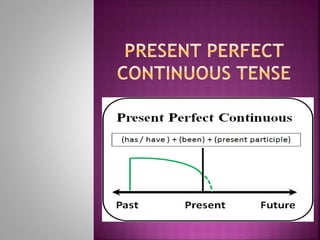
 Present Perfect Continuous Tense 
 Past Tense 
 Simple Past Tense 
 Past Perfect Tense 
 Past Continuous Tense 
 Past Perfect Continuous Tense 
 Future Tense 
 Simple Future Tense 
 Future Perfect Tense 
 Future Continuous Tense 
 Future Perfect Continuous Tense
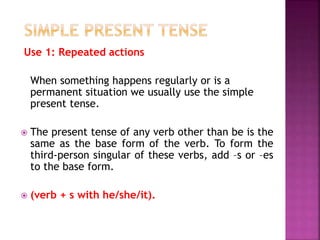
Use 1: Repeated actions 
When something happens regularly or is a 
permanent situation we usually use the simple 
present tense. 
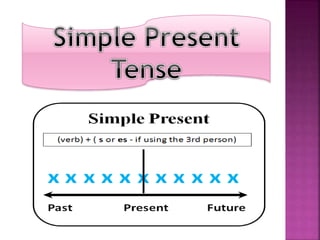
 The present tense of any verb other than be is the 
same as the base form of the verb. To form the 
third-person singular of these verbs, add –s or –es 
to the base form. 
 (verb + s with he/she/it).
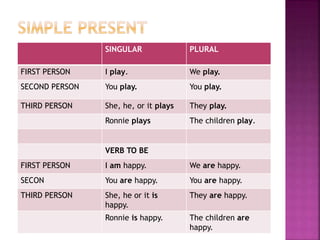
SINGULAR PLURAL 
FIRST PERSON I play. We play. 
SECOND PERSON You play. You play. 
THIRD PERSON She, he, or it plays They play. 
Ronnie plays The children play. 
VERB TO BE 
FIRST PERSON I am happy. We are happy. 
SECON You are happy. You are happy. 
THIRD PERSON She, he or it is 
happy. 
They are happy. 
Ronnie is happy. The children are 
happy.
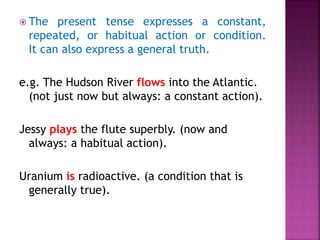
 The present tense expresses a constant, 
repeated, or habitual action or condition. 
It can also express a general truth. 
e.g. The Hudson River flows into the Atlantic. 
(not just now but always: a constant action). 
Jessy plays the flute superbly. (now and 
always: a habitual action). 
Uranium is radioactive. (a condition that is 
generally true).
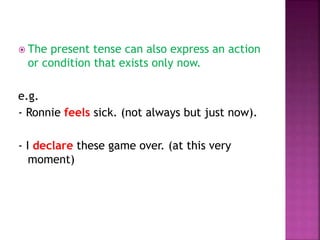
 The present tense can also express an action 
or condition that exists only now. 
e.g. 
- Ronnie feels sick. (not always but just now). 
- I declare these game over. (at this very 
moment)
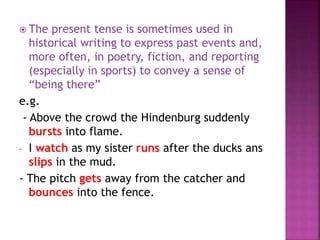
 The present tense is sometimes used in 
historical writing to express past events and, 
more often, in poetry, fiction, and reporting 
(especially in sports) to convey a sense of 
“being there” 
e.g. 
- Above the crowd the Hindenburg suddenly 
bursts into flame. 
- I watch as my sister runs after the ducks ans 
slips in the mud. 
- The pitch gets away from the catcher and 
bounces into the fence.
Use 2: Facts or Generalization. 
 The Simple Present can also indicate the 
speaker believes that a fact was true before, is 
true now, and will be true in the future. It is 
not important if the speaker is correct about 
the fact. It is also used to make generalizations 
about people or things. 
 Examples: 
 Cats like milk. 
 Birds do not like milk. 
 Do pigs like milk? 
 California is in America. 
 California is not in the United Kingdom.
 USE 3 Scheduled Events in the Near Future 
Speakers occasionally use Simple Present to talk 
about scheduled events in the near future. This 
is most commonly done when talking about 
public transportation, but it can be used with 
other scheduled events as well. 
 Examples: 
 The train leaves tonight at 6 PM. 
 The bus does not arrive at 11 AM, it arrives at 
11 PM. 
 When do we board the plane?
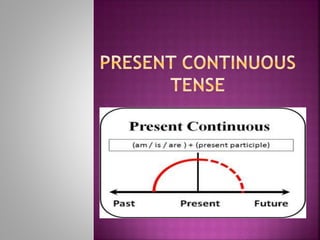
 Continuous tenses are also 
called progressive tenses. So the present 
progressive tense is the same as the present 
continuous tense. 
 subject+ auxiliary verb+ main verb be base + 
ing 
 [am/is/are + present participle]
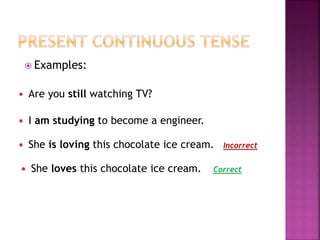
 Examples: 
 Are you still watching TV? 
 I am studying to become a engineer. 
 She is loving this chocolate ice cream. 
 She loves this chocolate ice cream. 
Incorrect 
Correct
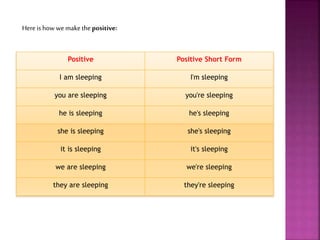
Here is how we make the positive: 
Positive Positive Short Form 
I am sleeping I'm sleeping 
you are sleeping you're sleeping 
he is sleeping he's sleeping 
she is sleeping she's sleeping 
it is sleeping it's sleeping 
we are sleeping we're sleeping 
they are sleeping they're sleeping
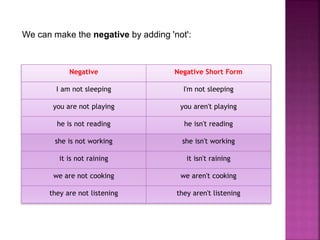
We can make the negative by adding 'not': 
Negative Negative Short Form 
I am not sleeping I'm not sleeping 
you are not playing you aren't playing 
he is not reading he isn't reading 
she is not working she isn't working 
it is not raining it isn't raining 
we are not cooking we aren't cooking 
they are not listening they aren't listening
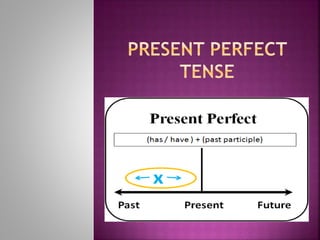
 The English Present Perfect tense is used to 
express actions which have already been 
completed, or perfected, at the time of 
speaking or writing. 
 Form: 
[ has/have + past participle of the verb ]
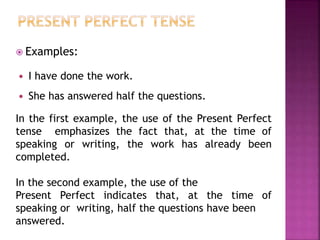
 Examples: 
 I have done the work. 
 She has answered half the questions. 
In the first example, the use of the Present Perfect 
tense emphasizes the fact that, at the time of 
speaking or writing, the work has already been 
completed. 
In the second example, the use of the 
Present Perfect indicates that, at the time of 
speaking or writing, half the questions have been 
answered.
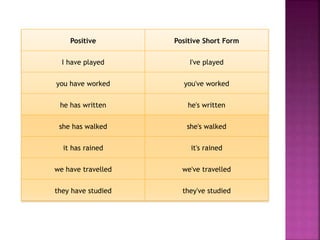
Positive Positive Short Form 
I have played I've played 
you have worked you've worked 
he has written he's written 
she has walked she's walked 
it has rained it's rained 
we have travelled we've travelled 
they have studied they've studied
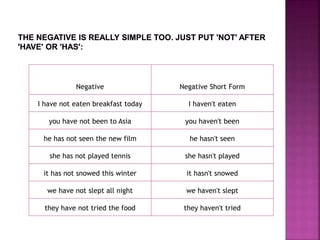
Negative Negative Short Form 
I have not eaten breakfast today I haven't eaten 
you have not been to Asia you haven't been 
he has not seen the new film he hasn't seen 
she has not played tennis she hasn't played 
it has not snowed this winter it hasn't snowed 
we have not slept all night we haven't slept 
they have not tried the food they haven't tried
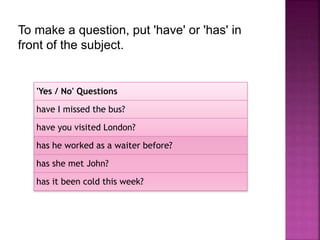
To make a question, put 'have' or 'has' in 
front of the subject. 
'Yes / No' Questions 
have I missed the bus? 
have you visited London? 
has he worked as a waiter before? 
has she met John? 
has it been cold this week?
 Present perfect continuous tense is used for 
an action which began at some time in past 
and is still continuing. 
 Syntax: 
Has/have + been + Present participle
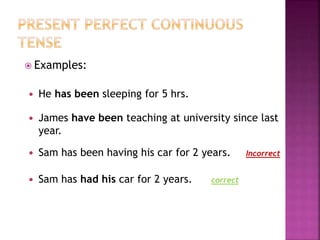
 Examples: 
 He has been sleeping for 5 hrs. 
 James have been teaching at university since last 
year. 
 Sam has been having his car for 2 years. 
 Sam has had his car for 2 years. 
Incorrect 
correct
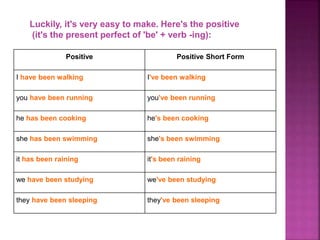
Luckily, it's very easy to make. Here's the positive 
(it's the present perfect of 'be' + verb -ing): 
Positive Positive Short Form 
I have been walking I've been walking 
you have been running you've been running 
he has been cooking he's been cooking 
she has been swimming she's been swimming 
it has been raining it's been raining 
we have been studying we've been studying 
they have been sleeping they've been sleeping
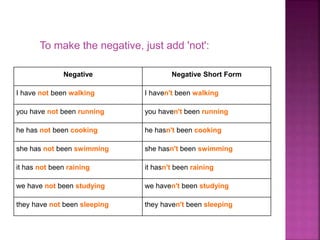
To make the negative, just add 'not': 
Negative Negative Short Form 
I have not been walking I haven't been walking 
you have not been running you haven't been running 
he has not been cooking he hasn't been cooking 
she has not been swimming she hasn't been swimming 
it has not been raining it hasn't been raining 
we have not been studying we haven't been studying 
they have not been sleeping they haven't been sleeping
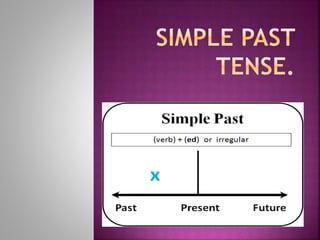
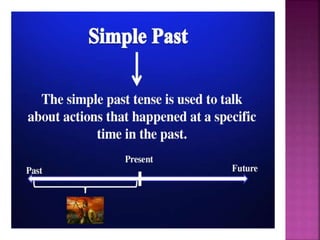
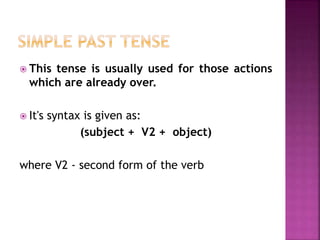
 This tense is usually used for those actions 
which are already over. 
 It's syntax is given as: 
(subject + V2 + object) 
where V2 - second form of the verb
 Examples: 
 She lived in Tokyo for seven years. 
 They were in London from Monday to Thursday of 
last week. 
 I went to all the art exhibitions I could.
Use 1: Completed action in the past. 
Use the Simple Past to express the idea that an 
action started and finished at a specific time in the 
past. Sometimes, the speaker may not actually 
mention the specific time, but they do have one 
specific time in mind. 
Examples: 
I saw a movie yesterday. 
I didn't see a play yesterday. 
Last year, I traveled to Japan. 
Did you have dinner last night? 
She washed her car.
Use 2: A series of completed actions. 
We use the Simple Past to list a series of 
completed actions in the past. These actions 
happen 1st, 2nd, 3rd, 4th, and so on. 
Examples: 
I finished work, walked to the beach, 
and found a nice place to swim. 
He arrived from the airport at 8:00, checked into 
the hotel at 9:00, and met the others at 10:00. 
Did you add flour, pour in the milk, and 
then add the eggs?
Use 3: Duration in past. 
The Simple Past can be used with a duration which 
starts and stops in the past. A duration is a longer 
action often indicated by expressions such as: for 
two years, for five minutes, all day, all year, etc. 
Examples: 
I lived in Brazil for two years. 
Shauna studied Japanese for five years. 
They sat at the beach all day. 
They did not stay at the party the entire time.
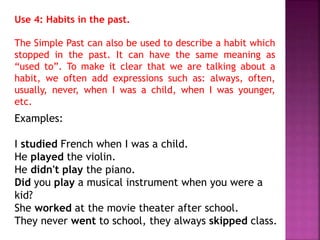
Use 4: Habits in the past. 
The Simple Past can also be used to describe a habit which 
stopped in the past. It can have the same meaning as 
“used to”. To make it clear that we are talking about a 
habit, we often add expressions such as: always, often, 
usually, never, when I was a child, when I was younger, 
etc. 
Examples: 
I studied French when I was a child. 
He played the violin. 
He didn't play the piano. 
Did you play a musical instrument when you were a 
kid? 
She worked at the movie theater after school. 
They never went to school, they always skipped class.
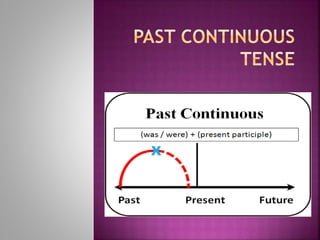
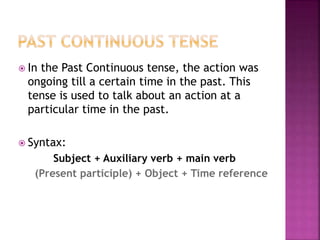
 In the Past Continuous tense, the action was 
ongoing till a certain time in the past. This 
tense is used to talk about an action at a 
particular time in the past. 
 Syntax: 
Subject + Auxiliary verb + main verb 
(Present participle) + Object + Time reference
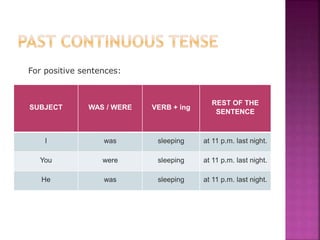
For positive sentences: 
SUBJECT WAS / WERE VERB + ing 
REST OF THE 
SENTENCE 
I was sleeping at 11 p.m. last night. 
You were sleeping at 11 p.m. last night. 
He was sleeping at 11 p.m. last night.
 Examples: 
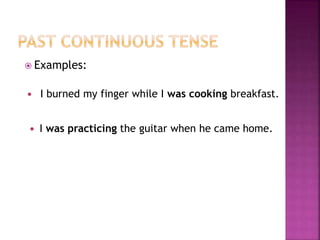
 I burned my finger while I was cooking breakfast. 
 I was practicing the guitar when he came home.
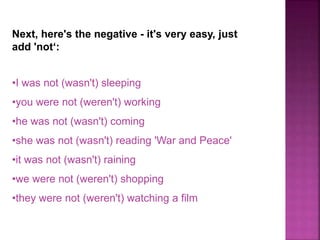
Next, here's the negative - it's very easy, just 
add 'not‘: 
•I was not (wasn't) sleeping 
•you were not (weren't) working 
•he was not (wasn't) coming 
•she was not (wasn't) reading 'War and Peace' 
•it was not (wasn't) raining 
•we were not (weren't) shopping 
•they were not (weren't) watching a film
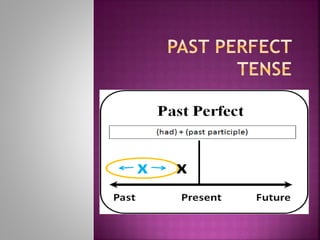
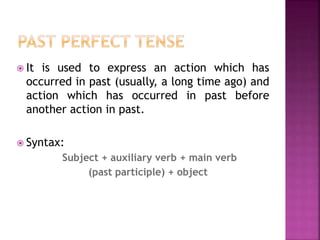
 It is used to express an action which has 
occurred in past (usually, a long time ago) and 
action which has occurred in past before 
another action in past. 
 Syntax: 
Subject + auxiliary verb + main verb 
(past participle) + object
 Examples: 
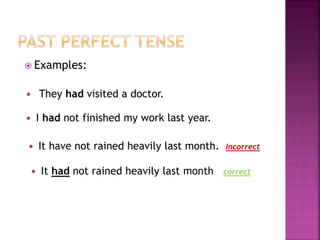
 They had visited a doctor. 
 I had not finished my work last year. 
 It have not rained heavily last month. 
 It had not rained heavily last month 
Incorrect 
correct
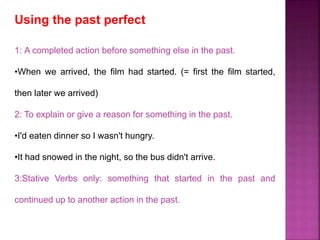
Using the past perfect 
1: A completed action before something else in the past. 
•When we arrived, the film had started. (= first the film started, 
then later we arrived) 
2: To explain or give a reason for something in the past. 
•I'd eaten dinner so I wasn't hungry. 
•It had snowed in the night, so the bus didn't arrive. 
3:Stative Verbs only: something that started in the past and 
continued up to another action in the past.
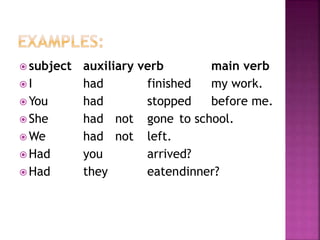
subject auxiliary verb main verb 
 I had finished my work. 
You had stopped before me. 
She had not gone to school. 
We had not left. 
Had you arrived? 
Had they eatendinner?
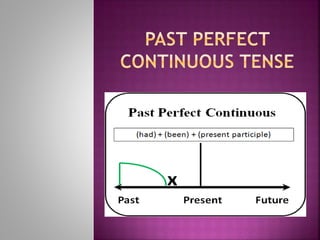
 It is used to express a continued or ongoing 
action in past, an ongoing action which 
occurred in past and completed at some point 
in past. 
 Syntax: 
Auxiliary verb + Subject + Main verb 
(present participle) + object
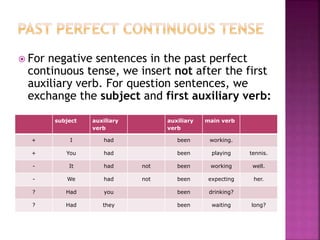
 For negative sentences in the past perfect 
continuous tense, we insert not after the first 
auxiliary verb. For question sentences, we 
exchange the subject and first auxiliary verb: 
subject auxiliary 
verb 
auxiliary 
verb 
main verb 
+ I had been working. 
+ You had been playing tennis. 
- It had not been working well. 
- We had not been expecting her. 
? Had you been drinking? 
? Had they been waiting long?
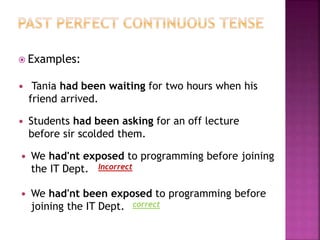
 Examples: 
 Tania had been waiting for two hours when his 
friend arrived. 
 Students had been asking for an off lecture 
before sir scolded them. 
 We had'nt exposed to programming before joining 
the IT Dept. 
Incorrect 
 We had'nt been exposed to programming before 
joining the IT Dept. 
correct
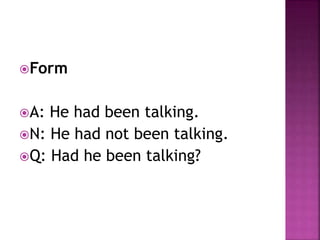
Form 
A: He had been talking. 
N: He had not been talking. 
Q: Had he been talking?
Action taking place before a 
certain time in the past. 
Sometimes interchangeable with 
past perfect simple. 
Puts emphasis on the course or 
duration of an action.
I had been working. 
You had beenplaying tennis. 
It had not been working well.
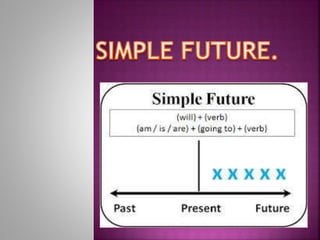
 It is used to express an action which has not 
occurred yet and will occur after saying or in 
future. 
 Syntax: 
Subject + auxiliary verb + main verb (present 
participle) + object
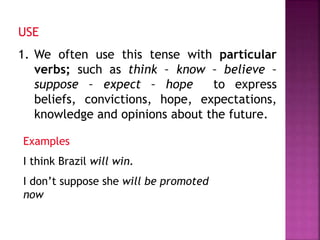
USE 
1. We often use this tense with particular 
verbs; such as think – know – believe – 
suppose – expect – hope to express 
beliefs, convictions, hope, expectations, 
knowledge and opinions about the future. 
Examples 
I think Brazil will win. 
I don’t suppose she will be promoted 
now
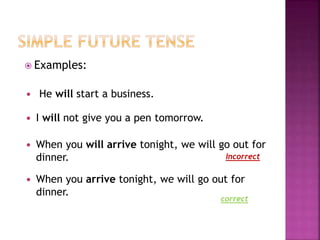
 Examples: 
 He will start a business. 
 I will not give you a pen tomorrow. 
 When you will arrive tonight, we will go out for 
dinner. 
Incorrect 
 When you arrive tonight, we will go out for 
dinner. 
correct
 The auxiliary verb going to is used in talking 
about intentions. (An intention is a plan for the 
future that you have already thought about.) 
 We're going to buy a new car next month. 
 I'm going to work in a bank when I leave school. 
 In the new year I'm going to stop eating so much 
junk. 
 He's not going to go to the dance. He's got too 
much work. 
 I'm not going to watch TV until my science 
project is finished.
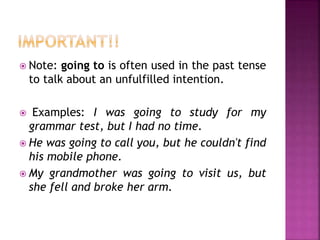
 Note: going to is often used in the past tense 
to talk about an unfulfilled intention. 
 Examples: I was going to study for my 
grammar test, but I had no time. 
 He was going to call you, but he couldn't find 
his mobile phone. 
 My grandmother was going to visit us, but 
she fell and broke her arm.
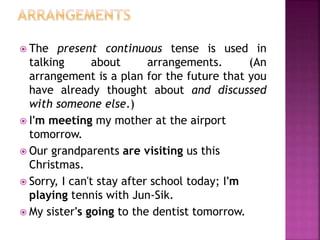
 The present continuous tense is used in 
talking about arrangements. (An 
arrangement is a plan for the future that you 
have already thought about and discussed 
with someone else.) 
 I'm meeting my mother at the airport 
tomorrow. 
 Our grandparents are visiting us this 
Christmas. 
 Sorry, I can't stay after school today; I'm 
playing tennis with Jun-Sik. 
 My sister's going to the dentist tomorrow.
Scheduled events 
The present simple tense is usually used to refer 
to future events that are scheduled (and outside 
of our control). 
Exercise: 
Hurry up! The train departs in 10 minutes. 
I leave Frankfurt at 5 o'clock in the morning 
and arrive in New York at midnight the next day. 
She has an appointment with the headmaster 
after school today. 
There's no need to hurry. The train doesn't 
leave for another 30 minutes.
 It is used to express a continued or an ongoing 
action in future. 
 Syntax: 
Subject + auxiliary verb + main verb 
(present participle) + object
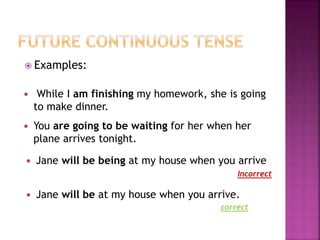
 Examples: 
 While I am finishing my homework, she is going 
to make dinner. 
 You are going to be waiting for her when her 
plane arrives tonight. 
 Jane will be being at my house when you arrive 
Incorrect 
 Jane will be at my house when you arrive. 
correct
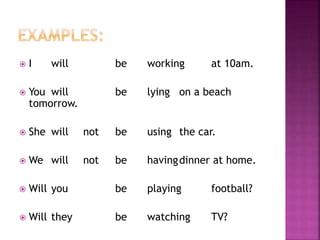
 I will be working at 10am. 
 You will be lying on a beach 
tomorrow. 
 She will not be using the car. 
 We will not be havingdinner at home. 
 Will you be playing football? 
 Will they be watching TV?
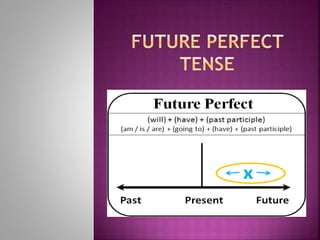
 It is used to express an action which will occur 
in future and is thought to be completed in 
future. 
 Syntax: 
Subject + auxiliary verb + main verb 
(past participle) + object
Examples: 
 They will have completed the Presentation 
before the deadline. 
 You are going to have perfected your English by 
the time you come back from the U.S.. 
 I am going to see a movie when I will have 
finished my homework. 
Incorrect 
 I am going to see a movie when I have 
finished my homework. 
correct
 I will have finished this book 
 You will have studied the English tenses 
 She will have cooked dinner 
For the short form, we change will to 'll. 
But, when we are speaking, we also make 
'have' shorter, so it sounds like I'll've finished 
(don't write this!).
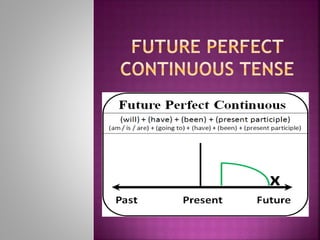
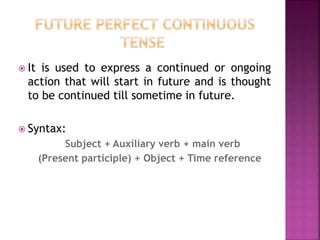
 It is used to express a continued or ongoing 
action that will start in future and is thought 
to be continued till sometime in future. 
 Syntax: 
Subject + Auxiliary verb + main verb 
(Present participle) + Object + Time reference
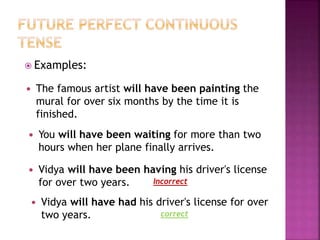
 Examples: 
 The famous artist will have been painting the 
mural for over six months by the time it is 
finished. 
 You will have been waiting for more than two 
hours when her plane finally arrives. 
 Vidya will have been having his driver's license 
for over two years. 
Incorrect 
 Vidya will have had his driver's license for over 
two years. 
correct
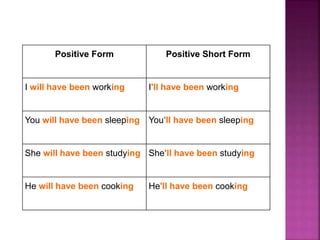
Positive Form Positive Short Form 
I will have been working I'll have been working 
You will have been sleeping You'll have been sleeping 
She will have been studying She'll have been studying 
He will have been cooking He'll have been cooking
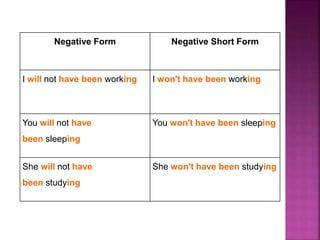
Negative Form Negative Short Form 
I will not have been working I won't have been working 
You will not have 
been sleeping 
You won't have been sleeping 
She will not have 
been studying 
She won't have been studying
Verb tenses

Verb tenses

  • 1.
    ONLINE COURSE: “IMPROVINGGRAMMAR FOR TOEFL TEST” UNIT ONE: VERB TENSES
  • 2.
    Verb forms indicatetense, number and person, voice and mood. There are twelve tenses in English:  Present Tense  Simple Present Tense  Present Continuous Tense  Present Perfect Tense  Present Perfect Continuous Tense  Past Tense  Simple Past Tense  Past Perfect Tense  Past Continuous Tense  Past Perfect Continuous Tense  Future Tense  Simple Future Tense  Future Perfect Tense  Future Continuous Tense  Future Perfect Continuous Tense
  • 4.
    Use 1: Repeatedactions When something happens regularly or is a permanent situation we usually use the simple present tense.  The present tense of any verb other than be is the same as the base form of the verb. To form the third-person singular of these verbs, add –s or –es to the base form.  (verb + s with he/she/it).
  • 5.
    SINGULAR PLURAL FIRSTPERSON I play. We play. SECOND PERSON You play. You play. THIRD PERSON She, he, or it plays They play. Ronnie plays The children play. VERB TO BE FIRST PERSON I am happy. We are happy. SECON You are happy. You are happy. THIRD PERSON She, he or it is happy. They are happy. Ronnie is happy. The children are happy.
  • 6.
     The presenttense expresses a constant, repeated, or habitual action or condition. It can also express a general truth. e.g. The Hudson River flows into the Atlantic. (not just now but always: a constant action). Jessy plays the flute superbly. (now and always: a habitual action). Uranium is radioactive. (a condition that is generally true).
  • 7.
     The presenttense can also express an action or condition that exists only now. e.g. - Ronnie feels sick. (not always but just now). - I declare these game over. (at this very moment)
  • 8.
     The presenttense is sometimes used in historical writing to express past events and, more often, in poetry, fiction, and reporting (especially in sports) to convey a sense of “being there” e.g. - Above the crowd the Hindenburg suddenly bursts into flame. - I watch as my sister runs after the ducks ans slips in the mud. - The pitch gets away from the catcher and bounces into the fence.
  • 9.
    Use 2: Factsor Generalization.  The Simple Present can also indicate the speaker believes that a fact was true before, is true now, and will be true in the future. It is not important if the speaker is correct about the fact. It is also used to make generalizations about people or things.  Examples:  Cats like milk.  Birds do not like milk.  Do pigs like milk?  California is in America.  California is not in the United Kingdom.
  • 10.
     USE 3Scheduled Events in the Near Future Speakers occasionally use Simple Present to talk about scheduled events in the near future. This is most commonly done when talking about public transportation, but it can be used with other scheduled events as well.  Examples:  The train leaves tonight at 6 PM.  The bus does not arrive at 11 AM, it arrives at 11 PM.  When do we board the plane?
  • 12.
     Continuous tensesare also called progressive tenses. So the present progressive tense is the same as the present continuous tense.  subject+ auxiliary verb+ main verb be base + ing  [am/is/are + present participle]
  • 13.
     Examples: Are you still watching TV?  I am studying to become a engineer.  She is loving this chocolate ice cream.  She loves this chocolate ice cream. Incorrect Correct
  • 14.
    Here is howwe make the positive: Positive Positive Short Form I am sleeping I'm sleeping you are sleeping you're sleeping he is sleeping he's sleeping she is sleeping she's sleeping it is sleeping it's sleeping we are sleeping we're sleeping they are sleeping they're sleeping
  • 15.
    We can makethe negative by adding 'not': Negative Negative Short Form I am not sleeping I'm not sleeping you are not playing you aren't playing he is not reading he isn't reading she is not working she isn't working it is not raining it isn't raining we are not cooking we aren't cooking they are not listening they aren't listening
  • 17.
     The EnglishPresent Perfect tense is used to express actions which have already been completed, or perfected, at the time of speaking or writing.  Form: [ has/have + past participle of the verb ]
  • 18.
     Examples: I have done the work.  She has answered half the questions. In the first example, the use of the Present Perfect tense emphasizes the fact that, at the time of speaking or writing, the work has already been completed. In the second example, the use of the Present Perfect indicates that, at the time of speaking or writing, half the questions have been answered.
  • 19.
    Positive Positive ShortForm I have played I've played you have worked you've worked he has written he's written she has walked she's walked it has rained it's rained we have travelled we've travelled they have studied they've studied
  • 20.
    Negative Negative ShortForm I have not eaten breakfast today I haven't eaten you have not been to Asia you haven't been he has not seen the new film he hasn't seen she has not played tennis she hasn't played it has not snowed this winter it hasn't snowed we have not slept all night we haven't slept they have not tried the food they haven't tried
  • 21.
    To make aquestion, put 'have' or 'has' in front of the subject. 'Yes / No' Questions have I missed the bus? have you visited London? has he worked as a waiter before? has she met John? has it been cold this week?
  • 23.
     Present perfectcontinuous tense is used for an action which began at some time in past and is still continuing.  Syntax: Has/have + been + Present participle
  • 24.
     Examples: He has been sleeping for 5 hrs.  James have been teaching at university since last year.  Sam has been having his car for 2 years.  Sam has had his car for 2 years. Incorrect correct
  • 25.
    Luckily, it's veryeasy to make. Here's the positive (it's the present perfect of 'be' + verb -ing): Positive Positive Short Form I have been walking I've been walking you have been running you've been running he has been cooking he's been cooking she has been swimming she's been swimming it has been raining it's been raining we have been studying we've been studying they have been sleeping they've been sleeping
  • 26.
    To make thenegative, just add 'not': Negative Negative Short Form I have not been walking I haven't been walking you have not been running you haven't been running he has not been cooking he hasn't been cooking she has not been swimming she hasn't been swimming it has not been raining it hasn't been raining we have not been studying we haven't been studying they have not been sleeping they haven't been sleeping
  • 29.
     This tenseis usually used for those actions which are already over.  It's syntax is given as: (subject + V2 + object) where V2 - second form of the verb
  • 30.
     Examples: She lived in Tokyo for seven years.  They were in London from Monday to Thursday of last week.  I went to all the art exhibitions I could.
  • 31.
    Use 1: Completedaction in the past. Use the Simple Past to express the idea that an action started and finished at a specific time in the past. Sometimes, the speaker may not actually mention the specific time, but they do have one specific time in mind. Examples: I saw a movie yesterday. I didn't see a play yesterday. Last year, I traveled to Japan. Did you have dinner last night? She washed her car.
  • 32.
    Use 2: Aseries of completed actions. We use the Simple Past to list a series of completed actions in the past. These actions happen 1st, 2nd, 3rd, 4th, and so on. Examples: I finished work, walked to the beach, and found a nice place to swim. He arrived from the airport at 8:00, checked into the hotel at 9:00, and met the others at 10:00. Did you add flour, pour in the milk, and then add the eggs?
  • 33.
    Use 3: Durationin past. The Simple Past can be used with a duration which starts and stops in the past. A duration is a longer action often indicated by expressions such as: for two years, for five minutes, all day, all year, etc. Examples: I lived in Brazil for two years. Shauna studied Japanese for five years. They sat at the beach all day. They did not stay at the party the entire time.
  • 34.
    Use 4: Habitsin the past. The Simple Past can also be used to describe a habit which stopped in the past. It can have the same meaning as “used to”. To make it clear that we are talking about a habit, we often add expressions such as: always, often, usually, never, when I was a child, when I was younger, etc. Examples: I studied French when I was a child. He played the violin. He didn't play the piano. Did you play a musical instrument when you were a kid? She worked at the movie theater after school. They never went to school, they always skipped class.
  • 36.
     In thePast Continuous tense, the action was ongoing till a certain time in the past. This tense is used to talk about an action at a particular time in the past.  Syntax: Subject + Auxiliary verb + main verb (Present participle) + Object + Time reference
  • 37.
    For positive sentences: SUBJECT WAS / WERE VERB + ing REST OF THE SENTENCE I was sleeping at 11 p.m. last night. You were sleeping at 11 p.m. last night. He was sleeping at 11 p.m. last night.
  • 38.
     Examples: I burned my finger while I was cooking breakfast.  I was practicing the guitar when he came home.
  • 39.
    Next, here's thenegative - it's very easy, just add 'not‘: •I was not (wasn't) sleeping •you were not (weren't) working •he was not (wasn't) coming •she was not (wasn't) reading 'War and Peace' •it was not (wasn't) raining •we were not (weren't) shopping •they were not (weren't) watching a film
  • 41.
     It isused to express an action which has occurred in past (usually, a long time ago) and action which has occurred in past before another action in past.  Syntax: Subject + auxiliary verb + main verb (past participle) + object
  • 42.
     Examples: They had visited a doctor.  I had not finished my work last year.  It have not rained heavily last month.  It had not rained heavily last month Incorrect correct
  • 43.
    Using the pastperfect 1: A completed action before something else in the past. •When we arrived, the film had started. (= first the film started, then later we arrived) 2: To explain or give a reason for something in the past. •I'd eaten dinner so I wasn't hungry. •It had snowed in the night, so the bus didn't arrive. 3:Stative Verbs only: something that started in the past and continued up to another action in the past.
  • 44.
    subject auxiliary verbmain verb  I had finished my work. You had stopped before me. She had not gone to school. We had not left. Had you arrived? Had they eatendinner?
  • 46.
     It isused to express a continued or ongoing action in past, an ongoing action which occurred in past and completed at some point in past.  Syntax: Auxiliary verb + Subject + Main verb (present participle) + object
  • 47.
     For negativesentences in the past perfect continuous tense, we insert not after the first auxiliary verb. For question sentences, we exchange the subject and first auxiliary verb: subject auxiliary verb auxiliary verb main verb + I had been working. + You had been playing tennis. - It had not been working well. - We had not been expecting her. ? Had you been drinking? ? Had they been waiting long?
  • 48.
     Examples: Tania had been waiting for two hours when his friend arrived.  Students had been asking for an off lecture before sir scolded them.  We had'nt exposed to programming before joining the IT Dept. Incorrect  We had'nt been exposed to programming before joining the IT Dept. correct
  • 49.
    Form A: Hehad been talking. N: He had not been talking. Q: Had he been talking?
  • 50.
    Action taking placebefore a certain time in the past. Sometimes interchangeable with past perfect simple. Puts emphasis on the course or duration of an action.
  • 51.
    I had beenworking. You had beenplaying tennis. It had not been working well.
  • 53.
     It isused to express an action which has not occurred yet and will occur after saying or in future.  Syntax: Subject + auxiliary verb + main verb (present participle) + object
  • 54.
    USE 1. Weoften use this tense with particular verbs; such as think – know – believe – suppose – expect – hope to express beliefs, convictions, hope, expectations, knowledge and opinions about the future. Examples I think Brazil will win. I don’t suppose she will be promoted now
  • 55.
     Examples: He will start a business.  I will not give you a pen tomorrow.  When you will arrive tonight, we will go out for dinner. Incorrect  When you arrive tonight, we will go out for dinner. correct
  • 56.
     The auxiliaryverb going to is used in talking about intentions. (An intention is a plan for the future that you have already thought about.)  We're going to buy a new car next month.  I'm going to work in a bank when I leave school.  In the new year I'm going to stop eating so much junk.  He's not going to go to the dance. He's got too much work.  I'm not going to watch TV until my science project is finished.
  • 57.
     Note: goingto is often used in the past tense to talk about an unfulfilled intention.  Examples: I was going to study for my grammar test, but I had no time.  He was going to call you, but he couldn't find his mobile phone.  My grandmother was going to visit us, but she fell and broke her arm.
  • 58.
     The presentcontinuous tense is used in talking about arrangements. (An arrangement is a plan for the future that you have already thought about and discussed with someone else.)  I'm meeting my mother at the airport tomorrow.  Our grandparents are visiting us this Christmas.  Sorry, I can't stay after school today; I'm playing tennis with Jun-Sik.  My sister's going to the dentist tomorrow.
  • 59.
    Scheduled events Thepresent simple tense is usually used to refer to future events that are scheduled (and outside of our control). Exercise: Hurry up! The train departs in 10 minutes. I leave Frankfurt at 5 o'clock in the morning and arrive in New York at midnight the next day. She has an appointment with the headmaster after school today. There's no need to hurry. The train doesn't leave for another 30 minutes.
  • 61.
     It isused to express a continued or an ongoing action in future.  Syntax: Subject + auxiliary verb + main verb (present participle) + object
  • 62.
     Examples: While I am finishing my homework, she is going to make dinner.  You are going to be waiting for her when her plane arrives tonight.  Jane will be being at my house when you arrive Incorrect  Jane will be at my house when you arrive. correct
  • 64.
     I willbe working at 10am.  You will be lying on a beach tomorrow.  She will not be using the car.  We will not be havingdinner at home.  Will you be playing football?  Will they be watching TV?
  • 66.
     It isused to express an action which will occur in future and is thought to be completed in future.  Syntax: Subject + auxiliary verb + main verb (past participle) + object
  • 67.
    Examples:  Theywill have completed the Presentation before the deadline.  You are going to have perfected your English by the time you come back from the U.S..  I am going to see a movie when I will have finished my homework. Incorrect  I am going to see a movie when I have finished my homework. correct
  • 68.
     I willhave finished this book  You will have studied the English tenses  She will have cooked dinner For the short form, we change will to 'll. But, when we are speaking, we also make 'have' shorter, so it sounds like I'll've finished (don't write this!).
  • 70.
     It isused to express a continued or ongoing action that will start in future and is thought to be continued till sometime in future.  Syntax: Subject + Auxiliary verb + main verb (Present participle) + Object + Time reference
  • 71.
     Examples: The famous artist will have been painting the mural for over six months by the time it is finished.  You will have been waiting for more than two hours when her plane finally arrives.  Vidya will have been having his driver's license for over two years. Incorrect  Vidya will have had his driver's license for over two years. correct
  • 72.
    Positive Form PositiveShort Form I will have been working I'll have been working You will have been sleeping You'll have been sleeping She will have been studying She'll have been studying He will have been cooking He'll have been cooking
  • 73.
    Negative Form NegativeShort Form I will not have been working I won't have been working You will not have been sleeping You won't have been sleeping She will not have been studying She won't have been studying