Polymer Synthesis
CHEM 421
Odian Book: Chapter 4
Polymer Synthesis
CHEM 421
Emulsion Polymerizations
• Economically important
• Western countries 108
tons/year
• 30% of all polymers made by free radical
methods
–emulsion polymers accounts for 40-50% of
this
• First employed during WWII for
production of synthetic rubber
• Today: MMA, VC, vinylidene chloride,
styrene, fluoropolymers, vinyl acetate,
EVA, SA, SBR, chloroprene, etc
Polymer Synthesis
CHEM 421
Emulsion Polymerization
Recipe
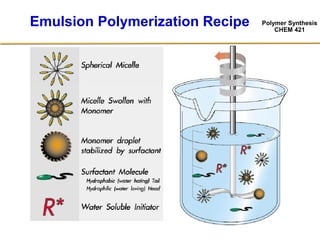
• Water (continuous phase)
• Water-insoluble monomer
• Water-soluble initiator
• Surfactant (detergent)
Polymer Synthesis
CHEM 421
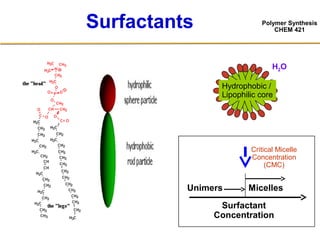
Surfactants
H2O
Hydrophobic /
Lipophilic core
Surfactant
Concentration
Unimers Micelles
Critical Micelle
Concentration
(CMC)
Polymer Synthesis
CHEM 421
Surfactants
Types
- Anionic
- Cationic
- Amphoterics
- Non-ionics
Polymer Synthesis
CHEM 421
Emulsion Polymerization Recipe
Polymer Synthesis
CHEM 421
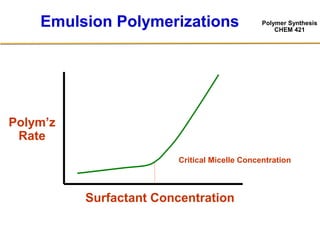
Emulsion Polymerizations
Polym’z
Rate
Surfactant Concentration
Critical Micelle Concentration
Polymer Synthesis
CHEM 421
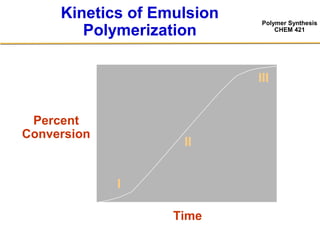
Kinetics of Emulsion
Polymerization
Percent
Conversion
Time
I
II
III
Polymer Synthesis
CHEM 421
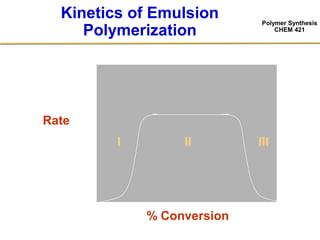
Kinetics of Emulsion
Polymerization
Rate
% Conversion
I II III
Polymer Synthesis
CHEM 421
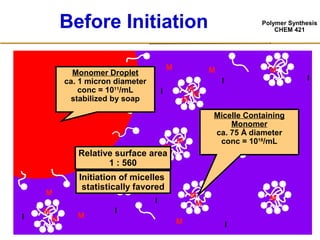
Before Initiation
I
I
I
I
I
I
I I
I
M
M
M
M
M
M
M
M
M M
MM
M
M
M
M
M
M
M
Monomer Droplet
ca. 1 micron diameter
conc = 1011
/mL
stabilized by soap
Micelle Containing
Monomer
ca. 75 Å diameter
conc = 1018
/mL
Relative surface area
1 : 560
Initiation of micelles
statistically favored
Polymer Synthesis
CHEM 421
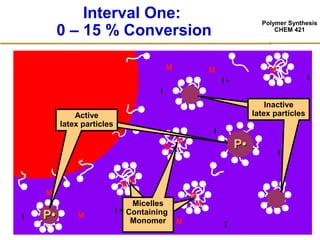
Interval One:
0 – 15 % Conversion
I •
I
I
I
I
I
I • I
I
M
M
M
M
M
M M
M
M
M
MM
M
PP••
PP••
M M
Micelles
Containing
Monomer
Active
latex particle
Micelles
Containing
Monomer
Micelles
Containing
Monomer
Active
latex particles
Inactive
latex particles
Inactive
latex particles
Polymer Synthesis
CHEM 421
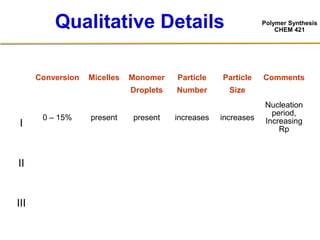
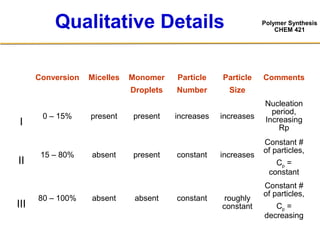
Qualitative Details
Conversion Micelles Monomer
Droplets
Particle
Number
Particle
Size
Comments
I
0 – 15% present present increases increases
Nucleation
period,
Increasing
Rp
II
III
Polymer Synthesis
CHEM 421
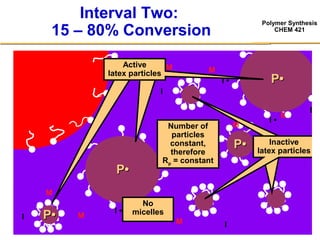
Interval Two:
15 – 80% Conversion
I
I
I
I
I • I
I
M
M
M
M
M
M
MM
M
PP••
PP•• I •
I
M
M
PP••
Inactive
latex particles
Inactive
latex particles
Inactive
latex particles
Active
latex particles
Active
latex particles
I •
I
M
PP••
Active
latex particles
No
micelles
Number of
particles
constant,
therefore
Rp = constant
Polymer Synthesis
CHEM 421
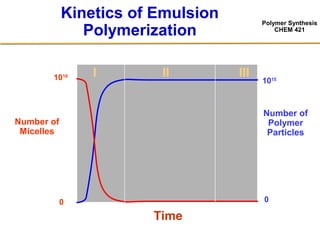
Kinetics of Emulsion
Polymerization
Number of
Micelles
Time
I II III
Number of
Polymer
Particles
1018
0
1015
0
Polymer Synthesis
CHEM 421
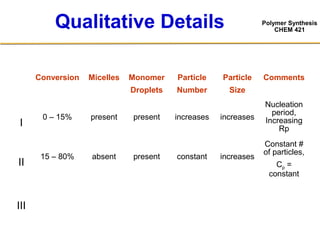
Qualitative Details
Conversion Micelles Monomer
Droplets
Particle
Number
Particle
Size
Comments
I
0 – 15% present present increases increases
Nucleation
period,
Increasing
Rp
II
15 – 80% absent present constant increases
Constant #
of particles,
Cp =
constant
III
Polymer Synthesis
CHEM 421
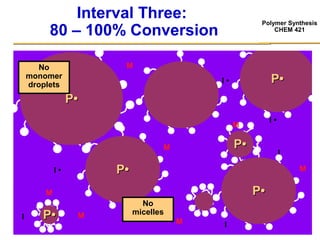
Interval Three:
80 – 100% Conversion
I
I
I
I
I • I
M
M
M
M
M
M
M
PP••
PP••
I
M
M
PP••
I •
M
PP••
M
PP••
M
PP••
I •
No
monomer
droplets
No
micelles
Polymer Synthesis
CHEM 421
Qualitative Details
Conversion Micelles Monomer
Droplets
Particle
Number
Particle
Size
Comments
I
0 – 15% present present increases increases
Nucleation
period,
Increasing
Rp
II
15 – 80% absent present constant increases
Constant #
of particles,
Cp =
constant
III
80 – 100% absent absent constant roughly
constant
Constant #
of particles,
Cp =
decreasing
Polymer Synthesis
CHEM 421
Emulsion Polymerization Kinetics
• Once inside a particle, radical propagates
as rp = kp[M]
• Overall rate: Rp = kp[M][P.
]
• [P.
] = N’ñ (where N’ = the sum of micelle
and particle concentrations and
ñ = average # of radicals per particle)
• Therefore,
–Increase N’ to increase rate!
][' MknNR pp =
Polymer Synthesis
CHEM 421
Emulsion Kinetics, cont.
• Smith-Ewart Kinetics:
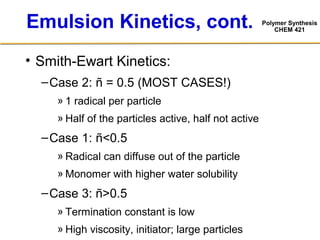
–Case 2: ñ = 0.5 (MOST CASES!)
» 1 radical per particle
» Half of the particles active, half not active
–Case 1: ñ<0.5
» Radical can diffuse out of the particle
» Monomer with higher water solubility
–Case 3: ñ>0.5
» Termination constant is low
» High viscosity, initiator; large particles
Polymer Synthesis
CHEM 421
Emulsion Polymerization Kinetics
• How to increase Rp?
–Increase N’ to increase rate
»Increase surfactant concentration to increase N’
][' MknNR pp =
Polymer Synthesis
CHEM 421
Molecular Weight in Emulsion
Polymerizations
• Molecular weight determined by rate of growth
of a chain divided by rate of radical entry (ri)
–How to increase molecular weight?
DP
rp
= ——ri
Ri
= ——
N
ri = kp[M]rp
N kp [M]
Ri
= ———DP
Polymer Synthesis
CHEM 421
Free Radical Solution
Polymerizations
• Recall
– To increase molecular weight…
» Increase monomer concentration
» Decrease initiator concentration
– To increase Rate of Polymerization
» Increase monomer concentration
» Increase initiator concentration
٧ =
kp [M]
2 (kt kd f [I])1/2
= —————
Can’t do
both!
Rp = kp [M] (kd f [I] / kt)1/2

Synthesis poly

  • 1.
  • 2.
    Polymer Synthesis CHEM 421 EmulsionPolymerizations • Economically important • Western countries 108 tons/year • 30% of all polymers made by free radical methods –emulsion polymers accounts for 40-50% of this • First employed during WWII for production of synthetic rubber • Today: MMA, VC, vinylidene chloride, styrene, fluoropolymers, vinyl acetate, EVA, SA, SBR, chloroprene, etc
  • 3.
    Polymer Synthesis CHEM 421 EmulsionPolymerization Recipe • Water (continuous phase) • Water-insoluble monomer • Water-soluble initiator • Surfactant (detergent)
  • 4.
    Polymer Synthesis CHEM 421 Surfactants H2O Hydrophobic/ Lipophilic core Surfactant Concentration Unimers Micelles Critical Micelle Concentration (CMC)
  • 5.
    Polymer Synthesis CHEM 421 Surfactants Types -Anionic - Cationic - Amphoterics - Non-ionics
  • 6.
  • 7.
    Polymer Synthesis CHEM 421 EmulsionPolymerizations Polym’z Rate Surfactant Concentration Critical Micelle Concentration
  • 8.
    Polymer Synthesis CHEM 421 Kineticsof Emulsion Polymerization Percent Conversion Time I II III
  • 9.
    Polymer Synthesis CHEM 421 Kineticsof Emulsion Polymerization Rate % Conversion I II III
  • 10.
    Polymer Synthesis CHEM 421 BeforeInitiation I I I I I I I I I M M M M M M M M M M MM M M M M M M M Monomer Droplet ca. 1 micron diameter conc = 1011 /mL stabilized by soap Micelle Containing Monomer ca. 75 Å diameter conc = 1018 /mL Relative surface area 1 : 560 Initiation of micelles statistically favored
  • 11.
    Polymer Synthesis CHEM 421 IntervalOne: 0 – 15 % Conversion I • I I I I I I • I I M M M M M M M M M M MM M PP•• PP•• M M Micelles Containing Monomer Active latex particle Micelles Containing Monomer Micelles Containing Monomer Active latex particles Inactive latex particles Inactive latex particles
  • 12.
    Polymer Synthesis CHEM 421 QualitativeDetails Conversion Micelles Monomer Droplets Particle Number Particle Size Comments I 0 – 15% present present increases increases Nucleation period, Increasing Rp II III
  • 13.
    Polymer Synthesis CHEM 421 IntervalTwo: 15 – 80% Conversion I I I I I • I I M M M M M M MM M PP•• PP•• I • I M M PP•• Inactive latex particles Inactive latex particles Inactive latex particles Active latex particles Active latex particles I • I M PP•• Active latex particles No micelles Number of particles constant, therefore Rp = constant
  • 14.
    Polymer Synthesis CHEM 421 Kineticsof Emulsion Polymerization Number of Micelles Time I II III Number of Polymer Particles 1018 0 1015 0
  • 15.
    Polymer Synthesis CHEM 421 QualitativeDetails Conversion Micelles Monomer Droplets Particle Number Particle Size Comments I 0 – 15% present present increases increases Nucleation period, Increasing Rp II 15 – 80% absent present constant increases Constant # of particles, Cp = constant III
  • 16.
    Polymer Synthesis CHEM 421 IntervalThree: 80 – 100% Conversion I I I I I • I M M M M M M M PP•• PP•• I M M PP•• I • M PP•• M PP•• M PP•• I • No monomer droplets No micelles
  • 17.
    Polymer Synthesis CHEM 421 QualitativeDetails Conversion Micelles Monomer Droplets Particle Number Particle Size Comments I 0 – 15% present present increases increases Nucleation period, Increasing Rp II 15 – 80% absent present constant increases Constant # of particles, Cp = constant III 80 – 100% absent absent constant roughly constant Constant # of particles, Cp = decreasing
  • 18.
    Polymer Synthesis CHEM 421 EmulsionPolymerization Kinetics • Once inside a particle, radical propagates as rp = kp[M] • Overall rate: Rp = kp[M][P. ] • [P. ] = N’ñ (where N’ = the sum of micelle and particle concentrations and ñ = average # of radicals per particle) • Therefore, –Increase N’ to increase rate! ][' MknNR pp =
  • 19.
    Polymer Synthesis CHEM 421 EmulsionKinetics, cont. • Smith-Ewart Kinetics: –Case 2: ñ = 0.5 (MOST CASES!) » 1 radical per particle » Half of the particles active, half not active –Case 1: ñ<0.5 » Radical can diffuse out of the particle » Monomer with higher water solubility –Case 3: ñ>0.5 » Termination constant is low » High viscosity, initiator; large particles
  • 20.
    Polymer Synthesis CHEM 421 EmulsionPolymerization Kinetics • How to increase Rp? –Increase N’ to increase rate »Increase surfactant concentration to increase N’ ][' MknNR pp =
  • 21.
    Polymer Synthesis CHEM 421 MolecularWeight in Emulsion Polymerizations • Molecular weight determined by rate of growth of a chain divided by rate of radical entry (ri) –How to increase molecular weight? DP rp = ——ri Ri = —— N ri = kp[M]rp N kp [M] Ri = ———DP
  • 22.
    Polymer Synthesis CHEM 421 FreeRadical Solution Polymerizations • Recall – To increase molecular weight… » Increase monomer concentration » Decrease initiator concentration – To increase Rate of Polymerization » Increase monomer concentration » Increase initiator concentration ٧ = kp [M] 2 (kt kd f [I])1/2 = ————— Can’t do both! Rp = kp [M] (kd f [I] / kt)1/2