Styrene Butadiene
Rubber
Polymeric and Composite Materials
HELLO!
I am Muhammad Asad Jamil
16-MME-S2-335
Metallurgy and Materials Engineering
2
Contents
1. Introduction of SBR
2. Synthesis
3. Applications
4. Properties
5. Relevant Research
3
Introduction of SBR
The General Overview of the Polymer
4
1
Introduction
▰ SBR is an elastomer that was originally developed
during WW2 as a replacement for natural rubber.
▰ It is a copolymer belonging to the family of synthetic
rubbers derived from styrene and butadiene.
▰ SBR has good abraision resistance.
▰ Initially, it was marketed by the name of Buna S.
▰ The properties of SBR depends upon the
styrene/butadiene ratio.
5
Introduction
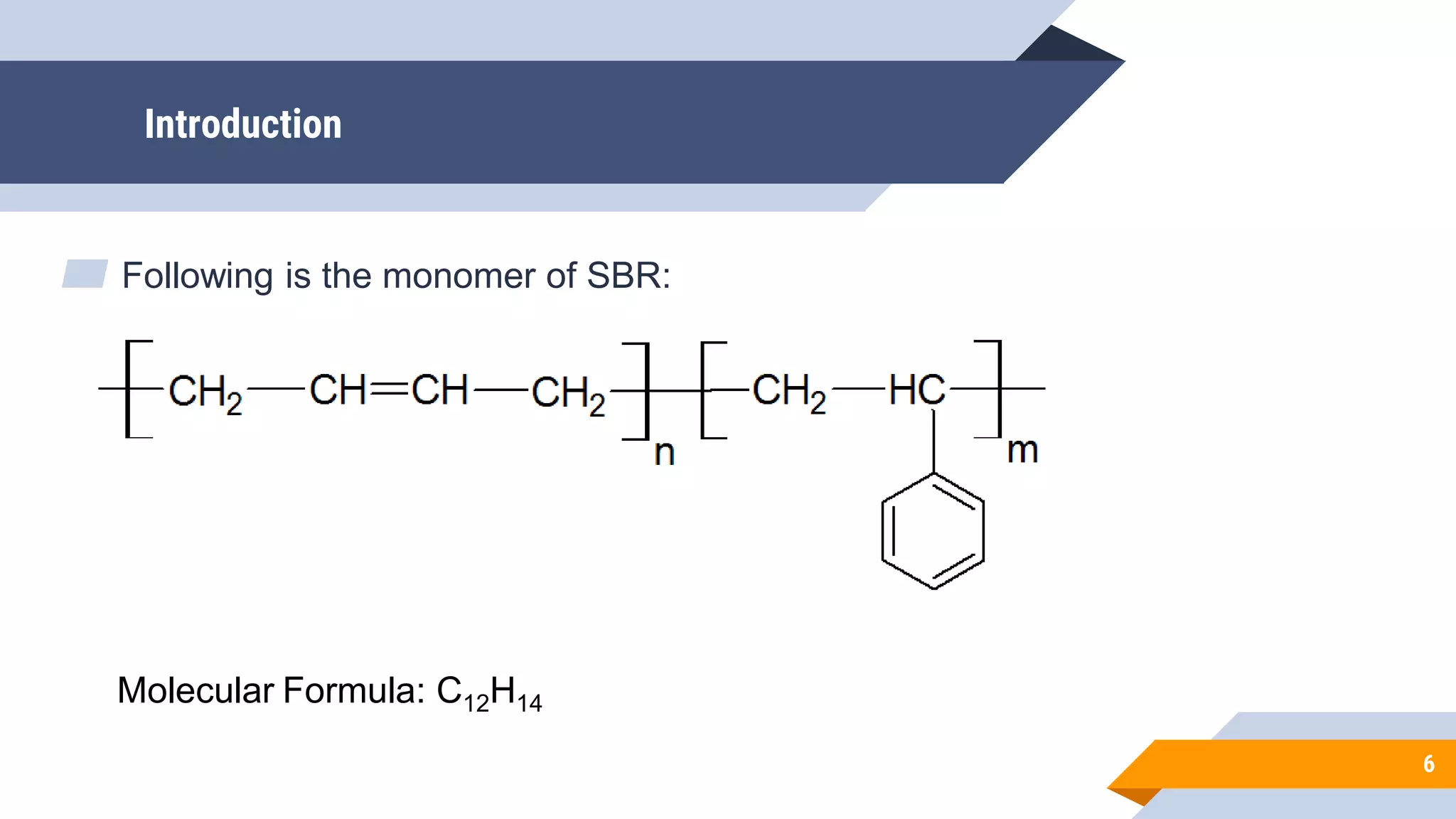
▰ Following is the monomer of SBR:
6
Molecular Formula: C12H14
Introduction
▰ Butadiene is obtained as a by-product of naphtha
cracking during the production of ethylene.
▰ Styrene is obtained by the dehydrogenation of ethyl
benzene by Dow’s process.
7
Synthesis
Techniques by which SBR is synthesized?
8
2
Synthesis
▰ There are two types of SBR depending upon the
method of synthesis or manufacturing:
▻ E-SBR
It is produced by Emulsion Polymerization
▻ S-SBR
It is produced by Solution Polymerization.
9
Emulsion Polymerization
▰ The manufacturing of E-SBR is carried out by free
radical mechanism.
▰ The polymerization is initiated by free radicals.
▰ ”Reaction vessels are typically charged with the two
monomers, a free radical generator, and a chain
transfer agent such as an alkyl mercaptan.”
▰ “Radical initiators include potassium
persulphate and hydroperoxides in combination with
ferrous salts. Emulsifying agents include
various soaps.”
▰ Mercaptan controls the molecular weight and viscosity
of the product. 10
Solution Polymerization
▰ Solution-SBR is produced by an anionic
polymerization process.
▰ Polymerization is initiated by alkyl lithium
compounds.
▰ “All components are dissolved, which provides
greater control over the process.”
▰ “The organolithium compound adds to one of the
monomers , generating a carbanion that then adds to
another monomer, and so on.”
11
Manufacturing at large scale
▰ SBR is produced by the copolymerization of
Butadiene and Styrene by emulsion polymerization in
3 : 1 weight ratio.
▰ Purification of recycled and fresh monomers
▰ Heating, water cooling and refrigeration in stainless
steel reactors
▰ Reactors are equipped for both hot and cold SBR
▰ Cold SBR is produced at 5°C and 1 atm gage by
refrigeration techniques
▰ Hot SBR is manufactured at 50°C , and 3-4 atm gage.
12
13
Manufacturing at large scale
▰ The polymerization product is then stripped with
chemical inhibitors and the latex resulting from the
reactors is collected in blow down tanks.
▰ The latex is then sent to a falling film stripper to
remove the butadiene.
▰ The bottoms are fed to a perforated plate column
where styrene is stripped out.
▰ Colloid Mill reduces the particle size in emulsions.
▰ Coagulation Conversion is done to avoid clots.
14
Applications
Main applications of SBR
15
3
50% Tires
Around 50% tires are made of various SBR grades
16
Solution or Emulsion SBR for Tire Manufacturing?
▰ For tire manufacture, S-SBR is increasingly favoured.
▰ It offers improved wet grip and reduced rolling
resistance.
▰ It translates to greater safety and better fuel
economy, respectively.
17
Applications
▰ Adhesives
▰ Flow modifiers
▰ Footwear
▰ Chewing Gums
▰ Pharmaceutical
18
Grades and Commercial Availability
▰ “The grades of SBR depends upon the styrene
content as well as the Mooney's viscosity.”
▰ “The commercial availability is also based upon
Mooney’s viscosity.”
19
20
Properties
Different properties of SBR
21
4
Properties
22
Properties
▰ “SBR lacks the self-reinforcing qualities of
natural rubber.”
▰ “It is poor conductor of electricity as it’s electrical
conductivity depends upon emulsifier.”
▰ “E-SBR is resistant to polar solvents such as
acids and base.”
▰ “They swell considerably when in contact with
gasoline, fats and oils.”
▰ “While S-SBR with random distribution of
styrene has greater abrasion resistance and
better electrical properties then E-SBR.”
23
Research Article
Relevant Research on SBR
24
5
Prediction of the Styrene Butadiene Rubber
Performance by Emulsion Polymerization
▰ “The research deals with the prediction of SBR
performance.”
▰ “The performance was determined by the amount of
initiator used.”
▰ “The effect of styrene content upon the Mooney’s
viscosity was also determined.”
▰ “The polymerization rate of butadiene styrene rubber
can be accelerated by 30% via increasing the initiator
and emulsion amount.”
25
26
Conclusion
▰ “SBR belonging to the family of synthetic rubber have
good abrasion resistance and aging stability with
additives.”
▰ “50% tires around the world are made up of various
SBR grades.”
▰ “The properties depends upon styrene/butadiene
content as well as Mooney’s viscosity.”
27
References
▰ “L. Shulai, S. Yan, Z. Liu et al., “In�uence factors of
increasing conversion of emulsion styrene butadiene
rubber,” China Synthetic Rubber Industry, vol. 29, no.
4, pp. 245–249, 2006.”
▰ “G. Martinez Delfa, A. Olivieri, and C. E. Boschetti,
“Multiple response optimization of styrene-butadiene
rubber emulsion polymerization,” Computers and
Chemical Engineering, vol. 33, no. 4, pp. 850–856,
2009.”
28
29
THANKS!
Any questions?

Styrene Butadiene Rubber

  • 1.
  • 2.
    HELLO! I am MuhammadAsad Jamil 16-MME-S2-335 Metallurgy and Materials Engineering 2
  • 3.
    Contents 1. Introduction ofSBR 2. Synthesis 3. Applications 4. Properties 5. Relevant Research 3
  • 4.
    Introduction of SBR TheGeneral Overview of the Polymer 4 1
  • 5.
    Introduction ▰ SBR isan elastomer that was originally developed during WW2 as a replacement for natural rubber. ▰ It is a copolymer belonging to the family of synthetic rubbers derived from styrene and butadiene. ▰ SBR has good abraision resistance. ▰ Initially, it was marketed by the name of Buna S. ▰ The properties of SBR depends upon the styrene/butadiene ratio. 5
  • 6.
    Introduction ▰ Following isthe monomer of SBR: 6 Molecular Formula: C12H14
  • 7.
    Introduction ▰ Butadiene isobtained as a by-product of naphtha cracking during the production of ethylene. ▰ Styrene is obtained by the dehydrogenation of ethyl benzene by Dow’s process. 7
  • 8.
    Synthesis Techniques by whichSBR is synthesized? 8 2
  • 9.
    Synthesis ▰ There aretwo types of SBR depending upon the method of synthesis or manufacturing: ▻ E-SBR It is produced by Emulsion Polymerization ▻ S-SBR It is produced by Solution Polymerization. 9
  • 10.
    Emulsion Polymerization ▰ Themanufacturing of E-SBR is carried out by free radical mechanism. ▰ The polymerization is initiated by free radicals. ▰ ”Reaction vessels are typically charged with the two monomers, a free radical generator, and a chain transfer agent such as an alkyl mercaptan.” ▰ “Radical initiators include potassium persulphate and hydroperoxides in combination with ferrous salts. Emulsifying agents include various soaps.” ▰ Mercaptan controls the molecular weight and viscosity of the product. 10
  • 11.
    Solution Polymerization ▰ Solution-SBRis produced by an anionic polymerization process. ▰ Polymerization is initiated by alkyl lithium compounds. ▰ “All components are dissolved, which provides greater control over the process.” ▰ “The organolithium compound adds to one of the monomers , generating a carbanion that then adds to another monomer, and so on.” 11
  • 12.
    Manufacturing at largescale ▰ SBR is produced by the copolymerization of Butadiene and Styrene by emulsion polymerization in 3 : 1 weight ratio. ▰ Purification of recycled and fresh monomers ▰ Heating, water cooling and refrigeration in stainless steel reactors ▰ Reactors are equipped for both hot and cold SBR ▰ Cold SBR is produced at 5°C and 1 atm gage by refrigeration techniques ▰ Hot SBR is manufactured at 50°C , and 3-4 atm gage. 12
  • 13.
  • 14.
    Manufacturing at largescale ▰ The polymerization product is then stripped with chemical inhibitors and the latex resulting from the reactors is collected in blow down tanks. ▰ The latex is then sent to a falling film stripper to remove the butadiene. ▰ The bottoms are fed to a perforated plate column where styrene is stripped out. ▰ Colloid Mill reduces the particle size in emulsions. ▰ Coagulation Conversion is done to avoid clots. 14
  • 15.
  • 16.
    50% Tires Around 50%tires are made of various SBR grades 16
  • 17.
    Solution or EmulsionSBR for Tire Manufacturing? ▰ For tire manufacture, S-SBR is increasingly favoured. ▰ It offers improved wet grip and reduced rolling resistance. ▰ It translates to greater safety and better fuel economy, respectively. 17
  • 18.
    Applications ▰ Adhesives ▰ Flowmodifiers ▰ Footwear ▰ Chewing Gums ▰ Pharmaceutical 18
  • 19.
    Grades and CommercialAvailability ▰ “The grades of SBR depends upon the styrene content as well as the Mooney's viscosity.” ▰ “The commercial availability is also based upon Mooney’s viscosity.” 19
  • 20.
  • 21.
  • 22.
  • 23.
    Properties ▰ “SBR lacksthe self-reinforcing qualities of natural rubber.” ▰ “It is poor conductor of electricity as it’s electrical conductivity depends upon emulsifier.” ▰ “E-SBR is resistant to polar solvents such as acids and base.” ▰ “They swell considerably when in contact with gasoline, fats and oils.” ▰ “While S-SBR with random distribution of styrene has greater abrasion resistance and better electrical properties then E-SBR.” 23
  • 24.
  • 25.
    Prediction of theStyrene Butadiene Rubber Performance by Emulsion Polymerization ▰ “The research deals with the prediction of SBR performance.” ▰ “The performance was determined by the amount of initiator used.” ▰ “The effect of styrene content upon the Mooney’s viscosity was also determined.” ▰ “The polymerization rate of butadiene styrene rubber can be accelerated by 30% via increasing the initiator and emulsion amount.” 25
  • 26.
  • 27.
    Conclusion ▰ “SBR belongingto the family of synthetic rubber have good abrasion resistance and aging stability with additives.” ▰ “50% tires around the world are made up of various SBR grades.” ▰ “The properties depends upon styrene/butadiene content as well as Mooney’s viscosity.” 27
  • 28.
    References ▰ “L. Shulai,S. Yan, Z. Liu et al., “In�uence factors of increasing conversion of emulsion styrene butadiene rubber,” China Synthetic Rubber Industry, vol. 29, no. 4, pp. 245–249, 2006.” ▰ “G. Martinez Delfa, A. Olivieri, and C. E. Boschetti, “Multiple response optimization of styrene-butadiene rubber emulsion polymerization,” Computers and Chemical Engineering, vol. 33, no. 4, pp. 850–856, 2009.” 28
  • 29.