Neural Networks
Universal Approximation of the Multilayer Perceptron
Andres Mendez-Vazquez
June 16, 2015
1 / 39
Outline
1 Introduction
2 Basic Defintions
Topology
Compactness
About Density in a Topology
Hausdorff Space
Measure
The Borel Measure
Discriminatory Functions
The Important Theorem
Universal Representation Theorem
2 / 39
Introduction
Representation of functions
The main result in multi-layer perceptron is its power of representation.
Furthermore
After all, it is quite striking if we can represent continuous functions of the
form f : Rn −→ R as a finite sum of simple functions.
3 / 39
Introduction
Representation of functions
The main result in multi-layer perceptron is its power of representation.
Furthermore
After all, it is quite striking if we can represent continuous functions of the
form f : Rn −→ R as a finite sum of simple functions.
3 / 39
Therefore
Our main goal
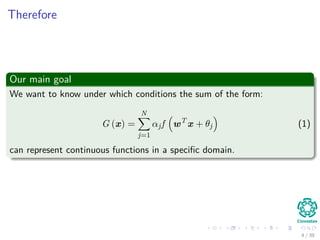
We want to know under which conditions the sum of the form:
G (x) =
N
j=1
αjf wT
x + θj (1)
can represent continuous functions in a specific domain.
4 / 39
Setup of the problem
Definition of In
It is an n-dimensional unit cube [0, 1]n
In addition, we have the following set of functions
C (In) = {f : In → R|f is a continous function} (2)
5 / 39
Setup of the problem
Definition of In
It is an n-dimensional unit cube [0, 1]n
In addition, we have the following set of functions
C (In) = {f : In → R|f is a continous function} (2)
5 / 39
Outline
1 Introduction
2 Basic Defintions
Topology
Compactness
About Density in a Topology
Hausdorff Space
Measure
The Borel Measure
Discriminatory Functions
The Important Theorem
Universal Representation Theorem
6 / 39
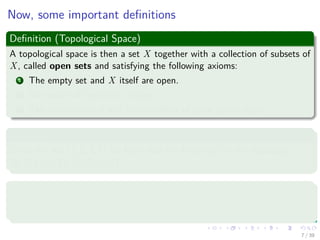
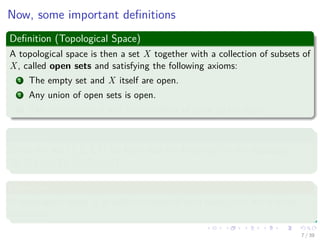
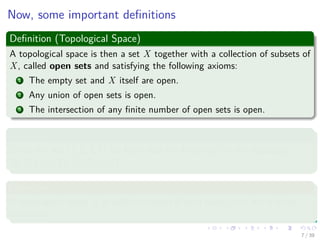
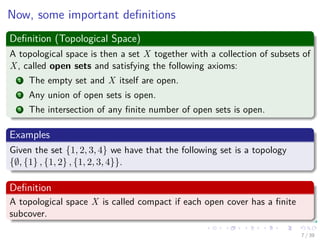
Now, some important definitions
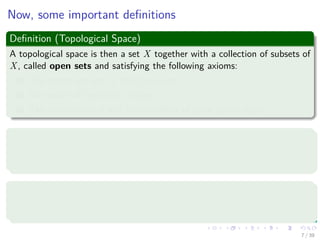
Definition (Topological Space)
A topological space is then a set X together with a collection of subsets of
X, called open sets and satisfying the following axioms:
1 The empty set and X itself are open.
2 Any union of open sets is open.
3 The intersection of any finite number of open sets is open.
Examples
Given the set {1, 2, 3, 4} we have that the following set is a topology
{∅, {1} , {1, 2} , {1, 2, 3, 4}}.
Definition
A topological space X is called compact if each open cover has a finite
subcover.
7 / 39
Now, some important definitions
Definition (Topological Space)
A topological space is then a set X together with a collection of subsets of
X, called open sets and satisfying the following axioms:
1 The empty set and X itself are open.
2 Any union of open sets is open.
3 The intersection of any finite number of open sets is open.
Examples
Given the set {1, 2, 3, 4} we have that the following set is a topology
{∅, {1} , {1, 2} , {1, 2, 3, 4}}.
Definition
A topological space X is called compact if each open cover has a finite
subcover.
7 / 39
Now, some important definitions
Definition (Topological Space)
A topological space is then a set X together with a collection of subsets of
X, called open sets and satisfying the following axioms:
1 The empty set and X itself are open.
2 Any union of open sets is open.
3 The intersection of any finite number of open sets is open.
Examples
Given the set {1, 2, 3, 4} we have that the following set is a topology
{∅, {1} , {1, 2} , {1, 2, 3, 4}}.
Definition
A topological space X is called compact if each open cover has a finite
subcover.
7 / 39
Now, some important definitions
Definition (Topological Space)
A topological space is then a set X together with a collection of subsets of
X, called open sets and satisfying the following axioms:
1 The empty set and X itself are open.
2 Any union of open sets is open.
3 The intersection of any finite number of open sets is open.
Examples
Given the set {1, 2, 3, 4} we have that the following set is a topology
{∅, {1} , {1, 2} , {1, 2, 3, 4}}.
Definition
A topological space X is called compact if each open cover has a finite
subcover.
7 / 39
Now, some important definitions
Definition (Topological Space)
A topological space is then a set X together with a collection of subsets of
X, called open sets and satisfying the following axioms:
1 The empty set and X itself are open.
2 Any union of open sets is open.
3 The intersection of any finite number of open sets is open.
Examples
Given the set {1, 2, 3, 4} we have that the following set is a topology
{∅, {1} , {1, 2} , {1, 2, 3, 4}}.
Definition
A topological space X is called compact if each open cover has a finite
subcover.
7 / 39
Outline
1 Introduction
2 Basic Defintions
Topology
Compactness
About Density in a Topology
Hausdorff Space
Measure
The Borel Measure
Discriminatory Functions
The Important Theorem
Universal Representation Theorem
8 / 39
Now
Theorem
A compact set is closed and bounded.
Thus
In is a compact set in Rn.
Definition (Continuous functions)
A function f : X → Y where the pre-image of every open set in Y is open
in X.
9 / 39
Now
Theorem
A compact set is closed and bounded.
Thus
In is a compact set in Rn.
Definition (Continuous functions)
A function f : X → Y where the pre-image of every open set in Y is open
in X.
9 / 39
Now
Theorem
A compact set is closed and bounded.
Thus
In is a compact set in Rn.
Definition (Continuous functions)
A function f : X → Y where the pre-image of every open set in Y is open
in X.
9 / 39
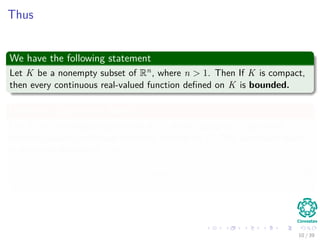
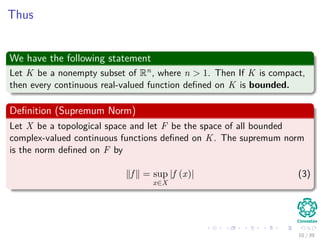
Thus
We have the following statement
Let K be a nonempty subset of Rn, where n > 1. Then If K is compact,
then every continuous real-valued function defined on K is bounded.
Definition (Supremum Norm)
Let X be a topological space and let F be the space of all bounded
complex-valued continuous functions defined on K. The supremum norm
is the norm defined on F by
f = sup
x∈X
|f (x)| (3)
10 / 39
Thus
We have the following statement
Let K be a nonempty subset of Rn, where n > 1. Then If K is compact,
then every continuous real-valued function defined on K is bounded.
Definition (Supremum Norm)
Let X be a topological space and let F be the space of all bounded
complex-valued continuous functions defined on K. The supremum norm
is the norm defined on F by
f = sup
x∈X
|f (x)| (3)
10 / 39
Outline
1 Introduction
2 Basic Defintions
Topology
Compactness
About Density in a Topology
Hausdorff Space
Measure
The Borel Measure
Discriminatory Functions
The Important Theorem
Universal Representation Theorem
11 / 39
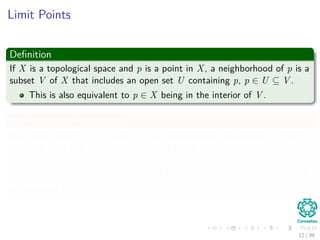
Limit Points
Definition
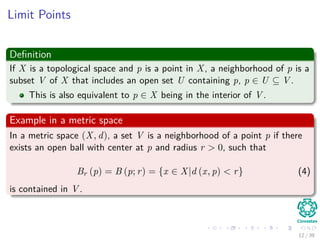
If X is a topological space and p is a point in X, a neighborhood of p is a
subset V of X that includes an open set U containing p, p ∈ U ⊆ V .
This is also equivalent to p ∈ X being in the interior of V .
Example in a metric space
In a metric space (X, d), a set V is a neighborhood of a point p if there
exists an open ball with center at p and radius r > 0, such that
Br (p) = B (p; r) = {x ∈ X|d (x, p) < r} (4)
is contained in V .
12 / 39
Limit Points
Definition
If X is a topological space and p is a point in X, a neighborhood of p is a
subset V of X that includes an open set U containing p, p ∈ U ⊆ V .
This is also equivalent to p ∈ X being in the interior of V .
Example in a metric space
In a metric space (X, d), a set V is a neighborhood of a point p if there
exists an open ball with center at p and radius r > 0, such that
Br (p) = B (p; r) = {x ∈ X|d (x, p) < r} (4)
is contained in V .
12 / 39
Limit Points
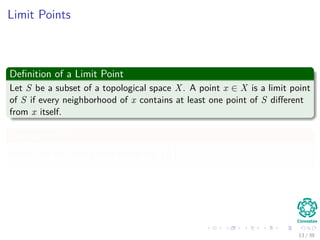
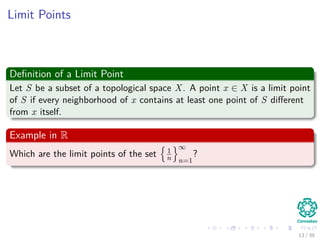
Definition of a Limit Point
Let S be a subset of a topological space X. A point x ∈ X is a limit point
of S if every neighborhood of x contains at least one point of S different
from x itself.
Example in R
Which are the limit points of the set 1
n
∞
n=1
?
13 / 39
Limit Points
Definition of a Limit Point
Let S be a subset of a topological space X. A point x ∈ X is a limit point
of S if every neighborhood of x contains at least one point of S different
from x itself.
Example in R
Which are the limit points of the set 1
n
∞
n=1
?
13 / 39
This allows to define the idea of density
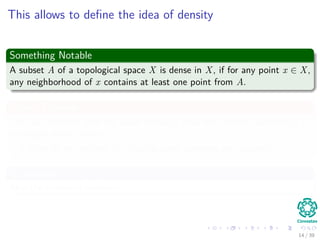
Something Notable
A subset A of a topological space X is dense in X, if for any point x ∈ X,
any neighborhood of x contains at least one point from A.
Classic Example
The real numbers with the usual topology have the rational numbers as a
countable dense subset.
Why do you believe the floating-point numbers are rational?
In addition
Also the irrational numbers.
14 / 39
This allows to define the idea of density
Something Notable
A subset A of a topological space X is dense in X, if for any point x ∈ X,
any neighborhood of x contains at least one point from A.
Classic Example
The real numbers with the usual topology have the rational numbers as a
countable dense subset.
Why do you believe the floating-point numbers are rational?
In addition
Also the irrational numbers.
14 / 39
This allows to define the idea of density
Something Notable
A subset A of a topological space X is dense in X, if for any point x ∈ X,
any neighborhood of x contains at least one point from A.
Classic Example
The real numbers with the usual topology have the rational numbers as a
countable dense subset.
Why do you believe the floating-point numbers are rational?
In addition
Also the irrational numbers.
14 / 39
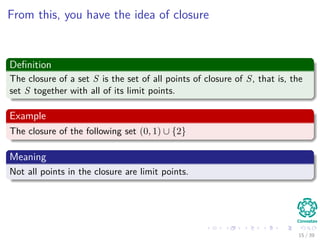
From this, you have the idea of closure
Definition
The closure of a set S is the set of all points of closure of S, that is, the
set S together with all of its limit points.
Example
The closure of the following set (0, 1) ∪ {2}
Meaning
Not all points in the closure are limit points.
15 / 39
From this, you have the idea of closure
Definition
The closure of a set S is the set of all points of closure of S, that is, the
set S together with all of its limit points.
Example
The closure of the following set (0, 1) ∪ {2}
Meaning
Not all points in the closure are limit points.
15 / 39
From this, you have the idea of closure
Definition
The closure of a set S is the set of all points of closure of S, that is, the
set S together with all of its limit points.
Example
The closure of the following set (0, 1) ∪ {2}
Meaning
Not all points in the closure are limit points.
15 / 39
Outline
1 Introduction
2 Basic Defintions
Topology
Compactness
About Density in a Topology
Hausdorff Space
Measure
The Borel Measure
Discriminatory Functions
The Important Theorem
Universal Representation Theorem
16 / 39
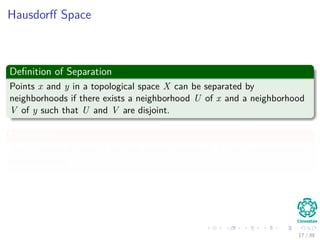
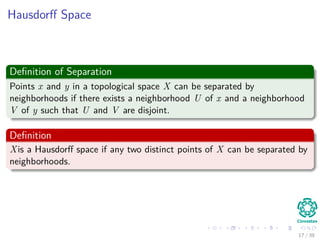
Hausdorff Space
Definition of Separation
Points x and y in a topological space X can be separated by
neighborhoods if there exists a neighborhood U of x and a neighborhood
V of y such that U and V are disjoint.
Definition
Xis a Hausdorff space if any two distinct points of X can be separated by
neighborhoods.
17 / 39
Hausdorff Space
Definition of Separation
Points x and y in a topological space X can be separated by
neighborhoods if there exists a neighborhood U of x and a neighborhood
V of y such that U and V are disjoint.
Definition
Xis a Hausdorff space if any two distinct points of X can be separated by
neighborhoods.
17 / 39
Outline
1 Introduction
2 Basic Defintions
Topology
Compactness
About Density in a Topology
Hausdorff Space
Measure
The Borel Measure
Discriminatory Functions
The Important Theorem
Universal Representation Theorem
18 / 39
We have then
Look at what we have
1 C (In) is compact
2 The continuous functions there are bounded!!!
19 / 39
We have then
Look at what we have
1 C (In) is compact
2 The continuous functions there are bounded!!!
19 / 39
We have then
Look at what we have
1 C (In) is compact
2 The continuous functions there are bounded!!!
19 / 39
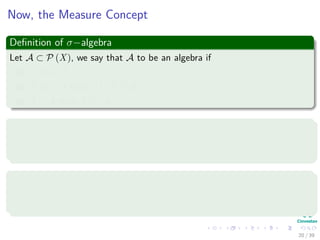
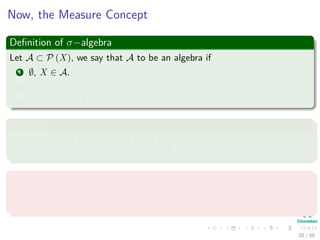
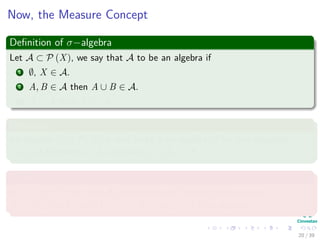
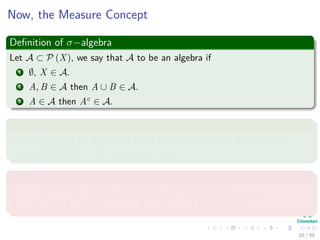
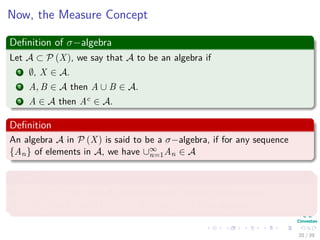
Now, the Measure Concept
Definition of σ−algebra
Let A ⊂ P (X), we say that A to be an algebra if
1 ∅, X ∈ A.
2 A, B ∈ A then A ∪ B ∈ A.
3 A ∈ A then Ac ∈ A.
Definition
An algebra A in P (X) is said to be a σ−algebra, if for any sequence
{An} of elements in A, we have ∪∞
n=1An ∈ A
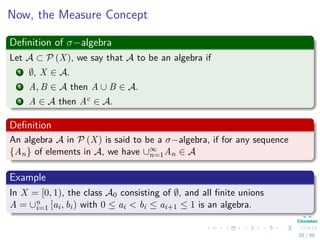
Example
In X = [0, 1), the class A0 consisting of ∅, and all finite unions
A = ∪n
i=1 [ai, bi) with 0 ≤ ai < bi ≤ ai+1 ≤ 1 is an algebra.
20 / 39
Now, the Measure Concept
Definition of σ−algebra
Let A ⊂ P (X), we say that A to be an algebra if
1 ∅, X ∈ A.
2 A, B ∈ A then A ∪ B ∈ A.
3 A ∈ A then Ac ∈ A.
Definition
An algebra A in P (X) is said to be a σ−algebra, if for any sequence
{An} of elements in A, we have ∪∞
n=1An ∈ A
Example
In X = [0, 1), the class A0 consisting of ∅, and all finite unions
A = ∪n
i=1 [ai, bi) with 0 ≤ ai < bi ≤ ai+1 ≤ 1 is an algebra.
20 / 39
Now, the Measure Concept
Definition of σ−algebra
Let A ⊂ P (X), we say that A to be an algebra if
1 ∅, X ∈ A.
2 A, B ∈ A then A ∪ B ∈ A.
3 A ∈ A then Ac ∈ A.
Definition
An algebra A in P (X) is said to be a σ−algebra, if for any sequence
{An} of elements in A, we have ∪∞
n=1An ∈ A
Example
In X = [0, 1), the class A0 consisting of ∅, and all finite unions
A = ∪n
i=1 [ai, bi) with 0 ≤ ai < bi ≤ ai+1 ≤ 1 is an algebra.
20 / 39
Now, the Measure Concept
Definition of σ−algebra
Let A ⊂ P (X), we say that A to be an algebra if
1 ∅, X ∈ A.
2 A, B ∈ A then A ∪ B ∈ A.
3 A ∈ A then Ac ∈ A.
Definition
An algebra A in P (X) is said to be a σ−algebra, if for any sequence
{An} of elements in A, we have ∪∞
n=1An ∈ A
Example
In X = [0, 1), the class A0 consisting of ∅, and all finite unions
A = ∪n
i=1 [ai, bi) with 0 ≤ ai < bi ≤ ai+1 ≤ 1 is an algebra.
20 / 39
Now, the Measure Concept
Definition of σ−algebra
Let A ⊂ P (X), we say that A to be an algebra if
1 ∅, X ∈ A.
2 A, B ∈ A then A ∪ B ∈ A.
3 A ∈ A then Ac ∈ A.
Definition
An algebra A in P (X) is said to be a σ−algebra, if for any sequence
{An} of elements in A, we have ∪∞
n=1An ∈ A
Example
In X = [0, 1), the class A0 consisting of ∅, and all finite unions
A = ∪n
i=1 [ai, bi) with 0 ≤ ai < bi ≤ ai+1 ≤ 1 is an algebra.
20 / 39
Now, the Measure Concept
Definition of σ−algebra
Let A ⊂ P (X), we say that A to be an algebra if
1 ∅, X ∈ A.
2 A, B ∈ A then A ∪ B ∈ A.
3 A ∈ A then Ac ∈ A.
Definition
An algebra A in P (X) is said to be a σ−algebra, if for any sequence
{An} of elements in A, we have ∪∞
n=1An ∈ A
Example
In X = [0, 1), the class A0 consisting of ∅, and all finite unions
A = ∪n
i=1 [ai, bi) with 0 ≤ ai < bi ≤ ai+1 ≤ 1 is an algebra.
20 / 39
Now, the Measure Concept
Definition of additivity
Let µ : A → [0, +∞] be such that µ (∅) = 0, we say that µ is σ−additive
if for any {Ai}i∈I ⊂ A (Where I can be finite of infinite countable) of
mutually disjoint sets such that ∪i∈I Ai ∈ A, we have that
µ (∪i∈I Ai) =
i∈I
µ (Ai) (5)
Definition of Measurability
Let A be a σ−algebra of subsets of X, we say that the [air (X, A) is a
measurable space where a σ−additive function µ : A → [0, +∞] is called a
measure on (X, A).
21 / 39
Now, the Measure Concept
Definition of additivity
Let µ : A → [0, +∞] be such that µ (∅) = 0, we say that µ is σ−additive
if for any {Ai}i∈I ⊂ A (Where I can be finite of infinite countable) of
mutually disjoint sets such that ∪i∈I Ai ∈ A, we have that
µ (∪i∈I Ai) =
i∈I
µ (Ai) (5)
Definition of Measurability
Let A be a σ−algebra of subsets of X, we say that the [air (X, A) is a
measurable space where a σ−additive function µ : A → [0, +∞] is called a
measure on (X, A).
21 / 39
Outline
1 Introduction
2 Basic Defintions
Topology
Compactness
About Density in a Topology
Hausdorff Space
Measure
The Borel Measure
Discriminatory Functions
The Important Theorem
Universal Representation Theorem
22 / 39
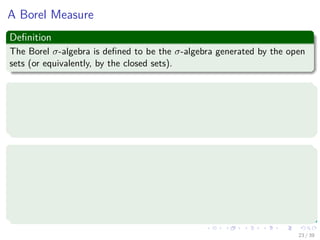
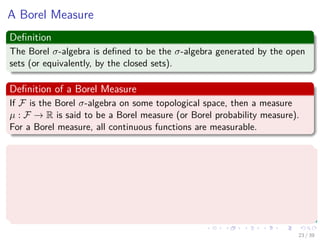
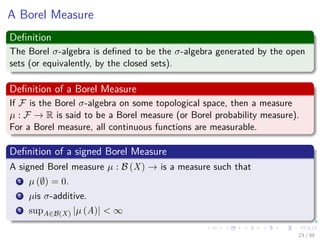
A Borel Measure
Definition
The Borel σ-algebra is defined to be the σ-algebra generated by the open
sets (or equivalently, by the closed sets).
Definition of a Borel Measure
If F is the Borel σ-algebra on some topological space, then a measure
µ : F → R is said to be a Borel measure (or Borel probability measure).
For a Borel measure, all continuous functions are measurable.
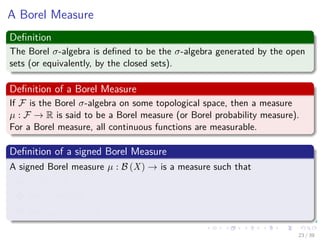
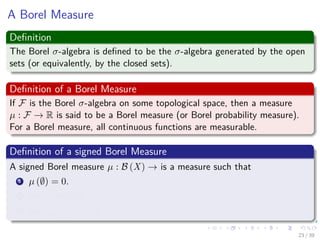
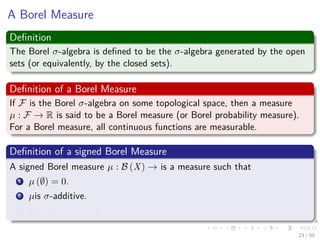
Definition of a signed Borel Measure
A signed Borel measure µ : B (X) → is a measure such that
1 µ (∅) = 0.
2 µis σ-additive.
3 supA∈B(X) |µ (A)| < ∞
23 / 39
A Borel Measure
Definition
The Borel σ-algebra is defined to be the σ-algebra generated by the open
sets (or equivalently, by the closed sets).
Definition of a Borel Measure
If F is the Borel σ-algebra on some topological space, then a measure
µ : F → R is said to be a Borel measure (or Borel probability measure).
For a Borel measure, all continuous functions are measurable.
Definition of a signed Borel Measure
A signed Borel measure µ : B (X) → is a measure such that
1 µ (∅) = 0.
2 µis σ-additive.
3 supA∈B(X) |µ (A)| < ∞
23 / 39
A Borel Measure
Definition
The Borel σ-algebra is defined to be the σ-algebra generated by the open
sets (or equivalently, by the closed sets).
Definition of a Borel Measure
If F is the Borel σ-algebra on some topological space, then a measure
µ : F → R is said to be a Borel measure (or Borel probability measure).
For a Borel measure, all continuous functions are measurable.
Definition of a signed Borel Measure
A signed Borel measure µ : B (X) → is a measure such that
1 µ (∅) = 0.
2 µis σ-additive.
3 supA∈B(X) |µ (A)| < ∞
23 / 39
A Borel Measure
Definition
The Borel σ-algebra is defined to be the σ-algebra generated by the open
sets (or equivalently, by the closed sets).
Definition of a Borel Measure
If F is the Borel σ-algebra on some topological space, then a measure
µ : F → R is said to be a Borel measure (or Borel probability measure).
For a Borel measure, all continuous functions are measurable.
Definition of a signed Borel Measure
A signed Borel measure µ : B (X) → is a measure such that
1 µ (∅) = 0.
2 µis σ-additive.
3 supA∈B(X) |µ (A)| < ∞
23 / 39
A Borel Measure
Definition
The Borel σ-algebra is defined to be the σ-algebra generated by the open
sets (or equivalently, by the closed sets).
Definition of a Borel Measure
If F is the Borel σ-algebra on some topological space, then a measure
µ : F → R is said to be a Borel measure (or Borel probability measure).
For a Borel measure, all continuous functions are measurable.
Definition of a signed Borel Measure
A signed Borel measure µ : B (X) → is a measure such that
1 µ (∅) = 0.
2 µis σ-additive.
3 supA∈B(X) |µ (A)| < ∞
23 / 39
A Borel Measure
Definition
The Borel σ-algebra is defined to be the σ-algebra generated by the open
sets (or equivalently, by the closed sets).
Definition of a Borel Measure
If F is the Borel σ-algebra on some topological space, then a measure
µ : F → R is said to be a Borel measure (or Borel probability measure).
For a Borel measure, all continuous functions are measurable.
Definition of a signed Borel Measure
A signed Borel measure µ : B (X) → is a measure such that
1 µ (∅) = 0.
2 µis σ-additive.
3 supA∈B(X) |µ (A)| < ∞
23 / 39
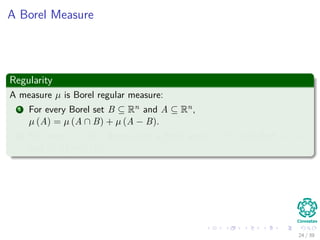
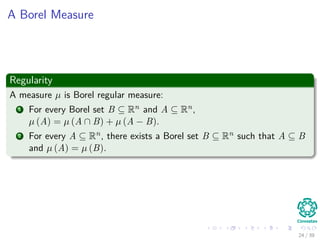
A Borel Measure
Regularity
A measure µ is Borel regular measure:
1 For every Borel set B ⊆ Rn and A ⊆ Rn,
µ (A) = µ (A ∩ B) + µ (A − B).
2 For every A ⊆ Rn, there exists a Borel set B ⊆ Rn such that A ⊆ B
and µ (A) = µ (B).
24 / 39
A Borel Measure
Regularity
A measure µ is Borel regular measure:
1 For every Borel set B ⊆ Rn and A ⊆ Rn,
µ (A) = µ (A ∩ B) + µ (A − B).
2 For every A ⊆ Rn, there exists a Borel set B ⊆ Rn such that A ⊆ B
and µ (A) = µ (B).
24 / 39
A Borel Measure
Regularity
A measure µ is Borel regular measure:
1 For every Borel set B ⊆ Rn and A ⊆ Rn,
µ (A) = µ (A ∩ B) + µ (A − B).
2 For every A ⊆ Rn, there exists a Borel set B ⊆ Rn such that A ⊆ B
and µ (A) = µ (B).
24 / 39
Outline
1 Introduction
2 Basic Defintions
Topology
Compactness
About Density in a Topology
Hausdorff Space
Measure
The Borel Measure
Discriminatory Functions
The Important Theorem
Universal Representation Theorem
25 / 39
Discriminatory Functions
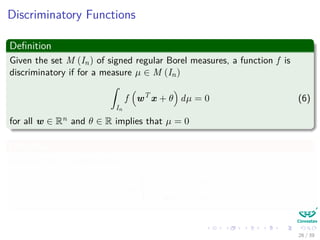
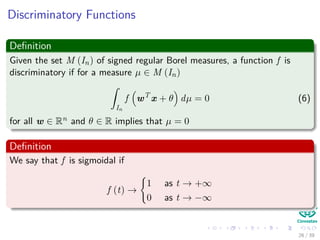
Definition
Given the set M (In) of signed regular Borel measures, a function f is
discriminatory if for a measure µ ∈ M (In)
ˆ
In
f wT
x + θ dµ = 0 (6)
for all w ∈ Rn and θ ∈ R implies that µ = 0
Definition
We say that f is sigmoidal if
f (t) →
1 as t → +∞
0 as t → −∞
26 / 39
Discriminatory Functions
Definition
Given the set M (In) of signed regular Borel measures, a function f is
discriminatory if for a measure µ ∈ M (In)
ˆ
In
f wT
x + θ dµ = 0 (6)
for all w ∈ Rn and θ ∈ R implies that µ = 0
Definition
We say that f is sigmoidal if
f (t) →
1 as t → +∞
0 as t → −∞
26 / 39
Outline
1 Introduction
2 Basic Defintions
Topology
Compactness
About Density in a Topology
Hausdorff Space
Measure
The Borel Measure
Discriminatory Functions
The Important Theorem
Universal Representation Theorem
27 / 39
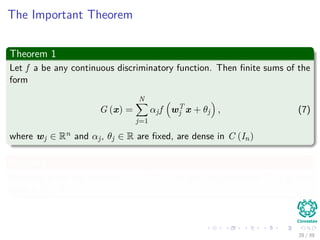
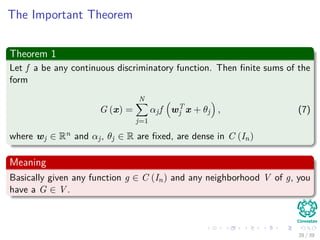
The Important Theorem
Theorem 1
Let f a be any continuous discriminatory function. Then finite sums of the
form
G (x) =
N
j=1
αjf wT
j x + θj , (7)
where wj ∈ Rn and αj, θj ∈ R are fixed, are dense in C (In)
Meaning
Basically given any function g ∈ C (In) and any neighborhood V of g, you
have a G ∈ V .
28 / 39
The Important Theorem
Theorem 1
Let f a be any continuous discriminatory function. Then finite sums of the
form
G (x) =
N
j=1
αjf wT
j x + θj , (7)
where wj ∈ Rn and αj, θj ∈ R are fixed, are dense in C (In)
Meaning
Basically given any function g ∈ C (In) and any neighborhood V of g, you
have a G ∈ V .
28 / 39
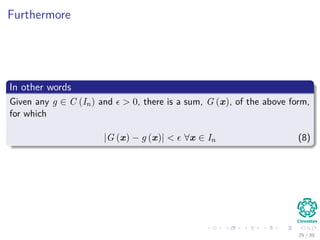
Furthermore
In other words
Given any g ∈ C (In) and > 0, there is a sum, G (x), of the above form,
for which
|G (x) − g (x)| < ∀x ∈ In (8)
29 / 39
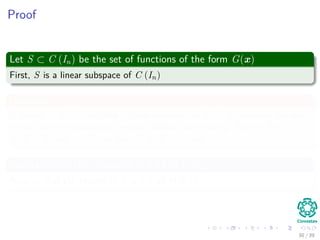
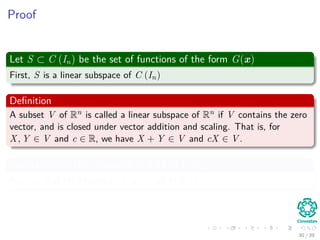
Proof
Let S ⊂ C (In) be the set of functions of the form G(x)
First, S is a linear subspace of C (In)
Definition
A subset V of Rn is called a linear subspace of Rn if V contains the zero
vector, and is closed under vector addition and scaling. That is, for
X, Y ∈ V and c ∈ R, we have X + Y ∈ V and cX ∈ V .
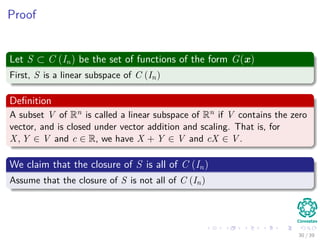
We claim that the closure of S is all of C (In)
Assume that the closure of S is not all of C (In)
30 / 39
Proof
Let S ⊂ C (In) be the set of functions of the form G(x)
First, S is a linear subspace of C (In)
Definition
A subset V of Rn is called a linear subspace of Rn if V contains the zero
vector, and is closed under vector addition and scaling. That is, for
X, Y ∈ V and c ∈ R, we have X + Y ∈ V and cX ∈ V .
We claim that the closure of S is all of C (In)
Assume that the closure of S is not all of C (In)
30 / 39
Proof
Let S ⊂ C (In) be the set of functions of the form G(x)
First, S is a linear subspace of C (In)
Definition
A subset V of Rn is called a linear subspace of Rn if V contains the zero
vector, and is closed under vector addition and scaling. That is, for
X, Y ∈ V and c ∈ R, we have X + Y ∈ V and cX ∈ V .
We claim that the closure of S is all of C (In)
Assume that the closure of S is not all of C (In)
30 / 39
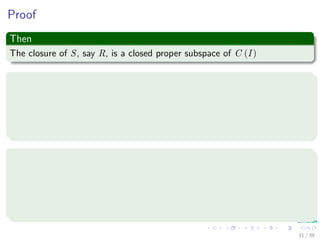
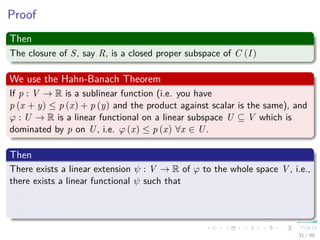
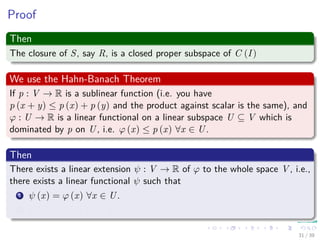
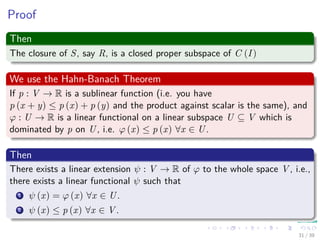
Proof
Then
The closure of S, say R, is a closed proper subspace of C (I)
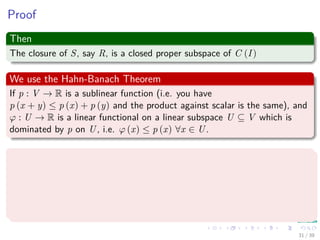
We use the Hahn-Banach Theorem
If p : V → R is a sublinear function (i.e. you have
p (x + y) ≤ p (x) + p (y) and the product against scalar is the same), and
ϕ : U → R is a linear functional on a linear subspace U ⊆ V which is
dominated by p on U, i.e. ϕ (x) ≤ p (x) ∀x ∈ U.
Then
There exists a linear extension ψ : V → R of ϕ to the whole space V , i.e.,
there exists a linear functional ψ such that
1 ψ (x) = ϕ (x) ∀x ∈ U.
2 ψ (x) ≤ p (x) ∀x ∈ V .
31 / 39
Proof
Then
The closure of S, say R, is a closed proper subspace of C (I)
We use the Hahn-Banach Theorem
If p : V → R is a sublinear function (i.e. you have
p (x + y) ≤ p (x) + p (y) and the product against scalar is the same), and
ϕ : U → R is a linear functional on a linear subspace U ⊆ V which is
dominated by p on U, i.e. ϕ (x) ≤ p (x) ∀x ∈ U.
Then
There exists a linear extension ψ : V → R of ϕ to the whole space V , i.e.,
there exists a linear functional ψ such that
1 ψ (x) = ϕ (x) ∀x ∈ U.
2 ψ (x) ≤ p (x) ∀x ∈ V .
31 / 39
Proof
Then
The closure of S, say R, is a closed proper subspace of C (I)
We use the Hahn-Banach Theorem
If p : V → R is a sublinear function (i.e. you have
p (x + y) ≤ p (x) + p (y) and the product against scalar is the same), and
ϕ : U → R is a linear functional on a linear subspace U ⊆ V which is
dominated by p on U, i.e. ϕ (x) ≤ p (x) ∀x ∈ U.
Then
There exists a linear extension ψ : V → R of ϕ to the whole space V , i.e.,
there exists a linear functional ψ such that
1 ψ (x) = ϕ (x) ∀x ∈ U.
2 ψ (x) ≤ p (x) ∀x ∈ V .
31 / 39
Proof
Then
The closure of S, say R, is a closed proper subspace of C (I)
We use the Hahn-Banach Theorem
If p : V → R is a sublinear function (i.e. you have
p (x + y) ≤ p (x) + p (y) and the product against scalar is the same), and
ϕ : U → R is a linear functional on a linear subspace U ⊆ V which is
dominated by p on U, i.e. ϕ (x) ≤ p (x) ∀x ∈ U.
Then
There exists a linear extension ψ : V → R of ϕ to the whole space V , i.e.,
there exists a linear functional ψ such that
1 ψ (x) = ϕ (x) ∀x ∈ U.
2 ψ (x) ≤ p (x) ∀x ∈ V .
31 / 39
Proof
Then
The closure of S, say R, is a closed proper subspace of C (I)
We use the Hahn-Banach Theorem
If p : V → R is a sublinear function (i.e. you have
p (x + y) ≤ p (x) + p (y) and the product against scalar is the same), and
ϕ : U → R is a linear functional on a linear subspace U ⊆ V which is
dominated by p on U, i.e. ϕ (x) ≤ p (x) ∀x ∈ U.
Then
There exists a linear extension ψ : V → R of ϕ to the whole space V , i.e.,
there exists a linear functional ψ such that
1 ψ (x) = ϕ (x) ∀x ∈ U.
2 ψ (x) ≤ p (x) ∀x ∈ V .
31 / 39
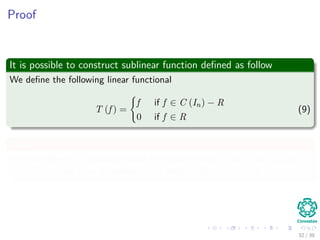
Proof
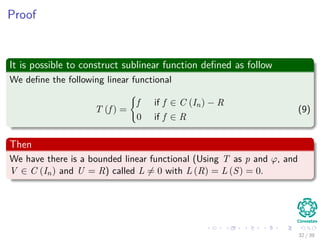
It is possible to construct sublinear function defined as follow
We define the following linear functional
T (f ) =
f if f ∈ C (In) − R
0 if f ∈ R
(9)
Then
We have there is a bounded linear functional (Using T as p and ϕ, and
V ∈ C (In) and U = R) called L = 0 with L (R) = L (S) = 0.
32 / 39
Proof
It is possible to construct sublinear function defined as follow
We define the following linear functional
T (f ) =
f if f ∈ C (In) − R
0 if f ∈ R
(9)
Then
We have there is a bounded linear functional (Using T as p and ϕ, and
V ∈ C (In) and U = R) called L = 0 with L (R) = L (S) = 0.
32 / 39
Proof
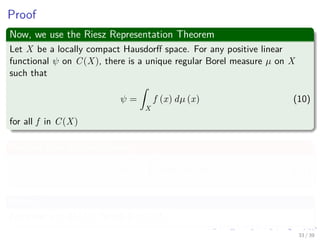
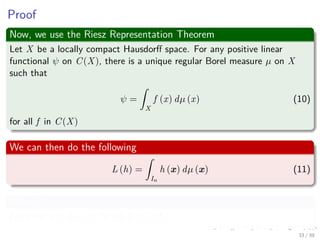
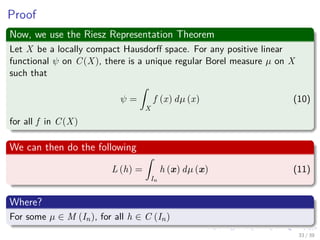
Now, we use the Riesz Representation Theorem
Let X be a locally compact Hausdorff space. For any positive linear
functional ψ on C(X), there is a unique regular Borel measure µ on X
such that
ψ =
ˆ
X
f (x) dµ (x) (10)
for all f in C(X)
We can then do the following
L (h) =
ˆ
In
h (x) dµ (x) (11)
Where?
For some µ ∈ M (In), for all h ∈ C (In)
33 / 39
Proof
Now, we use the Riesz Representation Theorem
Let X be a locally compact Hausdorff space. For any positive linear
functional ψ on C(X), there is a unique regular Borel measure µ on X
such that
ψ =
ˆ
X
f (x) dµ (x) (10)
for all f in C(X)
We can then do the following
L (h) =
ˆ
In
h (x) dµ (x) (11)
Where?
For some µ ∈ M (In), for all h ∈ C (In)
33 / 39
Proof
Now, we use the Riesz Representation Theorem
Let X be a locally compact Hausdorff space. For any positive linear
functional ψ on C(X), there is a unique regular Borel measure µ on X
such that
ψ =
ˆ
X
f (x) dµ (x) (10)
for all f in C(X)
We can then do the following
L (h) =
ˆ
In
h (x) dµ (x) (11)
Where?
For some µ ∈ M (In), for all h ∈ C (In)
33 / 39
Proof
In particular
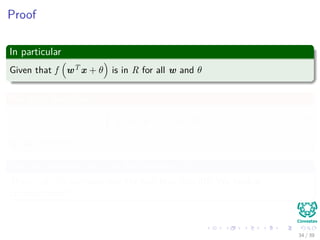
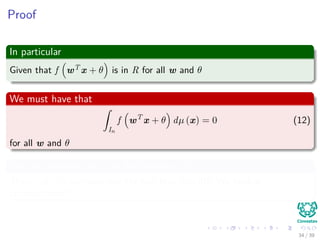
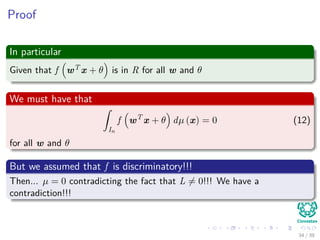
Given that f wT x + θ is in R for all w and θ
We must have that
ˆ
In
f wT
x + θ dµ (x) = 0 (12)
for all w and θ
But we assumed that f is discriminatory!!!
Then... µ = 0 contradicting the fact that L = 0!!! We have a
contradiction!!!
34 / 39
Proof
In particular
Given that f wT x + θ is in R for all w and θ
We must have that
ˆ
In
f wT
x + θ dµ (x) = 0 (12)
for all w and θ
But we assumed that f is discriminatory!!!
Then... µ = 0 contradicting the fact that L = 0!!! We have a
contradiction!!!
34 / 39
Proof
In particular
Given that f wT x + θ is in R for all w and θ
We must have that
ˆ
In
f wT
x + θ dµ (x) = 0 (12)
for all w and θ
But we assumed that f is discriminatory!!!
Then... µ = 0 contradicting the fact that L = 0!!! We have a
contradiction!!!
34 / 39
Proof
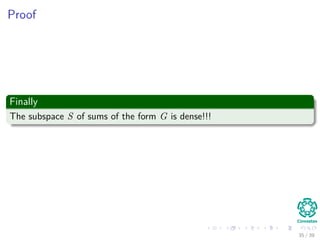
Finally
The subspace S of sums of the form G is dense!!!
35 / 39
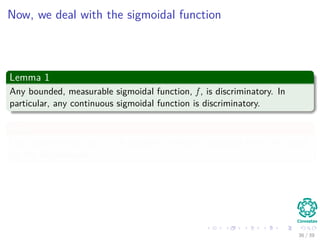
Now, we deal with the sigmoidal function
Lemma 1
Any bounded, measurable sigmoidal function, f , is discriminatory. In
particular, any continuous sigmoidal function is discriminatory.
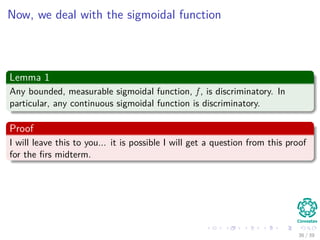
Proof
I will leave this to you... it is possible I will get a question from this proof
for the firs midterm.
36 / 39
Now, we deal with the sigmoidal function
Lemma 1
Any bounded, measurable sigmoidal function, f , is discriminatory. In
particular, any continuous sigmoidal function is discriminatory.
Proof
I will leave this to you... it is possible I will get a question from this proof
for the firs midterm.
36 / 39
Outline
1 Introduction
2 Basic Defintions
Topology
Compactness
About Density in a Topology
Hausdorff Space
Measure
The Borel Measure
Discriminatory Functions
The Important Theorem
Universal Representation Theorem
37 / 39
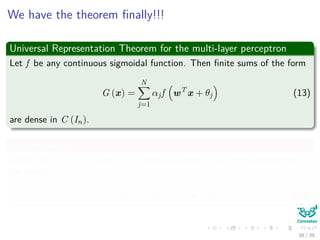
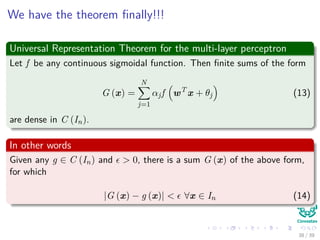
We have the theorem finally!!!
Universal Representation Theorem for the multi-layer perceptron
Let f be any continuous sigmoidal function. Then finite sums of the form
G (x) =
N
j=1
αjf wT
x + θj (13)
are dense in C (In).
In other words
Given any g ∈ C (In) and > 0, there is a sum G (x) of the above form,
for which
|G (x) − g (x)| < ∀x ∈ In (14)
38 / 39
We have the theorem finally!!!
Universal Representation Theorem for the multi-layer perceptron
Let f be any continuous sigmoidal function. Then finite sums of the form
G (x) =
N
j=1
αjf wT
x + θj (13)
are dense in C (In).
In other words
Given any g ∈ C (In) and > 0, there is a sum G (x) of the above form,
for which
|G (x) − g (x)| < ∀x ∈ In (14)
38 / 39
Poof
Simple
Combine the theorem and lemma 1... and because the continous
sigmoidals satisfy the conditions of the lemma... we have our
representation!!!
39 / 39

16 Machine Learning Universal Approximation Multilayer Perceptron

  • 1.
    Neural Networks Universal Approximationof the Multilayer Perceptron Andres Mendez-Vazquez June 16, 2015 1 / 39
  • 2.
    Outline 1 Introduction 2 BasicDefintions Topology Compactness About Density in a Topology Hausdorff Space Measure The Borel Measure Discriminatory Functions The Important Theorem Universal Representation Theorem 2 / 39
  • 3.
    Introduction Representation of functions Themain result in multi-layer perceptron is its power of representation. Furthermore After all, it is quite striking if we can represent continuous functions of the form f : Rn −→ R as a finite sum of simple functions. 3 / 39
  • 4.
    Introduction Representation of functions Themain result in multi-layer perceptron is its power of representation. Furthermore After all, it is quite striking if we can represent continuous functions of the form f : Rn −→ R as a finite sum of simple functions. 3 / 39
  • 5.
    Therefore Our main goal Wewant to know under which conditions the sum of the form: G (x) = N j=1 αjf wT x + θj (1) can represent continuous functions in a specific domain. 4 / 39
  • 6.
    Setup of theproblem Definition of In It is an n-dimensional unit cube [0, 1]n In addition, we have the following set of functions C (In) = {f : In → R|f is a continous function} (2) 5 / 39
  • 7.
    Setup of theproblem Definition of In It is an n-dimensional unit cube [0, 1]n In addition, we have the following set of functions C (In) = {f : In → R|f is a continous function} (2) 5 / 39
  • 8.
    Outline 1 Introduction 2 BasicDefintions Topology Compactness About Density in a Topology Hausdorff Space Measure The Borel Measure Discriminatory Functions The Important Theorem Universal Representation Theorem 6 / 39
  • 9.
    Now, some importantdefinitions Definition (Topological Space) A topological space is then a set X together with a collection of subsets of X, called open sets and satisfying the following axioms: 1 The empty set and X itself are open. 2 Any union of open sets is open. 3 The intersection of any finite number of open sets is open. Examples Given the set {1, 2, 3, 4} we have that the following set is a topology {∅, {1} , {1, 2} , {1, 2, 3, 4}}. Definition A topological space X is called compact if each open cover has a finite subcover. 7 / 39
  • 10.
    Now, some importantdefinitions Definition (Topological Space) A topological space is then a set X together with a collection of subsets of X, called open sets and satisfying the following axioms: 1 The empty set and X itself are open. 2 Any union of open sets is open. 3 The intersection of any finite number of open sets is open. Examples Given the set {1, 2, 3, 4} we have that the following set is a topology {∅, {1} , {1, 2} , {1, 2, 3, 4}}. Definition A topological space X is called compact if each open cover has a finite subcover. 7 / 39
  • 11.
    Now, some importantdefinitions Definition (Topological Space) A topological space is then a set X together with a collection of subsets of X, called open sets and satisfying the following axioms: 1 The empty set and X itself are open. 2 Any union of open sets is open. 3 The intersection of any finite number of open sets is open. Examples Given the set {1, 2, 3, 4} we have that the following set is a topology {∅, {1} , {1, 2} , {1, 2, 3, 4}}. Definition A topological space X is called compact if each open cover has a finite subcover. 7 / 39
  • 12.
    Now, some importantdefinitions Definition (Topological Space) A topological space is then a set X together with a collection of subsets of X, called open sets and satisfying the following axioms: 1 The empty set and X itself are open. 2 Any union of open sets is open. 3 The intersection of any finite number of open sets is open. Examples Given the set {1, 2, 3, 4} we have that the following set is a topology {∅, {1} , {1, 2} , {1, 2, 3, 4}}. Definition A topological space X is called compact if each open cover has a finite subcover. 7 / 39
  • 13.
    Now, some importantdefinitions Definition (Topological Space) A topological space is then a set X together with a collection of subsets of X, called open sets and satisfying the following axioms: 1 The empty set and X itself are open. 2 Any union of open sets is open. 3 The intersection of any finite number of open sets is open. Examples Given the set {1, 2, 3, 4} we have that the following set is a topology {∅, {1} , {1, 2} , {1, 2, 3, 4}}. Definition A topological space X is called compact if each open cover has a finite subcover. 7 / 39
  • 14.
    Outline 1 Introduction 2 BasicDefintions Topology Compactness About Density in a Topology Hausdorff Space Measure The Borel Measure Discriminatory Functions The Important Theorem Universal Representation Theorem 8 / 39
  • 15.
    Now Theorem A compact setis closed and bounded. Thus In is a compact set in Rn. Definition (Continuous functions) A function f : X → Y where the pre-image of every open set in Y is open in X. 9 / 39
  • 16.
    Now Theorem A compact setis closed and bounded. Thus In is a compact set in Rn. Definition (Continuous functions) A function f : X → Y where the pre-image of every open set in Y is open in X. 9 / 39
  • 17.
    Now Theorem A compact setis closed and bounded. Thus In is a compact set in Rn. Definition (Continuous functions) A function f : X → Y where the pre-image of every open set in Y is open in X. 9 / 39
  • 18.
    Thus We have thefollowing statement Let K be a nonempty subset of Rn, where n > 1. Then If K is compact, then every continuous real-valued function defined on K is bounded. Definition (Supremum Norm) Let X be a topological space and let F be the space of all bounded complex-valued continuous functions defined on K. The supremum norm is the norm defined on F by f = sup x∈X |f (x)| (3) 10 / 39
  • 19.
    Thus We have thefollowing statement Let K be a nonempty subset of Rn, where n > 1. Then If K is compact, then every continuous real-valued function defined on K is bounded. Definition (Supremum Norm) Let X be a topological space and let F be the space of all bounded complex-valued continuous functions defined on K. The supremum norm is the norm defined on F by f = sup x∈X |f (x)| (3) 10 / 39
  • 20.
    Outline 1 Introduction 2 BasicDefintions Topology Compactness About Density in a Topology Hausdorff Space Measure The Borel Measure Discriminatory Functions The Important Theorem Universal Representation Theorem 11 / 39
  • 21.
    Limit Points Definition If Xis a topological space and p is a point in X, a neighborhood of p is a subset V of X that includes an open set U containing p, p ∈ U ⊆ V . This is also equivalent to p ∈ X being in the interior of V . Example in a metric space In a metric space (X, d), a set V is a neighborhood of a point p if there exists an open ball with center at p and radius r > 0, such that Br (p) = B (p; r) = {x ∈ X|d (x, p) < r} (4) is contained in V . 12 / 39
  • 22.
    Limit Points Definition If Xis a topological space and p is a point in X, a neighborhood of p is a subset V of X that includes an open set U containing p, p ∈ U ⊆ V . This is also equivalent to p ∈ X being in the interior of V . Example in a metric space In a metric space (X, d), a set V is a neighborhood of a point p if there exists an open ball with center at p and radius r > 0, such that Br (p) = B (p; r) = {x ∈ X|d (x, p) < r} (4) is contained in V . 12 / 39
  • 23.
    Limit Points Definition ofa Limit Point Let S be a subset of a topological space X. A point x ∈ X is a limit point of S if every neighborhood of x contains at least one point of S different from x itself. Example in R Which are the limit points of the set 1 n ∞ n=1 ? 13 / 39
  • 24.
    Limit Points Definition ofa Limit Point Let S be a subset of a topological space X. A point x ∈ X is a limit point of S if every neighborhood of x contains at least one point of S different from x itself. Example in R Which are the limit points of the set 1 n ∞ n=1 ? 13 / 39
  • 25.
    This allows todefine the idea of density Something Notable A subset A of a topological space X is dense in X, if for any point x ∈ X, any neighborhood of x contains at least one point from A. Classic Example The real numbers with the usual topology have the rational numbers as a countable dense subset. Why do you believe the floating-point numbers are rational? In addition Also the irrational numbers. 14 / 39
  • 26.
    This allows todefine the idea of density Something Notable A subset A of a topological space X is dense in X, if for any point x ∈ X, any neighborhood of x contains at least one point from A. Classic Example The real numbers with the usual topology have the rational numbers as a countable dense subset. Why do you believe the floating-point numbers are rational? In addition Also the irrational numbers. 14 / 39
  • 27.
    This allows todefine the idea of density Something Notable A subset A of a topological space X is dense in X, if for any point x ∈ X, any neighborhood of x contains at least one point from A. Classic Example The real numbers with the usual topology have the rational numbers as a countable dense subset. Why do you believe the floating-point numbers are rational? In addition Also the irrational numbers. 14 / 39
  • 28.
    From this, youhave the idea of closure Definition The closure of a set S is the set of all points of closure of S, that is, the set S together with all of its limit points. Example The closure of the following set (0, 1) ∪ {2} Meaning Not all points in the closure are limit points. 15 / 39
  • 29.
    From this, youhave the idea of closure Definition The closure of a set S is the set of all points of closure of S, that is, the set S together with all of its limit points. Example The closure of the following set (0, 1) ∪ {2} Meaning Not all points in the closure are limit points. 15 / 39
  • 30.
    From this, youhave the idea of closure Definition The closure of a set S is the set of all points of closure of S, that is, the set S together with all of its limit points. Example The closure of the following set (0, 1) ∪ {2} Meaning Not all points in the closure are limit points. 15 / 39
  • 31.
    Outline 1 Introduction 2 BasicDefintions Topology Compactness About Density in a Topology Hausdorff Space Measure The Borel Measure Discriminatory Functions The Important Theorem Universal Representation Theorem 16 / 39
  • 32.
    Hausdorff Space Definition ofSeparation Points x and y in a topological space X can be separated by neighborhoods if there exists a neighborhood U of x and a neighborhood V of y such that U and V are disjoint. Definition Xis a Hausdorff space if any two distinct points of X can be separated by neighborhoods. 17 / 39
  • 33.
    Hausdorff Space Definition ofSeparation Points x and y in a topological space X can be separated by neighborhoods if there exists a neighborhood U of x and a neighborhood V of y such that U and V are disjoint. Definition Xis a Hausdorff space if any two distinct points of X can be separated by neighborhoods. 17 / 39
  • 34.
    Outline 1 Introduction 2 BasicDefintions Topology Compactness About Density in a Topology Hausdorff Space Measure The Borel Measure Discriminatory Functions The Important Theorem Universal Representation Theorem 18 / 39
  • 35.
    We have then Lookat what we have 1 C (In) is compact 2 The continuous functions there are bounded!!! 19 / 39
  • 36.
    We have then Lookat what we have 1 C (In) is compact 2 The continuous functions there are bounded!!! 19 / 39
  • 37.
    We have then Lookat what we have 1 C (In) is compact 2 The continuous functions there are bounded!!! 19 / 39
  • 38.
    Now, the MeasureConcept Definition of σ−algebra Let A ⊂ P (X), we say that A to be an algebra if 1 ∅, X ∈ A. 2 A, B ∈ A then A ∪ B ∈ A. 3 A ∈ A then Ac ∈ A. Definition An algebra A in P (X) is said to be a σ−algebra, if for any sequence {An} of elements in A, we have ∪∞ n=1An ∈ A Example In X = [0, 1), the class A0 consisting of ∅, and all finite unions A = ∪n i=1 [ai, bi) with 0 ≤ ai < bi ≤ ai+1 ≤ 1 is an algebra. 20 / 39
  • 39.
    Now, the MeasureConcept Definition of σ−algebra Let A ⊂ P (X), we say that A to be an algebra if 1 ∅, X ∈ A. 2 A, B ∈ A then A ∪ B ∈ A. 3 A ∈ A then Ac ∈ A. Definition An algebra A in P (X) is said to be a σ−algebra, if for any sequence {An} of elements in A, we have ∪∞ n=1An ∈ A Example In X = [0, 1), the class A0 consisting of ∅, and all finite unions A = ∪n i=1 [ai, bi) with 0 ≤ ai < bi ≤ ai+1 ≤ 1 is an algebra. 20 / 39
  • 40.
    Now, the MeasureConcept Definition of σ−algebra Let A ⊂ P (X), we say that A to be an algebra if 1 ∅, X ∈ A. 2 A, B ∈ A then A ∪ B ∈ A. 3 A ∈ A then Ac ∈ A. Definition An algebra A in P (X) is said to be a σ−algebra, if for any sequence {An} of elements in A, we have ∪∞ n=1An ∈ A Example In X = [0, 1), the class A0 consisting of ∅, and all finite unions A = ∪n i=1 [ai, bi) with 0 ≤ ai < bi ≤ ai+1 ≤ 1 is an algebra. 20 / 39
  • 41.
    Now, the MeasureConcept Definition of σ−algebra Let A ⊂ P (X), we say that A to be an algebra if 1 ∅, X ∈ A. 2 A, B ∈ A then A ∪ B ∈ A. 3 A ∈ A then Ac ∈ A. Definition An algebra A in P (X) is said to be a σ−algebra, if for any sequence {An} of elements in A, we have ∪∞ n=1An ∈ A Example In X = [0, 1), the class A0 consisting of ∅, and all finite unions A = ∪n i=1 [ai, bi) with 0 ≤ ai < bi ≤ ai+1 ≤ 1 is an algebra. 20 / 39
  • 42.
    Now, the MeasureConcept Definition of σ−algebra Let A ⊂ P (X), we say that A to be an algebra if 1 ∅, X ∈ A. 2 A, B ∈ A then A ∪ B ∈ A. 3 A ∈ A then Ac ∈ A. Definition An algebra A in P (X) is said to be a σ−algebra, if for any sequence {An} of elements in A, we have ∪∞ n=1An ∈ A Example In X = [0, 1), the class A0 consisting of ∅, and all finite unions A = ∪n i=1 [ai, bi) with 0 ≤ ai < bi ≤ ai+1 ≤ 1 is an algebra. 20 / 39
  • 43.
    Now, the MeasureConcept Definition of σ−algebra Let A ⊂ P (X), we say that A to be an algebra if 1 ∅, X ∈ A. 2 A, B ∈ A then A ∪ B ∈ A. 3 A ∈ A then Ac ∈ A. Definition An algebra A in P (X) is said to be a σ−algebra, if for any sequence {An} of elements in A, we have ∪∞ n=1An ∈ A Example In X = [0, 1), the class A0 consisting of ∅, and all finite unions A = ∪n i=1 [ai, bi) with 0 ≤ ai < bi ≤ ai+1 ≤ 1 is an algebra. 20 / 39
  • 44.
    Now, the MeasureConcept Definition of additivity Let µ : A → [0, +∞] be such that µ (∅) = 0, we say that µ is σ−additive if for any {Ai}i∈I ⊂ A (Where I can be finite of infinite countable) of mutually disjoint sets such that ∪i∈I Ai ∈ A, we have that µ (∪i∈I Ai) = i∈I µ (Ai) (5) Definition of Measurability Let A be a σ−algebra of subsets of X, we say that the [air (X, A) is a measurable space where a σ−additive function µ : A → [0, +∞] is called a measure on (X, A). 21 / 39
  • 45.
    Now, the MeasureConcept Definition of additivity Let µ : A → [0, +∞] be such that µ (∅) = 0, we say that µ is σ−additive if for any {Ai}i∈I ⊂ A (Where I can be finite of infinite countable) of mutually disjoint sets such that ∪i∈I Ai ∈ A, we have that µ (∪i∈I Ai) = i∈I µ (Ai) (5) Definition of Measurability Let A be a σ−algebra of subsets of X, we say that the [air (X, A) is a measurable space where a σ−additive function µ : A → [0, +∞] is called a measure on (X, A). 21 / 39
  • 46.
    Outline 1 Introduction 2 BasicDefintions Topology Compactness About Density in a Topology Hausdorff Space Measure The Borel Measure Discriminatory Functions The Important Theorem Universal Representation Theorem 22 / 39
  • 47.
    A Borel Measure Definition TheBorel σ-algebra is defined to be the σ-algebra generated by the open sets (or equivalently, by the closed sets). Definition of a Borel Measure If F is the Borel σ-algebra on some topological space, then a measure µ : F → R is said to be a Borel measure (or Borel probability measure). For a Borel measure, all continuous functions are measurable. Definition of a signed Borel Measure A signed Borel measure µ : B (X) → is a measure such that 1 µ (∅) = 0. 2 µis σ-additive. 3 supA∈B(X) |µ (A)| < ∞ 23 / 39
  • 48.
    A Borel Measure Definition TheBorel σ-algebra is defined to be the σ-algebra generated by the open sets (or equivalently, by the closed sets). Definition of a Borel Measure If F is the Borel σ-algebra on some topological space, then a measure µ : F → R is said to be a Borel measure (or Borel probability measure). For a Borel measure, all continuous functions are measurable. Definition of a signed Borel Measure A signed Borel measure µ : B (X) → is a measure such that 1 µ (∅) = 0. 2 µis σ-additive. 3 supA∈B(X) |µ (A)| < ∞ 23 / 39
  • 49.
    A Borel Measure Definition TheBorel σ-algebra is defined to be the σ-algebra generated by the open sets (or equivalently, by the closed sets). Definition of a Borel Measure If F is the Borel σ-algebra on some topological space, then a measure µ : F → R is said to be a Borel measure (or Borel probability measure). For a Borel measure, all continuous functions are measurable. Definition of a signed Borel Measure A signed Borel measure µ : B (X) → is a measure such that 1 µ (∅) = 0. 2 µis σ-additive. 3 supA∈B(X) |µ (A)| < ∞ 23 / 39
  • 50.
    A Borel Measure Definition TheBorel σ-algebra is defined to be the σ-algebra generated by the open sets (or equivalently, by the closed sets). Definition of a Borel Measure If F is the Borel σ-algebra on some topological space, then a measure µ : F → R is said to be a Borel measure (or Borel probability measure). For a Borel measure, all continuous functions are measurable. Definition of a signed Borel Measure A signed Borel measure µ : B (X) → is a measure such that 1 µ (∅) = 0. 2 µis σ-additive. 3 supA∈B(X) |µ (A)| < ∞ 23 / 39
  • 51.
    A Borel Measure Definition TheBorel σ-algebra is defined to be the σ-algebra generated by the open sets (or equivalently, by the closed sets). Definition of a Borel Measure If F is the Borel σ-algebra on some topological space, then a measure µ : F → R is said to be a Borel measure (or Borel probability measure). For a Borel measure, all continuous functions are measurable. Definition of a signed Borel Measure A signed Borel measure µ : B (X) → is a measure such that 1 µ (∅) = 0. 2 µis σ-additive. 3 supA∈B(X) |µ (A)| < ∞ 23 / 39
  • 52.
    A Borel Measure Definition TheBorel σ-algebra is defined to be the σ-algebra generated by the open sets (or equivalently, by the closed sets). Definition of a Borel Measure If F is the Borel σ-algebra on some topological space, then a measure µ : F → R is said to be a Borel measure (or Borel probability measure). For a Borel measure, all continuous functions are measurable. Definition of a signed Borel Measure A signed Borel measure µ : B (X) → is a measure such that 1 µ (∅) = 0. 2 µis σ-additive. 3 supA∈B(X) |µ (A)| < ∞ 23 / 39
  • 53.
    A Borel Measure Regularity Ameasure µ is Borel regular measure: 1 For every Borel set B ⊆ Rn and A ⊆ Rn, µ (A) = µ (A ∩ B) + µ (A − B). 2 For every A ⊆ Rn, there exists a Borel set B ⊆ Rn such that A ⊆ B and µ (A) = µ (B). 24 / 39
  • 54.
    A Borel Measure Regularity Ameasure µ is Borel regular measure: 1 For every Borel set B ⊆ Rn and A ⊆ Rn, µ (A) = µ (A ∩ B) + µ (A − B). 2 For every A ⊆ Rn, there exists a Borel set B ⊆ Rn such that A ⊆ B and µ (A) = µ (B). 24 / 39
  • 55.
    A Borel Measure Regularity Ameasure µ is Borel regular measure: 1 For every Borel set B ⊆ Rn and A ⊆ Rn, µ (A) = µ (A ∩ B) + µ (A − B). 2 For every A ⊆ Rn, there exists a Borel set B ⊆ Rn such that A ⊆ B and µ (A) = µ (B). 24 / 39
  • 56.
    Outline 1 Introduction 2 BasicDefintions Topology Compactness About Density in a Topology Hausdorff Space Measure The Borel Measure Discriminatory Functions The Important Theorem Universal Representation Theorem 25 / 39
  • 57.
    Discriminatory Functions Definition Given theset M (In) of signed regular Borel measures, a function f is discriminatory if for a measure µ ∈ M (In) ˆ In f wT x + θ dµ = 0 (6) for all w ∈ Rn and θ ∈ R implies that µ = 0 Definition We say that f is sigmoidal if f (t) → 1 as t → +∞ 0 as t → −∞ 26 / 39
  • 58.
    Discriminatory Functions Definition Given theset M (In) of signed regular Borel measures, a function f is discriminatory if for a measure µ ∈ M (In) ˆ In f wT x + θ dµ = 0 (6) for all w ∈ Rn and θ ∈ R implies that µ = 0 Definition We say that f is sigmoidal if f (t) → 1 as t → +∞ 0 as t → −∞ 26 / 39
  • 59.
    Outline 1 Introduction 2 BasicDefintions Topology Compactness About Density in a Topology Hausdorff Space Measure The Borel Measure Discriminatory Functions The Important Theorem Universal Representation Theorem 27 / 39
  • 60.
    The Important Theorem Theorem1 Let f a be any continuous discriminatory function. Then finite sums of the form G (x) = N j=1 αjf wT j x + θj , (7) where wj ∈ Rn and αj, θj ∈ R are fixed, are dense in C (In) Meaning Basically given any function g ∈ C (In) and any neighborhood V of g, you have a G ∈ V . 28 / 39
  • 61.
    The Important Theorem Theorem1 Let f a be any continuous discriminatory function. Then finite sums of the form G (x) = N j=1 αjf wT j x + θj , (7) where wj ∈ Rn and αj, θj ∈ R are fixed, are dense in C (In) Meaning Basically given any function g ∈ C (In) and any neighborhood V of g, you have a G ∈ V . 28 / 39
  • 62.
    Furthermore In other words Givenany g ∈ C (In) and > 0, there is a sum, G (x), of the above form, for which |G (x) − g (x)| < ∀x ∈ In (8) 29 / 39
  • 63.
    Proof Let S ⊂C (In) be the set of functions of the form G(x) First, S is a linear subspace of C (In) Definition A subset V of Rn is called a linear subspace of Rn if V contains the zero vector, and is closed under vector addition and scaling. That is, for X, Y ∈ V and c ∈ R, we have X + Y ∈ V and cX ∈ V . We claim that the closure of S is all of C (In) Assume that the closure of S is not all of C (In) 30 / 39
  • 64.
    Proof Let S ⊂C (In) be the set of functions of the form G(x) First, S is a linear subspace of C (In) Definition A subset V of Rn is called a linear subspace of Rn if V contains the zero vector, and is closed under vector addition and scaling. That is, for X, Y ∈ V and c ∈ R, we have X + Y ∈ V and cX ∈ V . We claim that the closure of S is all of C (In) Assume that the closure of S is not all of C (In) 30 / 39
  • 65.
    Proof Let S ⊂C (In) be the set of functions of the form G(x) First, S is a linear subspace of C (In) Definition A subset V of Rn is called a linear subspace of Rn if V contains the zero vector, and is closed under vector addition and scaling. That is, for X, Y ∈ V and c ∈ R, we have X + Y ∈ V and cX ∈ V . We claim that the closure of S is all of C (In) Assume that the closure of S is not all of C (In) 30 / 39
  • 66.
    Proof Then The closure ofS, say R, is a closed proper subspace of C (I) We use the Hahn-Banach Theorem If p : V → R is a sublinear function (i.e. you have p (x + y) ≤ p (x) + p (y) and the product against scalar is the same), and ϕ : U → R is a linear functional on a linear subspace U ⊆ V which is dominated by p on U, i.e. ϕ (x) ≤ p (x) ∀x ∈ U. Then There exists a linear extension ψ : V → R of ϕ to the whole space V , i.e., there exists a linear functional ψ such that 1 ψ (x) = ϕ (x) ∀x ∈ U. 2 ψ (x) ≤ p (x) ∀x ∈ V . 31 / 39
  • 67.
    Proof Then The closure ofS, say R, is a closed proper subspace of C (I) We use the Hahn-Banach Theorem If p : V → R is a sublinear function (i.e. you have p (x + y) ≤ p (x) + p (y) and the product against scalar is the same), and ϕ : U → R is a linear functional on a linear subspace U ⊆ V which is dominated by p on U, i.e. ϕ (x) ≤ p (x) ∀x ∈ U. Then There exists a linear extension ψ : V → R of ϕ to the whole space V , i.e., there exists a linear functional ψ such that 1 ψ (x) = ϕ (x) ∀x ∈ U. 2 ψ (x) ≤ p (x) ∀x ∈ V . 31 / 39
  • 68.
    Proof Then The closure ofS, say R, is a closed proper subspace of C (I) We use the Hahn-Banach Theorem If p : V → R is a sublinear function (i.e. you have p (x + y) ≤ p (x) + p (y) and the product against scalar is the same), and ϕ : U → R is a linear functional on a linear subspace U ⊆ V which is dominated by p on U, i.e. ϕ (x) ≤ p (x) ∀x ∈ U. Then There exists a linear extension ψ : V → R of ϕ to the whole space V , i.e., there exists a linear functional ψ such that 1 ψ (x) = ϕ (x) ∀x ∈ U. 2 ψ (x) ≤ p (x) ∀x ∈ V . 31 / 39
  • 69.
    Proof Then The closure ofS, say R, is a closed proper subspace of C (I) We use the Hahn-Banach Theorem If p : V → R is a sublinear function (i.e. you have p (x + y) ≤ p (x) + p (y) and the product against scalar is the same), and ϕ : U → R is a linear functional on a linear subspace U ⊆ V which is dominated by p on U, i.e. ϕ (x) ≤ p (x) ∀x ∈ U. Then There exists a linear extension ψ : V → R of ϕ to the whole space V , i.e., there exists a linear functional ψ such that 1 ψ (x) = ϕ (x) ∀x ∈ U. 2 ψ (x) ≤ p (x) ∀x ∈ V . 31 / 39
  • 70.
    Proof Then The closure ofS, say R, is a closed proper subspace of C (I) We use the Hahn-Banach Theorem If p : V → R is a sublinear function (i.e. you have p (x + y) ≤ p (x) + p (y) and the product against scalar is the same), and ϕ : U → R is a linear functional on a linear subspace U ⊆ V which is dominated by p on U, i.e. ϕ (x) ≤ p (x) ∀x ∈ U. Then There exists a linear extension ψ : V → R of ϕ to the whole space V , i.e., there exists a linear functional ψ such that 1 ψ (x) = ϕ (x) ∀x ∈ U. 2 ψ (x) ≤ p (x) ∀x ∈ V . 31 / 39
  • 71.
    Proof It is possibleto construct sublinear function defined as follow We define the following linear functional T (f ) = f if f ∈ C (In) − R 0 if f ∈ R (9) Then We have there is a bounded linear functional (Using T as p and ϕ, and V ∈ C (In) and U = R) called L = 0 with L (R) = L (S) = 0. 32 / 39
  • 72.
    Proof It is possibleto construct sublinear function defined as follow We define the following linear functional T (f ) = f if f ∈ C (In) − R 0 if f ∈ R (9) Then We have there is a bounded linear functional (Using T as p and ϕ, and V ∈ C (In) and U = R) called L = 0 with L (R) = L (S) = 0. 32 / 39
  • 73.
    Proof Now, we usethe Riesz Representation Theorem Let X be a locally compact Hausdorff space. For any positive linear functional ψ on C(X), there is a unique regular Borel measure µ on X such that ψ = ˆ X f (x) dµ (x) (10) for all f in C(X) We can then do the following L (h) = ˆ In h (x) dµ (x) (11) Where? For some µ ∈ M (In), for all h ∈ C (In) 33 / 39
  • 74.
    Proof Now, we usethe Riesz Representation Theorem Let X be a locally compact Hausdorff space. For any positive linear functional ψ on C(X), there is a unique regular Borel measure µ on X such that ψ = ˆ X f (x) dµ (x) (10) for all f in C(X) We can then do the following L (h) = ˆ In h (x) dµ (x) (11) Where? For some µ ∈ M (In), for all h ∈ C (In) 33 / 39
  • 75.
    Proof Now, we usethe Riesz Representation Theorem Let X be a locally compact Hausdorff space. For any positive linear functional ψ on C(X), there is a unique regular Borel measure µ on X such that ψ = ˆ X f (x) dµ (x) (10) for all f in C(X) We can then do the following L (h) = ˆ In h (x) dµ (x) (11) Where? For some µ ∈ M (In), for all h ∈ C (In) 33 / 39
  • 76.
    Proof In particular Given thatf wT x + θ is in R for all w and θ We must have that ˆ In f wT x + θ dµ (x) = 0 (12) for all w and θ But we assumed that f is discriminatory!!! Then... µ = 0 contradicting the fact that L = 0!!! We have a contradiction!!! 34 / 39
  • 77.
    Proof In particular Given thatf wT x + θ is in R for all w and θ We must have that ˆ In f wT x + θ dµ (x) = 0 (12) for all w and θ But we assumed that f is discriminatory!!! Then... µ = 0 contradicting the fact that L = 0!!! We have a contradiction!!! 34 / 39
  • 78.
    Proof In particular Given thatf wT x + θ is in R for all w and θ We must have that ˆ In f wT x + θ dµ (x) = 0 (12) for all w and θ But we assumed that f is discriminatory!!! Then... µ = 0 contradicting the fact that L = 0!!! We have a contradiction!!! 34 / 39
  • 79.
    Proof Finally The subspace Sof sums of the form G is dense!!! 35 / 39
  • 80.
    Now, we dealwith the sigmoidal function Lemma 1 Any bounded, measurable sigmoidal function, f , is discriminatory. In particular, any continuous sigmoidal function is discriminatory. Proof I will leave this to you... it is possible I will get a question from this proof for the firs midterm. 36 / 39
  • 81.
    Now, we dealwith the sigmoidal function Lemma 1 Any bounded, measurable sigmoidal function, f , is discriminatory. In particular, any continuous sigmoidal function is discriminatory. Proof I will leave this to you... it is possible I will get a question from this proof for the firs midterm. 36 / 39
  • 82.
    Outline 1 Introduction 2 BasicDefintions Topology Compactness About Density in a Topology Hausdorff Space Measure The Borel Measure Discriminatory Functions The Important Theorem Universal Representation Theorem 37 / 39
  • 83.
    We have thetheorem finally!!! Universal Representation Theorem for the multi-layer perceptron Let f be any continuous sigmoidal function. Then finite sums of the form G (x) = N j=1 αjf wT x + θj (13) are dense in C (In). In other words Given any g ∈ C (In) and > 0, there is a sum G (x) of the above form, for which |G (x) − g (x)| < ∀x ∈ In (14) 38 / 39
  • 84.
    We have thetheorem finally!!! Universal Representation Theorem for the multi-layer perceptron Let f be any continuous sigmoidal function. Then finite sums of the form G (x) = N j=1 αjf wT x + θj (13) are dense in C (In). In other words Given any g ∈ C (In) and > 0, there is a sum G (x) of the above form, for which |G (x) − g (x)| < ∀x ∈ In (14) 38 / 39
  • 85.
    Poof Simple Combine the theoremand lemma 1... and because the continous sigmoidals satisfy the conditions of the lemma... we have our representation!!! 39 / 39