REAL ANALYSIS

 Presentation Prepared by
Ms. M.VIJAYALAKSHMI ., M.Sc., M.Ed
ASSISTANT PROFESSOR
DEPARTMENT OF MATHEMATICS
SRI SARADA NIKETAN COLLEGE OF SCIENCE FOR WOMEN
KARUR
Unit -2
Subspace
Interior of a set
closed sets
Closure
Limit point
Dense sets
Completeness
Baire’s categary theorem
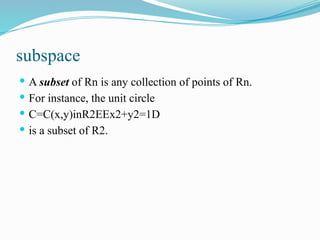
subspace
 A subset of Rn is any collection of points of Rn.
 For instance, the unit circle
 C=C(x,y)inR2EEx2+y2=1D
 is a subset of R2.
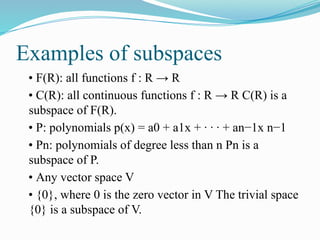
Examples of subspaces
• F(R): all functions f : R → R
• C(R): all continuous functions f : R → R C(R) is a
subspace of F(R).
• P: polynomials p(x) = a0 + a1x + · · · + an−1x n−1
• Pn: polynomials of degree less than n Pn is a
subspace of P.
• Any vector space V
• {0}, where 0 is the zero vector in V The trivial space
{0} is a subspace of V.
Interior of a set
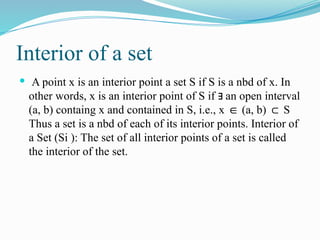
 A point x is an interior point a set S if S is a nbd of x. In
other words, x is an interior point of S if an open interval
∃
(a, b) containg x and contained in S, i.e., x (a, b) S
∈ ⊂
Thus a set is a nbd of each of its interior points. Interior of
a Set (Si ): The set of all interior points of a set is called
the interior of the set.
Open Sets
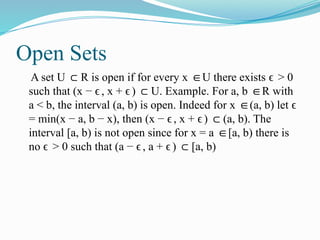
A set U R is open if for every x U there exists > 0
⊂ ∈ ϵ
such that (x − , x + ) U. Example. For a, b R with
ϵ ϵ ⊂ ∈
a < b, the interval (a, b) is open. Indeed for x (a, b) let
∈ ϵ
= min(x − a, b − x), then (x − , x + ) (a, b). The
ϵ ϵ ⊂
interval [a, b) is not open since for x = a [a, b) there is
∈
no > 0 such that (a − , a + ) [a, b)
ϵ ϵ ϵ ⊂
 Examples:
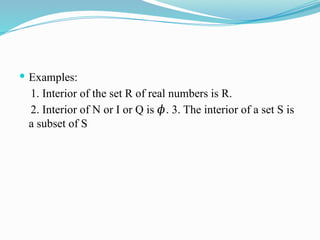
1. Interior of the set R of real numbers is R.
2. Interior of N or I or Q is . 3. The interior of a set S is
𝜙
a subset of S
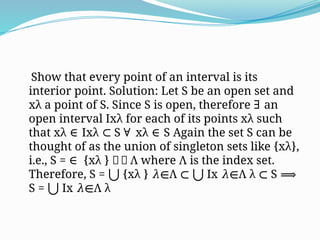
Show that every point of an interval is its
interior point. Solution: Let S be an open set and
xλ a point of S. Since S is open, therefore an
∃
open interval Ixλ for each of its points xλ such
that xλ Ixλ S xλ S Again the set S can be
∈ ⊂ ∀ ∈
thought of as the union of singleton sets like {xλ},
i.e., S = {xλ } 𝜆∈ Λ where Λ is the index set.
∈
Therefore, S = {xλ } Λ Ix Λ λ S
⋃ 𝜆∈ ⊂ ⋃ 𝜆∈ ⊂ ⟹
S = Ix Λ λ
⋃ 𝜆∈
Open Sets
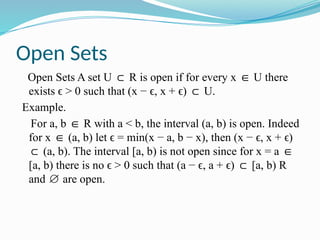
Open Sets A set U R is open if for every x U there
⊂ ∈
exists > 0 such that (x − , x + ) U.
ϵ ϵ ϵ ⊂
Example.
For a, b R with a < b, the interval (a, b) is open. Indeed
∈
for x (a, b) let = min(x − a, b − x), then (x − , x + )
∈ ϵ ϵ ϵ
(a, b). The interval [a, b) is not open since for x = a
⊂ ∈
[a, b) there is no > 0 such that (a − , a + ) [a, b) R
ϵ ϵ ϵ ⊂
and are open.
∅
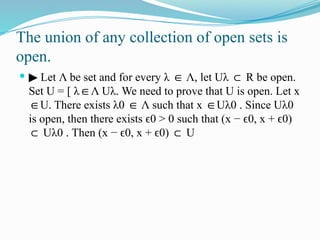
The union of any collection of open sets is
open.
 ▶ Let Λ be set and for every λ Λ,
∈ let Uλ ⊂ R be open.
Set U = [ λ Λ
∈ Uλ. We need to prove that U is open. Let x
U. There exists
∈ λ0 Λ
∈ such that x U
∈ λ0 . Since Uλ0
is open, then there exists 0 > 0
ϵ such that (x − 0,
ϵ x + 0)
ϵ
⊂ Uλ0 . Then (x − 0,
ϵ x + 0)
ϵ ⊂ U
closure
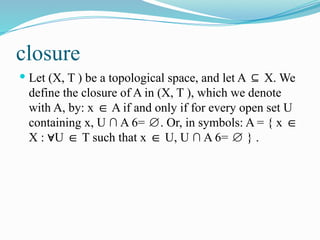
 Let (X, T ) be a topological space, and let A X. We
⊆
define the closure of A in (X, T ), which we denote
with A, by: x A if and only if for every open set U
∈
containing x, U ∩ A 6= . Or, in symbols: A = { x
∅ ∈
X : U T such that x U, U ∩ A 6= } .
∀ ∈ ∈ ∅
Limit point of a set
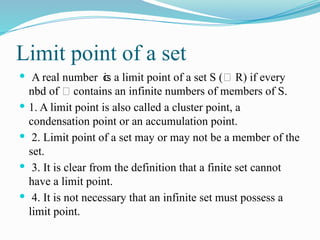
 A real number is a limit point of a set S (⊂ R) if every
⊂
nbd of 𝜉 contains an infinite numbers of members of S.
 1. A limit point is also called a cluster point, a
condensation point or an accumulation point.
 2. Limit point of a set may or may not be a member of the
set.
 3. It is clear from the definition that a finite set cannot
have a limit point.
 4. It is not necessary that an infinite set must possess a
limit point.
Dense set
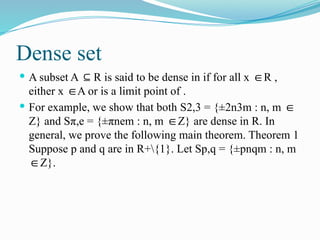
 A subset A R is said to be dense in if for all x R ,
⊆ ∈
either x A or is a limit point of .
∈
 For example, we show that both S2,3 = {±2n3m : n, m ∈
Z} and Sπ,e = {±πnem : n, m Z} are dense in R. In
∈
general, we prove the following main theorem. Theorem 1
Suppose p and q are in R+{1}. Let Sp,q = {±pnqm : n, m
Z}.
∈
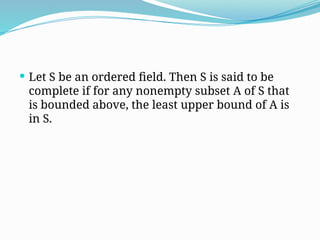
 Let S be an ordered field. Then S is said to be
complete if for any nonempty subset A of S that
is bounded above, the least upper bound of A is
in S.
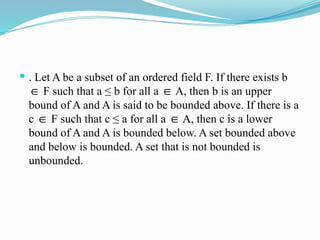
 . Let A be a subset of an ordered field F. If there exists b
F such that a ≤ b for all a A, then b is an upper
∈ ∈
bound of A and A is said to be bounded above. If there is a
c F such that c ≤ a for all a A, then c is a lower
∈ ∈
bound of A and A is bounded below. A set bounded above
and below is bounded. A set that is not bounded is
unbounded.
The Baire category theorem
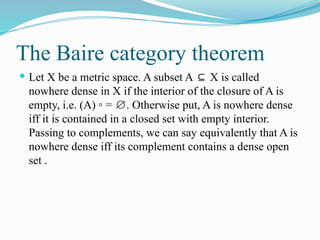
 Let X be a metric space. A subset A X is called
⊆
nowhere dense in X if the interior of the closure of A is
empty, i.e. (A) ◦ = . Otherwise put, A is nowhere dense
∅
iff it is contained in a closed set with empty interior.
Passing to complements, we can say equivalently that A is
nowhere dense iff its complement contains a dense open
set .
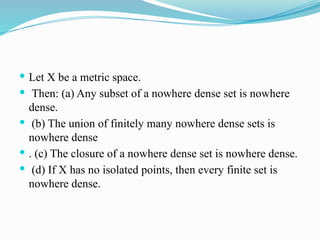
 Let X be a metric space.
 Then: (a) Any subset of a nowhere dense set is nowhere
dense.
 (b) The union of finitely many nowhere dense sets is
nowhere dense
 . (c) The closure of a nowhere dense set is nowhere dense.
 (d) If X has no isolated points, then every finite set is
nowhere dense.
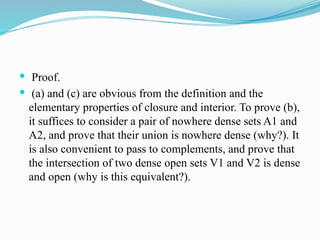
 Proof.
 (a) and (c) are obvious from the definition and the
elementary properties of closure and interior. To prove (b),
it suffices to consider a pair of nowhere dense sets A1 and
A2, and prove that their union is nowhere dense (why?). It
is also convenient to pass to complements, and prove that
the intersection of two dense open sets V1 and V2 is dense
and open (why is this equivalent?).
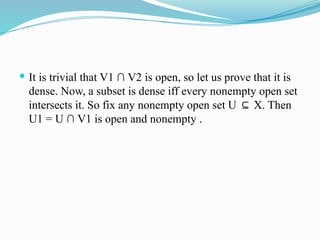
 It is trivial that V1 ∩ V2 is open, so let us prove that it is
dense. Now, a subset is dense iff every nonempty open set
intersects it. So fix any nonempty open set U X. Then
⊆
U1 = U ∩ V1 is open and nonempty .
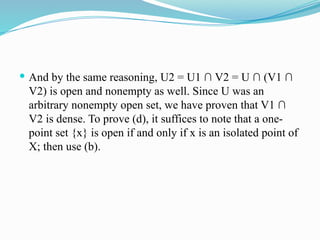
 And by the same reasoning, U2 = U1 ∩ V2 = U ∩ (V1 ∩
V2) is open and nonempty as well. Since U was an
arbitrary nonempty open set, we have proven that V1 ∩
V2 is dense. To prove (d), it suffices to note that a one-
point set {x} is open if and only if x is an isolated point of
X; then use (b).
THANK YOU

Unit -2 Real Analysis that explain the subspace, interior and closed set

  • 1.
    REAL ANALYSIS   PresentationPrepared by Ms. M.VIJAYALAKSHMI ., M.Sc., M.Ed ASSISTANT PROFESSOR DEPARTMENT OF MATHEMATICS SRI SARADA NIKETAN COLLEGE OF SCIENCE FOR WOMEN KARUR
  • 2.
    Unit -2 Subspace Interior ofa set closed sets Closure Limit point Dense sets Completeness Baire’s categary theorem
  • 3.
    subspace  A subsetof Rn is any collection of points of Rn.  For instance, the unit circle  C=C(x,y)inR2EEx2+y2=1D  is a subset of R2.
  • 4.
    Examples of subspaces •F(R): all functions f : R → R • C(R): all continuous functions f : R → R C(R) is a subspace of F(R). • P: polynomials p(x) = a0 + a1x + · · · + an−1x n−1 • Pn: polynomials of degree less than n Pn is a subspace of P. • Any vector space V • {0}, where 0 is the zero vector in V The trivial space {0} is a subspace of V.
  • 5.
    Interior of aset  A point x is an interior point a set S if S is a nbd of x. In other words, x is an interior point of S if an open interval ∃ (a, b) containg x and contained in S, i.e., x (a, b) S ∈ ⊂ Thus a set is a nbd of each of its interior points. Interior of a Set (Si ): The set of all interior points of a set is called the interior of the set.
  • 6.
    Open Sets A setU R is open if for every x U there exists > 0 ⊂ ∈ ϵ such that (x − , x + ) U. Example. For a, b R with ϵ ϵ ⊂ ∈ a < b, the interval (a, b) is open. Indeed for x (a, b) let ∈ ϵ = min(x − a, b − x), then (x − , x + ) (a, b). The ϵ ϵ ⊂ interval [a, b) is not open since for x = a [a, b) there is ∈ no > 0 such that (a − , a + ) [a, b) ϵ ϵ ϵ ⊂
  • 7.
     Examples: 1. Interiorof the set R of real numbers is R. 2. Interior of N or I or Q is . 3. The interior of a set S is 𝜙 a subset of S
  • 8.
    Show that everypoint of an interval is its interior point. Solution: Let S be an open set and xλ a point of S. Since S is open, therefore an ∃ open interval Ixλ for each of its points xλ such that xλ Ixλ S xλ S Again the set S can be ∈ ⊂ ∀ ∈ thought of as the union of singleton sets like {xλ}, i.e., S = {xλ } 𝜆∈ Λ where Λ is the index set. ∈ Therefore, S = {xλ } Λ Ix Λ λ S ⋃ 𝜆∈ ⊂ ⋃ 𝜆∈ ⊂ ⟹ S = Ix Λ λ ⋃ 𝜆∈
  • 9.
    Open Sets Open SetsA set U R is open if for every x U there ⊂ ∈ exists > 0 such that (x − , x + ) U. ϵ ϵ ϵ ⊂ Example. For a, b R with a < b, the interval (a, b) is open. Indeed ∈ for x (a, b) let = min(x − a, b − x), then (x − , x + ) ∈ ϵ ϵ ϵ (a, b). The interval [a, b) is not open since for x = a ⊂ ∈ [a, b) there is no > 0 such that (a − , a + ) [a, b) R ϵ ϵ ϵ ⊂ and are open. ∅
  • 10.
    The union ofany collection of open sets is open.  ▶ Let Λ be set and for every λ Λ, ∈ let Uλ ⊂ R be open. Set U = [ λ Λ ∈ Uλ. We need to prove that U is open. Let x U. There exists ∈ λ0 Λ ∈ such that x U ∈ λ0 . Since Uλ0 is open, then there exists 0 > 0 ϵ such that (x − 0, ϵ x + 0) ϵ ⊂ Uλ0 . Then (x − 0, ϵ x + 0) ϵ ⊂ U
  • 11.
    closure  Let (X,T ) be a topological space, and let A X. We ⊆ define the closure of A in (X, T ), which we denote with A, by: x A if and only if for every open set U ∈ containing x, U ∩ A 6= . Or, in symbols: A = { x ∅ ∈ X : U T such that x U, U ∩ A 6= } . ∀ ∈ ∈ ∅
  • 12.
    Limit point ofa set  A real number is a limit point of a set S (⊂ R) if every ⊂ nbd of 𝜉 contains an infinite numbers of members of S.  1. A limit point is also called a cluster point, a condensation point or an accumulation point.  2. Limit point of a set may or may not be a member of the set.  3. It is clear from the definition that a finite set cannot have a limit point.  4. It is not necessary that an infinite set must possess a limit point.
  • 13.
    Dense set  Asubset A R is said to be dense in if for all x R , ⊆ ∈ either x A or is a limit point of . ∈  For example, we show that both S2,3 = {±2n3m : n, m ∈ Z} and Sπ,e = {±πnem : n, m Z} are dense in R. In ∈ general, we prove the following main theorem. Theorem 1 Suppose p and q are in R+{1}. Let Sp,q = {±pnqm : n, m Z}. ∈
  • 14.
     Let Sbe an ordered field. Then S is said to be complete if for any nonempty subset A of S that is bounded above, the least upper bound of A is in S.
  • 15.
     . LetA be a subset of an ordered field F. If there exists b F such that a ≤ b for all a A, then b is an upper ∈ ∈ bound of A and A is said to be bounded above. If there is a c F such that c ≤ a for all a A, then c is a lower ∈ ∈ bound of A and A is bounded below. A set bounded above and below is bounded. A set that is not bounded is unbounded.
  • 16.
    The Baire categorytheorem  Let X be a metric space. A subset A X is called ⊆ nowhere dense in X if the interior of the closure of A is empty, i.e. (A) ◦ = . Otherwise put, A is nowhere dense ∅ iff it is contained in a closed set with empty interior. Passing to complements, we can say equivalently that A is nowhere dense iff its complement contains a dense open set .
  • 17.
     Let Xbe a metric space.  Then: (a) Any subset of a nowhere dense set is nowhere dense.  (b) The union of finitely many nowhere dense sets is nowhere dense  . (c) The closure of a nowhere dense set is nowhere dense.  (d) If X has no isolated points, then every finite set is nowhere dense.
  • 18.
     Proof.  (a)and (c) are obvious from the definition and the elementary properties of closure and interior. To prove (b), it suffices to consider a pair of nowhere dense sets A1 and A2, and prove that their union is nowhere dense (why?). It is also convenient to pass to complements, and prove that the intersection of two dense open sets V1 and V2 is dense and open (why is this equivalent?).
  • 19.
     It istrivial that V1 ∩ V2 is open, so let us prove that it is dense. Now, a subset is dense iff every nonempty open set intersects it. So fix any nonempty open set U X. Then ⊆ U1 = U ∩ V1 is open and nonempty .
  • 20.
     And bythe same reasoning, U2 = U1 ∩ V2 = U ∩ (V1 ∩ V2) is open and nonempty as well. Since U was an arbitrary nonempty open set, we have proven that V1 ∩ V2 is dense. To prove (d), it suffices to note that a one- point set {x} is open if and only if x is an isolated point of X; then use (b).
  • 21.