Hausdorff and Non-Hausdorff Spaces Mayra Ibarra MATH101
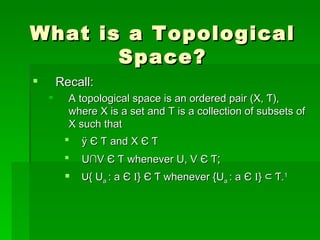
What is a Topological Space? Recall: A topological space is an ordered pair (X, Ƭ), where X is a set and T is a collection of subsets of X such that Ø  Є  Ƭ   and X  Є  Ƭ U ∩V  Є  Ƭ   whenever U, V  Є  Ƭ ; ∪ { U a  : a  Є   I }  Є  Ƭ whenever {U a  : a  Є   I }  ⊂ Ƭ. 1
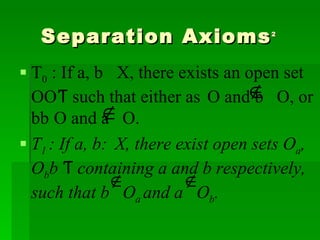
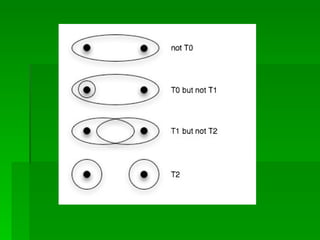
Separation Axioms 2   T 0  : If a, b ϵ X, there exists an open set O ϵ Ƭ   such that either a ϵ O and b  O, or b ϵ O and a  O. T 1  : If a, b ϵ X, there exist open sets O a , O b ϵ Ƭ   containing a and b respectively, such that b  O a  and a  O b .
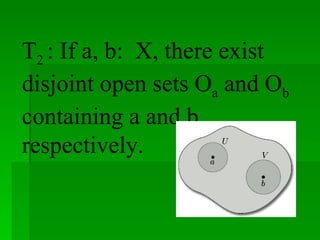
T 2  : If a, b ϵ X, there exist disjoint open sets O a  and O b  containing a and b respectively.
 
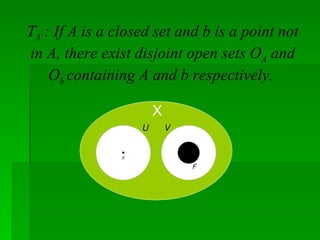
T 3  : If A is a closed set and b is a point not in A, there exist disjoint open sets O A  and O b  containing A and b respectively.  X
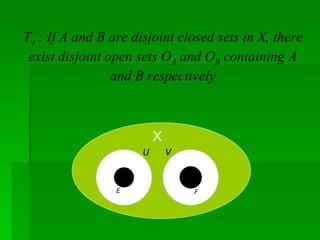
T 4  : If A and B are disjoint closed sets in X, there exist disjoint open sets O A  and O B  containing A and B respectively X
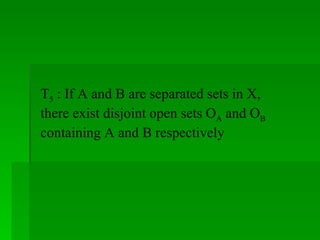
T 5  : If A and B are separated sets in X, there exist disjoint open sets O A  and O B  containing A and B respectively
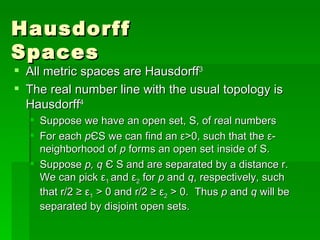
Hausdorff Spaces All metric spaces are Hausdorff 3 The real number line with the usual topology is Hausdorff 4 Suppose we have an open set, S, of real numbers For each  p Є S we can find an  ε >0, such that the  ε -neighborhood of  p  forms an open set inside of S.  Suppose  p, q   Є  S and are separated by a distance r.  We can pick  ε 1  and  ε 2  for  p  and  q , respectively, such that r/2 ≥  ε 1  > 0 and r/2 ≥  ε 2  > 0.  Thus  p  and  q  will be separated by disjoint open sets.
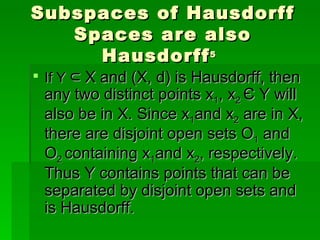
Subspaces of Hausdorff Spaces are also Hausdorff 5   If Y  ⊂ X and (X, d) is Hausdorff, then any two distinct points x 1 , x 2  Є  Y will also be in X. Since x 1 and x 2  are in X, there are disjoint open sets O 1  and O 2  containing x 1 and x 2 , respectively. Thus Y contains points that can be separated by disjoint open sets and is Hausdorff.
Non-Hausdorff Spaces Zariski Topology Let X be [0, 1]∪[2, 3]. Define the following equivalence relation on X: a ~ a + 2 for all 0 ≤ a ≤ 1 except for a = ½ b ~ b – 2  for 2 ≤ b ≤ 3 except for b = 5/2 [0] [1] 5/2 1/2
Proof: Notice that every point in [0, 1] is identified with a point of [2, 3] except fpr the two points ½ and 5/2, which remain unidentified. Thus are contained in X/~. A set in X/~ is open iff it is open in X. However, we see that there are no disjoint open sets that contain  ½ and 5/2. So X is Non-Hausdorff when considered under this equivalence relation.6
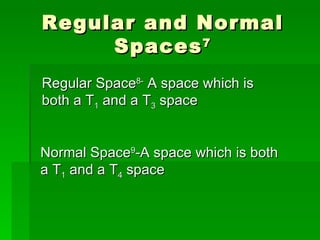
Regular and Normal Spaces 7 Regular Space 8-  A space which is both a T 1  and a T 3  space Normal Space 9 -A space which is both a T 1  and a T 4  space
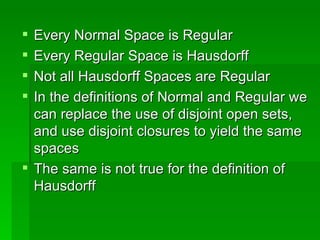
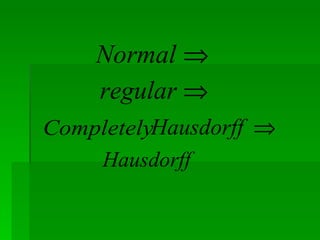
Every Normal Space is Regular Every Regular Space is Hausdorff Not all Hausdorff Spaces are Regular In the definitions of Normal and Regular we can replace the use of disjoint open sets, and use disjoint closures to yield the same spaces The same is not true for the definition of Hausdorff
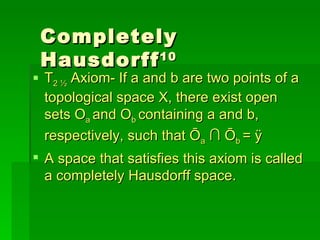
Completely Hausdorff 10   T 2 ½  Axiom- If a and b are two points of a topological space X, there exist open sets O a  and O b  containing a and b, respectively, such that Ō a   ∩  Ō b  = Ø A space that satisfies this axiom is called a completely Hausdorff space.
 
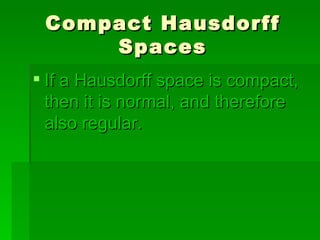
Compact Hausdorff Spaces If a Hausdorff space is compact, then it is normal, and therefore also regular.
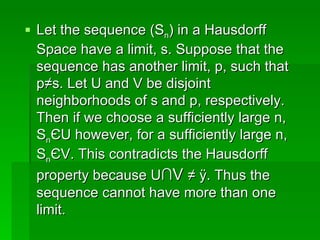
Let the sequence (S n ) in a Hausdorff Space have a limit, s. Suppose that the sequence has another limit, p, such that p≠s. Let U and V be disjoint neighborhoods of s and p, respectively. Then if we choose a sufficiently large n, S n Є U however, for a sufficiently large n, S n Є V. This contradicts the Hausdorff property because U ∩V  ≠ Ø. Thus the sequence cannot have more than one limit.
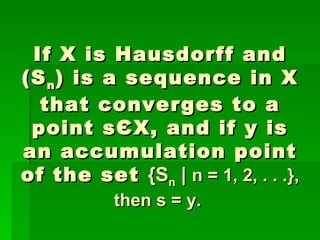
If X is Hausdorff and (S n ) is a sequence in X that converges to a point s Є X, and if y is an accumulation point of the set  {S n  |  n = 1, 2, . . .}, then s = y.
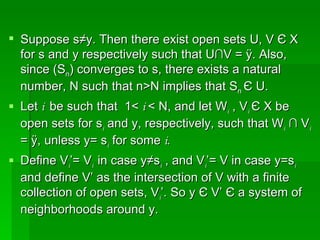
Suppose s≠y. Then there exist open sets U, V  Є  X  for s and y respectively such that U∩V = Ø. Also, since (S n ) converges to s, there exists a natural number, N such that n>N implies that S n  Є  U.  Let  i  be such that  1<  i  < N, and let W i  , V i   Є  X be open sets for s i  and y, respectively, such that W i  ∩ V i  = Ø, unless y= s i  for some  i. Define V i ’= V i  in case y≠s i  , and V i ’= V in case y=s i   and define V’ as the intersection of V with a finite collection of open sets, V i ’. So y  Є  V’  Є  a system of neighborhoods around y.
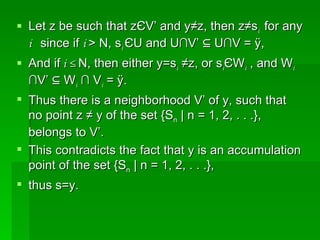
Let z be such that z Є V’ and y≠z, then z≠s i  for any  i  since if  i  > N, s i  Є U and U∩V’ ⊆ U∩V = Ø,  And if  i ≤  N, then either y=s i  ≠z, or s i Є W i  , and W i  ∩V’ ⊆ W i  ∩ V i  = Ø.  Thus there is a neighborhood V’ of y, such that no point z ≠ y of the set {S n  | n = 1, 2, . . .}, belongs to V’.  This contradicts the fact that y is an accumulation point of the set {S n  | n = 1, 2, . . .},  thus s=y.
Endnotes Greever, John.  Theory and Examples of Point-Set Topology.  Claremont: Waybread Publications, 1990.  Steen, Lynn Arthur and J. Arthur Seebach, Jr.  Counterexamples in Topology.  New York: Dover Publications Inc., 1995.  Image of axiom spaces: http://jtauber.com/2005/01/separation.png Sneddon, I. N. Ed. Andrew H. Wallace. “An Introduction To Algebraic Topology.”  International Series of Monographs in Pure and Applied Mathematics.  V.I. New York: Pergamon Press, 1957. Baum, John D.  Elements of Point Set Topology . New York: Dover Publications Inc., 1991  Sneddon, pg. 32. Goodman, Sue E.  Beginning Topology.  Belmont: Brooks/Cole, 2005.  Baum, pg. 81.  Image-http://en.wikipedia.org/wiki/Regular_space Image-http://commons.wikimedia.org/wiki/Image:Normal_space.svg Steen, pg. 13. Steen, pg. 13. Sneddon, pg. 31.

Hausdorff and Non-Hausdorff Spaces

  • 1.
    Hausdorff and Non-HausdorffSpaces Mayra Ibarra MATH101
  • 2.
    What is aTopological Space? Recall: A topological space is an ordered pair (X, Ƭ), where X is a set and T is a collection of subsets of X such that Ø Є Ƭ and X Є Ƭ U ∩V Є Ƭ whenever U, V Є Ƭ ; ∪ { U a : a Є I } Є Ƭ whenever {U a : a Є I } ⊂ Ƭ. 1
  • 3.
    Separation Axioms 2 T 0 : If a, b ϵ X, there exists an open set O ϵ Ƭ such that either a ϵ O and b O, or b ϵ O and a O. T 1 : If a, b ϵ X, there exist open sets O a , O b ϵ Ƭ containing a and b respectively, such that b O a and a O b .
  • 4.
    T 2 : If a, b ϵ X, there exist disjoint open sets O a and O b containing a and b respectively.
  • 5.
  • 6.
    T 3 : If A is a closed set and b is a point not in A, there exist disjoint open sets O A and O b containing A and b respectively. X
  • 7.
    T 4 : If A and B are disjoint closed sets in X, there exist disjoint open sets O A and O B containing A and B respectively X
  • 8.
    T 5 : If A and B are separated sets in X, there exist disjoint open sets O A and O B containing A and B respectively
  • 9.
    Hausdorff Spaces Allmetric spaces are Hausdorff 3 The real number line with the usual topology is Hausdorff 4 Suppose we have an open set, S, of real numbers For each p Є S we can find an ε >0, such that the ε -neighborhood of p forms an open set inside of S. Suppose p, q Є S and are separated by a distance r. We can pick ε 1 and ε 2 for p and q , respectively, such that r/2 ≥ ε 1 > 0 and r/2 ≥ ε 2 > 0. Thus p and q will be separated by disjoint open sets.
  • 10.
    Subspaces of HausdorffSpaces are also Hausdorff 5 If Y ⊂ X and (X, d) is Hausdorff, then any two distinct points x 1 , x 2 Є Y will also be in X. Since x 1 and x 2 are in X, there are disjoint open sets O 1 and O 2 containing x 1 and x 2 , respectively. Thus Y contains points that can be separated by disjoint open sets and is Hausdorff.
  • 11.
    Non-Hausdorff Spaces ZariskiTopology Let X be [0, 1]∪[2, 3]. Define the following equivalence relation on X: a ~ a + 2 for all 0 ≤ a ≤ 1 except for a = ½ b ~ b – 2 for 2 ≤ b ≤ 3 except for b = 5/2 [0] [1] 5/2 1/2
  • 12.
    Proof: Notice thatevery point in [0, 1] is identified with a point of [2, 3] except fpr the two points ½ and 5/2, which remain unidentified. Thus are contained in X/~. A set in X/~ is open iff it is open in X. However, we see that there are no disjoint open sets that contain ½ and 5/2. So X is Non-Hausdorff when considered under this equivalence relation.6
  • 13.
    Regular and NormalSpaces 7 Regular Space 8- A space which is both a T 1 and a T 3 space Normal Space 9 -A space which is both a T 1 and a T 4 space
  • 14.
    Every Normal Spaceis Regular Every Regular Space is Hausdorff Not all Hausdorff Spaces are Regular In the definitions of Normal and Regular we can replace the use of disjoint open sets, and use disjoint closures to yield the same spaces The same is not true for the definition of Hausdorff
  • 15.
    Completely Hausdorff 10 T 2 ½ Axiom- If a and b are two points of a topological space X, there exist open sets O a and O b containing a and b, respectively, such that Ō a ∩ Ō b = Ø A space that satisfies this axiom is called a completely Hausdorff space.
  • 16.
  • 17.
    Compact Hausdorff SpacesIf a Hausdorff space is compact, then it is normal, and therefore also regular.
  • 18.
    Let the sequence(S n ) in a Hausdorff Space have a limit, s. Suppose that the sequence has another limit, p, such that p≠s. Let U and V be disjoint neighborhoods of s and p, respectively. Then if we choose a sufficiently large n, S n Є U however, for a sufficiently large n, S n Є V. This contradicts the Hausdorff property because U ∩V ≠ Ø. Thus the sequence cannot have more than one limit.
  • 19.
    If X isHausdorff and (S n ) is a sequence in X that converges to a point s Є X, and if y is an accumulation point of the set {S n | n = 1, 2, . . .}, then s = y.
  • 20.
    Suppose s≠y. Thenthere exist open sets U, V Є X for s and y respectively such that U∩V = Ø. Also, since (S n ) converges to s, there exists a natural number, N such that n>N implies that S n Є U. Let i be such that 1< i < N, and let W i , V i Є X be open sets for s i and y, respectively, such that W i ∩ V i = Ø, unless y= s i for some i. Define V i ’= V i in case y≠s i , and V i ’= V in case y=s i and define V’ as the intersection of V with a finite collection of open sets, V i ’. So y Є V’ Є a system of neighborhoods around y.
  • 21.
    Let z besuch that z Є V’ and y≠z, then z≠s i for any i since if i > N, s i Є U and U∩V’ ⊆ U∩V = Ø, And if i ≤ N, then either y=s i ≠z, or s i Є W i , and W i ∩V’ ⊆ W i ∩ V i = Ø. Thus there is a neighborhood V’ of y, such that no point z ≠ y of the set {S n | n = 1, 2, . . .}, belongs to V’. This contradicts the fact that y is an accumulation point of the set {S n | n = 1, 2, . . .}, thus s=y.
  • 22.
    Endnotes Greever, John. Theory and Examples of Point-Set Topology. Claremont: Waybread Publications, 1990. Steen, Lynn Arthur and J. Arthur Seebach, Jr. Counterexamples in Topology. New York: Dover Publications Inc., 1995. Image of axiom spaces: http://jtauber.com/2005/01/separation.png Sneddon, I. N. Ed. Andrew H. Wallace. “An Introduction To Algebraic Topology.” International Series of Monographs in Pure and Applied Mathematics. V.I. New York: Pergamon Press, 1957. Baum, John D. Elements of Point Set Topology . New York: Dover Publications Inc., 1991 Sneddon, pg. 32. Goodman, Sue E. Beginning Topology. Belmont: Brooks/Cole, 2005. Baum, pg. 81. Image-http://en.wikipedia.org/wiki/Regular_space Image-http://commons.wikimedia.org/wiki/Image:Normal_space.svg Steen, pg. 13. Steen, pg. 13. Sneddon, pg. 31.