Pre-Hospital Capnography Dr Nick Foster  EMICS
Early Warning:  When do you want the patient’s parachute to open?   Capnography 4-10 minutes Pulse Oximetry Pulse Oximetry 30-60 seconds ECG ECG 10 seconds No monitor = free fall!
Physiology Carbon dioxide A Capnograph will show you second by second where you are with the patient by showing you The CO2 reading The CO2 waveform The Respiratory rate The Oxygen saturation The pulse rate Metabolism/Perfusion/Ventilation
Capnography   An EtCO 2  value of e.g..38mm/Hg   with a trace i s as diagnostic as an ECG T i m e 5 0 4 0 3 0 2 0 1 0 0
►  Application in clinical practice Objectives ►  How it works ►  The  physiology involved
► How it works
► CO 2  monitoring technology Capnometry:  the measurement and numerical display of the CO 2  level appearing in the airway Capnograpahy:  the measurement and  graphical display   of the CO 2  level appearing in the airway
► CO 2  monitoring technology Compares the amount of infrared light absorbed by a sample of expired CO 2  to a chamber with no CO 2 Infrared spectroscopy
► CO 2  monitoring technology Respiratory gases are continuously aspirated by a side port tube connection from the patients airway Sidestream sampling Advantages Able to monitor intubated and non-intubated patients Uses thin tubing therefore less dead space Less likely to become contaminated with moisture because it is away from the airway Uses a zero reference to keep the monitoring calibration
► CO 2  monitoring technology Sidestream sampling Disadvantages There is a lag time between sampling and measurement  Advances: faster response time If the patient is breathing rapidly, there may be contamination of the inhaled and exhaled gases and give a falsely low CO2 reading.  Advances: Lower sample rates now used The tubing can get obstructed by water and mucus Pre-hospital use is in its infancy
►  The physiology involved Physiology of Respiration Physiology of Metabolism
Physiology of metabolism An acidoisis makes the pH more acidic than usual An alkalosis makes the pH more alkaline than usual Metabolism Homeostasis.  The body tries to maintain a state of equilibrium despite everything we throw at it. Body pH range 71.-7.8, homeostasis is about 7.3 -7.4 A body pH of 7.2 called acidaemia A body pH of 7.5 called alkalaemia
Physiology of metabolism There are a number of acids in the body CO2 Lactic acid from cell activity if starved of oxygen. Complex chemical interactions that keep these in balance. These dangerous acids need to be removed Buffers: immediate CO2 production: minutes Renal excretion/Liver breakdown: days
Physiology of metabolism A balance exists ACID CO2 Tissues Lungs By looking at what goes into the body via the lungs (Oxygen) and what comes out (Carbon dioxide) you get a picture as to how damaged or ill the body is
Physiology of respiration a natural waste product of cellular activity Carbon dioxide
Oxygen  -> lungs -> alveoli -> blood muscles + organs Oxygen cells Oxygen Oxygen + Glucose energy CO 2 blood lungs CO 2 breath CO 2 Physiology of respiration Oxygen/Carbon dioxide interaction: Metabolism CO2 produced by cellular metabolism diffuses across the cell membrane into the circulating blood. 5-10% carried in solution 20-30% bound to haemoglobin 60-70% carried as bicarbonate in the red blood cell
O 2 CO 2 O 2 CO 2 CO 2 Physiology of respiration Oxygen/Carbon dioxide interaction: Perfusion and Ventilation Ventilation Perfusion
Oxygenation  = oxygen  ->  lungs ->  alveoli ->  blood Metabolism  = oxygen is converted to energy +    CO 2 CO 2  elimination   = CO 2   ->  blood ->  lungs ->  exhalation Physiology of respiration Ventilation Perfusion
METABOLISM PERFUSION VENTILATION So CO 2  levels provide evidence of three parameters going on the body Physiology What's happening at the cellular level How well the circulation is performing How well the lungs are working
METABOLISM PERFUSION VENTILATION Physiology If metabolism fails, acid forms (metabolic acid).  With severe shock, the patient becomes very “acidic” and very ill Metabolic acidosis This may be tolerated if circulation and oxygenation are maintained. The acid is converted to CO2 and this is blown off by the lungs
METABOLISM PERFUSION VENTILATION Physiology If the circulation is failing, this “acid” cannot be transported to the lungs and the patient becomes iller Metabolic acidosis CO2 cannot be removed from the lungs as it cannot get there. Your only hope is to get the circulation working more effectively
METABOLISM PERFUSION VENTILATION Physiology Carbon dioxide If the breathing is inadequate, CO2 accumulates in the blood and is converted to acid Respiratory acidosis By ventilating the patient, we can get rid of the excessive CO2 and thereby reduce the damage the “acid” in the blood is doing to the tissues
Physiology Metabolic acidosis Acid builds up (anaerobic metabolism) Tissue hypoxia  (anaemia, shock, severe infection, diabetic ketoacidosis) Renal failure Loss of body salts  (severe diarrhoea) Respiratory acidosis Hypoventilation: CO2 builds up Airway obstruction Central neuro : brain injury, stroke, opiates Periph neuro : spinal cord, MND Chest wall disease  (muscle, flail chest, trauma, pneumothorax COPD Pneumonia ,  Respiratory alkalosis Hyperventilation: CO2 blown off Anxiety states Asthma  -  low O2, low CO2 PE  - low O2, low CO2 BUT as exhaustion sets in -low O2 with rising CO2 Metabolic alkalosis Acid is lost Severe vomiting  (acid lost from stomach)
Capnography measurements
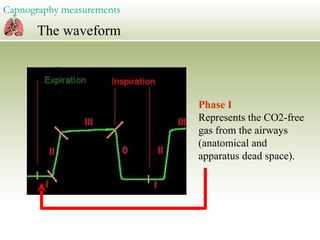
Normal waveform: Capnography measurements The waveform I just want you to look at the display first for a minute and then I will break the wave down into its constituent parts
Capnography measurements The waveform The lungs are composed of tissue involved in gas exchange (alveoli) and tubes connecting them to the outside world (bronchi, trachea). These tubes ARE NOT involved in gas exchange and is called dead space.
Capnography measurements The waveform Phase I Represents the CO2-free gas from the airways (anatomical and apparatus dead space).
Capnography measurements The waveform Phase II Consists of a rapid upswing on the tracing  (due to mixing of dead space gas with alveolar gas).
Capnography measurements The waveform Phase III Consists of an alveolar plateau representing CO2-rich gas from the alveoli. It almost always has a positive slope, indicating a rising PCO2
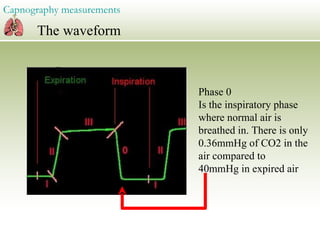
Capnography measurements The waveform Phase 0 Is the inspiratory phase where normal air is breathed in. There is only 0.36mmHg of CO2 in the air compared to 40mmHg in expired air
Capnography measurements The waveform
Normal waveform: Capnography measurements The waveform
Causes for a rise in end tidal CO 2 Fever  Hypercatabolic states Increased cardiac output  Increased blood pressure   Hypoventilation by patient Bronchial intubation (reduces the dead space) Rebreathing   Inadequate fresh gas flows Poor ventilation by Dr Faulty valves   Technical errors  Machine faults   Reduced Alveolar Ventilation   Increased Pulmonary perfusion   Increased CO2 output
Causes for a fall in end tidal CO 2 Hypothermia Hypocatabolic state (eg gross myxoedema) Reduced cardiac output  Hypotension Hypovolaemia Pulmonary embolism Cardiac arrest   Hyperventilation  Apnoea Airway blocked: obstruction, ET tube extubated   Circuit disconnection  Sampling tube leak Technical errors  Machine faults   Increased Alveolar Ventilation Reduced Pulmonary perfusion   Reduced CO2 output
Look for five characteristics of the waves, Height (normal = 38mmHg. Tall = high CO2, small = low CO2) Rate Rhythm (regular, getting bigger (or smaller) Base line (how wide it is) Shape of the wave Waveform analysis
Waveform analysis Hypoventilation  Base line at zero, but height is increased gradually Hyperventilation   Baseline at zero, but height is reduced gradually
Clinical applications
Intubated patients Applications
Intubation Verification of tube placement and monitoring ET placement during transport AND its dynamic (cf to a CO2 disc) 5-20% of tubes are misplaced either at the time of intubation or during transfer.  Applications Intubated patients
Cardiac arrest CO2 is a a measure of cardiac output. Because CO2 tracks cardiac output, capnography can show you how effective CPR is. It is the earliest sign of a returning circulation. It is even more effective than a pulse check PEA – an ECG with no endtidal CO2. Applications Intubated patients
Cardiac arrest and CPR Applications Intubated patients
Non-intubated patients Applications
Chest pain: MI or not an MI Chest pain + tachyarrhythmia with normal capnogrpahy: Pt stable Chest pain + tachyarrhytmia with CO2 at 10mmHg is about to have a cardiac arrest on you Applications Non-intubated patients
3 patients who are short of breath Who has asthma, who has COPD and who has CCF? Applications
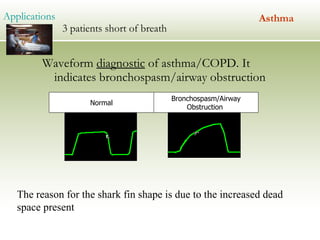
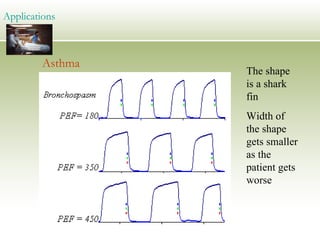
Waveform  diagnostic  of asthma/COPD. It indicates bronchospasm/airway obstruction Applications 3 patients short of breath Asthma The reason for the shark fin shape is due to the increased dead space present Bronchospasm/Airway Obstruction  Normal
Asthma Applications The shape is a shark fin Width of the shape gets smaller as the patient gets worse
Applications Worsening asthma This patient needs ventilatory assistance Note the narrow base and tachypnoea and rising CO2 3 patients short of breath Asthma
Applications Response to treatment with Terbutaline.  Indices return to normal. This patient has asthma: Diagnosis . 3 patients short of breath Asthma
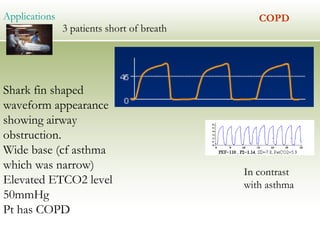
Applications COPD Shark fin shaped waveform appearance showing airway obstruction. Wide base (cf asthma which was narrow) Elevated ETCO2 level 50mmHg Pt has COPD In contrast with asthma 3 patients short of breath
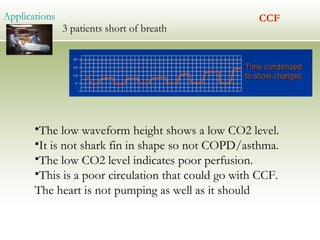
Applications CCF The low waveform height shows a low CO2 level.  It is not shark fin in shape so not COPD/asthma.  The low CO2 level indicates poor perfusion.  This is a poor circulation that could go with CCF. The heart is not pumping as well as it should 3 patients short of breath
Chest infection Applications
Chest infection Fever causes the CO2 level to go up and the pulse rate to go up The pneumonia causes the SpO2 level to go down Applications
Another patient with a chest infection Applications Endtidal CO2  27% SpO2  91 RR 30 Pulse 120 Seen by GP  5 days before and diagnosed flu. Fever for 6 days. Temp 104F, Left side chest sign, creps ++, increased breathsounds, Whisp pect,  Diagnosis left pneumonia in fact Legionella  developed empyema 4 days later.
Patient with pleuritic chest pain Applications Endtidal CO2  38 SpO2 99 on air RR 14 Pulse 80 Chest pain, pleuritic. 4 hours. ECG normal. Chest examination normal, normal percussion, normal breath sounds. Tender chest wall. Calves normal and no tenderness
RTA – M1 Car fire following RTA Applications Endtidal CO2  22 SpO2 – on 99% oxygen RR 23 Pulse 98 24 year old male, driver RTA car fire. Had to be pulled from the car by passers by.  Airway open, no carbonaceous material around mouth, nares clear. Breathing spontaneous, good A/E. Cap refill <2 radial pulse 110/80 GCS 14/15. No focal neurology. No obvious fracture
The unconscious patient Applications
Applications The unconscious patient Look for hypoventilation i.e. a high endtidal CO2 reading And a low respiratory rate
Applications The unconscious patient Sedation: Alcohol:  a drunk with a normal CO2 is stable. A drunk who is hypoventilating is at risk Drug ingestion:
Metabolic states   Applications
Applications Metabolic states With acidosis, the respiratory rate increases (e.g. diabetic ketoacidosis)
METABOLISM PERFUSION VENTILATION Physiology reminder If the circulation is failing, this “acid” cannot be transported to the lungs and the patient becomes iller Metabolic acidosis CO2 cannot be removed from the lungs as it cannot get there. Your only hope is to get the circulation working more effectively
Applications Metabolic states: a tale of two patient both with diabetic ketoacidosis Who is the sickest of the two? Patient A Endtidal CO2  30mmHg SpO2 100 RR 30 Pulse 120 Patient B Endtidal CO2  30mmHg SpO2 99 RR 10 Pulse 120
Applications Metabolic states A diabetic with a normal ETCO2 is not sick A diabetic with a low ETCO2 is a sick person.  An ETCO2 of 6mmHg is bordering on a cardiac arrest
Applications Metabolic states 55 year old male collapsed at home Endtidal CO2  24 SpO2 92 RR 10 Pulse 80 Alcoholic, Myxoedema ( had not taken  thyroxine for two years) very pale (Hb 2.4) BP 80/-, hepatic encephalopathy, jaundice, hypotensive. He died 3 days later This patient is very ill.
The head injured patient Applications
The head injured patient Midazolam light anaesthesia capnography  and assisted ventilation to maintain homeostasis Applications
Why is Pre-Hospital Capnography important
Why is Pre-Hospital Capnography important We cannot do anything about those who are going to die whatever we do. (Triage) However we should be able to recognise and prevent those who would otherwise die needlessly
Why is Pre-Hospital Capnography important Preventable needless deaths occur  Immediately at the time of injury Hypoxia and Airway obstruction Later following their injury Hypercarbia (too much CO 2  ) Acidaemia Cerebral vasodilation Hypoxia (not enough O 2  ) Hypoxic encephalopathy Cardiac arrest
Why is Pre-Hospital Capnography important Time is important. For every minute of “no pre-hospital resuscitation”, the risk of dying increases by 4.3%
Why is Pre-Hospital Capnography important Airway Breathing Circulation Scene Management The only thing about ABC is that it occurs at the beginning of the alphabet but it ain’t very practical and doesn't really help
Ilkeston 2330hrs head on RTA – four casualties three unconscious, one conscious but with a fractured L3 spine female GCS 7 SpO2 100  Pulse 120 Applications Real life incidents RR 10 End tidal CO2  72mmHg The ABC had been followed But as I arrived, she had her first fit capnography
Why is Pre-Hospital Capnography important Airway Breathing Circulation Scene Management Just because they are BREATHING, does NOT mean they are oxygenating and ventilating properly
Why is Pre-Hospital Capnography important Airway Breathing Circulation Scene Management and just because they have a CIRCULATION doesn’t mean the blood’s going to the right places or may even be going in the wrong direction.
Why is Pre-Hospital Capnography important Airway Breathing Circulation Scene Management So having caused you all to have sleepless nights, I would like to suggest an alternative concept
Why is Pre-Hospital Capnography important Airway Breathing Circulation Scene Management Ventilation Perfusion Capnography
Why is Pre-Hospital Capnography important Airway Ventilation Haemorrhage control Assisting the circulation Procedural sedation To facilitate extrication To facilitate manipulation Pre-hospital anaesthesia Severe trauma management is not ABC Perfusion Ventilation Airway
Beware……………….. The patient with the low CO2 and the low respiratory rate They could be about to die on you Take home tip
When do you want the parachute to open?   Capnography 4-10 minutes Pulse Oximetry Pulse Oximetry 30-60 seconds ECG ECG 10 seconds No monitor = free fall!

09 pre hospital capnography

  • 1.
    Pre-Hospital Capnography DrNick Foster EMICS
  • 2.
    Early Warning: When do you want the patient’s parachute to open? Capnography 4-10 minutes Pulse Oximetry Pulse Oximetry 30-60 seconds ECG ECG 10 seconds No monitor = free fall!
  • 3.
    Physiology Carbon dioxideA Capnograph will show you second by second where you are with the patient by showing you The CO2 reading The CO2 waveform The Respiratory rate The Oxygen saturation The pulse rate Metabolism/Perfusion/Ventilation
  • 4.
    Capnography An EtCO 2 value of e.g..38mm/Hg with a trace i s as diagnostic as an ECG T i m e 5 0 4 0 3 0 2 0 1 0 0
  • 5.
    ► Applicationin clinical practice Objectives ► How it works ► The physiology involved
  • 6.
  • 7.
    ► CO 2 monitoring technology Capnometry: the measurement and numerical display of the CO 2 level appearing in the airway Capnograpahy: the measurement and graphical display of the CO 2 level appearing in the airway
  • 8.
    ► CO 2 monitoring technology Compares the amount of infrared light absorbed by a sample of expired CO 2 to a chamber with no CO 2 Infrared spectroscopy
  • 9.
    ► CO 2 monitoring technology Respiratory gases are continuously aspirated by a side port tube connection from the patients airway Sidestream sampling Advantages Able to monitor intubated and non-intubated patients Uses thin tubing therefore less dead space Less likely to become contaminated with moisture because it is away from the airway Uses a zero reference to keep the monitoring calibration
  • 10.
    ► CO 2 monitoring technology Sidestream sampling Disadvantages There is a lag time between sampling and measurement Advances: faster response time If the patient is breathing rapidly, there may be contamination of the inhaled and exhaled gases and give a falsely low CO2 reading. Advances: Lower sample rates now used The tubing can get obstructed by water and mucus Pre-hospital use is in its infancy
  • 11.
    ► Thephysiology involved Physiology of Respiration Physiology of Metabolism
  • 12.
    Physiology of metabolismAn acidoisis makes the pH more acidic than usual An alkalosis makes the pH more alkaline than usual Metabolism Homeostasis. The body tries to maintain a state of equilibrium despite everything we throw at it. Body pH range 71.-7.8, homeostasis is about 7.3 -7.4 A body pH of 7.2 called acidaemia A body pH of 7.5 called alkalaemia
  • 13.
    Physiology of metabolismThere are a number of acids in the body CO2 Lactic acid from cell activity if starved of oxygen. Complex chemical interactions that keep these in balance. These dangerous acids need to be removed Buffers: immediate CO2 production: minutes Renal excretion/Liver breakdown: days
  • 14.
    Physiology of metabolismA balance exists ACID CO2 Tissues Lungs By looking at what goes into the body via the lungs (Oxygen) and what comes out (Carbon dioxide) you get a picture as to how damaged or ill the body is
  • 15.
    Physiology of respirationa natural waste product of cellular activity Carbon dioxide
  • 16.
    Oxygen ->lungs -> alveoli -> blood muscles + organs Oxygen cells Oxygen Oxygen + Glucose energy CO 2 blood lungs CO 2 breath CO 2 Physiology of respiration Oxygen/Carbon dioxide interaction: Metabolism CO2 produced by cellular metabolism diffuses across the cell membrane into the circulating blood. 5-10% carried in solution 20-30% bound to haemoglobin 60-70% carried as bicarbonate in the red blood cell
  • 17.
    O 2 CO2 O 2 CO 2 CO 2 Physiology of respiration Oxygen/Carbon dioxide interaction: Perfusion and Ventilation Ventilation Perfusion
  • 18.
    Oxygenation =oxygen -> lungs -> alveoli -> blood Metabolism = oxygen is converted to energy + CO 2 CO 2 elimination = CO 2 -> blood -> lungs -> exhalation Physiology of respiration Ventilation Perfusion
  • 19.
    METABOLISM PERFUSION VENTILATIONSo CO 2 levels provide evidence of three parameters going on the body Physiology What's happening at the cellular level How well the circulation is performing How well the lungs are working
  • 20.
    METABOLISM PERFUSION VENTILATIONPhysiology If metabolism fails, acid forms (metabolic acid). With severe shock, the patient becomes very “acidic” and very ill Metabolic acidosis This may be tolerated if circulation and oxygenation are maintained. The acid is converted to CO2 and this is blown off by the lungs
  • 21.
    METABOLISM PERFUSION VENTILATIONPhysiology If the circulation is failing, this “acid” cannot be transported to the lungs and the patient becomes iller Metabolic acidosis CO2 cannot be removed from the lungs as it cannot get there. Your only hope is to get the circulation working more effectively
  • 22.
    METABOLISM PERFUSION VENTILATIONPhysiology Carbon dioxide If the breathing is inadequate, CO2 accumulates in the blood and is converted to acid Respiratory acidosis By ventilating the patient, we can get rid of the excessive CO2 and thereby reduce the damage the “acid” in the blood is doing to the tissues
  • 23.
    Physiology Metabolic acidosisAcid builds up (anaerobic metabolism) Tissue hypoxia (anaemia, shock, severe infection, diabetic ketoacidosis) Renal failure Loss of body salts (severe diarrhoea) Respiratory acidosis Hypoventilation: CO2 builds up Airway obstruction Central neuro : brain injury, stroke, opiates Periph neuro : spinal cord, MND Chest wall disease (muscle, flail chest, trauma, pneumothorax COPD Pneumonia , Respiratory alkalosis Hyperventilation: CO2 blown off Anxiety states Asthma - low O2, low CO2 PE - low O2, low CO2 BUT as exhaustion sets in -low O2 with rising CO2 Metabolic alkalosis Acid is lost Severe vomiting (acid lost from stomach)
  • 24.
  • 25.
    Normal waveform: Capnographymeasurements The waveform I just want you to look at the display first for a minute and then I will break the wave down into its constituent parts
  • 26.
    Capnography measurements Thewaveform The lungs are composed of tissue involved in gas exchange (alveoli) and tubes connecting them to the outside world (bronchi, trachea). These tubes ARE NOT involved in gas exchange and is called dead space.
  • 27.
    Capnography measurements Thewaveform Phase I Represents the CO2-free gas from the airways (anatomical and apparatus dead space).
  • 28.
    Capnography measurements Thewaveform Phase II Consists of a rapid upswing on the tracing (due to mixing of dead space gas with alveolar gas).
  • 29.
    Capnography measurements Thewaveform Phase III Consists of an alveolar plateau representing CO2-rich gas from the alveoli. It almost always has a positive slope, indicating a rising PCO2
  • 30.
    Capnography measurements Thewaveform Phase 0 Is the inspiratory phase where normal air is breathed in. There is only 0.36mmHg of CO2 in the air compared to 40mmHg in expired air
  • 31.
  • 32.
    Normal waveform: Capnographymeasurements The waveform
  • 33.
    Causes for arise in end tidal CO 2 Fever Hypercatabolic states Increased cardiac output Increased blood pressure Hypoventilation by patient Bronchial intubation (reduces the dead space) Rebreathing Inadequate fresh gas flows Poor ventilation by Dr Faulty valves Technical errors Machine faults Reduced Alveolar Ventilation Increased Pulmonary perfusion Increased CO2 output
  • 34.
    Causes for afall in end tidal CO 2 Hypothermia Hypocatabolic state (eg gross myxoedema) Reduced cardiac output Hypotension Hypovolaemia Pulmonary embolism Cardiac arrest Hyperventilation Apnoea Airway blocked: obstruction, ET tube extubated Circuit disconnection Sampling tube leak Technical errors Machine faults Increased Alveolar Ventilation Reduced Pulmonary perfusion Reduced CO2 output
  • 35.
    Look for fivecharacteristics of the waves, Height (normal = 38mmHg. Tall = high CO2, small = low CO2) Rate Rhythm (regular, getting bigger (or smaller) Base line (how wide it is) Shape of the wave Waveform analysis
  • 36.
    Waveform analysis Hypoventilation Base line at zero, but height is increased gradually Hyperventilation Baseline at zero, but height is reduced gradually
  • 37.
  • 38.
  • 39.
    Intubation Verification oftube placement and monitoring ET placement during transport AND its dynamic (cf to a CO2 disc) 5-20% of tubes are misplaced either at the time of intubation or during transfer. Applications Intubated patients
  • 40.
    Cardiac arrest CO2is a a measure of cardiac output. Because CO2 tracks cardiac output, capnography can show you how effective CPR is. It is the earliest sign of a returning circulation. It is even more effective than a pulse check PEA – an ECG with no endtidal CO2. Applications Intubated patients
  • 41.
    Cardiac arrest andCPR Applications Intubated patients
  • 42.
  • 43.
    Chest pain: MIor not an MI Chest pain + tachyarrhythmia with normal capnogrpahy: Pt stable Chest pain + tachyarrhytmia with CO2 at 10mmHg is about to have a cardiac arrest on you Applications Non-intubated patients
  • 44.
    3 patients whoare short of breath Who has asthma, who has COPD and who has CCF? Applications
  • 45.
    Waveform diagnostic of asthma/COPD. It indicates bronchospasm/airway obstruction Applications 3 patients short of breath Asthma The reason for the shark fin shape is due to the increased dead space present Bronchospasm/Airway Obstruction Normal
  • 46.
    Asthma Applications Theshape is a shark fin Width of the shape gets smaller as the patient gets worse
  • 47.
    Applications Worsening asthmaThis patient needs ventilatory assistance Note the narrow base and tachypnoea and rising CO2 3 patients short of breath Asthma
  • 48.
    Applications Response totreatment with Terbutaline. Indices return to normal. This patient has asthma: Diagnosis . 3 patients short of breath Asthma
  • 49.
    Applications COPD Sharkfin shaped waveform appearance showing airway obstruction. Wide base (cf asthma which was narrow) Elevated ETCO2 level 50mmHg Pt has COPD In contrast with asthma 3 patients short of breath
  • 50.
    Applications CCF Thelow waveform height shows a low CO2 level. It is not shark fin in shape so not COPD/asthma. The low CO2 level indicates poor perfusion. This is a poor circulation that could go with CCF. The heart is not pumping as well as it should 3 patients short of breath
  • 51.
  • 52.
    Chest infection Fevercauses the CO2 level to go up and the pulse rate to go up The pneumonia causes the SpO2 level to go down Applications
  • 53.
    Another patient witha chest infection Applications Endtidal CO2 27% SpO2 91 RR 30 Pulse 120 Seen by GP 5 days before and diagnosed flu. Fever for 6 days. Temp 104F, Left side chest sign, creps ++, increased breathsounds, Whisp pect, Diagnosis left pneumonia in fact Legionella developed empyema 4 days later.
  • 54.
    Patient with pleuriticchest pain Applications Endtidal CO2 38 SpO2 99 on air RR 14 Pulse 80 Chest pain, pleuritic. 4 hours. ECG normal. Chest examination normal, normal percussion, normal breath sounds. Tender chest wall. Calves normal and no tenderness
  • 55.
    RTA – M1Car fire following RTA Applications Endtidal CO2 22 SpO2 – on 99% oxygen RR 23 Pulse 98 24 year old male, driver RTA car fire. Had to be pulled from the car by passers by. Airway open, no carbonaceous material around mouth, nares clear. Breathing spontaneous, good A/E. Cap refill <2 radial pulse 110/80 GCS 14/15. No focal neurology. No obvious fracture
  • 56.
  • 57.
    Applications The unconsciouspatient Look for hypoventilation i.e. a high endtidal CO2 reading And a low respiratory rate
  • 58.
    Applications The unconsciouspatient Sedation: Alcohol: a drunk with a normal CO2 is stable. A drunk who is hypoventilating is at risk Drug ingestion:
  • 59.
    Metabolic states Applications
  • 60.
    Applications Metabolic statesWith acidosis, the respiratory rate increases (e.g. diabetic ketoacidosis)
  • 61.
    METABOLISM PERFUSION VENTILATIONPhysiology reminder If the circulation is failing, this “acid” cannot be transported to the lungs and the patient becomes iller Metabolic acidosis CO2 cannot be removed from the lungs as it cannot get there. Your only hope is to get the circulation working more effectively
  • 62.
    Applications Metabolic states:a tale of two patient both with diabetic ketoacidosis Who is the sickest of the two? Patient A Endtidal CO2 30mmHg SpO2 100 RR 30 Pulse 120 Patient B Endtidal CO2 30mmHg SpO2 99 RR 10 Pulse 120
  • 63.
    Applications Metabolic statesA diabetic with a normal ETCO2 is not sick A diabetic with a low ETCO2 is a sick person. An ETCO2 of 6mmHg is bordering on a cardiac arrest
  • 64.
    Applications Metabolic states55 year old male collapsed at home Endtidal CO2 24 SpO2 92 RR 10 Pulse 80 Alcoholic, Myxoedema ( had not taken thyroxine for two years) very pale (Hb 2.4) BP 80/-, hepatic encephalopathy, jaundice, hypotensive. He died 3 days later This patient is very ill.
  • 65.
    The head injuredpatient Applications
  • 66.
    The head injuredpatient Midazolam light anaesthesia capnography and assisted ventilation to maintain homeostasis Applications
  • 67.
    Why is Pre-HospitalCapnography important
  • 68.
    Why is Pre-HospitalCapnography important We cannot do anything about those who are going to die whatever we do. (Triage) However we should be able to recognise and prevent those who would otherwise die needlessly
  • 69.
    Why is Pre-HospitalCapnography important Preventable needless deaths occur Immediately at the time of injury Hypoxia and Airway obstruction Later following their injury Hypercarbia (too much CO 2 ) Acidaemia Cerebral vasodilation Hypoxia (not enough O 2 ) Hypoxic encephalopathy Cardiac arrest
  • 70.
    Why is Pre-HospitalCapnography important Time is important. For every minute of “no pre-hospital resuscitation”, the risk of dying increases by 4.3%
  • 71.
    Why is Pre-HospitalCapnography important Airway Breathing Circulation Scene Management The only thing about ABC is that it occurs at the beginning of the alphabet but it ain’t very practical and doesn't really help
  • 72.
    Ilkeston 2330hrs headon RTA – four casualties three unconscious, one conscious but with a fractured L3 spine female GCS 7 SpO2 100 Pulse 120 Applications Real life incidents RR 10 End tidal CO2 72mmHg The ABC had been followed But as I arrived, she had her first fit capnography
  • 73.
    Why is Pre-HospitalCapnography important Airway Breathing Circulation Scene Management Just because they are BREATHING, does NOT mean they are oxygenating and ventilating properly
  • 74.
    Why is Pre-HospitalCapnography important Airway Breathing Circulation Scene Management and just because they have a CIRCULATION doesn’t mean the blood’s going to the right places or may even be going in the wrong direction.
  • 75.
    Why is Pre-HospitalCapnography important Airway Breathing Circulation Scene Management So having caused you all to have sleepless nights, I would like to suggest an alternative concept
  • 76.
    Why is Pre-HospitalCapnography important Airway Breathing Circulation Scene Management Ventilation Perfusion Capnography
  • 77.
    Why is Pre-HospitalCapnography important Airway Ventilation Haemorrhage control Assisting the circulation Procedural sedation To facilitate extrication To facilitate manipulation Pre-hospital anaesthesia Severe trauma management is not ABC Perfusion Ventilation Airway
  • 78.
    Beware……………….. The patientwith the low CO2 and the low respiratory rate They could be about to die on you Take home tip
  • 79.
    When do youwant the parachute to open? Capnography 4-10 minutes Pulse Oximetry Pulse Oximetry 30-60 seconds ECG ECG 10 seconds No monitor = free fall!