


Intralipid
Fat, Stat.
Jeff Hall, DO EM2
Capt, USAF
Criticism
• Alaska Women
• “Born in Oregon, Holly
Madison calls Prince
of Wales Island,
Alaska home!”
Case
• 58 yo M OR holding room - R torn rotator cuff
• PMHx: CAD, HTN, Angina
• PSHx: CABG 43 yo
• Meds: nitro prn, isosorbide mononitrate,
lisinopril, atenolol, clopidogrel, and asa
• Allergies: NKDA
• Pre-op ECG: RBBB, LAHB, old anterior wall MI
Case
• 120/80, 98% RA, HR: 60, T: 98.9, RR: 16
• O2 - 3 l/min NC, PIV – 20 gauge L hand
• 2 mg midazolam and 50 μg fentanyl
• 50-mm, 22-gauge stim needle - brachial
plexus
• 20ml bupivacaine, 0.5%
• 20ml mepivacaine, 1.5%
• No blood aspirated, no p/p
Case
• 30 s later - incoherent, tonic–clonic seizure
• What now?
• Oxygen, 50 mg propofol, seizure stopped
• 90 s later, seized again, 100 mg propofol
• ECG: asystole, no pulse, no BP
• What now?
Case
• ACLS
• Intubate
• 20 min - 3 mg epinephrine, 2 mg atropine,
300 mg amiodarone, 40 U vasopressin
– Monophasic defib 200, 300, 360 x2
– Primary rhythms- pulseless v-tach and asystole
Case
• What now?
• Call for help – colleagues, poison center
Case
• 20 min - 100 ml of 20% Intralipid IV, 360 J D-fib
• Single sinus beat, 1 dose atropine/epinephrine
• Within 15 s, SR 90, detectable BP and pulse
• Intralipid infusion 0.5 ml/kg/min x2 h then d/c’d
• Remained in SR, extubated 2.5h
• Awake/responsive, RUE weakness c/w block
• Disposition?
Case
• Overnight obs
• No complitactions 2 weeks following
• Cath’d 2/2 incr. cardiac markers s/p arrest
• Total RCA occlusion and EF 32%
• Defibrillator placed and d/c’d home
Intralipid: Goals
• Brief History
• *Mechanism
• Complications
• LAST
• Other toxicities
• Evidence
• *Applications
• *Our ED
• *Dose
Brief History
• IV fat - soybean oil, egg yolk phospholipids,
glycerin, and water
• ’98 - bupivacaine OD in rat study with
soybean oil – poss tx for cardiac toxicity
• ‘03 – bupivacaine toxicity in dogs undergoing
internal cardiac massage – IL recovered
• ’06 - isolated rat heart – bupivacaine
removed faster from cardiac muscle – IL
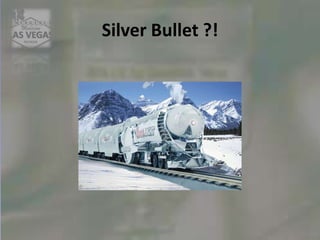
Silver Bullet ?!
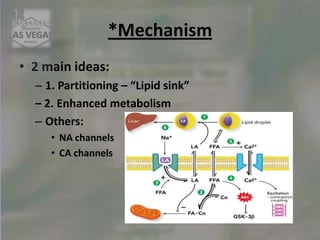
*Mechanism
• 2 main ideas:
– 1. Partitioning – “Lipid sink”
– 2. Enhanced metabolism
– Others:
• NA channels
• CA channels
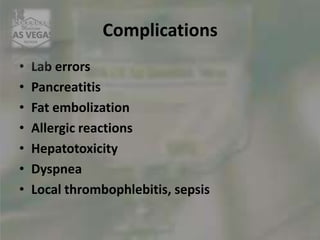
Complications
• Lab errors
• Pancreatitis
• Fat embolization
• Allergic reactions
• Hepatotoxicity
• Dyspnea
• Local thrombophlebitis, sepsis
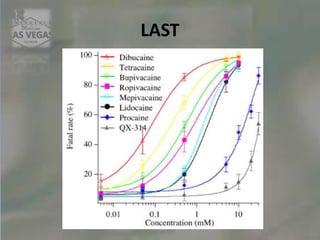
LAST
• Local anesthetic systemic toxicity
• ’06 case report – 1st published human use
• Case reports – witnessed, standard ACLS
failed, ROSC s/p lipid, underlying heart dz
– Most reports with bupivacaine toxicity
LAST
Lidocaine Toxicity
• Lightheadedness, dizzin
ess
• Headache
• Visual disturbance
• Perioral/tongue tingling
• Sedation
• Impaired
concentration
• Dysarthria
• Tinnitus
• Metallic taste
• Muscular twitching,
tremors
Lidocaine
• Intra-lipid rescue for CNS toxicity after
Lidocaine local for excision of breast mass
– 35 yo F - breast mass excised, 40cc of 1% lido w/o
– PACU – jerking motions UE/LE
– MS waning, tachycardic 110s
– Bolus 120cc 20% intralipid over 15min
– A+Ox3 end of bolus
– Infusion 0.25cc/kg/min over 1 hour
– No post-ictal/further comp, d/c’d 5 hours later
Lidocaine
• Intractable cardiac arrest due to lidocaine
toxicity successfully resuscitated with lipid
emulsion
– Prolonged lidocaine toxicity – pt ressusitated
with intralipid
– Consider intralipid in ACLS for lidocaine toxicity
as well as other lipid soluble drug intoxications
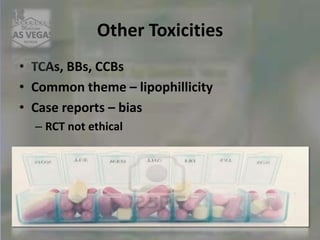
Other Toxicities
• TCAs, BBs, CCBs
• Common theme – lipophillicity
• Case reports – bias
– RCT not ethical
Evidence
• Cochrane – nada
• BestBets:
– TCA OD - no clear evidence about effectiveness
of Intralipid in TCA OD
– BB OD – same
– Reference Toxbase – Intralipid rec in TCA and BB
OD with cv collapse not responsive to stnd tx
Literature Review
• Lipid emulsions in the treatment of acute
poisoning: a systematic review of human and
animal studies. (Clinical Toxicology 2010)
– 23 animal trials, 50 human and 1 animal case rep
– Conclusion
• Weak evidence
• Suggest some benefits - bupivacaine, verapamil,
chlorpromazine, some TCAs and BBs
• Safety not established
Case Report
• 17 yo F sz and cv collapse s/p 7.95 g
bupropion & 4 g of lamotrigine (2008)
– ACLS x 70min unsuccessful
– 100-mL IV 20% lipid emulsion administered
– 1 min later – ROSC
– Pt suffered ALI but recovered with near-normal
neurologic function
*Applications
• Highly lipid soluble:
bupivacaine, ropivacaine, verapamil, propran
olol, TCAs
• Moderate lipid soluble:
bupropion, organophosphates
• Others: other CCBs, BBs, and LAs
*Applications
• ACLS
• Airway
• LA toxicity-> Intralipid
• TCA, BB, CCB -> stnd tx
• Failed tx -> Intralipid
*Our ED
• Not currently stocked
• Pharmacy – call, bedside in minutes
• Potential stock in future
• Shortage, use for dietary therapy
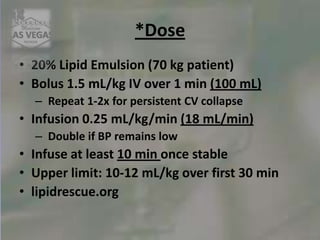
*Dose
• 20% Lipid Emulsion (70 kg patient)
• Bolus 1.5 mL/kg IV over 1 min (100 mL)
– Repeat 1-2x for persistent CV collapse
• Infusion 0.25 mL/kg/min (18 mL/min)
– Double if BP remains low
• Infuse at least 10 min once stable
• Upper limit: 10-12 mL/kg over first 30 min
• lipidrescue.org
Review
• Mechanism
• Current applications
• Where in our hospital
• Dose
Questions?
References
• 1. Weinberg GL, VadeBoncouer T, Ramaraju GA, Garcia-Amaro MF, Cwik MJ:
Pretreatment or resuscitation with a lipid infusion shifts the dose-response to
bupivacaine-induced asystole in rats. ANESTHESIOLOGY 1998; 88:1071–5
• 2. Weinberg GL, Ripper R, Murphy P, Edelman LB, Hoffman W, Strichartz G,
Feinstein DL: Lipid infusion accelerates removal of bupivacaine and recovery from
bupivacaine toxicity in the isolated rat heart. Reg Anesth Pain Med 2006; 31:296–
303
• 3. Weinberg G, Ripper R, Feinstein DL, Hoffman W: Lipid emulsion infusion rescues
dogs from bupivacaine-induced cardiac toxicity. Reg Anesth Pain Med 2003;
28:198–202
• 4. Rosenblatt MA, Abel M, Fischer GW, Itzkovich CJ, Eisenkraft JB: Successful use of
a 20% lipid emulsion to resuscitate a patient after a presumed bupivacaine-related
cardiac arrest. ANESTHESIOLOGY 2006; 105:217–8
• 5. Spence AG: Lipid reversal of central nervous system symptoms of bupivacaine
toxicity. ANESTHESIOLOGY 2007; 107:516–7
References
• 6. Rothschild L, Bern S, Oswald S, Weinberg G: Intravenous lipid emulsion in clinical
toxicology. Scand J Trauma Resusc Emerg Med 2010; 18:51
• 7. Sirianni AJ, Osterhoudt KC, Calello DP, Muller AA, Waterhouse MR, Goodkin MB,
Weinberg GL, Henretig FM: Use of lipid emulsion in the resuscitation of a patient
with prolonged cardiovascular collapse after overdose of bupropion and
lamotrigine. Ann Emerg Med 2008; 51:412–5, 415.e1
• 8. Weinberg G, Lin B, Zheng S, Di Gregorio G, Hiller D, Ripper R, Edelman L, Kelly K,
Feinstein D: Partitioning effect in lipid resuscitation: Further evidence for the lipid
sink. Crit Care Med 2010; 38:2268–9
• 9. http://bestbets.org/bets/bet.php?id=1939
• 10. http://bestbets.org/bets/bet.php?id=1934
• 11. Lipid Emulsion Infusion: Resuscitation for Local Anesthetic and Other Drug
Overdose. Anesthesiology: July 2012 - Volume 117 - Issue 1 - p 180–187. doi:
10.1097/ALN.0b013e31825ad8de

Intralipid

  • 1.
  • 2.
    Criticism • Alaska Women •“Born in Oregon, Holly Madison calls Prince of Wales Island, Alaska home!”
  • 3.
    Case • 58 yoM OR holding room - R torn rotator cuff • PMHx: CAD, HTN, Angina • PSHx: CABG 43 yo • Meds: nitro prn, isosorbide mononitrate, lisinopril, atenolol, clopidogrel, and asa • Allergies: NKDA • Pre-op ECG: RBBB, LAHB, old anterior wall MI
  • 4.
    Case • 120/80, 98%RA, HR: 60, T: 98.9, RR: 16 • O2 - 3 l/min NC, PIV – 20 gauge L hand • 2 mg midazolam and 50 μg fentanyl • 50-mm, 22-gauge stim needle - brachial plexus • 20ml bupivacaine, 0.5% • 20ml mepivacaine, 1.5% • No blood aspirated, no p/p
  • 5.
    Case • 30 slater - incoherent, tonic–clonic seizure • What now? • Oxygen, 50 mg propofol, seizure stopped • 90 s later, seized again, 100 mg propofol • ECG: asystole, no pulse, no BP • What now?
  • 6.
    Case • ACLS • Intubate •20 min - 3 mg epinephrine, 2 mg atropine, 300 mg amiodarone, 40 U vasopressin – Monophasic defib 200, 300, 360 x2 – Primary rhythms- pulseless v-tach and asystole
  • 7.
    Case • What now? •Call for help – colleagues, poison center
  • 8.
    Case • 20 min- 100 ml of 20% Intralipid IV, 360 J D-fib • Single sinus beat, 1 dose atropine/epinephrine • Within 15 s, SR 90, detectable BP and pulse • Intralipid infusion 0.5 ml/kg/min x2 h then d/c’d • Remained in SR, extubated 2.5h • Awake/responsive, RUE weakness c/w block • Disposition?
  • 9.
    Case • Overnight obs •No complitactions 2 weeks following • Cath’d 2/2 incr. cardiac markers s/p arrest • Total RCA occlusion and EF 32% • Defibrillator placed and d/c’d home
  • 10.
    Intralipid: Goals • BriefHistory • *Mechanism • Complications • LAST • Other toxicities • Evidence • *Applications • *Our ED • *Dose
  • 11.
    Brief History • IVfat - soybean oil, egg yolk phospholipids, glycerin, and water • ’98 - bupivacaine OD in rat study with soybean oil – poss tx for cardiac toxicity • ‘03 – bupivacaine toxicity in dogs undergoing internal cardiac massage – IL recovered • ’06 - isolated rat heart – bupivacaine removed faster from cardiac muscle – IL
  • 12.
  • 13.
    *Mechanism • 2 mainideas: – 1. Partitioning – “Lipid sink” – 2. Enhanced metabolism – Others: • NA channels • CA channels
  • 14.
    Complications • Lab errors •Pancreatitis • Fat embolization • Allergic reactions • Hepatotoxicity • Dyspnea • Local thrombophlebitis, sepsis
  • 15.
    LAST • Local anestheticsystemic toxicity • ’06 case report – 1st published human use • Case reports – witnessed, standard ACLS failed, ROSC s/p lipid, underlying heart dz – Most reports with bupivacaine toxicity
  • 16.
  • 17.
    Lidocaine Toxicity • Lightheadedness,dizzin ess • Headache • Visual disturbance • Perioral/tongue tingling • Sedation • Impaired concentration • Dysarthria • Tinnitus • Metallic taste • Muscular twitching, tremors
  • 18.
    Lidocaine • Intra-lipid rescuefor CNS toxicity after Lidocaine local for excision of breast mass – 35 yo F - breast mass excised, 40cc of 1% lido w/o – PACU – jerking motions UE/LE – MS waning, tachycardic 110s – Bolus 120cc 20% intralipid over 15min – A+Ox3 end of bolus – Infusion 0.25cc/kg/min over 1 hour – No post-ictal/further comp, d/c’d 5 hours later
  • 19.
    Lidocaine • Intractable cardiacarrest due to lidocaine toxicity successfully resuscitated with lipid emulsion – Prolonged lidocaine toxicity – pt ressusitated with intralipid – Consider intralipid in ACLS for lidocaine toxicity as well as other lipid soluble drug intoxications
  • 20.
    Other Toxicities • TCAs,BBs, CCBs • Common theme – lipophillicity • Case reports – bias – RCT not ethical
  • 21.
    Evidence • Cochrane –nada • BestBets: – TCA OD - no clear evidence about effectiveness of Intralipid in TCA OD – BB OD – same – Reference Toxbase – Intralipid rec in TCA and BB OD with cv collapse not responsive to stnd tx
  • 22.
    Literature Review • Lipidemulsions in the treatment of acute poisoning: a systematic review of human and animal studies. (Clinical Toxicology 2010) – 23 animal trials, 50 human and 1 animal case rep – Conclusion • Weak evidence • Suggest some benefits - bupivacaine, verapamil, chlorpromazine, some TCAs and BBs • Safety not established
  • 23.
    Case Report • 17yo F sz and cv collapse s/p 7.95 g bupropion & 4 g of lamotrigine (2008) – ACLS x 70min unsuccessful – 100-mL IV 20% lipid emulsion administered – 1 min later – ROSC – Pt suffered ALI but recovered with near-normal neurologic function
  • 24.
    *Applications • Highly lipidsoluble: bupivacaine, ropivacaine, verapamil, propran olol, TCAs • Moderate lipid soluble: bupropion, organophosphates • Others: other CCBs, BBs, and LAs
  • 25.
    *Applications • ACLS • Airway •LA toxicity-> Intralipid • TCA, BB, CCB -> stnd tx • Failed tx -> Intralipid
  • 26.
    *Our ED • Notcurrently stocked • Pharmacy – call, bedside in minutes • Potential stock in future • Shortage, use for dietary therapy
  • 27.
    *Dose • 20% LipidEmulsion (70 kg patient) • Bolus 1.5 mL/kg IV over 1 min (100 mL) – Repeat 1-2x for persistent CV collapse • Infusion 0.25 mL/kg/min (18 mL/min) – Double if BP remains low • Infuse at least 10 min once stable • Upper limit: 10-12 mL/kg over first 30 min • lipidrescue.org
  • 28.
    Review • Mechanism • Currentapplications • Where in our hospital • Dose
  • 29.
  • 30.
    References • 1. WeinbergGL, VadeBoncouer T, Ramaraju GA, Garcia-Amaro MF, Cwik MJ: Pretreatment or resuscitation with a lipid infusion shifts the dose-response to bupivacaine-induced asystole in rats. ANESTHESIOLOGY 1998; 88:1071–5 • 2. Weinberg GL, Ripper R, Murphy P, Edelman LB, Hoffman W, Strichartz G, Feinstein DL: Lipid infusion accelerates removal of bupivacaine and recovery from bupivacaine toxicity in the isolated rat heart. Reg Anesth Pain Med 2006; 31:296– 303 • 3. Weinberg G, Ripper R, Feinstein DL, Hoffman W: Lipid emulsion infusion rescues dogs from bupivacaine-induced cardiac toxicity. Reg Anesth Pain Med 2003; 28:198–202 • 4. Rosenblatt MA, Abel M, Fischer GW, Itzkovich CJ, Eisenkraft JB: Successful use of a 20% lipid emulsion to resuscitate a patient after a presumed bupivacaine-related cardiac arrest. ANESTHESIOLOGY 2006; 105:217–8 • 5. Spence AG: Lipid reversal of central nervous system symptoms of bupivacaine toxicity. ANESTHESIOLOGY 2007; 107:516–7
  • 31.
    References • 6. RothschildL, Bern S, Oswald S, Weinberg G: Intravenous lipid emulsion in clinical toxicology. Scand J Trauma Resusc Emerg Med 2010; 18:51 • 7. Sirianni AJ, Osterhoudt KC, Calello DP, Muller AA, Waterhouse MR, Goodkin MB, Weinberg GL, Henretig FM: Use of lipid emulsion in the resuscitation of a patient with prolonged cardiovascular collapse after overdose of bupropion and lamotrigine. Ann Emerg Med 2008; 51:412–5, 415.e1 • 8. Weinberg G, Lin B, Zheng S, Di Gregorio G, Hiller D, Ripper R, Edelman L, Kelly K, Feinstein D: Partitioning effect in lipid resuscitation: Further evidence for the lipid sink. Crit Care Med 2010; 38:2268–9 • 9. http://bestbets.org/bets/bet.php?id=1939 • 10. http://bestbets.org/bets/bet.php?id=1934 • 11. Lipid Emulsion Infusion: Resuscitation for Local Anesthetic and Other Drug Overdose. Anesthesiology: July 2012 - Volume 117 - Issue 1 - p 180–187. doi: 10.1097/ALN.0b013e31825ad8de