Design Methods
• Highway Pavements
AASHTO
The Asphalt Institute
Portland Cement Association

• Airfield Pavements
FAA
The Asphalt Institute
Portland Cement Association
U.S. Army Corps of Engineers

Objectives of Pavement Design
To provide a surface that is:

• Strong
Surface strength
Moisture control

• Smooth
• Safe
Friction
Drainage

• Economical
Initial construction cost
Recurring maintenance cost

1
Pavements are Designed
to Fail !!

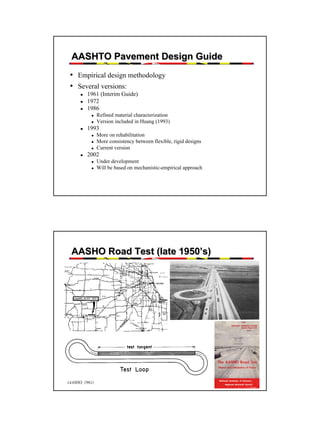
Pavement Design Methodologies
• Experience
• Empirical
Statistical models from road tests

• Mechanistic-Empirical
Calculation of pavement stresses/strains/deformations
Empirical pavement performance models

• Mechanistic
Calculation of pavement stresses/strains/deformations
Mechanics-based pavement performance models

2
Empirical vs. Mechanistic Design
P

d

L

Wood Floor Joist

Empirical “Rule of 2”:
d in inches= (L in feet / 2) + 2

Mechanistic: σbending =

PL
≤ σ allowable
4S

1993 Version

3
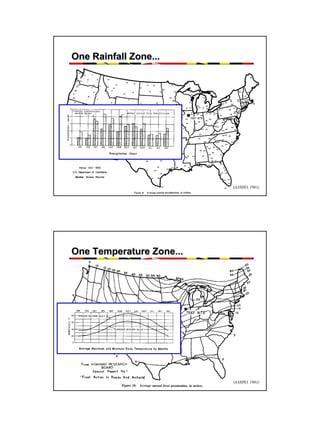
AASHTO Pavement Design Guide
• Empirical design methodology
• Several versions:
1961 (Interim Guide)
1972
1986
Refined material characterization
Version included in Huang (1993)

1993
More on rehabilitation
More consistency between flexible, rigid designs
Current version

2002
Under development
Will be based on mechanistic-empirical approach

AASHO Road Test (late 1950’s)

(AASHO, 1961)

4
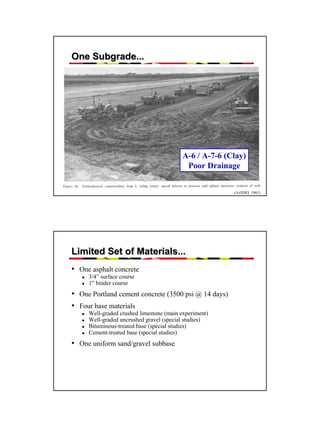
One Rainfall Zone...

(AASHO, 1961)

One Temperature Zone...

(AASHO, 1961)

5
One Subgrade...

A-6 / A-7-6 (Clay)
Poor Drainage
(AASHO, 1961)

Limited Set of Materials...
• One asphalt concrete
3/4” surface course
1” binder course

• One Portland cement concrete (3500 psi @ 14 days)
• Four base materials
Well-graded crushed limestone (main experiment)
Well-graded uncrushed gravel (special studies)
Bituminous-treated base (special studies)
Cement-treated base (special studies)

• One uniform sand/gravel subbase

6
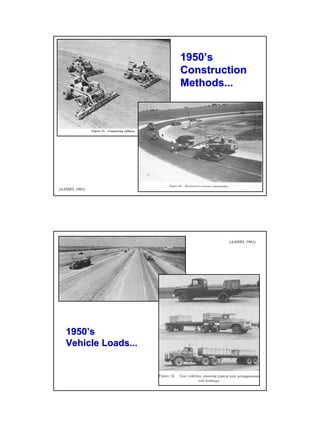
1950’s
Construction
Methods...

(AASHO, 1961)

(AASHO, 1961)

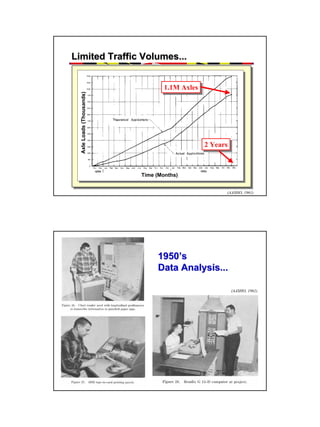
1950’s
Vehicle Loads...

7
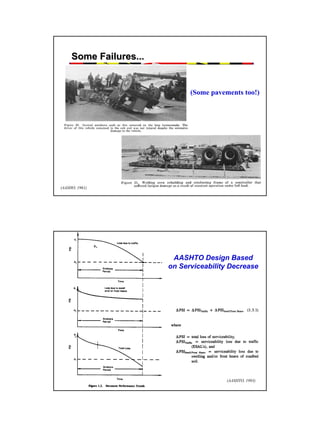
Axle Loads (Thousands)

Limited Traffic Volumes...
1.1M Axles
1.1M Axles

2 Years
2 Years

Time (Months)
(AASHO, 1961)

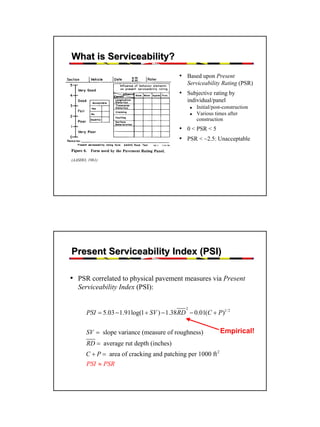
1950’s
Data Analysis...
(AASHO, 1961)

8
Some Failures...

(Some pavements too!)

(AASHO, 1961)

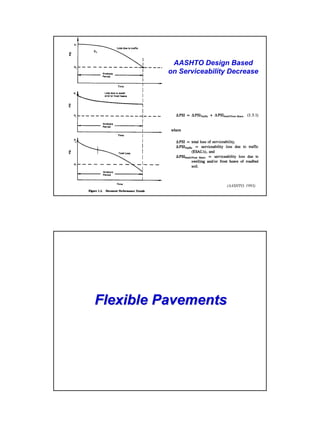
AASHTO Design Based
on Serviceability Decrease

(AASHTO, 1993)

9
What is Serviceability?
• Based upon Present
Serviceability Rating (PSR)

• Subjective rating by
individual/panel
Initial/post-construction
Various times after
construction

• 0 < PSR < 5
• PSR < ~2.5: Unacceptable
(AASHO, 1961)

Present Serviceability Index (PSI)
• PSR correlated to physical pavement measures via Present
Serviceability Index (PSI):
2

PSI = 5.03 − 1.91log(1 + SV ) − 1.38 RD − 0.01(C + P)1/ 2
SV = slope variance (measure of roughness)

Empirical!

RD = average rut depth (inches)
C + P = area of cracking and patching per 1000 ft 2
PSI ≈ PSR

10
AASHTO Design Guide (1993)
Part I: Pavement Design and Management
Principles
• Introduction and Background
• Design Related to Project Level Pavement Management
• Economic Evaluation of Alternative Design Strategies
• Reliability

AASHTO Design Guide (1993)
Part II: Pavement Design Procedures for New
Construction or Reconstruction
• Design Requirements
• Highway Pavement Structural Design
• Low-Volume Road Design

11
AASHTO Design Guide (1993)
Part III: Pavement Design Procedures for
Rehabilitation of Existing Pavements
• Rehabilitation Concepts
• Guides for Field Data Collection
• Rehabilitation Methods Other Than Overlay
• Rehabilitation Methods With Overlays

Design Scenarios
Included in
AASHTO Guide

(AASHTO, 1993)

12
AASHTO Design Based
on Serviceability Decrease

(AASHTO, 1993)

Flexible Pavements

13
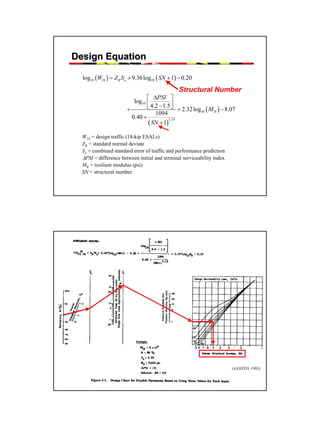
Design Equation
log10 (W18 ) = Z R So + 9.36 log10 ( SN + 1) − 0.20

Structural Number

 ∆PSI 
log10 
 4.2 − 1.5  + 2.32 log M − 8.07

+
10 (
R)
1094
0.40 +
5.19
( SN + 1)
W18 = design traffic (18-kip ESALs)
ZR = standard normal deviate
So = combined standard error of traffic and performance prediction
∆PSI = difference between initial and terminal serviceability index
MR = resilient modulus (psi)
SN = structural number

(AASHTO, 1993)

14
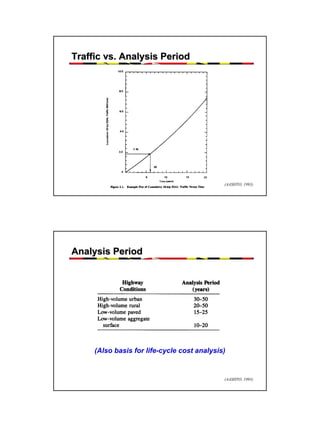
Traffic vs. Analysis Period

(AASHTO, 1993)

Analysis Period

(Also basis for life-cycle cost analysis)

(AASHTO, 1993)

15
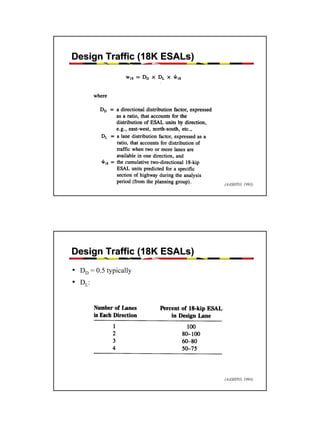
Design Traffic (18K ESALs)

(AASHTO, 1993)

Design Traffic (18K ESALs)
• DD = 0.5 typically
• DL:

(AASHTO, 1993)

16
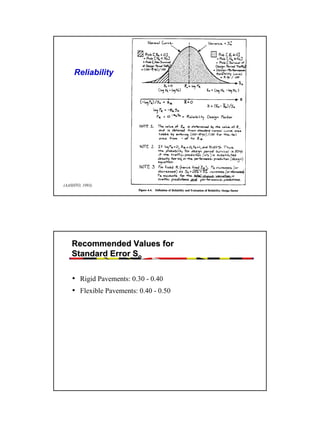
Reliability

(AASHTO, 1993)

Recommended Values for
Standard Error So

• Rigid Pavements: 0.30 - 0.40
• Flexible Pavements: 0.40 - 0.50

17
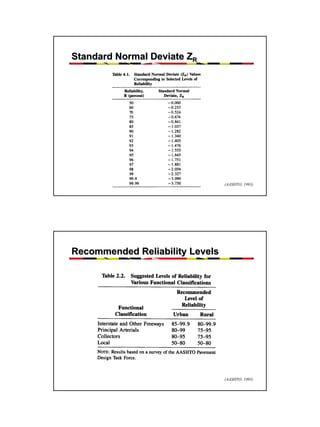
Standard Normal Deviate ZR

(AASHTO, 1993)

Recommended Reliability Levels

(AASHTO, 1993)

18
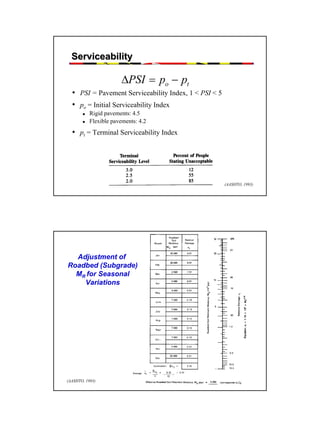
Serviceability

∆PSI = po − pt
• PSI = Pavement Serviceability Index, 1 < PSI < 5
• po = Initial Serviceability Index
Rigid pavements: 4.5
Flexible pavements: 4.2

• pt = Terminal Serviceability Index

(AASHTO, 1993)

Adjustment of
Roadbed (Subgrade)
MR for Seasonal
Variations

(AASHTO, 1993)

19
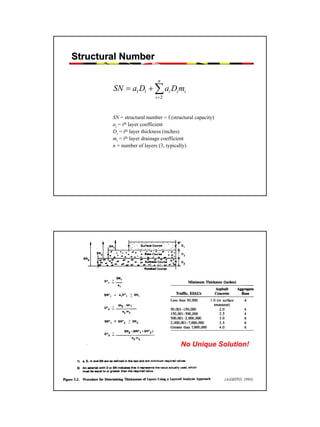
Structural Number
n

SN = a1 D1 + ∑ ai Di mi
i =2

SN = structural number = f (structural capacity)
ai = ith layer coefficient
Di = ith layer thickness (inches)
mi = ith layer drainage coefficient
n = number of layers (3, typically)

No Unique Solution!

(AASHTO, 1993)

20
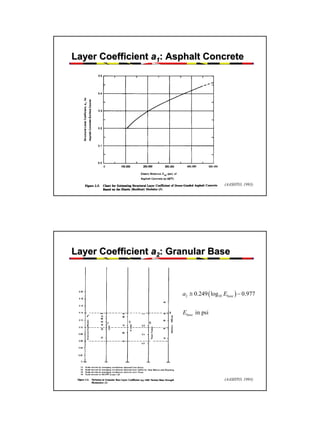
Layer Coefficient a1: Asphalt Concrete

(AASHTO, 1993)

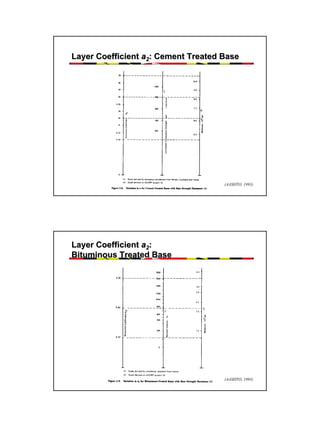
Layer Coefficient a2: Granular Base

a2 ≅ 0.249 ( log10 Ebase ) − 0.977
Ebase in psi

(AASHTO, 1993)

21
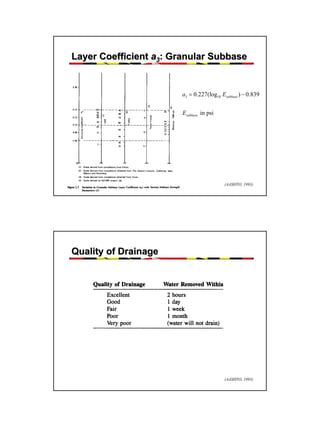
Layer Coefficient a2: Cement Treated Base

(AASHTO, 1993)

Layer Coefficient a2:
Bituminous Treated Base

(AASHTO, 1993)

22
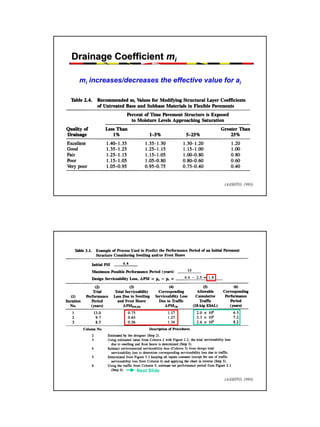
Layer Coefficient a3: Granular Subbase

a3 = 0.227(log10 Esubbase ) − 0.839
Esubbase in psi

(AASHTO, 1993)

Quality of Drainage

(AASHTO, 1993)

23
Drainage Coefficient mi
mi increases/decreases the effective value for ai

(AASHTO, 1993)

Next Slide
(AASHTO, 1993)

24
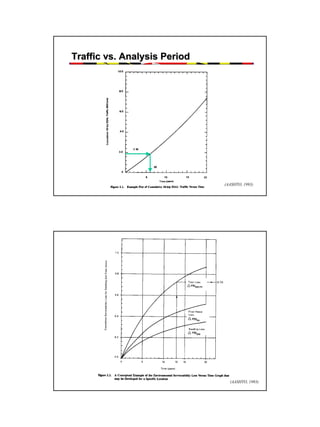
Traffic vs. Analysis Period

(AASHTO, 1993)

(AASHTO, 1993)

25
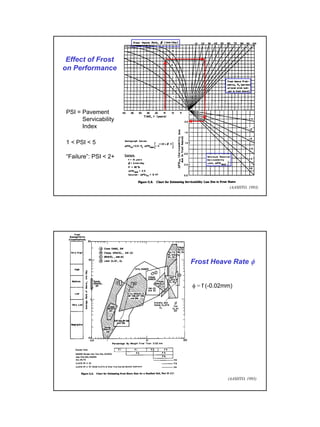
Effect of Frost
on Performance

PSI = Pavement
Servicability
Index
1 < PSI < 5
“Failure”: PSI < 2+

(AASHTO, 1993)

Frost Heave Rate φ
φ = f (-0.02mm)

(AASHTO, 1993)

26
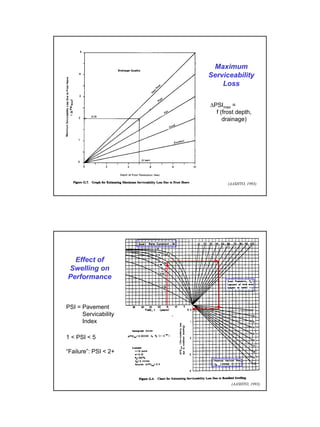
Maximum
Serviceability
Loss
∆PSImax =
f (frost depth,
drainage)

(AASHTO, 1993)

Effect of
Swelling on
Performance

PSI = Pavement
Servicability
Index
1 < PSI < 5
“Failure”: PSI < 2+

(AASHTO, 1993)

27
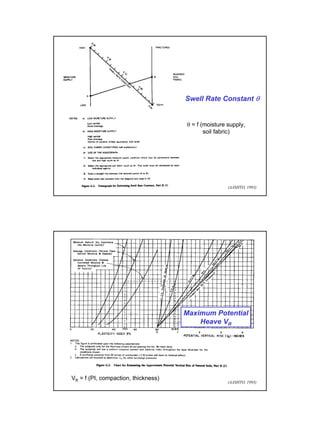
Swell Rate Constant θ

θ = f (moisture supply,
soil fabric)

(AASHTO, 1993)

Maximum Potential
Heave VR

VR = f (PI, compaction, thickness)

(AASHTO, 1993)

28
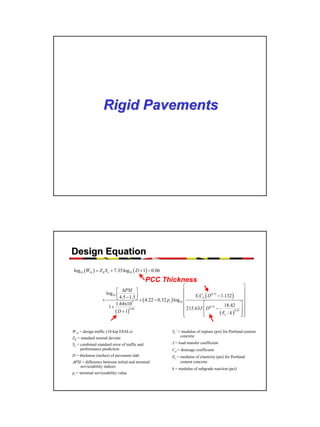
Rigid Pavements

Design Equation
log10 (W18 ) = Z R So + 7.35log10 ( D + 1) − 0.06

PCC Thickness



 ∆PSI 


log10 
'
0.75
S c Cd ( D − 1.132 )

 4.5 − 1.5  + 4.22 − 0.32 p log 

+
(

t)
10 
1.64x10⁷
 0.75

18.42

1+
8.46
215.63 J  D −

0.25

( D + 1)
( Ec / k )  





W18 = design traffic (18-kip ESALs)
ZR = standard normal deviate

Sc’ = modulus of rupture (psi) for Portland cement
concrete

So = combined standard error of traffic and
performance prediction

J = load transfer coefficient

D = thickness (inches) of pavement slab

Ec = modulus of elasticity (psi) for Portland
cement concrete

∆PSI = difference between initial and terminal
serviceability indices

pt = terminal serviceability value

Cd = drainage coefficient

k = modulus of subgrade reaction (pci)

29
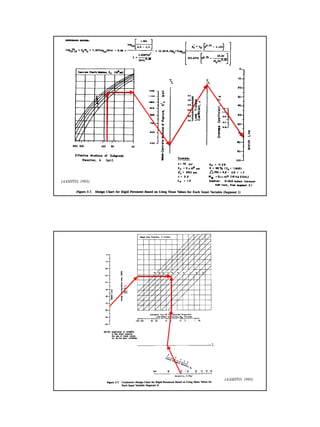
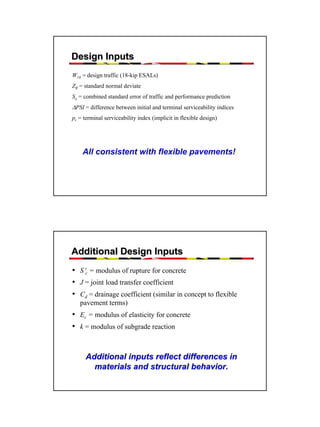
(AASHTO, 1993)

(AASHTO, 1993)

30
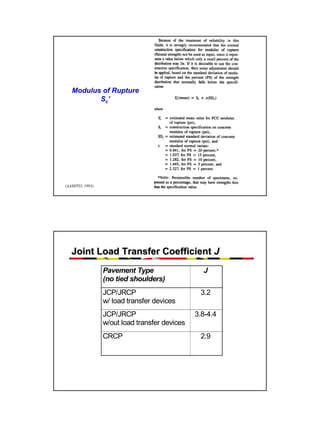
Design Inputs
W18 = design traffic (18-kip ESALs)
ZR = standard normal deviate
So = combined standard error of traffic and performance prediction

∆PSI = difference between initial and terminal serviceability indices
pt = terminal serviceability index (implicit in flexible design)

All consistent with flexible pavements!

Additional Design Inputs
• S′c = modulus of rupture for concrete
• J = joint load transfer coefficient
• Cd = drainage coefficient (similar in concept to flexible
pavement terms)

• Ec = modulus of elasticity for concrete
• k = modulus of subgrade reaction
Additional inputs reflect differences in
materials and structural behavior.

31
Modulus of Rupture
Sc’

(AASHTO, 1993)

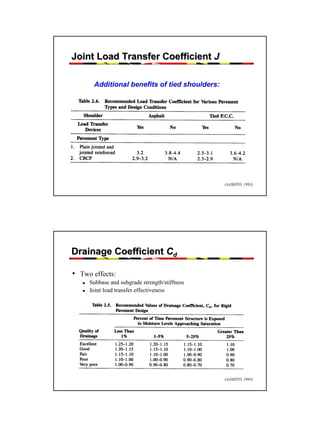
Joint Load Transfer Coefficient J
Pavement Type
(no tied shoulders)
JCP/JRCP
w/ load transfer devices
JCP/JRCP
w/out load transfer devices
CRCP

J
3.2
3.8-4.4
2.9

32
Joint Load Transfer Coefficient J
Additional benefits of tied shoulders:

(AASHTO, 1993)

Drainage Coefficient Cd
• Two effects:
Subbase and subgrade strength/stiffness
Joint load transfer effectiveness

(AASHTO, 1993)

33
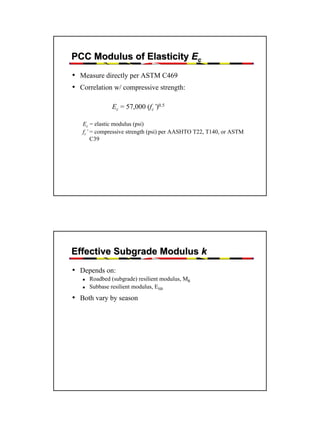
PCC Modulus of Elasticity Ec
• Measure directly per ASTM C469
• Correlation w/ compressive strength:
Ec = 57,000 (fc’)0.5
Ec = elastic modulus (psi)
fc’ = compressive strength (psi) per AASHTO T22, T140, or ASTM
C39

Effective Subgrade Modulus k
• Depends on:
Roadbed (subgrade) resilient modulus, MR
Subbase resilient modulus, ESB

• Both vary by season

34
Determining Effective k (See Table 3.2)
• Identify:
Subbase types
Subbase thicknesses
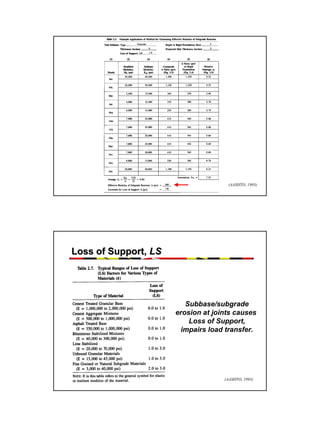
Loss of support, LS (erosion potential of subbase)
Depth to rigid foundation (feet)

• Assign roadbed soil resilient modulus (MR) for each season
• Assign subbase resilient modulus (ESB) for each season
15,000 psi (spring thaw) < ESB < 50,000 psi (winter freeze)
ESB < 4(MR)

(AASHTO, 1993)

35
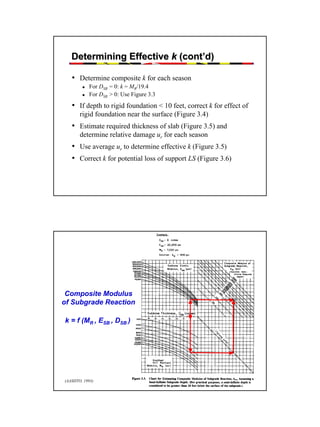
Determining Effective k (cont’d)
• Determine composite k for each season
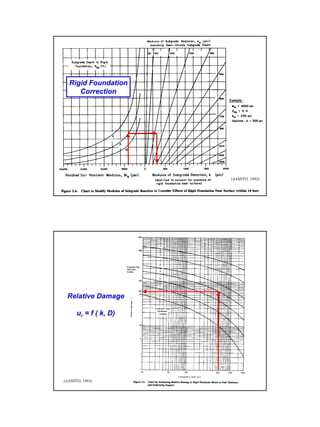
For DSB = 0: k = MR/19.4
For DSB > 0: Use Figure 3.3

• If depth to rigid foundation < 10 feet, correct k for effect of
rigid foundation near the surface (Figure 3.4)

• Estimate required thickness of slab (Figure 3.5) and
determine relative damage ur for each season

• Use average ur to determine effective k (Figure 3.5)
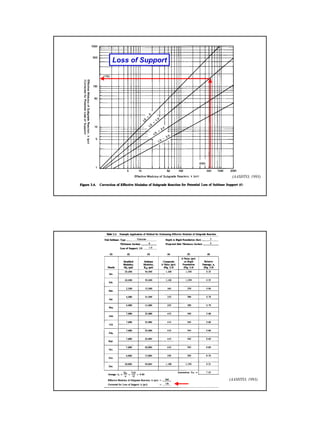
• Correct k for potential loss of support LS (Figure 3.6)

Composite Modulus
of Subgrade Reaction
k = f (MR , ESB , DSB )

(AASHTO, 1993)

36
Rigid Foundation
Correction

(AASHTO, 1993)

Relative Damage
ur = f ( k, D)

(AASHTO, 1993)

37
(AASHTO, 1993)

Loss of Support, LS

Subbase/subgrade
erosion at joints causes
Loss of Support,
impairs load transfer.

(AASHTO, 1993)

38
Loss of Support

(AASHTO, 1993)

(AASHTO, 1993)

39
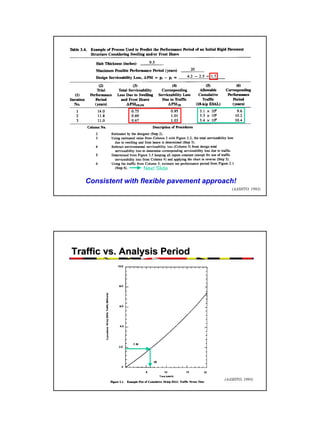
Next Slide

Consistent with flexible pavement approach!
(AASHTO, 1993)

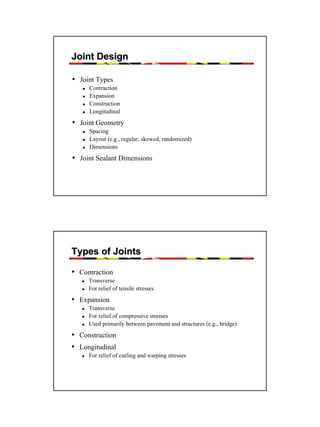
Traffic vs. Analysis Period

(AASHTO, 1993)
(AASHTO, 1993)

40
Joint Design
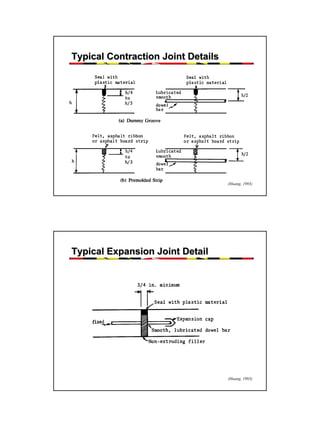
• Joint Types
Contraction
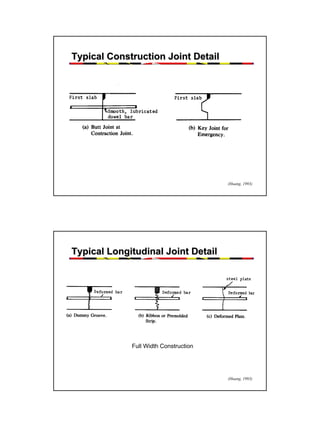
Expansion
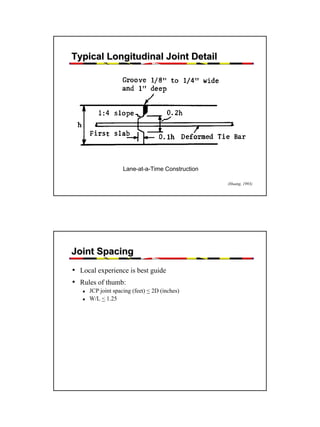
Construction
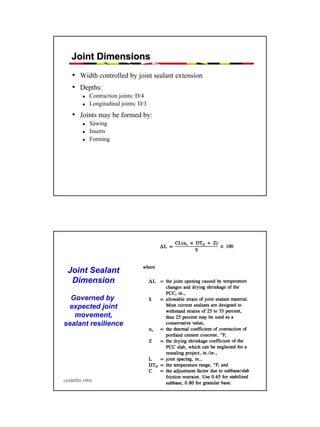
Longitudinal

• Joint Geometry
Spacing
Layout (e.g., regular, skewed, randomized)
Dimensions

• Joint Sealant Dimensions

Types of Joints
• Contraction
Transverse
For relief of tensile stresses

• Expansion
Transverse
For relief of compressive stresses
Used primarily between pavement and structures (e.g., bridge)

• Construction
• Longitudinal
For relief of curling and warping stresses

41
Typical Contraction Joint Details

(Huang, 1993)

Typical Expansion Joint Detail

(Huang, 1993)

42
Typical Construction Joint Detail

(Huang, 1993)

Typical Longitudinal Joint Detail

Full Width Construction

(Huang, 1993)

43
Typical Longitudinal Joint Detail

Lane-at-a-Time Construction
(Huang, 1993)

Joint Spacing
• Local experience is best guide
• Rules of thumb:
JCP joint spacing (feet) < 2D (inches)
W/L < 1.25

44
Joint Dimensions
• Width controlled by joint sealant extension
• Depths:
Contraction joints: D/4
Longitudinal joints: D/3

• Joints may be formed by:
Sawing
Inserts
Forming

Joint Sealant
Dimension
Governed by
expected joint
movement,
sealant resilience

(AASHTO, 1993)

45
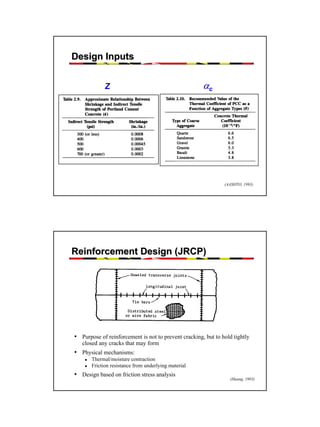
Design Inputs
Z

αc

(AASHTO, 1993)

Reinforcement Design (JRCP)

• Purpose of reinforcement is not to prevent cracking, but to hold tightly
closed any cracks that may form

• Physical mechanisms:
Thermal/moisture contraction
Friction resistance from underlying material

• Design based on friction stress analysis

(Huang, 1993)

46
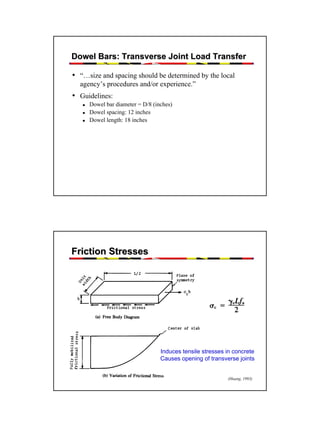
Dowel Bars: Transverse Joint Load Transfer

• “…size and spacing should be determined by the local
agency’s procedures and/or experience.”

• Guidelines:
Dowel bar diameter = D/8 (inches)
Dowel spacing: 12 inches
Dowel length: 18 inches

Friction Stresses

Induces tensile stresses in concrete
Causes opening of transverse joints
(Huang, 1993)

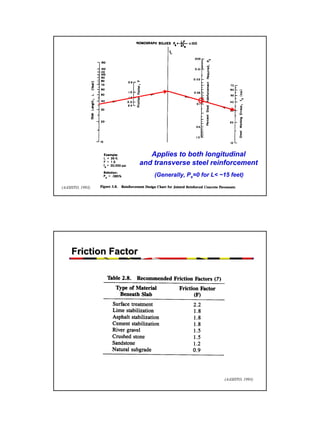
47
Applies to both longitudinal
and transverse steel reinforcement
(Generally, Ps=0 for L< ~15 feet)
(AASHTO, 1993)

Friction Factor

(AASHTO, 1993)

48
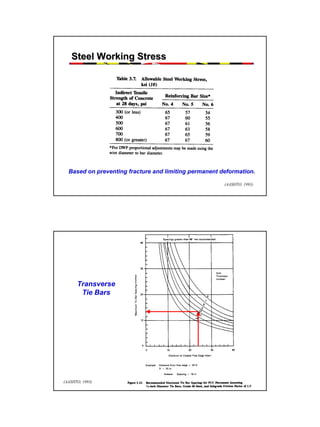
Steel Working Stress

Based on preventing fracture and limiting permanent deformation.
(AASHTO, 1993)

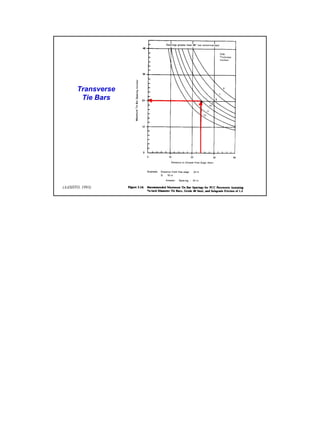
Transverse
Tie Bars

(AASHTO, 1993)

49
Transverse
Tie Bars

(AASHTO, 1993)

50

Aashto design

  • 1.
    Design Methods • HighwayPavements AASHTO The Asphalt Institute Portland Cement Association • Airfield Pavements FAA The Asphalt Institute Portland Cement Association U.S. Army Corps of Engineers Objectives of Pavement Design To provide a surface that is: • Strong Surface strength Moisture control • Smooth • Safe Friction Drainage • Economical Initial construction cost Recurring maintenance cost 1
  • 2.
    Pavements are Designed toFail !! Pavement Design Methodologies • Experience • Empirical Statistical models from road tests • Mechanistic-Empirical Calculation of pavement stresses/strains/deformations Empirical pavement performance models • Mechanistic Calculation of pavement stresses/strains/deformations Mechanics-based pavement performance models 2
  • 3.
    Empirical vs. MechanisticDesign P d L Wood Floor Joist Empirical “Rule of 2”: d in inches= (L in feet / 2) + 2 Mechanistic: σbending = PL ≤ σ allowable 4S 1993 Version 3
  • 4.
    AASHTO Pavement DesignGuide • Empirical design methodology • Several versions: 1961 (Interim Guide) 1972 1986 Refined material characterization Version included in Huang (1993) 1993 More on rehabilitation More consistency between flexible, rigid designs Current version 2002 Under development Will be based on mechanistic-empirical approach AASHO Road Test (late 1950’s) (AASHO, 1961) 4
  • 5.
    One Rainfall Zone... (AASHO,1961) One Temperature Zone... (AASHO, 1961) 5
  • 6.
    One Subgrade... A-6 /A-7-6 (Clay) Poor Drainage (AASHO, 1961) Limited Set of Materials... • One asphalt concrete 3/4” surface course 1” binder course • One Portland cement concrete (3500 psi @ 14 days) • Four base materials Well-graded crushed limestone (main experiment) Well-graded uncrushed gravel (special studies) Bituminous-treated base (special studies) Cement-treated base (special studies) • One uniform sand/gravel subbase 6
  • 7.
  • 8.
    Axle Loads (Thousands) LimitedTraffic Volumes... 1.1M Axles 1.1M Axles 2 Years 2 Years Time (Months) (AASHO, 1961) 1950’s Data Analysis... (AASHO, 1961) 8
  • 9.
    Some Failures... (Some pavementstoo!) (AASHO, 1961) AASHTO Design Based on Serviceability Decrease (AASHTO, 1993) 9
  • 10.
    What is Serviceability? •Based upon Present Serviceability Rating (PSR) • Subjective rating by individual/panel Initial/post-construction Various times after construction • 0 < PSR < 5 • PSR < ~2.5: Unacceptable (AASHO, 1961) Present Serviceability Index (PSI) • PSR correlated to physical pavement measures via Present Serviceability Index (PSI): 2 PSI = 5.03 − 1.91log(1 + SV ) − 1.38 RD − 0.01(C + P)1/ 2 SV = slope variance (measure of roughness) Empirical! RD = average rut depth (inches) C + P = area of cracking and patching per 1000 ft 2 PSI ≈ PSR 10
  • 11.
    AASHTO Design Guide(1993) Part I: Pavement Design and Management Principles • Introduction and Background • Design Related to Project Level Pavement Management • Economic Evaluation of Alternative Design Strategies • Reliability AASHTO Design Guide (1993) Part II: Pavement Design Procedures for New Construction or Reconstruction • Design Requirements • Highway Pavement Structural Design • Low-Volume Road Design 11
  • 12.
    AASHTO Design Guide(1993) Part III: Pavement Design Procedures for Rehabilitation of Existing Pavements • Rehabilitation Concepts • Guides for Field Data Collection • Rehabilitation Methods Other Than Overlay • Rehabilitation Methods With Overlays Design Scenarios Included in AASHTO Guide (AASHTO, 1993) 12
  • 13.
    AASHTO Design Based onServiceability Decrease (AASHTO, 1993) Flexible Pavements 13
  • 14.
    Design Equation log10 (W18) = Z R So + 9.36 log10 ( SN + 1) − 0.20 Structural Number  ∆PSI  log10   4.2 − 1.5  + 2.32 log M − 8.07  + 10 ( R) 1094 0.40 + 5.19 ( SN + 1) W18 = design traffic (18-kip ESALs) ZR = standard normal deviate So = combined standard error of traffic and performance prediction ∆PSI = difference between initial and terminal serviceability index MR = resilient modulus (psi) SN = structural number (AASHTO, 1993) 14
  • 15.
    Traffic vs. AnalysisPeriod (AASHTO, 1993) Analysis Period (Also basis for life-cycle cost analysis) (AASHTO, 1993) 15
  • 16.
    Design Traffic (18KESALs) (AASHTO, 1993) Design Traffic (18K ESALs) • DD = 0.5 typically • DL: (AASHTO, 1993) 16
  • 17.
    Reliability (AASHTO, 1993) Recommended Valuesfor Standard Error So • Rigid Pavements: 0.30 - 0.40 • Flexible Pavements: 0.40 - 0.50 17
  • 18.
    Standard Normal DeviateZR (AASHTO, 1993) Recommended Reliability Levels (AASHTO, 1993) 18
  • 19.
    Serviceability ∆PSI = po− pt • PSI = Pavement Serviceability Index, 1 < PSI < 5 • po = Initial Serviceability Index Rigid pavements: 4.5 Flexible pavements: 4.2 • pt = Terminal Serviceability Index (AASHTO, 1993) Adjustment of Roadbed (Subgrade) MR for Seasonal Variations (AASHTO, 1993) 19
  • 20.
    Structural Number n SN =a1 D1 + ∑ ai Di mi i =2 SN = structural number = f (structural capacity) ai = ith layer coefficient Di = ith layer thickness (inches) mi = ith layer drainage coefficient n = number of layers (3, typically) No Unique Solution! (AASHTO, 1993) 20
  • 21.
    Layer Coefficient a1:Asphalt Concrete (AASHTO, 1993) Layer Coefficient a2: Granular Base a2 ≅ 0.249 ( log10 Ebase ) − 0.977 Ebase in psi (AASHTO, 1993) 21
  • 22.
    Layer Coefficient a2:Cement Treated Base (AASHTO, 1993) Layer Coefficient a2: Bituminous Treated Base (AASHTO, 1993) 22
  • 23.
    Layer Coefficient a3:Granular Subbase a3 = 0.227(log10 Esubbase ) − 0.839 Esubbase in psi (AASHTO, 1993) Quality of Drainage (AASHTO, 1993) 23
  • 24.
    Drainage Coefficient mi miincreases/decreases the effective value for ai (AASHTO, 1993) Next Slide (AASHTO, 1993) 24
  • 25.
    Traffic vs. AnalysisPeriod (AASHTO, 1993) (AASHTO, 1993) 25
  • 26.
    Effect of Frost onPerformance PSI = Pavement Servicability Index 1 < PSI < 5 “Failure”: PSI < 2+ (AASHTO, 1993) Frost Heave Rate φ φ = f (-0.02mm) (AASHTO, 1993) 26
  • 27.
    Maximum Serviceability Loss ∆PSImax = f (frostdepth, drainage) (AASHTO, 1993) Effect of Swelling on Performance PSI = Pavement Servicability Index 1 < PSI < 5 “Failure”: PSI < 2+ (AASHTO, 1993) 27
  • 28.
    Swell Rate Constantθ θ = f (moisture supply, soil fabric) (AASHTO, 1993) Maximum Potential Heave VR VR = f (PI, compaction, thickness) (AASHTO, 1993) 28
  • 29.
    Rigid Pavements Design Equation log10(W18 ) = Z R So + 7.35log10 ( D + 1) − 0.06 PCC Thickness    ∆PSI    log10  ' 0.75 S c Cd ( D − 1.132 )   4.5 − 1.5  + 4.22 − 0.32 p log   + (  t) 10  1.64x10⁷  0.75  18.42  1+ 8.46 215.63 J  D −  0.25  ( D + 1) ( Ec / k )        W18 = design traffic (18-kip ESALs) ZR = standard normal deviate Sc’ = modulus of rupture (psi) for Portland cement concrete So = combined standard error of traffic and performance prediction J = load transfer coefficient D = thickness (inches) of pavement slab Ec = modulus of elasticity (psi) for Portland cement concrete ∆PSI = difference between initial and terminal serviceability indices pt = terminal serviceability value Cd = drainage coefficient k = modulus of subgrade reaction (pci) 29
  • 30.
  • 31.
    Design Inputs W18 =design traffic (18-kip ESALs) ZR = standard normal deviate So = combined standard error of traffic and performance prediction ∆PSI = difference between initial and terminal serviceability indices pt = terminal serviceability index (implicit in flexible design) All consistent with flexible pavements! Additional Design Inputs • S′c = modulus of rupture for concrete • J = joint load transfer coefficient • Cd = drainage coefficient (similar in concept to flexible pavement terms) • Ec = modulus of elasticity for concrete • k = modulus of subgrade reaction Additional inputs reflect differences in materials and structural behavior. 31
  • 32.
    Modulus of Rupture Sc’ (AASHTO,1993) Joint Load Transfer Coefficient J Pavement Type (no tied shoulders) JCP/JRCP w/ load transfer devices JCP/JRCP w/out load transfer devices CRCP J 3.2 3.8-4.4 2.9 32
  • 33.
    Joint Load TransferCoefficient J Additional benefits of tied shoulders: (AASHTO, 1993) Drainage Coefficient Cd • Two effects: Subbase and subgrade strength/stiffness Joint load transfer effectiveness (AASHTO, 1993) 33
  • 34.
    PCC Modulus ofElasticity Ec • Measure directly per ASTM C469 • Correlation w/ compressive strength: Ec = 57,000 (fc’)0.5 Ec = elastic modulus (psi) fc’ = compressive strength (psi) per AASHTO T22, T140, or ASTM C39 Effective Subgrade Modulus k • Depends on: Roadbed (subgrade) resilient modulus, MR Subbase resilient modulus, ESB • Both vary by season 34
  • 35.
    Determining Effective k(See Table 3.2) • Identify: Subbase types Subbase thicknesses Loss of support, LS (erosion potential of subbase) Depth to rigid foundation (feet) • Assign roadbed soil resilient modulus (MR) for each season • Assign subbase resilient modulus (ESB) for each season 15,000 psi (spring thaw) < ESB < 50,000 psi (winter freeze) ESB < 4(MR) (AASHTO, 1993) 35
  • 36.
    Determining Effective k(cont’d) • Determine composite k for each season For DSB = 0: k = MR/19.4 For DSB > 0: Use Figure 3.3 • If depth to rigid foundation < 10 feet, correct k for effect of rigid foundation near the surface (Figure 3.4) • Estimate required thickness of slab (Figure 3.5) and determine relative damage ur for each season • Use average ur to determine effective k (Figure 3.5) • Correct k for potential loss of support LS (Figure 3.6) Composite Modulus of Subgrade Reaction k = f (MR , ESB , DSB ) (AASHTO, 1993) 36
  • 37.
    Rigid Foundation Correction (AASHTO, 1993) RelativeDamage ur = f ( k, D) (AASHTO, 1993) 37
  • 38.
    (AASHTO, 1993) Loss ofSupport, LS Subbase/subgrade erosion at joints causes Loss of Support, impairs load transfer. (AASHTO, 1993) 38
  • 39.
    Loss of Support (AASHTO,1993) (AASHTO, 1993) 39
  • 40.
    Next Slide Consistent withflexible pavement approach! (AASHTO, 1993) Traffic vs. Analysis Period (AASHTO, 1993) (AASHTO, 1993) 40
  • 41.
    Joint Design • JointTypes Contraction Expansion Construction Longitudinal • Joint Geometry Spacing Layout (e.g., regular, skewed, randomized) Dimensions • Joint Sealant Dimensions Types of Joints • Contraction Transverse For relief of tensile stresses • Expansion Transverse For relief of compressive stresses Used primarily between pavement and structures (e.g., bridge) • Construction • Longitudinal For relief of curling and warping stresses 41
  • 42.
    Typical Contraction JointDetails (Huang, 1993) Typical Expansion Joint Detail (Huang, 1993) 42
  • 43.
    Typical Construction JointDetail (Huang, 1993) Typical Longitudinal Joint Detail Full Width Construction (Huang, 1993) 43
  • 44.
    Typical Longitudinal JointDetail Lane-at-a-Time Construction (Huang, 1993) Joint Spacing • Local experience is best guide • Rules of thumb: JCP joint spacing (feet) < 2D (inches) W/L < 1.25 44
  • 45.
    Joint Dimensions • Widthcontrolled by joint sealant extension • Depths: Contraction joints: D/4 Longitudinal joints: D/3 • Joints may be formed by: Sawing Inserts Forming Joint Sealant Dimension Governed by expected joint movement, sealant resilience (AASHTO, 1993) 45
  • 46.
    Design Inputs Z αc (AASHTO, 1993) ReinforcementDesign (JRCP) • Purpose of reinforcement is not to prevent cracking, but to hold tightly closed any cracks that may form • Physical mechanisms: Thermal/moisture contraction Friction resistance from underlying material • Design based on friction stress analysis (Huang, 1993) 46
  • 47.
    Dowel Bars: TransverseJoint Load Transfer • “…size and spacing should be determined by the local agency’s procedures and/or experience.” • Guidelines: Dowel bar diameter = D/8 (inches) Dowel spacing: 12 inches Dowel length: 18 inches Friction Stresses Induces tensile stresses in concrete Causes opening of transverse joints (Huang, 1993) 47
  • 48.
    Applies to bothlongitudinal and transverse steel reinforcement (Generally, Ps=0 for L< ~15 feet) (AASHTO, 1993) Friction Factor (AASHTO, 1993) 48
  • 49.
    Steel Working Stress Basedon preventing fracture and limiting permanent deformation. (AASHTO, 1993) Transverse Tie Bars (AASHTO, 1993) 49
  • 50.