1
Pavement Design
CE 453 Lecture 28
2
Objectives
 Understand and complete ESAL
calculation
 Know variables involved in and be
able to calculate required thickness
of rigid and flexible pavements
3
AASHTO Pavement Design
Method Considerations
 Pavement Performance
 Traffic
 Roadbed Soil
 Materials of Construction
 Environment
 Drainage
 Reliability
 Life-Cycle Costs
 Shoulder Design
4
Two Categories of Roadway Pavements
 Rigid Pavement
 Flexible Pavement
Rigid Pavement Typical Applications
 High volume traffic lanes
 Freeway to freeway connections
 Exit ramps with heavy traffic
5
Advantages of Rigid Pavement
 Good durability
 Long service life
 Withstand repeated flooding and
subsurface water without deterioration
6
Disadvantages of Rigid Pavement
 May lose non-skid surface with time
 Needs even sub-grade with uniform
settling
 May fault at transverse joints
 Requires frequent joint maintenance
7
Flexible Pavement Typical
Applications
 Traffic lanes
 Auxiliary lanes
 Ramps
 Parking areas
 Frontage roads
 Shoulders
8
Advantages to Flexible Pavement
 Adjusts to limited differential
settlement
 Easily repaired
 Additional thickness added any time
 Non-skid properties do not deteriorate
 Quieter and smoother
 Tolerates a greater range of
temperatures
9
Disadvantages of Flexible Pavement
 Loses some flexibility and cohesion with
time
 Needs resurfacing sooner than PC
concrete
 Not normally chosen where water is
expected
10
Basic AASHTO Flexible
Pavement Design Method
 Determine the desired terminal
serviceability, pt
 Convert traffic volumes to number of
equivalent 18-kip single axle loads (ESAL)
 Determine the structural number, SN
 Determine the layer coefficients, ai
 Solve layer thickness equations for
individual layer thickness
11
Basic AASHTO Rigid Pavement
Design Method
 Select terminal serviceability
 Determine number of ESALs
 Determine the modulus of sub-grade
reaction
 Determine the slab thickness
12
Variables included in
Nomographs
 Reliability, R
• Incorporates a degree of certainty
into design process
• Ensures various design alternatives will
last the analysis period
 Resilient Modulus for Roadbed Soil,
MR
• Generally obtained from laboratory
testing
13
Variables included in
Nomographs
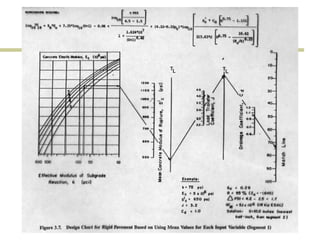
 Effective Modulus of Sub-Grade
Reaction, k
• Considers:
1. Sub-base type
2. Sub-base thickness
3. Loss of support
4. Depth to rigid foundation
 Drainage Coefficient, mi
• Use in layer thickness determination
• Applies only to base and sub-base
• See Tables 20.15 (flexible) and 21.9 (rigid)
14
15
Other Growth Rates
 Multiple payment compound amount
factor, with i = growth rate
 G = [(1+i)n
-1]/i
16
17
18
19
20
21
22
23
24
25
26
27
Flexible Pavement Design
 Pavement structure is a multi-layered elastic
system, material is characterized by certain
properties
 Modulus of elasticity
 Resilient modulus
 Poisson ratio
 Wheel load causes stress distribution (fig 20.2)
 Horizontal: tensile or compressive
 Vertical: maximum are compressive, decrease with
depth
 Temperature distribution: affects magnitude of
stresses
28
Components
Sub-grade (roadbed) course: natural material that serves as the
foundation of the pavement structure
Sub-base course: above the sub-grade, superior to sub-grade course
Base course: above the sub base, granular materials such as crushed
stone, crushed or uncrushed slag, gravel, and sand
Surface course: upper course of the road pavement, should withstand
tire pressures, resistant to abrasive forces of traffic, provide skid-
resistant driving surface, prevent penetration of surface water
3 inches to > 6 inches
29
Economic Analysis
• Different treatments results in
different designs
• Evaluate cost of different
alternatives
30
Sensitivity Analysis
• Input different values of traffic
volume
• Compare resulting differences in
pavement
• Fairly significant differences in ADT
do not yield equally significant
differences in pavement thickness
31
OTHER ISSUES
 Drainage
 Joints
 Grooving (noise vs. hydroplaning)
 Rumble strips
 Climate
 Level and type of usage
32
FAILURE EXAMPLES
 Primarily related to design or life-
cycle, not construction
 All images from Distress
Identification Manual for the Long-
Term Pavement Performance
Program, Publication No. FHWA-
RD-03-031, June 2003
33
FATIGUE CRACKING
34
RUTTING
35
SHOVING
36
PUMPING
37
EXAMPLES
 http://training.ce.washington.edu/wsdot

28pavementdesign 100821132847-phpapp02(2)

  • 1.
  • 2.
    2 Objectives  Understand andcomplete ESAL calculation  Know variables involved in and be able to calculate required thickness of rigid and flexible pavements
  • 3.
    3 AASHTO Pavement Design MethodConsiderations  Pavement Performance  Traffic  Roadbed Soil  Materials of Construction  Environment  Drainage  Reliability  Life-Cycle Costs  Shoulder Design
  • 4.
    4 Two Categories ofRoadway Pavements  Rigid Pavement  Flexible Pavement Rigid Pavement Typical Applications  High volume traffic lanes  Freeway to freeway connections  Exit ramps with heavy traffic
  • 5.
    5 Advantages of RigidPavement  Good durability  Long service life  Withstand repeated flooding and subsurface water without deterioration
  • 6.
    6 Disadvantages of RigidPavement  May lose non-skid surface with time  Needs even sub-grade with uniform settling  May fault at transverse joints  Requires frequent joint maintenance
  • 7.
    7 Flexible Pavement Typical Applications Traffic lanes  Auxiliary lanes  Ramps  Parking areas  Frontage roads  Shoulders
  • 8.
    8 Advantages to FlexiblePavement  Adjusts to limited differential settlement  Easily repaired  Additional thickness added any time  Non-skid properties do not deteriorate  Quieter and smoother  Tolerates a greater range of temperatures
  • 9.
    9 Disadvantages of FlexiblePavement  Loses some flexibility and cohesion with time  Needs resurfacing sooner than PC concrete  Not normally chosen where water is expected
  • 10.
    10 Basic AASHTO Flexible PavementDesign Method  Determine the desired terminal serviceability, pt  Convert traffic volumes to number of equivalent 18-kip single axle loads (ESAL)  Determine the structural number, SN  Determine the layer coefficients, ai  Solve layer thickness equations for individual layer thickness
  • 11.
    11 Basic AASHTO RigidPavement Design Method  Select terminal serviceability  Determine number of ESALs  Determine the modulus of sub-grade reaction  Determine the slab thickness
  • 12.
    12 Variables included in Nomographs Reliability, R • Incorporates a degree of certainty into design process • Ensures various design alternatives will last the analysis period  Resilient Modulus for Roadbed Soil, MR • Generally obtained from laboratory testing
  • 13.
    13 Variables included in Nomographs Effective Modulus of Sub-Grade Reaction, k • Considers: 1. Sub-base type 2. Sub-base thickness 3. Loss of support 4. Depth to rigid foundation  Drainage Coefficient, mi • Use in layer thickness determination • Applies only to base and sub-base • See Tables 20.15 (flexible) and 21.9 (rigid)
  • 14.
  • 15.
  • 16.
    Other Growth Rates Multiple payment compound amount factor, with i = growth rate  G = [(1+i)n -1]/i 16
  • 17.
  • 18.
  • 19.
  • 20.
  • 21.
  • 22.
  • 23.
  • 24.
  • 25.
  • 26.
  • 27.
    27 Flexible Pavement Design Pavement structure is a multi-layered elastic system, material is characterized by certain properties  Modulus of elasticity  Resilient modulus  Poisson ratio  Wheel load causes stress distribution (fig 20.2)  Horizontal: tensile or compressive  Vertical: maximum are compressive, decrease with depth  Temperature distribution: affects magnitude of stresses
  • 28.
    28 Components Sub-grade (roadbed) course:natural material that serves as the foundation of the pavement structure Sub-base course: above the sub-grade, superior to sub-grade course Base course: above the sub base, granular materials such as crushed stone, crushed or uncrushed slag, gravel, and sand Surface course: upper course of the road pavement, should withstand tire pressures, resistant to abrasive forces of traffic, provide skid- resistant driving surface, prevent penetration of surface water 3 inches to > 6 inches
  • 29.
    29 Economic Analysis • Differenttreatments results in different designs • Evaluate cost of different alternatives
  • 30.
    30 Sensitivity Analysis • Inputdifferent values of traffic volume • Compare resulting differences in pavement • Fairly significant differences in ADT do not yield equally significant differences in pavement thickness
  • 31.
    31 OTHER ISSUES  Drainage Joints  Grooving (noise vs. hydroplaning)  Rumble strips  Climate  Level and type of usage
  • 32.
    32 FAILURE EXAMPLES  Primarilyrelated to design or life- cycle, not construction  All images from Distress Identification Manual for the Long- Term Pavement Performance Program, Publication No. FHWA- RD-03-031, June 2003
  • 33.
  • 34.
  • 35.
  • 36.
  • 37.