Fire Protection Systems
Third Edition
Course Overview
Course Description
‣ This is a study of private fire protection and
detection systems such as sprinkler and standpipe
systems, chemical extinguishing systems, and
detection systems and devices. Each system is
discussed as to its need, construction,
preventative maintenance and individual uses.
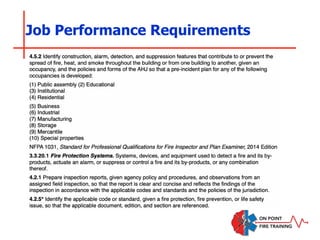
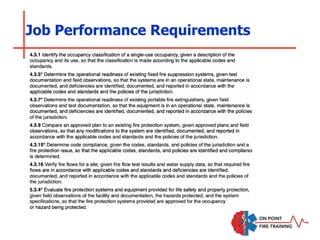
Job Performance Requirements
‣ Given information from discussion and reading
materials, the student will satisfy the Job Performance
Requirements (JPR) of the applicable National Fire
Protection Association (NFPA) standards, any
applicable skill sheets, and the applicable Fire and Life
Safety Initiatives of the National Fallen Firefighters
Foundation Everyone Goes Home program.
‣ NFPA, Standard for Fire and Emergency Service
Instructor Professional Qualifications, 2019 Edition
Job Performance Requirements
Chapter 1
‣ This chapter focuses on fundamental concepts such as fire
behavior, the combustion process, and the chemistry and physics
of fire. It discusses them in relation to the design of fire protection
systems.
Chapter Overview
Chapter 1
‣ Describe the difference between fire and combustion.
‣ Identify and describe the elements of the fire triangle.
‣ Identify and describe the elements of the fire tetrahedron.
‣ List and describe the different types of fire.
‣ List and describe the different stages of fire.
‣ List and describe the mechanisms of heat transfer.
‣ List and describe the methods used to extinguish fires.
‣ List and describe the classes of fire and their relationship to extinguishing
agents.
Learning Objective
Chapter 2
‣ This chapter explores the code development process and the
model code requirements to install fire protection systems.
Chapter Overview
Chapter 2
‣ Define the terms code and model code.
‣ Name the two most prominent model code organizations.
‣ Describe the International Code Council (ICC) model code
development process.
‣ Describe the National Fire Protection Association (NFPA) model
code development process.
‣ Define the terms referenced standard and code amendment.
‣ Describe the advantages to governments and organizations that
adopt model codes.
‣ List the two most important code-related conditions that
determine the installation requirements for fire protection
systems.
Learning Objective
Chapter 3
‣ This chapter focuses on different fire alarm system components,
how they function, and the different signals generated by these
systems.
Chapter Overview
Chapter 3
‣ Describe the purpose of a fire alarm system.
‣ List five functions fire alarm systems provide.
‣ List and describe the three types of fire alarm signals.
‣ Discuss the characteristics of conventional fire alarm system technology.
‣ Discuss the characteristics of addressable fire alarm system technology.
‣ Discuss the functions of a fire alarm control unit/panel and annunciator
panel.
‣ List and describe the different components that make up a fire alarm
system.
‣ List and describe devices that interface with a fire alarm system to
supervise the condition of other fire protection systems.
Learning Objective
Chapter 4
‣ This chapter discusses fire alarm system classifications and
interface capabilities as well as automatic-detection system
installation requirements, and acceptance, inspection, and
maintenance requirements for fire alarm systems.
Chapter Overview
Chapter 4
‣ List and discuss the different fire alarm system classifications.
‣ List and discuss the interface capabilities between fire alarm
systems and other building fire protection and life safety systems.
‣ List and discuss the different conditions, situations, and
circumstances used to determine manual fire alarm and automatic
detection system installation requirements.
‣ Describe the different acceptance and periodic inspections, tests,
and maintenance activities required for fire alarm and detection
systems.
Learning Objective
Chapter 5
‣ This chapter discusses water, including flow, duration, and
movement as well as water supply, friction loss, stationary fire
pump characteristics, and testing.
Chapter Overview
Chapter 5
‣ Define the terms pressure, flow, and duration as they relate to the movement of water.
‣ Discuss the characteristics of the source/supply network and the distribution network.
‣ Discuss the difference between a municipal/public water system and a private water system.
‣ Describe how pumped, gravity, and combined supply systems operate.
‣ Define friction loss and discuss how it affects water flow.
‣ Identify and describe the components of a source/supply network and distribution network.
‣ List and describe the different types of valves found in a source/supply network and distribution
network.
‣ List and describe the different types of fire hydrants found in a source/supply network and
distribution network.
‣ Define the terms static pressure and residual pressure.
‣ List and discuss the characteristics of the two types of National Fire Protection Association
(NFPA)-approved stationary fire pumps.
‣ Define the terms churn, total rated head, and peak load in relation to stationary fire pump testing.
Learning Objective
Chapter 6
‣ This chapter discusses the importance of a standpipe system to
firefighting.
Chapter Overview
Chapter 6
‣ List and describe the different types of standpipes and the
different standpipe classifications.
‣ List and describe the different standpipe system components.
‣ State when and where standpipes and hose systems are required
in buildings.
‣ Reference the design and installation standards that apply to
standpipes.
‣ State the minimum standpipe system design pressure and flow
requirements.
‣ Reference the inspection, testing, and maintenance requirements.
‣ Recognize the possible impairments to standpipe systems.
Learning Objective
Chapter 7
‣ This chapter discusses automatic fire sprinkler systems, including
the myths and realities of operation, the components that make up
different systems, types of heads, and choosing, installing, and
testing systems.
Chapter Overview
Chapter 7
‣ Describe an automatic fire sprinkler system.
‣ Discuss the myths and realities associated with automatic fire sprinkler system
operation.
‣ List and describe the different components that make up an automatic fire sprinkler
system.
‣ List and describe the different types of automatic fire sprinkler system heads.
‣ Describe the different types of automatic fire sprinkler systems and the best
applications for those systems.
‣ State the factors that determine requirements to install automatic fire sprinkler
systems.
‣ Discuss the design concepts behind automatic fire sprinkler systems.
‣ List and describe different occupancy and commodity classifications.
‣ Discuss the inspection and testing requirements for automatic fire sprinkler
systems.
Learning Objective
Chapter 8
‣ This chapter discusses the reasons for installation of, as well as
the characteristics and applications for, specialized types of water-
based fire protection systems.
Chapter Overview
Chapter 8
‣ State three reasons why, under certain circumstances, the installation
of specialized types of water-based fire protection systems is a better
choice than standard automatic fire sprinkler systems.
‣ Discuss the characteristics and applications for fixed foam systems.
‣ Discuss the characteristics and applications for foam-water sprinkler
and foam-water spray systems.
‣ Discuss the characteristics and applications for water spray fixed
systems.
‣ Discuss the characteristics and applications for water mist systems.
‣ Discuss the inspection and test requirements for acceptance of
specialized water-based fire protection systems.
‣ Recognize the possible impairments to specialized water-based fire
protection systems.
Learning Objective
Chapter 9
‣ This chapter discusses the applicable design standards,
components, agents, types of systems, and applications for fixed
wet and dry chemical systems.
Chapter Overview
Chapter 9
‣ Describe the characteristics of fixed wet and dry chemical extinguishing
systems.
‣ Discuss the hazards fixed wet and dry chemical extinguishing systems most
likely protect.
‣ Describe how fixed wet and dry chemical agents control and extinguish fire.
‣ Describe the characteristics of a pre-engineered system.
‣ Describe the conditions that would require an engineered suppression system.
‣ List the major components that make up fixed wet and dry chemical
extinguishing systems.
‣ Describe the types of fixed wet and dry chemical extinguishing systems.
‣ Discuss the various acceptance and periodic inspection, testing, and
maintenance requirements for fixed wet and dry chemical extinguishing
systems.
Learning Objective
Chapter 10
‣ This chapter focuses on the agents, applications, applicable design
standards, types of systems, components, and inspection, testing,
and maintenance associated with gaseous agent extinguishing
systems.
Chapter Overview
Chapter 10
‣ Describe the physical characteristics of carbon dioxide.
‣ Describe the four application methods for delivery of carbon dioxide.
‣ Describe the physical characteristics of halogenated hydrocarbons
(halons).
‣ Explain the halon numbering identification system.
‣ Describe the physical characteristics of halocarbons and inert gases
(clean agents).
‣ Discuss the two categories of clean agents.
‣ Explain the difference between the two types of aerosol generators.
‣ Discuss the various acceptance and periodic inspections and tests that
are required to certify and maintain gaseous agent extinguishing
systems.
Learning Objective
Chapter 11
‣ This chapter discusses code requirements for fire extinguishers,
the different types of fire extinguishers, the different suppression
agents in the extinguishers, and extinguisher ratings.
Chapter Overview
Chapter 11
‣ Discuss the fire extinguisher classification system.
‣ List the different extinguishing agents and their applications.
‣ Discuss the fire extinguisher rating system and identify to which
classifications of extinguishers it applies.
‣ Explain why a certain extinguisher classification requires a
conductivity test.
‣ Describe the different types of fire extinguishers and how they
operate.
‣ Explain the acronym PASS in relation to fire extinguisher operation.
‣ Discuss the inspection, testing, and maintenance procedures for
portable fire extinguishers.
Learning Objective
Chapter 12
‣ This chapter discusses the different types of active smoke control
systems that contain, exhaust, and oppose the undesirable
movement of smoke and toxic gases. It also covers code-required
smoke control, design requirements, operational characteristics,
and interaction with fire protection systems.
Chapter Overview
Chapter 12
‣ Define the terms smoke control and smoke management.
‣ State the design goals for smoke control systems.
‣ State the design goals for smoke management systems.
‣ Name the three general methods used to control smoke movement.
‣ Describe the four pressure differential methods used to control
smoke.
‣ Describe five design requirements or operational characteristics of
smoke control systems.
‣ List the different life safety and fire protection systems that interface
with smoke control systems and describe how they interact.
‣ Discuss the importance of the acceptance testing and annual retesting
of smoke control and management systems.
Learning Objective
Chapter 13
‣ This chapter discusses the various specialized locking
arrangements for ingress and egress, how they interface with fire
protection systems, and the tools, methods, and systems available
to first responders that permit rapid entry to properties and
structures.
Chapter Overview
Chapter 13
‣ Identify and describe the three components of the means of egress.
‣ List and describe the override requirements for interior exit stairway
doors.
‣ List and describe the requirements for delayed egress locking systems.
‣ List and describe the requirements for sensor release of electrically locked
egress doors.
‣ List and describe the requirements for door hardware release of
electrically locked egress doors.
‣ Describe the purpose of an emergency building entrance system.
‣ List what is typically found inside an emergency building entrance system.
‣ List and describe the different methods of property access through
security gates and vehicle barriers.
Learning Objective

1540 Course overview JPR

  • 1.
    Fire Protection Systems ThirdEdition Course Overview
  • 2.
    Course Description ‣ Thisis a study of private fire protection and detection systems such as sprinkler and standpipe systems, chemical extinguishing systems, and detection systems and devices. Each system is discussed as to its need, construction, preventative maintenance and individual uses.
  • 3.
    Job Performance Requirements ‣Given information from discussion and reading materials, the student will satisfy the Job Performance Requirements (JPR) of the applicable National Fire Protection Association (NFPA) standards, any applicable skill sheets, and the applicable Fire and Life Safety Initiatives of the National Fallen Firefighters Foundation Everyone Goes Home program. ‣ NFPA, Standard for Fire and Emergency Service Instructor Professional Qualifications, 2019 Edition
  • 4.
  • 5.
  • 6.
  • 7.
    Chapter 1 ‣ Thischapter focuses on fundamental concepts such as fire behavior, the combustion process, and the chemistry and physics of fire. It discusses them in relation to the design of fire protection systems. Chapter Overview
  • 8.
    Chapter 1 ‣ Describethe difference between fire and combustion. ‣ Identify and describe the elements of the fire triangle. ‣ Identify and describe the elements of the fire tetrahedron. ‣ List and describe the different types of fire. ‣ List and describe the different stages of fire. ‣ List and describe the mechanisms of heat transfer. ‣ List and describe the methods used to extinguish fires. ‣ List and describe the classes of fire and their relationship to extinguishing agents. Learning Objective
  • 9.
    Chapter 2 ‣ Thischapter explores the code development process and the model code requirements to install fire protection systems. Chapter Overview
  • 10.
    Chapter 2 ‣ Definethe terms code and model code. ‣ Name the two most prominent model code organizations. ‣ Describe the International Code Council (ICC) model code development process. ‣ Describe the National Fire Protection Association (NFPA) model code development process. ‣ Define the terms referenced standard and code amendment. ‣ Describe the advantages to governments and organizations that adopt model codes. ‣ List the two most important code-related conditions that determine the installation requirements for fire protection systems. Learning Objective
  • 11.
    Chapter 3 ‣ Thischapter focuses on different fire alarm system components, how they function, and the different signals generated by these systems. Chapter Overview
  • 12.
    Chapter 3 ‣ Describethe purpose of a fire alarm system. ‣ List five functions fire alarm systems provide. ‣ List and describe the three types of fire alarm signals. ‣ Discuss the characteristics of conventional fire alarm system technology. ‣ Discuss the characteristics of addressable fire alarm system technology. ‣ Discuss the functions of a fire alarm control unit/panel and annunciator panel. ‣ List and describe the different components that make up a fire alarm system. ‣ List and describe devices that interface with a fire alarm system to supervise the condition of other fire protection systems. Learning Objective
  • 13.
    Chapter 4 ‣ Thischapter discusses fire alarm system classifications and interface capabilities as well as automatic-detection system installation requirements, and acceptance, inspection, and maintenance requirements for fire alarm systems. Chapter Overview
  • 14.
    Chapter 4 ‣ Listand discuss the different fire alarm system classifications. ‣ List and discuss the interface capabilities between fire alarm systems and other building fire protection and life safety systems. ‣ List and discuss the different conditions, situations, and circumstances used to determine manual fire alarm and automatic detection system installation requirements. ‣ Describe the different acceptance and periodic inspections, tests, and maintenance activities required for fire alarm and detection systems. Learning Objective
  • 15.
    Chapter 5 ‣ Thischapter discusses water, including flow, duration, and movement as well as water supply, friction loss, stationary fire pump characteristics, and testing. Chapter Overview
  • 16.
    Chapter 5 ‣ Definethe terms pressure, flow, and duration as they relate to the movement of water. ‣ Discuss the characteristics of the source/supply network and the distribution network. ‣ Discuss the difference between a municipal/public water system and a private water system. ‣ Describe how pumped, gravity, and combined supply systems operate. ‣ Define friction loss and discuss how it affects water flow. ‣ Identify and describe the components of a source/supply network and distribution network. ‣ List and describe the different types of valves found in a source/supply network and distribution network. ‣ List and describe the different types of fire hydrants found in a source/supply network and distribution network. ‣ Define the terms static pressure and residual pressure. ‣ List and discuss the characteristics of the two types of National Fire Protection Association (NFPA)-approved stationary fire pumps. ‣ Define the terms churn, total rated head, and peak load in relation to stationary fire pump testing. Learning Objective
  • 17.
    Chapter 6 ‣ Thischapter discusses the importance of a standpipe system to firefighting. Chapter Overview
  • 18.
    Chapter 6 ‣ Listand describe the different types of standpipes and the different standpipe classifications. ‣ List and describe the different standpipe system components. ‣ State when and where standpipes and hose systems are required in buildings. ‣ Reference the design and installation standards that apply to standpipes. ‣ State the minimum standpipe system design pressure and flow requirements. ‣ Reference the inspection, testing, and maintenance requirements. ‣ Recognize the possible impairments to standpipe systems. Learning Objective
  • 19.
    Chapter 7 ‣ Thischapter discusses automatic fire sprinkler systems, including the myths and realities of operation, the components that make up different systems, types of heads, and choosing, installing, and testing systems. Chapter Overview
  • 20.
    Chapter 7 ‣ Describean automatic fire sprinkler system. ‣ Discuss the myths and realities associated with automatic fire sprinkler system operation. ‣ List and describe the different components that make up an automatic fire sprinkler system. ‣ List and describe the different types of automatic fire sprinkler system heads. ‣ Describe the different types of automatic fire sprinkler systems and the best applications for those systems. ‣ State the factors that determine requirements to install automatic fire sprinkler systems. ‣ Discuss the design concepts behind automatic fire sprinkler systems. ‣ List and describe different occupancy and commodity classifications. ‣ Discuss the inspection and testing requirements for automatic fire sprinkler systems. Learning Objective
  • 21.
    Chapter 8 ‣ Thischapter discusses the reasons for installation of, as well as the characteristics and applications for, specialized types of water- based fire protection systems. Chapter Overview
  • 22.
    Chapter 8 ‣ Statethree reasons why, under certain circumstances, the installation of specialized types of water-based fire protection systems is a better choice than standard automatic fire sprinkler systems. ‣ Discuss the characteristics and applications for fixed foam systems. ‣ Discuss the characteristics and applications for foam-water sprinkler and foam-water spray systems. ‣ Discuss the characteristics and applications for water spray fixed systems. ‣ Discuss the characteristics and applications for water mist systems. ‣ Discuss the inspection and test requirements for acceptance of specialized water-based fire protection systems. ‣ Recognize the possible impairments to specialized water-based fire protection systems. Learning Objective
  • 23.
    Chapter 9 ‣ Thischapter discusses the applicable design standards, components, agents, types of systems, and applications for fixed wet and dry chemical systems. Chapter Overview
  • 24.
    Chapter 9 ‣ Describethe characteristics of fixed wet and dry chemical extinguishing systems. ‣ Discuss the hazards fixed wet and dry chemical extinguishing systems most likely protect. ‣ Describe how fixed wet and dry chemical agents control and extinguish fire. ‣ Describe the characteristics of a pre-engineered system. ‣ Describe the conditions that would require an engineered suppression system. ‣ List the major components that make up fixed wet and dry chemical extinguishing systems. ‣ Describe the types of fixed wet and dry chemical extinguishing systems. ‣ Discuss the various acceptance and periodic inspection, testing, and maintenance requirements for fixed wet and dry chemical extinguishing systems. Learning Objective
  • 25.
    Chapter 10 ‣ Thischapter focuses on the agents, applications, applicable design standards, types of systems, components, and inspection, testing, and maintenance associated with gaseous agent extinguishing systems. Chapter Overview
  • 26.
    Chapter 10 ‣ Describethe physical characteristics of carbon dioxide. ‣ Describe the four application methods for delivery of carbon dioxide. ‣ Describe the physical characteristics of halogenated hydrocarbons (halons). ‣ Explain the halon numbering identification system. ‣ Describe the physical characteristics of halocarbons and inert gases (clean agents). ‣ Discuss the two categories of clean agents. ‣ Explain the difference between the two types of aerosol generators. ‣ Discuss the various acceptance and periodic inspections and tests that are required to certify and maintain gaseous agent extinguishing systems. Learning Objective
  • 27.
    Chapter 11 ‣ Thischapter discusses code requirements for fire extinguishers, the different types of fire extinguishers, the different suppression agents in the extinguishers, and extinguisher ratings. Chapter Overview
  • 28.
    Chapter 11 ‣ Discussthe fire extinguisher classification system. ‣ List the different extinguishing agents and their applications. ‣ Discuss the fire extinguisher rating system and identify to which classifications of extinguishers it applies. ‣ Explain why a certain extinguisher classification requires a conductivity test. ‣ Describe the different types of fire extinguishers and how they operate. ‣ Explain the acronym PASS in relation to fire extinguisher operation. ‣ Discuss the inspection, testing, and maintenance procedures for portable fire extinguishers. Learning Objective
  • 29.
    Chapter 12 ‣ Thischapter discusses the different types of active smoke control systems that contain, exhaust, and oppose the undesirable movement of smoke and toxic gases. It also covers code-required smoke control, design requirements, operational characteristics, and interaction with fire protection systems. Chapter Overview
  • 30.
    Chapter 12 ‣ Definethe terms smoke control and smoke management. ‣ State the design goals for smoke control systems. ‣ State the design goals for smoke management systems. ‣ Name the three general methods used to control smoke movement. ‣ Describe the four pressure differential methods used to control smoke. ‣ Describe five design requirements or operational characteristics of smoke control systems. ‣ List the different life safety and fire protection systems that interface with smoke control systems and describe how they interact. ‣ Discuss the importance of the acceptance testing and annual retesting of smoke control and management systems. Learning Objective
  • 31.
    Chapter 13 ‣ Thischapter discusses the various specialized locking arrangements for ingress and egress, how they interface with fire protection systems, and the tools, methods, and systems available to first responders that permit rapid entry to properties and structures. Chapter Overview
  • 32.
    Chapter 13 ‣ Identifyand describe the three components of the means of egress. ‣ List and describe the override requirements for interior exit stairway doors. ‣ List and describe the requirements for delayed egress locking systems. ‣ List and describe the requirements for sensor release of electrically locked egress doors. ‣ List and describe the requirements for door hardware release of electrically locked egress doors. ‣ Describe the purpose of an emergency building entrance system. ‣ List what is typically found inside an emergency building entrance system. ‣ List and describe the different methods of property access through security gates and vehicle barriers. Learning Objective