Fire Officer: Principles and
Practice
Third Edition
Course Overview
Course Description
‣ This course is designed to provide the student
with an understanding of being a company officer
through various areas of knowledge as well as
solving the varied problems and situations they
will be required to manage effectively in today’s
ever-changing fire service. The curriculum includes
a review of fire department organization and
administration, management theory, leadership,
communications, motivation and group dynamics.
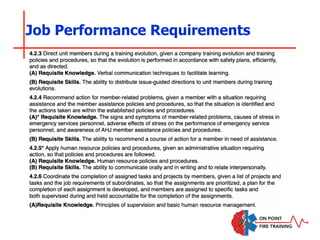
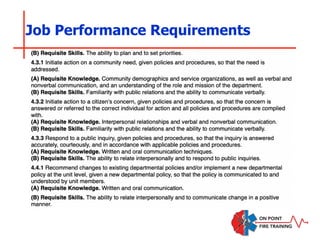
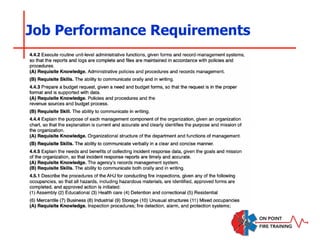
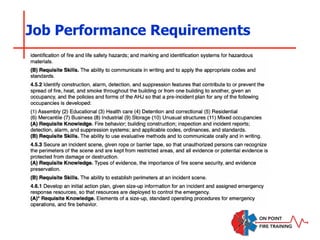
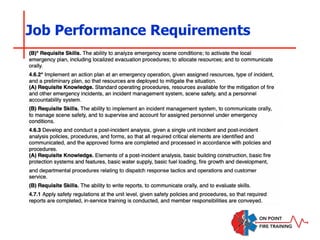
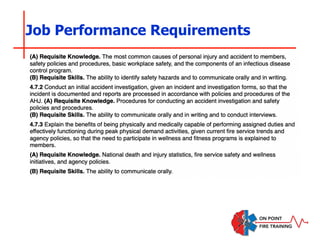
Job Performance Requirements
‣ Given information from discussion and reading
materials, the student will satisfy the Job Performance
Requirements (JPR) of the applicable National Fire
Protection Association (NFPA) standards, any
applicable skill sheets, and the applicable Fire and Life
Safety Initiatives of the National Fallen Firefighters
Foundation Everyone Goes Home program.
‣ NFPA, Standard for Fire and Emergency Service
Instructor Professional Qualifications, 2019 Edition
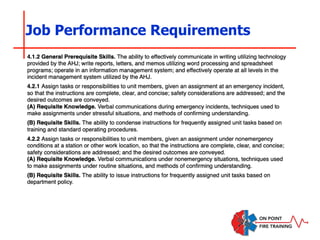
Job Performance Requirements
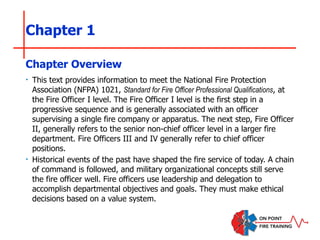
Chapter 1
‣ This text provides information to meet the National Fire Protection
Association (NFPA) 1021, Standard for Fire Officer Professional Qualifications, at
the Fire Officer I level. The Fire Officer I level is the first step in a
progressive sequence and is generally associated with an officer
supervising a single fire company or apparatus. The next step, Fire Officer
II, generally refers to the senior non-chief officer level in a larger fire
department. Fire Officers III and IV generally refer to chief officer
positions.
‣ Historical events of the past have shaped the fire service of today. A chain
of command is followed, and military organizational concepts still serve
the fire officer well. Fire officers use leadership and delegation to
accomplish departmental objectives and goals. They must make ethical
decisions based on a value system.
Chapter Overview
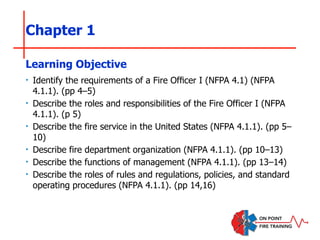
Chapter 1
‣ Identify the requirements of a Fire Officer I (NFPA 4.1) (NFPA
4.1.1). (pp 4–5)
‣ Describe the roles and responsibilities of the Fire Officer I (NFPA
4.1.1). (p 5)
‣ Describe the fire service in the United States (NFPA 4.1.1). (pp 5–
10)
‣ Describe fire department organization (NFPA 4.1.1). (pp 10–13)
‣ Describe the functions of management (NFPA 4.1.1). (pp 13–14)
‣ Describe the roles of rules and regulations, policies, and standard
operating procedures (NFPA 4.1.1). (pp 14,16)
Learning Objective
Chapter 2
‣ Taking a promotional exam is a major undertaking, requiring a huge
amount of preparation time for a few minutes of performance. Adequate
preparation has become all the more important as opportunities for
promotion have decreased during the recent economic recession: An
effective promotional process allows the department to identify which
candidates have the knowledge, skills, and abilities to function as a
supervisory or managing fire officer. Some states, however, do not require
certification training for volunteer fire officers.
‣ Promotional processes are not perfect, so the candidate must identify
areas of weakness or poor job fit before the exam. The best way to begin
is to obtain the narrative job description and the class specification sheet
from the personnel office or human resources. These two documents
create the map in developing the promotional exam.
Chapter Overview
Chapter 2
‣ Discuss the origin of civil service promotional examinations. (p 24)
‣ Discuss promotional processes that can be used by fire
departments. (pp 25–26)
‣ Describe how a promotional examination is prepared. (pp 26–29)
‣ Identify the elements of a promotional examination. (pp 29–32)
‣ Identify the components of an assessment center. (pp 30–31)
‣ List techniques for studying for a promotional examination. (pp
33, 35–36)
Learning Objective
Chapter 3
‣ A fire officer must account for the people and resources at a fire station and
work location. Transitioning from fire fighter to fire officer changes how the
individual relates to the formal fire department organization and the role the
fire officer plays with fellow fire fighters. A fire officer has a larger sphere of
responsibility, and he or she should “walk the talk” and demonstrate integrity
by behaving ethically. This is especially important now that social media and
24-hour news can bring rapid attention to even minor firehouse incidents.
‣ Supervisors should be kept informed and must be consulted before making
major disciplinary or policy changes. The Equal Employment Opportunity
Commission (EEOC) is empowered to promote workplace diversity. Employees
can file sexual harassment or hostile workplace complaints, which the fire
officer must handle with fairness while following local procedures. The trend in
local government is to expect the fire station to comply with the same rules of
behavior that are applied to other offices.
Chapter Overview
Chapter 3
‣ Describe the fire officer’s basic tasks. (pp 42–44)
‣ Describe a typical fire station workday. (pp 44–45)
‣ Describe the transition from fire fighter to fire officer. (pp 45–46)
‣ Discuss the fire officer’s role as a supervisor. (pp 46–47)
‣ Discuss the fire officer’s role as a commander. (p 47)
‣ Discuss the fire officer’s role as a trainer. (pp 47–49)
‣ Describe the activities a fire officer performs to maintain an effective working
relationship with his or her supervisor (NFPA 4.1.1). (pp 49–50)
‣ Discuss the importance of integrity and ethical behavior (NFPA 4.1.1 ). (pp
50–51)
‣ Describe how to maintain workplace diversity (NFPA 4.1.1 ). (pp 51, 53–55)
‣ Describe the concept of the fire station as a business work location. (pp 55–
56)
Learning Objective
Chapter 4
‣ Effective communication skills are vital for a fire officer. These
skills are essential to provide direction to crew members, review
new policies and procedures, and simply exchange information in
a wide range of situations. Effectively transmitting radio reports
requires a unique skill set. This chapter presents a variety of
means of better understanding and improving the fire officer’s
communication skills.
Chapter Overview
Chapter 4
‣ Describe the steps in the communication cycle (NFPA 4.2.2). (pp
62–63)
‣ List the basic skills for effective communication (NFPA 4.2.2). (pp
63, 65–66)
‣ Identify ways to improve listening skills. (pp 63, 65)
‣ Describe the ways to counteract environmental noise (NFPA
4.2.2 ). (pp 65–66)
‣ Identify the key points for emergency communications (NFPA
4.2.1) (NFPA 4.4.5). (pp 66–68)
‣ dentify types of reports and discuss their use (NFPA 4.1.2) (NFPA
4.4.5). (pp 68–72)
Learning Objective
Chapter 5
‣ About 100 fire fighters die in the line of duty each year. More than 40
percent die of heart attacks, and more than 20 percent die in motor
vehicle crashes. Although fewer structural fires now occur, the rate of
death associated with such fires has increased. For every death, there are
nearly 1000 injuries.
‣ Promoting fire fighter safety and health is one of the most important roles
of a supervising or managing fire officer. Every company officer can have
a positive effect by requiring drivers to wear a seat belt and by removing
fire fighters with significant cardiac risk factors from the front line. An
incident safety officer helps manage risk at the scene of an emergency
and conducts postincident analysis. A designated infection control officer
manages the department’s infection control program and handles
occupational exposures. A health and safety officer investigates accidents.
Chapter Overview
Chapter 5
‣ Discuss how to develop an incident action plan. (NFPA 4.2.1) (pp 86, 89)
‣ Describe the initiatives that have been implemented to reduce fire fighter injuries and deaths.
(pp 86–92)
‣ List the most common causes of personal injury and deaths to fire fighters (NFPA 4.7.1) (NFPA
4.7.3). (pp 87–89)
‣ Describe methods for reducing the risk of personal injury and death to fire fighters (NFPA
4.2.1) (NFPA 4.7) (NFPA 4.7.3). (pp 86–99)
‣ Discuss the role and requirements of an incident safety officer. (pp 92–94)
‣ Describe safety policies and procedures and basic workplace safety (NFPA 4.2.3) (NFPA 4.7)
(NFPA 4.7.1). (p 95)
‣ Describe principles to prevent emergency incident injuries (NFPA 4.2.1) (NFPA 4.7) (NFPA
4.7.1). (pp 95–96)
‣ Describe safety considerations for the fire station (NFPA 4.7) (NFPA 4.7.1). (pp 96–97)
‣ Describe the components of an infectious disease control program (NFPA 4.7) (NFPA 4.7.1). (pp
97–99)
‣ Describe procedures for conducting and documenting an accident investigation (NFPA 4.7.2). (p
99)
‣ List the elements of a postincident analysis (NFPA 4.6.3). (p 99)
Learning Objective
Chapter 6
‣ A fire officer is a manager given the responsibility of directing and supervising a
group of fire fighters, as well as apparatus, equipment, facilities, and other
resources, to achieve certain outcomes. The outcomes begin with protecting people
and property. Managing people is an important part of a fire officer’s job—enough
so to justify taking a look at some of the theories and techniques of management.
‣ Scientific management arose out of the Industrial Revolution, when researchers
broke down repetitive work tasks into elements that could be timed. This approach
may have been suited to the assembly line, and it still is appropriate for some fire
department tasks. Today, however, humanistic management theories are more
widely applied. Several theories are applicable to management of fire service
members, but key among them is Maslow’s hierarchy of needs. Employees must
satisfy each level of their needs to “climb the ladder” to meet the next level. The
fire officer’s job is to help fire fighters in this process, which ends in achieving self-
actualization.
Chapter Overview
Chapter 6
‣ Discuss the principles of supervision and basic human resources
management (NFPA 4.1.1) (NFPA 4.2). (pp 112–113)
‣ Explain the history and principles of scientific management (NFPA
4.2.6). (pp 113–114)
‣ Explain the history and principles of humanistic management
(NFPA 4.2.6). (pp 114–118)
‣ Discuss the function of human resources management (NFPA 4.2)
(NFPA 4.2.5). (pp 118, 120–122)
‣ Coordinate the completion of assigned tasks and projects (NFPA
4.2.6) (NFPA 4.2). (pp 120–121)
Learning Objective
Chapter 7
‣ Leadership requires the fire officer to provide purpose, direction,
and motivation to fire fighters. The fire officer applies personal
attributes to the leadership process. Effective leaders are also
good followers, supporting the fire department leadership.
‣ Three leadership styles are autocratic, democratic, and laissez-
faire. Emergency situations, such as an evacuation order or may-
day, require an autocratic response. In more routine situations,
leadership is accomplished through influencing, operating, and
improving. The fire officer should establish house rules for the fire
station that preserve the public trust in the fire department.
Chapter Overview
Chapter 7
‣ Describe the role of the fire officer as both a leader and a follower.
(pp 128–129)
‣ Identify leadership styles used in the fire service (NFPA 4.2.1)
(NFPA 4.2.2). (p 129)
‣ Identify types of power used in leadership. (p 129–130)
‣ Describe leadership in routine situations (NFPA 4.2.2). (p 130)
‣ Describe the leadership challenges related to the fire station work
environment. (pp 134–135)
‣ Describe the leadership challenges related to the volunteer fire
service. (p 135)
Learning Objective
Chapter 8
‣ Education is the process of imparting knowledge or skill through
systematic instruction. Training is directed toward the practical
application of education to produce an action. The four-step
method, a core part of most Fire Instructor I certification
programs, consists of preparation, presentation, application, and
evaluation.
Chapter Overview
Chapter 8
‣ Discuss the role of training in the fire service. (pp 142–143)
‣ Discuss the fire officer’s role in training fire service personnel. (pp
143–147)
‣ Describe the four-step method of instruction. (pp 143–146)
‣ Describe on-the-job training and the order in which skills must be
taught. (pp 147–148)
‣ Discuss the requirements for conducting live fire training (NFPA
4.2.3). (pp 148, 150–151)
‣ Describe how to develop a specific training program. (pp 151–
152)
Learning Objective
Chapter 9
‣ The fire officer is responsible for providing performance
evaluations, both as an ongoing process throughout the year and
in an annual review. Evaluation helps fire fighters set goals for
performance improvement. The fire officer is also responsible for
overseeing any structured probationary fire fighter in-field training
and experience programs. Feedback is most effective when
delivered as soon as possible after an action or incident.
Chapter Overview
Chapter 9
‣ Discuss the purpose of regular fire fighter evaluations (NFPA 4.2)
(NFPA 4.2.5). (pp 164–166)
‣ Describe methods of positive discipline (NFPA 4.2.4) (NFPA 4.2.5).
(pp 166–169)
‣ Discuss the role of documentation and record keeping for
evaluations and discipline (NFPA 4.2). (p 171)
Learning Objective
Chapter 10
‣ The fire officer is in a unique position regarding labor issues within
the fire station. As a working supervisor, the fire officer is often
both the representative of the fire department administration and
a union member. The officer needs to know the grievance
procedures, labor contract provisions, and personnel regulations
that affect his or her supervisory work.
Chapter Overview
Chapter 10
‣ Discuss the impact of the International Association of Fire Fighters
on fire fighters and emergency medical services personnel. (p
185).
‣ Describe how to establish a strong supervisor–employee
relationship (NFPA 4.1.1) (NFPA 4.2.5). (pp 185–186)
‣ Discuss the value of positive labor–management relations (NFPA
4.1.1). (p 186)
‣ Describe the fire officer’s role as a supervisor (NFPA 4.1.1) (NFPA
4.2.5). (pp 186–187, 189–190)
Learning Objective
Chapter 11
‣ The fire officer is an ambassador of the fire department who will
be called upon to represent the department in a number of
situations. A fire officer’s challenge is to be able to meet the
community’s needs and respond to emergency incidents in a
manner that creates community goodwill and reduces fire-related
deaths and injuries. The fire officer is responsible for conducting,
and possibly helping to develop, public safety education programs.
Chapter Overview
Chapter 11
‣ Discuss the role of demographics in fire department-community
relations (NFPA 4.3.1). (pp 204–206)
‣ Discuss the role of fire safety education in risk reduction (NFPA
4.3) (NFPA 4.3.3). (pp 206–207)
‣ List and describe opportunities for public education (NFPA 4.3)
(NFPA 4.3.1) (NFPA 4.3.3). (pp 207, 208–212)
‣ List and describe steps to develop public education programs at
the local level (NFPA 4.3) (NFPA 4.3.1). (pp 212–213)
Learning Objective
Chapter 12
‣ Conflicts within a fire station, citizen complaints, and mistakes are
common, and the fire officer must be able to deal with them
effectively. This chapter describes many problem-solving and
decision-making tools and techniques that the officer can call
upon in such situations. The officer is in a unique position both to
create an effectively functioning emergency response unit and to
recognize instances in which new departmental policies should be
considered.
Chapter Overview
Chapter 12
‣ Describe the interrelationships among complaints, conflicts, and
mistakes. (pp 224–225)
‣ Describe the general decision-making procedure. (pp 225–229)
‣ Discuss how to manage conflict within the department. (pp 230,
232–234)
‣ Discuss how to recommend and implement policy changes (NFPA
4.4) (NFPA 4.4.1). (pp 234–235)
‣ Describe how to field and resolve citizen complaints (NFPA 4.3)
(NFPA 4.3.2) (NFPA 4.3.3). (p 235)
‣ Describe the difference between customer service and customer
satisfaction (NFPA 4.3). (pp 235–236)
Learning Objective
Chapter 13
‣ Preincident planning and code enforcement require the fire officer to
perform within the education, enforcement, and engineering areas of fire
prevention. NFPA 1620 outlines a six-step method of developing a
preincident plan: (1) evaluate physical elements and site considerations,
(2) evaluate occupant considerations, (3) evaluate fire protection systems
and water supply, (4) evaluate special hazards, (5) evaluate emergency
operation considerations, and (6) evaluate special or unusual
characteristics of common occupancy.
‣ The state, commonwealth, or province determines the range and scope of
local community fire code enforcement. Code enforcement inspections
must be systematically planned, carried out, and documented, taking into
account construction, occupancy type, and use group-specific concerns.
Chapter Overview
Chapter 13
‣ Discuss the fire officer’s role in community fire safety. (pp 242–243)
‣ Discuss the purpose of preincident planning and list the relevant factors to consider
(NFPA 4.5) (NFPA 4.6). (pp 243–247)
‣ Discuss the types of fire codes and their use. (pp 247–249)
‣ Discuss the purpose and function of built-in fire protection systems (NFPA 4.5.2). (pp
249–252)
‣ Discuss the purpose and process of a fire code compliance inspection. (p 252)
‣ Discuss the classification of buildings by occupancy (NFPA 4.5.1) (NFPA 4.5.2). (pp 252–
256)
‣ Describe how to prepare for an inspection (NFPA 4.5) (NFPA 4.5.1). (pp 258–259)
‣ Describe how to conduct an inspection (NFPA 4.5). (pp 259–260)
‣ Discuss the creation and use of the written inspection/correction report (NFPA 4.6). (p
260)
‣ Identify general inspection requirements (NFPA 4.5) (NFPA 4.5.1). (pp 260–261)
‣ Identify groups and their specific concerns (NFPA 4.5) (NFPA 4.5.1) (NFPA 4.5.2). (pp
261–264)
Learning Objective
Chapter 14
‣ A budget is an itemized summary of estimated or intended revenues and
expenditures. The budget process is a cycle. Fire departments are
involved in complex revenue streams, using fees, grants, and other
creative techniques to ensure that enough resources are available.
Budgeting is also a technical and political process. There are often
opportunities for organizational change, and these sometimes arise during
times of disaster.
‣ Knowledge of the budget process is useful for the fire officer, even though
it is not covered in most promotional exams. Instead, budgeting is
considered a professional development skill as identified by the
International Association of Fire Chiefs (IAFC). The fire officer must
demonstrate good judgment in allocating or conserving the resources for
which he or she is responsible.
Chapter Overview
Chapter 14
‣ Describe the budget cycle (NFPA 4.1.1) (NFPA 4.4.3). (pp 272–
273)
‣ Identify revenue sources. (pp 274–275)
‣ Discuss the impact of lower revenue on resources. (pp 275–276)
‣ Describe the purchasing process (NFPA 4.4.3). (pp 276–277, 279)
Learning Objective
Chapter 15
‣ Every fire officer should be able to assume a variety of roles in the
Incident Command System (ICS). He or she must be prepared to
perform the duties of a first-arriving officer at any incident,
including assuming initial command of the incident, establishing
the basic management structure, and following standard operating
procedures (SOPs). The fire officer must also be fully competent
at working within the ICS at every scene. The procedures to be
followed are outlined in detail in this chapter.
Chapter Overview
Chapter 15
‣ Explain how the Incident Command System was created. (pp 292–
293)
‣ Describe the National Incident Management System (NFPA 4.6.1)
(NFPA 4.6.2). (pp 293–294)
‣ Describe the postincident review process (NFPA 4.6.3). (pp 294–
296)
‣ Describe the fire officer’s role in incident management (NFPA 4.6)
(NFPA 4.6.2). (pp 296–297)
‣ Discuss strategic-level incident management (NFPA 4.6). (pp 297–
301)
Learning Objective
Chapter 16
‣ The Rules of Engagement for Structural Firefighting, developed by the
International Association of Fire Chiefs’ (IAFC) Safety, Health, and
Survival Section, are best safety practices and model procedures for
carrying out high-risk operations. These 11 rules cover decisions that fire
crew members must make during life-threatening incidents. They focus
on the fire fighters and fire officers working at the task level of fire
suppression operations. It is the responsibility of the fire department and
the company officer to minimize fire fighters’ exposure to unsafe
conditions and to stop unsafe practices. To do so, a two-way decision-
making process is preferable to the more familiar top-down command
perspective. In this chapter, we examine the Rules of Engagement,
including their objectives, practical application, and limitations.
Chapter Overview
Chapter 16
‣ Discuss the origins of the Rules of Engagement (ROE). (pp 318–319)
‣ Describe the scope of the line-of-duty death problem. (p 319)
‣ Describe the elements of size-up (NFPA 4.6.1). (p 320)
‣ Discuss occupant survivability in terms of fire behavior and fire fighter safety (NFPA
4.6.1). (pp 320–321)
‣ Discuss the concept that lives should not be risked for lives or property that cannot be
saved (NFPA 4.6.1). (pp 321–322)
‣ Discuss the level of risk extended to protect savable property (NFPA 4.6.1). (pp 322–323)
‣ Discuss the level of risk extended to protect savable lives (NFPA 4.6.1). (pp 323–324)
‣ Discuss the importance of fire fighters staying together (NFPA 4.6.1). (pp 324, 326)
‣ Discuss the importance of maintaining situational awareness (NFPA 4.6.1). (pp 326–327)
‣ Discuss the importance of fire-ground communications (NFPA 4.2.1). (pp 327–328)
‣ Discuss the importance of reporting unsafe practices or conditions. (pp 328–329)
‣ Discuss the value of retreat in unsafe conditions (NFPA 4.6.1). (p 330)
‣ Describe when a mayday should be declared. (pp 330–331, 333)
Learning Objective
Chapter 17
‣ Experience and experiments are the cornerstones of structural
firefighting. New findings have changed our understanding of fire
dynamics and the built environment, prompting the evolution of
firefighting practices and allowing the officer to develop a safer
and more effective incident action plan.
‣ A managing or supervising fire officer is responsible for direct
supervision of the crew at fire and other emergency incidents. He
or she must mitigate the incident while ensuring the safety of fire
fighters and civilians. This chapter describes incident size-up,
determination of incident priorities, and development of tactical
assignments to control a fire.
Chapter Overview
Chapter 17
‣ Discuss the results of the full-scale structure fire experiments
conducted by the National Institute of Standards and Technology
(NIST) and Underwriters Laboratories (UL). (pp 340–343).
‣ Describe a fire officer’s role in supervising a single company (NFPA
4.2.1). (pp 342–344)
‣ Describe how to size up the incident. (pp 344–348)
‣ Discuss how to develop an incident action plan (IAP) (NFPA 4.6.1)
(NFPA 4.6.2). (pp 348–349)
‣ Discuss tactical safety considerations when fighting fires. (pp 349–
350, 352)
Learning Objective
Chapter 18
‣ Determining the initial origin and cause of a fire is one of the
responsibilities of a company officer. He or she must first
determine the origin of the fire and then identify which material
was first ignited, how, and why. The officer may find it necessary
to request a fire investigator, or the investigation may conclude
with the officer’s report. All fires must be properly documented
according to the fire department’s standard operating procedures.
Legal responsibility for conducting fire investigations is determined
by state and local laws. The fire officer must be familiar with
applicable regulations, respect the competing interests of a
citizen’s right to privacy and due process, and be prepared to
testify in court if asked to do so.
Chapter Overview
Chapter 18
‣ Identify the common causes of fire. (pp 364–365)
‣ Explain when to request a fire investigator. (p 365)
‣ Describe how to find the point of origin of a fire (NFPA 4.5). (pp
365–366)
‣ Discuss the legal considerations of fire cause determination (NFPA
4.5) (NFPA 4.5.3). (pp 366–368)
Learning Objective
Chapter 19
‣ The crew resource management (CRM) system concentrates on the
conditions under which people work and tries to build defenses to avert
errors or mitigate their effects. It has been embraced by “high-reliability”
organizations, and in the aviation industry it is partly responsible for an
80 percent drop in accidents.
‣ Everyone makes mistakes, and CRM focuses on preventing those
mistakes, fixing them, or working around them. The fire officer accepts
suggestions from crew members, who may well have spotted something
important that he or she has missed. Good communication and teamwork
are stressed. Implementing CRM provides specific practices in six areas:
communication skills, teamwork, task allocation, critical decision making,
situational awareness, and debriefing.
Chapter Overview
Chapter 19
‣ Discuss the origins of crew resource management (CRM). (p 386)
‣ Discuss the concepts involved in researching and validating CRM.
(pp 386–387)
‣ List Dupont’s “dirty dozen” human factors that contribute to
tragedy. (p 387)
‣ Describe the six-point CRM model that can be used in the fire
service. (pp 388–389, 391–394)
‣ Discuss the fire officer’s role in recommending change within a
department (NFPA 4.4.1) (NFPA 4.4.4). (p 395)
Learning Objective

2720 Course overview JPR

  • 1.
    Fire Officer: Principlesand Practice Third Edition Course Overview
  • 2.
    Course Description ‣ Thiscourse is designed to provide the student with an understanding of being a company officer through various areas of knowledge as well as solving the varied problems and situations they will be required to manage effectively in today’s ever-changing fire service. The curriculum includes a review of fire department organization and administration, management theory, leadership, communications, motivation and group dynamics.
  • 3.
    Job Performance Requirements ‣Given information from discussion and reading materials, the student will satisfy the Job Performance Requirements (JPR) of the applicable National Fire Protection Association (NFPA) standards, any applicable skill sheets, and the applicable Fire and Life Safety Initiatives of the National Fallen Firefighters Foundation Everyone Goes Home program. ‣ NFPA, Standard for Fire and Emergency Service Instructor Professional Qualifications, 2019 Edition
  • 4.
  • 5.
  • 6.
  • 7.
  • 8.
  • 9.
  • 10.
  • 11.
    Chapter 1 ‣ Thistext provides information to meet the National Fire Protection Association (NFPA) 1021, Standard for Fire Officer Professional Qualifications, at the Fire Officer I level. The Fire Officer I level is the first step in a progressive sequence and is generally associated with an officer supervising a single fire company or apparatus. The next step, Fire Officer II, generally refers to the senior non-chief officer level in a larger fire department. Fire Officers III and IV generally refer to chief officer positions. ‣ Historical events of the past have shaped the fire service of today. A chain of command is followed, and military organizational concepts still serve the fire officer well. Fire officers use leadership and delegation to accomplish departmental objectives and goals. They must make ethical decisions based on a value system. Chapter Overview
  • 12.
    Chapter 1 ‣ Identifythe requirements of a Fire Officer I (NFPA 4.1) (NFPA 4.1.1). (pp 4–5) ‣ Describe the roles and responsibilities of the Fire Officer I (NFPA 4.1.1). (p 5) ‣ Describe the fire service in the United States (NFPA 4.1.1). (pp 5– 10) ‣ Describe fire department organization (NFPA 4.1.1). (pp 10–13) ‣ Describe the functions of management (NFPA 4.1.1). (pp 13–14) ‣ Describe the roles of rules and regulations, policies, and standard operating procedures (NFPA 4.1.1). (pp 14,16) Learning Objective
  • 13.
    Chapter 2 ‣ Takinga promotional exam is a major undertaking, requiring a huge amount of preparation time for a few minutes of performance. Adequate preparation has become all the more important as opportunities for promotion have decreased during the recent economic recession: An effective promotional process allows the department to identify which candidates have the knowledge, skills, and abilities to function as a supervisory or managing fire officer. Some states, however, do not require certification training for volunteer fire officers. ‣ Promotional processes are not perfect, so the candidate must identify areas of weakness or poor job fit before the exam. The best way to begin is to obtain the narrative job description and the class specification sheet from the personnel office or human resources. These two documents create the map in developing the promotional exam. Chapter Overview
  • 14.
    Chapter 2 ‣ Discussthe origin of civil service promotional examinations. (p 24) ‣ Discuss promotional processes that can be used by fire departments. (pp 25–26) ‣ Describe how a promotional examination is prepared. (pp 26–29) ‣ Identify the elements of a promotional examination. (pp 29–32) ‣ Identify the components of an assessment center. (pp 30–31) ‣ List techniques for studying for a promotional examination. (pp 33, 35–36) Learning Objective
  • 15.
    Chapter 3 ‣ Afire officer must account for the people and resources at a fire station and work location. Transitioning from fire fighter to fire officer changes how the individual relates to the formal fire department organization and the role the fire officer plays with fellow fire fighters. A fire officer has a larger sphere of responsibility, and he or she should “walk the talk” and demonstrate integrity by behaving ethically. This is especially important now that social media and 24-hour news can bring rapid attention to even minor firehouse incidents. ‣ Supervisors should be kept informed and must be consulted before making major disciplinary or policy changes. The Equal Employment Opportunity Commission (EEOC) is empowered to promote workplace diversity. Employees can file sexual harassment or hostile workplace complaints, which the fire officer must handle with fairness while following local procedures. The trend in local government is to expect the fire station to comply with the same rules of behavior that are applied to other offices. Chapter Overview
  • 16.
    Chapter 3 ‣ Describethe fire officer’s basic tasks. (pp 42–44) ‣ Describe a typical fire station workday. (pp 44–45) ‣ Describe the transition from fire fighter to fire officer. (pp 45–46) ‣ Discuss the fire officer’s role as a supervisor. (pp 46–47) ‣ Discuss the fire officer’s role as a commander. (p 47) ‣ Discuss the fire officer’s role as a trainer. (pp 47–49) ‣ Describe the activities a fire officer performs to maintain an effective working relationship with his or her supervisor (NFPA 4.1.1). (pp 49–50) ‣ Discuss the importance of integrity and ethical behavior (NFPA 4.1.1 ). (pp 50–51) ‣ Describe how to maintain workplace diversity (NFPA 4.1.1 ). (pp 51, 53–55) ‣ Describe the concept of the fire station as a business work location. (pp 55– 56) Learning Objective
  • 17.
    Chapter 4 ‣ Effectivecommunication skills are vital for a fire officer. These skills are essential to provide direction to crew members, review new policies and procedures, and simply exchange information in a wide range of situations. Effectively transmitting radio reports requires a unique skill set. This chapter presents a variety of means of better understanding and improving the fire officer’s communication skills. Chapter Overview
  • 18.
    Chapter 4 ‣ Describethe steps in the communication cycle (NFPA 4.2.2). (pp 62–63) ‣ List the basic skills for effective communication (NFPA 4.2.2). (pp 63, 65–66) ‣ Identify ways to improve listening skills. (pp 63, 65) ‣ Describe the ways to counteract environmental noise (NFPA 4.2.2 ). (pp 65–66) ‣ Identify the key points for emergency communications (NFPA 4.2.1) (NFPA 4.4.5). (pp 66–68) ‣ dentify types of reports and discuss their use (NFPA 4.1.2) (NFPA 4.4.5). (pp 68–72) Learning Objective
  • 19.
    Chapter 5 ‣ About100 fire fighters die in the line of duty each year. More than 40 percent die of heart attacks, and more than 20 percent die in motor vehicle crashes. Although fewer structural fires now occur, the rate of death associated with such fires has increased. For every death, there are nearly 1000 injuries. ‣ Promoting fire fighter safety and health is one of the most important roles of a supervising or managing fire officer. Every company officer can have a positive effect by requiring drivers to wear a seat belt and by removing fire fighters with significant cardiac risk factors from the front line. An incident safety officer helps manage risk at the scene of an emergency and conducts postincident analysis. A designated infection control officer manages the department’s infection control program and handles occupational exposures. A health and safety officer investigates accidents. Chapter Overview
  • 20.
    Chapter 5 ‣ Discusshow to develop an incident action plan. (NFPA 4.2.1) (pp 86, 89) ‣ Describe the initiatives that have been implemented to reduce fire fighter injuries and deaths. (pp 86–92) ‣ List the most common causes of personal injury and deaths to fire fighters (NFPA 4.7.1) (NFPA 4.7.3). (pp 87–89) ‣ Describe methods for reducing the risk of personal injury and death to fire fighters (NFPA 4.2.1) (NFPA 4.7) (NFPA 4.7.3). (pp 86–99) ‣ Discuss the role and requirements of an incident safety officer. (pp 92–94) ‣ Describe safety policies and procedures and basic workplace safety (NFPA 4.2.3) (NFPA 4.7) (NFPA 4.7.1). (p 95) ‣ Describe principles to prevent emergency incident injuries (NFPA 4.2.1) (NFPA 4.7) (NFPA 4.7.1). (pp 95–96) ‣ Describe safety considerations for the fire station (NFPA 4.7) (NFPA 4.7.1). (pp 96–97) ‣ Describe the components of an infectious disease control program (NFPA 4.7) (NFPA 4.7.1). (pp 97–99) ‣ Describe procedures for conducting and documenting an accident investigation (NFPA 4.7.2). (p 99) ‣ List the elements of a postincident analysis (NFPA 4.6.3). (p 99) Learning Objective
  • 21.
    Chapter 6 ‣ Afire officer is a manager given the responsibility of directing and supervising a group of fire fighters, as well as apparatus, equipment, facilities, and other resources, to achieve certain outcomes. The outcomes begin with protecting people and property. Managing people is an important part of a fire officer’s job—enough so to justify taking a look at some of the theories and techniques of management. ‣ Scientific management arose out of the Industrial Revolution, when researchers broke down repetitive work tasks into elements that could be timed. This approach may have been suited to the assembly line, and it still is appropriate for some fire department tasks. Today, however, humanistic management theories are more widely applied. Several theories are applicable to management of fire service members, but key among them is Maslow’s hierarchy of needs. Employees must satisfy each level of their needs to “climb the ladder” to meet the next level. The fire officer’s job is to help fire fighters in this process, which ends in achieving self- actualization. Chapter Overview
  • 22.
    Chapter 6 ‣ Discussthe principles of supervision and basic human resources management (NFPA 4.1.1) (NFPA 4.2). (pp 112–113) ‣ Explain the history and principles of scientific management (NFPA 4.2.6). (pp 113–114) ‣ Explain the history and principles of humanistic management (NFPA 4.2.6). (pp 114–118) ‣ Discuss the function of human resources management (NFPA 4.2) (NFPA 4.2.5). (pp 118, 120–122) ‣ Coordinate the completion of assigned tasks and projects (NFPA 4.2.6) (NFPA 4.2). (pp 120–121) Learning Objective
  • 23.
    Chapter 7 ‣ Leadershiprequires the fire officer to provide purpose, direction, and motivation to fire fighters. The fire officer applies personal attributes to the leadership process. Effective leaders are also good followers, supporting the fire department leadership. ‣ Three leadership styles are autocratic, democratic, and laissez- faire. Emergency situations, such as an evacuation order or may- day, require an autocratic response. In more routine situations, leadership is accomplished through influencing, operating, and improving. The fire officer should establish house rules for the fire station that preserve the public trust in the fire department. Chapter Overview
  • 24.
    Chapter 7 ‣ Describethe role of the fire officer as both a leader and a follower. (pp 128–129) ‣ Identify leadership styles used in the fire service (NFPA 4.2.1) (NFPA 4.2.2). (p 129) ‣ Identify types of power used in leadership. (p 129–130) ‣ Describe leadership in routine situations (NFPA 4.2.2). (p 130) ‣ Describe the leadership challenges related to the fire station work environment. (pp 134–135) ‣ Describe the leadership challenges related to the volunteer fire service. (p 135) Learning Objective
  • 25.
    Chapter 8 ‣ Educationis the process of imparting knowledge or skill through systematic instruction. Training is directed toward the practical application of education to produce an action. The four-step method, a core part of most Fire Instructor I certification programs, consists of preparation, presentation, application, and evaluation. Chapter Overview
  • 26.
    Chapter 8 ‣ Discussthe role of training in the fire service. (pp 142–143) ‣ Discuss the fire officer’s role in training fire service personnel. (pp 143–147) ‣ Describe the four-step method of instruction. (pp 143–146) ‣ Describe on-the-job training and the order in which skills must be taught. (pp 147–148) ‣ Discuss the requirements for conducting live fire training (NFPA 4.2.3). (pp 148, 150–151) ‣ Describe how to develop a specific training program. (pp 151– 152) Learning Objective
  • 27.
    Chapter 9 ‣ Thefire officer is responsible for providing performance evaluations, both as an ongoing process throughout the year and in an annual review. Evaluation helps fire fighters set goals for performance improvement. The fire officer is also responsible for overseeing any structured probationary fire fighter in-field training and experience programs. Feedback is most effective when delivered as soon as possible after an action or incident. Chapter Overview
  • 28.
    Chapter 9 ‣ Discussthe purpose of regular fire fighter evaluations (NFPA 4.2) (NFPA 4.2.5). (pp 164–166) ‣ Describe methods of positive discipline (NFPA 4.2.4) (NFPA 4.2.5). (pp 166–169) ‣ Discuss the role of documentation and record keeping for evaluations and discipline (NFPA 4.2). (p 171) Learning Objective
  • 29.
    Chapter 10 ‣ Thefire officer is in a unique position regarding labor issues within the fire station. As a working supervisor, the fire officer is often both the representative of the fire department administration and a union member. The officer needs to know the grievance procedures, labor contract provisions, and personnel regulations that affect his or her supervisory work. Chapter Overview
  • 30.
    Chapter 10 ‣ Discussthe impact of the International Association of Fire Fighters on fire fighters and emergency medical services personnel. (p 185). ‣ Describe how to establish a strong supervisor–employee relationship (NFPA 4.1.1) (NFPA 4.2.5). (pp 185–186) ‣ Discuss the value of positive labor–management relations (NFPA 4.1.1). (p 186) ‣ Describe the fire officer’s role as a supervisor (NFPA 4.1.1) (NFPA 4.2.5). (pp 186–187, 189–190) Learning Objective
  • 31.
    Chapter 11 ‣ Thefire officer is an ambassador of the fire department who will be called upon to represent the department in a number of situations. A fire officer’s challenge is to be able to meet the community’s needs and respond to emergency incidents in a manner that creates community goodwill and reduces fire-related deaths and injuries. The fire officer is responsible for conducting, and possibly helping to develop, public safety education programs. Chapter Overview
  • 32.
    Chapter 11 ‣ Discussthe role of demographics in fire department-community relations (NFPA 4.3.1). (pp 204–206) ‣ Discuss the role of fire safety education in risk reduction (NFPA 4.3) (NFPA 4.3.3). (pp 206–207) ‣ List and describe opportunities for public education (NFPA 4.3) (NFPA 4.3.1) (NFPA 4.3.3). (pp 207, 208–212) ‣ List and describe steps to develop public education programs at the local level (NFPA 4.3) (NFPA 4.3.1). (pp 212–213) Learning Objective
  • 33.
    Chapter 12 ‣ Conflictswithin a fire station, citizen complaints, and mistakes are common, and the fire officer must be able to deal with them effectively. This chapter describes many problem-solving and decision-making tools and techniques that the officer can call upon in such situations. The officer is in a unique position both to create an effectively functioning emergency response unit and to recognize instances in which new departmental policies should be considered. Chapter Overview
  • 34.
    Chapter 12 ‣ Describethe interrelationships among complaints, conflicts, and mistakes. (pp 224–225) ‣ Describe the general decision-making procedure. (pp 225–229) ‣ Discuss how to manage conflict within the department. (pp 230, 232–234) ‣ Discuss how to recommend and implement policy changes (NFPA 4.4) (NFPA 4.4.1). (pp 234–235) ‣ Describe how to field and resolve citizen complaints (NFPA 4.3) (NFPA 4.3.2) (NFPA 4.3.3). (p 235) ‣ Describe the difference between customer service and customer satisfaction (NFPA 4.3). (pp 235–236) Learning Objective
  • 35.
    Chapter 13 ‣ Preincidentplanning and code enforcement require the fire officer to perform within the education, enforcement, and engineering areas of fire prevention. NFPA 1620 outlines a six-step method of developing a preincident plan: (1) evaluate physical elements and site considerations, (2) evaluate occupant considerations, (3) evaluate fire protection systems and water supply, (4) evaluate special hazards, (5) evaluate emergency operation considerations, and (6) evaluate special or unusual characteristics of common occupancy. ‣ The state, commonwealth, or province determines the range and scope of local community fire code enforcement. Code enforcement inspections must be systematically planned, carried out, and documented, taking into account construction, occupancy type, and use group-specific concerns. Chapter Overview
  • 36.
    Chapter 13 ‣ Discussthe fire officer’s role in community fire safety. (pp 242–243) ‣ Discuss the purpose of preincident planning and list the relevant factors to consider (NFPA 4.5) (NFPA 4.6). (pp 243–247) ‣ Discuss the types of fire codes and their use. (pp 247–249) ‣ Discuss the purpose and function of built-in fire protection systems (NFPA 4.5.2). (pp 249–252) ‣ Discuss the purpose and process of a fire code compliance inspection. (p 252) ‣ Discuss the classification of buildings by occupancy (NFPA 4.5.1) (NFPA 4.5.2). (pp 252– 256) ‣ Describe how to prepare for an inspection (NFPA 4.5) (NFPA 4.5.1). (pp 258–259) ‣ Describe how to conduct an inspection (NFPA 4.5). (pp 259–260) ‣ Discuss the creation and use of the written inspection/correction report (NFPA 4.6). (p 260) ‣ Identify general inspection requirements (NFPA 4.5) (NFPA 4.5.1). (pp 260–261) ‣ Identify groups and their specific concerns (NFPA 4.5) (NFPA 4.5.1) (NFPA 4.5.2). (pp 261–264) Learning Objective
  • 37.
    Chapter 14 ‣ Abudget is an itemized summary of estimated or intended revenues and expenditures. The budget process is a cycle. Fire departments are involved in complex revenue streams, using fees, grants, and other creative techniques to ensure that enough resources are available. Budgeting is also a technical and political process. There are often opportunities for organizational change, and these sometimes arise during times of disaster. ‣ Knowledge of the budget process is useful for the fire officer, even though it is not covered in most promotional exams. Instead, budgeting is considered a professional development skill as identified by the International Association of Fire Chiefs (IAFC). The fire officer must demonstrate good judgment in allocating or conserving the resources for which he or she is responsible. Chapter Overview
  • 38.
    Chapter 14 ‣ Describethe budget cycle (NFPA 4.1.1) (NFPA 4.4.3). (pp 272– 273) ‣ Identify revenue sources. (pp 274–275) ‣ Discuss the impact of lower revenue on resources. (pp 275–276) ‣ Describe the purchasing process (NFPA 4.4.3). (pp 276–277, 279) Learning Objective
  • 39.
    Chapter 15 ‣ Everyfire officer should be able to assume a variety of roles in the Incident Command System (ICS). He or she must be prepared to perform the duties of a first-arriving officer at any incident, including assuming initial command of the incident, establishing the basic management structure, and following standard operating procedures (SOPs). The fire officer must also be fully competent at working within the ICS at every scene. The procedures to be followed are outlined in detail in this chapter. Chapter Overview
  • 40.
    Chapter 15 ‣ Explainhow the Incident Command System was created. (pp 292– 293) ‣ Describe the National Incident Management System (NFPA 4.6.1) (NFPA 4.6.2). (pp 293–294) ‣ Describe the postincident review process (NFPA 4.6.3). (pp 294– 296) ‣ Describe the fire officer’s role in incident management (NFPA 4.6) (NFPA 4.6.2). (pp 296–297) ‣ Discuss strategic-level incident management (NFPA 4.6). (pp 297– 301) Learning Objective
  • 41.
    Chapter 16 ‣ TheRules of Engagement for Structural Firefighting, developed by the International Association of Fire Chiefs’ (IAFC) Safety, Health, and Survival Section, are best safety practices and model procedures for carrying out high-risk operations. These 11 rules cover decisions that fire crew members must make during life-threatening incidents. They focus on the fire fighters and fire officers working at the task level of fire suppression operations. It is the responsibility of the fire department and the company officer to minimize fire fighters’ exposure to unsafe conditions and to stop unsafe practices. To do so, a two-way decision- making process is preferable to the more familiar top-down command perspective. In this chapter, we examine the Rules of Engagement, including their objectives, practical application, and limitations. Chapter Overview
  • 42.
    Chapter 16 ‣ Discussthe origins of the Rules of Engagement (ROE). (pp 318–319) ‣ Describe the scope of the line-of-duty death problem. (p 319) ‣ Describe the elements of size-up (NFPA 4.6.1). (p 320) ‣ Discuss occupant survivability in terms of fire behavior and fire fighter safety (NFPA 4.6.1). (pp 320–321) ‣ Discuss the concept that lives should not be risked for lives or property that cannot be saved (NFPA 4.6.1). (pp 321–322) ‣ Discuss the level of risk extended to protect savable property (NFPA 4.6.1). (pp 322–323) ‣ Discuss the level of risk extended to protect savable lives (NFPA 4.6.1). (pp 323–324) ‣ Discuss the importance of fire fighters staying together (NFPA 4.6.1). (pp 324, 326) ‣ Discuss the importance of maintaining situational awareness (NFPA 4.6.1). (pp 326–327) ‣ Discuss the importance of fire-ground communications (NFPA 4.2.1). (pp 327–328) ‣ Discuss the importance of reporting unsafe practices or conditions. (pp 328–329) ‣ Discuss the value of retreat in unsafe conditions (NFPA 4.6.1). (p 330) ‣ Describe when a mayday should be declared. (pp 330–331, 333) Learning Objective
  • 43.
    Chapter 17 ‣ Experienceand experiments are the cornerstones of structural firefighting. New findings have changed our understanding of fire dynamics and the built environment, prompting the evolution of firefighting practices and allowing the officer to develop a safer and more effective incident action plan. ‣ A managing or supervising fire officer is responsible for direct supervision of the crew at fire and other emergency incidents. He or she must mitigate the incident while ensuring the safety of fire fighters and civilians. This chapter describes incident size-up, determination of incident priorities, and development of tactical assignments to control a fire. Chapter Overview
  • 44.
    Chapter 17 ‣ Discussthe results of the full-scale structure fire experiments conducted by the National Institute of Standards and Technology (NIST) and Underwriters Laboratories (UL). (pp 340–343). ‣ Describe a fire officer’s role in supervising a single company (NFPA 4.2.1). (pp 342–344) ‣ Describe how to size up the incident. (pp 344–348) ‣ Discuss how to develop an incident action plan (IAP) (NFPA 4.6.1) (NFPA 4.6.2). (pp 348–349) ‣ Discuss tactical safety considerations when fighting fires. (pp 349– 350, 352) Learning Objective
  • 45.
    Chapter 18 ‣ Determiningthe initial origin and cause of a fire is one of the responsibilities of a company officer. He or she must first determine the origin of the fire and then identify which material was first ignited, how, and why. The officer may find it necessary to request a fire investigator, or the investigation may conclude with the officer’s report. All fires must be properly documented according to the fire department’s standard operating procedures. Legal responsibility for conducting fire investigations is determined by state and local laws. The fire officer must be familiar with applicable regulations, respect the competing interests of a citizen’s right to privacy and due process, and be prepared to testify in court if asked to do so. Chapter Overview
  • 46.
    Chapter 18 ‣ Identifythe common causes of fire. (pp 364–365) ‣ Explain when to request a fire investigator. (p 365) ‣ Describe how to find the point of origin of a fire (NFPA 4.5). (pp 365–366) ‣ Discuss the legal considerations of fire cause determination (NFPA 4.5) (NFPA 4.5.3). (pp 366–368) Learning Objective
  • 47.
    Chapter 19 ‣ Thecrew resource management (CRM) system concentrates on the conditions under which people work and tries to build defenses to avert errors or mitigate their effects. It has been embraced by “high-reliability” organizations, and in the aviation industry it is partly responsible for an 80 percent drop in accidents. ‣ Everyone makes mistakes, and CRM focuses on preventing those mistakes, fixing them, or working around them. The fire officer accepts suggestions from crew members, who may well have spotted something important that he or she has missed. Good communication and teamwork are stressed. Implementing CRM provides specific practices in six areas: communication skills, teamwork, task allocation, critical decision making, situational awareness, and debriefing. Chapter Overview
  • 48.
    Chapter 19 ‣ Discussthe origins of crew resource management (CRM). (p 386) ‣ Discuss the concepts involved in researching and validating CRM. (pp 386–387) ‣ List Dupont’s “dirty dozen” human factors that contribute to tragedy. (p 387) ‣ Describe the six-point CRM model that can be used in the fire service. (pp 388–389, 391–394) ‣ Discuss the fire officer’s role in recommending change within a department (NFPA 4.4.1) (NFPA 4.4.4). (p 395) Learning Objective