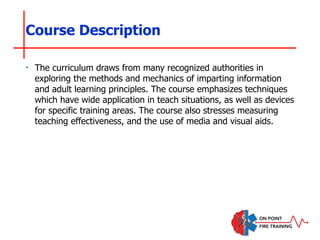
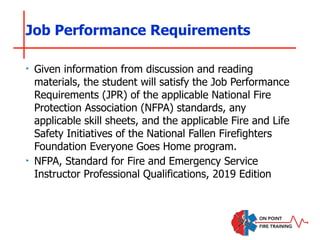
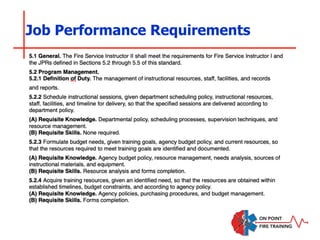
The document outlines the curriculum and job performance requirements for the Fire and Emergency Services Instructor course, emphasizing adult learning principles and effective teaching techniques. It covers lesson plan development, safety challenges faced by instructors, evaluation instruments, and supervisory duties, each with specific learning objectives. The course is aligned with national standards from the National Fire Protection Association and the National Fallen Firefighters Foundation.
![Chapter 11
‣ Discuss effects the laws of learning have on developing a lesson
plan. [NFPA 1041, 5.3.2]
‣ Identify components and steps used to create a lesson plan.
[NFPA 1041, 5.3.2]
‣ Describe considerations when teaching from a newly developed
lesson plan. [NFPA 1041, 5.4.2]
‣ Discuss lesson plan evaluation and revision. [NFPA 1041, 5.3.2,
5.4.2]
Learning Objective
Lesson Goal
‣ After completing this lesson, the student shall be able to discuss
lesson plan development.](https://image.slidesharecdn.com/2741courseoverview-240630134854-1e9f2cc1/85/2741-Course-overview-JPR-9-320.jpg)
![Chapter 12
‣ Describe the safety challenges a Level II Instructor faces during a training
evolution. [NFPA 1041, 5.4.3]
‣ Summarize the use of the Incident Management System (IMS) model to supervise
training. [NFPA 1041, 5.4.3]
‣ Discuss environmental regulations that affect training evolutions. [NFPA 1041,
5.4.3]
‣ Discuss the roles and responsibilities of the Level II Instructor during an accident
investigation. [NFPA 1041, 5.4.3]
‣ Skill Sheet 12-1: Supervise multiple instructors and candidates during an increased
hazard exposure training. [NFPA 1041, 5.4.3]
Learning Objective
Lesson Goal
‣ After completing this lesson, the student shall be able to discuss
training evolution supervision.](https://image.slidesharecdn.com/2741courseoverview-240630134854-1e9f2cc1/85/2741-Course-overview-JPR-10-320.jpg)
![Chapter 13
‣ Describe common considerations for test instruments. [NFPA 1041,
5.5.2]
‣ Discuss various types of evaluation instruments used in fire and
emergency service training. [NFPA 1041, 5.5.2]
‣ Explain the steps for test planning. [NFPA 1041, 5.5.2]
‣ Describe the process to select a test scoring method. [NFPA 1041,
5.5.2]
Learning Objective
Lesson Goal
‣ After completing this lesson, the student shall be able discuss test
item construction.](https://image.slidesharecdn.com/2741courseoverview-240630134854-1e9f2cc1/85/2741-Course-overview-JPR-11-320.jpg)
![Chapter 14
‣ Discuss techniques for supervising other instructors. [NFPA 1041, 5.2.6]
‣ Describe the tasks necessary for scheduling instructional delivery and
resources. [NFPA 1041, 5.2.2]
‣ Explain the process used for recommending budget needs. [NFPA 1041,
5.2.3, 5.2.4]
‣ Discuss the components of the purchasing process. [NFPA 1041, 5.2.4]
‣ Explain the aspects of managing training records. [NFPA 1041, 5.2.5]
Learning Objective
Lesson Goal
‣ After completing this lesson, the student shall be able to discuss
supervisory and administrative duties.](https://image.slidesharecdn.com/2741courseoverview-240630134854-1e9f2cc1/85/2741-Course-overview-JPR-12-320.jpg)
![Chapter 15
‣ Describe the process for evaluating instructors. [NFPA 1041, 5.2.6]
‣ Describe the process for developing class evaluation instruments.
[NFPA 1041, 5.5.3]
‣ Explain the benefits of evaluation findings. [NFPA 1041, 5.2.6]
‣ Skill Sheet 15-1: Administer a Level I Instructor performance
evaluation. [NFPA 1041, 5.2.6]
‣ Skill Sheet 15-2: Develop class evaluation forms. [NFPA 1041, 5.5.3]
Learning Objective
Lesson Goal
‣ After completing this lesson, the student shall be able to discuss
instructor and class evaluations.](https://image.slidesharecdn.com/2741courseoverview-240630134854-1e9f2cc1/85/2741-Course-overview-JPR-13-320.jpg)


