Basic Components
Introduction
Discuss Objectives
The Automatic Sprinkler
Types of Sprinkler Systems
Matching The Risk With The Correct Protection
Design Methods and Water Supplies
Automatic Sprinkler System Components
Sprinkler System Inspection, Tests, and Maintenance
The Automatic Sprinkler
History dates to mid to late 1800’s
Forerunner of modern sprinkler was perforated pipes
Extremely effective - Controls over 96% of fires
Designed to apply water over the source of the fire
Operates from heat generated by fire
Each sprinkler operates independently
Numerous types to meet protection requirements
The Automatic Sprinkler
Deflector (Upright)
Frame
Levers
Links
Solder
Cap
Upright & Pendent Standard Sprinklers
Pendent Quick Response Glass Bulb
Sprinkler
ESFR Sprinkler
Early Suppression Fast Response
Types of Sprinkler Systems
Wet Pipe Systems
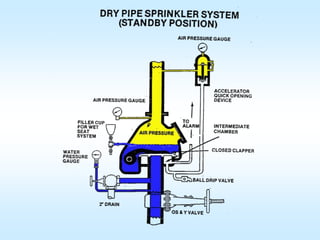
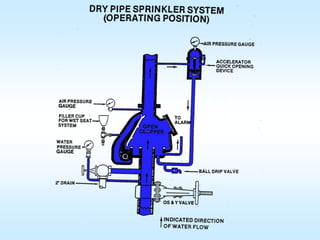
Dry pipe Systems
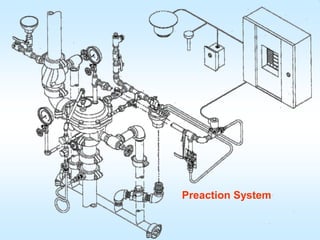
Pre-action Systems
Early Suppression Fast Response (ESFR)
Large Drop
Wet Pipe Systems
Area must be heated
Piping contains water under pressure
Water applied as soon as sprinkler fuses
Fast acting - Preferred system
Typical Wet Pipe System Riser
Alarm Check Valve with Trim
Alarm Check Valve for Wet Pipe System
Dry Pipe Systems
Area experiences freezing temperatures
Piping contains air under pressure
Water application delayed until air
pressure bleeds from system after sprinkler
fuses
Slow acting - Less desirable system
Typical Dry Pipe System
Typical Dry Pipe Valve with Trim
Dry Pipe Valve Assembly
Pre-action Systems
Area contains high valued water
damageable contents
Piping contains air under pressure
Separate fire detection system
Early alarm before water discharge
Preaction System
Typical Preaction System Riser
ESFR Sprinklers
Applications/Advantages
 Excellent for high storage
 Eliminates in-rack sprinklers
 Flexible storage arrangements
ESFR Sprinklers
Disadvantages
 Cost …often require fire pump
 Installation / construction restrictions
 Not Good for coolers or freezers
 Still require in-racks for motor oils,
vegetable oils and aerosols
Large Drop Sprinklers
Applications/Advantages
 Also excellent for high storage
 Also eliminates in-rack sprinklers
 Good for coolers & freezers
Large Drop Sprinklers
Disadvantages
 Larger water demands … fire pump
 Still require in-racks for motor oils,
vegetable oils and aerosols
Matching The Risk
With The Correct
Protection
+
Design Methods and Water
Supplies
Design Methods
Pipe Schedule
 Older method based on tables in NFPA 13.
Hydraulically Designed
 System specifically matched to the
Occupancy or Commodity Classification
 based on specific water density for a
calculated area (_ usgpm/sq.ft. over _ sq.ft.)
Key Determining Factors
 “Occupancy”- Light, Ordinary, Extra
Hazard
 “Commodity Classification” for storage &
warehousing (Class I to IV or Plastic)
 Storage Heights
 Storage Arrangements (Rack vs Palletized)
 Specialty products / risks (aerosols, etc.)
The Decision Tree
Determine
Occupancy
Storage or
Warehousing
Use NFPA 13
Occupancy Tables
See Appendix A
Commodity Class
1,2,3,4 or Plastics
See Appendix B
Temperatures
above 400F
Use wet pipe
Temperatures
between
00F and 400F
Use drypipe
Temperatures
below 00F
Use pre-action
Storage > 12 foot
Use NFPA 231C
See Appendix D
Rack Storage
Idle Pallets
Aerosols
Motor Oils
Vegetable Oils
Other
Flammable
Liquids
Tires
Rolled Paper
NFPA 231
NFPA 30B
NFPA 30
NFPA 30
NFPA 231D
NFPA 231F
Use NFPA 231
See Appendix C)
Yes
Yes
Yes
Yes
No
No
No
The Decision Tree - Example
The Details:
 Dry Grocery Warehouse
 Cereal, paper towels, pop canned food
products
 New building 25 ‘ high roof
 20 feet high storage
 Product palletized in solid piles (no racks)
Water Supplies
 Public Supply & Booster Pumps
 Gravity Tanks (Water Towers)
 Pressure Tanks
 Suction Tanks or reservoirs with Fire
Pumps
System
Components
The Fire Pump
Typical Fire Department Connection
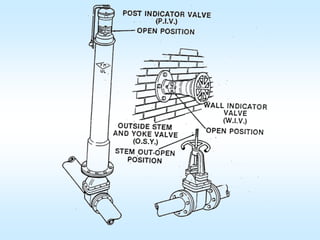
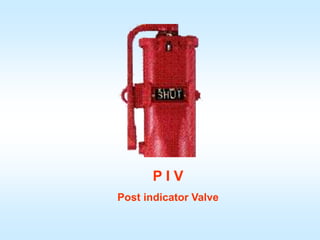
P I V
Post indicator Valve
OS&Y
Outside Stem & Yoke Valve
Butterfly Valve w/ Tamper Wiring
Standard Gate Valve
Swing Check Valve
Typical Inspector’s Test Connection
Dry Pipe System Shown - Wet Pipe System is Similar
Dry System Auxiliary Drain
Typical Air Maintenance Arrangement
for Dry Pipe System from
Separate Air Compressor
The Complete
Fire Protection
System
Typical Plant
Fire Protection System
Sprinkler System Inspection,
Test, and Maintenance
National Fire Protection Association
Standard #25

Sprinkler_Systems_Presentation.ppt