BASIC ELECTRICAL AND ELECTRONICS
ENGINEERING
Aligeti Akhil
23001-CS-034
FET’S AND MOSFET’S
Introduction:
• The field effect transistor (FET) is a three terminal semiconductor device in which the
current is controlled by an electric field.
• A FET is an example of a unipolar device. It works only depending on the majority carriers.
(i.e.., either holes)
• FET’s are voltage controlled devices, in contrast to bipolar transistors, which are current
controlled.
CLASSIFICATION OF FETS
• The FET’S are classified into two types . They are
1.JFET (Junction Field Effect Transistor, and
2. MOSFET( Metal Oxide Semiconductor Field Effect Transistor)
The MOSFETs are also called as Insulated Gate Field Effect
Transistor (IGFET)
CONSTRUCTION OF JFET
• The basic construction and circuit symbols of N-channel and P-channelFETs are
shown in figure.
• A junction field effect transistor (JFET) is a three terminal semiconductor device in
which current conduction is by one type of charge carrier i.e.., electrons or holes.
• The three terminals are designate as Gate (G),Source(S) and Drain(D).
• It consists of a P-type or N- type silicon bar(channel) containing two PN-junctions at
the both sides the silicon bar forms the conducting channel for the charge carriers.
• If the silicon bar is of N-type , it is called N-channel JFET and if the silicon bar is of P-
type, it is called a P-channel JFET.
1.Gate(G): Both the p-type regions are connected to internally and a single wire is
taken out. This is called Gate Terminal. It is similar to base in BJT. It controls the flow
of carrier through the channel.
2.Source(S): It is the terminal through which the majority carriers (electrons in case of
N- channel or Holes in case of P-channel) enters the channel (lik emitter in BJT).
3.Drain(D):It is the terminal, through which the majority carriers leaves the channel( like
collector inBJT).
4.Channel: The region between the source and drain, sandwiched between the two
gates is called the channel and the majority carriers move from source to drain
through this channel.
CONSTRUCTION AND CIRCUIT SYMBOLS OF JFET
SUPPLY VOLTAGE OF JFET
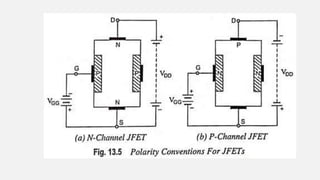
• Figure shows N-channel JFET polarities whereas and shows the P- channel JFET
polarities.
• Note that in each case, the voltage between the gate and source is such that the
gate is reverse biased.
• This is the normal way of JFET Connection. The drain and source terminals are
interchangable i.e., either end can be used as source and the other end as drain.
The following points may be noted,
(1) The input circuit (i.e.., gate to source) of a JFET is reverse biased. This means that the device
has high input impedance.
(2) The drain is so biased w.r.t. source that drain current ID flows from the source to drain.
(3) In all JFET’s , source current IS is equal to the drain current i.e.., .
PRINCIPLE OF OPERATION OF N-
CHANNEL JFET
1. When VGS =0 and VDS=0 :
* when no voltage is applied between drain and source and gate and
sourcei.e.., VGS=0 and VDS=0. So drain current is zero shown in figure
2. When VGS=0 and VDS is increased from zero
• When a voltage VDS is applied between drain and source terminals and voltage on the
gate is zero, the two PN- junctions at the sides of the bar establish depletion layers.
• The majority charge carriers i.e.., electrons (holes in case of P-channel FET) flow from
source to drain through a channel between the depletion layers hence drain current
Idflows through the channel from Drain to source.
• As VDS is gradually increased from zero, ID increases proportionally as per Ohm’s law.
3. When VGS is negative and VDS is increased:
When a reverse bias voltage VGS is applied between the gate and source, and the VDS is
increased, the width of the depletion layers are increased.
At particular VGS the two depletion regions may touch each other, this is referred to as
put-in at, this condition the channel resistance is inifinite, the corresponding VGS is
known as Pinch off voltage.
DRAIN CHARACTERISTICS OF JFET
Definition: The curves which shows the relationship between the drain current
(ID) and drain to source voltage (VDs) for different values of (VGS) are called
“drain characteristics of JFET”.
* Keeping VGS fixed at some value, drain-source voltage is changed in steps.
Ohmic Region :
* In this region,drain current (ID) is directly proportional to drain to source voltage
(VDS)
* For applying the low values of VDS, drain current ID varies directly with voltage
following OHM’S law.
Pinch-Off Region:
• Here, JFET operates as a constant-current device because ID constant and is relatively
independence of VDS.
• It is due to the fact that as VDS increase, channel resistance also increases
proportionally thereby keeping ID practically constant.
3. Breakdown Region:
• The voltage between the drain and the source (VDS) is high enough to causes the JFET’S
resistive channel to break down and pass uncontrolled maximum current.
• If the JFET enters the breakdown region where ID increases to an excessive value.
Pinch-Off Voltage: It is the maximum drain-source voltage at which the drain current
essentially becomes constant.
MUTUAL CHARACTERISTICS OF JFET
DEFINITION: The graph which show the relationship between the drain current (ID) and
the gate to source voltage (VGS) for constant value of drain to source voltage is called
“Mutual or transfer characteristics of JFET.”
ID=IDSS[1-VGS/ VGS(off)] 2
PARAMETERS OF JFET:
• A JFET has certain parameters which determine is performance in a circuit.
• The main parameters of JFET when connected in common source mode are :
1. A. C. DRAIN RESISTANCE(rd)
2. Trans-conductor(gm)
3. Amplification factor
1. A. C. Drain Resistance: It is the a. c. resistance between drain and
source terminals when JFET operates in the pinch-off region
• It is the ratio of change in drain to source voltage to the change in
drain current at constant gate to source voltage
2.Trans- conductance :
* The control that the gate voltage has over the drain current is
measured by trans-conductance.
3. Amplification Factor: It is the ratio of change in drain to source
voltage to the change in gate to source voltage at constant drain
current (ID).
Specification of JFET:
1. Saturation current(IDSS): It is the maximum drain saturation current at
VGS=0in the 2. Pinch-off voltage: It is the voltage at which the current ID
reaches to its constant saturation level.
3. TRANS- CONDUCTANCE: It is the change in the drain current for given
change in gate to source voltage with the drain to source voltage constant.
4.Drain Resistance: It is the a. c resistance between drain and source
terminals, when the FET is operating in the pinch-off region.
5. Cut-off Voltage: It is the value of gate to source voltage at which the drain
current is zero.
6. Drain Source ON Resistance: It is the d. c resistance of the channel when
the depletion region are absent, when the device is biased on the channel
ohmic region of the characteristics.
7.VDGO(Drain-gate Breakdown voltage): It is the drain-gate breakdown
voltage with the source open- circuit.
8.VGSS(Gate-source Breakdown voltage): It is the gate- source
breakdown voltage with drain shorted to the source.
Application of JFET:
1.JFETs are used in RF amplifiers.
2.JFET is used as a buffer amplifier.
3. JEFT can be used as a chopper.
4. JFET can be used as a electronic switch.
5. JFET is used as a voltage variable resistor.
6. It is used a oscillator circuits because frequency drift is low.
MERITS OF JFET OVER BJT
Advantages:
1.It has very high input impedance.
2. It is less noisy than BJT.
3. FET’s are much easier to fabricate in IC’s.
4. High power gain.
5.FET is voltage controlled device.
DEFINITION: MOSFET is an important semiconductor device and is widely
used in many circuit application.
Types of MOSFET:
1. Depletion MOSFET (D- MOSFET)
2.Enhancement-MOSFET (E-MOSFET)
1.DEPLETION MOSFET : This MOSFET can be operated in both
depletion mode and enhancement mode by changing the polarity of
VGS. When negative gate-to-source voltage is applied, the N-channel D-
MOSFET operates in the depletion mode.
However, with positive gate voltage, it operates in the enhancement
mode. Since a channel exists between drain and source, ID flows even
when VGS=0. That is why D-MOSFET is Known as normally-ON MOSFET.
2. Enhancement-MOSFET: As it is name indicates, this MOSFET
operates only in the enhancement mode and has no depletion mode. It
works with large Positive gate voltage only. It differs in construction
from the D-MOSFET in the structurally there exists no channel between
the drain and source. Hence, it doesn’t conduct VGS=0. That is why it is
called normally –OFF MOSFET.
CONSTRUCTION AND WORKING OF N-CHANNEL DEPLETION TYPE
MOSFET :
CONSTRUCTION :
* Figure shows the basic construction of N-channel depletion type
MOSFET.
• It consists of two heavily doped N+ regions are diffused into a lightly
doped p-type substrate.
• One N+ regions acts as Source (S) and another N+ acts as drain (D).
• A metal aluminium is deposited over the entire surface of the SiO2 layer
in such a way it covers the entire channel region as shown in figure . This
aluminium layer is called as gate(G).
Working of N-channel Depletion Type MOSFET:
1.When VGS=0 and VDS is applied between source and drain :
• *when the VGS =0 and VDS is applied between source and drain, then the drain
current flows because there is a channel exists between source and drain.
• For the reason, D-MOSFET is normally ON when VGS=0V.
2. When VGS=-ve and VDS=+ve (depletion mode):
• When negative voltage is applied to gate (G), the free electrons in N-channel will
move towards the P-type subtract (like charge are repel) and attract holes from P-
type substrate (opposite charge are attract).
• This will results recombination of electrons and holes in N-channel.
3. When VGS=+ve and VDS =+ve(Enhancement Mode):
• Depletion MOSFET can also be operated in Enhancement mode by simply applying
positive voltage to gate.
• Application of positive gate voltage results in induced negative channel in the N-
type channel. This the conductivity of the channel gets increased.
Construction
*Figure shows the basic construction of N-channel Enhancement type
MOSFET.
*A N-channel Enhancement MOSFET consists of lightly doped P-substrate.
*Two heavily doped N+ regions are diffused into a lightly doped p-type
substrate.
*This two N+ regions act as the source and the drain.
*On the SiO2 layer, a metal layer is formed to cover the entire channel
region. This aluminium layer is called the gate(G).
Working
1.When VGS=0 and VDS is applied between source and drain:
• When VGS =0V, then ID current is zero because there is no channel
exists between source and drain.
• The substrate has only a few thermally produced free electrons (
minority carriers).
2.When positive voltage is applied to Gate and VDS is applied between
source and drain :
• When positive voltage is applied to gate. The substrate will be
connected to the common terminal will be connected to the ground
* The induced negative charge become minority carriers in the p-type
of substrate, which provides channel for the flow electrons from source
to drain is called N-type inversion layer.
Construction
• The figure shows the construction details of CMOSFET.
• CMOSFET actually stands for complementary MOSFET, means
that the logic device has both PMOS and NMOS within its
design.
• Enhancement-mode MOSFETs are used in integrated circuits to
produce CMOS type logic gates and power switching circuits
in the form of as PMOS(P-channel)and NMOS (N-channel)
gates.
• The drain of both the MOSFETs are combine and single
terminal is taken
• In the circuit two MOSFETs that are complementary to each
other are used.
• The drains of both the MOSFETs are combined and single
terminal is taken.
• The circuit diagram of CMOSFET inverter .
Working
• When the input voltage Vinis high or equal to VDD then
NMOS(Q1)is turned ON and PMOS(Q2) is turned OFF. The out V0
is zero.
• When the input voltage Vin is low or equal to 0V, then PMOS (Q1)
is turned ON and NMOS (Q1) is turned OFF. So the output
voltage V0 is high.
• In this way the CMOSFET works as an inverter.
Vin Q1(NMOS) Q2(PMOS) V0
High(Logic 1) ON OFF LOW
Low(Logic 0) OFF ON HIGH
FET..pptx

FET..pptx

  • 1.
    BASIC ELECTRICAL ANDELECTRONICS ENGINEERING Aligeti Akhil 23001-CS-034
  • 2.
    FET’S AND MOSFET’S Introduction: •The field effect transistor (FET) is a three terminal semiconductor device in which the current is controlled by an electric field. • A FET is an example of a unipolar device. It works only depending on the majority carriers. (i.e.., either holes) • FET’s are voltage controlled devices, in contrast to bipolar transistors, which are current controlled.
  • 3.
    CLASSIFICATION OF FETS •The FET’S are classified into two types . They are 1.JFET (Junction Field Effect Transistor, and 2. MOSFET( Metal Oxide Semiconductor Field Effect Transistor) The MOSFETs are also called as Insulated Gate Field Effect Transistor (IGFET)
  • 5.
    CONSTRUCTION OF JFET •The basic construction and circuit symbols of N-channel and P-channelFETs are shown in figure. • A junction field effect transistor (JFET) is a three terminal semiconductor device in which current conduction is by one type of charge carrier i.e.., electrons or holes. • The three terminals are designate as Gate (G),Source(S) and Drain(D). • It consists of a P-type or N- type silicon bar(channel) containing two PN-junctions at the both sides the silicon bar forms the conducting channel for the charge carriers. • If the silicon bar is of N-type , it is called N-channel JFET and if the silicon bar is of P- type, it is called a P-channel JFET.
  • 7.
    1.Gate(G): Both thep-type regions are connected to internally and a single wire is taken out. This is called Gate Terminal. It is similar to base in BJT. It controls the flow of carrier through the channel. 2.Source(S): It is the terminal through which the majority carriers (electrons in case of N- channel or Holes in case of P-channel) enters the channel (lik emitter in BJT). 3.Drain(D):It is the terminal, through which the majority carriers leaves the channel( like collector inBJT). 4.Channel: The region between the source and drain, sandwiched between the two gates is called the channel and the majority carriers move from source to drain through this channel. CONSTRUCTION AND CIRCUIT SYMBOLS OF JFET
  • 8.
    SUPPLY VOLTAGE OFJFET • Figure shows N-channel JFET polarities whereas and shows the P- channel JFET polarities. • Note that in each case, the voltage between the gate and source is such that the gate is reverse biased. • This is the normal way of JFET Connection. The drain and source terminals are interchangable i.e., either end can be used as source and the other end as drain.
  • 10.
    The following pointsmay be noted, (1) The input circuit (i.e.., gate to source) of a JFET is reverse biased. This means that the device has high input impedance. (2) The drain is so biased w.r.t. source that drain current ID flows from the source to drain. (3) In all JFET’s , source current IS is equal to the drain current i.e.., .
  • 11.
    PRINCIPLE OF OPERATIONOF N- CHANNEL JFET 1. When VGS =0 and VDS=0 : * when no voltage is applied between drain and source and gate and sourcei.e.., VGS=0 and VDS=0. So drain current is zero shown in figure
  • 12.
    2. When VGS=0and VDS is increased from zero • When a voltage VDS is applied between drain and source terminals and voltage on the gate is zero, the two PN- junctions at the sides of the bar establish depletion layers. • The majority charge carriers i.e.., electrons (holes in case of P-channel FET) flow from source to drain through a channel between the depletion layers hence drain current Idflows through the channel from Drain to source. • As VDS is gradually increased from zero, ID increases proportionally as per Ohm’s law. 3. When VGS is negative and VDS is increased: When a reverse bias voltage VGS is applied between the gate and source, and the VDS is increased, the width of the depletion layers are increased. At particular VGS the two depletion regions may touch each other, this is referred to as put-in at, this condition the channel resistance is inifinite, the corresponding VGS is known as Pinch off voltage.
  • 13.
    DRAIN CHARACTERISTICS OFJFET Definition: The curves which shows the relationship between the drain current (ID) and drain to source voltage (VDs) for different values of (VGS) are called “drain characteristics of JFET”. * Keeping VGS fixed at some value, drain-source voltage is changed in steps.
  • 14.
    Ohmic Region : *In this region,drain current (ID) is directly proportional to drain to source voltage (VDS) * For applying the low values of VDS, drain current ID varies directly with voltage following OHM’S law.
  • 15.
    Pinch-Off Region: • Here,JFET operates as a constant-current device because ID constant and is relatively independence of VDS. • It is due to the fact that as VDS increase, channel resistance also increases proportionally thereby keeping ID practically constant. 3. Breakdown Region: • The voltage between the drain and the source (VDS) is high enough to causes the JFET’S resistive channel to break down and pass uncontrolled maximum current. • If the JFET enters the breakdown region where ID increases to an excessive value. Pinch-Off Voltage: It is the maximum drain-source voltage at which the drain current essentially becomes constant.
  • 16.
    MUTUAL CHARACTERISTICS OFJFET DEFINITION: The graph which show the relationship between the drain current (ID) and the gate to source voltage (VGS) for constant value of drain to source voltage is called “Mutual or transfer characteristics of JFET.” ID=IDSS[1-VGS/ VGS(off)] 2 PARAMETERS OF JFET: • A JFET has certain parameters which determine is performance in a circuit. • The main parameters of JFET when connected in common source mode are : 1. A. C. DRAIN RESISTANCE(rd) 2. Trans-conductor(gm) 3. Amplification factor
  • 17.
    1. A. C.Drain Resistance: It is the a. c. resistance between drain and source terminals when JFET operates in the pinch-off region • It is the ratio of change in drain to source voltage to the change in drain current at constant gate to source voltage 2.Trans- conductance : * The control that the gate voltage has over the drain current is measured by trans-conductance. 3. Amplification Factor: It is the ratio of change in drain to source voltage to the change in gate to source voltage at constant drain current (ID).
  • 18.
    Specification of JFET: 1.Saturation current(IDSS): It is the maximum drain saturation current at VGS=0in the 2. Pinch-off voltage: It is the voltage at which the current ID reaches to its constant saturation level. 3. TRANS- CONDUCTANCE: It is the change in the drain current for given change in gate to source voltage with the drain to source voltage constant. 4.Drain Resistance: It is the a. c resistance between drain and source terminals, when the FET is operating in the pinch-off region. 5. Cut-off Voltage: It is the value of gate to source voltage at which the drain current is zero. 6. Drain Source ON Resistance: It is the d. c resistance of the channel when the depletion region are absent, when the device is biased on the channel ohmic region of the characteristics.
  • 19.
    7.VDGO(Drain-gate Breakdown voltage):It is the drain-gate breakdown voltage with the source open- circuit. 8.VGSS(Gate-source Breakdown voltage): It is the gate- source breakdown voltage with drain shorted to the source. Application of JFET: 1.JFETs are used in RF amplifiers. 2.JFET is used as a buffer amplifier. 3. JEFT can be used as a chopper. 4. JFET can be used as a electronic switch. 5. JFET is used as a voltage variable resistor. 6. It is used a oscillator circuits because frequency drift is low.
  • 20.
    MERITS OF JFETOVER BJT Advantages: 1.It has very high input impedance. 2. It is less noisy than BJT. 3. FET’s are much easier to fabricate in IC’s. 4. High power gain. 5.FET is voltage controlled device.
  • 21.
    DEFINITION: MOSFET isan important semiconductor device and is widely used in many circuit application. Types of MOSFET: 1. Depletion MOSFET (D- MOSFET) 2.Enhancement-MOSFET (E-MOSFET)
  • 22.
    1.DEPLETION MOSFET :This MOSFET can be operated in both depletion mode and enhancement mode by changing the polarity of VGS. When negative gate-to-source voltage is applied, the N-channel D- MOSFET operates in the depletion mode. However, with positive gate voltage, it operates in the enhancement mode. Since a channel exists between drain and source, ID flows even when VGS=0. That is why D-MOSFET is Known as normally-ON MOSFET. 2. Enhancement-MOSFET: As it is name indicates, this MOSFET operates only in the enhancement mode and has no depletion mode. It works with large Positive gate voltage only. It differs in construction from the D-MOSFET in the structurally there exists no channel between the drain and source. Hence, it doesn’t conduct VGS=0. That is why it is called normally –OFF MOSFET.
  • 23.
    CONSTRUCTION AND WORKINGOF N-CHANNEL DEPLETION TYPE MOSFET : CONSTRUCTION : * Figure shows the basic construction of N-channel depletion type MOSFET. • It consists of two heavily doped N+ regions are diffused into a lightly doped p-type substrate. • One N+ regions acts as Source (S) and another N+ acts as drain (D). • A metal aluminium is deposited over the entire surface of the SiO2 layer in such a way it covers the entire channel region as shown in figure . This aluminium layer is called as gate(G).
  • 25.
    Working of N-channelDepletion Type MOSFET: 1.When VGS=0 and VDS is applied between source and drain : • *when the VGS =0 and VDS is applied between source and drain, then the drain current flows because there is a channel exists between source and drain. • For the reason, D-MOSFET is normally ON when VGS=0V.
  • 26.
    2. When VGS=-veand VDS=+ve (depletion mode): • When negative voltage is applied to gate (G), the free electrons in N-channel will move towards the P-type subtract (like charge are repel) and attract holes from P- type substrate (opposite charge are attract). • This will results recombination of electrons and holes in N-channel. 3. When VGS=+ve and VDS =+ve(Enhancement Mode): • Depletion MOSFET can also be operated in Enhancement mode by simply applying positive voltage to gate. • Application of positive gate voltage results in induced negative channel in the N- type channel. This the conductivity of the channel gets increased.
  • 27.
    Construction *Figure shows thebasic construction of N-channel Enhancement type MOSFET. *A N-channel Enhancement MOSFET consists of lightly doped P-substrate. *Two heavily doped N+ regions are diffused into a lightly doped p-type substrate. *This two N+ regions act as the source and the drain. *On the SiO2 layer, a metal layer is formed to cover the entire channel region. This aluminium layer is called the gate(G).
  • 29.
    Working 1.When VGS=0 andVDS is applied between source and drain: • When VGS =0V, then ID current is zero because there is no channel exists between source and drain. • The substrate has only a few thermally produced free electrons ( minority carriers). 2.When positive voltage is applied to Gate and VDS is applied between source and drain : • When positive voltage is applied to gate. The substrate will be connected to the common terminal will be connected to the ground * The induced negative charge become minority carriers in the p-type of substrate, which provides channel for the flow electrons from source to drain is called N-type inversion layer.
  • 30.
    Construction • The figureshows the construction details of CMOSFET. • CMOSFET actually stands for complementary MOSFET, means that the logic device has both PMOS and NMOS within its design. • Enhancement-mode MOSFETs are used in integrated circuits to produce CMOS type logic gates and power switching circuits in the form of as PMOS(P-channel)and NMOS (N-channel) gates. • The drain of both the MOSFETs are combine and single terminal is taken • In the circuit two MOSFETs that are complementary to each other are used. • The drains of both the MOSFETs are combined and single terminal is taken. • The circuit diagram of CMOSFET inverter .
  • 32.
    Working • When theinput voltage Vinis high or equal to VDD then NMOS(Q1)is turned ON and PMOS(Q2) is turned OFF. The out V0 is zero. • When the input voltage Vin is low or equal to 0V, then PMOS (Q1) is turned ON and NMOS (Q1) is turned OFF. So the output voltage V0 is high. • In this way the CMOSFET works as an inverter. Vin Q1(NMOS) Q2(PMOS) V0 High(Logic 1) ON OFF LOW Low(Logic 0) OFF ON HIGH