UNIT-III
ADVANCES IN METROLOGY
Basic concepts of laser, Advantages of laser –
laser interferometers – Types – DC and AC laser
interferometer – Applications – Straightness –
Alignment. Basic concept of CMM – Types of
CMM – constructional features – Probes –
Accessories – Software – Application – Basic
concepts of machine vision system – Element –
Application
LASER
• Laser stands for Light Amplification by Stimulated
Emission of Radiation.
• Laser instrument is a device to produce powerful,
monochromatic, collimated beam of light in which
the waves are coherent.
• Energy appears to be emanating from a very small
point.
• The laser is used extensively for interferometry
particularly the He- Ne gas type.
• This produces 1 to 2mm diameter beam of red light
power of 1MW and focused at a point of very high
intensity.
• Laser systems have wide dynamic range, low
optical cross talk and high contrast.
• Laser fined application in dimensional
measurements and surface inspection
because of the properties of laser light.
• These are useful where precision, accuracy,
rapid non-contact gauging of soft, delicate or
hot moving points.
• An electromagnetic radiation is emitted
whenever a charged particles such as an
electron drops from a higher energy state E2
to E 1
Terminology
• WAVELENGTH: the distance between the two
crest and two trough
• FREQUENCY: the number of waves passing in
a point in a certain time
• MONOCHROMATIC LIGHT: spectrum of visible
light having the same wavelength
• COHERENT: The distance over which the beam
stays in phase with itself
TYPES OF LASER
• Solid state laser
• Liquid laser
• Gas laser( He-Ne, 632 wavelength)
• Semiconductor laser(laser diode)
ADVANTAGES
• More intensive than any other monochromatic
source
• High precise, accurate
• It facilitates rapid non-contact gauging of soft,
delicate or hot moving parts
• Allow fabrication of fine structures with high
quality avoiding mechanical stress
APPLICATIONS
• MANUFACTURING- quality cutting, drilling,
welding
• DATA STORAGE- CD, DVD,
• COMMUNICATION
• DISPLAYS
• SCIENTIFIC APPLICATIONS
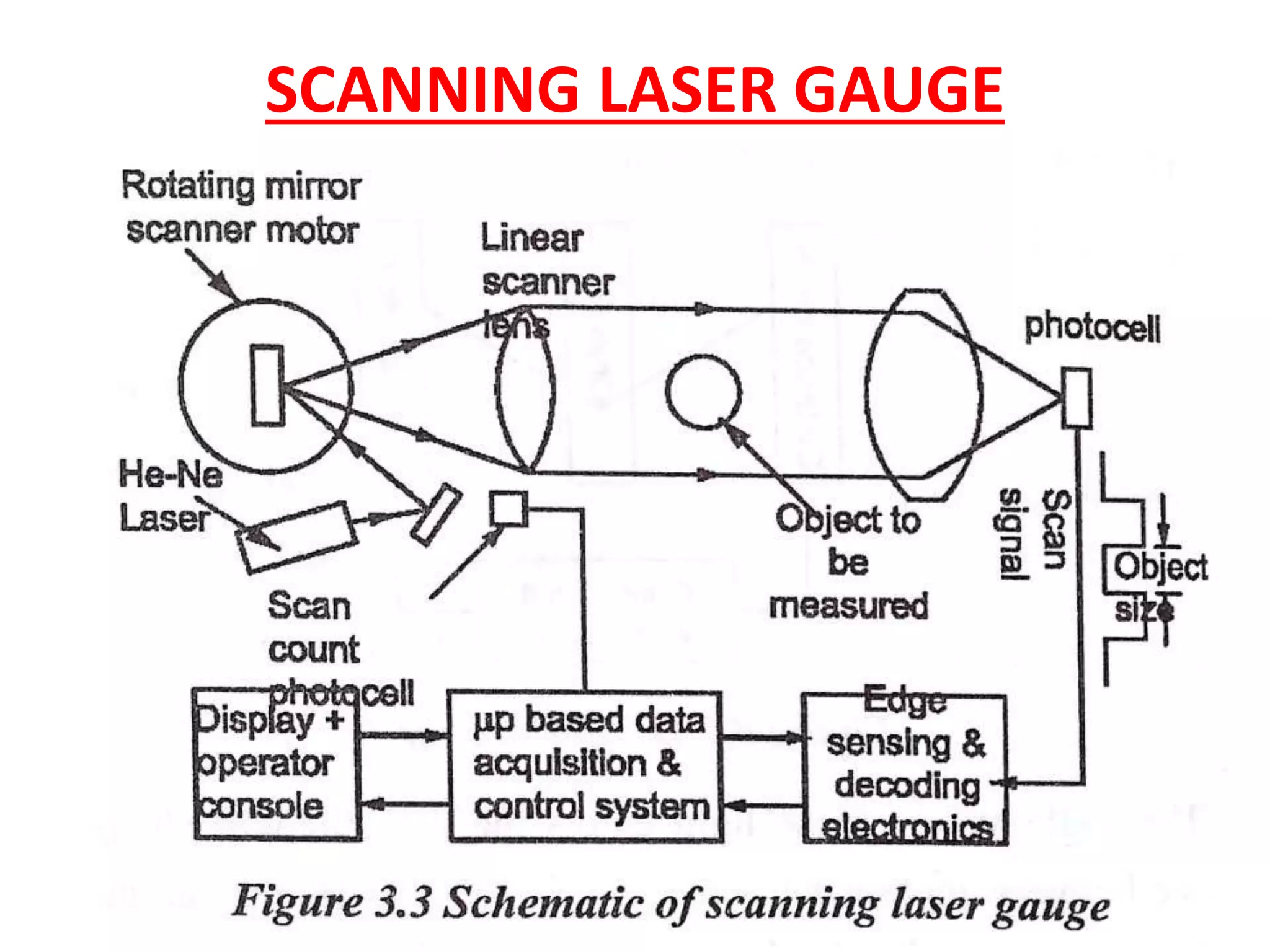
SCANNING LASER GAUGE
• TRANSMITTING UNIT
• PHOTO CELL OR RECEIVER
• MICROPROCESSOR OR CONTROL UNIT
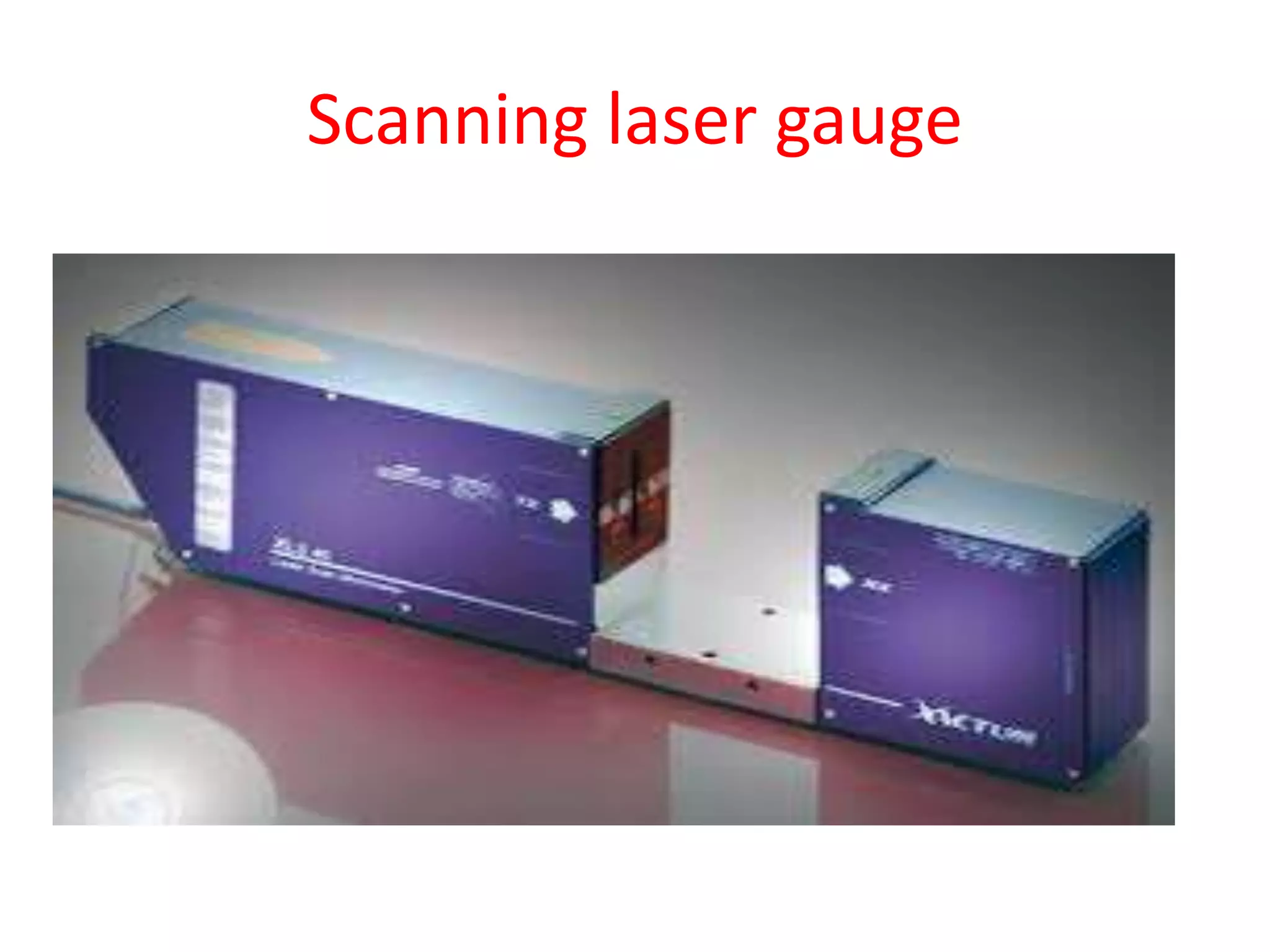
• Used to measure the roundness and
diameter of hot steel bars
• Accuracy of 0.025mm for 5 - 25 mm dia
objects
SCANNING LASER GAUGE
Scanning laser gauge
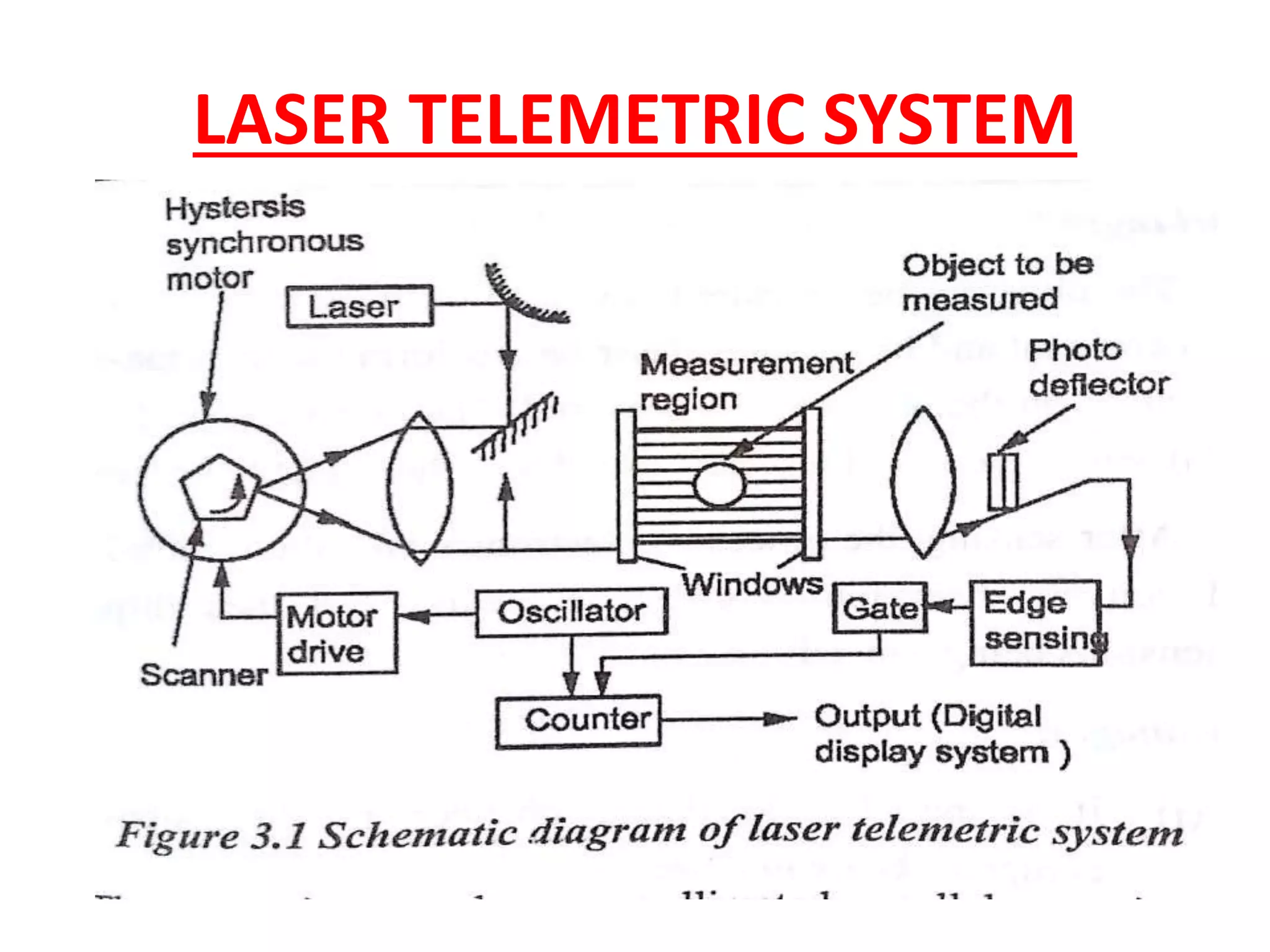
LASER TELEMETRIC SYSTEM
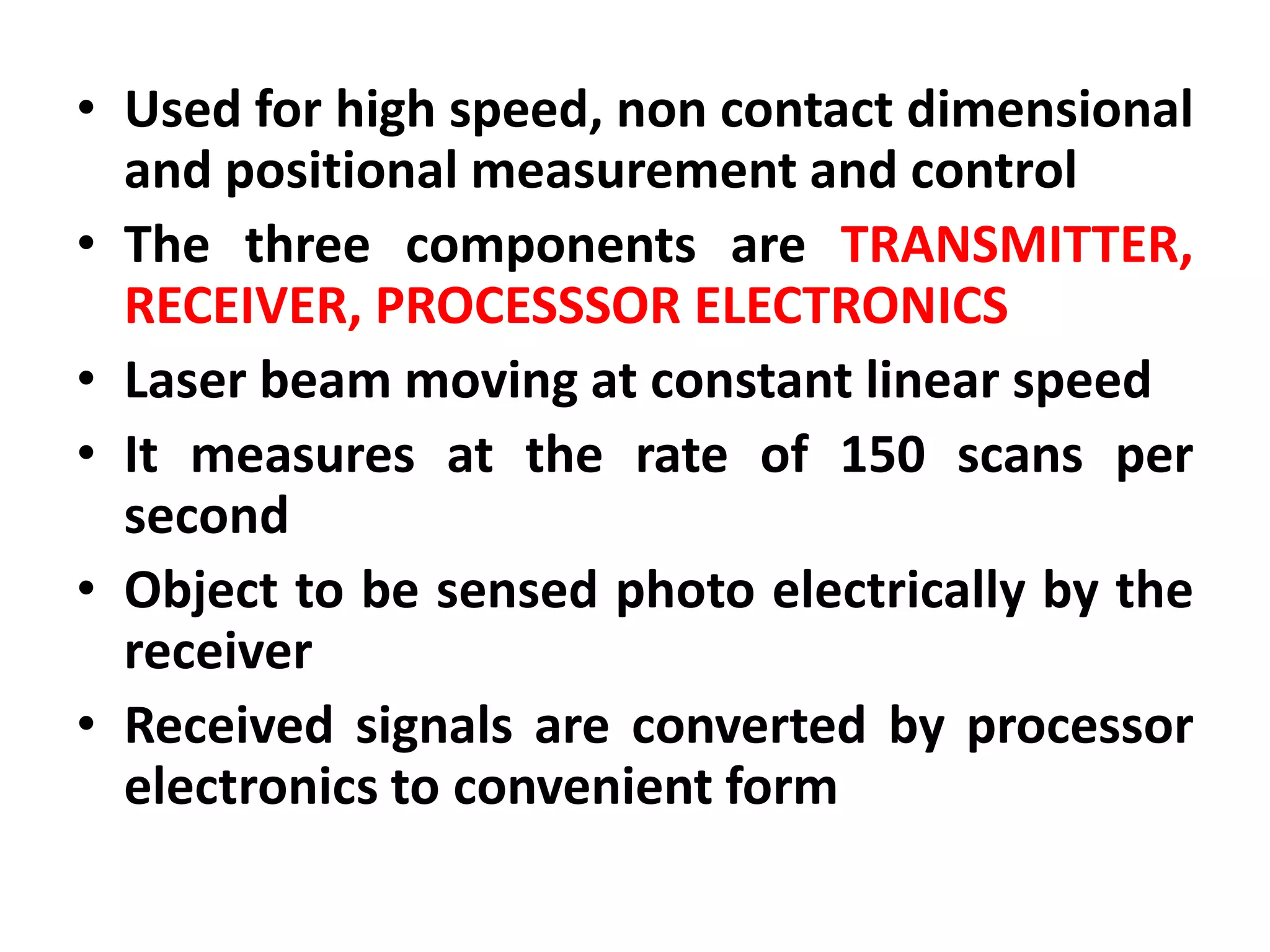
• Used for high speed, non contact dimensional
and positional measurement and control
• The three components are TRANSMITTER,
RECEIVER, PROCESSSOR ELECTRONICS
• Laser beam moving at constant linear speed
• It measures at the rate of 150 scans per
second
• Object to be sensed photo electrically by the
receiver
• Received signals are converted by processor
electronics to convenient form
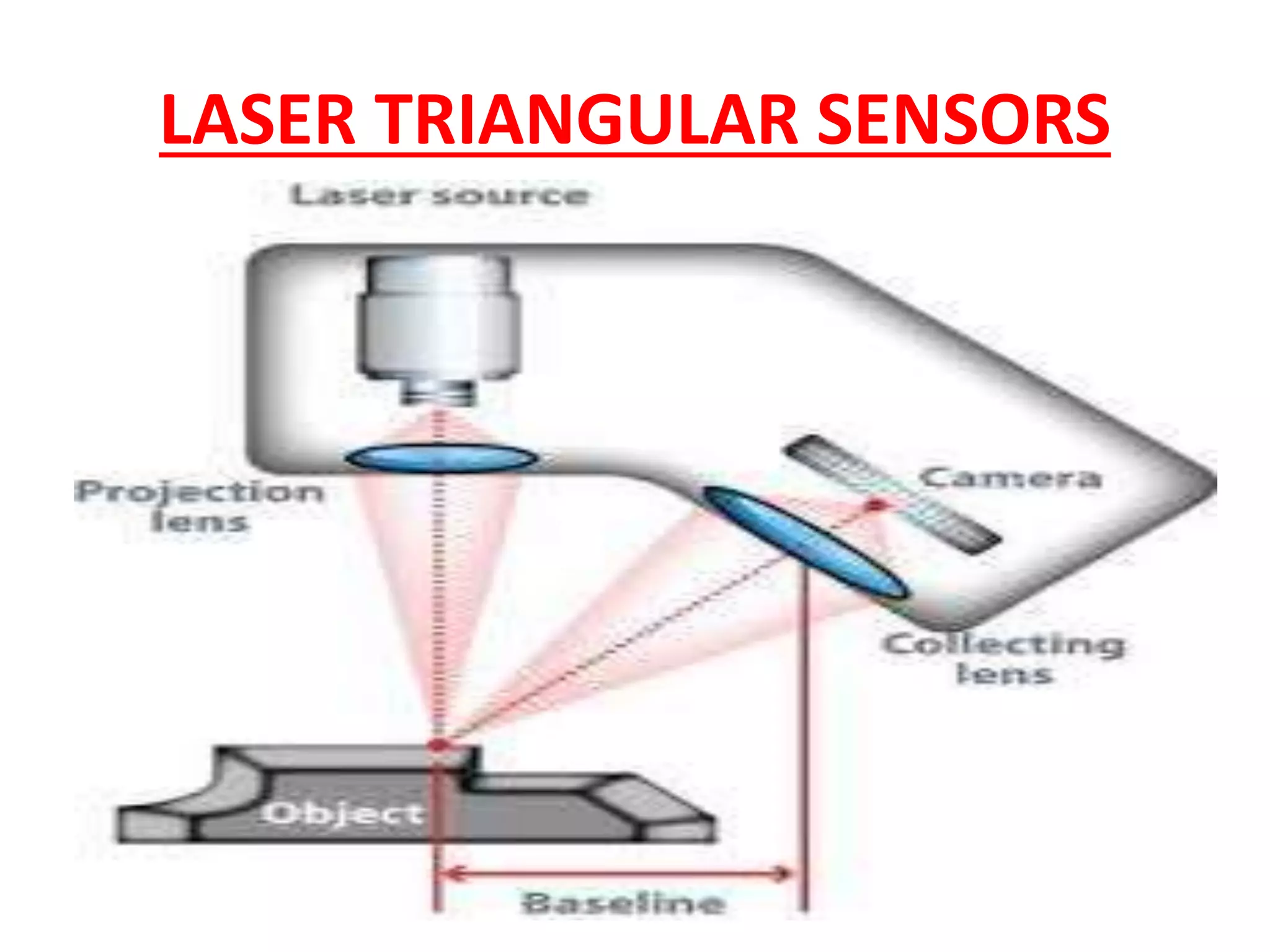
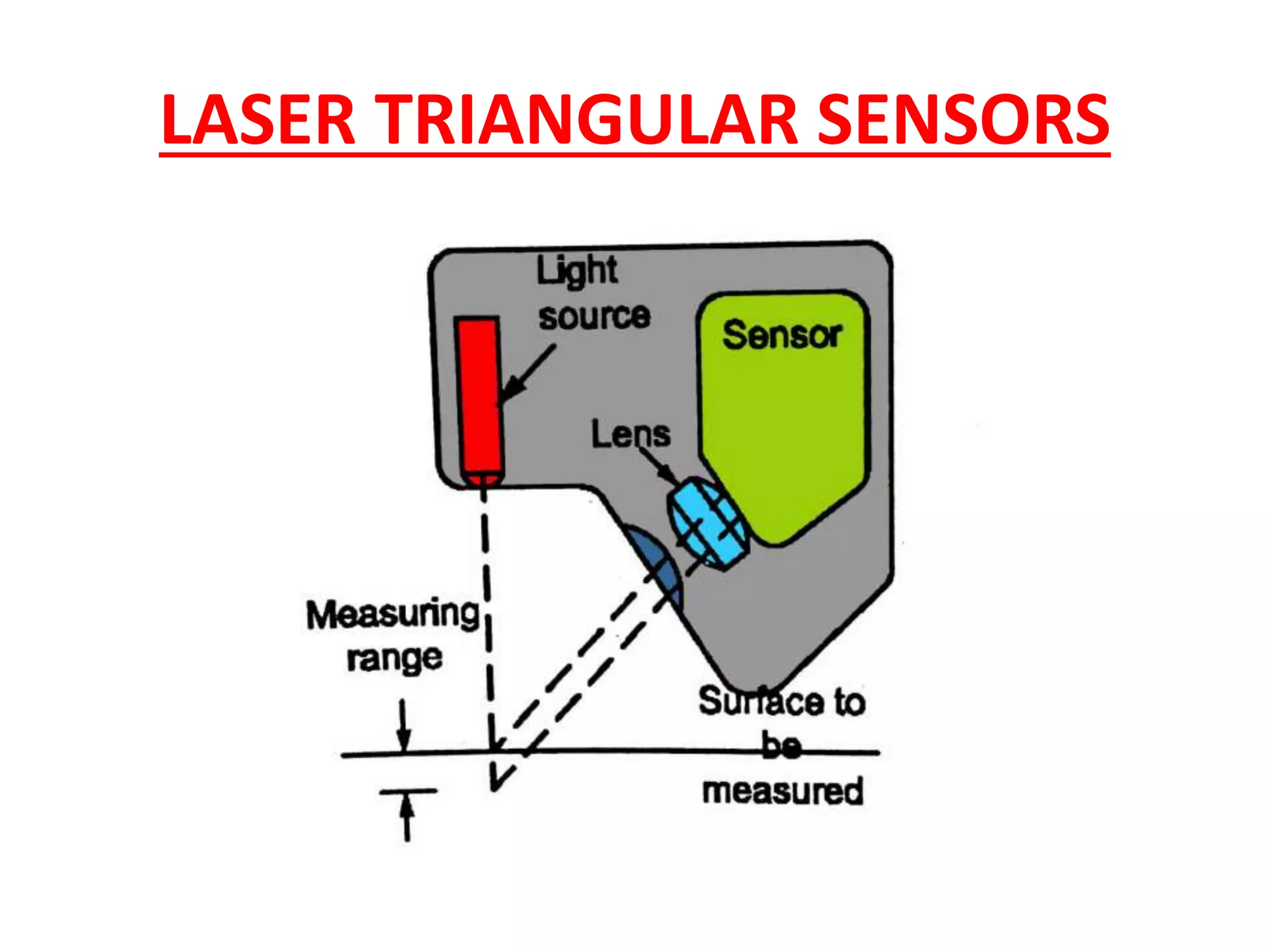
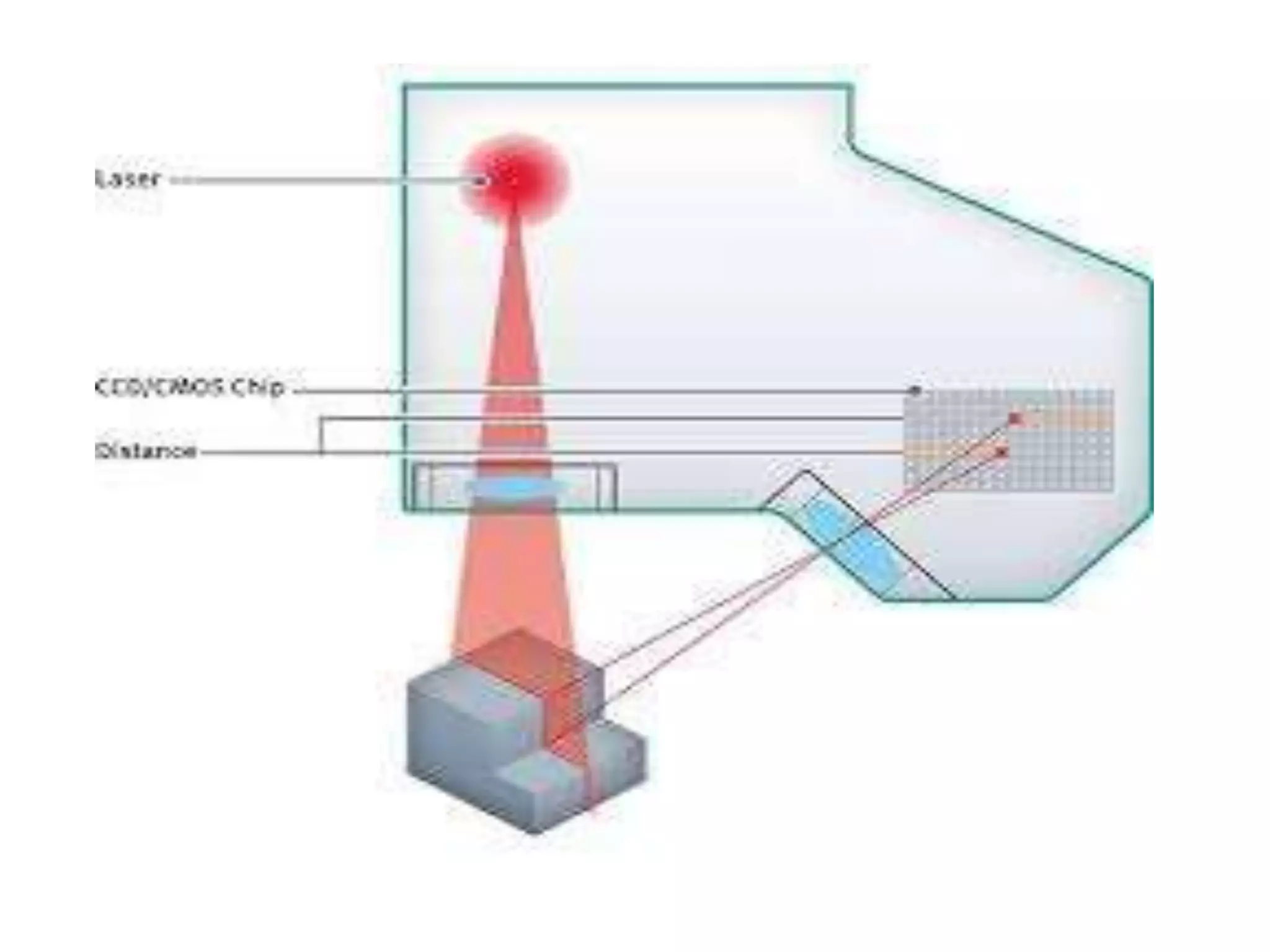
LASER TRIANGULAR SENSORS
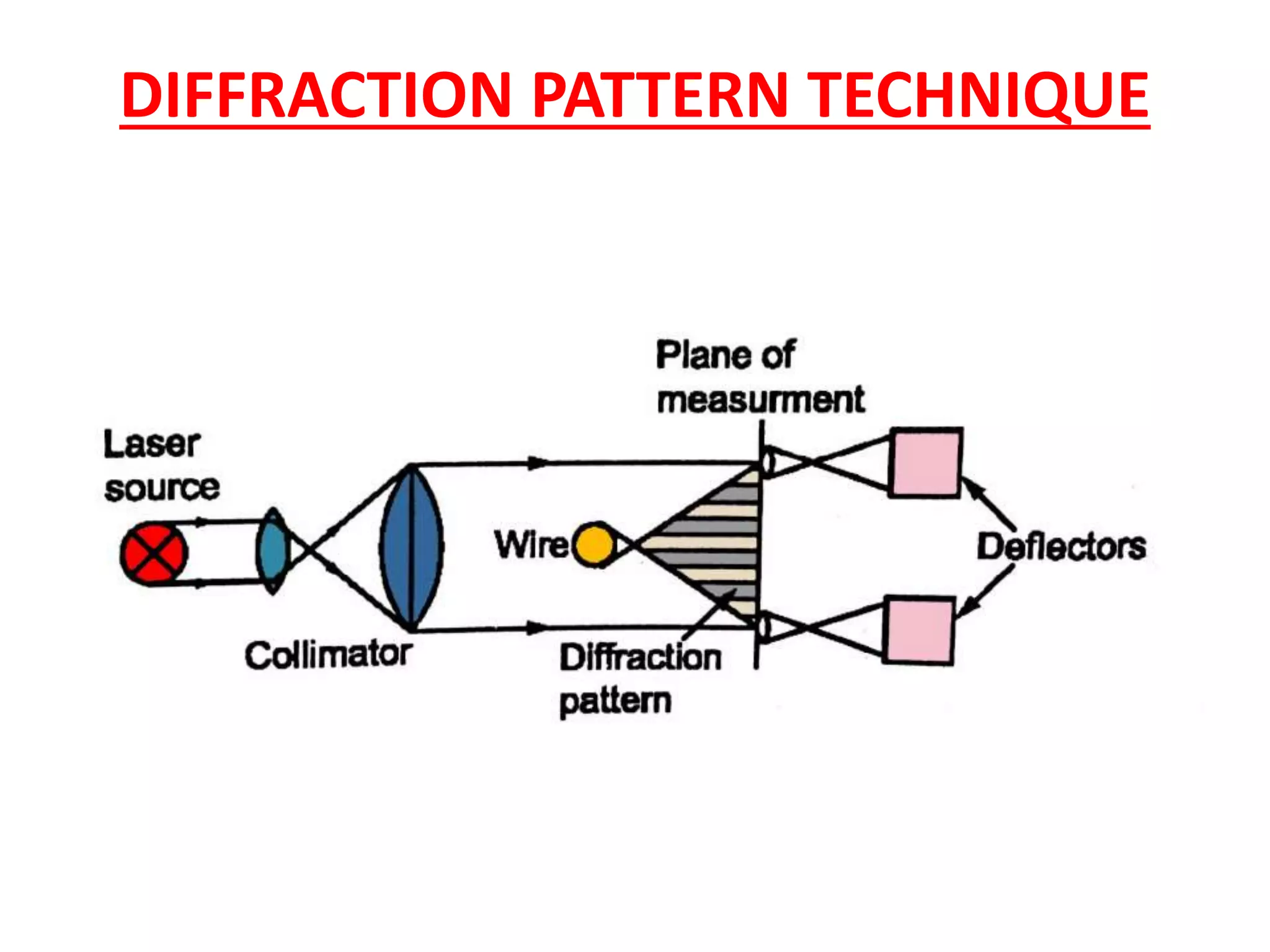
DIFFRACTION PATTERN TECHNIQUE
WHAT IS DIFFRACTION?
• Which involves a change in direction of
waves as they pass through an opening or
around a barrier in their path.
• Above fig shows a method of measuring the
diameter of thin wire using the interference
fringes (edges, borders) resulting from
diffraction of the light by the wire in the laser
beam.
• A measure of the diameter can be obtained by
moving the photo detector until the output is
restored to its original value.
• Variation in wire diameter as small as 0.2%
over wire diameter from 0.005 to 0.2mm can
be measured.
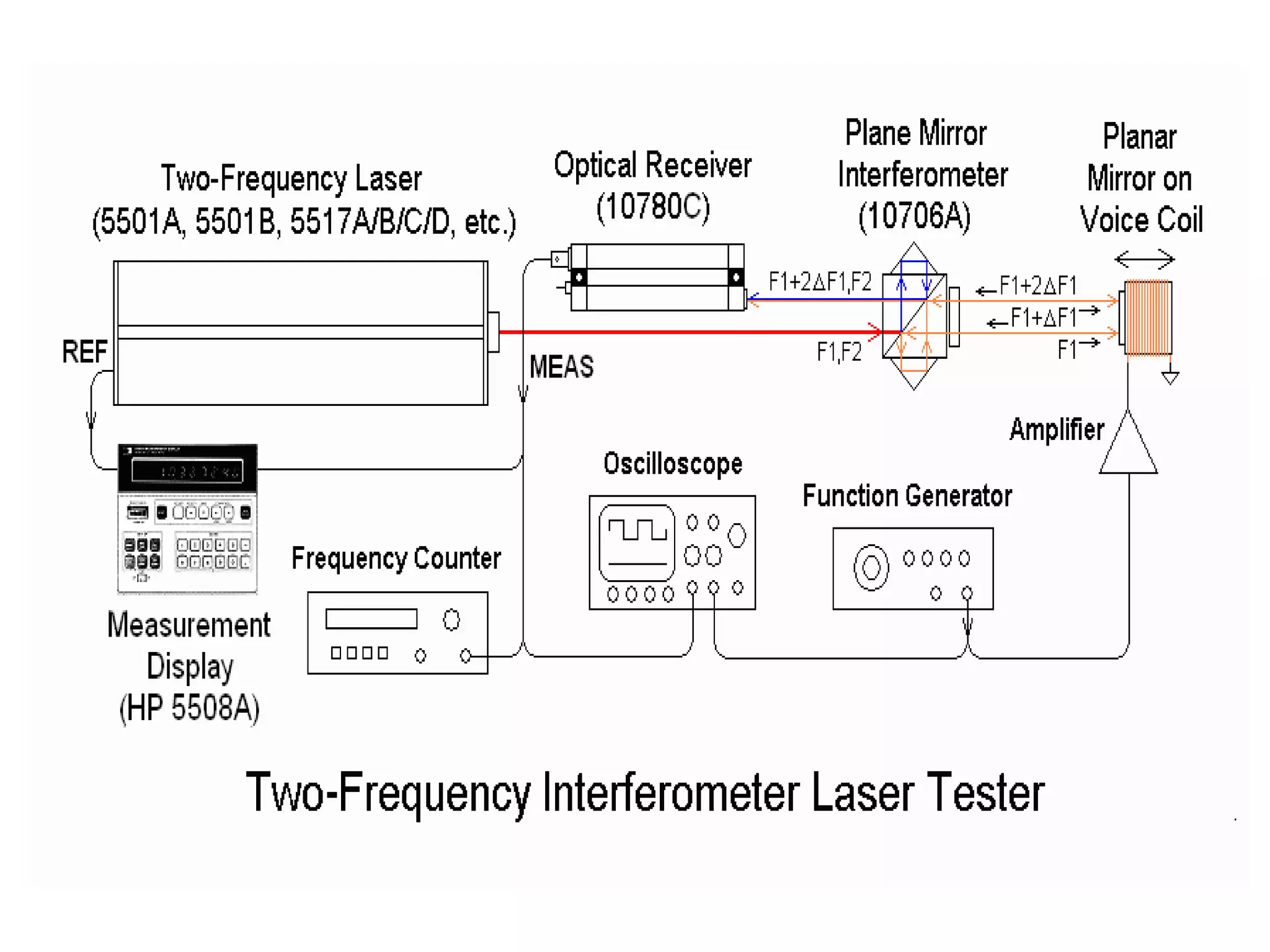
TWO FREQUENCY LASER INTERFEROMETER
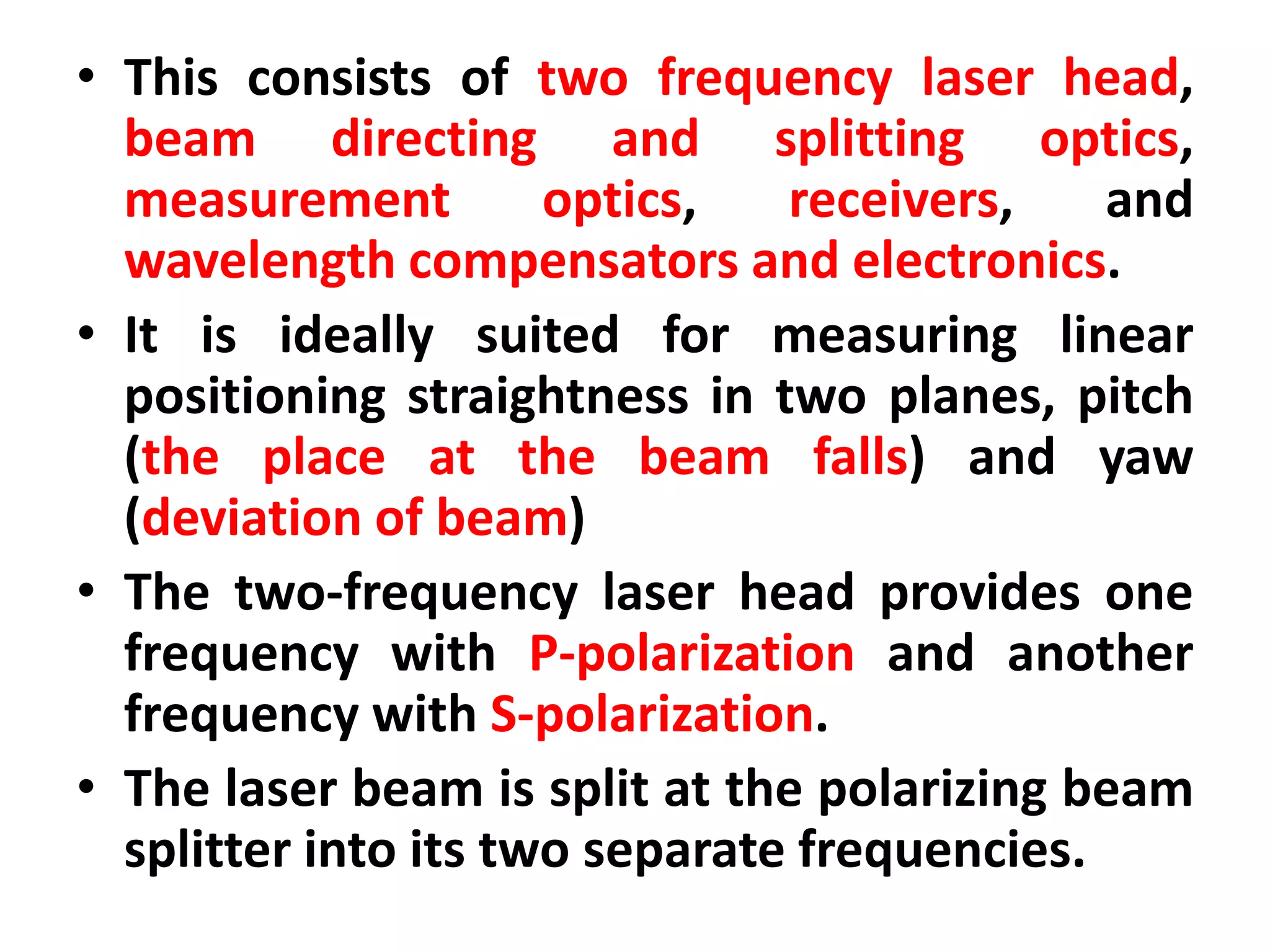
• This consists of two frequency laser head,
beam directing and splitting optics,
measurement optics, receivers, and
wavelength compensators and electronics.
• It is ideally suited for measuring linear
positioning straightness in two planes, pitch
(the place at the beam falls) and yaw
(deviation of beam)
• The two-frequency laser head provides one
frequency with P-polarization and another
frequency with S-polarization.
• The laser beam is split at the polarizing beam
splitter into its two separate frequencies.
• The measuring beam is directed through the
interferometer to reflect off a target mirror
or retro reflector attached to the object to be
measured.
• The reference beam is reflected from fixed
retro reflector.
• The measurement beam on its return path
recombines with the reference beam and is
directed to the electronic receiver.
• POLARIZATION – to produce different views
on different sides
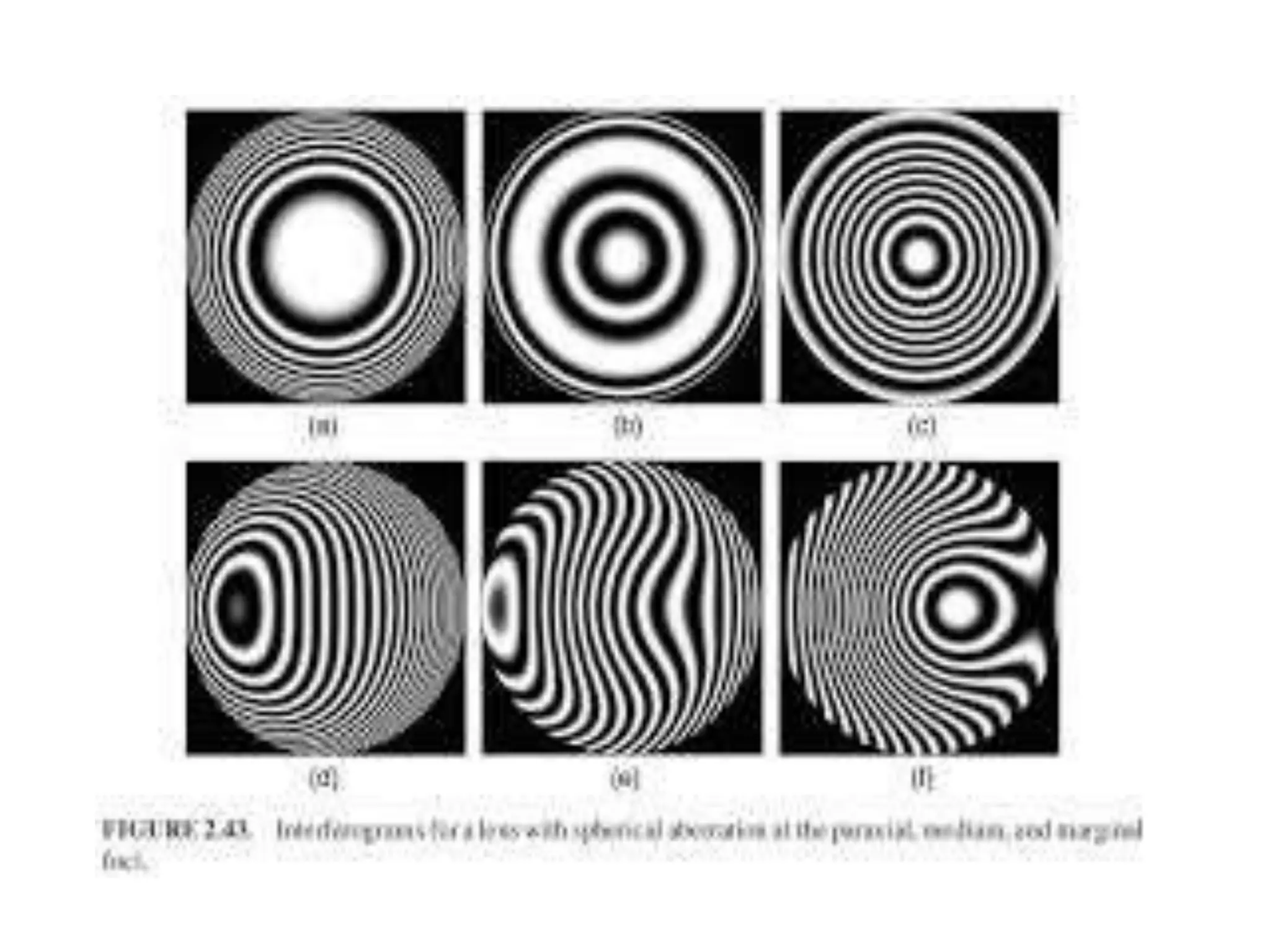
• INTERFERENCE
The two waves suppose to form a resultant
wave of greater or lower amplitude is called
interference
• PRINCIPLE OF SUPERPOSITION
The two waves have same wavelength and
exactly in phase with each other – the resultant
wave is sum of the amplitudes which produces
increased brightness
if the phase not each other, the resultant
amplitude is the difference of the individual
amplitudes which results darkness
PRINCIPLE OF SUPER POSITION
INTERFEROMETER
• An instrument which generates and
compares the difference between the two
light waves which are reflected off two
different surfaces.
• Utilizes the effect of interference.
• INTERFEROMETRY: accurate measurement of
linear dimensions using a pure
monochromatic light source
• Laser Interferometer:
–the instrument used for high precision
measurements (distance, angles…. etc.)
–it uses the very small, stable and accurately
defined wavelength of laser as a unit of
measure
Applications
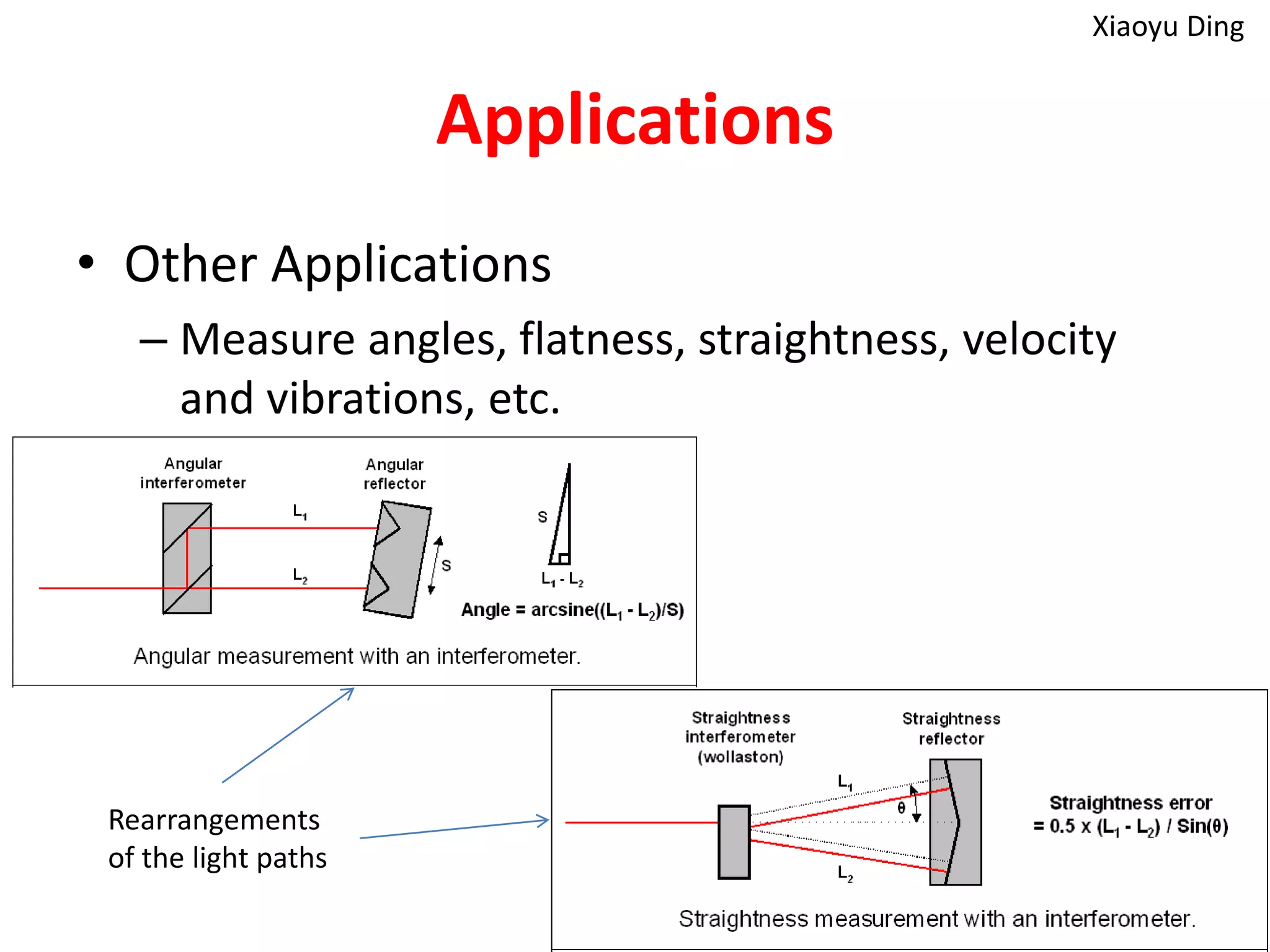
• Other Applications
– Measure angles, flatness, straightness, velocity
and vibrations, etc.
Xiaoyu Ding
Rearrangements
of the light paths
Linear Distance Measurement
The positioning accuracy is measured by
comparing the position value displayed by
machine with the actual position.
Straightness Measurements
Straightness and parallelism measurements with
moving board up to 20 mm.
• Measurement of lengths
• Small changes in lengths
• Optical testing
• Surface structure
• Measurement of pressure and
temperature difference in gas flows and
plasmas
APPLICATIONS OF INTERFEROMETERS
• Particle velocities and vibration
amplitudes
• Wavelength measurements
• Testing of optical components
• Calibration of slip gauges
• Co ordinate measuring machine
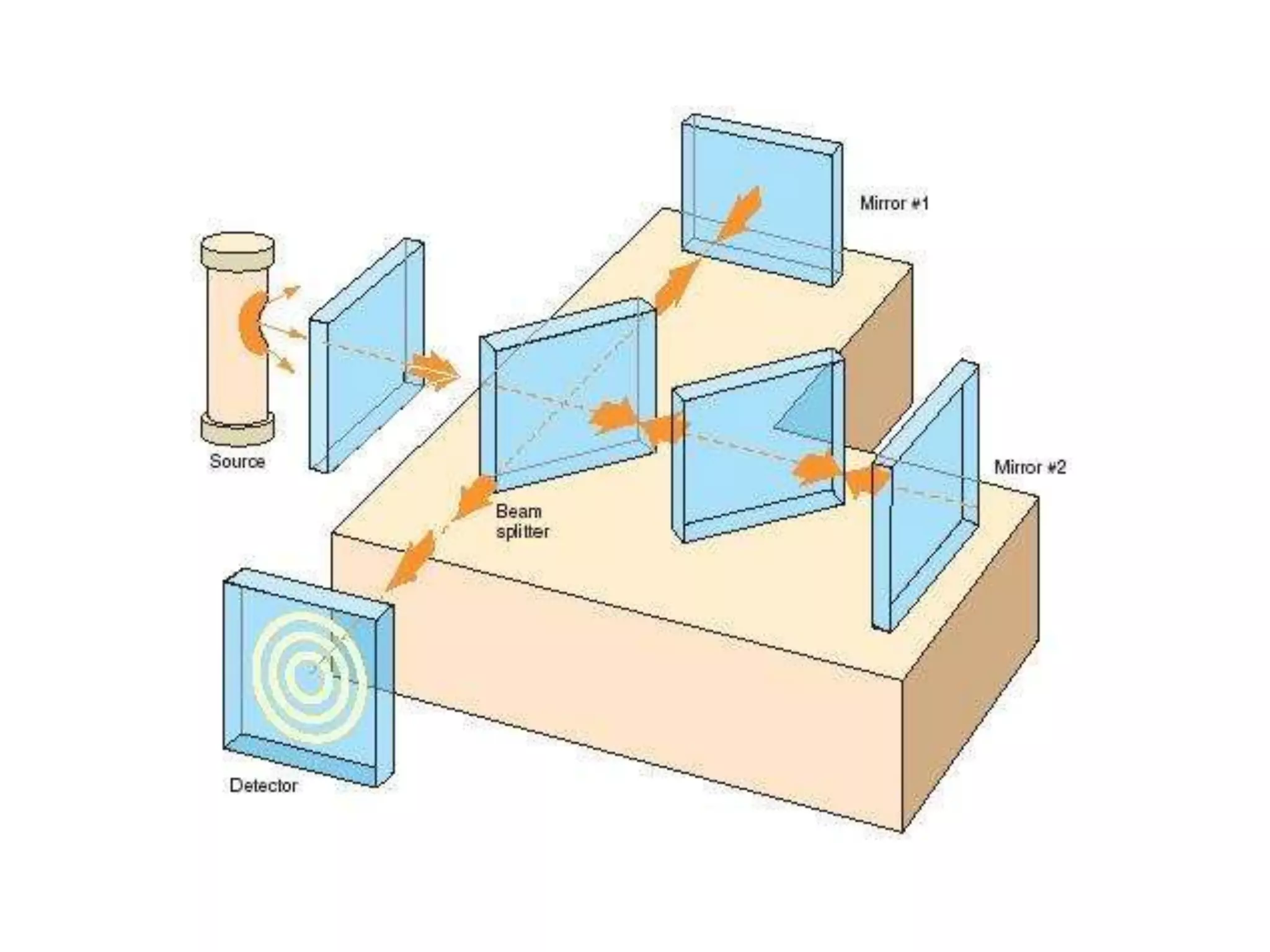
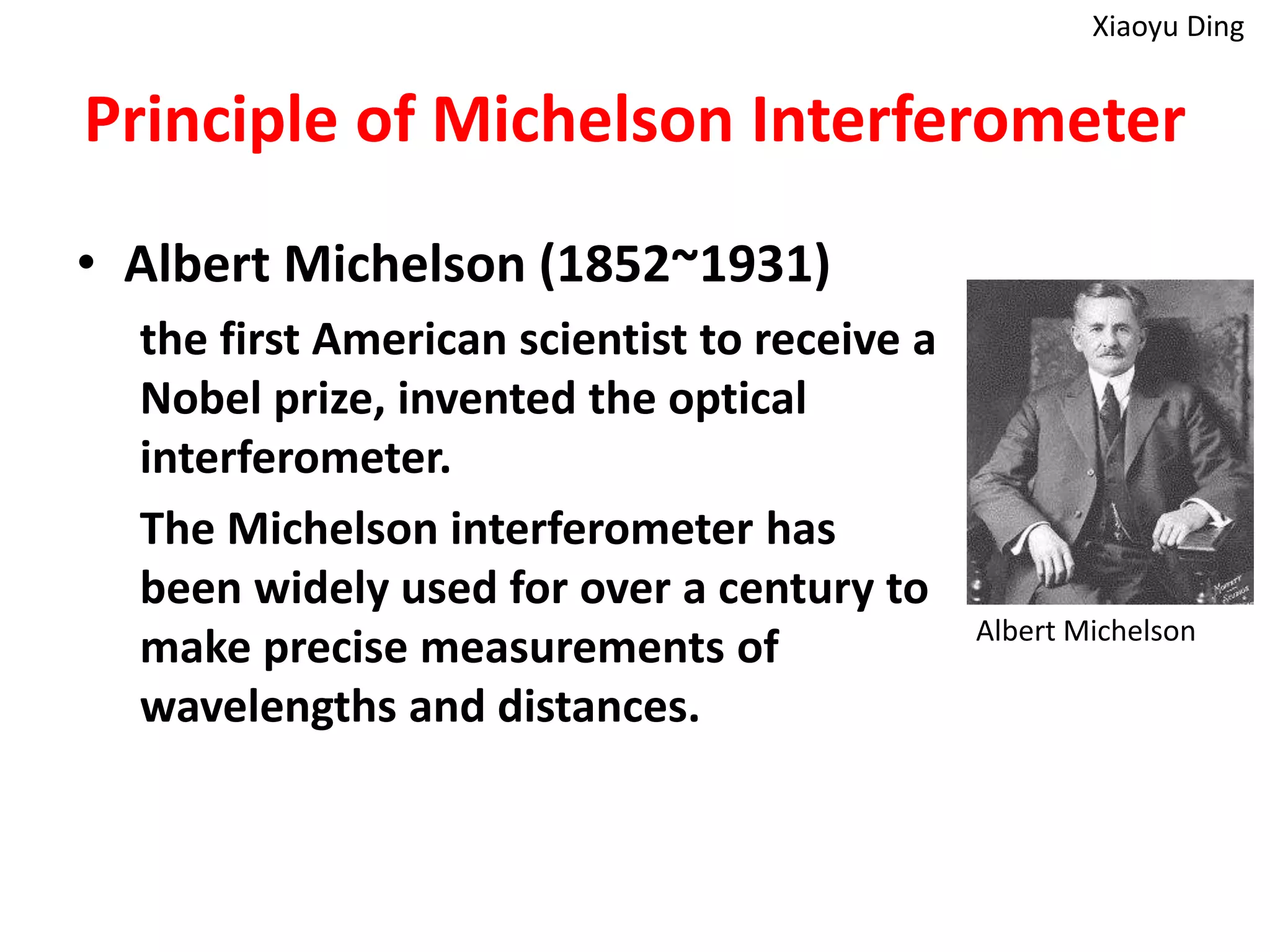
Principle of Michelson Interferometer
• Albert Michelson (1852~1931)
the first American scientist to receive a
Nobel prize, invented the optical
interferometer.
The Michelson interferometer has
been widely used for over a century to
make precise measurements of
wavelengths and distances.
Albert Michelson
Xiaoyu Ding
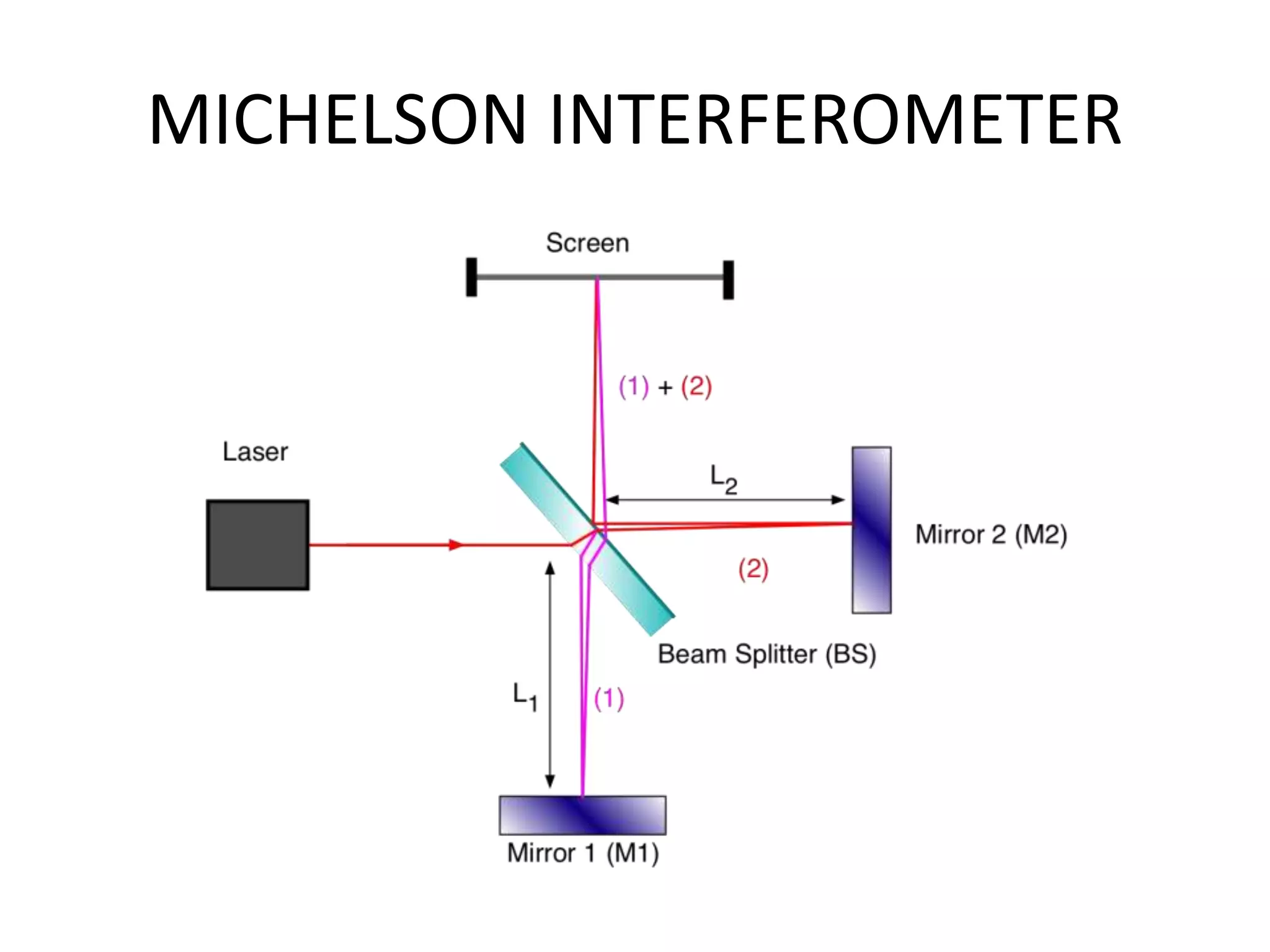
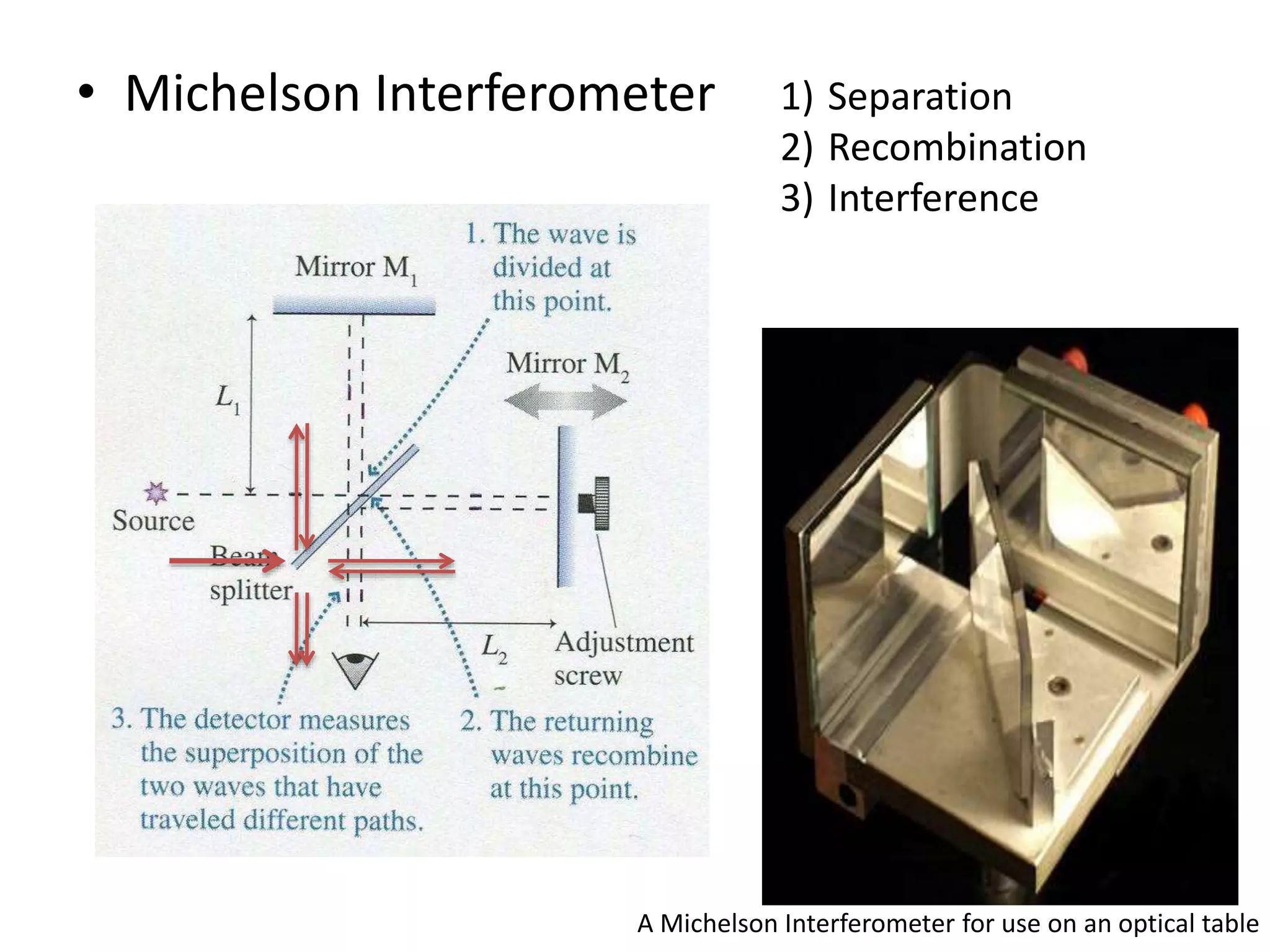
• Michelson Interferometer 1) Separation
2) Recombination
3) Interference
A Michelson Interferometer for use on an optical table
MICHELSON INTERFEROMETER
OBJECTIVE
• To determine the wave length of light derived
from certain sources by comparison to meter
bar.
• Based on the principle of constructive and
destructive interference
• The reflected rays back to beam splitter from
where they are transmitted to photo detector
Twyman green interferometer
TYPES OF INTERFEROMETERS
• Homodyne or single – frequency or DC laser
interferometer
• Hetrodyne or dual – frequency or AC laser
interferometer
AC LASER INTERFEROMETER
• OBJECTIVE
The A.C system mixes the beams of
slightly different frequencies, permitting the
distance information to be carried on a.c wave
form
a.c laser interferometer measures mirror
displacement by measuring the phase change
due to the doppler effect.
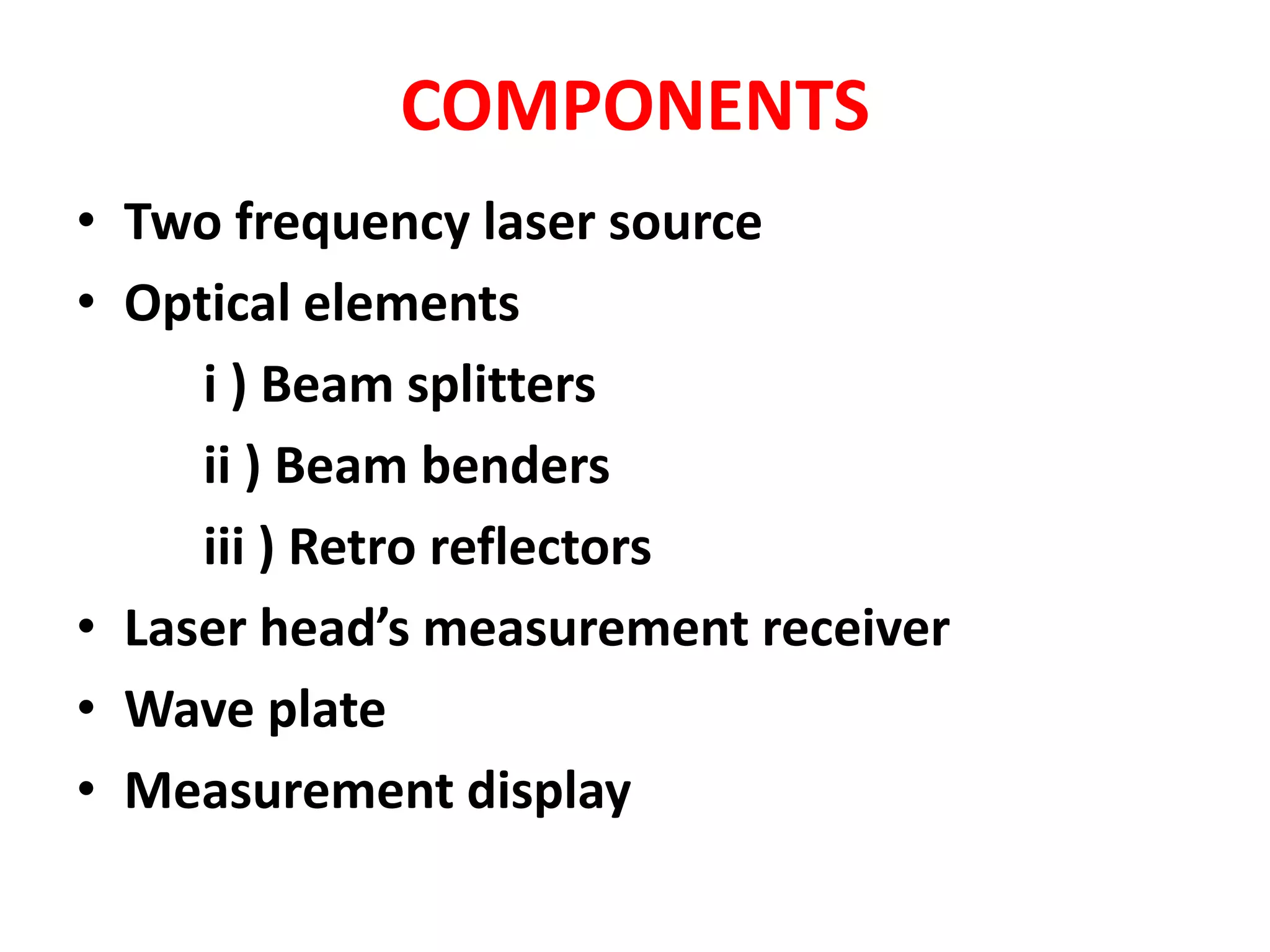
COMPONENTS
• Two frequency laser source
• Optical elements
i ) Beam splitters
ii ) Beam benders
iii ) Retro reflectors
• Laser head’s measurement receiver
• Wave plate
• Measurement display
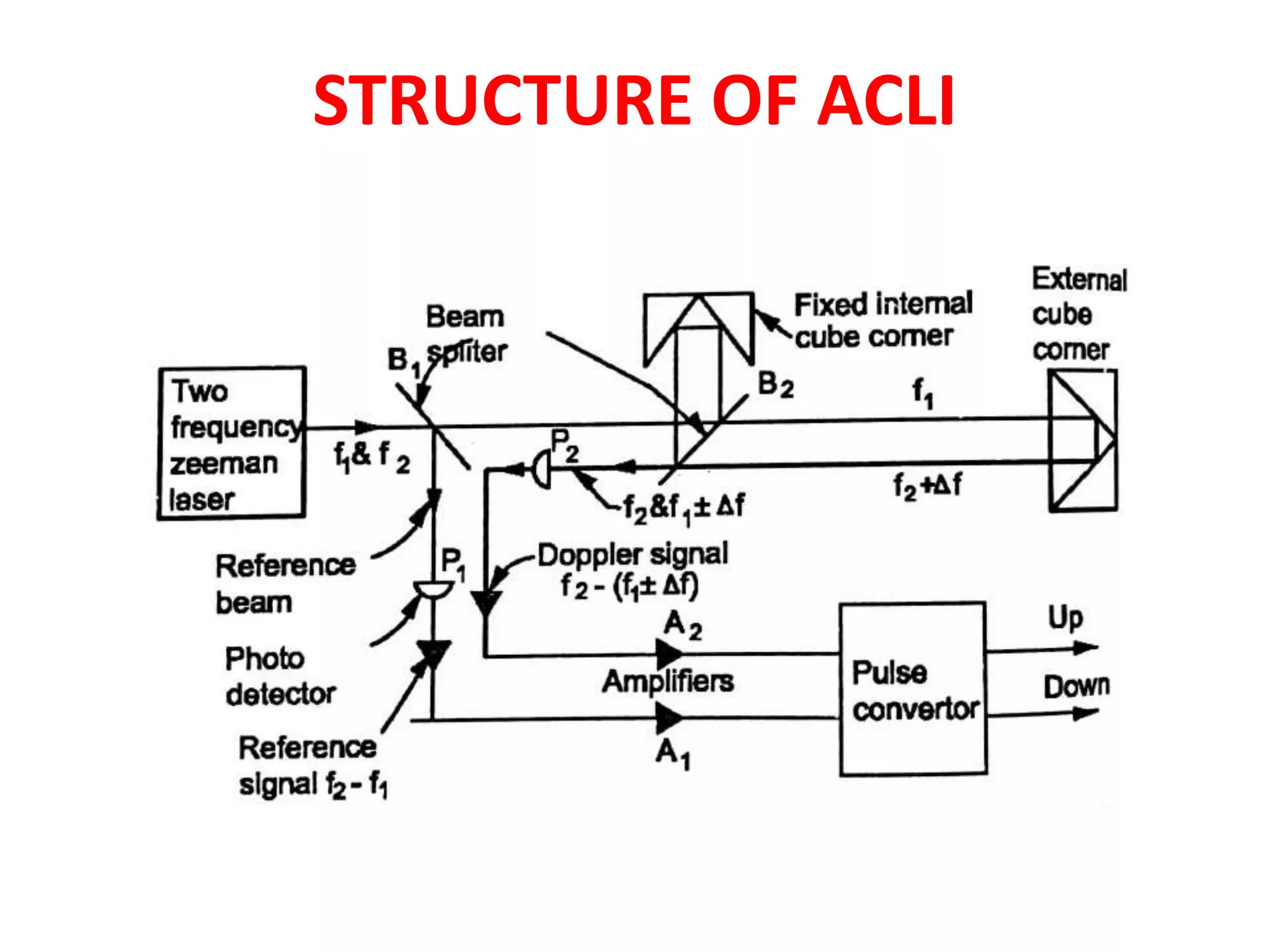
STRUCTURE OF ACLI
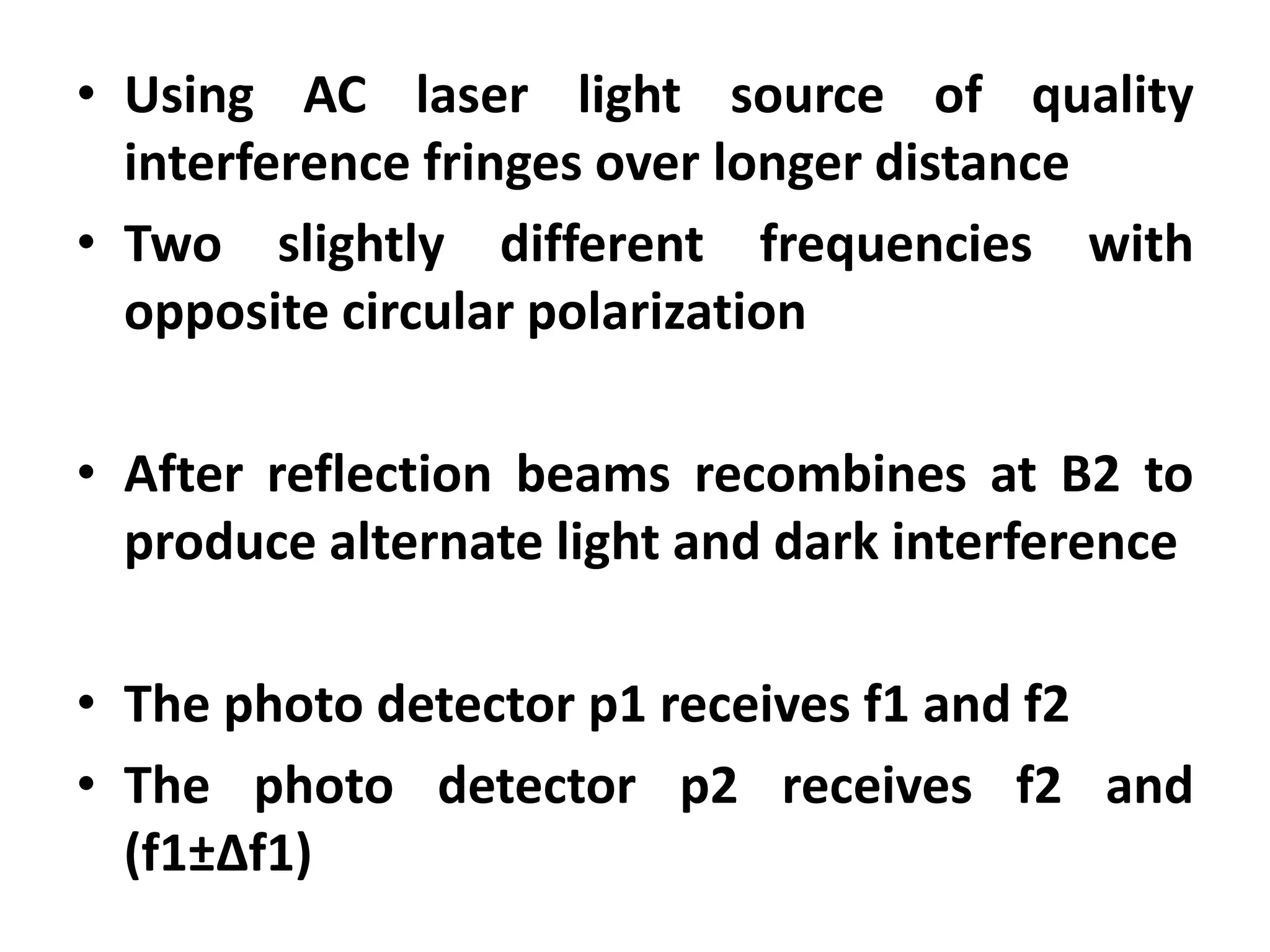
• Using AC laser light source of quality
interference fringes over longer distance
• Two slightly different frequencies with
opposite circular polarization
• After reflection beams recombines at B2 to
produce alternate light and dark interference
• The photo detector p1 receives f1 and f2
• The photo detector p2 receives f2 and
(f1±Δf1)
• f2-f1 in Amplifier1
• F2- (f1±Δf1) in Aamplifier2
• The up and down pulses from the converter
are converted electronically and displayed In
analog or digital form on the indicator
• Has high repeatability and resolution of
displacement measurement
• High accuracy
• 60 m range
• Easy to install
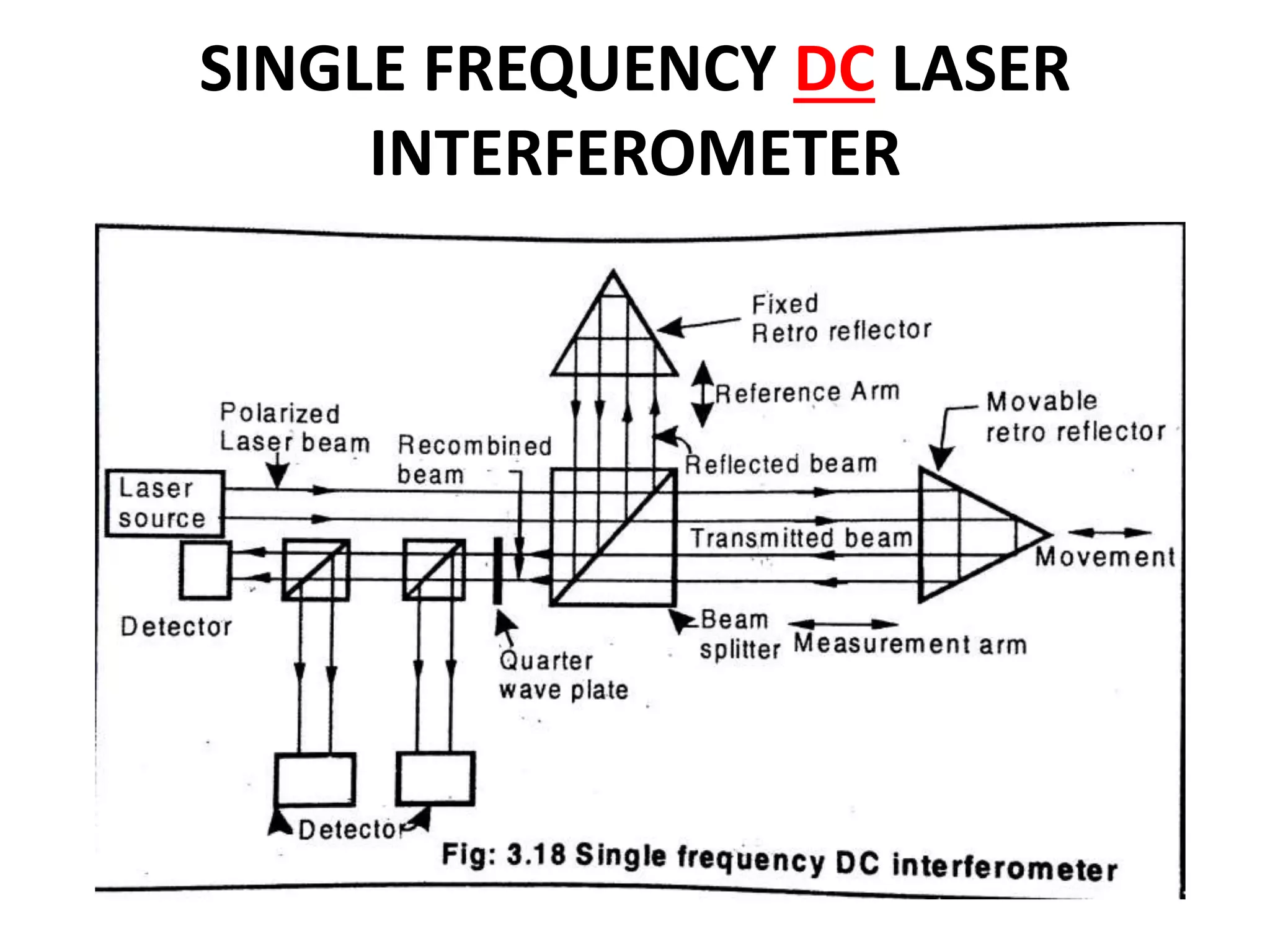
SINGLE FREQUENCY DC LASER
INTERFEROMETER
COMPONENTS
• Laser source
• Beam splitter
• Retro reflectors
• Quarter Wave plate
• Photo detectors
• Measurement electronics
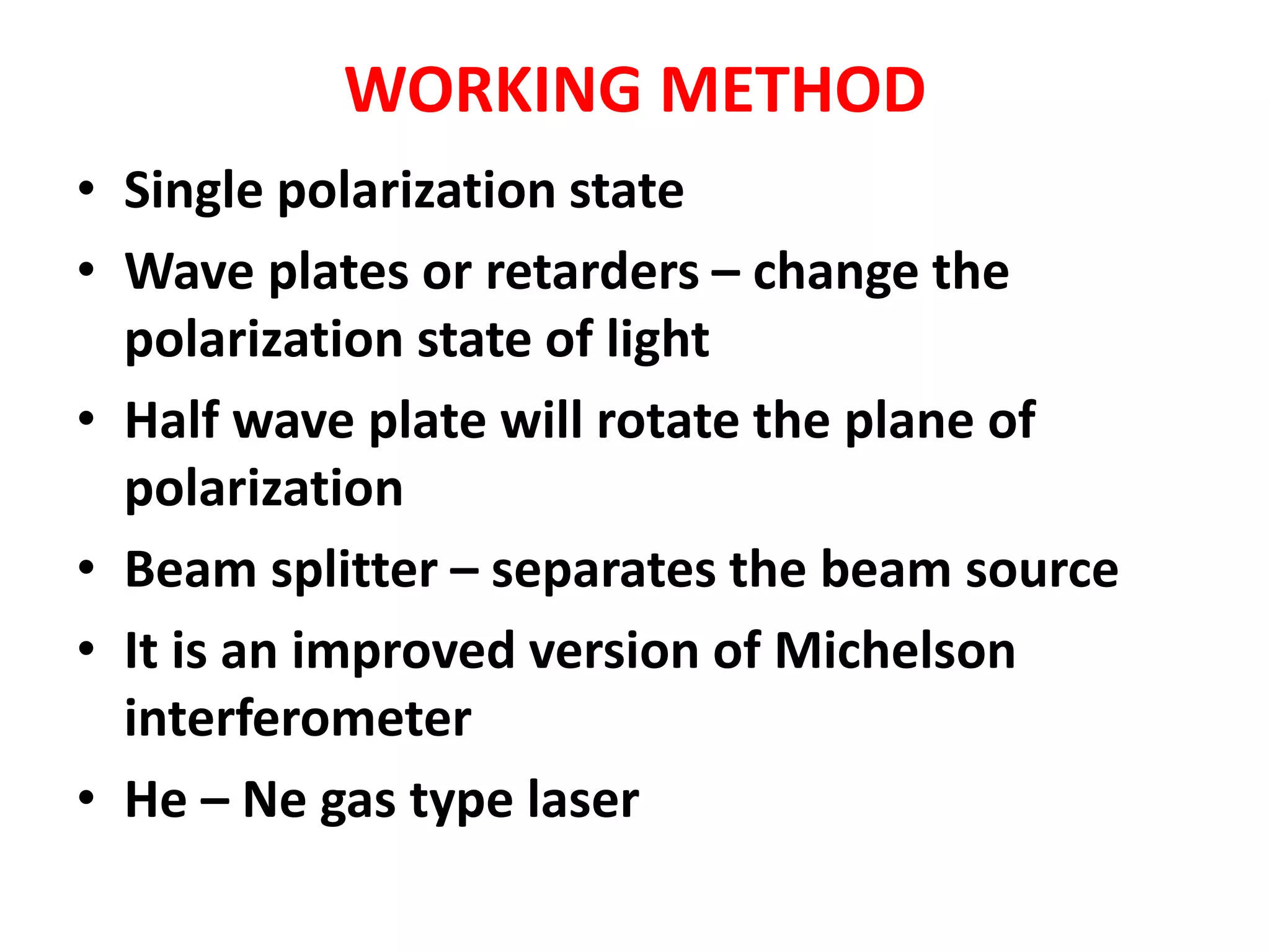
WORKING METHOD
• Single polarization state
• Wave plates or retarders – change the
polarization state of light
• Half wave plate will rotate the plane of
polarization
• Beam splitter – separates the beam source
• It is an improved version of Michelson
interferometer
• He – Ne gas type laser
• Beam having two opposing circularly
polarized components
• the two beams are reference beam and
transmitted beam
• These are recombines at beam splitter but
differently polarized but do not interfere
• Wave plate used to interfere with one
another to produce plane polarized beam
• The detectors used to distinguish the
direction of movement and the moveable
retro reflector is able to attach to the
required place for finding distance
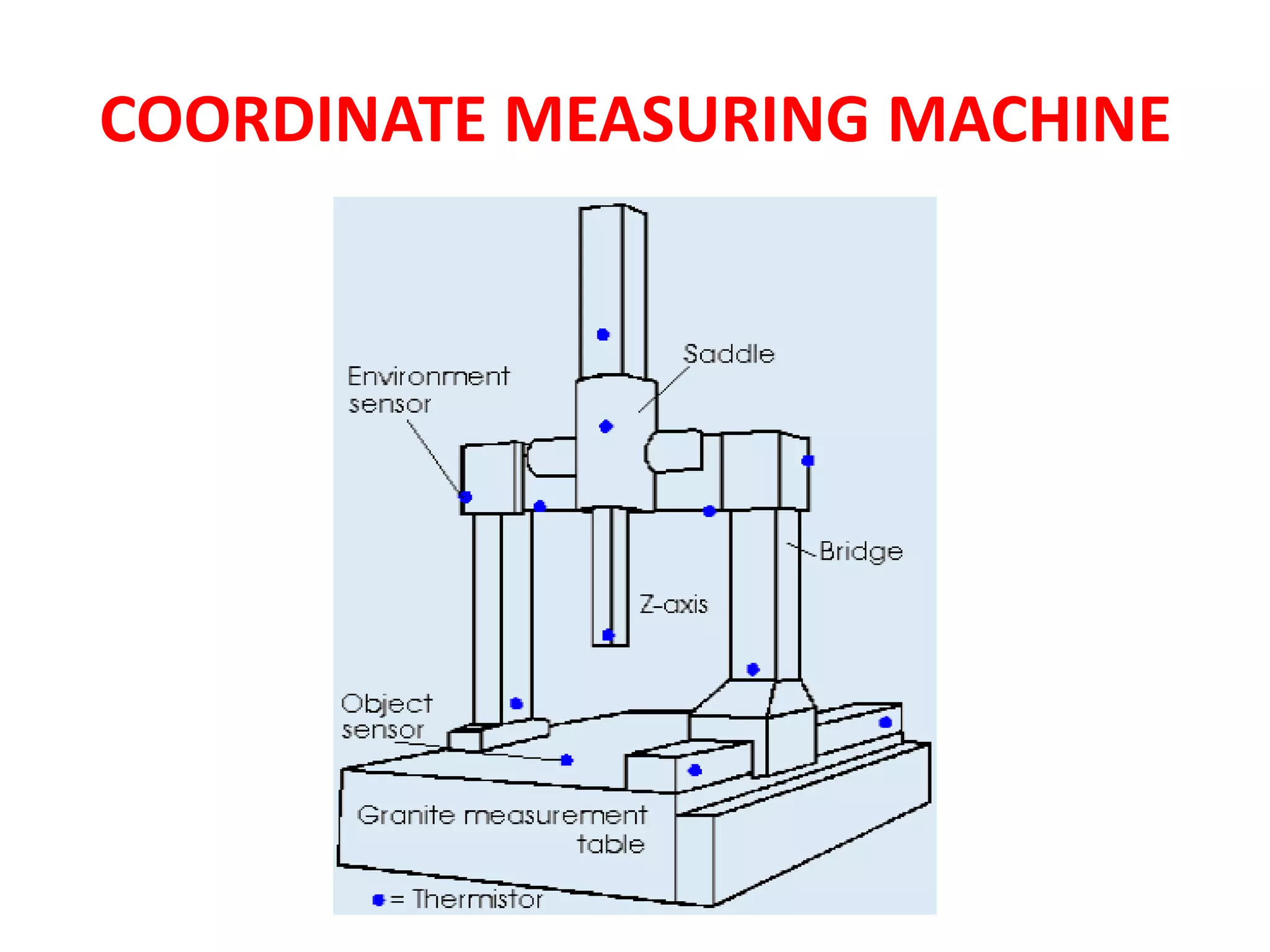
COORDINATE MEASURING MACHINE
• OBJECTIVE:
To determine the geometrical
characteristics of an object operating in a three
dimensional space.
• Role of inspection process
• Measuring probe to determine coordinates of
points on an object surface.
• Design, testing, profiling
• 100% dimensional assessment.
• First developed in Ferranti in scotland
COORDINATE MEASURING MACHINE
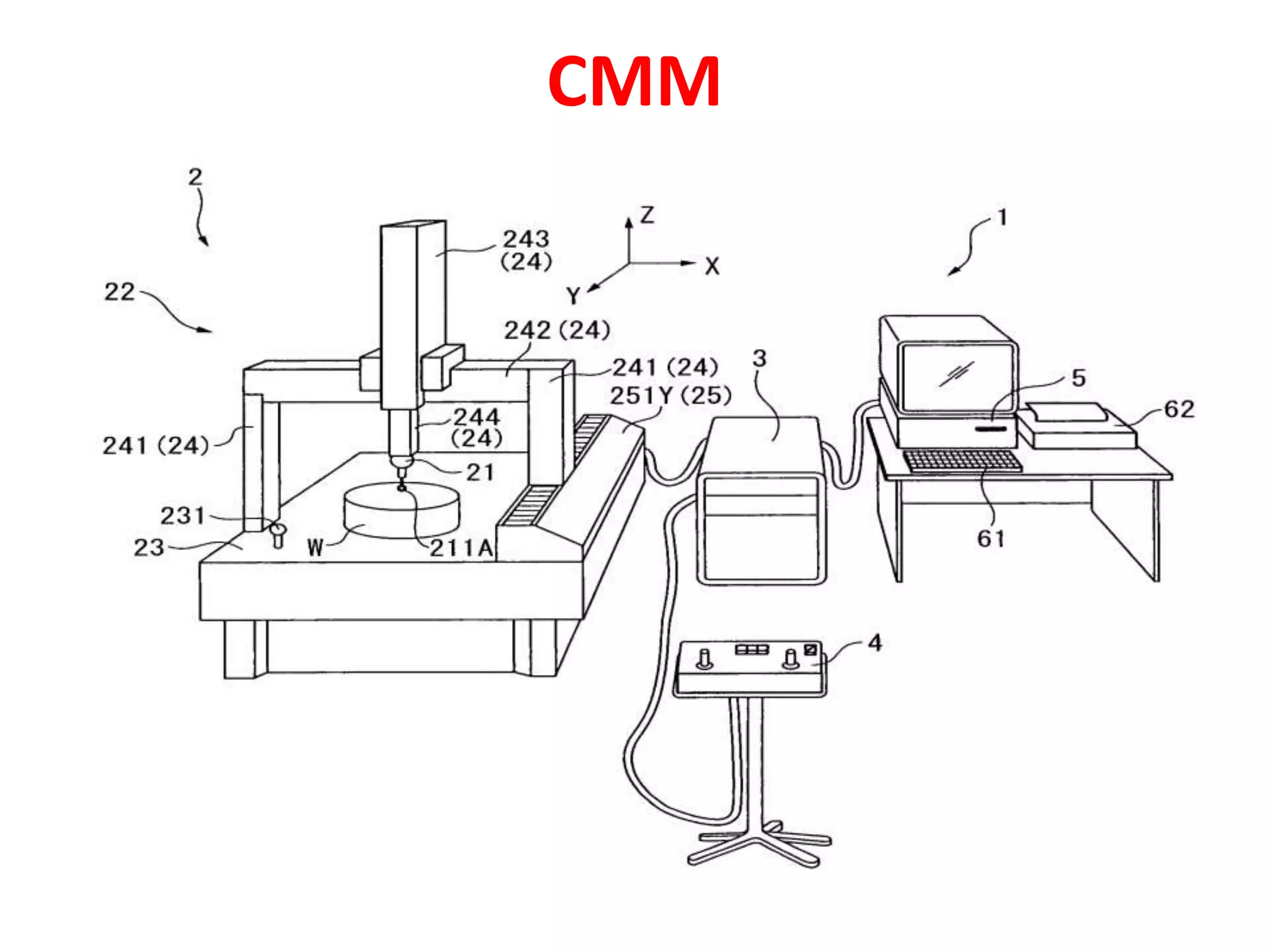
CMM
WORKING
• Measuring machines are used for measurement
of length over the outer surfaces of a length bar
or any other long member.
• The member may be either rounded or flat and
parallel. It is more useful and advantageous than
vernier calipers, micrometer, screw gauges etc.
• The measuring machines are generally universal
character and can be used for works of varied
nature.
• The co-ordinate measuring machine is used for
contact inspection of parts.
• When used for computer-integrated
manufacturing these machines are controlled by
computer numerical control.
• General software is provided for reverse
engineering complex shaped objects.
• The component is digitized using CNC, CMM
and it is then converted into a computer model
which gives the two surface of the component.
• These advances include for automatic work part
alignment on the table. Savings in inspection 5
to 10 percent of the time is required on a CMM
compared to manual inspection methods.
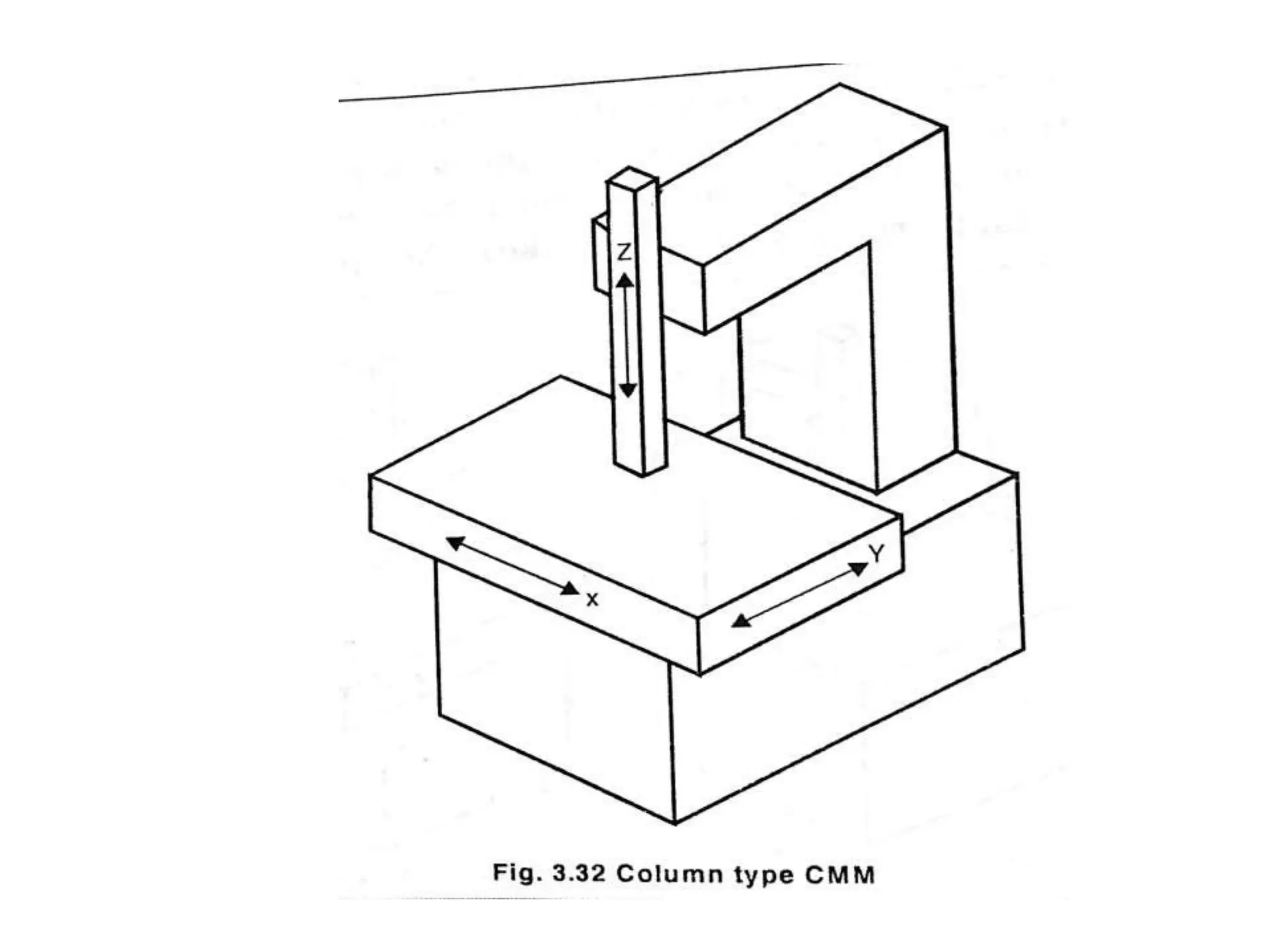
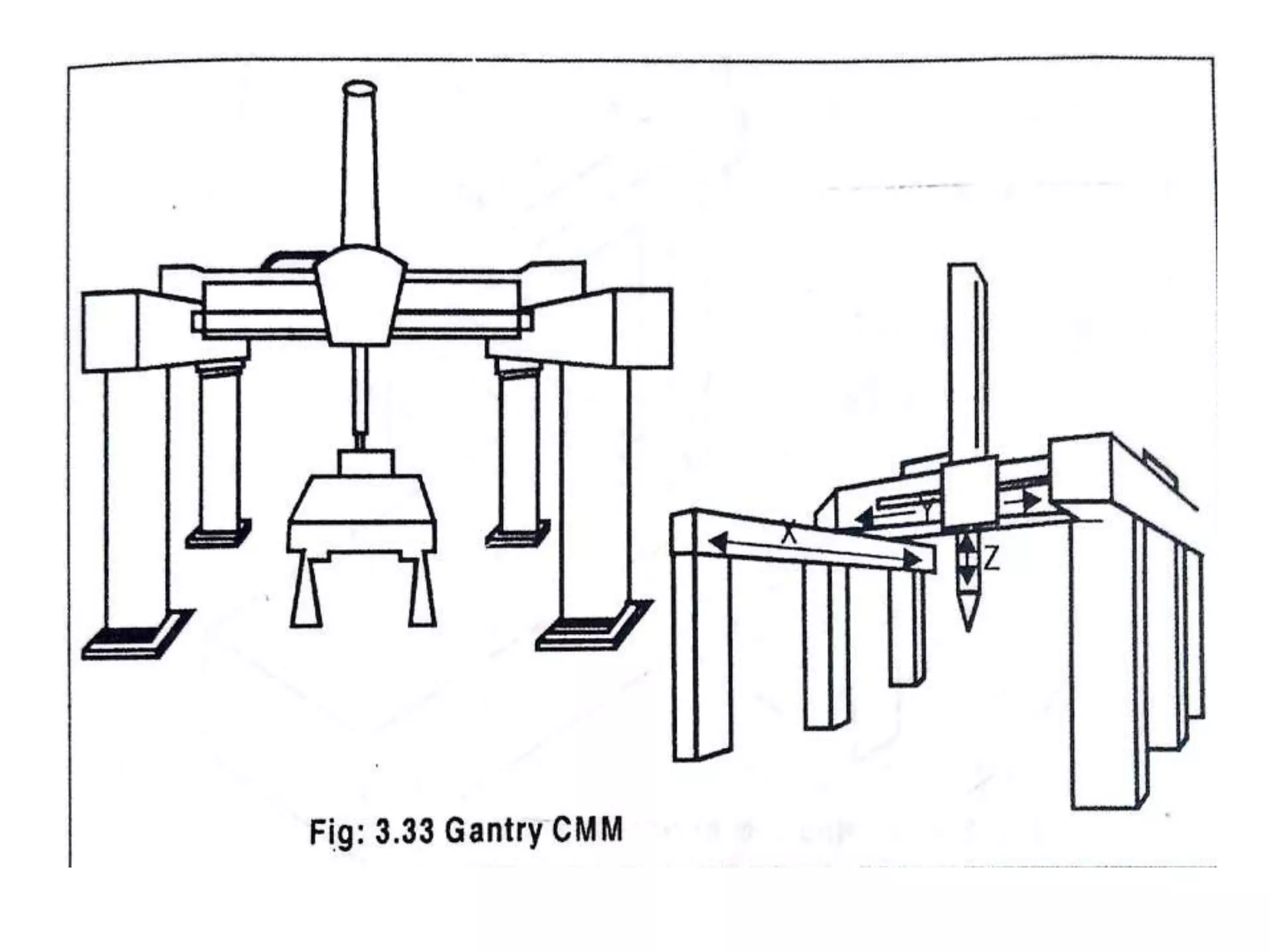
TYPES OF CMM
Working Principle
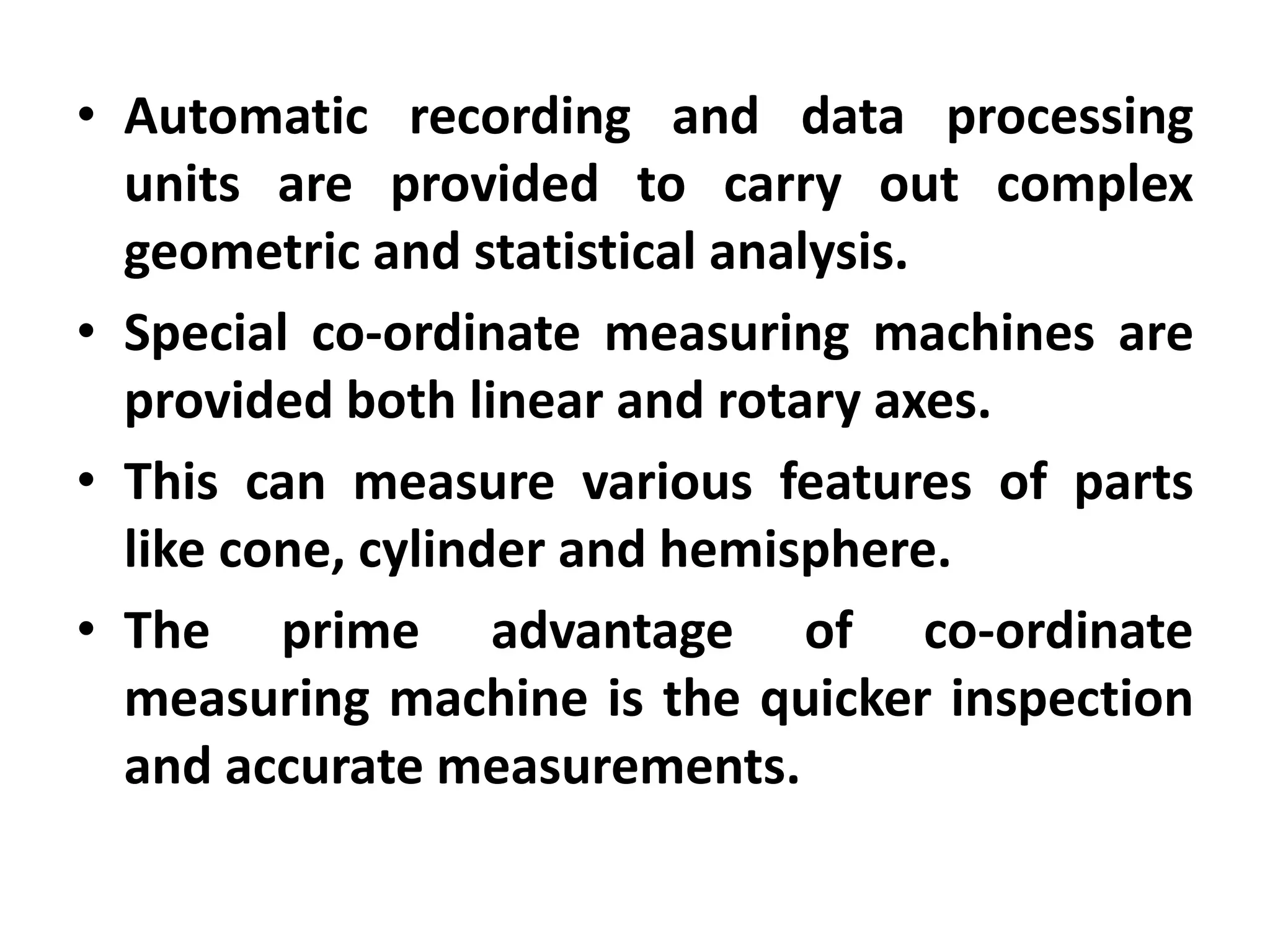
• CMM is used for measuring the distance
between two holes. The work piece is
clamped to the worktable and aligned for
three measuring slides x, y and z.
• The measuring head provides a taper probe tip
which is seated in first datum hole and the
position of probe digital read out is set to zero.
• The probe is then moved to successive holes,
the read out represent the co-ordinate part print
hole location with respect to the datum hole.
• Automatic recording and data processing
units are provided to carry out complex
geometric and statistical analysis.
• Special co-ordinate measuring machines are
provided both linear and rotary axes.
• This can measure various features of parts
like cone, cylinder and hemisphere.
• The prime advantage of co-ordinate
measuring machine is the quicker inspection
and accurate measurements.
Performance of CMM
• Geometrical accuracies such as positioning
accuracy, Straightness and Squareness.
• Total measuring accuracy in terms of axial length
measuring accuracy.
• Volumetric length measuring accuracy and
length measuring repeatability. i.e.,
Coordinate measuring machine has to be tested
as complete system.
• Since environmental effects have great influence
for the accuracy testing, including thermal
parameters, vibrations and relative humidity are
required.
APPLICATIONS
• Co-ordinate measuring machines find applications
in automobile, machine tool, electronics, space and
many other large companies.
• These machines are best suited for the test and
inspection of test equipment, gauges and tools.
• For aircraft and space vehicles, hundred percent
inspections is carried out by using CMM.
• CMM can be used for determining dimensional
accuracy of the components.
• These are ideal for determination of shape and
position, maximum metal condition, linkage of results
etc. which cannot do in conventional machines.
• CMM can also be used for sorting tasks to
achieve optimum pairing of components
within tolerance limits.
• CMMs are also best for ensuring economic
viability of NC machines by reducing their
downtime for inspection results.
• They also help in reducing cost, rework cost
at the appropriate time with a suitable CMM.
PROBE SYSTEM
MACHINE VISION SYSTEM
• OBJECTIVE
A Vision system can be defined as a system
for automatic acquisition and analysis of images
to obtain desired data for interpreting or
controlling an activity.
It is a technique which allows a sensor to
view a scene and derive a numerical or logical
decision without further human intervention.
Machine vision can be defined as a means of
simulating the image recognition and analysis
capabilities of the human system with electronic
and electro mechanical techniques.
USES OF MACHINE VISION
• Functions like gauging of dimensions,
• Identification of shapes,
• Measurement of distances,
• Determining orientation of parts,
• Quantifying motion-detecting surface shading
• It is best suited for high production.
• These systems function without fatigue.
• This is suited for inspecting the masks used in
the production of micro-electronic devices
MACHINE VISION SYSTEM
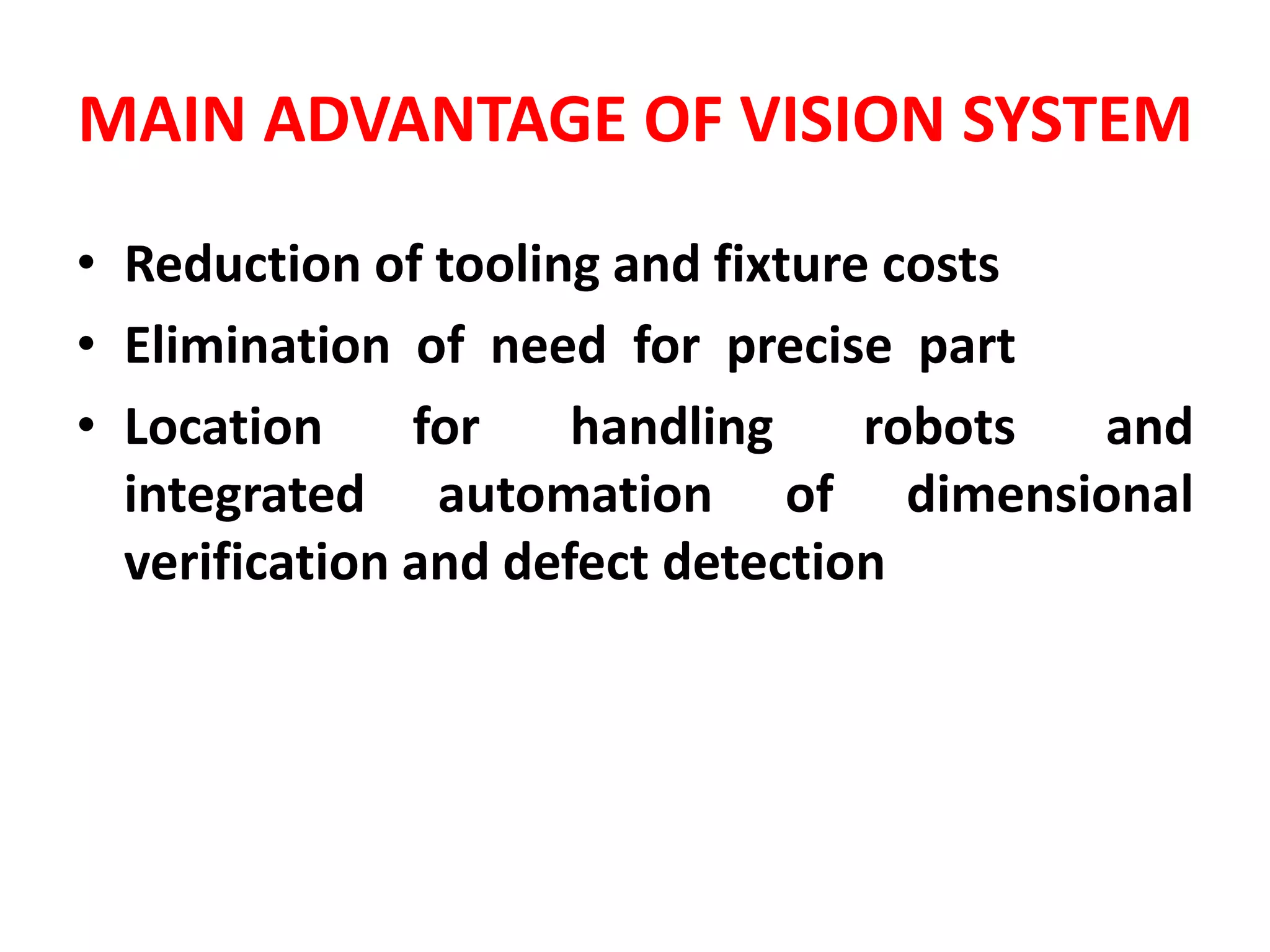
MAIN ADVANTAGE OF VISION SYSTEM
• Reduction of tooling and fixture costs
• Elimination of need for precise part
• Location for handling robots and
integrated automation of dimensional
verification and defect detection
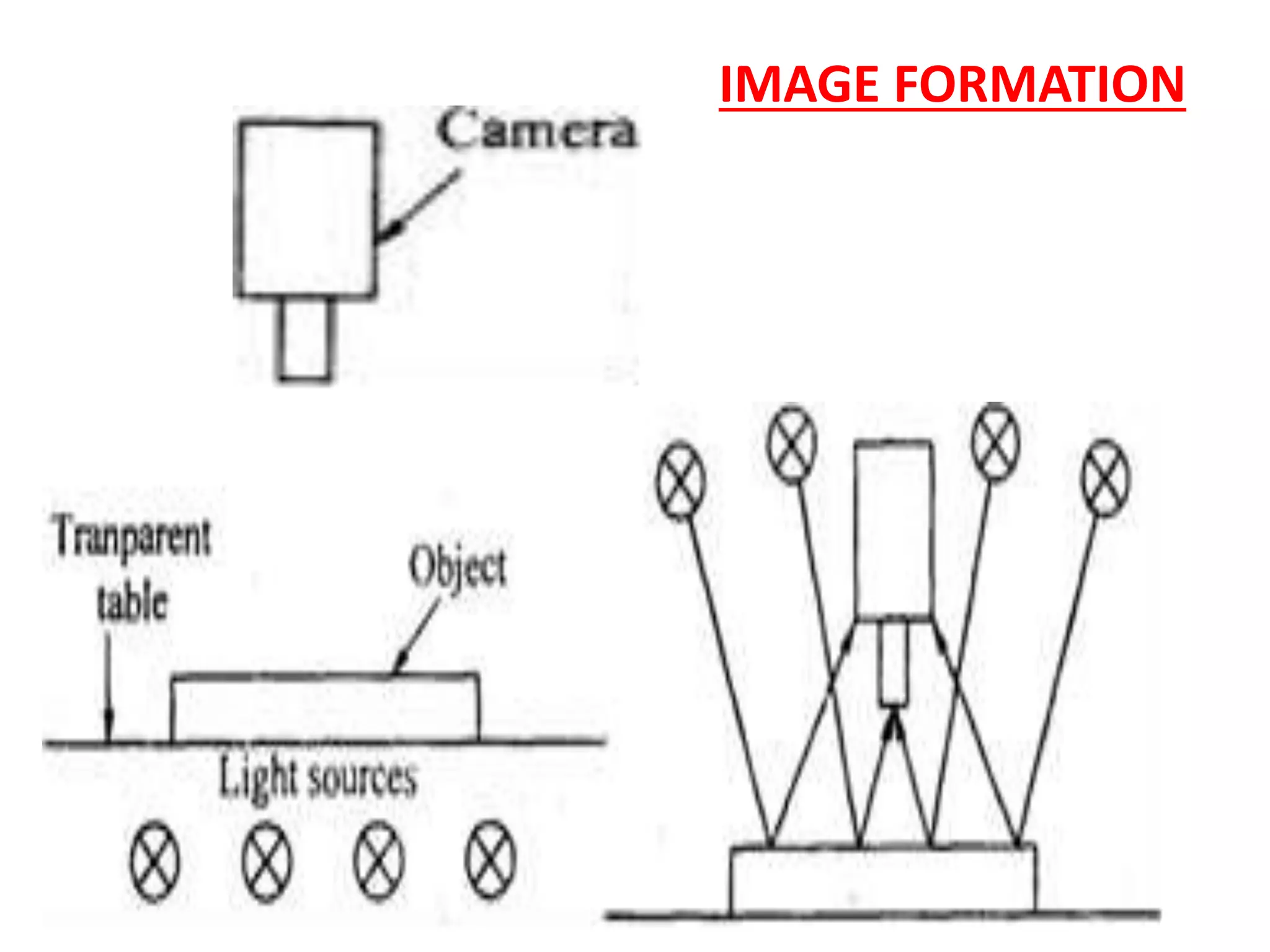
IMAGE FORMATION
FUNCTION OF MACHINE VISION
• Lighting and presentation of object to be
evaluated.
• It has great compact on repeatability,
reliability and accuracy.
• Iighting source and projection should be
chosen and give sharp contrast.
• Images sensor compressor TV camera may be
vidiocon or solid state.
• For simple processing, analog comparator
and a computer controller to convert the
video information to a binary image is used.
• Data compactor employs a high speed away
processor to provide high speed processing of
the input image data.
• System control computer communicates with
the operator and make decision about the
part being inspected.
• The output and peripheral devices operate
the control of the system.
• The output enables the vision system to
either control a process or provide caution
and orientation information two a robot, etc.
FUNCTION OF MACHINE VISION
ELEMENTS OF MACHINE VISION
SYSTEM
• The delivery system
• Light source(illumination)
• Lenses – Field Of View of working distance
• Image sensor and digitizer
1. Converting optical into electrical signal
2. Videocon camera, solid state, camera and
frame grabber, synchronizing sensor
• Preprocessor – greater degree of image
refinement and removing or enhancing
features
• Vision processor/ controller – preprocessed
can be analyze here
Programmable Logic Controller
• Communication links
• Output devices – to control machine function
according to communication received from
the processor
APPLICATION
• Machine vision can be used to replace
human vision for welding.
• Machining and maintained
relationship between tool and work
piece and assembly of parts to
analyze the parts.
• This is frequently used for printed
circuit board inspection to ensure
minimum conduction width and
spacing between conductors.
• These are used for weld seam tracking,
robot guideness and control, inspection
of microelectronic devices and tooling,
on line inspection in machining
operation, assemblies monitoring high-
speed packaging equipment etc.
• Automotive – to guid robots, identify
codes, engine block inspection.
• Semiconductor manufacturing
• Manufacturing industries
• Solar panel manufacturing
• Food and packaging
• Postal and parcel inspection
• Non destructive testing
• Inspections of continuous webs
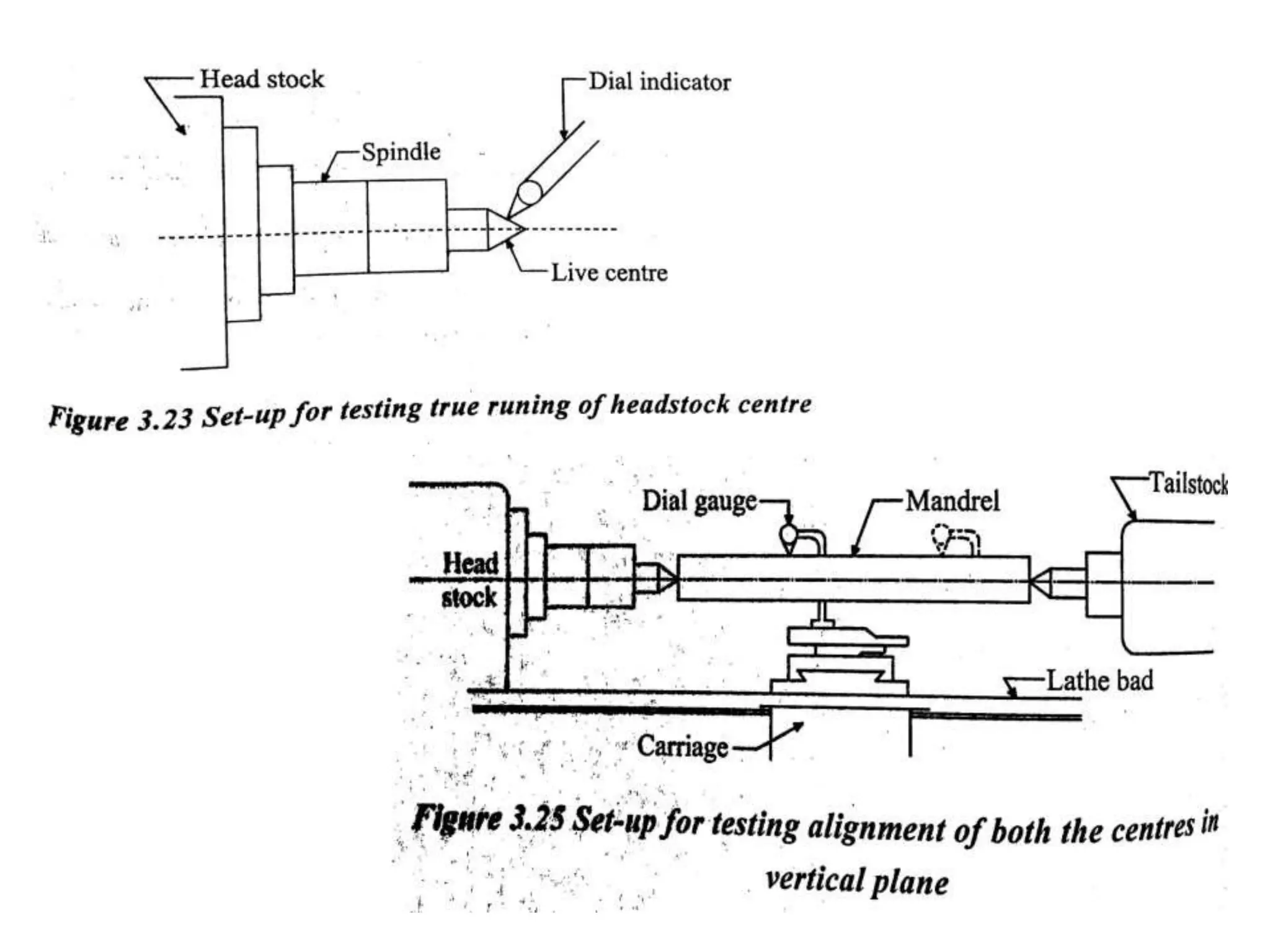
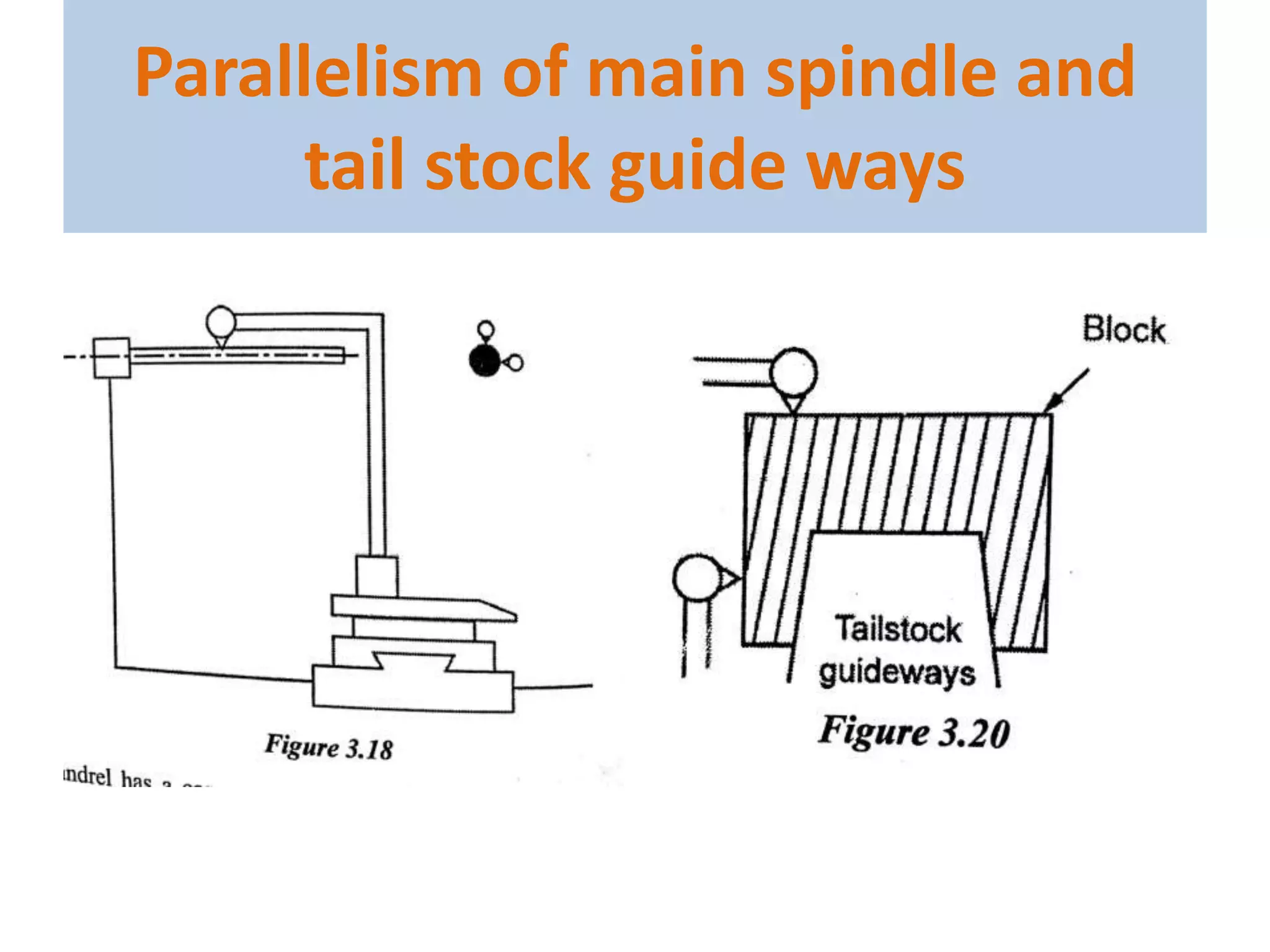
MACHINE TOOL METROLOGY
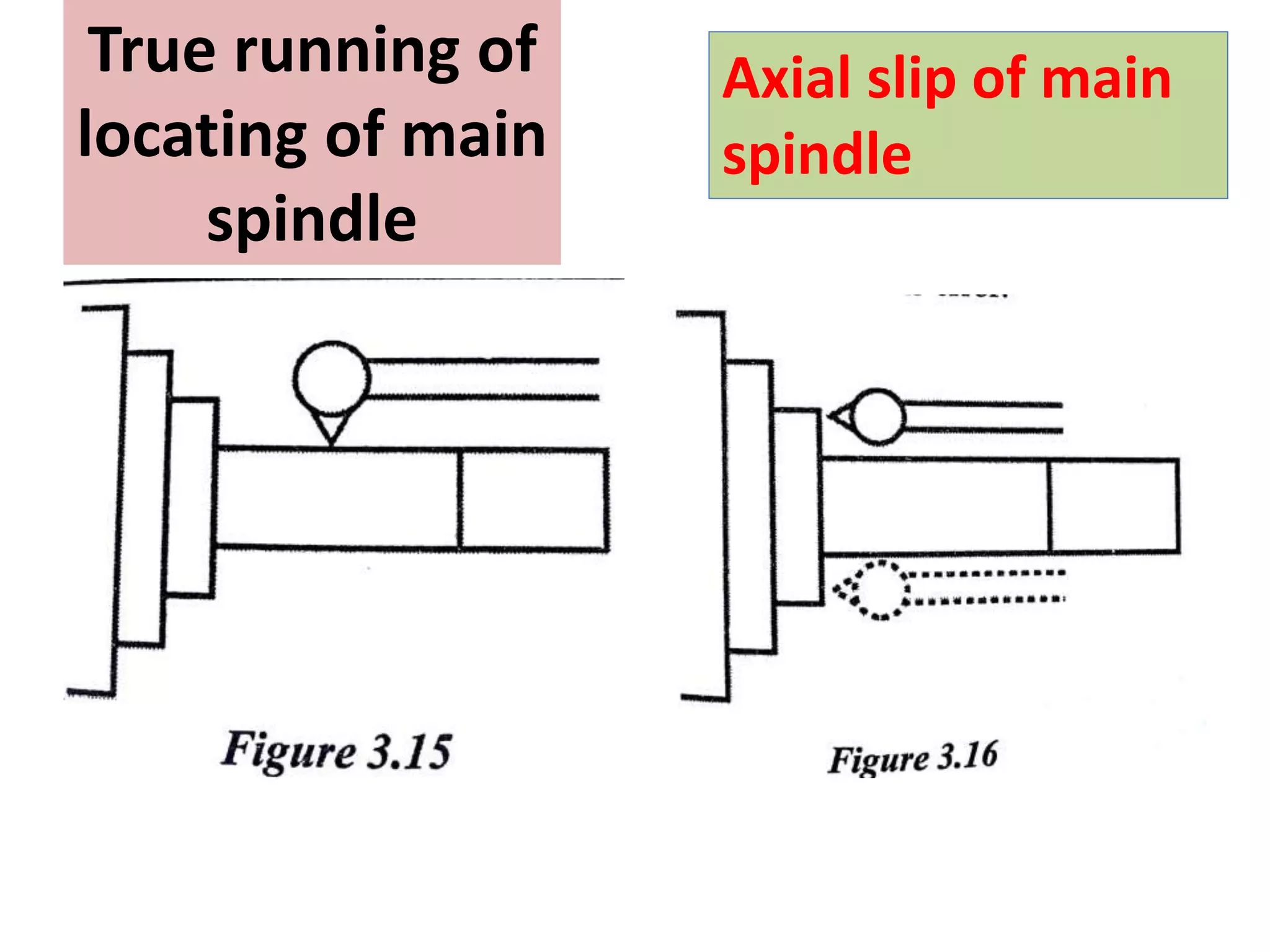
True running of
locating of main
spindle
Axial slip of main
spindle
Parallelism of main spindle and
tail stock guide ways
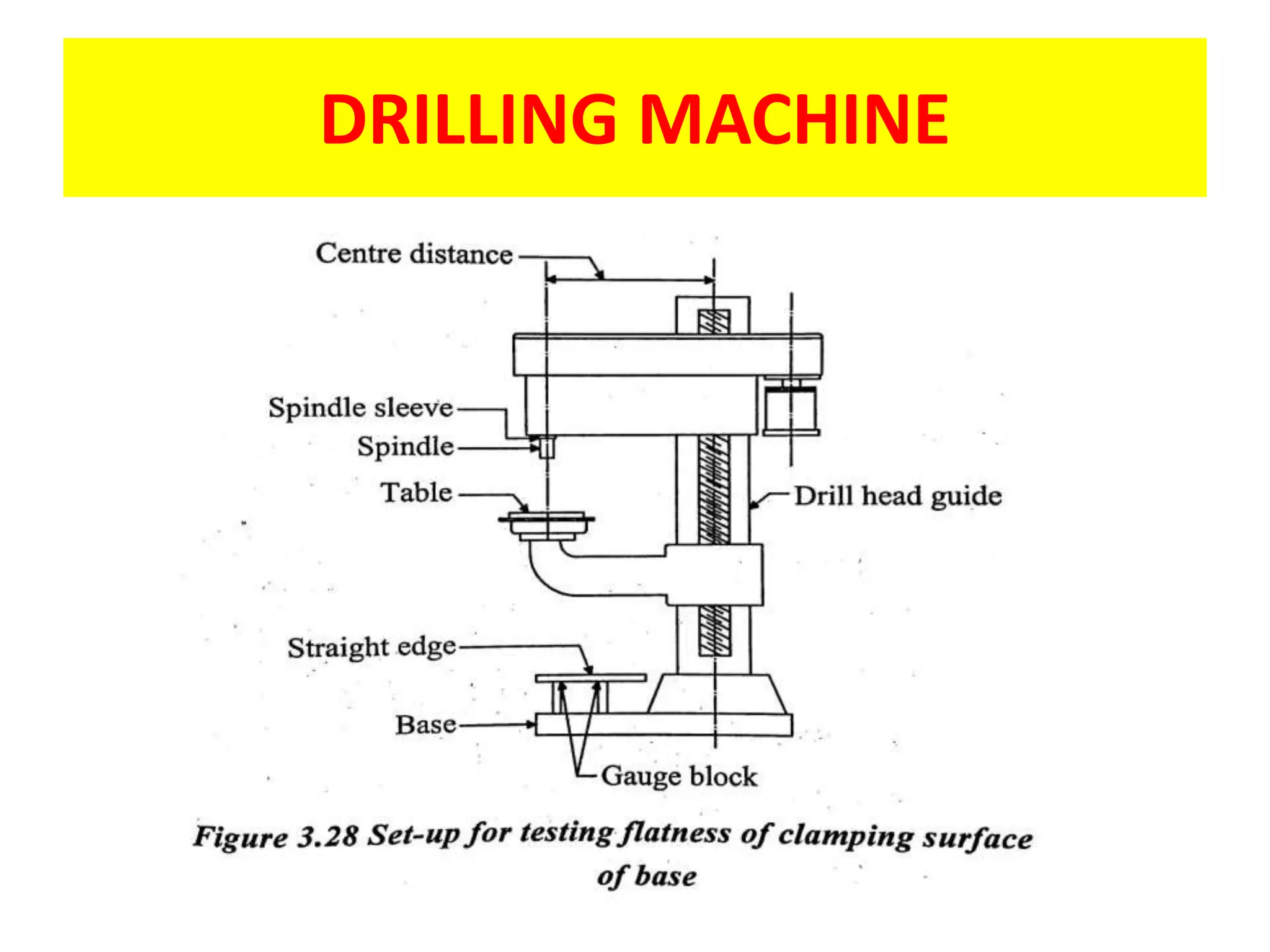
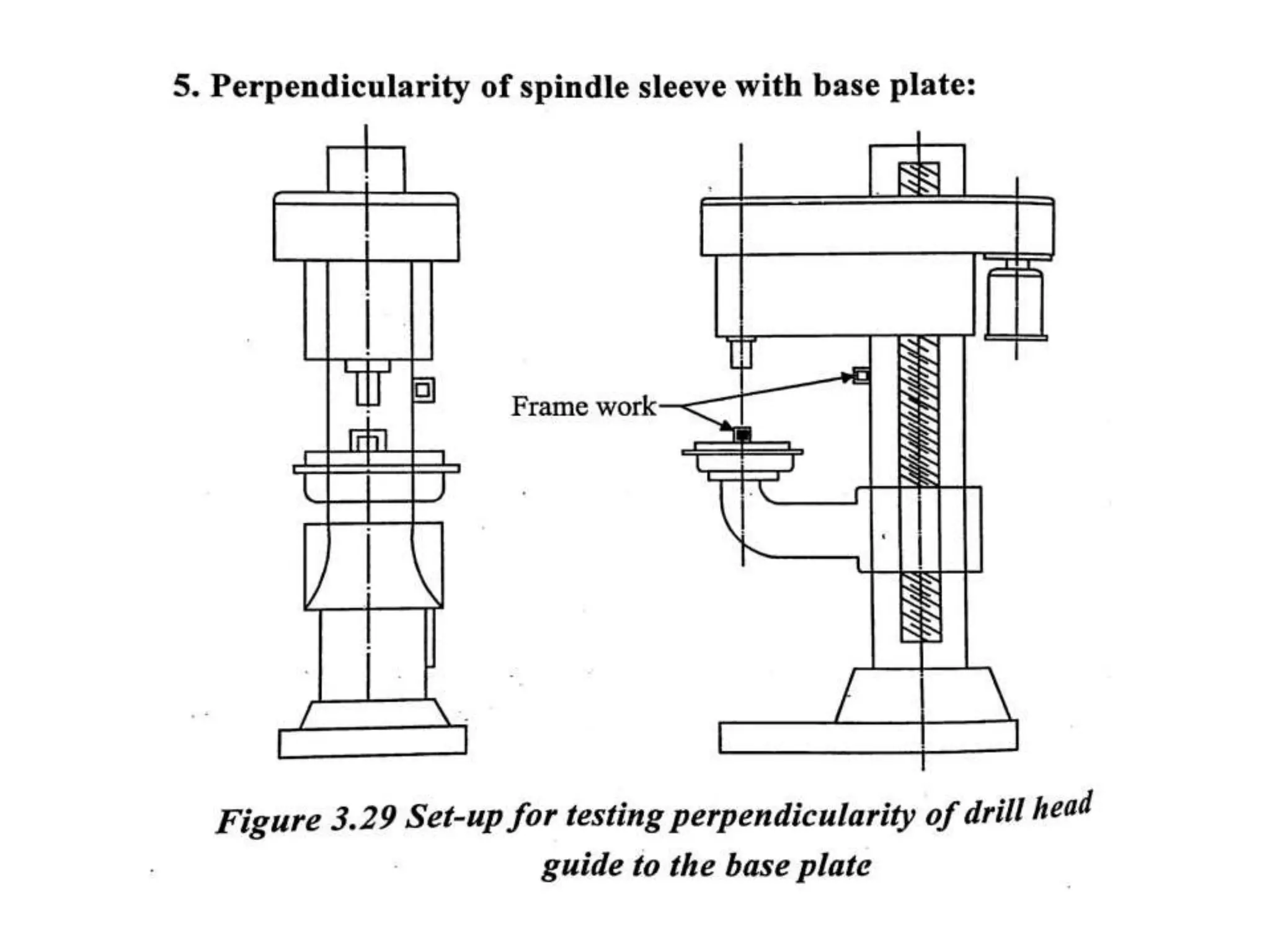
DRILLING MACHINE
ADVANCES IN METROLOGY

ADVANCES IN METROLOGY

  • 1.
    UNIT-III ADVANCES IN METROLOGY Basicconcepts of laser, Advantages of laser – laser interferometers – Types – DC and AC laser interferometer – Applications – Straightness – Alignment. Basic concept of CMM – Types of CMM – constructional features – Probes – Accessories – Software – Application – Basic concepts of machine vision system – Element – Application
  • 2.
    LASER • Laser standsfor Light Amplification by Stimulated Emission of Radiation. • Laser instrument is a device to produce powerful, monochromatic, collimated beam of light in which the waves are coherent. • Energy appears to be emanating from a very small point. • The laser is used extensively for interferometry particularly the He- Ne gas type. • This produces 1 to 2mm diameter beam of red light power of 1MW and focused at a point of very high intensity.
  • 3.
    • Laser systemshave wide dynamic range, low optical cross talk and high contrast. • Laser fined application in dimensional measurements and surface inspection because of the properties of laser light. • These are useful where precision, accuracy, rapid non-contact gauging of soft, delicate or hot moving points. • An electromagnetic radiation is emitted whenever a charged particles such as an electron drops from a higher energy state E2 to E 1
  • 4.
    Terminology • WAVELENGTH: thedistance between the two crest and two trough • FREQUENCY: the number of waves passing in a point in a certain time • MONOCHROMATIC LIGHT: spectrum of visible light having the same wavelength • COHERENT: The distance over which the beam stays in phase with itself
  • 5.
    TYPES OF LASER •Solid state laser • Liquid laser • Gas laser( He-Ne, 632 wavelength) • Semiconductor laser(laser diode)
  • 6.
    ADVANTAGES • More intensivethan any other monochromatic source • High precise, accurate • It facilitates rapid non-contact gauging of soft, delicate or hot moving parts • Allow fabrication of fine structures with high quality avoiding mechanical stress
  • 7.
    APPLICATIONS • MANUFACTURING- qualitycutting, drilling, welding • DATA STORAGE- CD, DVD, • COMMUNICATION • DISPLAYS • SCIENTIFIC APPLICATIONS
  • 8.
  • 9.
    • TRANSMITTING UNIT •PHOTO CELL OR RECEIVER • MICROPROCESSOR OR CONTROL UNIT • Used to measure the roundness and diameter of hot steel bars • Accuracy of 0.025mm for 5 - 25 mm dia objects
  • 10.
  • 11.
  • 12.
  • 13.
    • Used forhigh speed, non contact dimensional and positional measurement and control • The three components are TRANSMITTER, RECEIVER, PROCESSSOR ELECTRONICS • Laser beam moving at constant linear speed • It measures at the rate of 150 scans per second • Object to be sensed photo electrically by the receiver • Received signals are converted by processor electronics to convenient form
  • 14.
  • 15.
  • 16.
  • 19.
  • 20.
    WHAT IS DIFFRACTION? •Which involves a change in direction of waves as they pass through an opening or around a barrier in their path.
  • 21.
    • Above figshows a method of measuring the diameter of thin wire using the interference fringes (edges, borders) resulting from diffraction of the light by the wire in the laser beam. • A measure of the diameter can be obtained by moving the photo detector until the output is restored to its original value. • Variation in wire diameter as small as 0.2% over wire diameter from 0.005 to 0.2mm can be measured.
  • 22.
    TWO FREQUENCY LASERINTERFEROMETER
  • 27.
    • This consistsof two frequency laser head, beam directing and splitting optics, measurement optics, receivers, and wavelength compensators and electronics. • It is ideally suited for measuring linear positioning straightness in two planes, pitch (the place at the beam falls) and yaw (deviation of beam) • The two-frequency laser head provides one frequency with P-polarization and another frequency with S-polarization. • The laser beam is split at the polarizing beam splitter into its two separate frequencies.
  • 28.
    • The measuringbeam is directed through the interferometer to reflect off a target mirror or retro reflector attached to the object to be measured. • The reference beam is reflected from fixed retro reflector. • The measurement beam on its return path recombines with the reference beam and is directed to the electronic receiver. • POLARIZATION – to produce different views on different sides
  • 29.
    • INTERFERENCE The twowaves suppose to form a resultant wave of greater or lower amplitude is called interference • PRINCIPLE OF SUPERPOSITION The two waves have same wavelength and exactly in phase with each other – the resultant wave is sum of the amplitudes which produces increased brightness if the phase not each other, the resultant amplitude is the difference of the individual amplitudes which results darkness
  • 30.
  • 31.
    INTERFEROMETER • An instrumentwhich generates and compares the difference between the two light waves which are reflected off two different surfaces. • Utilizes the effect of interference. • INTERFEROMETRY: accurate measurement of linear dimensions using a pure monochromatic light source
  • 32.
    • Laser Interferometer: –theinstrument used for high precision measurements (distance, angles…. etc.) –it uses the very small, stable and accurately defined wavelength of laser as a unit of measure
  • 33.
    Applications • Other Applications –Measure angles, flatness, straightness, velocity and vibrations, etc. Xiaoyu Ding Rearrangements of the light paths
  • 34.
    Linear Distance Measurement Thepositioning accuracy is measured by comparing the position value displayed by machine with the actual position.
  • 35.
    Straightness Measurements Straightness andparallelism measurements with moving board up to 20 mm.
  • 36.
    • Measurement oflengths • Small changes in lengths • Optical testing • Surface structure • Measurement of pressure and temperature difference in gas flows and plasmas APPLICATIONS OF INTERFEROMETERS
  • 37.
    • Particle velocitiesand vibration amplitudes • Wavelength measurements • Testing of optical components • Calibration of slip gauges • Co ordinate measuring machine
  • 38.
    Principle of MichelsonInterferometer • Albert Michelson (1852~1931) the first American scientist to receive a Nobel prize, invented the optical interferometer. The Michelson interferometer has been widely used for over a century to make precise measurements of wavelengths and distances. Albert Michelson Xiaoyu Ding
  • 39.
    • Michelson Interferometer1) Separation 2) Recombination 3) Interference A Michelson Interferometer for use on an optical table
  • 40.
  • 43.
    OBJECTIVE • To determinethe wave length of light derived from certain sources by comparison to meter bar. • Based on the principle of constructive and destructive interference • The reflected rays back to beam splitter from where they are transmitted to photo detector
  • 44.
  • 46.
    TYPES OF INTERFEROMETERS •Homodyne or single – frequency or DC laser interferometer • Hetrodyne or dual – frequency or AC laser interferometer
  • 47.
    AC LASER INTERFEROMETER •OBJECTIVE The A.C system mixes the beams of slightly different frequencies, permitting the distance information to be carried on a.c wave form a.c laser interferometer measures mirror displacement by measuring the phase change due to the doppler effect.
  • 48.
    COMPONENTS • Two frequencylaser source • Optical elements i ) Beam splitters ii ) Beam benders iii ) Retro reflectors • Laser head’s measurement receiver • Wave plate • Measurement display
  • 49.
  • 50.
    • Using AClaser light source of quality interference fringes over longer distance • Two slightly different frequencies with opposite circular polarization • After reflection beams recombines at B2 to produce alternate light and dark interference • The photo detector p1 receives f1 and f2 • The photo detector p2 receives f2 and (f1±Δf1)
  • 51.
    • f2-f1 inAmplifier1 • F2- (f1±Δf1) in Aamplifier2 • The up and down pulses from the converter are converted electronically and displayed In analog or digital form on the indicator • Has high repeatability and resolution of displacement measurement • High accuracy • 60 m range • Easy to install
  • 52.
    SINGLE FREQUENCY DCLASER INTERFEROMETER
  • 53.
    COMPONENTS • Laser source •Beam splitter • Retro reflectors • Quarter Wave plate • Photo detectors • Measurement electronics
  • 54.
    WORKING METHOD • Singlepolarization state • Wave plates or retarders – change the polarization state of light • Half wave plate will rotate the plane of polarization • Beam splitter – separates the beam source • It is an improved version of Michelson interferometer • He – Ne gas type laser
  • 55.
    • Beam havingtwo opposing circularly polarized components • the two beams are reference beam and transmitted beam • These are recombines at beam splitter but differently polarized but do not interfere • Wave plate used to interfere with one another to produce plane polarized beam • The detectors used to distinguish the direction of movement and the moveable retro reflector is able to attach to the required place for finding distance
  • 57.
    COORDINATE MEASURING MACHINE •OBJECTIVE: To determine the geometrical characteristics of an object operating in a three dimensional space. • Role of inspection process • Measuring probe to determine coordinates of points on an object surface. • Design, testing, profiling • 100% dimensional assessment. • First developed in Ferranti in scotland
  • 58.
  • 60.
  • 61.
    WORKING • Measuring machinesare used for measurement of length over the outer surfaces of a length bar or any other long member. • The member may be either rounded or flat and parallel. It is more useful and advantageous than vernier calipers, micrometer, screw gauges etc. • The measuring machines are generally universal character and can be used for works of varied nature. • The co-ordinate measuring machine is used for contact inspection of parts.
  • 62.
    • When usedfor computer-integrated manufacturing these machines are controlled by computer numerical control. • General software is provided for reverse engineering complex shaped objects. • The component is digitized using CNC, CMM and it is then converted into a computer model which gives the two surface of the component. • These advances include for automatic work part alignment on the table. Savings in inspection 5 to 10 percent of the time is required on a CMM compared to manual inspection methods.
  • 63.
  • 66.
    Working Principle • CMMis used for measuring the distance between two holes. The work piece is clamped to the worktable and aligned for three measuring slides x, y and z. • The measuring head provides a taper probe tip which is seated in first datum hole and the position of probe digital read out is set to zero. • The probe is then moved to successive holes, the read out represent the co-ordinate part print hole location with respect to the datum hole.
  • 67.
    • Automatic recordingand data processing units are provided to carry out complex geometric and statistical analysis. • Special co-ordinate measuring machines are provided both linear and rotary axes. • This can measure various features of parts like cone, cylinder and hemisphere. • The prime advantage of co-ordinate measuring machine is the quicker inspection and accurate measurements.
  • 71.
    Performance of CMM •Geometrical accuracies such as positioning accuracy, Straightness and Squareness. • Total measuring accuracy in terms of axial length measuring accuracy. • Volumetric length measuring accuracy and length measuring repeatability. i.e., Coordinate measuring machine has to be tested as complete system. • Since environmental effects have great influence for the accuracy testing, including thermal parameters, vibrations and relative humidity are required.
  • 72.
    APPLICATIONS • Co-ordinate measuringmachines find applications in automobile, machine tool, electronics, space and many other large companies. • These machines are best suited for the test and inspection of test equipment, gauges and tools. • For aircraft and space vehicles, hundred percent inspections is carried out by using CMM. • CMM can be used for determining dimensional accuracy of the components. • These are ideal for determination of shape and position, maximum metal condition, linkage of results etc. which cannot do in conventional machines.
  • 73.
    • CMM canalso be used for sorting tasks to achieve optimum pairing of components within tolerance limits. • CMMs are also best for ensuring economic viability of NC machines by reducing their downtime for inspection results. • They also help in reducing cost, rework cost at the appropriate time with a suitable CMM.
  • 76.
  • 81.
    MACHINE VISION SYSTEM •OBJECTIVE A Vision system can be defined as a system for automatic acquisition and analysis of images to obtain desired data for interpreting or controlling an activity. It is a technique which allows a sensor to view a scene and derive a numerical or logical decision without further human intervention. Machine vision can be defined as a means of simulating the image recognition and analysis capabilities of the human system with electronic and electro mechanical techniques.
  • 82.
    USES OF MACHINEVISION • Functions like gauging of dimensions, • Identification of shapes, • Measurement of distances, • Determining orientation of parts, • Quantifying motion-detecting surface shading • It is best suited for high production. • These systems function without fatigue. • This is suited for inspecting the masks used in the production of micro-electronic devices
  • 85.
  • 86.
    MAIN ADVANTAGE OFVISION SYSTEM • Reduction of tooling and fixture costs • Elimination of need for precise part • Location for handling robots and integrated automation of dimensional verification and defect detection
  • 87.
  • 88.
    FUNCTION OF MACHINEVISION • Lighting and presentation of object to be evaluated. • It has great compact on repeatability, reliability and accuracy. • Iighting source and projection should be chosen and give sharp contrast. • Images sensor compressor TV camera may be vidiocon or solid state.
  • 89.
    • For simpleprocessing, analog comparator and a computer controller to convert the video information to a binary image is used. • Data compactor employs a high speed away processor to provide high speed processing of the input image data. • System control computer communicates with the operator and make decision about the part being inspected.
  • 90.
    • The outputand peripheral devices operate the control of the system. • The output enables the vision system to either control a process or provide caution and orientation information two a robot, etc.
  • 91.
  • 92.
    ELEMENTS OF MACHINEVISION SYSTEM • The delivery system • Light source(illumination) • Lenses – Field Of View of working distance • Image sensor and digitizer 1. Converting optical into electrical signal 2. Videocon camera, solid state, camera and frame grabber, synchronizing sensor
  • 93.
    • Preprocessor –greater degree of image refinement and removing or enhancing features • Vision processor/ controller – preprocessed can be analyze here Programmable Logic Controller • Communication links • Output devices – to control machine function according to communication received from the processor
  • 94.
    APPLICATION • Machine visioncan be used to replace human vision for welding. • Machining and maintained relationship between tool and work piece and assembly of parts to analyze the parts. • This is frequently used for printed circuit board inspection to ensure minimum conduction width and spacing between conductors.
  • 95.
    • These areused for weld seam tracking, robot guideness and control, inspection of microelectronic devices and tooling, on line inspection in machining operation, assemblies monitoring high- speed packaging equipment etc. • Automotive – to guid robots, identify codes, engine block inspection.
  • 96.
    • Semiconductor manufacturing •Manufacturing industries • Solar panel manufacturing • Food and packaging • Postal and parcel inspection • Non destructive testing • Inspections of continuous webs
  • 97.
  • 98.
    True running of locatingof main spindle Axial slip of main spindle
  • 99.
    Parallelism of mainspindle and tail stock guide ways
  • 101.