RAQUEL P. FARIÑAS
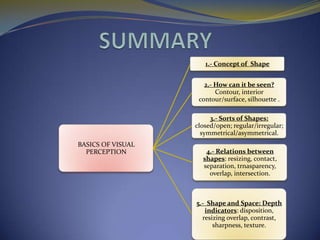
1.- Concept of Shape


                      2.- How can it be seen?
                          Contour, interior
                    contour/surface, silhouette .

                        3.- Sorts of Shapes:
                   closed/open; regular/irregular;
                     symmetrical/asymmetrical.
BASICS OF VISUAL
  PERCEPTION          4.- Relations between
                     shapes: resizing, contact,
                     separation, trnasparency,
                       overlap, intersection.


                   5.- Shape and Space: Depth
                      indicators: disposition,
                     resizing overlap, contrast,
                         sharpness, texture.
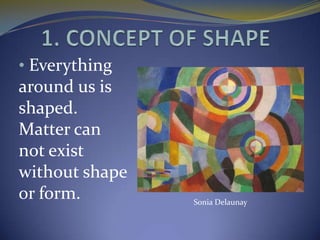
• Everything
around us is
shaped.
Matter can
not exist
without shape
or form.        Sonia Delaunay
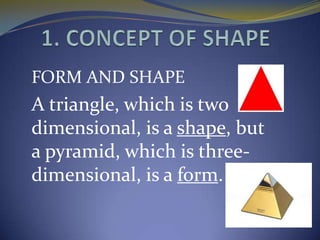
FORM AND SHAPE
A triangle, which is two
dimensional, is a shape, but
a pyramid, which is three-
dimensional, is a form.
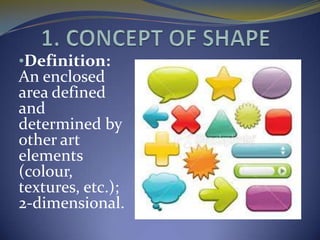
•Definition:
An enclosed
area defined
and
determined by
other art
elements
(colour,
textures, etc.);
2-dimensional.
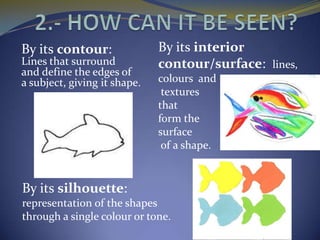
By its contour:               By its interior
Lines that surround           contour/surface: lines,
and define the edges of
a subject, giving it shape.   colours and
                               textures
                              that
                              form the
                              surface
                               of a shape.


By its silhouette:
representation of the shapes
through a single colour or tone.
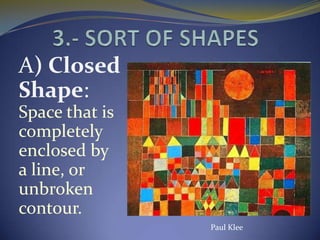
A) Closed
Shape:
Space that is
completely
enclosed by
a line, or
unbroken
contour.
                Paul Klee
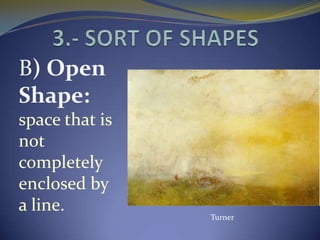
B) Open
Shape:
space that is
not
completely
enclosed by
a line.
                Turner
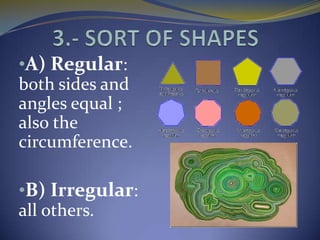
•A) Regular:
both sides and
angles equal ;
also the
circumference.

•B) Irregular:
all others.
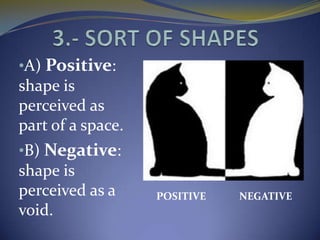
•A) Positive:
shape is
perceived as
part of a space.
•B) Negative:
shape is
perceived as a     POSITIVE   NEGATIVE
void.
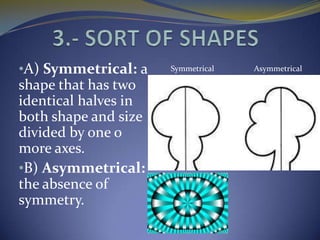
•A) Symmetrical: a    Symmetrical   Asymmetrical

shape that has two
identical halves in
both shape and size
divided by one o
more axes.
•B) Asymmetrical:
the absence of
symmetry.
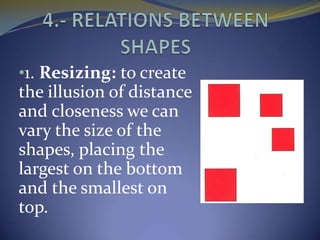
•1. Resizing: to create
the illusion of distance
and closeness we can
vary the size of the
shapes, placing the
largest on the bottom
and the smallest on
top.
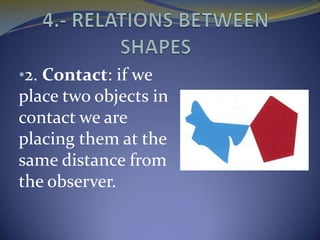
•2. Contact: if we
place two objects in
contact we are
placing them at the
same distance from
the observer.
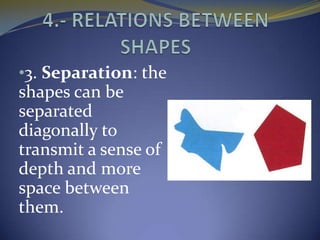
•3. Separation: the
shapes can be
separated
diagonally to
transmit a sense of
depth and more
space between
them.
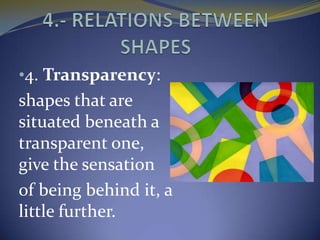
•4. Transparency:
shapes that are
situated beneath a
transparent one,
give the sensation
of being behind it, a
little further.
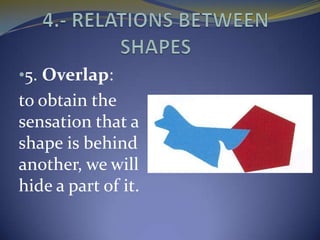
•5. Overlap:
to obtain the
sensation that a
shape is behind
another, we will
hide a part of it.
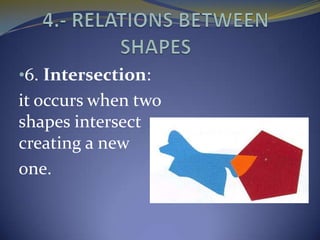
•6. Intersection:
it occurs when two
shapes intersect
creating a new
one.
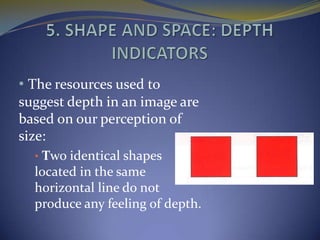
• The resources used to
suggest depth in an image are
based on our perception of
size:
  • Two identical shapes
  located in the same
  horizontal line do not
  produce any feeling of depth.
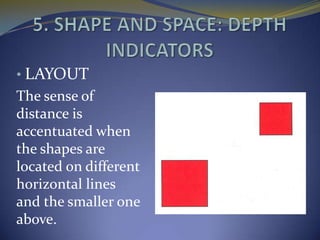
• LAYOUT
The sense of
distance is
accentuated when
the shapes are
located on different
horizontal lines
and the smaller one
above.
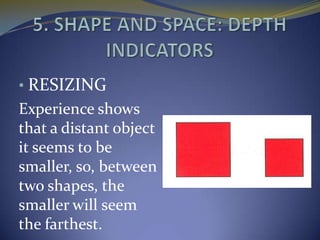
• RESIZING
Experience shows
that a distant object
it seems to be
smaller, so, between
two shapes, the
smaller will seem
the farthest.
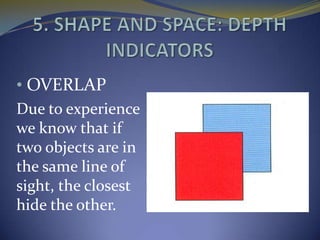
• OVERLAP
Due to experience
we know that if
two objects are in
the same line of
sight, the closest
hide the other.
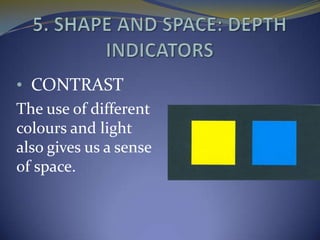
• CONTRAST
The use of different
colours and light
also gives us a sense
of space.
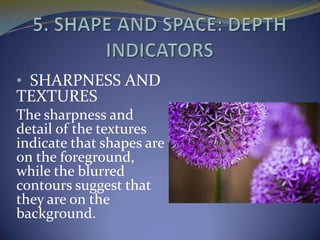
• SHARPNESS AND
TEXTURES
The sharpness and
detail of the textures
indicate that shapes are
on the foreground,
while the blurred
contours suggest that
they are on the
background.

1.4. basics of visual perception

  • 1.
  • 2.
    1.- Concept ofShape 2.- How can it be seen? Contour, interior contour/surface, silhouette . 3.- Sorts of Shapes: closed/open; regular/irregular; symmetrical/asymmetrical. BASICS OF VISUAL PERCEPTION 4.- Relations between shapes: resizing, contact, separation, trnasparency, overlap, intersection. 5.- Shape and Space: Depth indicators: disposition, resizing overlap, contrast, sharpness, texture.
  • 3.
    • Everything around usis shaped. Matter can not exist without shape or form. Sonia Delaunay
  • 4.
    FORM AND SHAPE Atriangle, which is two dimensional, is a shape, but a pyramid, which is three- dimensional, is a form.
  • 5.
    •Definition: An enclosed area defined and determinedby other art elements (colour, textures, etc.); 2-dimensional.
  • 6.
    By its contour: By its interior Lines that surround contour/surface: lines, and define the edges of a subject, giving it shape. colours and textures that form the surface of a shape. By its silhouette: representation of the shapes through a single colour or tone.
  • 7.
    A) Closed Shape: Space thatis completely enclosed by a line, or unbroken contour. Paul Klee
  • 8.
    B) Open Shape: space thatis not completely enclosed by a line. Turner
  • 9.
    •A) Regular: both sidesand angles equal ; also the circumference. •B) Irregular: all others.
  • 10.
    •A) Positive: shape is perceivedas part of a space. •B) Negative: shape is perceived as a POSITIVE NEGATIVE void.
  • 11.
    •A) Symmetrical: a Symmetrical Asymmetrical shape that has two identical halves in both shape and size divided by one o more axes. •B) Asymmetrical: the absence of symmetry.
  • 12.
    •1. Resizing: tocreate the illusion of distance and closeness we can vary the size of the shapes, placing the largest on the bottom and the smallest on top.
  • 13.
    •2. Contact: ifwe place two objects in contact we are placing them at the same distance from the observer.
  • 14.
    •3. Separation: the shapescan be separated diagonally to transmit a sense of depth and more space between them.
  • 15.
    •4. Transparency: shapes thatare situated beneath a transparent one, give the sensation of being behind it, a little further.
  • 16.
    •5. Overlap: to obtainthe sensation that a shape is behind another, we will hide a part of it.
  • 17.
    •6. Intersection: it occurswhen two shapes intersect creating a new one.
  • 18.
    • The resourcesused to suggest depth in an image are based on our perception of size: • Two identical shapes located in the same horizontal line do not produce any feeling of depth.
  • 19.
    • LAYOUT The senseof distance is accentuated when the shapes are located on different horizontal lines and the smaller one above.
  • 20.
    • RESIZING Experience shows thata distant object it seems to be smaller, so, between two shapes, the smaller will seem the farthest.
  • 21.
    • OVERLAP Due toexperience we know that if two objects are in the same line of sight, the closest hide the other.
  • 22.
    • CONTRAST The useof different colours and light also gives us a sense of space.
  • 23.
    • SHARPNESS AND TEXTURES Thesharpness and detail of the textures indicate that shapes are on the foreground, while the blurred contours suggest that they are on the background.