Bilingual Educational Psycology
Profesor Gladys Maradiaga
By: Irvin Alejandro De León Reyes
 Visual perception refers to
information that is perceived
through the eyes. In preschool
children this perception is still
developing, and will continue
to develop right through
primary school.
Good visual perception is an important
skill, especially for school success.
Children need good visual perception
to discriminate well, copy text
accurately, develop visual memory of
things observed, develop good eye-
hand co-ordination and integrate visual
information while using other senses in
order to perform tasks like recognizing
the source of a sound etc.
 color perception and color constancy - the ability to
distinguish different colors and to recognize different
shades of color and light intensities.
 shape perception and shape constancy - the ability to
recognize shapes and to recognize a shape regardless of
size, color or the angle from which it is viewed.
 spatial relations - interpreting the position of one object
in relation to others.
 visual analysis and synthesis - the ability to differentiate
between parts and whole objects e.g. letters that make
up words.
 visual closure - the ability to complete an
incomplete image e.g. a dot-to-dot picture or a
puzzle.
 visual conceptualizing - making pictures in the mind
based on observations, experiences and data.
 visual discrimination - interpreting differences
between objects observed e.g. b versus d
 visual figure-ground distinction - focusing on
important impressions amidst many, e.g. selecting a
blue pencil among many or focusing on a particular
word among others
 visual memory - the ability to store and recall
information perceived with the eyes either spatial
e.g. remembering where an object is situated, or
sequential, e.g. remembering a phone number
 visual pattern-following - recognizing and
repeating a visual pattern.
visual sequence - observing images in a realistic
order
 Children need to learn to improve their
weak areas to an acceptable standard,
compensate for them where necessary
while focusing on, developing and enjoying
our strengths and talents.
 No one is good at everything. The object of
these stimulating activities, is to help your
child develop each area to his/her unique
potential, not to over-stimulate or try and
develop super-kids!
 1. Make a scrap book with a page for each
color. Let your child cut out pictures of
objects of various shades from old
magazines and paste them on the
appropriate pages:
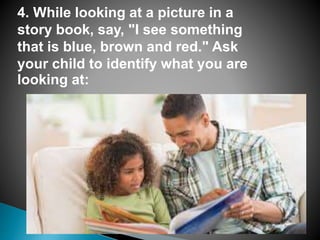
4. While looking at a picture in a
story book, say, "I see something
that is blue, brown and red." Ask
your child to identify what you are
looking at:
5. Let your child match
socks while you sort and
fold your clean laundry:
These activities will help your child
develop shape perception and shape
constancy which are important aspects
of visual perception.
Shape perception refers to the ability to
recognize shapes and to recognize a shape
regardless of size, color or the angle from
which it is viewed.
-You could ask your child to first color all
the circles and then the rest of the
picture. Ask her to count how many of
each specific shape she can spot in the
picture.
-Also use the pictures for language
development by naming and talking about
the various items shown.
-You could encourage your child to try and
draw pictures of his/her own that are
made up of shapes.
Thank you for
your time!

Visual Perception

  • 1.
    Bilingual Educational Psycology ProfesorGladys Maradiaga By: Irvin Alejandro De León Reyes
  • 2.
     Visual perceptionrefers to information that is perceived through the eyes. In preschool children this perception is still developing, and will continue to develop right through primary school.
  • 4.
    Good visual perceptionis an important skill, especially for school success. Children need good visual perception to discriminate well, copy text accurately, develop visual memory of things observed, develop good eye- hand co-ordination and integrate visual information while using other senses in order to perform tasks like recognizing the source of a sound etc.
  • 5.
     color perceptionand color constancy - the ability to distinguish different colors and to recognize different shades of color and light intensities.  shape perception and shape constancy - the ability to recognize shapes and to recognize a shape regardless of size, color or the angle from which it is viewed.  spatial relations - interpreting the position of one object in relation to others.  visual analysis and synthesis - the ability to differentiate between parts and whole objects e.g. letters that make up words.
  • 6.
     visual closure- the ability to complete an incomplete image e.g. a dot-to-dot picture or a puzzle.  visual conceptualizing - making pictures in the mind based on observations, experiences and data.  visual discrimination - interpreting differences between objects observed e.g. b versus d  visual figure-ground distinction - focusing on important impressions amidst many, e.g. selecting a blue pencil among many or focusing on a particular word among others
  • 7.
     visual memory- the ability to store and recall information perceived with the eyes either spatial e.g. remembering where an object is situated, or sequential, e.g. remembering a phone number  visual pattern-following - recognizing and repeating a visual pattern. visual sequence - observing images in a realistic order
  • 8.
     Children needto learn to improve their weak areas to an acceptable standard, compensate for them where necessary while focusing on, developing and enjoying our strengths and talents.  No one is good at everything. The object of these stimulating activities, is to help your child develop each area to his/her unique potential, not to over-stimulate or try and develop super-kids!
  • 9.
     1. Makea scrap book with a page for each color. Let your child cut out pictures of objects of various shades from old magazines and paste them on the appropriate pages:
  • 14.
    4. While lookingat a picture in a story book, say, "I see something that is blue, brown and red." Ask your child to identify what you are looking at:
  • 15.
    5. Let yourchild match socks while you sort and fold your clean laundry:
  • 16.
    These activities willhelp your child develop shape perception and shape constancy which are important aspects of visual perception. Shape perception refers to the ability to recognize shapes and to recognize a shape regardless of size, color or the angle from which it is viewed.
  • 17.
    -You could askyour child to first color all the circles and then the rest of the picture. Ask her to count how many of each specific shape she can spot in the picture. -Also use the pictures for language development by naming and talking about the various items shown. -You could encourage your child to try and draw pictures of his/her own that are made up of shapes.
  • 18.