INTRO TO
LINEAR PERSPECTIVE
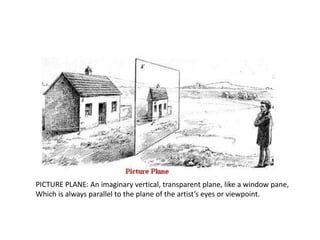
PICTURE PLANE: An imaginary vertical, transparent plane, like a window pane,
Which is always parallel to the plane of the artist’s eyes or viewpoint.
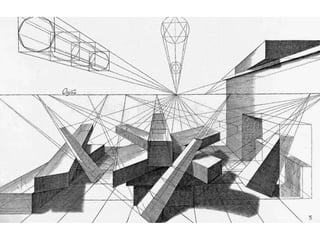
LINEAR PERSPECTIVE – System of spatial alignment
which creates an Illusion of depth on a 2D flat surface.
It captures the optical effects of receding objects
by organizing Space and depth from a vanishing
point of view.
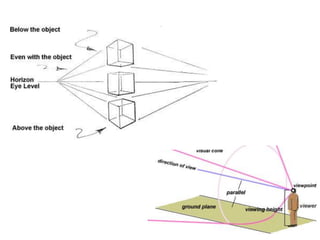
Study and consider what you're looking at. Is this the best viewpoint to find the best
composition? Where are you physically in relation to the scene you are considering
painting? Are you elevated, looking downward at your subject? Are you looking up?
Standing, sitting, or kneeling? Flying? Once you know where you are find the horizon.
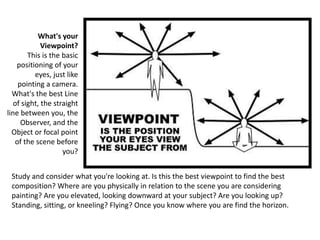
What's your
Viewpoint?
This is the basic
positioning of your
eyes, just like
pointing a camera.
What's the best Line
of sight, the straight
line between you, the
Observer, and the
Object or focal point
of the scene before
you?
See where the sky meets the land? That's the horizon line. It's on the horizon. If objects
are blocking your view of the horizon line, turn around until you can determine where it
is in relation to your line of sight and extend that knowledge into your chosen view.
REMEMBER:
The horizon
line is
always at
the eye level
of the artist,
sitting,
standing,
flying…
It can be
high, low or
the middle
of YOUR
work
surface.
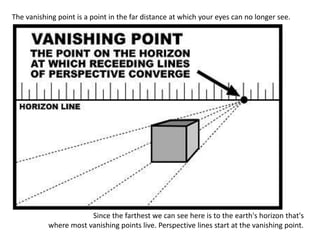
Since the farthest we can see here is to the earth's horizon that's
where most vanishing points live. Perspective lines start at the vanishing point.
The vanishing point is a point in the far distance at which your eyes can no longer see.
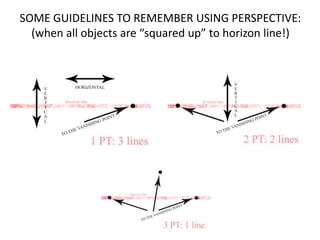
SOME GUIDELINES TO REMEMBER USING PERSPECTIVE:
(when all objects are “squared up” to horizon line!)
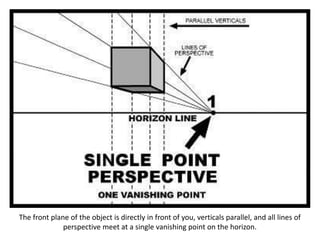
The front plane of the object is directly in front of you, verticals parallel, and all lines of
perspective meet at a single vanishing point on the horizon.
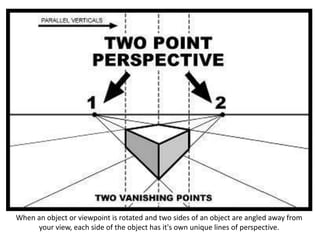
When an object or viewpoint is rotated and two sides of an object are angled away from
your view, each side of the object has it's own unique lines of perspective.
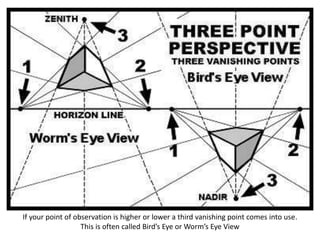
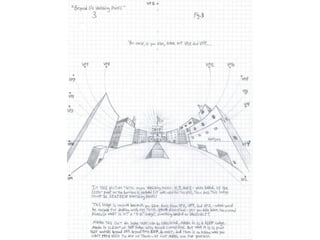
If your point of observation is higher or lower a third vanishing point comes into use.
This is often called Bird’s Eye or Worm’s Eye View
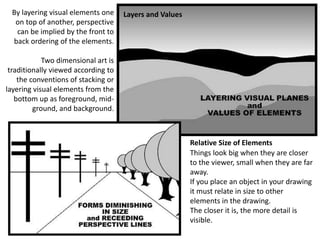
By layering visual elements one
on top of another, perspective
can be implied by the front to
back ordering of the elements.
Two dimensional art is
traditionally viewed according to
the conventions of stacking or
layering visual elements from the
bottom up as foreground, mid-
ground, and background.
Things look big when they are closer
to the viewer, small when they are far
away.
If you place an object in your drawing
it must relate in size to other
elements in the drawing.
The closer it is, the more detail is
visible.
Relative Size of Elements
Layers and Values
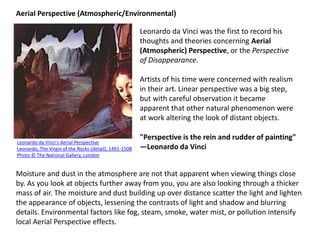
Aerial Perspective (Atmospheric/Environmental)
Leonardo da Vinci was the first to record his
thoughts and theories concerning Aerial
(Atmospheric) Perspective, or the Perspective
of Disappearance.
Artists of his time were concerned with realism
in their art. Linear perspective was a big step,
but with careful observation it became
apparent that other natural phenomenon were
at work altering the look of distant objects.
Leonardo da Vinci's Aerial Perspective
Leonardo, The Virgin of the Rocks (detail), 1491-1508
Photo © The National Gallery, London
"Perspective is the rein and rudder of painting"
—Leonardo da Vinci
Moisture and dust in the atmosphere are not that apparent when viewing things close
by. As you look at objects further away from you, you are also looking through a thicker
mass of air. The moisture and dust building up over distance scatter the light and lighten
the appearance of objects, lessening the contrasts of light and shadow and blurring
details. Environmental factors like fog, steam, smoke, water mist, or pollution intensify
local Aerial Perspective effects.
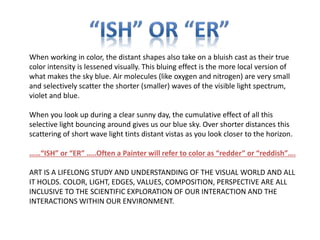
When working in color, the distant shapes also take on a bluish cast as their true
color intensity is lessened visually. This bluing effect is the more local version of
what makes the sky blue. Air molecules (like oxygen and nitrogen) are very small
and selectively scatter the shorter (smaller) waves of the visible light spectrum,
violet and blue.
When you look up during a clear sunny day, the cumulative effect of all this
selective light bouncing around gives us our blue sky. Over shorter distances this
scattering of short wave light tints distant vistas as you look closer to the horizon.
……“ISH” or “ER” …..Often a Painter will refer to color as “redder” or “reddish”….
ART IS A LIFELONG STUDY AND UNDERSTANDING OF THE VISUAL WORLD AND ALL
IT HOLDS. COLOR, LIGHT, EDGES, VALUES, COMPOSITION, PERSPECTIVE ARE ALL
INCLUSIVE TO THE SCIENTIFIC EXPLORATION OF OUR INTERACTION AND THE
INTERACTIONS WITHIN OUR ENVIRONMENT.
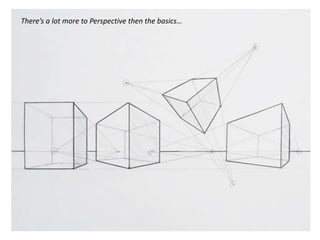
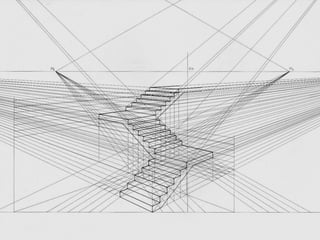
There’s a lot more to Perspective then the basics…
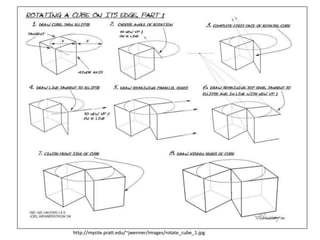
http://mysite.pratt.edu/~jwenner/images/rotate_cube_1.jpg
WEB RESOURCE AND IMAGES FROM GOOGLE &
http://www.watercolorpainting.com/
If you wish to advance your perspective:
http://userwww.sfsu.edu/trogu/420/reference/pers
pective/

Intro to Perspective

  • 1.
  • 2.
    PICTURE PLANE: Animaginary vertical, transparent plane, like a window pane, Which is always parallel to the plane of the artist’s eyes or viewpoint.
  • 3.
    LINEAR PERSPECTIVE –System of spatial alignment which creates an Illusion of depth on a 2D flat surface. It captures the optical effects of receding objects by organizing Space and depth from a vanishing point of view.
  • 5.
    Study and considerwhat you're looking at. Is this the best viewpoint to find the best composition? Where are you physically in relation to the scene you are considering painting? Are you elevated, looking downward at your subject? Are you looking up? Standing, sitting, or kneeling? Flying? Once you know where you are find the horizon. What's your Viewpoint? This is the basic positioning of your eyes, just like pointing a camera. What's the best Line of sight, the straight line between you, the Observer, and the Object or focal point of the scene before you?
  • 6.
    See where thesky meets the land? That's the horizon line. It's on the horizon. If objects are blocking your view of the horizon line, turn around until you can determine where it is in relation to your line of sight and extend that knowledge into your chosen view. REMEMBER: The horizon line is always at the eye level of the artist, sitting, standing, flying… It can be high, low or the middle of YOUR work surface.
  • 7.
    Since the farthestwe can see here is to the earth's horizon that's where most vanishing points live. Perspective lines start at the vanishing point. The vanishing point is a point in the far distance at which your eyes can no longer see.
  • 8.
    SOME GUIDELINES TOREMEMBER USING PERSPECTIVE: (when all objects are “squared up” to horizon line!)
  • 9.
    The front planeof the object is directly in front of you, verticals parallel, and all lines of perspective meet at a single vanishing point on the horizon.
  • 10.
    When an objector viewpoint is rotated and two sides of an object are angled away from your view, each side of the object has it's own unique lines of perspective.
  • 11.
    If your pointof observation is higher or lower a third vanishing point comes into use. This is often called Bird’s Eye or Worm’s Eye View
  • 12.
    By layering visualelements one on top of another, perspective can be implied by the front to back ordering of the elements. Two dimensional art is traditionally viewed according to the conventions of stacking or layering visual elements from the bottom up as foreground, mid- ground, and background. Things look big when they are closer to the viewer, small when they are far away. If you place an object in your drawing it must relate in size to other elements in the drawing. The closer it is, the more detail is visible. Relative Size of Elements Layers and Values
  • 13.
    Aerial Perspective (Atmospheric/Environmental) Leonardoda Vinci was the first to record his thoughts and theories concerning Aerial (Atmospheric) Perspective, or the Perspective of Disappearance. Artists of his time were concerned with realism in their art. Linear perspective was a big step, but with careful observation it became apparent that other natural phenomenon were at work altering the look of distant objects. Leonardo da Vinci's Aerial Perspective Leonardo, The Virgin of the Rocks (detail), 1491-1508 Photo © The National Gallery, London "Perspective is the rein and rudder of painting" —Leonardo da Vinci Moisture and dust in the atmosphere are not that apparent when viewing things close by. As you look at objects further away from you, you are also looking through a thicker mass of air. The moisture and dust building up over distance scatter the light and lighten the appearance of objects, lessening the contrasts of light and shadow and blurring details. Environmental factors like fog, steam, smoke, water mist, or pollution intensify local Aerial Perspective effects.
  • 14.
    When working incolor, the distant shapes also take on a bluish cast as their true color intensity is lessened visually. This bluing effect is the more local version of what makes the sky blue. Air molecules (like oxygen and nitrogen) are very small and selectively scatter the shorter (smaller) waves of the visible light spectrum, violet and blue. When you look up during a clear sunny day, the cumulative effect of all this selective light bouncing around gives us our blue sky. Over shorter distances this scattering of short wave light tints distant vistas as you look closer to the horizon. ……“ISH” or “ER” …..Often a Painter will refer to color as “redder” or “reddish”…. ART IS A LIFELONG STUDY AND UNDERSTANDING OF THE VISUAL WORLD AND ALL IT HOLDS. COLOR, LIGHT, EDGES, VALUES, COMPOSITION, PERSPECTIVE ARE ALL INCLUSIVE TO THE SCIENTIFIC EXPLORATION OF OUR INTERACTION AND THE INTERACTIONS WITHIN OUR ENVIRONMENT.
  • 15.
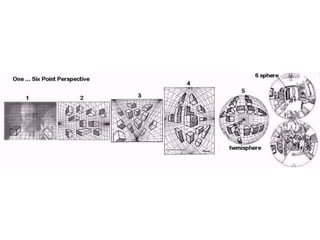
    There’s a lotmore to Perspective then the basics…
  • 18.
  • 21.
    WEB RESOURCE ANDIMAGES FROM GOOGLE & http://www.watercolorpainting.com/ If you wish to advance your perspective: http://userwww.sfsu.edu/trogu/420/reference/pers pective/