1.1.ELEMENTS OF ART
RAQUEL P. FARIÑAS
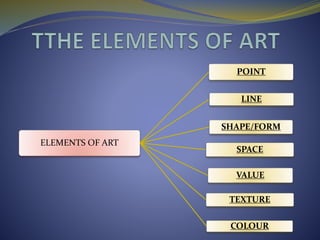
ELEMENTS OF ART
POINT
LINE
COLOUR
SHAPE/FORM
TEXTURE
VALUE
SPACE
Are the "building
blocks" or ingredients of
art. This is the
“vocabulary” we use to
describe or create works
of art.
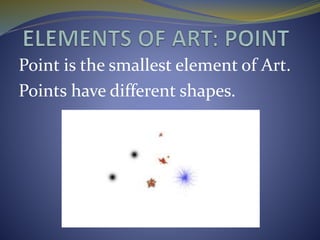
Point is the smallest element of Art.
Points have different shapes.
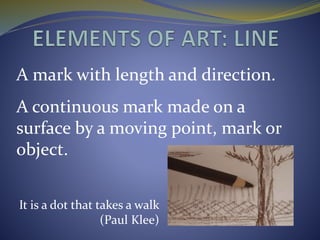
A mark with length and direction.
A continuous mark made on a
surface by a moving point, mark or
object.
It is a dot that takes a walk
(Paul Klee)
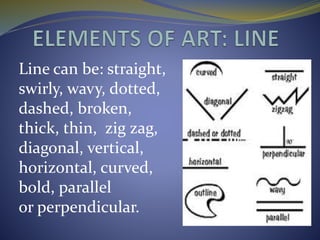
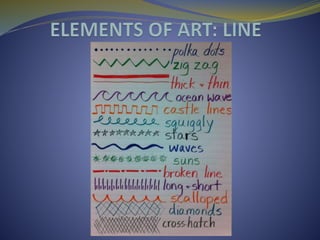
Line can be: straight,
swirly, wavy, dotted,
dashed, broken,
thick, thin, zig zag,
diagonal, vertical,
horizontal, curved,
bold, parallel
or perpendicular.
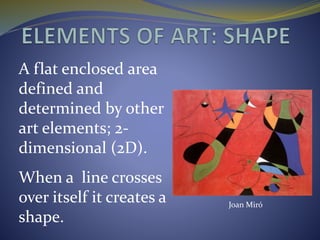
A flat enclosed area
defined and
determined by other
art elements; 2-
dimensional (2D).
When a line crosses
over itself it creates a
shape.
Joan Miró
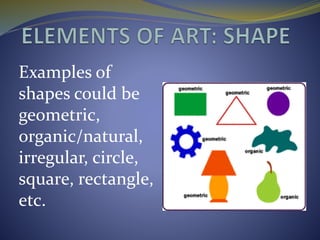
Examples of
shapes could be
geometric,
organic/natural,
irregular, circle,
square, rectangle,
etc.
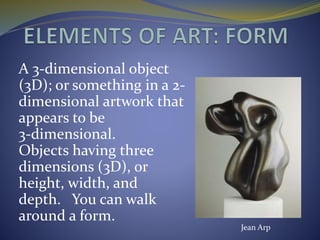
A 3-dimensional object
(3D); or something in a 2-
dimensional artwork that
appears to be
3-dimensional.
Objects having three
dimensions (3D), or
height, width, and
depth. You can walk
around a form.
Jean Arp
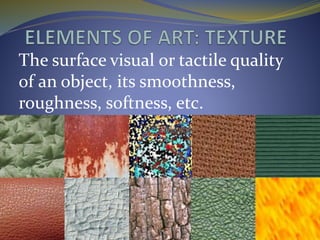
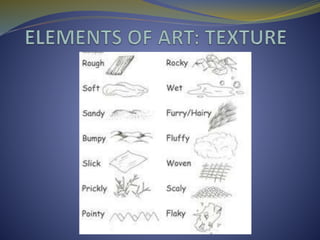
The surface visual or tactile quality
of an object, its smoothness,
roughness, softness, etc.
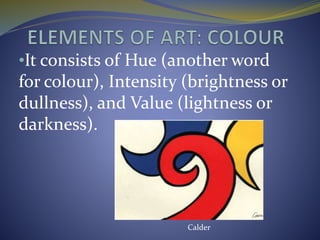
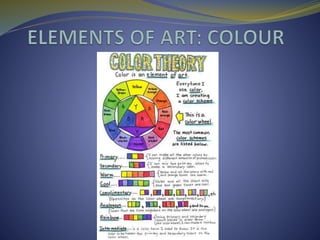
•It consists of Hue (another word
for colour), Intensity (brightness or
dullness), and Value (lightness or
darkness).
Calder
1.1 elements of art

1.1 elements of art

  • 1.
  • 2.
  • 3.
    Are the "building blocks"or ingredients of art. This is the “vocabulary” we use to describe or create works of art.
  • 4.
    Point is thesmallest element of Art. Points have different shapes.
  • 5.
    A mark withlength and direction. A continuous mark made on a surface by a moving point, mark or object. It is a dot that takes a walk (Paul Klee)
  • 6.
    Line can be:straight, swirly, wavy, dotted, dashed, broken, thick, thin, zig zag, diagonal, vertical, horizontal, curved, bold, parallel or perpendicular.
  • 8.
    A flat enclosedarea defined and determined by other art elements; 2- dimensional (2D). When a line crosses over itself it creates a shape. Joan Miró
  • 9.
    Examples of shapes couldbe geometric, organic/natural, irregular, circle, square, rectangle, etc.
  • 10.
    A 3-dimensional object (3D);or something in a 2- dimensional artwork that appears to be 3-dimensional. Objects having three dimensions (3D), or height, width, and depth. You can walk around a form. Jean Arp
  • 11.
    The surface visualor tactile quality of an object, its smoothness, roughness, softness, etc.
  • 13.
    •It consists ofHue (another word for colour), Intensity (brightness or dullness), and Value (lightness or darkness). Calder