World War II

   Part III
Battle of the Bulge
    Germany’s last major stand
    Began December 16, 1944
    Known as the The German
     Ardennes offensive or the
     Battle of the Bulge
        The Americans were taken
         completely by surprise
        Resisted and held Saint-Vith and
         Bastogne
        German effort was doomed after
         December 23, when good flying
         weather allowed the
         overwhelming Allied air
         superiority to make itself felt.
        End of January, the last of the
         80-km- (50-mi-) deep "bulge" in
         the Allied lines is eliminated.
        Allied advance into Germany
         resumed in February
Soviet Successes
   By December 1944
      Soviets have forced the Nazis out of Belarus, Ukraine,
       Estonia, Latvia, Lithuania, Bulgaria, Romania, and
       half of Hungary and Poland
   Liberation of Majdanek – July 23, 1944
   Fighting in Budapest
   Warsaw Uprising – Summer 1944
   By the end of the war
      Soviets have also liberated Czechoslovakia, Poland,
       the Auschwitz-Birkenau extermination camps, and
       parts of Germany
Liberation of Majdanek
Former Inmates After Liberation
By December 1944
Warsaw Uprising


http://www.warsawuprising.com/photos.htm
Allies Successes
   Through the Spring of 1945
      Liberated the Netherlands,
       Belgium, Luxembourg,
       Denmark, Norway, Austria,
      Occupied portions of
       Germany
      April 1945 – FDR dies
       suddenly
      April 30, 1945 – Hitler
       commits suicide
Conclusion of War
   Unconditional surrender
    from Germans on May 7th
    at General Eisenhower's
    post
   VE Day – Victory in
    Europe – May 8, 1945
   Unconditional surrender
    from Germans on May 9th
    in Soviet occupied Berlin
Yalta Conference
• Yalta – Feb 4 to Feb 11, 1945
• Big Three
• Begin making post-war plans
• Roosevelt – wants Soviets to
  help in the Pacific
• Churchill – pushed for
  importance of democratic gvts
  and free elections in Eastern
  Europe after the war
• Stalin – demands that Eastern
  Europe become a Soviet sphere
  of political influence for the
  USSR’s protection
• Discuss how to handle Germany
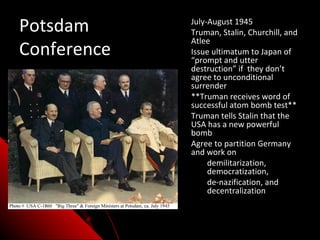
Potsdam      • July-August 1945
             • Truman, Stalin, Churchill, and
               Atlee
Conference   • Issue ultimatum to Japan of
               “prompt and utter
               destruction” if they don’t
               agree to unconditional
               surrender
             • **Truman receives word of
               successful atom bomb test**
             • Truman tells Stalin that the
               USA has a new powerful
               bomb
             • Agree to partition Germany
               and work on
                 • demilitarization,
                    democratization,
                 • de-nazification, and
                    decentralization
Casualties of WW II
   Quotes in Handout
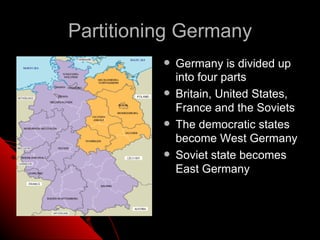
Partitioning Germany
             Germany is divided up
              into four parts
             Britain, United States,
              France and the Soviets
             The democratic states
              become West Germany
             Soviet state becomes
              East Germany
The Eastern Bloc
 Soviets refuse to give up Poland and
  cling onto the countries they had
  liberated from Nazi Germany
 Soviet Red Army hand picked dictators
  that would be allegiant to the Soviet
  Union
 Eastern European countries forcibly
  become communist
     opposition is eliminated
     noncompliant states are threatened to be
      “crushed with Soviet tanks”
   Eastern Bloc states forced to have communist leadership
    and have “loyalty” to Soviet Union
   NATO established April 1949, still exists
      North Atlantic Treaty Organization
      Today: 26 member states, 14 allies
   Soviet Union successfully tests the atom bomb August
    1949
   Warsaw Pact established to counter NATO
      Officially Warsaw Treaty of Friendship, Cooperation,
       and Mutual Assistance
      Signed May 1955, not disestablished until 1991
      Founding members: Albania (leaves 1961), Bulgaria,
       Czechoslovakia, Romania, Poland, Hungary, and later
       East Germany
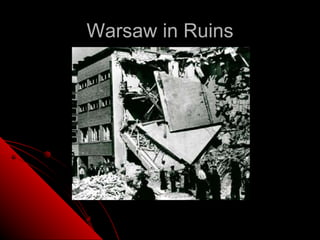
Rebuilding Europe
• Europe is in ruins
• Aerial attack abilities devastated most of the
  major cities of Europe
• Rebuild buildings, railroads, and infrastructure
• Where do you start?
  – brick by brick
Warsaw in Ruins
Hamburg, Germany
Marshall Plan
   European Recovery Plan
   Secretary of State – George Marshall
   Reconstruction plan offered in July 1947
   Intended to help foster stability and rehabilitation to
    European countries
   4 year plan of economic and technical assistance – 13
    billion US Dollars
   West takes advantage
   Eastern bloc offered same deal if the Soviets were willing
    to make political reforms and allow for some external
    controls – Deny help
Marshall Plan
 Extremely successful!
 Restores countries to even better status
  than before the war
United Nations
 April 1945 50 countries met
 Charter and purpose developed
   Save future from war
   Promote national self-determination
   Promote respect for human rights
   Help nations solve problems
 Headquarters- New York City
 The P5 – Permanent 5 members with veto
  power
       USA, China, GB, France, and USSR
Advantages Over
      League
No  major power refused
 to join
UN peace keeping force
 Armed  group to enforce
  decisions
Overall…
 UN more effective socially,
  economically not politically
 1948 Universal Declaration of
  Human Rights-
   Protect from oppression
   Preservation of rights

World War II Part 3

  • 1.
    World War II Part III
  • 2.
    Battle of theBulge  Germany’s last major stand  Began December 16, 1944  Known as the The German Ardennes offensive or the Battle of the Bulge  The Americans were taken completely by surprise  Resisted and held Saint-Vith and Bastogne  German effort was doomed after December 23, when good flying weather allowed the overwhelming Allied air superiority to make itself felt.  End of January, the last of the 80-km- (50-mi-) deep "bulge" in the Allied lines is eliminated.  Allied advance into Germany resumed in February
  • 3.
    Soviet Successes  By December 1944  Soviets have forced the Nazis out of Belarus, Ukraine, Estonia, Latvia, Lithuania, Bulgaria, Romania, and half of Hungary and Poland  Liberation of Majdanek – July 23, 1944  Fighting in Budapest  Warsaw Uprising – Summer 1944  By the end of the war  Soviets have also liberated Czechoslovakia, Poland, the Auschwitz-Birkenau extermination camps, and parts of Germany
  • 4.
  • 5.
  • 6.
  • 7.
  • 8.
    Allies Successes  Through the Spring of 1945  Liberated the Netherlands, Belgium, Luxembourg, Denmark, Norway, Austria,  Occupied portions of Germany  April 1945 – FDR dies suddenly  April 30, 1945 – Hitler commits suicide
  • 9.
    Conclusion of War  Unconditional surrender from Germans on May 7th at General Eisenhower's post  VE Day – Victory in Europe – May 8, 1945  Unconditional surrender from Germans on May 9th in Soviet occupied Berlin
  • 10.
    Yalta Conference • Yalta– Feb 4 to Feb 11, 1945 • Big Three • Begin making post-war plans • Roosevelt – wants Soviets to help in the Pacific • Churchill – pushed for importance of democratic gvts and free elections in Eastern Europe after the war • Stalin – demands that Eastern Europe become a Soviet sphere of political influence for the USSR’s protection • Discuss how to handle Germany
  • 11.
    Potsdam • July-August 1945 • Truman, Stalin, Churchill, and Atlee Conference • Issue ultimatum to Japan of “prompt and utter destruction” if they don’t agree to unconditional surrender • **Truman receives word of successful atom bomb test** • Truman tells Stalin that the USA has a new powerful bomb • Agree to partition Germany and work on • demilitarization, democratization, • de-nazification, and decentralization
  • 12.
    Casualties of WWII  Quotes in Handout
  • 13.
    Partitioning Germany  Germany is divided up into four parts  Britain, United States, France and the Soviets  The democratic states become West Germany  Soviet state becomes East Germany
  • 14.
    The Eastern Bloc Soviets refuse to give up Poland and cling onto the countries they had liberated from Nazi Germany  Soviet Red Army hand picked dictators that would be allegiant to the Soviet Union  Eastern European countries forcibly become communist  opposition is eliminated  noncompliant states are threatened to be “crushed with Soviet tanks”
  • 16.
    Eastern Bloc states forced to have communist leadership and have “loyalty” to Soviet Union  NATO established April 1949, still exists  North Atlantic Treaty Organization  Today: 26 member states, 14 allies  Soviet Union successfully tests the atom bomb August 1949  Warsaw Pact established to counter NATO  Officially Warsaw Treaty of Friendship, Cooperation, and Mutual Assistance  Signed May 1955, not disestablished until 1991  Founding members: Albania (leaves 1961), Bulgaria, Czechoslovakia, Romania, Poland, Hungary, and later East Germany
  • 17.
    Rebuilding Europe • Europeis in ruins • Aerial attack abilities devastated most of the major cities of Europe • Rebuild buildings, railroads, and infrastructure • Where do you start? – brick by brick
  • 18.
  • 19.
  • 20.
    Marshall Plan  European Recovery Plan  Secretary of State – George Marshall  Reconstruction plan offered in July 1947  Intended to help foster stability and rehabilitation to European countries  4 year plan of economic and technical assistance – 13 billion US Dollars  West takes advantage  Eastern bloc offered same deal if the Soviets were willing to make political reforms and allow for some external controls – Deny help
  • 21.
    Marshall Plan  Extremelysuccessful!  Restores countries to even better status than before the war
  • 22.
    United Nations  April1945 50 countries met  Charter and purpose developed  Save future from war  Promote national self-determination  Promote respect for human rights  Help nations solve problems  Headquarters- New York City  The P5 – Permanent 5 members with veto power  USA, China, GB, France, and USSR
  • 23.
    Advantages Over League No major power refused to join UN peace keeping force Armed group to enforce decisions
  • 24.
    Overall…  UN moreeffective socially, economically not politically  1948 Universal Declaration of Human Rights-  Protect from oppression  Preservation of rights