POP ART
Pop art is now most associated with the work of New York artists of the early 1960s. Pop artists
celebrated commonplace objects and people of everyday life, in this way seeking to elevate popular
culture to the level of fine art. Pop artists seemingly embraced the post-WWII manufacturing and
media boom.
The actual term "Pop art" has several possible origins:
the first use of the term in writing has been attributed to both Lawrence Alloway and Alison and
Peter Smithson, and alternately to Richard Hamilton, who defined Pop in a letter
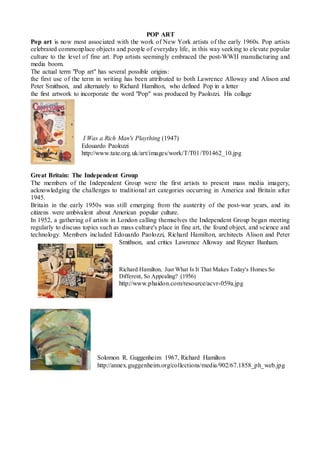
the first artwork to incorporate the word "Pop" was produced by Paolozzi. His collage
I Was a Rich Man's Plaything (1947)
Edouardo Paolozzi
http://www.tate.org.uk/art/images/work/T/T01/T01462_10.jpg
Great Britain: The Independent Group
The members of the Independent Group were the first artists to present mass media imagery,
acknowledging the challenges to traditional art categories occurring in America and Britain after
1945.
Britain in the early 1950s was still emerging from the austerity of the post-war years, and its
citizens were ambivalent about American popular culture.
In 1952, a gathering of artists in London calling themselves the Independent Group began meeting
regularly to discuss topics such as mass culture's place in fine art, the found object, and science and
technology. Members included Edouardo Paolozzi, Richard Hamilton, architects Alison and Peter
Smithson, and critics Lawrence Alloway and Reyner Banham.
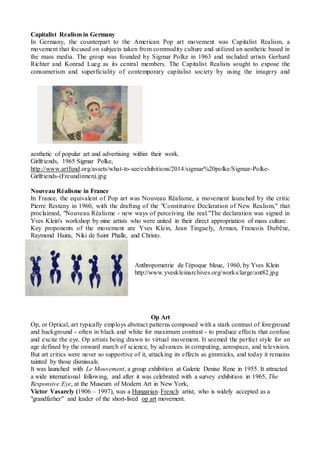
Richard Hamilton, Just What Is It That Makes Today's Homes So
Different, So Appealing? (1956)
http://www.phaidon.com/resource/acvr-059a.jpg
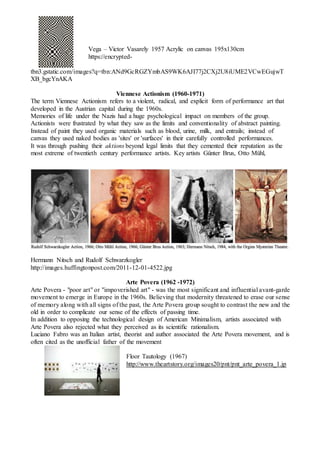
Solomon R. Guggenheim 1967, Richard Hamilton
http://annex.guggenheim.org/collections/media/902/67.1858_ph_web.jpg
Capitalist Realism in Germany
In Germany, the counterpart to the American Pop art movement was Capitalist Realism, a
movement that focused on subjects taken from commodity culture and utilized an aesthetic based in
the mass media. The group was founded by Sigmar Polke in 1963 and included artists Gerhard
Richter and Konrad Lueg as its central members. The Capitalist Realists sought to expose the
consumerism and superficiality of contemporary capitalist society by using the imagery and
aesthetic of popular art and advertising within their work.
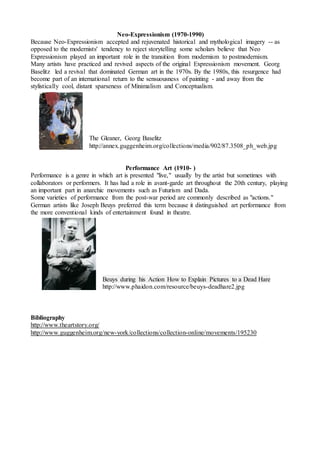
Girlfriends, 1965 Sigmar Polke,
http://www.artfund.org/assets/what-to-see/exhibitions/2014/sigmar%20polke/Sigmar-Polke-
Girlfriends-(Freundinnen).jpg
Nouveau Réalisme in France
In France, the equivalent of Pop art was Nouveau Réalisme, a movement launched by the critic
Pierre Restany in 1960, with the drafting of the "Constitutive Declaration of New Realism," that
proclaimed, "Nouveau Réalisme - new ways of perceiving the real."The declaration was signed in
Yves Klein's workshop by nine artists who were united in their direct appropriation of mass culture.
Key proponents of the movement are Yves Klein, Jean Tinguely, Arman, Francois Dufrêne,
Raymond Hains, Niki de Saint Phalle, and Christo.
Anthropometrie de l’époque bleue, 1960, by Yves Klein
http://www.yveskleinarchives.org/works/large/ant82.jpg
Op Art
Op, or Optical, art typically employs abstract patterns composed with a stark contrast of foreground
and background - often in black and white for maximum contrast - to produce effects that confuse
and excite the eye. Op artists being drawn to virtual movement. It seemed the perfect style for an
age defined by the onward march of science, by advances in computing, aerospace, and television.
But art critics were never so supportive of it, attacking its effects as gimmicks, and today it remains
tainted by those dismissals.
It was launched with Le Mouvement, a group exhibition at Galerie Denise Rene in 1955. It attracted
a wide international following, and after it was celebrated with a survey exhibition in 1965, The
Responsive Eye, at the Museum of Modern Art in New York,
Victor Vasarely (1906 – 1997), was a Hungarian–French artist, who is widely accepted as a
"grandfather" and leader of the short-lived op art movement.
Vega – Victor Vasarely 1957 Acrylic on canvas 195x130cm
https://encrypted-
tbn3.gstatic.com/images?q=tbn:ANd9GcRGZYmbAS9WK6AJI77j2CXj2U8iUME2VCwEGujwT
XB_bgcYnAKA
Viennese Actionism (1960-1971)
The term Viennese Actionism refers to a violent, radical, and explicit form of performance art that
developed in the Austrian capital during the 1960s.
Memories of life under the Nazis had a huge psychological impact on members of the group.
Actionists were frustrated by what they saw as the limits and conventionality of abstract painting.
Instead of paint they used organic materials such as blood, urine, milk, and entrails; instead of
canvas they used naked bodies as 'sites' or 'surfaces' in their carefully controlled performances.
It was through pushing their aktions beyond legal limits that they cemented their reputation as the
most extreme of twentieth century performance artists. Key artists Günter Brus, Otto Mühl,
Hermann Nitsch and Rudolf Schwarzkogler
http://images.huffingtonpost.com/2011-12-01-4522.jpg
Arte Povera (1962 -1972)
Arte Povera - "poor art" or "impoverished art" - was the most significant and influential avant-garde
movement to emerge in Europe in the 1960s. Believing that modernity threatened to erase our sense
of memory along with all signs of the past, the Arte Povera group sought to contrast the new and the
old in order to complicate our sense of the effects of passing time.
In addition to opposing the technological design of American Minimalism, artists associated with
Arte Povera also rejected what they perceived as its scientific rationalism.
Luciano Fabro was an Italian artist, theorist and author associated the Arte Povera movement, and is
often cited as the unofficial father of the movement
Floor Tautology (1967)
http://www.theartstory.org/images20/pnt/pnt_arte_povera_1.jp
Neo-Expressionism (1970-1990)
Because Neo-Expressionism accepted and rejuvenated historical and mythological imagery -- as
opposed to the modernists' tendency to reject storytelling some scholars believe that Neo
Expressionism played an important role in the transition from modernism to postmodernism.
Many artists have practiced and revived aspects of the original Expressionism movement. Georg
Baselitz led a revival that dominated German art in the 1970s. By the 1980s, this resurgence had
become part of an international return to the sensuousness of painting - and away from the
stylistically cool, distant sparseness of Minimalism and Conceptualism.
The Gleaner, Georg Baselitz
http://annex.guggenheim.org/collections/media/902/87.3508_ph_web.jpg
Performance Art (1910- )
Performance is a genre in which art is presented "live," usually by the artist but sometimes with
collaborators or performers. It has had a role in avant-garde art throughout the 20th century, playing
an important part in anarchic movements such as Futurism and Dada.
Some varieties of performance from the post-war period are commonly described as "actions."
German artists like Joseph Beuys preferred this term because it distinguished art performance from
the more conventional kinds of entertainment found in theatre.
Beuys during his Action How to Explain Pictures to a Dead Hare
http://www.phaidon.com/resource/beuys-deadhare2.jpg
Bibliography
http://www.theartstory.org/
http://www.guggenheim.org/new-york/collections/collection-online/movements/195230

Artistic events (1945- 1968)

  • 1.
    POP ART Pop artis now most associated with the work of New York artists of the early 1960s. Pop artists celebrated commonplace objects and people of everyday life, in this way seeking to elevate popular culture to the level of fine art. Pop artists seemingly embraced the post-WWII manufacturing and media boom. The actual term "Pop art" has several possible origins: the first use of the term in writing has been attributed to both Lawrence Alloway and Alison and Peter Smithson, and alternately to Richard Hamilton, who defined Pop in a letter the first artwork to incorporate the word "Pop" was produced by Paolozzi. His collage I Was a Rich Man's Plaything (1947) Edouardo Paolozzi http://www.tate.org.uk/art/images/work/T/T01/T01462_10.jpg Great Britain: The Independent Group The members of the Independent Group were the first artists to present mass media imagery, acknowledging the challenges to traditional art categories occurring in America and Britain after 1945. Britain in the early 1950s was still emerging from the austerity of the post-war years, and its citizens were ambivalent about American popular culture. In 1952, a gathering of artists in London calling themselves the Independent Group began meeting regularly to discuss topics such as mass culture's place in fine art, the found object, and science and technology. Members included Edouardo Paolozzi, Richard Hamilton, architects Alison and Peter Smithson, and critics Lawrence Alloway and Reyner Banham. Richard Hamilton, Just What Is It That Makes Today's Homes So Different, So Appealing? (1956) http://www.phaidon.com/resource/acvr-059a.jpg Solomon R. Guggenheim 1967, Richard Hamilton http://annex.guggenheim.org/collections/media/902/67.1858_ph_web.jpg
  • 2.
    Capitalist Realism inGermany In Germany, the counterpart to the American Pop art movement was Capitalist Realism, a movement that focused on subjects taken from commodity culture and utilized an aesthetic based in the mass media. The group was founded by Sigmar Polke in 1963 and included artists Gerhard Richter and Konrad Lueg as its central members. The Capitalist Realists sought to expose the consumerism and superficiality of contemporary capitalist society by using the imagery and aesthetic of popular art and advertising within their work. Girlfriends, 1965 Sigmar Polke, http://www.artfund.org/assets/what-to-see/exhibitions/2014/sigmar%20polke/Sigmar-Polke- Girlfriends-(Freundinnen).jpg Nouveau Réalisme in France In France, the equivalent of Pop art was Nouveau Réalisme, a movement launched by the critic Pierre Restany in 1960, with the drafting of the "Constitutive Declaration of New Realism," that proclaimed, "Nouveau Réalisme - new ways of perceiving the real."The declaration was signed in Yves Klein's workshop by nine artists who were united in their direct appropriation of mass culture. Key proponents of the movement are Yves Klein, Jean Tinguely, Arman, Francois Dufrêne, Raymond Hains, Niki de Saint Phalle, and Christo. Anthropometrie de l’époque bleue, 1960, by Yves Klein http://www.yveskleinarchives.org/works/large/ant82.jpg Op Art Op, or Optical, art typically employs abstract patterns composed with a stark contrast of foreground and background - often in black and white for maximum contrast - to produce effects that confuse and excite the eye. Op artists being drawn to virtual movement. It seemed the perfect style for an age defined by the onward march of science, by advances in computing, aerospace, and television. But art critics were never so supportive of it, attacking its effects as gimmicks, and today it remains tainted by those dismissals. It was launched with Le Mouvement, a group exhibition at Galerie Denise Rene in 1955. It attracted a wide international following, and after it was celebrated with a survey exhibition in 1965, The Responsive Eye, at the Museum of Modern Art in New York, Victor Vasarely (1906 – 1997), was a Hungarian–French artist, who is widely accepted as a "grandfather" and leader of the short-lived op art movement.
  • 3.
    Vega – VictorVasarely 1957 Acrylic on canvas 195x130cm https://encrypted- tbn3.gstatic.com/images?q=tbn:ANd9GcRGZYmbAS9WK6AJI77j2CXj2U8iUME2VCwEGujwT XB_bgcYnAKA Viennese Actionism (1960-1971) The term Viennese Actionism refers to a violent, radical, and explicit form of performance art that developed in the Austrian capital during the 1960s. Memories of life under the Nazis had a huge psychological impact on members of the group. Actionists were frustrated by what they saw as the limits and conventionality of abstract painting. Instead of paint they used organic materials such as blood, urine, milk, and entrails; instead of canvas they used naked bodies as 'sites' or 'surfaces' in their carefully controlled performances. It was through pushing their aktions beyond legal limits that they cemented their reputation as the most extreme of twentieth century performance artists. Key artists Günter Brus, Otto Mühl, Hermann Nitsch and Rudolf Schwarzkogler http://images.huffingtonpost.com/2011-12-01-4522.jpg Arte Povera (1962 -1972) Arte Povera - "poor art" or "impoverished art" - was the most significant and influential avant-garde movement to emerge in Europe in the 1960s. Believing that modernity threatened to erase our sense of memory along with all signs of the past, the Arte Povera group sought to contrast the new and the old in order to complicate our sense of the effects of passing time. In addition to opposing the technological design of American Minimalism, artists associated with Arte Povera also rejected what they perceived as its scientific rationalism. Luciano Fabro was an Italian artist, theorist and author associated the Arte Povera movement, and is often cited as the unofficial father of the movement Floor Tautology (1967) http://www.theartstory.org/images20/pnt/pnt_arte_povera_1.jp
  • 4.
    Neo-Expressionism (1970-1990) Because Neo-Expressionismaccepted and rejuvenated historical and mythological imagery -- as opposed to the modernists' tendency to reject storytelling some scholars believe that Neo Expressionism played an important role in the transition from modernism to postmodernism. Many artists have practiced and revived aspects of the original Expressionism movement. Georg Baselitz led a revival that dominated German art in the 1970s. By the 1980s, this resurgence had become part of an international return to the sensuousness of painting - and away from the stylistically cool, distant sparseness of Minimalism and Conceptualism. The Gleaner, Georg Baselitz http://annex.guggenheim.org/collections/media/902/87.3508_ph_web.jpg Performance Art (1910- ) Performance is a genre in which art is presented "live," usually by the artist but sometimes with collaborators or performers. It has had a role in avant-garde art throughout the 20th century, playing an important part in anarchic movements such as Futurism and Dada. Some varieties of performance from the post-war period are commonly described as "actions." German artists like Joseph Beuys preferred this term because it distinguished art performance from the more conventional kinds of entertainment found in theatre. Beuys during his Action How to Explain Pictures to a Dead Hare http://www.phaidon.com/resource/beuys-deadhare2.jpg Bibliography http://www.theartstory.org/ http://www.guggenheim.org/new-york/collections/collection-online/movements/195230